If you have ever been curious as to how the planes you ride on stay in the air or how a rocket can travel all the way to space, then you think like an aerospace engineer. From Aerospace Engineering Courses, eligibility criteria to future scope and interesting specializations available, this all you need to know guide will help you make an informed decision which you take for pursuing aerospace engineering course in India.
The Indian aerospace industry is booming. ISRO, DRDO, HAL, and a host of private companies are actively hunting for talented engineers to design, build and fly planes and spacecraft. With increasing demand and attractive salary packages, this is the way to your dream career.
What Exactly is Aerospace Engineering?
Aerospace engineering is the primary engineering discipline concerned with the design, construction, science and technology of aircraft and spacecraft. It is a combination of physics, mathematics, materials science, and advanced tech that address real life problems in the fields of aviation and space travel.
The range of activities in this field is so broad that it divides into four key specializations:
Aeronautics — This pertains to air within the atmosphere and includes such things as commercial jets, military planes, helicopters, drones (UAVs), and blimps. Aeronautical engineers study flow-air, aircraft design, motion, and propulsion.
Astronautics — A subject of business such as astronauts, rockets, satellites and all the stuff that goes beyond the atmosphere. Astronautical engineers specialize in orbital mechanics, satellite communications, rocket propulsion, and space exploration missions.
Avionics — These are the electronics and computers used in an aircraft and spacecraft. Avionics engineers create the system software of navigation, communication and autopilot systems, etc., in raw air borne machines.
Defense Technologies — This area concentrates on military, and its ability to develop and deploy new systems involving missiles, defense technologies, military drones and weaponized technology. This is important part of national security and defense system.
Aerospace Engineering Courses
Now let’s move on to the various types of courses under aero space engineering. Whether you are a high school beginner or already have a bachelor’s degree, there is a path for you.
1.Diploma in Aerospace Engineering (3 Years)
If you are looking forward to pursue a career in aerospace engineering, you can opt for the Diploma in Aerospace Engineering from a reputable board after 10th class.
This is good to start if you have done your 10th grade. It is not really theoretical but ‘practical’ which provides aerospace technologies experience.
| Aspect | Details |
| Duration | 3 years |
| Eligibility | 10th pass with Mathematics and Science (minimum 50% marks) |
| Focus | Practical skills and industry-ready training |
| Career Path | Can pursue B.Tech (lateral entry) or start working |
| Average Fees | ₹2-4 Lakh for the entire program |
2. Bachelors in Aerospace Engineering — B.Tech (4 Years)
It serves the largest client base and is considered the gateway course for professional aerospace. It is a bachelor’s degree course and the eligibility is 10+2 with Physics, Chemistry and Mathematics (PCM).
| Aspect | Details |
| Duration | 4 years (8 semesters) |
| Eligibility | 12th pass with PCM (minimum 50-60% depending on college) |
| Admission | Based on JEE Main Score, state-level exams, or direct merit |
| Average Fees | ₹ 2-2.5 Lakh/year in government; ₹5-10 Lakh/year in Private colleges |
| Total Program Cost | ₹4-40 Lakh depending on college type |
The B.Tech is an all-inclusive course which includes theory and practical based knowledge. Subjects like mathematics, physics, and general engineering will be included in your first two years for foundation then you can choose specializing in aerospace-related subjects in your third year.
3. M.Tech in Aerospace Engineering (2 Years)
M.Tech in Aerospace suits better for those who want a higher level of education in aerospace engineering. Building a professional level career internationally, you must need this degree.
| Aspect | Details |
| Duration | 2 years (4 semesters) |
| Eligibility | B.Tech/BE in Aerospace or related field with 55% minimum marks |
| Admission | Through GATE exam (for government colleges) or merit-based (private) |
| Average Fees | ₹40,000-1 Lakh/year in Government; ₹2-4 Lakh/year in Private colleges |
| Career Advantage | Higher salaries, research opportunities, senior positions |
Job opportunities for M.Tech graduates are applicable in research, designing and higher level management. Top companies and research centres look for M.Tech holders for their specialised projects.
4. Ph.D. in Aerospace Engineering (3-5 Years)
“This Is for the Research and Innovative Curious”. It’s the top aerospace engineer qualification for those who want to know how to research and innovate.
| Aspect | Details |
| Duration | 3-5 years |
| Eligibility | M.Tech or equivalent with GATE qualification |
| Focus | Original research and innovation |
| Opportunity | Teaching, research at ISRO, universities, private labs |
5. Aerospace Engineering Few Months Certification Courses
In just 6 months to 1 year duration, you can enhance knowledge or skills in certain areas. It is best for hands-on experience in a specific field.
| Course Type | Duration | Cost | Suitable For |
| CAD and Aircraft Design | 6 months | ₹20,000-50,000 | Working professionals, students |
| Avionics Systems | 6-8 months | ₹30,000-60,000 | Interested in Electronics |
| Propulsion Systems | 3-6 months | ₹15,000-40,000 | Engineers wanting specialization |
| Aerospace Materials | 4-6 months | ₹25,000-50,000 | Manufacturing professionals |
B.Tech Aerospace Engineering Core Subjects
| Year | Semesters | Essential Subjects |
| 1st Year | Sem 1-2 | Mathematics/Physics/Chemistry help develop problem-solving skillsEngineering Mechanics/Thermodynamics/Fluid Mechanics/ and Basic Electronics introduce how physical laws apply to real engineering systems. |
| 2nd Year | Sem 3-4 | Gas Dynamics and Aerodynamics, which explain how air behaves around aircraftPropulsion and Aircraft Structures teach how engines work and how aircraft are builtStrength of Materials and Computer Programming strengthen technical and analytical skills. |
| 3rd Year | Sem 5-6 | You study higher-level aerodynamics, flight dynamics, and structural analysis Heat Transfer and Avionics. |
| 4th Year | Sem 7-8 | You learn advanced tools like Computational Fluid Dynamics (CFD)Aircraft Design and Systems |
Aerodynamics describes how air moves around air and is an important factor in the level of efficiency of airflow around the wings.
- Propulsion: Discussion of jet engines, rockets, turboprops
- Structures deals with building an aircraft to be as strong as possible but still as light as possible.
- Stability and control the motion of an aircraft.
- CFD Computational Fluid Dynamics: Uses computers to emulate airflow — a modern necessity
- Aircraft Design: All of the above are brought to bear on realistic, total aircraft design projects.
- Most B.Tech courses will involve a lot of lab work, wind tunnel testing, simulators and a capstone design project where you actually design an aircraft or spacecraft.
Who Are Eligible For Aerospace Engineering
| B.Tech (Undergraduate) | Need to pass 12th class with PCMB or PCB and should have obtained 50 to 60% marks Meet the age criteria of 17 to 28 yearsEntrance exams such as JEE Main, State Level Exam etc |
| M.Tech (Postgraduate) | Hold a valid B.Tech/BE degree in Aerospace or equivalent with 55% marks Valid GATE score (for government colleges) |
| Diploma | After 10th with Mathematics and Science having 50% marks as a minimum15 years as a minimum age |
| Lateral Entry to B.Tech | 3-year engineering diplomaBSc in Physics, Chemistry, Mathematics |
Where Will Aerospace Engineers Work?
| Organization | Type | Specialization | Salary Range (Fresh) |
| ISRO | Government | Satellites, space missions, rocket development | ₹8-10 LPA |
| DRDO | Government | Defense systems, missile technology | ₹7-10.5 LPA |
| HAL (Hindustan Aeronautics) | Government | Aircraft manufacturing, defense | ₹7-9.5 LPA |
| Boeing India | International | Aircraft systems, defense solutions | ₹8-12 LPA |
| Airbus India | International | Aircraft manufacturing, maintenance | ₹7-10 LPA |
| GE Aviation | International | Aerospace engine design | ₹7-9 LPA |
| Rolls-Royce India | International | Propulsion systems | ₹8-11 LPA |
| Tata Advanced Systems | Private | Aircraft components, defense | ₹7-11 LPA |
| Godrej Aerospace | Private | Space and defense hardware | ₹5.5-7.5 LPA |
Salary & Career Growth
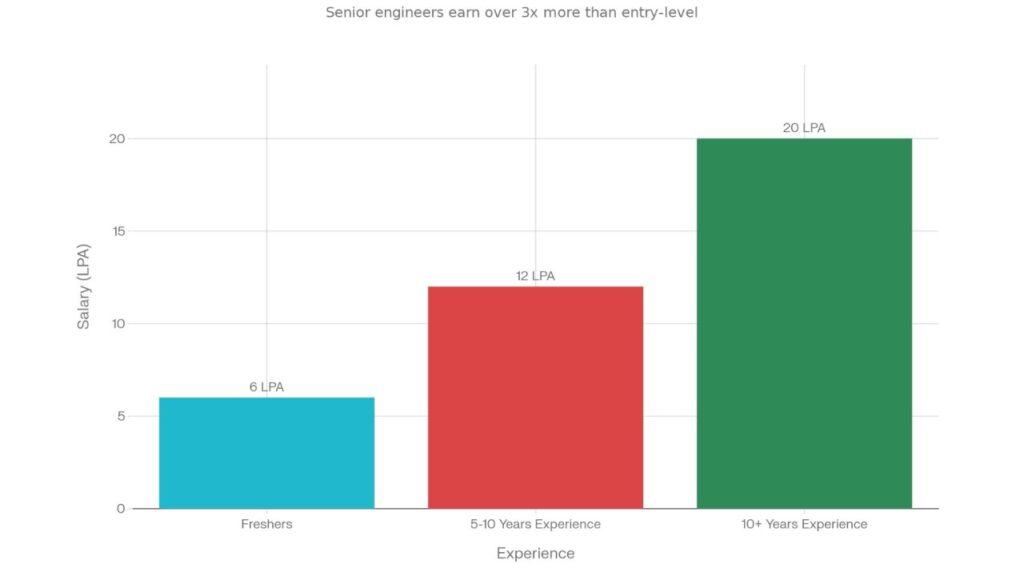
Aerospace Engineering Salary Progression in India
| Levels | Salary — LPA | Monthly Income | Stages |
| Fresher (0-1 year) | ₹4.5-7 | ₹37,500-58,333 | Graduate joining first job |
| 2-5 years | ₹8-12 | ₹66,667-1,00,000 | Intermediate engineer |
| 5-10 years | ₹8-15 | ₹66,667-1,25,000 | Senior engineer or team lead |
| 10+ years | ₹15-25+ | ₹1,25,000-2,08,000+ | Manager, specialist, researcher |
Salary by Sector:
| Sector | Fresher Package | Experienced Package |
| Government (ISRO, DRDO, HAL) | ₹7-10 LPA | ₹20+ LPA |
| Private Indian Companies | ₹5-9 LPA | ₹12-18 LPA |
| International Companies (Boeing, Airbus) | ₹8-12 LPA | ₹20-28+ LPA |
| Startups & Newer Companies | ₹4.5-6.5 LPA | ₹10-14 LPA |
The Future Looks Bright
India’s aerospace engineering salary will increase by 20-25% by 2030 and is highly influenced by demand in electric aircraft, AI integration, space exploration, and green aviation related technologies, suggest the industry projections. .
Read More 👉 HR Professional Courses: Get Complete Guide on Career Path, Salary & Growth
The Roadmap To Become Aerospace Engineer
Year 1 & 2: Begin From Basics
The initial two years are dedicated to core subjects such as mathematics, physics and general engineering. These years are tough, but necessary. If you have a strong base in these stuff, then you can understand high level stuff in aero easily later on.
Year 3: Where Aerospace Engineering Gets Exciting
In year 3, the real aerospace journey begins. You then go on to such specialised areas as aerodynamics, propulsion and aircraft structures.
Year 4: Major Project and Real-World Problem Solving
Senior year is spent mostly on a senior project. You could design an airplane, build spacecraft systems, or even study a real problem in aerospace engineering. Many of these projects are sponsored by industry, giving students real-world experience and making them more employable.
Internships: The Key to Career Growth
The majority of aerospace engineering programs require 2 to 3 internships, such as summer and at times semester-long training. Top organizations including ISRO, HAL and Boeing hire interns on a regular basis. This hands on experience is invaluable and it contributes a lot in building a strong resume and career in future.
Choose Your Specializations
| Specialization | Focus | Scope | Preferred Companies |
| Aerodynamics | Airflow, drag reduction, aircraft efficiency | Aircraft design, research | ISRO, Airbus, NASA etc |
| Propulsion | Engines in Jet engines, space rockets | Engine design, space missions | GE Aviation, Rolls-Royce, ISRO |
| Flight Dynamics & Control | Aircraft stability, autopilots, guidance systems | Control systems, UAVs | Boeing, HAL, Airbus |
| Aircraft Structures | Materials, stress analysis, lightweight design | Design Structure, & aerospace manufacturing | Airbus, HAL |
| Avionics | Radio System, navigation, Electronics | UAVs & Avionics | Boeing, DRDO |
Best Aerospace Engineering Colleges in India
| College | Type | Location | Specialization |
| IIT Bombay | Government | Mumbai | All specializations |
| IIT Madras | Government | Chennai | Aircraft & Space |
| IIT Kharagpur | Government | West Bengal | All specializations |
| IIT Kanpur | Government | Uttar Pradesh | All specializations |
| Mahindra University | Private | Hyderabad | Comprehensive curriculum |
| SRM IST | Private | Chennai | Modern labs & industry focus |
| Chandigarh University | Private | Punjab | Industry-driven curriculum |
| Ramaiah Institute | Private | Bangalore | Well-equipped facilities |
| Manipal Academy | Private | Bangalore | Research-oriented |
Conclusion
Aerospace Engineering Courses aren’t simple, it’s a journey through innovation, precision and human ability. Whether you want to design the next generation of commercial planes, put satellites into space, or work on autonomous drones, this is a field with limitless options.
The Indian aerospace industry is poised for growth. With ISRO’s ambitious space programs, HAL’s indigenous aircraft development and international partnerships with Boeing and Airbus, there is no dearth of opportunities. And if you are in the top performers, the world is your sky.