Railway RRB Technician Exam Date 2026: If you are waiting for the RRB Technician Grade 1 and Grade 3 post exam then be ready, as the Railway Recruitment Board has revealed the CBT dates — held from 05 to 09 March 2026. People who submitted their applications for these posts can start their preparations from now on and for more information about the examination refer to the official notification.
The exam dates have been announced officially, there is no more space for procrastination. If you are aiming for Technician Grade 1 or Grade 3, begin to formulate your preparation strategy now. General Intelligence & Reasoning, General Science and General Awareness are the subjects to be focused for Grade 3 and you should make a habit of solving previous year question papers and mock tests regularly.
Mark Your Calendars
The First Stage Exam RRB Technician (CEN 02/2025) Computer-Based Test(e-CBT) will be conducted from 5th to 9th March, 2026. Yes, you read it right the examination will be conducted for five days, and your exam city and category date and time slot will be considered as the assign of the date and slot.
This huge recruitment is to fill a staggering 6,238 vacancies which includes 183 posts for Technician Grade 1 Signal and 6,055 for Technician Grade 3 in multiple railway zones.
Important Dates You Can’t Afford to Miss
Application Dates
28th June — 9th August 2025
City Intimation
10 days before exam date (expected 23/February/2026)
Admit Card
4 days before exam date (Expected 1/March /2026)
Exam Date 2026
5th to 9th March 2026
Application Fee
SC / ST / Ex-Serviceman / PWDs
Rs. 250/-
Gen / OBC / EWS
Rs. 500/-
Exam Pattern For RRB Technician
The exam is simple in format featuring 100 multiple choice questions accounting for 100 marks. You will be given 90 minutes to write it. One-third of a mark will be deducted for every incorrect answer – so be accurate!
If you are preparing for the UPSC exam then getting every update for the exam is necessary to appear in the exam and achieve your goal. Get UPSC Notification for UPSC CSE 2025 Exam which will happen in 3 phases—Prelims, Mains, and Interview. Aspirants should prepare according to the exam pattern. You can check the eligibility criteria, and exam pattern in this article.
Highlights Of The UPSC Exam
Conducting By
Union Public Service Commission
Exam Name
UPSC Civil Service Exam
Posts
Group A & B Officers
Vacancy
1129
Selection Process
Prelims, Mains, Interview
Starting Salary
Rs. 56,100 per Month
Notification Release
22/January/ 2025
Application Starts On
22/January/ 2025
Application Ends On
11/February/ 2025
UPSC Prelims Exam Date
25/ May/ 2025
UPSC Mains Exam Dates
22, 23, 24, 30, & 31/August/2025
Final Result
Update Soon
Exam Pattern for UPSC Exam 2025
Prelims: General Studies and CSAT, the two objective types of paper are conducted in prelims. Candidates must complete the first paper within 2 hours, the same duration applies to 2nd paper 2 too. Each paper is holding 200 marks, negative marking of 1/3 for every wrong answer.
CSAT Qualifying: 33% is the least to get in Paper 2 (CSAT) for clearing the exam and there is no change in the marking scheme.
Mains: Nine papers descriptive in terms 3 hours each, total marks 1750.
Interview: Personality Test is conducted of 275 marks
No major changes: In exam pattern for 2025, just procedural changes happen this year and you can find the updates on the official website.
CTET 2025 exam notices have been released and soon notification is likely to be released for Level 1 & Level 2 Paper. Online applications for the CTET 2025 are expected to start from November 2025 at the official site. If you are a job seeker then do visit the complete notification for more details on eligibility, application fees, age limits, pay scale, and selection process. Both Levels have different approach, Level 1 is for Class I to V and Level 2 is for Class VI to VIII. For those of you who are teaching job aspirants it is good chance so don’t miss this! All the necessary details along with the application form link will be available in the official notification.
Candidates’ minimum age must be above 17 years and there is no upper age limit for this position. This paper is held at two levels – level 1 and level 2. The educational qualification depends on the exam level.
CTET Level 1 (Class 1 to 5):
Code 01: 12th + 2-year D.El.Ed Certificate
Code 02: 12th with 45% + according to NCTE 2-year D.El.Ed is required
Code 03: 12th + 4-year B.El.Ed Certificate
Code 04: 12th + 2-year Diploma in Special Education Certificate
CTET Level 2 (Class 6 to 8):
Code 01: Candidate having Graduation degree with a good score + passed or appear in last year of 2-year D.El.Ed
Code 02: Graduate with 50% marks + passed or appear in 1-year B.Ed
Code 03: Graduate with 45% + 1-year B.Ed (as per NCTE norms)
Code 04: 12th with 50% + 4-year B.El.Ed (completed/in progress)
Code 05: 12th with 50% II Year B.A/B.Sc.Ed or B.A.Ed/B.Sc.Ed (completed/in progress)
Code 06: Graduate with 50% + 1-year B.Ed (Special Education)
Code 07: Any one having NCTE recognized B.Ed degree is eligible for TET/CTET
Exam Pattern for CTET 2025
CTET level 1 paper is held for 30 marks in each section, each question contains one mark and there are a total of 150 questions. The given time for all the questions is 2.5 hours.
CTET level 2 paper is held for 150 marks in which child development, Language 1 & 2 paper is 30 marks but mathematics & social science paper is 60 marks.
Let’s start with the thing nobody says out loud — your branch matters more than your college tag. A Computer Science student from NIT Trichy will almost always out-earn a Mechanical Engineering student from IIT Roorkee in the first five years. If you’re comparing IIT vs NIT without first locking down your branch and domain, you’re solving the wrong problem.
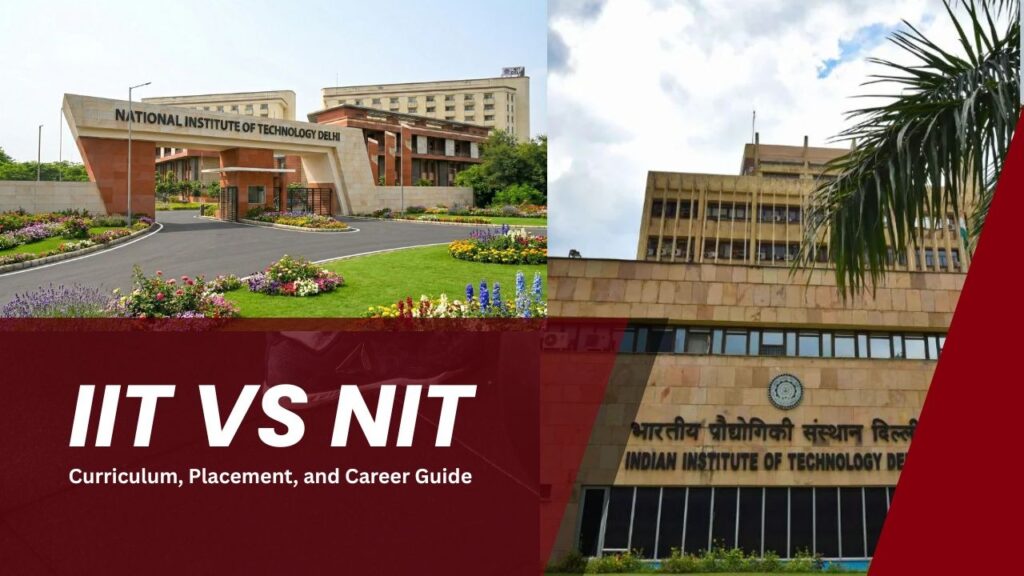
The IIT vs NIT debate is real and the differences are meaningful. Here’s what actually separates them.
Understand The Value of IIT and NIT
IITs carry a premium that opens doors before you even speak. Walk into a Goldman Sachs or Google recruiter’s room with an IIT stamp and you clear the resume filter automatically. NITs don’t have that reflex recognition globally, though the top five — Trichy, Warangal, Surathkal, Calicut, and Allahabad are well-respected domestically.
But here’s what this advantage actually means in practice: it gets you the interview. After that, you’re on your own. IIT students who coast on the brand tag get filtered out just as fast as anyone else. The brand buys you roughly one extra shot — use it well or waste it.
For postgraduate studies abroad, IIT carries more weight than NIT with foreign universities, especially in the US and Europe. If a master’s or PhD is your goal, this gap genuinely matters.
Curriculum is Almost Same For Both
Both systems run four-year B.Tech programs under roughly similar structures — core engineering subjects in years one and two, specialisation from year three, electives and projects in year four.
IIT vs NIT Comparison on Research Environment
The real curricular difference isn’t the syllabus on paper — it’s the research environment. IITs have substantially more funded research labs, active PhD programs, and faculty who are publishing in international journals. If you’re the kind of student who wants to do undergraduate research, intern in a faculty lab, or co-author a paper, IIT is genuinely the better environment. The infrastructure isn’t comparable.
NITs, particularly the older and larger ones, have improved their lab facilities significantly over the last decade. But the research culture at most NITs remains thin. The focus is largely on getting students job-ready — which is not a criticism, just a different orientation.
One underrated advantage at many NITs: smaller competition pools. At some IITs, particularly the newer ones established post-2008, the facilities are not significantly better than top NITs, but the peer competition and internal politics are fiercer. At a top NIT, you can more easily stand out, take leadership roles, build a visible profile, and walk into placements as a known quantity.
JEE Main and JEE Advanced are not the same exam. This distinction trips up more students than any other part of the process.
JEE Main is the entry point for NITs. It’s conducted by NTA — National Testing Agency — typically twice a year, in January and April. You appear, you get a percentile score, and that percentile determines your rank. The top 2.5 lakh candidates from JEE Main qualify to sit JEE Advanced. NIT admissions happen through JoSAA counselling using your JEE Main rank.
JEE Advanced is the second, harder exam that gates IIT admission. Clearing JEE Main doesn’t mean you’re close to an IIT seat — it means you’re eligible to try. In 2024, roughly 1.8 lakh students appeared for JEE Advanced. Around 48,000 qualified. Total IIT seats across all 23 IITs are approximately 17,000. The math is brutal.
For NITs, total available seats across 31 institutions are around 23,000 — nearly 40% more seats than IITs, spread across more institutions and more states.
1. The cutoff reality nobody frames honestly: Getting into IIT isn’t one bar — it’s dozens of bars stacked by branch, category, and institute. A General category student needs roughly AIR under 100 for CS at IIT Bombay or Delhi. AIR under 2,000 gets you CS at a newer IIT. AIR under 5,000 might land you Mechanical or Civil at a mid-tier IIT. Meanwhile, NIT Trichy CS closes around JEE Main AIR 500–800 for the General category genuinely competitive, but on a different scale of difficulty.
2. State quota is NIT’s hidden advantage. 50% of NIT seats are reserved for students from the home state. If you’re from Tamil Nadu, your NIT Trichy odds are structurally better than an out-of-state competitor with a higher rank. IITs have no state quota, every seat is All India. This sounds fairer. It also means every seat is more contested.
3. The year-drop calculation. Roughly 35–40% of IIT aspirants drop a year after Class 12 to improve their JEE rank. At Kota coaching centers, repeat batches are larger than fresh batches in most institutes. The question nobody asks before dropping: what’s your realistic rank improvement ceiling, and is the branch you’d access after dropping actually better than what you can access now? Most students who drop are chasing a brand, not a branch. That’s the wrong reason.
4. JOSAA Counselling is where seats are actually allocated. After both exams, IIT and NIT admissions run through a single joint counselling platform — JOSAA. You fill preferences in order, locks run in rounds, and seats fill from the top. There are typically six rounds, with seat upgrades possible in later rounds if a better preference opens up. Freezing too early or not understanding the upgrade system costs students better seats every year.
It’s around 10–15% of initially allotted seats go vacant or are surrendered before final lock-in, which means students who stay active through all rounds often access seats that weren’t available in round one. Most students abandon the process after round two. Don’t be that student.
Institute(s)
Typical CS AIR range (General)
IIT Bombay / IIT Delhi
1–100
IIT Madras / IIT Kanpur / IIT Kharagpur
100–400
Remaining older IITs
400–1,500
NIT Trichy / NIT Warangal
500–1,200
NIT Surathkal / NIT Calicut
1,200–3,500
Newer IITs
1,500–5,000
IIT and NIT Difference in Placements
IIT placement averages are inflated. Median packages matter more than the maximum, and those Rs. 1.5 crore headlines you see are almost always international offers that convert at absurd rates rarely representative of what most graduates earn. The honest median domestic CTC at most IITs in CS ranges from Rs. 18–30 LPA for the class of 2024. That’s excellent. But it’s not a different universe.
Top NITs in CS — Trichy, Warangal, Surathkal are seeing domestic medians between Rs. 12–22 LPA. The gap exists. But it’s not a lifetime gap.
IIT vs NIT salary packages? core vs software. If you’re in a non-CS branch, IIT placement networks have more depth in core engineering — PSUs, defence contractors, manufacturing than most NITs. But if you’re going into IT, FAANG, or fintech, the brand premium on the offer letter is smaller than students expect.
One thing NITs do well: mass recruitment. Companies like TCS, Infosys, Wipro, and Cognizant recruit heavily from NITs. If you’re okay with a service-sector start, NIT gets you employed efficiently. IIT students often hold out for better offers which work when it works, but adds uncertainty.
Which is better IIT vs NIT? The answer is not that simple. IIT to IIM or IIT to top MS programs abroad is a well-worn path with strong alumni networks actively supporting it. The IIT alumni ecosystem — particularly for IIT Bombay, Delhi, Madras, and Kharagpur functions as a career accelerator that NIT alumni networks simply don’t match at scale yet.
GATE scores change this calculation slightly. NIT graduates who crack GATE with high scores can access IIT M.Tech seats, effectively re-entering the IIT ecosystem. This is a legitimate strategy that many NIT students use and it works.
For entrepreneurship, the IIT brand helps with early investor trust. It shouldn’t matter, but it does if an IIT founder gets a longer initial conversation. The IIT incubators also have more funding, better mentorship networks, and stronger Venture Capital connections.
Which is Better in IIT vs NIT?
Stop asking “IIT vs NIT” and start asking these:
Which branch at which college? An IIT seat in a branch you dislike will hurt you more than a NIT seat in a branch you’re good at.
What is your exit? Software job, core engineering, MS abroad, MBA, research, startup — each has a different answer.
Which specific NIT? NIT Trichy is not the same institution as NIT Agartala. Treating all NITs as one category is the most common mistake in this comparison.
What are your GATE/CAT plans? If higher studies are likely, the IIT tag matters more. If you’re going straight into industry in India, the top NITs compete seriously.
Conclusion
IIT wins on research environment, global brand, alumni network depth, and higher-studies outcomes. NIT wins on accessible entry, focused placement infrastructure for domestic jobs, and the underrated advantage of being a bigger fish in a smaller pond.
Neither is a wrong choice. The wrong choice is picking based on brand alone and ignoring branch, location, faculty quality, and what you actually want to do after graduation. Both IIT vs NIT deliver the same curriculum with different environments and futures.
There is a huge scope of government jobs in Jammu & Kashmir, which many youths get every year with their hard work and preparation. If you also want to make your career in Jammu & Kashmir as a government job, then many good opportunities are available for you in 2025.
The advantage of government jobs is that the job is permanent, salary is received on time, and along with that good benefits like pension, medical facility, and stability are also available. In government jobs in Jammu & Kashmir, jobs are available in different departments like police, education, health, agriculture, forest, and many more.
This blog will give you information about the Best Government Jobs in Jammu & Kashmir in 2025, so that you can choose a job according to your eligibility. In the table given below, you will find the list of top 15 government jobs in Jammu & Kashmir, in which the name, department, eligibility, and official website of each job is given.
Top 15 Government Jobs in Jammu & Kashmir in 2025
S.No.
Job Title
Department/Organization
Eligibility
Official Website
1
JKAS Officer
Jammu and Kashmir Public Service Commission (JKPSC)
There are a plethora of government jobs for you in Sikkim. These roles offer job security, career stability, and high paying. Whether you have a background in engineering, medicine, or just a 12th pass do not miss the chance to secure the Best government jobs in Sikkim. Reshaping your future with an excellent career option without preferring to relocate is the best way to have a work-life balance. The professional growth will continuously grow with the years of experience and promotion to the next stage can increase your salary.