SSC CGL Online Form 2025: SSC Combined Graduate Level CGL Online Form 2025 Released for multiple posts in government sector. Candidates who graduated from any stream can apply to appear in the exam. There are a total of 14582 vacancies, for online form check the link in this article and apply directly to join Combined Graduate Level Exam.
SSC Combined Graduate Level CGL Online Form Details
Application Fee for SSC Combined Graduate Level CGL
General / OBC / EWS
SC / ST / PH
All Category Female
Correction Fee 1st Time
Correction Fee 2nd Time
100/-
0
0
200
500
Application Form Expected Exam Dates
Start Date
9-June-2025
End Date
4-July-2025
Correction Date
9 to 11 – July-2025
Admit Card – Tier 1
August 2025
Exam Date Tier 1
13-30 – August-2025
Exam Date Tier 2
December-2025
Department-Wise Post Detail for SSC Combined Graduate Level CGL Online Form 2025
Post Name
Age-Limit
Eligibility
Auditor in AG or otherMinistries, Accountant in AG or Other, Sr Secretarial Assistant in Electronics, IT, UDC, CSCS, Tax Assistant in CBDT, CBIC, CBN
18-27 Years
Bachelor in Any Stream
Sub Inspector in NIADivisional Accountant in OfficesResearch Assistant, Assistant in Other ministriesInspector in Central Narcotics, DOP, CBIC, in Income Tax (CBDT)
18-30 years
Bachelor in Any Stream
Sub Inspector in CBI
20-30 years
Bachelor in Any Stream
Junior Statistical Officer in MSPI
18-32 Years
Bachelor in Any Stream with Statistics as Statistics
Stenographer Grade C & D Recruitment 2025 official notification has been released for a total of 261 vacancies. If you’re hoping for your future in a government job, secure your position by applying for a Stenographer Job. This could be your best chance to work in a government office, department, and ministries. Candidates who have passed their 12th from any recognised board are eligible to apply. This is conducted annually by the SSC to recruit the candidates for this position. You can apply online from the official website or directly from the link mentioned in the article.
Stenographer Grade C & D Recruitment 2025 Highlights
Exam Conducting by
Staff Selection Commission (SSC)
Post
Stenographer Grade C & D
Stenographer Grade C & D Recruitment
Government recruitment process to fill the 261 vacancies. Candidates who passed 12th and have stenographer skills can apply for this job.
For decades, a government job has been the most lucrative career option in India. These SSC Job List 2026 will help you to take the right direction of your career. As we head into 2026, the Staff Selection Commission (SSC) still remains the dream gate for lakhs of aspirants to get their foot into stability, respect and serving the nation.
If you are preparing your career roadmap for this year, then getting to know about the huge range of SSC jobs is step one! From the Central Secretariat to paramilitary forces, desk-bound jobs to high-octane field jobs, the SSC 2026 calendar is bulging.
So, here is the detailed information of Your SSC Job List 2026 by Exams and Qualification.
SSC Combined Graduate Level (CGL)
The SSC CGL which is popularly known as ‘Mini-IAS’ exam is the most reputed exam for selection to Group B and C posts in various SSC Job List 2026 in ministries and departments. Candidates need to have a Bachelor’s Degree in any stream to be eligible.
Some of the SSC Job List 2026 under SSC CGL are:
1. Assistant Section Officers (ASOs) watchful policy realization in the Central Secretariat Service (CSS) in the Ministry of External Affairs (MEA), or Intelligence Bureau (IB) or the ASOs business is largely on one’s table at any rate!Desk based post of execution policy.
2. Roles in the Ministry of Finance related to taxation that are high-paying and profitable are Income Tax Inspector and GST Inspector.
3. AAO or Assistant Audit Officer – Indian CAG This is the Gazetted post In SSC CGL under the Indian Comptroller and Auditor General (CAG) and working with the Indian Comptroller & Auditor General this post is unique.
4. Sub-Inspector in CBI: This post is for those who are willing to serve in the National Investigative Agency.
SSC Combined Higher Secondary Level
SSC CHSL is a great opportunity for 12th pass candidates to get an entry level post in the government sector.
Job Roles:
1. These posts (Junior Secretariat Assistant and Lower Divisional Clerk) are the best paying jobs at entry level which are the backbone of office administration and are indispensable to the smooth working of the office.
2. Data Entry Operator (DEO): Hold the responsibility for maintenance of essential Government files, up-to-date and complete, with accuracy.
This examination leads to secure and respectable employment within government organizations.
SSC MTS & Havaldar
This is an excellent opportunity to enter in the Multi Tasing Staff job role or Havaldar, 10th pass candidates can get a central government job/staff.
Job Roles:
MTS (Multi Tasking Staff): It serves as a kind of general office support, some such duties include, running files, pushing files from one desk to another, housekeeping in office space, across various government ministries.
Havaldar: Havaldar post Candidate Should belong to Central Board of Indirect Taxes & Customs (CBIC) and Central Bureau of Narcotics (CBN). The duties of the security personnel are all field-based i.e. they are related to security and watch and ward.
SSC GD Constable
The SSC GD Constable 2026 Recruitment if you would like to serve in uniform and keep yourself physically fit, then consider it. The exam is held for recruitment to various Paramilitary forces like:
BSF —-Border Security Force
CISF —-Central Industrial Security Force
CRPF —-Central Reserve Police Force
ITBP —-Indo-Tibetan Border Police
SSB —-Sashastra Seema Bal
AR —Assam Rifles
Qualification Criteria: The applicants must have cleared 10th standard with some physical standards in order to be eligible for the recruitment.
SSC CPO
The SSC CPO exam is a good chance for the ones who want to be a Sub-Inspector (SI). It is a tough but rewarding path to take. Candidates are required to have a graduation degree and Qualify Physical Endurance Test to be eligible.
Selected candidate have the opportunity to serve in prestigious position like Sub-Inspector in Delhi Police (which is considered one of the most orderly police service) or Sub-Inspector in Central Armed Police Forces (CAPFs) – BSF, CRPF and more.
SSC Specialized Exams
Stenographer (Grade C & D)
If you are good at shorthand typing and can crack SSC Exam then SSC Stenographer may be a door for you to enter into government jobs.
Via this exam candidate is selected for the post of Stenographer in various ministries, departments and organizations of Government.
The core responsibilities of this role involve providing dictation assistance to senior officials, drafting official documents, processing correspondence and carrying out administrative tasks.
They frequently are called upon to assist higher-ranking officers, making it a key supporting position in the government system. You can get a great pay from this job role as it requires your skills.
Junior Engineer
The SSC Junior Engineer exam is disputed for the candidates who have a Diploma/Degree from the recognized board in a relevant field of engineering i.e. Civil, Mechanical, Electrical etc.
The result of SSC Junior Engineer Exam contains qualified candidates who are selected for appointment in various government departments, organizations such as public works, infrastructure, etc.
They also oversee such projects as cleaning and maintaining government buildings and roads, write technical reports, and verify that engineering projects conform to safety and quality requirements.
SSC Selection Posts (Phase XIV):
The Staff Selection Commission Selection Post Exam is a good opportunity to get a government job for the person who has educational qualification of 10th pass 12th pass and Graduates.
Unlike other SSC exams which appoint the candidates for common posts, this exam appoints candidates for distinct and specialised posts in various central government departments.
These posts can be for Scientific Assistant or Laboratory Attendant or even Library Clerk, Data Entry Operator or Technical Assistant. Every post has different eligibility criteria and different skills that are needed as per the requirement of department.
Due to the wide range of posts, the Selection Post examination is an ideal platform for the people who are having professional or vocational qualifications and interested to work in a particular domain in the government sector.
Job Security: Students can rely on their jobs for lifetime as it is not like private jobs undisputed, particularly in times of economic downturn.
Work-Life Balance: There are public holidays and weekends leave can be more relaxful and also on the weekdays you have to work only 9 to 5.
Salary and Perks: The salary is very competitive with the 7th Pay Commission norms. Benefits such as HRA (House Rent Allowance), DA (Dearness Allowance) and medical benefits for family are some of the major highlights.
Social Prestige: It is a centrally administered ministry, so it has a good standing in society to serve in it or the national police force.
SSC Job List 2026 Exam Timeline
The SSC Job List 2026 exam timeline is given for the students to take an idea to begin their journey, accurate date and time are declared by the official website of SSC. Students who are interested in any of these job posts can check the official notice of the exam on the official website.
Exam Name (2026)
Notification Date (Expected)
Exam Month
CGL
March/2026
May—June/2026
CHSL
April/2026
July—Sept/2026
MTS
June/2026
Sept—Nov/2026
CPO
May/2026
Oct–-Nov/2026
GD
Sept//2026
Jan—March/2027
Conclusion
Whether you are a 10th-pass student or a postgraduate engineer, the SSC Job List 2026 has all the opportunities for you. The only question you must ask yourself is which post defines my personality better? If you love discipline and being outdoors, go for CPO or GD, if you love a quiet office and wielding admin powers, go for CGL.
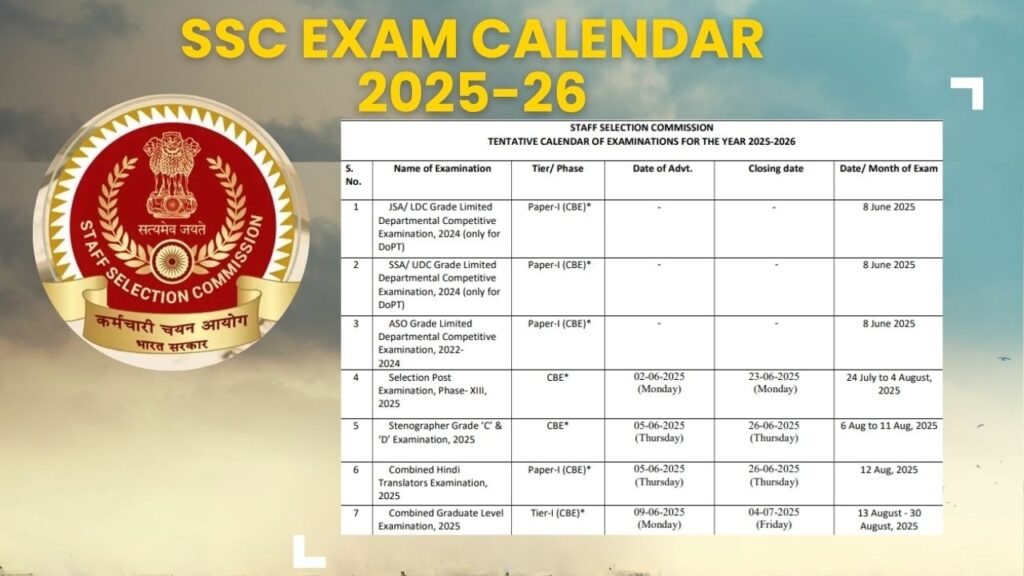
The SSC has announced the SSC Exam Calendar 2025–26 on its official website, so start preparing for the upcoming exams. More than 10 lakh candidates appear out of 50 exams conducted by the SSC every year after 10th, 12th or graduation for jobs in various central government departments and ministries.
This year SSC Calendar (Important Dates) for SSC Exam 2025 (20, 25, 26) contains all info regarding SSC Exams for CGL, CHSL, JE GD Constable, Delhi Police, Steno orga, Stenographer post holders. Candidate can check important events such as notification release date, application dates, exam dates from the schedule to know about the upcoming events which should be useful in your preparation.
Check Out The SSC Exam Calendar 2025-26
More than five million candidates take the SSC exams for government jobs once in a year after either 10th, 12th or graduation. The revised SSC calendar includes all notification, application, and exam dates for the 2025-26 cycle, providing transparency and a clear path for the candidates.
Exam Name
Schedule Period
SSC Constable (Driver)-Male in Delhi Police Exam
July to December 2025
Head Constable (Ministerial) in Delhi Police
July to December 2025
Head Constable (AWO/TPO)
July to December 2025
Constable (Executive)
July to December 2025
Grade C Stenographer
July to February 2026
Constables and Rifleman in Assam
October to February 2026
JSA/LDC
January to March 2026
SSA/UDC
January to March 2026
ASO
January to March 2026
Key Details for Aspirants
All SSC examinations are held at the designated centers across all over India in Online mode only.
Updates are posted on the official SSC website (https://ssc.gov.in). Aspirants are advised to track the notifications and deadlines for application.
Dates of the examination are liable to change due to unforeseen circumstances, keep watching official notifications for updates if travelling or taking study leaves.
There are more levels/phases to the selection process; CGL, CHSL and JE have additional rounds after Tier 1.
Admit cards, syllabus and other directions for the candidates are issued just before the exam, so keep visiting the official website of SSC regularly.
Follow the Guide to Download the SSC Exam Calendar 2025-26
1. Go To The Official Website of SSC, which is mentioned in this article.
2. Now Search for the SSC exam calendar in the Notification on SSC Exam Schedule 2025-26.
3. Open the link and download the calendar in pdf file OR you can just download it directly from the link section of this article.
4. Download the pdf file in your device.
5. Keep this file save or print for future uses.
The SSC timetable for the 2025-26 session is designed as per the pattern of previous years and it clearly indicates that there are 5 stages in the exam process.Changes or modifications, if any, will be notified on the official website of SSC.
To prepare and score well for the government job exam you must have to acknowledge SSC CGL Syllabus 2025. Lakhs of students are attempting the SSC CGL (Staff Selection Commission Combined Graduate Level) exam every year. Here is the breakdown of the SSC CGL exam syllabus and exam pattern.
Introduction
The SSC CGL exam is conducted by the SSC (Staff Selection Commission (SSC) for those who want to make a career in government job roles including Income Tax Officer, Assistant Section Officer, Excise Inspector, JSO, AAO, SO, and Upper division clerk. This exam comes with a stable career but also an attractive salary and other benefits. SSC CGL is a golden opportunity for job seekers to work in a government job.
Why Updated 2025 Syllabus is crucial to prepare strategically The SSC CGL syllabus can be updated each year to keep the examination relevant and aligned with the latest requirements. To prepare strategically and efficiently students must understand the importance of checking the updated syllabus. It will help you to focus on the most important topic to avoid irrelevant topics that can waste your time while preparing.
The SSC CGL exam is conducted in two parts, i.e. Tier 1 and Tier 2. Tier 1 is the first step to qualify the candidate for the next stage. Tier 1 marks are not counted for the final selection but it is necessary to clear the exam to reach Tier 2. After qualification, the candidate is eligible to attempt the Tier 2 main exam, the marks obtained in this stage are counted in the final selection and rank matters for various roles in government posts.
Feature
Tier 1
Tier 2
Subjects
General Intelligence & Reasoning, General Awareness, Mathematics, English
Mathematical Abilities, Logic & Reasoning, English Language, General Awareness, Computer Knowledge, Statistics (for some posts)
Total Marks
200 (each section for 50 marks)
Each paper for 200 marks
Total Question
100 (each section has 25 questions)
Paper 1, Paper 2, and Paper 3 (each paper has a various sections)
Duration
60 minutes
Each paper for 2 hours
Negative Marking
Yes (0.50 per wrong answer)
Yes (varies by section, usually 1 mark per wrong answer in some papers)
SSC CGL Tier 1 Exam Syllabus: Topic-Wise
General Intelligence and Reasoning
In this section, the candidate’s ability to think logically and problem-solving skills are tested. This section covers topics such as Numbers, Analytics which involves patterns, number problems, and basic operations. Coding-Decoding checks the ability how fast and reliably you can solve the code. Syllogistic reasoning helps you to understand and make the conclusion from statements. Analogy questions check the ability to understand the relation between the phrases or words. Series questions are challenging. It will open up your ability to recognize sequences-based algorithms.
General awareness
This section highlights the importance of general knowledge. Candidate must be aware of the environment and recent events in the country. This section checks the ability of your basic knowledge in the History span from ancient to modern, Geography that covers global value, physical features, and important locations. Science takes another assessment of the candidate’s basic knowledge of normal phenomena. The economic section checks the awareness of policies that affect the entire nation. Most importantly financial system is important to understand to secure the wealth from fraudsters. Polity covers the law and governance, and current Affairs is a dynamic topic that includes Important Days & Events.
Quantitative Aptitude
Quantitative aptitude or mathematics covers the basic topic of the subject. The candidates who were having PCM in 10th grade were already prepared for this topic. It is a simple and basic mathematics topic that candidates can prepare easily. The topics include Number System, Percentage, Profit & Loss, Time & Distance, Trigonometry, Statistics, Algebra, Geometry, and Ratio & Proportion.
English Comprehension
Candidates should improve their grammar to score well in English, the topics include Active/Passive, Antonyms, Synonyms, Comprehension, Sentence improvement, Indirect/Direct Speech, Idioms & Phrases, and Error Spotting.
SSC CGL Tier 2 Syllabus for 2025 In-Depth Topics
The SSC CGL conducted three papers in Tier 2, Paper 1 is necessary for all the posts. Paper 2 is important only for those who are applying for the Junior Statistical Officer posts. Paper 3 is for the Assistant/Accounts Officer posts. Paper 1 concluded with three sections and each section has various topics. Here is the breakdown for the Paper 1:
Mathematical Abilities
In the Mathematics section, the topics are generally to help assess a candidate’s ability to solve typical patterns and numbers. This topic included Trigonometry, Geometry, Algebra, Profit & Loss, Mensuration Statistics and Data interpretations, and Probability. Mastering these topics will help you excel in the Mathematics paper and qualify for the job position.
Reasoning & General Intelligence
Verbal & Non-Verbal Reasoning helps to understand the ability of the candidates. Candidates must be able to connect words and phrases to a conclusion. Critical thinking covers the concept of higher-level objectives in the real world. Problem-solving and Syllogism topics are important for Reasoning & General Intelligence.
English Language & Comprehension
English Paper covers a range of topics from correcting the sentence to making the structure of the sentences. Grammar rules, Vocabulary, Synonyms & Antonyms are relevant topics in the Comprehension. Preparing well in these topics will help you score in English Paper.
General Awareness
This section involves the general science & technology questions which help to improve the ability in basic awareness. Economy, Government Schemes & Policies for improving the knowledge in the current information related to the country. Geography, History & Culture have spanned from ancient to modern and global locations and important places. Current Affairs are important for this competitive exam. Mastering these topics will help you excel in the General Awareness paper.
Computer Knowledge (Tier 2 Only)
Computer fundamentals, MS Office, Cyber Security & Threat, Networking Concepts. These topics are easy and necessary knowledge required for some job roles. Practical Skills can be helpful for banking and railway jobs. Additionally, Understanding the Common threats and backup data can be helpful. You must know the basics to clear this section and score well.
Statistics (For JSO Post Only)
This paper 2 is especially for the candidates who are applying for the Junior Statistical Officer (JSO) post. To perform analysis and Presentation of Statistical Data is a work in this job role. The section covers relevant topics like methods to collect data and presenting in a manner for better understanding and making decisions to perform the operations. Sampling Theory, Correlation and Regression and Probability Theory are also important topics. Mastering these topics will help you excel in the Statistics paper and qualify for the JSO post.
Finance and Economics
This is 3rd paper of Tier 2 which includes the topic of basic financing such as Limitations of Financial Accounting, Basic concepts and Conventions, Nature, and scope. This paper has some accounting concepts too, Basic Concepts of Accounting, which improve the concept of banking.
Preparation Tips for SSC CGL Exam 2025
To score higher in each subject you must divide every subject with your routine to learn. You can start preparation according to the exam pattern. Knowing the pattern helps you improve the ability to navigate important topics first. Clearing out the SSC CGL exam for a government job in any sector is a golden opportunity you do not wanna miss it.
Conclusion
The candidates for the SSC CGL exam 2025 must understand the updated syllabus before the exam preparation to prepare well and efficiently to pass this competitive exam and grab the job post. There are lakhs of students every year to attempt this exam. The syllabus updates are important to make the exam paper relevant. Candidates can know all the details about SSC CGL Syllabus 2025 here before the examination.
The Combined Higher & Secondary level exams by SSC are golden opportunities for the candidates. Candidates must understand the importance of the latest SSC CHSL Syllabus 2025. This will help shift the focus to the main topics, enabling candidates to be prepared well to clear the exam. SSC CHSL is a national-level exam for various government jobs and offices.
There are two Tiers in the SSC CHSL examination. Tier 1 has an objective-type exam. Candidates must prepare for the Tier 1 subjects and clear the stage to reach Tier 2. Tier 2 paper is also an objective and skills test. A lot of candidates applied each year for this exam. This exam’s final score is crucial for the government job post.
SSC CHSL Tier 1 Syllabus 2025
Tier 1 subjects included subjects such as English language, General awareness, General Intelligence & Reasoning, and Quantitative Aptitude. Each subject has various topics but focusing on the most important topic is crucial for the candidates for higher scores in examinations.Exam pattern and Syllabus will be helpful for candidates to prepare strategically and efficiently.
English Language
English is an easy subject and you can reach the top score in this subject so prepare well. The most important topics in Grammar are Comprehension, Error spotting, Synonyms & Antonyms, and Idioms. These topics cover the general English that can be necessary for every post. Candidates must score well in the English Language by mastering these topics.
General Intelligence & Reasoning
To improve the ability of the candidate’s logical thinking and reasoning, this subject includes the topic of analogies, series, and coding-decoding. Focusing on these topics will enhance the ability to think logically and irrationally. There are some more topics to cover in this subject such as blood relations, puzzles, and syllogism.
Quantitative Aptitude
Mathematics problems always help to sharpen the mind to solve critical problems and improve logic. Topics covered in the quantitative aptitude are arithmetic operations, algebra, geometry, mensuration, and data interpretation which are normally the important sections to focus on every sector that has a need for the candidate who has the ability. Mastering the topics will excel in clearing the exam.
General Awareness
Current Affairs are the most important topic to cover. As a government official, you need to be up-to-date with the latest events and recent policies of the country. The topics to cover for this paper are history, geography, politics, science, and important books/authors.
SSC CHSL Tier 2 Syllabus 2025
Mathematical Abilities
This section covers the topic of advanced arithmetic. After clearing tier 1 you should focus on practicing more than before in arithmetic because it has more hard-level questions. The topics included in the subject are algebra, geometry, and data analysis.
Reasoning & General Intelligence
Candidates are tested with higher-level puzzles to enhance their abilities. The candidate should practice puzzle activity well regularly because it is important to cover the whole section and it will improve critical thinking.
English Language & Comprehension
Candidates who write well in grammar can get high scores in English. The scoring will give you the chance to be selected for a government job. The most important topics to cover are Essay and letter writing, advanced grammar, and comprehension.
General Awareness (Detailed)
Current Affairs topics are crucial to cover, if a candidate wants to work in a government office should be aware of the surroundings including events, official events, important dates, historical events, and static GK.
Computer Proficiency
The computer exam is crucial these days especially because Job roles in banking or railway will require computer knowledge. This section covered the topics of basic computers, Networking, and MS Office.
Preparation Tips for SSC CHSL Exam 2025
Candidates must cover the important topic first and structure them to study in-depth. To understand exam patterns, check previous year papers. Understanding the exam pattern will help in preparing according to the exam syllabus. So, every important topic will be covered. Get recommended books and online resources and study from relevant sources.