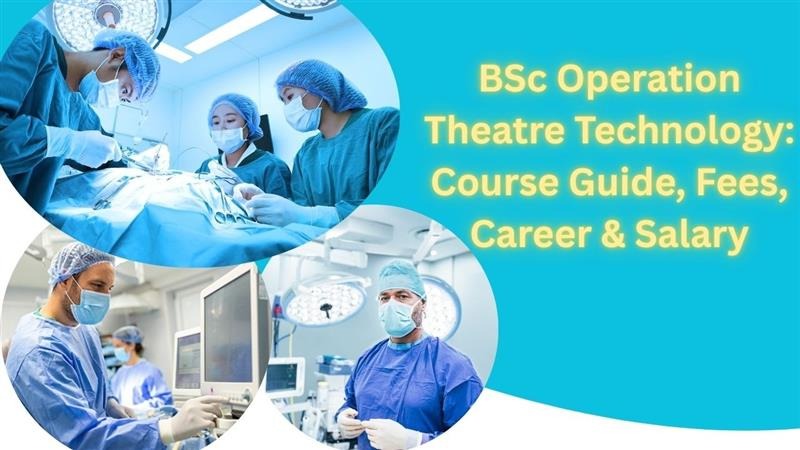
BSc Operation Theatre Technology: Course Guide, Fees, Career & Salary

BSc Operation Theatre Technology

If you’ve ever seen a surgical scene in a film, the camera almost always lingers on the surgeon. While behind every successful operation, there is a team, who make everything run smoothly silently in the background. One of the most vital members of the team is Operation Theatre Technologists. Degree in BSc Operation Theatre Technology (BSc OTT) trains students to undertake this pivotal position in the healthcare organisation. 

It is a professional undergraduate course for aspirants who wish to collaborate with surgeons, anesthesiologists and nurses within the operating room. From instrument preparation to ensuring sterility to direct procedure support, OT technologists are paramount to patient safety and managing successful surgeries.

For the students who are interested in medicine but do not want to do MBBS, BSc Operation Theatre Technology course has emerged as a very lucrative career option with rising demand in hospitals across India and abroad. 

What is BSc Operation Theatre Technology About?

BSc OTT (BSc Operation Theatre Technology) is an undergraduate course which makes you ready to be the backbone of surgeries. OT professionals ensure the operating theater is clean, equipment works flawlessly and patients are protected during their surgical journey, above and beyond what the surgeons have time to do themselves. The training enables you to work as a surgical technologist with surgeons and anesthesiologists in the operating room, as a surgical instrument sterilizer, and an assistive user of the advanced technology on which today’s surgical procedures rely.Consider it the technical conductor of an orchestra where every instrument must play perfectly in time. 

Course Duration and Structure: What to Expect

This is the interesting part and also the part you should keep a very close eye on because it changes depending on where you study.

Standard Duration: BSc Operation Theatre Technology is a 3-year course and accompanied by the attendance of a 6 month to 1 year mandatory internship.However, a few top listed universities such as SRM University, Apollo University provide the option of pursuing it as a 4 year course.Professional training in anesthesia technology is provided along with OT management. 

Welcome to Year 1, Are you ready to make a start all you need to do is dust off your knowledge for the big four; Anatomy, Physiology, Biochemistry and Microbiology. But it’s not like just cramming textbooks. You will also begin to understand more general nursing principles, as well as the language that healthcare professionals really speak on a daily basis. Think of it as learning to walk before you run.

The second year is when things start to get a bit more “real”. You’ll advance into pharmacology, gain surgical skills, and for the first time — enter the realm of OT management and sterilization techniques. That’s when you start to realize how all that stuff you learned in Year 1 actually relates to what takes place in an operating room.

Year 3 is where it gets real. You will be learning advanced surgical procedures, anesthetic methods and intensive care. There’s a similar emphasis on quality control, because in medicine, precision and responsibility aren’t optional, they are everything.

Then you do the Internship and that is where everything changes. No more simulations. No more hypotheticals. You’ll be in a real hospital operating theatre, assisting in real surgeries on real patients. Yes, it’s intense. And I was tested in ways I never thought I would be. After all, it is the final stage of your training, but also the most important one, because this is when you stop being a trainee and start becoming a practitioner.  

Are You Eligible For BSc Operation Theatre Technology?

Check your qualification before applying for the admission into this course, Here’s what you need based on official university guidelines:

Educational Background: You need to have done Class 12 (10+2) in Science stream with Physics, Chemistry And Biology (PCB) as core subjects. Some universities allow Mathematics instead of Biology, but the latter is the better choice.

Minimum Marks: Most organizations expect you to have minimum 50% aggregate marks in your PCB. While 55% and 60% needed for the top colleges like AIIMS Delhi and Brainware University.

Age Limit: Starting from 17 and the upper age limit is usually 40 years, with 5% relaxation for reserved categories.

Medical Fitness: A compulsory medical certificate of fitness from a government medical officer must make sense since you’ll be hectoring life. 

Admission Process: How to Get In

If you’ve been panicking over entrance exams, here’s some relief. The cut throat competition is not that much higher as compared to BSc Operation Theatre Technology when it comes to MBBS seats. It’s really not too bad if you know what to expect.

For most colleges, both government and private, it all boils down to your Class 12 PCB percentage. That’s it. If you work hard in your board exams, that work directly opens doors for you here. No complicated formulas, no years of entrance prep — just your actual academic performance talking.

A few universities want to play it their own way. There is no one all India entrance test for BSc Operation Theatre Technology but a few institutions/universities conduct their own tests or they accept students based on their CUET scores for admission. 

Course Fee

As we all presume that it’s not always a career choice that’s based on passion, but also what makes practical sense for you and your family. 

BSc Operation Theatre Technology fees: The good news here is BSc Operation Theatre Technology is really one of the less costly healthcare courses you will find anywhere, more so if you get a government college seat. We’re talking anywhere from ₹10,000 to ₹50,000 per annum and that is fairly affordable when you compare with most private medical courses. For a lot of students, this is what separates the dream from the doable. 

Private colleges have, as one would expect, a more varied selection. Most are in the range of ₹50,000 to ₹2,50,000 per annum, but among the premium institutions the total cost of the course can go up to ₹10 lakhs for the entire programme. 

That’s a big cost, so you should consider what you’re getting in return — facilities, faculty, hospital partnerships, and placement assistance all make a difference. Other expenses like books and hostel costs are not included in these fees.

A majority of the government hospitals and colleges provide scholarships or stipends for pursuing internships. It is helpful for taking ideas on how things work. So look into what assistance you’re eligible for before you commit anything. That one conversation or Google search could save you a pretty meaningful amount of money over four years. 

Where Can Your Career Take You?

Here’s where your heart might skip a beat (and I mean that in the best possible way). The Indian healthcare sector is booming and OT technologists are highly demanded.

  • OT Technician/Technologist: Your main role will be to assist in surgeries and help in the theatre
  • Anesthesia Technologist: Role required to keep monitor patients and machines.
  • Surgical Assistant: Assisting doctors/surgeons during operations.
  • CSSD Technician: Crucial industrial service in central sterile supply departments
  • Emergency Care Technician: Managing Critical Care and Trauma Cases 

Salary Expectations

You can have a good career in this field and it no doubt grows much better with intense experience. For freshers 0-1 years experienced, they get paid from 15k to 25k in government hospitals with job security, pension and all other benefits.

Private hospitals salary ranges from minimum 20k to 35k and maximum 40k in top corporate chains.

₹ 30,000 to ₹ 50,000 per month – With 2 to 5 years Experience Team leader Position holders And Private sector job holders.

Senior Experienced – If you are a senior with 5+ years of experience, you can earn anywhere between 50,000 to 80,000+ Rs per month, be it managerial role or any other specialized area. So, this just build up that how much you can get financial support and more out of this career.  

Read More:- Bihar BPSC APO Recruitment 2026: Eligibility, Vacancy & Apply Online

The Next Step After BSc Operation Theatre Technology Course

Having gained experience in BSc Operation Theatre Technology, expanses of job associated with go up in professional life are endless. Experts may become teachers to mentor and educate students who want to become OT technologists, or they may apply their skills in medical equipment sales, with firms such as Siemens or GE Healthcare, which can be quite rewarding. 

Also, a career in hospital management through MBA in Hospital Management can lead to the door to the top management. 

Specialization is also a viable option for career growth with specialized certifications in robotic surgery, endoscopy and critical care. Learning always pays off for career growth. 

Postgraduate studies such as MSc in Operation Theatre Technology or Anesthesia Technology allow individuals to take on advanced clinical roles, while MBA in Hospital Administration qualifies one for leadership opportunities. 

PG Diplomas in Critical Care or specific Surgical Procedures, along with Certifications in Robotic Surgery, Laparoscopy or Medical Coding, also enhance the career prospects. It is through these career paths that professionals can grow both personally and professionally but at the same time make a meaningful impact on the healthcare sector. 

Conclusion

BSc Operation Theatre Technology is not only a degree, it’s an opportunity to be a crucial part of life saving surgeries. With the healthcare industry in India expected to grow to $638 billion by 2025 and the medical device market expanding at 28% per year, the need for talented OT practitioners is strengthening.

You’ll be at the heart of the hospital, seeing medical miracles every day, and have a stable, respectable career with real upward mobility. If you envisage a career in India’s best AIIMS hospitals or want to work abroad, this degree takes you there.

The operating room isn’t for everyone—it’s stressful, physically and mentally exhausting, and you have to be totally exact. But for those who have the passion for healthcare and the disposition to work in a high-pressure set-up, BSc Operation Theatre Technology provides a career path, that allows you to make a difference in the lives of patients — each and every day. 
Leave a Comment

Your email address will not be published. Required fields are marked *

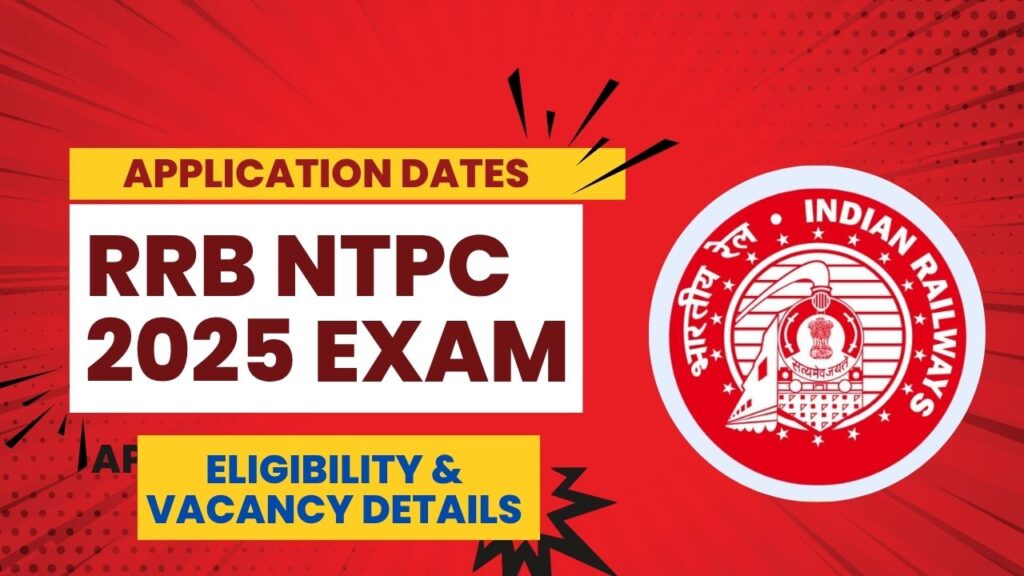
RRB NTPC 2025 Exam – Application Dates, Eligibility & Vacancy Details

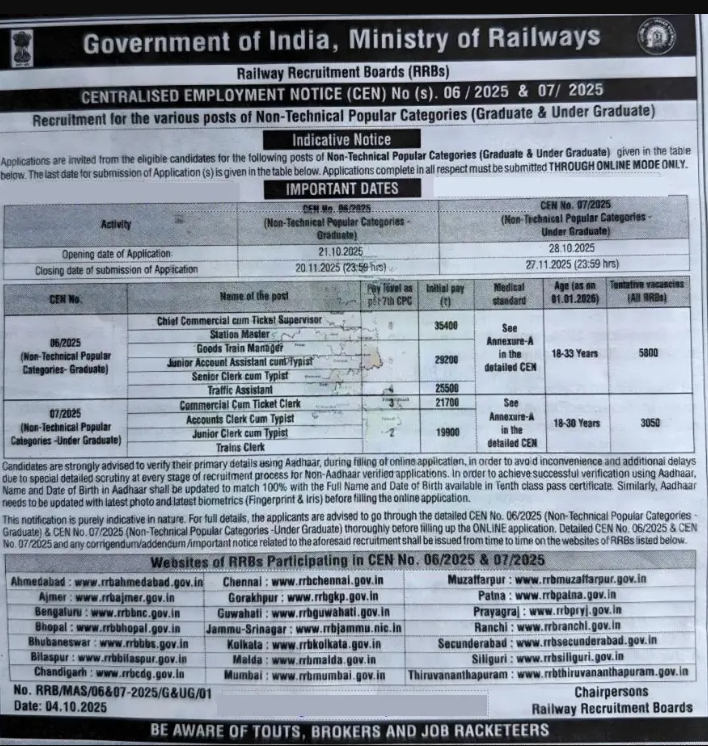
Railway Recruitment Board announced about the NTPC recruitment drive for the interested candidates who are waiting to apply for Railway jobs. RRB posted on the official website about the recruitment drive for the posts of Station Master, Goods Train Manager, Traffic Assistant, Senior Clerk cum Typist, and more. There are 5810 vacancies out there, and the online application process commences on October 21, 2025 and deadlines for submissions are November 20, 2025. Interested candidates can see the full notice for eligibility rules, fees, age limits, pay info, and how the selection works. Graduates who want jobs in railways should barge at this. 

RRB NTPC Application Dates

Notification Date29/September/2025
Application Start On21/October/2025
Last Date For Application20/November/2025
Admit CardUpdate Soon
ResultUpdate Soon

RRB NTPC Application Fee To Apply

Gen/OBC/EWSRs. 500
SC/ST/EBCRs. 250
Refund amount for Gen/OBC/EWSRs. 400
Refund amount for SC/ST/EBCRs. 250

Read More 👉 Download The Meghalaya Police Result 2025: Get Direct Link Here

Guide to Apply for RRB NTPC Application

Aspiring students can follow the guide to fill the application form for this recruitment process. Be prepared for the exam that will happen soon.

  1. Click on the official website link in this article which redirects you to the official site of RRB.
  2. There is a link “RRB NTPC Graduate Level Recruitment 2025, follow the link and register yourself.
  3. The next step is to fill out every detail carefully in the application and upload documents.
  4. Final submit, then pay application fee to proceed further. 
  5. Remember application is required to appear in the examination but it will eventually return.
  6. Save the form and print it out for any future use.

RRB NTPC Application Job Vacancy

Post VacancySalary
Chief Commercial Cum Ticket Supervisor161₹35,400
Station Master615₹35,400
Good Train Manager3416₹29,200
Traffic Assistant59₹30,000
Junior Account Assistant Cum Typist921₹29,200
Senior Clerk Cum Typist638₹29,200
Total Posts5810
Useful Links
Online ApplicationClick Here
Official NotificationClick Here
Official WebsiteClick Here

SSC Stenographer Grade C & D Recruitment 2025 Apply for 261 Post

SSC Stenographer Grade C & D Recruitment 2025

Stenographer Grade C & D Recruitment 2025 official notification has been released for a total of 261 vacancies. If you’re hoping for your future in a government job, secure your position by applying for a Stenographer Job. This could be your best chance to work in a government office, department, and ministries. Candidates who have passed their 12th from any recognised board are eligible to apply. This is conducted annually by the SSC to recruit the candidates for this position. You can apply online from the official website or directly from the link mentioned in the article.

Stenographer Grade C & D Recruitment 2025 Highlights

Exam Conducting byStaff Selection Commission (SSC)
PostStenographer Grade C & D
Stenographer Grade C & D RecruitmentGovernment recruitment process to fill the 261 vacancies. Candidates who passed 12th and have stenographer skills can apply for this job.
Vacancies261
Mode of applicationOnline
Selection ProcessComputer-Based Test (CBT) + Skill Test
Job LocationAcross India
Apply OnlineClick Here
Official WebsiteClick Here

Events Dates 

Notification Release6th June 2025
Application Start6th June 2025
Application End date26th June 2025
Last date to Pay Application Fee27th June 2025
Exam Date 6th to 11th August 2025

Application Fee

Female, SC/ST, PWD, and ex-servicemen candidatesNIL
General100/-

Eligibility Criteria

Qualification12th passedStenography skills
Age LimitStenographer Grade C: 18 to 30 yearsStenographer Grade D: 18 to 27 years
Reserved category can get age relaxation according to SSC rules.

Selection Process

1. Computer-Based Test (CBT) (First Stage)

Subject Questions (Time duration: 2 hours)Marks (Negative Marking: 0.25 mark for each incorrect answer)
English Language 100100
General Awareness5050
General Intelligence & Reasoning5050
Total200200

2. Skill Test

  • Grade C: Dictation at 100 words per minute.
  • Grade D: Dictation at 80 words per minute.
  • Candidates will have to transcribe on a computer within given time limits.

Some Useful Links

Apply OnlineGo To
Download SyllabusGo To
Download NotificationGo To
Official WebsiteGo To

Indian Police Service IPS: How to Crack and Become IPS Officer

Indian Police Service

If you’re dreaming about the Indian Police Service (IPS) standing tall as a law and peace officer in the Indian Police Service. Whatever got you started on this dream, pursuing it in real life is more than just a passion to do. It requires a sharp strategy to prepare accordingly and what’s right to study. Not everything is important. 

Instituted in 1948 as a successor to the British colonial-era Indian Imperial Police, the IPS is the ground holder of India’s internal security system. But the reality check is that every year lakhs of candidates chase this dream and only a few hundred come out successful. So what separates those who make it and those who don’t? More often than not, it is the preparation strategy. 

Understanding the Battlefield: The Three-Stage War

Know what you are getting into before you go to the books and notes. The UPSC Civil Services Examination (CSE) is a rigorous three-tiered exam which tests not only your knowledge but stamina, analytical abilities & character. 

First Level— The Preliminary Examination 

Think of the Prelims as the bouncer at the door to that exclusive club — it sifts out the wheat from the chaff. It consists of two objective papers, each of two hours duration and carrying 200 marks. 

Paper – I is General Studies—current events, history, geography, polity, economy, environment and general science. The Civil Services Aptitude Test (CSAT), now known as Paper II, tests your concepts on comprehension, logical reasoning, decision making and basic numeracy. It is qualifying in nature and it just needs 33% to pass.  

Do not make the mistake to understand that Prelims score is gonna add in the final merit list, it’s important to score for going into the next stage but it doesn’t hold final value. So don’t get that to take it lightly because 97-98% of candidates are eliminated at this stage. 

Second Level: The Main Examination 

If Prelims is a sprint, Mains is like running a marathon. Nine descriptive papers across a few days with a total of 1750 marks designed to push how well you know what you know and how well you can express complex thoughts when you’re under a lot of stress.

The pattern is: two qualifying papers (English and an Indian language), one Essay paper (250 marks), four General Studies papers ranging from Indian heritage to ethics and integrity (250 marks each), and two papers on your chosen Optional subject (250 marks each).

The hard copy elective also has an impact on your total score with a weightage of 500 marks. Choosing the appropriate subject is very important. Although you have a whole bunch of popular subjects like Geography, History, Public Administration, Political Science etc, it is always advisable to go with the subject you are really interested in rather than seeing what others have taken up. 

Third Level: The Personality Test (The Interview)

The remaining 275 marks are given in the Personality Test, during which an UPSC panel evaluates your mental alertness, critical thinking, communication skills, leadership potential, and moral uprightness. They don’t want to know-your-everything; they want well-rounded people who can manage the enormous burden of public service. 

Check Your Eligibility For Indian Police Service

Nationality

IPS is only open to Indian citizens. The UPSC CSE permits Nepali, Bhutanese and Tibetan refugees (who came before 1 January 1962) to apply for certain services like IAS and IFS, the Indian Police Service, however, is limited to Indian citizens. 

Qualification

You must have a bachelor’s degree from a recognized university – all streams are acceptable.  If you’ve studied English Literature, Engineering or Zoology, you can apply.

Important caveat for final-year students: You may apply for the Preliminary examination as a final year student, but you need to submit degree certificate before going in for the Mains.  Don not count on your provisional certificate to arrive in time—make your plans accordingly.

Final MBBS students can also apply, but they have to submit a certificate from their university. 

Age Limit

CategoryAge LimitCut-off Birth Date (for 2026 exam)
General/EWS21-32 years2/August/1993 to 1/August/2005
OBC21-35 years (3 years relaxation)2/August/1990 to 1/August/2005
SC/ST21-37 years (5 years relaxation)2/August/1988 to 1/August/2005
PwBD21-42 years (10 years relaxation)2/August/1983 to 1/August/2005
Ex-servicemen5 years relaxation2/August/1988 to 1/August/2005

Attempts Restrictions

CategoryNo. of Attempts
General/EWS6 attempts
OBC9 attempts
SC/STUnlimited (until age 37)
PwBD9 attempts (until age 42)

The Physical Reality: More Than Just Books

Unlike IAS, Indian Police Service has certain physical eligibility condition which you need to fulfill. Male candidates should have a minimum height of 165 cm (160 cm for ST and some other categories) and must have chest measurements of 84 cm along with expansion. Female applicants need 150 cm height (145 cm for ST) .

Myopia shall not be more than minus 4.00D and hypermetropia shall not be more than plus 4.00D. Color blindness is a disqualification as well as squint. Begin training for your physical fitness right away — don’t wait until you have the written exam behind you. 

Height Requirements category-wise:

CategoryMaleFemale
General/OBC/SCMinimum 165 cmMinimum 150 cm
ST (except SC/OBC)Minimum 160 cmMinimum 145 cm
Gorkhas, Garhwalis, etc.Minimum 160 cmMinimum 145 cm

Read More:- AIIMS Nursing Officer Recruitment (NORCET-10) – 3600+ Vacancies, Eligibility, Exam Date & Apply Online

Application Process To Apply

  1. Stay tuned to the official UPSC website for the latest updates/notification of IPS. 
  2. After the notification is released, download it carefully and go through all the instructions and wait for the online process to start.  
  3. Check all the dates and fill the application before the deadline. 
  4. Fill valid and correct details in the form and then attached requisite documents with the application.
  5. Submit the form and the application fee is applicable.
  6. Print it for the proof in future and prepare yourself for the toughest examination.
CategoryFee
General/EWS/OBC (Male)₹100
SC/ST/PwBD/Female (All categories)Exempt (₹0)

Conclusion

Becoming an Indian Police Service officer is not only about passing an exam, it’s about dedicating oneself to a life of discipline, service, bravery, and accountability. Everything about the process, from meeting the eligibility and physical criteria to surviving one of the most competitive exams in the country, requires one to be consistent, resilient and long-term driven. Luck or short-cuts don’t make you succeed in this path- it takes strategy, smart preparation, mental toughness and commitment.

If you really want to see yourself in that uniform, leading from the front and serving the country, begin today—lay your groundwork, condition your body and mind, and approach preparation as a way of life, not a phase. The road to IPS is tough, but to those who make it through, it is one of the most dignified and influential careers in India. 

GovUpdatewala is your trusted source for real-time updates on government exams and jobs in India. We provide verified info on SSC, UPSC, Banking, Railways, Defense, and Teaching exams. From syllabus and patterns to important dates and career tips — we support aspirants at every step.

BBA in Artificial Intelligence: Course Details, Admission, Fees and Career Scope

BBA in Artificial Intelligence

Changes in the world are happening so fast, and artificial intelligence is at the center of them all. If you are a Class 12 student considering your future course of study, the Bachelor of Business Administration in Artificial Intelligence (BBA in AI) is more than just a degree—it’s your chance to shape the future while earning a stable career in one of the most in-demand areas today. This programme stands for an exceptional blend of business management and state of the art AI technology that is transforming the business operations around the world.

Why BBA in AI Matters More Than Ever

You may have heard the term “artificial intelligence” (AI) thrown around a lot, but what does that actually mean for your job? AI isn’t some far-off science fiction concept anymore, it’s baked into the apps you use every day, from Netflix recommendations to banking fraud alerts. Businesses in every sector — healthcare, finance, manufacturing, e-commerce — are scrambling to adopt AI in their operations. That means there is a great opportunity for graduates with knowledge of business strategy and AI technologies. 

Instead of traditional BBA programs that just teach the basics of business or engineering degrees that focus only on technical skills, a BBA in AI is really both. You study business principles such as management, finance, and marketing as well as machine learning, data analytics, and applications of AI. With this cross-domain training, you have an extremely strong value proposition to potential employers as you can convert AI technicalities to business use cases and create meaningful innovation. 

Understanding the SET 2026 Pathway

If you want to pursue the BBA in AI through SET 2026, then here’s what you need to know. The Symbiosis Entrance Exam (SET) is your pathway to Symbiosis Artificial Intelligence Institute (SAII), IILM, IIMT, & many more. SET 2026 Exam will be held on 2nd May and 10th May 2026. There are approximately 760 seats in total through the SET at the Symbiosis institutes, which is a very competitive but rewarding process of selection. The application form from these universities is expected to be released From December 2025 to March 2026 for admission. ​

You should have passed Class 12 with at least 50% aggregate marks (45% for SC/ST students) to be eligible. The good news is that you can also apply if you have not got your Class 12 result, but will need to upload your certificate of passing later. The SET exam itself is simple – it’s a one-hour online test with multiple-choice questions (MCQs) in English and there’s no negative marking. 

The syllabus includes the following: General English, Logical Reasoning, Quantitative Skills, and General Awareness. The application fee is INR 2,250, and the test is held in over 80 cities across the country, so you have no excuse for not knowing where you can take it. 

Read More :- CTET Exam Date 2026: Notification, Exam Schedule, Application Dates and Complete Details

BBA in AI Curriculum

The SAII BBA in AI program curriculum is well planned as per the NEP 2020 directives and it provides an exit policy which is flexible. This means you can earn qualifications progressively — a Certificate after Year 1, a Diploma after Year 2, or proceed to complete your full Bachelor’s degree after Year 3, with an option for Honours or Honours with Research in Year 4.​

This isn’t just a matter of learning about theoretical concepts. Practicing real industry issues in project-based courses, obtaining hands-on experience in AI-specialized laboratories and studio spaces, receiving industry mentoring, and doing internships that connect the theory studied in classrooms and application in real industry.

Students can use the core curriculum to learn the basics of AI, machine learning, statistics and programming alongside more traditional business course topics. You will also study a number of specialist modules tailored to your individual interests, whether you want to work in healthcare technology, financial services, marketing analytics, or in the creative industries. 

Career Opportunities After BBA in AI

BBA in AI pass outs are earning good salaries and have excellent career options. New graduates usually receive packages ranging from 6 to 10 LPA followed by huge pay hikes as they gain experience and specialization. AI/ML Researchers or Data Scientists at mid-level earn ₹7-14 LPA, and a senior AI/ML Architect commands ₹10-20 LPA or more.​

The career options are extremely varied. I can imagine it as being either AI Business Analyst – making the data-driven business decisions for a company. You could be a Product Manager for AI platforms and guide the building of new solutions. 

Digital Strategy Consultants With AI Credentials Are Especially Needed as Organizations Seek to Transform Digitally. Data Science to Business Strategy Business Intelligence Experts While there are numerous talented experts in business intelligence, few possess a robust knowledge of both data science and business strategy, making their services highly sought after in today’s economy. 

More than 74% of Indian employers are expected to recruit freshers for AI jobs in 2025, witnessing a 22% year-on-year growth in fresher opportunities. Top companies including Amazon Web Services (AWS), Microsoft, Google Cloud, Meta, IBM, Infosys, TCS, HCLTech and Tech Mahindra are aggressively hiring freshers with skills in AI and business. Even startups and fintech firms are engaged in a bidding war for talent, paying lip smacking packages and offering work on bleeding edge projects. 

The Skills You’ll Need

For this profession you need communication and technical skills. Technical background is having knowledge in programming languages, mainly python, the standard of the industry for AI and ML. You also have to be well versed in math, statistics, and data science. As a part of your toolkit, you will have to understand machine learning algorithms, deep learning methodologies and frameworks such as TensorFlow and PyTorch.

But it’s not all code and algorithms. You’ll also need to be a critical thinker, a problem solver, and an effective communicator — because at the end of the day you’ll be explaining some pretty complex AI concepts to non-technical stakeholders in business environments. Creativity and an open mind are critical since you will have to solve new problems that may not have textbook answers. 

Fees and Financial Considerations

Cost transparency is important. BBA in AI from top Symbiosis institutes are between ₹1 lakh to 3 lakhs per annum but it depends on your chosen institute and mode of delivery. The range of total fees for 3 years for top institutions is around ₹ 3 lakhs and ₹ 9 lakhs but it varies from one institute to another. There are a few cheaper BBA programs through online or distance mode, where the entire program costs between ₹1.5 and ₹1.68 lakhs.​

So important to add that most schools do provide scholarships/financial aid in some way for need or merit – so don’t let fees be the only thing that stops you from applying if this is your passion. 

There are a number of colleges in India that provide BBA in Artificial Intelligence (AI)/ BBA in Data Analytics or BBA in Machine Learning, as per the demand in emerging field of business over the technology. Important information regarding fees, admission procedure, and recognitions including accreditations for particular colleges are mentioned in the following paragraphs, which are curated from authentic sources. 

CollegeProgram NameTotal Fees (INR)Admission ProcessRecognition
IIMT University, MeerutBBA in Data Analytics & AI (3 years)2.25 Lakh ​10+2 merit, assessment test, PI, CUET UG accepted, ₹2,000 application fee ​UGC approved, NAAC A Grade ​
IILM University— GurgaonBBA (Hons.) for 4 years with AI13.60 Lakh ​Eligibility-based (10+2), specific process via official site ​Private university (UGC implied) ​
Jagannath University—-NCRBBA in Artificial Intelligence in Business 1.50 Lakh (₹37,500/semester x 4) ​10+2 with 50%, merit/JUEE entrance + PI; ₹500 application fee ​Private university ​
LPU—- (Lovely Professional University)BBA in AI & ML3.00-7.20 Lakh (₹1-2.4 Lakh/year) ​10+2 with 45-60%; LPUNEST/CUET ​UGC recognized, high rankings ​
Graphic Era University— DehradunBBA in AI & Data Science (3 years)5.04-5.27 Lakh ​Online application (₹1,500 fee); 10+2 eligibility ​NAAC A+ Grade, UGC

Note that fees are the estimated total tuition fees (excluding one-time fees such as registration fee), and are subject to change, please check with the official website.

Conclusion

Selecting a BBA in AI with SET 2026 is opting for an opportunity laden future. The blend of business and technology results in graduates who are in high demand in today’s market place. You’re not just earning a degree — you’re staking your claim at the convergence of two powerful currents: strategic business thought and transformative technology.

Generic graduates are not what the world needs—it needs industry-ready professionals who can leverage AI to solve business problems, bring innovations, and deliver business value. If you’re inquisitive, analytical, enjoy problem solving, and want to make a difference with a rewarding career, BBA in AI through SET 2026 may just be what you are seeking. Begin to prepare for SET today, and the future of business and technology. 

B.Sc Agriculture Government Jobs – Career Options, Salary & Exams

B.Sc Agriculture Government Jobs

B.Sc Agriculture Government Jobs offers high salary, security, and professional growth then consider applying in the government sector. In India, government jobs offer many additional perks that private jobs can’t offer. BSc Agriculture opens you a vast range of options in the agricultural sector of India, it offers roles based on research, administration, and field officers.

But getting selected for one of the government jobs is really tough. By preparing hard and strategically, you can achieve your goal. 

Students who have a background in agriculture can be appointed to these roles including Agriculture Officer, Lab Assistant, Forest Officer, AFO, and Specialist. However, clearing out the competitive exams for these roles is still a big deal. 

There are various job opportunities in different sectors like rural development, agriculture research, and many more. Those who are interested in working in agricultural development can take these job roles. 

B.Sc Agriculture Government Jobs – Best Career Options

The field of agriculture offers many options for career, especially in the government sector. You can explore jobs in agriculture that offer stability, high salaries, and contribution to the nation’s development. B.Sc students can grab any of the options in which they find interest. But choosing the job which aligns with your skills is the right decision.

Agriculture Officer 

The Agriculture Officer works for agriculture production by providing techniques and advice to the farmers. To get potential output they implement government policies. 

ResponsibilitiesGood crop selection, pesticide control techniques, irrigation, agriculture development schemes implementation, and inspections.
Recruitment ExamIBPS SO or state-level exam
Salary RangeRs. 40,000 to Rs. 70,000 per month

National Seed Corporation Roles

In this category, there are various roles for BSc Agriculture graduates including Seed Analyst or Assistant Manager. But overall work is related to maintaining seed quality and production of the field.

ResponsibilitiesEnsuring Quality and production, Seed certification, and promoting certified seeds.
Recruitment ExamNSC recruitment exam
Salary RangeRs. 35,000 to Rs. 65,000 per month

Agriculture Research Scientist

Agriculture Research Scientists are very helpful to this industry, they focus on research to provide better options for farming and resolve problems in agriculture.

ResponsibilitiesResearching, innovating, developing varieties of crops, and experimenting with disease-resistant crops.
Recruitment ExamICAR ARS/NET recruitment exam
Salary RangeRs. 60,000 to Rs. 80,000 per month

Field Officer in Fertilizer and Agricultural Companies

There are multiple companies in the public sector that work for agriculture fertilizers and agri-inputs to ensure proper seeding of the crops. The field officer is responsible for distributing them properly in all the different lands. 

CompaniesIFFCO, NFL, and FCI 
Recruitment ExamCompanies recruit field officers through separate exams
Salary RangeRs. 35,000 to Rs. 60,000 per month

State Agricultural Department

Students after BSc in Agriculture can work in different roles for the state agricultural department. The work in these departments is rural development, implementing welfare schemes, and providing field support to farmers.

PostsTechnologists, Agriculture Officer, Development Officer
Recruitment ExamRecruitment through PSC exam
Salary RangeRs. 30,000 to Rs. 55,000 per month

Read More 👉 Government Job vs Private Job: Which Career Offers a Better Future in 2025?

Other Career Options After B.Sc Agriculture

Further Studies: Students can pursue a masters degree in agriculture for more professional growth. Acquire specialization in Agronomy, soil science, and plant breeding can help them solve bigger problems in the agriculture sector. 

Private Sector Jobs: Agro-based companies can hire candidates with a BSc in agriculture for food processing firms, and biotech-related roles.

Entrepreneurship: Start-up ideas are good in the agricultural sector, if you are interested in this, there are options like farming ventures, organic farming, and agritech businesses.

Competitive Exams: UPSC exams like IFS Indian Forest Service will help you get a better job in the government sector with a high salary and additional perks.

Additionally, BSc Agriculture graduates can work as Block Development Officers, Plantation Managers, Food Safety Officers, and Agricultural Banks. These roles can pay you enough to settle down but the starting salary range is not high, 3 to 7 lakh per annum for beginners, it will increase with experience.

Core Agricultural RolesAgricultural Officer, Field Officer, Plantation Manager, Agriculture Technologist
Research & InnovationICAR Scientist, Junior/Senior Research Fellow, Agricultural Research Assistant, Project Associate, Plant Breeder, Animal Breeder, Seed Technologist
Business & Market-FocusedAgricultural Analyst, Agricultural Sales Officer, Marketing Executive
Agricultural Bank JobsLoan Officer, Rural Development, Field Officer, Junior Associate, Probationary Officer.

Teaching and Research Scientist Government Jobs

Many students like to teach and research while being interested in agriculture or farming. Students can get a different post in government jobs. Becoming a teacher in agricultural universities is a great option but check the selection process to get every detail and be prepared. The Pay scale range is Rs. 40,000-70,000 per month. You can level up your position to senior lecturers or researchers. 

Why Pursue a BSc Agriculture

BSc Agriculture is designed to shape students’ skills to become professionals in their respective roles. To achieve your goal, whether it’s research, entrepreneurship, or field officer. You need to polish your skills to keep the agricultural industry on the right track. Providing the best options to minimize the risk and new challenges with crops.

High Demand: With growing demand for food, India has a very large production of food crops. So, it required advancement in the agricultural industry to fulfill the need for crops. 

Good Salary: The average salary package for technologists is 3 LPA and Agriculture Officer is around 9 LPA. The Indian population’s livelihood depends 40% on agriculture. 

Affordable Education: BSc Agriculture is a budget-friendly course. Anyone can afford it, the fee range is 15,000 to 1,00,000. 

Conclusion

BSc Agriculture Government Job is a seamless offer for students to make an impactful career. It opens up a gate to many roles from research and fieldwork to administration and entrepreneurship. This field is largely to secure a job in any role. Students can apply after graduation through competitive exams. These jobs not only provide financial security but a chance for professional growth and future security.

Scroll to Top