NBEMS NEET PG Answer Key 2026: How To Download & Calculate Your Score

NEET PG Answer Key

NBEMS NEET PG Answer Key will be released soon on the official website, since August 30, over 2.65 lakh candidates are constantly searching and waiting for that. The exam held across 1,111 centres in 338 cities, and exam centres in Sitapura, Jaipur disrupted by a power failure and sat a re-examination on September 5 instead. This situation is also important to consider because NBEMS is processing two exam batches into one result and one answer key cycle, so that can be the reason why the board hasn’t rushed the provisional key out yet.

NEET PG Answer Key 2026 Important Dates

EventDate
Issue of Admit Cards27/August/2026
Examination Date30/August/2026
Declaration of ResultBy 30/September/2026
Cut-off Date for Completion of Internship Towards Eligibility for NEET-PG 202630/September/ 2026

When Will NBEMS NEET PG Answer Key Release?

As of previous year NBEMS NEET PG exam cycle the provisional key was released after the time gap of three to four weeks from the day of exam. The NEET PG 2025 was held on August 3, and the answer key was released on August 29, 2025.

So you can expect a similar gap this year too, due to power cut situations in some districts leading to re-examination of NEET PG, that is probably the reason for the delay in the result. A mid-to-late September release for the NBEMS NEET PG answer 2026 key is a reasonable expectation so check out the official notice section on natboard.edu.in directly.

Why This Year’s Key Looks Different

This year’s release isn’t just another routine update — it follows a Supreme Court directive from 2025 that instructed NBEMS to build more transparency into the NEET PG process. 

The National Board of Examination of Medical Sciences updated the format — they will release candidate’s individual response sheets alongside the provisional answer key. It will allow candidates to check their own marked responses side by side with the correct answers, so you don’t have to remember what you tick on the test day.

The exam pattern was also revised for NEET PG 2026, now the paper carries 180 questions worth 720 marks, not the 200-question format which was used in previous years. The marking pattern is the same as before — 4 marks for each correct answer and -1 for every wrong answer. 

But it’s worth recalculating your expectations of scores rather than guessing because the paper is shorter this year, so how much a single wrong guess costs you relative to your total score calculation is important.

How to Download NEET PG Answer Key Once It’s Live

  1. Head to the official website and look for the NEET PG 2026 notice link on the homepage — NBEMS typically doesn’t send individual emails for this, so you have to go find it. 
  2. You’ll need to log in using your registered application number and password, the same credentials you used for your admit card. 
  3. Once you’re in, the answer key and your personal response sheet should both be downloadable as PDFs. 
  4. Before you close the tab, cross-check the Question ID numbers on the key against your response sheet line by line — mismatches here are exactly what the objection window exists for.

Read More 👉 Apple iPhone Duo Changes the Cost Effectively With These Methods

How to Calculate Your Probable Score

Once the NEET PG Answer Key is released and download it to check your answers, calculation is not that hard. Use a simple formula to get your NEET PG score, multiply your total number of correct answers by four and minus by the total number of incorrect answers. Unattempted questions don’t count either way.

So if you attempted 165 of the 180 questions and your correct answers are 130 and 35 are incorrect according to the answer key. Put the numbers as: 

(Correct Answer × 4) − (Incorrect Answer × 1)
(130 × 4) − (35 × 1) = 485

Which means your probable score would be 485 out of 720. 

Do this calculation as soon as the key drops, before you start second-guessing individual answers — it gives you a real number to work with instead of an anxious estimate.

If You Disagree With an Answer

Once the provisional NEET PG Answer Key is out, NBEMS is expected to open a short window for candidates to raise objections against specific answers — based on past cycles, this window has typically stayed open for just two to three days, so it isn’t something to sit on. 

Objections generally need to be backed by references to standard textbooks, not just a strong feeling that the key is wrong, and there’s usually a small fee attached per question challenged. Check the official notification to know the process and fee amount. NBEMS will check your objections carefully and issue a final answer key before declaring results.

The moment the NEET PG Answer Key and response sheet go live, download and save, don’t leave it to login after and match the answers because the site servers may crash down later.  

What Happens After NEET PG Answer Key Is Released?

NBEMS has scheduled the NEET PG 2026 result for September 30, though the board has released results earlier than its stated deadline in previous years, so don’t be surprised if it moves up. 

Once results are out, MCC counselling for MD, MS, and PG diploma seats follows on a fairly tight timeline, which means the NEET PG Answer Key isn’t really the finish line — it’s the number that tells you which counselling conversations are actually worth planning for. 

Use the score you calculate today to start looking at realistic cutoffs for your target specialty, rather than waiting for the official result to start that homework.

Read More 👉 Bihar STET 2026 Online Form Out: Check Exam Syllabus and Pattern To Get Teacher Job

Conclusion

Once the NEET PG Answer Key is out by the authority, start your counselling preparation for the next phase of your career. If you want to check the final score, you have to wait for final results which will be released once the objections against specific answers will close.

Candidates can download & save the PDF once it is released on the official website of NBEMS, but don’t refresh the site every hour because it’ll come out in mid-to-late September. Check the steps to download and calculate your score.


Leave a Comment

Your email address will not be published. Required fields are marked *

UP Police Constable Recruitment 2026: Apply Online for 32,679 Posts

UP Police Constable Recruitment 2026

The UP Police Constable Recruitment 2026 Board has published a new UP Police Constable Recruitment for the year 2026 in Uttar Pradesh. There are 32,679 posts that need to be filled. Dec 31, 2025 Last date for online submission of applications Jan 30, 2026. Interested candidates can download the application form and detailed notification from the official website of UPPRPB.

You can check all the details including eligibility, application fee, age limit, pay scale & selection procedure before applying. Ensure that you apply within the deadline so that you do not miss this opportunity. For more details and updates, login the official portal. 

OrganizationUP Police Recruitment Board
Post UP Police Constable
Vacancies32,679
Last Date30/Jan/2026
Application FeeRs 400—500
Age Limit18—22 years;18—25 years
Official WebsiteClick Here

Dates To Remember For Apply To This Position

Notification Date31 December 2026
Application Start Date31 December 2026
Last Date to Apply30 January 2026
Fee Payment Last Date30 January 2026
Exam DateUpdate Soon

Who Is Eligible for This Position?

The qualification condition is quite simple and easy to understand. You should have cleared 12th standard (10+2) from a known board. Male candidates can apply till an age of 25 years and female candidates can apply till an age of 28 years, relaxation in upper age limit will be provided as per category. This means if you are studying for competitive exams presently, or just finished your 12th, you’re just about right. 

Read More :- How to Join Indian Army — Your Complete Guide to Serving the Nation

The Application Process

UPPRPB has started a revolutionary “One Time Registration (OTR)” system for the convenience of the applicants. These days where you no longer have to fill in the same forms over and over again for every recruitment — you just register once, and your data is saved for use in future applications. It is a reflection of the board’s dedication to making the process candidate-friendly.”  

  1. Visit the Official Site: Go to uppbpb.gov.in and search for the notification link related to UP Police Constable Recruitment 2026.
  2. ​Complete OTR Registration: Fill in your Preliminary information like name, father’s name, date of birth, contact details and education qualifications.
  3. Submit the Application: After the registration is complete, login and submit the application form with the necessary details.
  4. Upload Documents: You will be required to upload a passport-size photo and signature in the specified format.
  5. Submit the Application Fee: Pay the fee via debit/credit card, net banking and UPI. 

Salary Package Receive For Constable Position

As a newly selected UP Police Constable, you will receive the basic pay of ₹21,700 per month with the grade pay of ₹2,000. Your salary per month would be something between Rs 30,000 to 40,000 so far as you hold the gross (with all the allowances like DA, HRA, TA etc) salary.

This salary scale is not just frozen, it increases with time. After years of diligent service and good performances, you can get paid up to ₹69,100. Plus the government has been pursuing the implementation of the 8th Pay Commission that might increase your earnings by 20-30% in the next few years. 

Important Links
Apply NowClick Here
Download NotificationClick Here
Official WebsiteClick Here

Best Government Jobs in Uttarakhand

If you are looking for a government job in Uttarakhand, then this is a golden opportunity for you. Every year, recruitments come out for many posts in various departments of the state government and central government. Whether you are a graduate, have an engineering degree, are from the medical field or just 12th pass — there are job opportunities for everyone in Uttarakhand.

Best Government Jobs in Uttarakhand includes prestigious jobs like Civil Services Officer, Police Sub-Inspector, Teacher, Engineer, Forest Guard, Medical Officer, Accountant. The biggest feature of these jobs is that they offer good salary, permanent job and other government facilities.

In the table given below, we have prepared a list of top 15 government jobs in Uttarakhand, which also provides information about the department, qualification and official website. This list will help in giving direction to your government job preparation.

S.No.Job TitleDepartment/OrganizationEligibilityOfficial Website
1Civil Services OfficerUttarakhand Public Service Commission (UKPSC)Graduationukpsc.gov.in
2Police Sub Inspector/ConstableUttarakhand Police Department12th/Graduationuttarakhandpolice.uk.gov.in
3Forest Range Officer/Forest GuardUttarakhand Forest Department / UKPSC12th/Graduationforest.uk.gov.in
4Assistant Engineer (AE)UJVNL / UKPSC / Various DepartmentsB.E. / B.Techujvnl.com
5Junior Engineer (JE)UJVNL / Various DepartmentsDiploma in Engineeringuksssc.gov.in
6High Court Clerk / StenographerUttarakhand High CourtGraduation + Typing / Stenohighcourtofuttarakhand.gov.in
7Teacher (TGT / PGT / Assistant Teacher)School Education Department / UKPSCGraduation + B.Ed / PGschooleducation.uk.gov.in
8Medical Officer / Staff NurseHealth Department / Medical Selection BoardMBBS / B.Sc Nursinghealth.uk.gov.in
9Patwari / LekhpalRevenue DepartmentGraduationuk.gov.in
10Accountant / AuditorAccounts / Audit DepartmentB.Com / M.Comuk.gov.in
11Veterinary OfficerAnimal Husbandry DepartmentB.V.Sc & AHahd.uk.gov.in
12Agriculture OfficerAgriculture DepartmentB.Sc Agricultureagriculture.uk.gov.in
13Program Officer / Social WorkerSocial Welfare DepartmentGraduation / PG in Social Worksocialwelfare.uk.gov.in
14Transport Inspector / Driver / ConductorTransport Department10th / 12th + Driving Licensetransport.uk.gov.in
15Bank Officer (Nainital Bank, etc.)Public Sector BanksGraduationnainitalbank.co.in

RRB NTPC Syllabus 2025: CBT 1 & 2 Detailed Exam Pattern

The RRB NTPC is a competitive exam for candidates recruitment in various roles. The goal of this examination is to fill 11,558 vacancies in non-technical sectors. The massive recruitment of over 12 million applicants includes both graduate and undergraduate candidates. The selection process is multi-staged, having two computer-based tests following up the typing or aptitude skill test, document verification, and medical examination (for certain posts like railway). This rigorous process ensures that only the most capable and well-prepared candidates secure a position in the Indian Railways.

To crack this exam candidates must prepare by understanding the latest syllabus and exam pattern of the examination. The exam pattern is designed to assess the ability of the candidate for such roles as Station Master, Goods Train Manager, Senior Clerk cum Typist, Junior Clerk cum Typist, and many more. Candidates must be proficient in General Awareness, Mathematics, and General Intelligence & Reasoning, with each stage testing different aspects of knowledge and aptitude.

Stages of selection

To recruit the most qualified candidates they structured the process in multiple stages for various non-technical posts. The First stage includes a Computer Based Test, a common screening round for all applicants. This stage covers the topics of General Awareness, Mathematics, and General Intelligence & Reasoning. Candidates must clear the CBT-1 to get their name in the shortlist for the next round.

Second Stage following up the more advanced topics in the subjects to ensure the ability of the candidate. Candidates must clear this second stage with a higher level of difficulty of the questions and more questions. Those who clear this stage are eligible for subsequent skill-based assessments.

The Next stage requires the skill test of the candidates for which they were applied. Some Job posts are required to pass the typing skill test to clear the stage they must score better in this stage. The Typing Skill Test is mandatory for clerical posts, evaluating candidates’ typing proficiency. Posts like Station Master and Traffic Assistant have to take aptitude tests for operational roles.

The Last stage is for the shortlisted candidates who passed the above stage and now time to proceed with the document Verification and then the Medical examination to ensure the candidates are perfectly fine to join the organization or department. Only those who qualify in all these stages are considered for final appointment.

RRB NTPC Exam Pattern 2025 (Subjects, Marks, Duration, and no of questions)

Exam StageSubjectsNumber of QuestionsTotal MarksDuration
CBT 1General Awareness,Mathematics,General Intelligence & Reasoning10010090 minutes
CBT 2General Awareness,Mathematics,General Intelligence & Reasoning12012090 minutes

Negative marking: The candidate should be aware of negative markings for the question. 1/3 mark is deducted for every wrong answer. While the correct answer gets you 1 mark. Negative marking applies to both CBTs. 

Language: This exam is available in multiple languages. Candidates can choose a regional language from different regions can also attempt this exam. The primary languages include English and Hindi. For the Computer-Based Aptitude Test (CBAT), the question paper is provided only in English and Hindi.

Also Read : RRB NTPC Graduate Admit Card Out! Direct Link To Download Hall Ticket Now

Subject-Wise Number of Questions and marks for RRB NTPC

SubjectCBT 1: No. of QuestionsCBT 1: MarksCBT 2: No. of QuestionsCBT 2: Marks
General Awareness40405050
Mathematics30303535
General Intelligence & Reasoning30303535
Total100100120120

Detailed Syllabus for RRB NTPC 2025

It is structured in a way that helps evaluate the candidate’s proficiency in Mathematics, General Intelligence & Reasoning, and General Awareness. Both CBT-1 and CBT-2 contained the same syllabus, the key difference is there are more questions in CBT-2 and harder-level questions. Let’s break down the topics of each subject that will help you to maintain the learning pattern.

Mathematics

This sections includes basic quantitative skills enhancing topics like Number System, Decimals & Fractions, LCM & HCF, Ratio and Proportion, Percentage, Mensuration, Time and Work, Time and Distance, Simple & Compound Interest, Profit and Loss, Algebra, Geometry & Trigonometry, Elementary Statistics, and Data Interpretation. 

General Intelligence & Reasoning

This section has reasoning topics to check the candidates’ logical thinking and the ability to assess their skill in problem-solving. The important topics are Analogies, Number & Alphabet Series, Coding-Decoding, Mathematical Operations, Similarities & Differences, Blood Relations, Analytical Reasoning, Syllogism, Jumbling, Venn Diagrams, Puzzles, Data Sufficiency, Statement-Conclusion, Decision Making, Maps & Graph Interpretation. To prepare for this subject you must practice logic-related questions daily to crack the exam.

General Awareness

General Awareness means how much you observe the changes and updates around yourself. It must be national or international but have high value for government jobs. You must prepare well in this subject for higher scores. Current Affairs (National & International), Indian History & Freedom Struggle, Geography (India & World), Indian Polity & Governance, Indian Economy, General Science (Physics, Chemistry, Biology), Art & Culture of India, Sports, Computer Basics & Applications, Important Organizations (UN, WHO, etc.), Government Schemes, and Static GK.

Conclusion

Here is the updated syllabus for the candidates who want to crack the RRB NTPC examination. This exam is conducted to recruit candidates for non-technical posts in the government sector. This structured RRB NTPC Syllabus 2025 will help you crack the exam.

CAT 2025 Exam Analysis: Difficulty Breakdown for VARC, DILR & QA

CAT 2025 Exam Analysis

Almost 2 lakh nervous students are going to throng into exam centres across the country, their heartbeats racing for one of the most competitive entrance exams in India. The CAT 2025 Exam Analysis was held on November 30, 2025 in three slots. It was more difficult than last year and some parts were a lot harder. Let’s understand what exactly made these sections tick and why DILR turned out to be the section that had aspirants sweating bullets. 

VARC: The Surprisingly Approachable Section

Starting with the section which allowed students a fighting chance—Verbal Ability and Reading Comprehension came in at 24 questions to be answered in 40 minutes. Here’s what made VARC the relative breeze compared to the others. The section continued the following pattern: 4 RC passages (reading comprehension question) with 16 questions, and 8 Verbal Ability questions based on parajumbles, para-summaries, and odd sentences out. 

What took many students by surprise was that although VARC had a few tough passages, it was more-or-less the same as last year’s CAT. One highlight was a tract on the ill effects of dams that proved to be amperable, while tracts on AI ethics and The Forest Act 1982 presented mild difficulties with knotty questions and extended options. 

No Rule-Breaking Surprises in the distribution of topics (or in the format). For those students planning to go for a decent percentile, somewhere close to 18-20 correct attempts out of 24 can easily take you till 85 percentile. 

DILR: The Monster Everyone Feared

Now, let’s talk about the elephant in the room — DILR or as many started calling it, “the nightmare section.” With 22 questions distributed in five sets, this section turned out to be the toughest part of CAT 2025. DILR was reportedly “much harder” than the previous year, according to candidates across all three sessions. 

There were about 11 Data Interpretation and 11 Logical Reasoning questions, and about 11–12 questions were to be Type In The Answer (TITA). But here’s the real kicker: DI sets were moderately solvable, LR sets were much more demanding in terms of analytical thinking and puzzle solving skills. One set on a pollution index using weighted averages left many candidates baffled, while simpler sets such as the Spider + Bar graph gave some relief. 

The psychological effect was true. Students observed that in this section, smart question choice became an absolute must. 8–10 good questions with high accuracy was the realistic target to get 90 percentile, as against that year it might have been the need of similar accuracy in 10–12 questions. This was the part that really tested not only what you know, but how you prioritize when you’re under fire. 

QA: Deceptively Moderate but Tricky

Quant may be described by experts as “medium-difficult having a flavor of difficulty and toughness. With 22 questions from the areas of Arithmetic (8), Algebra (5), Geometry (3), Modern Math (4), and Numbers (2), the pattern was pretty much the same. But this is where CAT 2025 surprised many aspirants—each question appeared doable, but a large number of them required multi-step thinking and fast computations while under heavy time pressure. 

Geometry questions, though easier, could be answered quickly, but the other portions were more calculation-intensive and tested not only your speed but your accuracy. To score well, answering 12-15 questions correctly appeared to be the magic number, with somewhere around 13-14 potentially pushing you towards the 90 percentile. 

Read More 👉 Top Companies in IIT Placements 2025: Top Hiring Firms, Salary Trends & Full Details

Overall CAT 2025 Analysis 

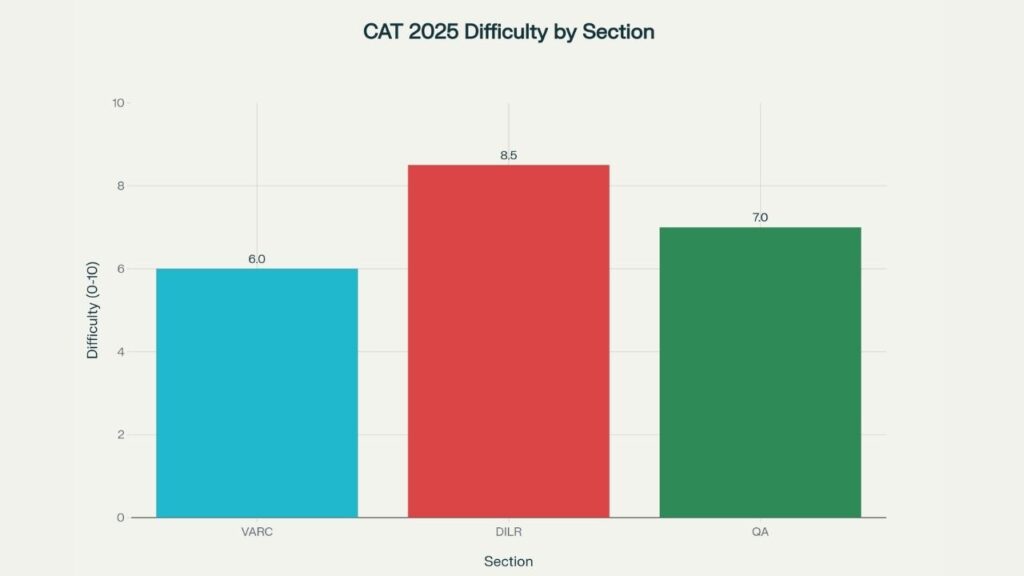
Here’s the hard truth about CAT 2025: the paper was overall a shade more challenging than CAT 2024. DILR took center stage as the villain in the storyline of this year, while VARC surprisingly ended up as the hero. QA swung to the challenging side, particularly in the afternoon and evening slots. 

SectionTotal QuestionsDifficulty LevelComparison to 2024Good AttemptsTarget Percentile
VARC24ModerateSimilar18-2085%
DILR22HighTougher8-1090%
QA22Moderate-HighSlightly Tougher12-1590%

So What Does That Mean for You and Your Prep? 

Quality trumps quantity Every bit as much as in volume matters in this area. Increased difficulty on all three positions also means as you go through the percentiles, the score ranges will be more condensed. You can’t let yourself be sloppy. Smart question selection Knowing when to skip and managing your time ruthlessly become your superpower.

CAT 2025 Section-Wise Difficulty Level Comparison

To those who are readying themselves for CAT 2026 or are giving it another shot, this is what I want you to take away — practice consistently, analyze your errors and know your weak links in each section, that is what will give you an edge. It’s not just testing what you know anymore, it’s testing how you think under pressure. 

Conclusion

CAT 2025 was a testament to how this exam is not only about knowledge of concepts but also about stamina, being flexible and taking razor-sharp decisions under pressure. VARC was somewhat relaxing, DILR was the real game changer which stretched even the best candidates to the brink. QA struck a difficult calculation-heavy balance, rewarding calm precision.

For future aspirants, the biggest take away is simple — “Accuracy is the key, build strong basics and selective solving is the art”. As long as you keep your cool, read patterns fast and fight your battles wisely in the exam, you will always be having that extra edge – Whatever way CAT chooses to dance! 

Switching Jobs? Don’t Ignore Your EPF, NPS, and Mutual Fund Investments 

Jobs

Your resignation letter is signed, the new offer is accepted, and you’re ready for switching Jobs but what happens to the EPF account and should the new company’s NPS enrollment change anything about how you’re already investing through mutual funds? Don’t Ignore your EPF, NPS and Mutual Fund which most people already are doing.

The EPF vs NPS vs mutual funds decision isn’t really one choice — it’s three separate accounts with three different rules, and a job switch is exactly the moment most people either transfer things correctly or lose track of money they’ve already earned.

What Is EPF, NPS, and Mutual Funds

EPF — 8.25% for FY 2025-26, third year running at that rate, govt-backed, EEE (contribution, interest, withdrawal all tax-free if you cross 5 years’ continuous service). Mandatory for salaried staff at covered establishments; you don’t really “choose” this one, you’re already in it.

NPS — Market-linked, mix of equity/debt/govt bonds you can allocate; extra ₹50,000 deduction under 80CCD(1B) on top of the 80C limit. At exit, minimum 40% of the corpus must go into an annuity — you don’t get the whole pot in cash, and annuity payout rates in India have historically been mediocre (5–6% range).

Mutual funds — No lock-in except ELSS (3 years); LTCG/STCG taxed, no EEE treatment. Best long-run equity return potential of the three, but zero forced discipline — nothing stops you from redeeming during a panic.

Don’t Ignore Your EPF, NPS, and Mutual Funds After Switching Job

Your EPF doesn’t “carry over” automatically. A lot of people assume EPF just follows them to the new job. It doesn’t — not unless you actually transfer it.

When you leave a company, your EPF account under that employer becomes inactive. Your new employer opens a fresh account. If you don’t link the two using your UAN (Universal Account Number), you end up with multiple EPF accounts scattered across your career. Each one earns interest for a while, but an account that stays inactive for 36 months stops earning interest altogether.

How To Set Up Your EPF Account After Job Switch

  • Use the “One Employee One EPF Account” (OEEOA) transfer request on the EPFO portal, or let your new employer initiate it.
  • Don’t withdraw your EPF just because it feels like “extra cash” during the job switch. Withdrawing before 5 years of continuous service makes it taxable, and you lose out on decades of compounding.
  • Check your UAN is correctly linked to Aadhaar and your new employer’s establishment ID — half of all transfer delays come from mismatched KYC details.

The instinct to cash out is understandable when you’re between Jobs and expenses are piling up. But EPF is one of the few instruments giving you a stable, tax-free return over the long run. Treat withdrawal as a last resort, not a bonus.

Read More 👉 Your Credit Score Ignores 90% of Your Financial Life — What Your First Credit Card Changes 

Check Your NPS Before Leaving the Company

Your NPS account isn’t tied to your employer at all. It’s tied to you, through your PRAN (Permanent Retirement Account Number). So technically, nothing needs to be “transferred.”

But there’s a catch. If your NPS contribution was happening through your employer under the corporate NPS model, that contribution stops the day you resign. Your new employer may or may not offer an NPS benefit. If they don’t, your account doesn’t close but it goes silent unless you start contributing on your own through the eNPS platform or a POP (Point of Presence).

What to check:

  • Confirm your new employer’s NPS deduction is active and linked to your existing PRAN — don’t let them create a second one by mistake.
  • If your new company doesn’t offer NPS, decide if you want to keep contributing voluntarily. Many people simply let it sit, which defeats the purpose of consistent, long-term retirement investing.
  • Update your bank and nominee details after the switch — this is the most commonly skipped step.

NPS rewards discipline more than any other retirement product because of how compounding and low fund management costs stack up over 20-30 years. A gap of even a couple of years in contributions has a real, measurable impact on your final corpus.

Mutual funds: the SIPs nobody remembers to check

Job switches usually come with a change in salary account, and that’s where mutual fund SIPs quietly break. If your SIP auto-debit was linked to your old salary account and you close that account (or stop maintaining the minimum balance), your SIP simply fails. Most people don’t notice for months — until they check their portfolio and realize three or four SIP cycles never went through.

What to do immediately after switching:

Re-link your SIP mandates to your new primary bank account, or keep enough balance in the old one until the transition is smooth.

Review your asset allocation. A new job often means a new salary, new expenses, maybe new financial goals (relocation, higher rent, a shorter or longer commute cost). Your SIP amounts should reflect your current life, not your old one.

If you got a signing bonus or relocation allowance, resist the urge to let it sit in a savings account. Even a lump sum top-up into an existing fund puts that money to work instead of losing value to inflation.

What Happens If You Neglect These Procedures

None of this is complicated. It’s just easy to postpone because nothing about it feels urgent in the middle of a job change. But delayed EPF transfers lose interest. Paused NPS contributions lose compounding years you can’t get back. Broken SIPs mean missed market cycles.

A Jobs switch is one of the few moments where you’re forced to look at your entire financial setup at once — new salary, new perks, new expenses. Use that moment. Spend one weekend afternoon logging into EPFO, checking your PRAN, and confirming your SIPs are active. It’s boring, unglamorous work. It’s also the difference between a retirement corpus that actually reflects your career and one that has quiet, unexplained gaps in it.

Your new job deserves your excitement. Your old investments deserve five minutes of your attention before you move on.

Read More 👉 Collateral vs No Collateral Loan Amount Where Collateral Starts Making Financial Sense

Conclusion

Switching Jobs is exciting but don’t ignore your EPF, NPS, and mutual funds investment as it is a chance to reset your financial checklist. Your EPF needs to be transferred, your NPS needs to stay linked to your PRAN, and your mutual fund SIPs need to keep running without interruption.

You don’t have to choose between EPF vs NPS vs mutual funds, understanding the role each plays in your long-term financial plan is important. EPF provides retirement stability, NPS adds a dedicated retirement investment option, while mutual funds offer greater flexibility and growth potential.

Scroll to Top