UIICL AO is the highest paying job for the candidates who have graduated with first division in any discipline. But the Hindi Administrative officers are required to have a masters degree from any subject. Candidates who have filled the form for United India Insurance Company Ltd recruitment must understand UIICL Administrative Officer AO syllabus, exam pattern, and preparation to secure your position.
United India Insurance Company Ltd proceeded to selection in three stages: Prelims, Mains (objective plus descriptive), and interview. Once the candidate gets selected the salary will be around 84,245 INR per month. The UIICL Administrative Officer will get a raise up to ₹4,050 every year for 14 years which approximately reaches ₹1,56,745 per month in the future years.
UIICL Administrative Officer AO Exam Pattern
Prelims:
Section
Questions
Marks
Time
English Language
30
30
20 minutes
Reasoning
35
35
20 minutes
Quantitative Aptitude
35
35
20 minutes
Total
100
100
60 minutes
Mains: Generalist AO:
Section
Questions
Marks
Time
English Language
40
50
30 minutes
Reasoning
50
60
40 minutes
Quantitative Aptitude
50
60
40 minutes
General Awareness, with Financial Sector focus
40
60
30 minutes
Computer Knowledge
20
20
10 minutes
Objective total
200
250
150 minutes
English descriptive: letter and essay
2
30
30 minutes
UIICL Administrative Officer AO Topic-Wise Syllabus
For the 30 questions of the English section, you need to focus on your grammar because there is no time for reading comprehension slowly. You need to catch errors, and improve sentences as fast as you can. Try to learn vocabulary and fillers. Everything is related to English Grammar so don’t panic.
Logical question carries 35 marks in prelims and 60 marks in Mains. get ready for prelims first and practice puzzles, syllogism, and coding-decoding which improves your capability. There are other topics like blood relations, input-output, data sufficiency, which is a little hard but gives you a good score if you solve every question right.
Quantitative covers your mathematical power which is crucial for the financial sector so prelims carry 35 marks for 35 questions from Simplification, approximation, number series. Practice these topics along with percentage, ratio and proportion, averages, profit and loss, which also comes in the Mains paper. The Mains carry more weightage, 60 marks for these topics. Aptitude also covers SI/CI, time and work, time-speed-distance, and data interpretation.
Current Affairs covers recent news from banking and insurance so keep an eye on main things while practicing for math and reasoning. Updates from RBI, IRDAI, insurance terminology, government schemes are also important because they can be asked in the exam. Questions can come from economy, budget, financial institutions, so focus on these topics as it carries 60 marks in the Mains.
The computer section in Mains covers basic knowledge of hardware and software such as MS office, networking, data bases, and cybersecurity.
Insurance and regulatory awareness should be treated as a high-priority rather than common general knowledge because the exam focuses on the financial sector more.
Preparation Strategy
Start from the hard topics first, aptitude topics need time for practice and analyzing mistakes then go to the reasoning part. Once these two hard sections can be done, you can move on to the next section: English.
Because English can secure your good score without any headache and hard practice. Once you practice reading and writing along with using correct grammar, your answers will let you score properly.
If you focus on these three sections, you can secure nearly 90 in Prelims and also prepare for the Mains. So after the Prelims you just have to practice Essay and letter in English, general knowledge, and computer basics.
You must start taking note or subscribe to a few current affairs channels on Youtube which mainly focuses on the financial sectors and economy of India. Once you prepare all of these topics, start taking mock tests. The mock test will help you analyze your mistakes and give you hands-on practice on questions so it accelerates your speed.
Remember: Avoid blind guessing: leaving a question unanswered carries no penalty, while an incorrect objective answer deducts one-fourth of its assigned marks.
Conclusion
Check the official website for the recruitment of UIICL Administrative Officer and download the notification for eligibility, selection process, dates to follow up and much more. You can check the UIICL Administrative Officer AO syllabus, exam pattern, and preparation here to understand where to start for the preparation of UIICL Administrative Officer exam.
Almost 2 lakh nervous students are going to throng into exam centres across the country, their heartbeats racing for one of the most competitive entrance exams in India. The CAT 2025 Exam Analysis was held on November 30, 2025 in three slots. It was more difficult than last year and some parts were a lot harder. Let’s understand what exactly made these sections tick and why DILR turned out to be the section that had aspirants sweating bullets.
VARC: The Surprisingly Approachable Section
Starting with the section which allowed students a fighting chance—Verbal Ability and Reading Comprehension came in at 24 questions to be answered in 40 minutes. Here’s what made VARC the relative breeze compared to the others. The section continued the following pattern: 4 RC passages (reading comprehension question) with 16 questions, and 8 Verbal Ability questions based on parajumbles, para-summaries, and odd sentences out.
What took many students by surprise was that although VARC had a few tough passages, it was more-or-less the same as last year’s CAT. One highlight was a tract on the ill effects of dams that proved to be amperable, while tracts on AI ethics and The Forest Act 1982 presented mild difficulties with knotty questions and extended options.
No Rule-Breaking Surprises in the distribution of topics (or in the format). For those students planning to go for a decent percentile, somewhere close to 18-20 correct attempts out of 24 can easily take you till 85 percentile.
DILR: The Monster Everyone Feared
Now, let’s talk about the elephant in the room — DILR or as many started calling it, “the nightmare section.” With 22 questions distributed in five sets, this section turned out to be the toughest part of CAT 2025. DILR was reportedly “much harder” than the previous year, according to candidates across all three sessions.
There were about 11 Data Interpretation and 11 Logical Reasoning questions, and about 11–12 questions were to be Type In The Answer (TITA). But here’s the real kicker: DI sets were moderately solvable, LR sets were much more demanding in terms of analytical thinking and puzzle solving skills. One set on a pollution index using weighted averages left many candidates baffled, while simpler sets such as the Spider + Bar graph gave some relief.
The psychological effect was true. Students observed that in this section, smart question choice became an absolute must. 8–10 good questions with high accuracy was the realistic target to get 90 percentile, as against that year it might have been the need of similar accuracy in 10–12 questions. This was the part that really tested not only what you know, but how you prioritize when you’re under fire.
QA: Deceptively Moderate but Tricky
Quant may be described by experts as “medium-difficult having a flavor of difficulty and toughness. With 22 questions from the areas of Arithmetic (8), Algebra (5), Geometry (3), Modern Math (4), and Numbers (2), the pattern was pretty much the same. But this is where CAT 2025 surprised many aspirants—each question appeared doable, but a large number of them required multi-step thinking and fast computations while under heavy time pressure.
Geometry questions, though easier, could be answered quickly, but the other portions were more calculation-intensive and tested not only your speed but your accuracy. To score well, answering 12-15 questions correctly appeared to be the magic number, with somewhere around 13-14 potentially pushing you towards the 90 percentile.
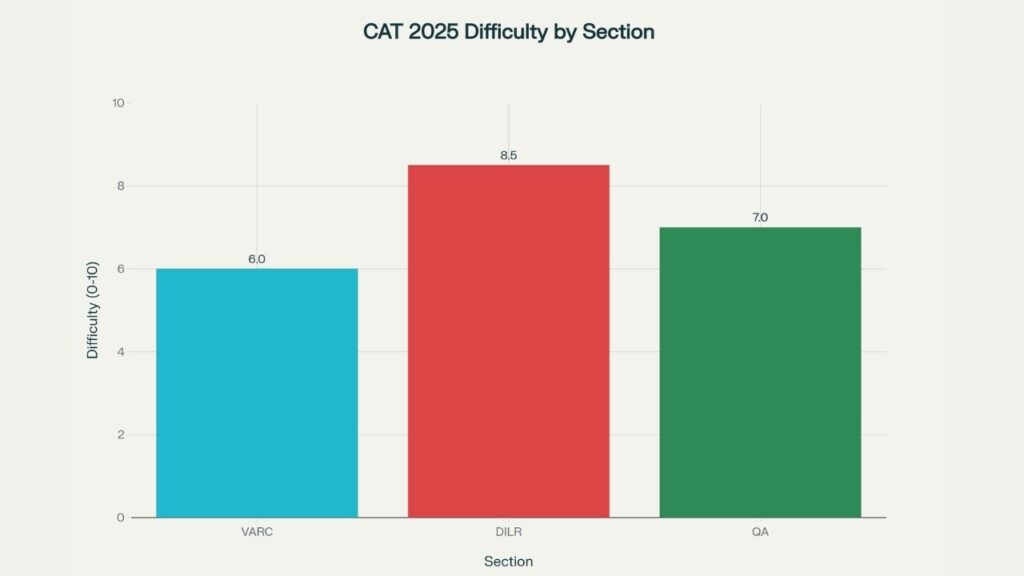
Here’s the hard truth about CAT 2025: the paper was overall a shade more challenging than CAT 2024. DILR took center stage as the villain in the storyline of this year, while VARC surprisingly ended up as the hero. QA swung to the challenging side, particularly in the afternoon and evening slots.
Section
Total Questions
Difficulty Level
Comparison to 2024
Good Attempts
Target Percentile
VARC
24
Moderate
Similar
18-20
85%
DILR
22
High
Tougher
8-10
90%
QA
22
Moderate-High
Slightly Tougher
12-15
90%
So What Does That Mean for You and Your Prep?
Quality trumps quantity Every bit as much as in volume matters in this area. Increased difficulty on all three positions also means as you go through the percentiles, the score ranges will be more condensed. You can’t let yourself be sloppy. Smart question selection Knowing when to skip and managing your time ruthlessly become your superpower.
CAT 2025 Section-Wise Difficulty Level Comparison
To those who are readying themselves for CAT 2026 or are giving it another shot, this is what I want you to take away — practice consistently, analyze your errors and know your weak links in each section, that is what will give you an edge. It’s not just testing what you know anymore, it’s testing how you think under pressure.
Conclusion
CAT 2025 was a testament to how this exam is not only about knowledge of concepts but also about stamina, being flexible and taking razor-sharp decisions under pressure. VARC was somewhat relaxing, DILR was the real game changer which stretched even the best candidates to the brink. QA struck a difficult calculation-heavy balance, rewarding calm precision.
For future aspirants, the biggest take away is simple — “Accuracy is the key, build strong basics and selective solving is the art”. As long as you keep your cool, read patterns fast and fight your battles wisely in the exam, you will always be having that extra edge – Whatever way CAT chooses to dance!
Distance Education offers a degree without attending regular classes which makes it easier for students who are working professionals, homemakers or living abroad. Sometimes it’s hard to keep your study going with any of these circumstances, so Distance Learning is the best option to learn and grow in your interested career. But you must understand it properly before applying for it.
In this guide, we’ll learn about distance education, is it meaningful or not, which programs are worth your time, and where it can take your career.
What Is Distance Education?
Distance education is a different way of learning the same curriculum as in regular studies. In this mode, you must become responsible for your studies and exams because nobody is going to push you or motivate you for it. Students and Instructors are physically separated from each other but connected through online groups. All the lecture videos, study material, and exams conducted on a digital platform in Distance education.
This concept was practiced back in the days when universities began offering correspondence courses through postal mail. But everything becomes so quick and easy by accessing the internet. Now, distance education is backed by the government and offered undergraduate, postgraduate, diploma, and certificate.
“Distance education is not about removing the classroom — it’s about removing the barriers that stop people from entering one.”
Distance Education vs. Online Education
Some people think these are the same but both have differences. Distance Education is a bigger level learning concept which includes proper online classes, various courses, and hybrid modes.
Meanwhile, Online education is free and paid both, but it delivers lessons online only live or pre-recorded lectures.
In India, institutions like IGNOU offer recognised distance education degrees that are accepted the same as regular university degrees for most government and private sector jobs.
How Does Distance Education Work?
At its core, attendance won’t matter so you can study in your free time. You must know how typical distance education journey works:
Enrollment & Study Material
Students enroll online or through physical study centres. After admission, they receive study material access with downloadable PDFs and e-books. The material is designed in a way that anyone can understand easily and learn independently, without a teacher explaining every concept in real time.
Learning Platforms & Digital Tools
Most modern distance education programs now use a Learning Management System (LMS) — platforms like Moodle, Blackboard, or custom university portals. These platforms host video lectures, assignment portals, notice boards, and sometimes even live sessions with faculty.
Assignments & Exams
Students submit regular assignments and Term End Examinations online or designated exam centres. Online proctored exams are also available in many courses which allow students to complete from anywhere.
Contact Sessions & Study Centres
Some programs include optional or mandatory contact sessions — short workshops or doubt-clearing sessions held at study centres. These are especially helpful for subjects requiring practical training or face-to-face interaction.
There are many benefits for students who take a distance education degree when it’s hard to get a regular one. This is a smart choice for millions of students:
Flexibility in Schedule: Open study material and start studying at your own free time. No need to rush for 8’o clock class.
More Affordable: Regular degrees are more expensive than Distance degrees. No hostel fees, no transport costs, fewer hidden expenses.
Access from Anywhere: Many top universities offer distance courses which are valuable in your career. And it can be accessible from anywhere.
Work While You Study: The biggest benefit of distance learning is that working professionals can earn a degree without quitting their jobs.
Wide Course Selection: From graduation in B.Com to Masters inMBA, there are hundreds of programs are now available in distance mode.
Recognised Degrees: UGC-approved distance degrees are recognised by employers, government bodies, and higher education institutions.
Benefits for Working Professionals
One of the biggest wins of distance education is for people already in the workforce. People who want to level up their position in a multinational company or government sector, they need a masters degree but can’t leave their jobs. So, Distance Education offers them a chance to upskill themselves in their profession. To switch industries, or add a specialisation — all while holding down a full-time job.
Life doesn’t always follow a straight academic path. Whether you had to pause your education due to family responsibilities, financial constraints, or health — distance education gives you a genuine second chance. There’s no age bar in most programs, no pressure of daily attendance, and no commute to manage.
Distance Learning Programs Available in India
The variety of programs available through distance education has expanded dramatically. You’re no longer limited to a handful of arts and commerce degrees.
Program
Duration
Popular Courses
Level
Bachelor’s Degree (BA/B.Com/BCA)
3 Years
BA English, B.Com, BCA, BA Sociology
UG
Master’s Degree (MA/MBA/MCA)
2 Years
MBA, MA Psychology, MCA, MSc IT
PG
B.Ed / M.Ed
2 Years
Bachelor & Master of Education
Professional
Diploma Programs
6–12 Months
Journalism, Event Mgmt, HR, Nutrition
Diploma
Certificate Courses
3–6 Months
Cyber Security, Digital Marketing, TEFL
Certificate
Ph.D. / Research Programs
3–5 Years
Management, Humanities, Social Sciences
Doctoral
Top Institutions Offering Distance Education
Choose the right institution for your distance degree because recognition of the institution matters a great deal. The most trusted universities are:
IGNOU (Indira Gandhi National Open University) — First and prestigious university in India which offers more that 200 distance programs in different streams.
Annamalai University — This one is the oldest but private open university, its degrees hold real values.
Symbiosis Centre for Distance Learning (SCDL) — Known for top-tier MBA and business programs.
Osmania University Distance Learning — A strong option for South Indian students seeking commerce and science degrees.
NMIMS Global Access — Highly regarded for MBA and management programs in the private sector.
Always verify that the institution is approved by UGC-DEB (University Grants Commission – Distance Education Bureau) before enrolling. This ensures your degree is legally recognised.
Career Opportunities in Distance Education
Distance degree will help you in almost every sector:
Corporate Sector & Management Roles
A distance MBA from a recognised university allows the applicant to apply for various roles such as HR, marketing, operations and finance in the corporate world. Many organizations do not differentiate between full-time and distance learning MBA graduates for mid and senior level positions.
Teaching & Academic Careers
A B.Ed or M.Ed distance education course is the requisite qualification to be able to teach in schools. Along with UGC-NET, distance PG programmes can also lead you to the posts of college lectureship.
Government & Public Sector Jobs
Government recruitment boards such as SSC, UPSC, and state PSCs, accept degrees earned through distance education from recognised universities. Your distance degree is as valid as any regular degree for these exams.
IT & Technology Careers
BCA, MCA, and B.Sc IT through distance mode are popular routes into the tech industry. Many software companies hire on the basis of skill and certification portfolios, making a distance IT degree a perfectly valid entry point.
Media, Journalism & Communication
In this fast paced digital world, skills matter more than degree. So, distance programs are a good choice for candidates who want to join mass communication, journalism, and public relations. Even skilled students can take a degree while working in PR agencies, digital marketing firms, and content creation for switching to other companies.
Freelancing & Entrepreneurship
Distance education is ideal for graphic design, digital marketing, content writing, and event management jobs as it provides a certificate to add value in your resume for getting freelance work and launching small businesses.
Social Work & NGO Sector
MSW (Master of Social Work) and related degrees offered through distance mode prepare students for roles in NGOs, community development, government welfare departments, and international organisations like UNICEF.
Distance education gives you freedom — but with freedom comes the responsibility of self-discipline. Here’s what actually works:
Set a Fixed Study Schedule: Take your time for studies daily and stick to it. Even two focused hours a day will take you far over a semester.
Don’t Wait for the Last Minute: Don’t wait for the exam dates, stay consistent and complete your entirestudy material until exams are around the corner. Break your syllabus into monthly and weekly targets from day one.
Use Online Communities: Join other students online through college groups for exchanging notes and guidance.You’ll find past papers, important updates, and peers who are going through the same journey.
Take Advantage of Contact Sessions: Some programs offer saturday and sunday classes, go and join if you are free or through an online platform. Clear your doubts and seek opportunities.
Supplement with Online Courses: Platforms like Coursera, Simplilearn, and Swayam offer free courses that perfectly complement most distance education syllabuses. Pairing your degree with relevant certifications makes your profile significantly stronger in the job market.
Conclusion
Distance education is no longer a Plan B. For millions of students such as working professionals, homemakers, students in remote towns, and people switching careers — it is the most practical, accessible, and respectful route toward a degree and a brighter future.
The world is changing rapidly. Skills are more important than ever and the good news is that you don’t have to be in the right city or have the right amount of time to access “high-quality” education anymore. Distance learning has flung those doors wide, you just have to walk through them.
Good news for job seekers in India! The Railway Recruitment Board (RRB) has released RRB Group D Recruitment 2026 notification with approximately 22000 Level-1 posts. This drive, for CEN 09/2025 will fill posts of Track Maintainer, Assistant (Workshop), Pointsman and the like and is suited for 10th-pass youngsters aspiring for handsome coach packets jobs in railways.
Key Dates at a Glance
Short Notification
19/Jan/2026
Online Registration Start
31/Jan/2026
Application Deadline
02/March/2026
Detailed Notification
Update Soon
Application Fee For RRB Group D Recruitment
General/OBC/EWS : Rs. 500 per person
Female/SC/ST/PWD : Rs. 250/-
Eligibility Essentials For RRB Group D Recruitment 2026
Candidates who have 10th pass (or ITI from NCVT/SCVT for certain posts) are qualified to apply for this job. Age must be above 18 and below 33 years (relaxation for SC/ST/OBC). No degree required, so it’s open to millions. Physical health and rudimentary abilities are important also.
Criterion
Requirement
Education
10th Pass / ITI
Age Limit
18-33 years
Nationality
Indian Citizen
Age relaxation is provided for reserved category
Selection Process Breakdown
The procedure of selection is conducted in phases: at the beginning, a Computer-Based Test (CBT) includes the subjects Mathematics, General Awareness, Science, and Reasoning (100 questions within 90 minutes).
Then, there is a Physical Efficiency Test (PET), consisting of running and lifting, among other things. This is followed up by Document Verification and Medical Examination.
Aspirants are shortlisted in accordance with merit, so begin your preparations for the PET right away.
Salary and Perks
Get the job and enjoy Level-1 pay: Basic 18,000 + DA, HRA, TA – take-home 22,000-25,000 a month. Throw in job security, pensions, free travel and prospects for advancement.
Follow These Steps To Apply
Go to Official Website via direct Link given in the below section
Under the ‘Notices’, click on the Railway Recruitment 2026 and find registration form
Once the link will be active to the application portal, you can fill up your details and submit.
While submitting it requires you to pay the amount and print out the offline copy of the application.