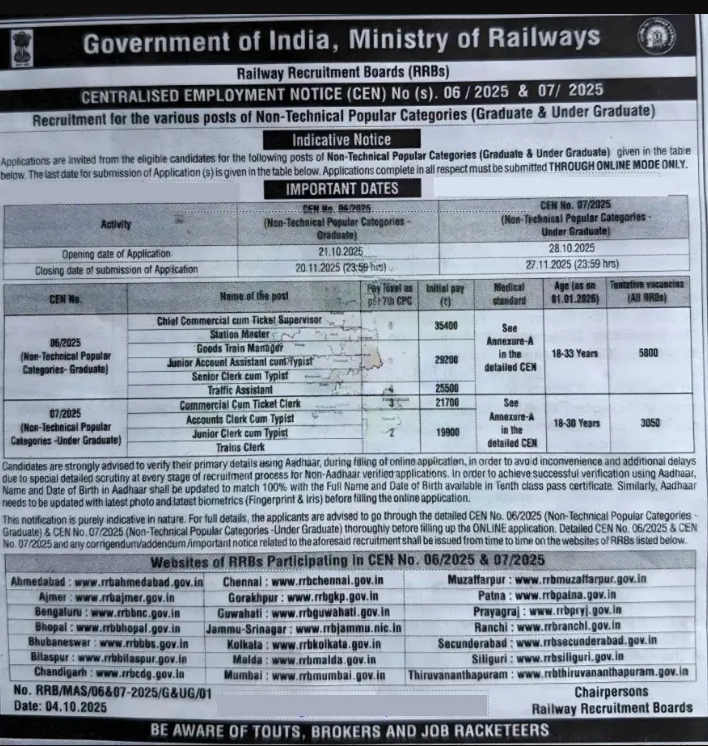
Railway Recruitment Board announced about the NTPC recruitment drive for the interested candidates who are waiting to apply for Railway jobs. RRB posted on the official website about the recruitment drive for the posts of Station Master, Goods Train Manager, Traffic Assistant, Senior Clerk cum Typist, and more. There are 5810 vacancies out there, and the online application process commences on October 21, 2025 and deadlines for submissions are November 20, 2025. Interested candidates can see the full notice for eligibility rules, fees, age limits, pay info, and how the selection works. Graduates who want jobs in railways should barge at this.
Railway Recruitment Boards (RRB), indianrailways.gov.in has issued notification for the job vacancies for RRB Isolated Categories Recruitment 2026 now available. The recruitment is being conducted for a total of 311 vacancies for various posts such as Senior Publicity Inspector, Lab Assistant Grade III (Chemist & Metallurgist), Chief Law Assistant, Junior Translator (Hindi), Staff & Welfare Inspector, Public Prosecutor, and Scientific Assistant/Training.
The RRB CEN 08/2025 – RRB Isolated Categories Recruitment 2026 Application submission has started for this RRB vacancy online from 30/December/2025 to 29/January/2026. Interested and eligible candidates may apply online through the official RRB website.
Candidates are requested to read the full notification very carefully to clear all the essential facts of eligibility criteria, Fee, Age Limit, Salary, Selection process and other important instructions. Here is the direct link to apply online for the RRB Isolated Categories Recruitment 2026 along with detailed information.
Graduation with a diploma in Public Relations, Advertising, Journalism or Mass Communication from a recognized University/Institute.
Lab Assistant Grade III (Chemist/Metallurgist)
39
12th passed with Physics & Chemistry from a recognized board.
Chief Law Assistant
22
Bachelor’s in Law + 3 years practice as a leader at Bar from recognized university.
Junior Translator (Hindi)
202
Master’s in Hindi/English + Diploma/Certificate in Translation from recognized university.
Staff and Welfare Inspector
24
Bachelor’s + Diploma in Labour/Social Welfare/Labour Laws/LLB (Labour Laws)/PG in Personnel Mgmt/MBA(HR)/PG in HRM from recognized institutions.
Public Prosecutor
7
Bachelor’s in Law + 5 years practice as advocate at Bar from recognized university.
Scientific Assistant/Training
2
Master’s in Psychology from a recognized university.
Salary Scale For RRB Isolated Categories Recruitment 2026
The base Salary starts at Rs. 19,900/- then it can go higher up to Rs. 44,900/- per month according to the post. So, candidates can now hurry to fill the application for this golden opportunity.
Follow These Steps to Apply Online for RRB Isolated Categories Recruitment 2026
Read the Notification: Download the RRB Isolated Categories Notification 2026 (PDF) and read it thoroughly to have the eligibility criteria.
Visit the Official Website: Indian Railways Recruitment 2023 Apply Online at indianrailways.gov.in
Fill the Application Form: Fill in the application form with as your personal, educational and contact details in an accurate manner.
Upload Documents: In the specified format, upload the necessary papers including photos and signatures.
Pay the Application Fee: Pay the application fee using any of the supported online payment methods.
Submit & Print: Before submitting the application form, check it thoroughly, submit it and then take a printout of the application form for the record.
The Railway Recruitment Board announced RRB JE vacancy count which is 3,993 posts, spread across Junior Engineer, Depot Material Superintendent, and Chemical & Metallurgical Assistant roles. The RRB JE Notification was released on August 13 with important dates, eligibility, vacancy figure, exam pattern and salary.
RRB JE Vacancy 2026: Post-Wise and Category-Wise Breakup
The 3,993 vacancies cover four engineering streams — Civil, Mechanical, Electrical, and Signal & Telecom along with the DMS and CMA posts. That’s a real jump from the previous cycle, which had closed at 2,588 vacancies, so this is one of the larger JE drives in recent years.
Category-wise, the RRB JE Vacancy split works out to 1,699 for Unreserved, 913 for OBC, 624 for SC, 394 forEWS, and 363 for ST candidates. Zone-wise, Kolkata leads the pack with 457 posts, followed by Mumbai at 411 and Chennai at 362 — useful to know if you’re weighing zone preference during the application, since your posting zone affects both competition and your eventual place of work.
Dates You Actually Need to Track
Event
Date & Time
Short notice released
21/July/2026
Detailed notification out
13/August/2026
Online application window opens
14/August/2026
Last date to apply
13/September/2026 (11:59 PM)
Correction window
Opens after the application period closes (exact dates to be notified)
Eligibility For Students to Apply
The age bracket is 18 to 33 years, calculated as on January 1, 2027 — not the application date, which trips up a lot of candidates who calculate their age wrong and either apply thinking they’re ineligible or, worse, apply thinking they qualify when they don’t. Reserved category candidates get the usual RRB age relaxation on top of this.
On qualification, you need a Diploma or a B.Tech/BE degree in the relevant engineering discipline — Civil, Mechanical, Electrical, or Electronics/IT, depending on which post you’re targeting. If your degree doesn’t map cleanly onto one of the notified branches, it’s worth checking the equivalence list in the detailed PDF before you pay the fee, not after.
How Will You Get Selected For RRB JE in 2026?
RRB JE recruitment runs through four stages. CBT-1 is common to everyone regardless of discipline — 100 questions in 90 minutes, covering general awareness, mathematics, general intelligence, and general science.
Clear that, and you move to CBT-2, which is discipline-specific: 150 questions in 120 minutes, including a technical abilities section tied to your branch, with an on-screen virtual calculator provided during the exam.
Both stages carry negative marking of one-third mark per wrong answer, so guessing blind isn’t free.
Category
Qualifying %
Equivalent marks (out of 100)
PwBD relaxation
UR
40%
40
−2 marks (i.e., 38) where applicable
EWS
40%
40
−2 marks (i.e., 38) where applicable
OBC-NCL
30%
30
−2 marks (i.e., 28) where applicable
SC
30%
30
−2 marks (i.e., 28) where applicable
ST
25%
25
−2 marks (i.e., 23) where applicable
After CBT-2, it’s document verification followed by a medical exam — and only your CBT-2 score determines the final merit list, CBT-1 is purely a screening round.
Candidates who got the place in RRB JE Vacancy are going to earn around ₹35,400 under Pay Level 6 of the 7th CPCwhich increases with candidates experience up to ₹1,12,400. The In-hand salary lands somewhere in the₹40,000–₹50,000 range per month, although the exact amount can vary based on the place of posting and applicable deductions.
On the application fee, the short notice confirms that candidates who appear for CBT-1 get a refund minus applicable bank charges, but the exact fee amount for this cycle isn’t listed in what RRB has published so far — check the fee section of the detailed CEN PDF directly before you pay, rather than going by last cycle’s number.
Where To Start Preparing Yourself For RRB JE Exam
Start with CBT-1 prep, not CBT-2. Since CBT-1 is the common gate for every discipline, the candidates who clear it fastest are usually the ones who treat general awareness and reasoning as seriously as their core engineering subjects, instead of saving all their time for the technical paper. You can branch into discipline-specific CBT-2 prep once CBT-1 is behind you — trying to do both at once from day one is how most aspirants burn out before September even arrives.
Apply through rrbapply.gov.in, and keep your documents, especially your diploma/degree certificates and category proof — scanned and ready before you sit down to fill the form. The application window is open now; there’s no reason to wait on this one.
How to Apply for RRB JE Vacancy 2026
The entire process runs on the RRB Official Website, and it starts with One-Time Registration (OTR). If you’ve never applied to an RRB CEN before, you’ll need to complete OTR first: enter your basic details, mobile number, and email ID, then verify both through OTP before you get a registration ID and password. If you already hold valid OTR credentials from an earlier RRB cycle, you can skip straight to login.
Once you’re in, go to the “Apply” section, select CEN 04/2026 – JE/DMS from the list of active notifications, and choose your preferred post, discipline, exam language, and RRB zone. Zone choice matters more than people think — it affects both how competitive your slot is and where you could end up posted, so don’t just pick your home state by default without checking that zone’s vacancy count against the others.
From there, fill in your educational and personal details carefully, upload your photograph, signature, and category or PwBD certificate where applicable, and move to fee payment. JE cycle charged ₹500 for General/OBC/EWS candidates, with ₹400 refunded after CBT-1 appearance, and a lower, fully refundable fee for SC/ST, women, Ex-servicemen, and PwBD candidates — treat that as a reference point, not a confirmed number, and check the fee section of the detailed PDF before you pay.
Review every field before hitting submit — RRB doesn’t allow changes to most details after the correction window closes, and errors in category, post preference, or documents can cost you the entire cycle. Once submitted, download and save the confirmation page. And don’t leave this for September 12: the portal slows down badly in the final 48 hours of every RRB cycle, and a payment that fails at 11:58 PM on the last date isn’t RRB’s problem to fix.
The RRB JE Notification is out, the number of RRB JE Vacancy is 3,993, and the application window is open right now — the uncertainty phase of this cycle is over, and what’s left is execution.
The CBT-1 date hasn’t been announced yet, which actually works in your favor if you use the gap between now and September 13 to get your OTR done, your documents scanned, and your CBT-1 prep started, instead of waiting for the exam date to create urgency for you.
Railway Recruitment Board updates the answer key for non-technical popular categories (NTPC) exam held from June 5-24, 2025, on their official website. Students who are waiting for the answer key can download from the direct link mentioned in the article. Candidates can raise the objections for the answers with proof until 6/July/2025. The charge for objection is Rs. 50 per question.
There are various posts under the RRB NTPC 2025 to open for undergraduate students who appeared in the exam. If you want to learn more about RRB NTPC exam details, a link is provided in the article below to download the official notification.
Highlight For The RRB NTPC 2025
Exam
RRB NTPC
Posts
Chief Commercial Ticket Supervisor, Station Master, Good Train Manager, Junior Account Assistant, Senior Clerk
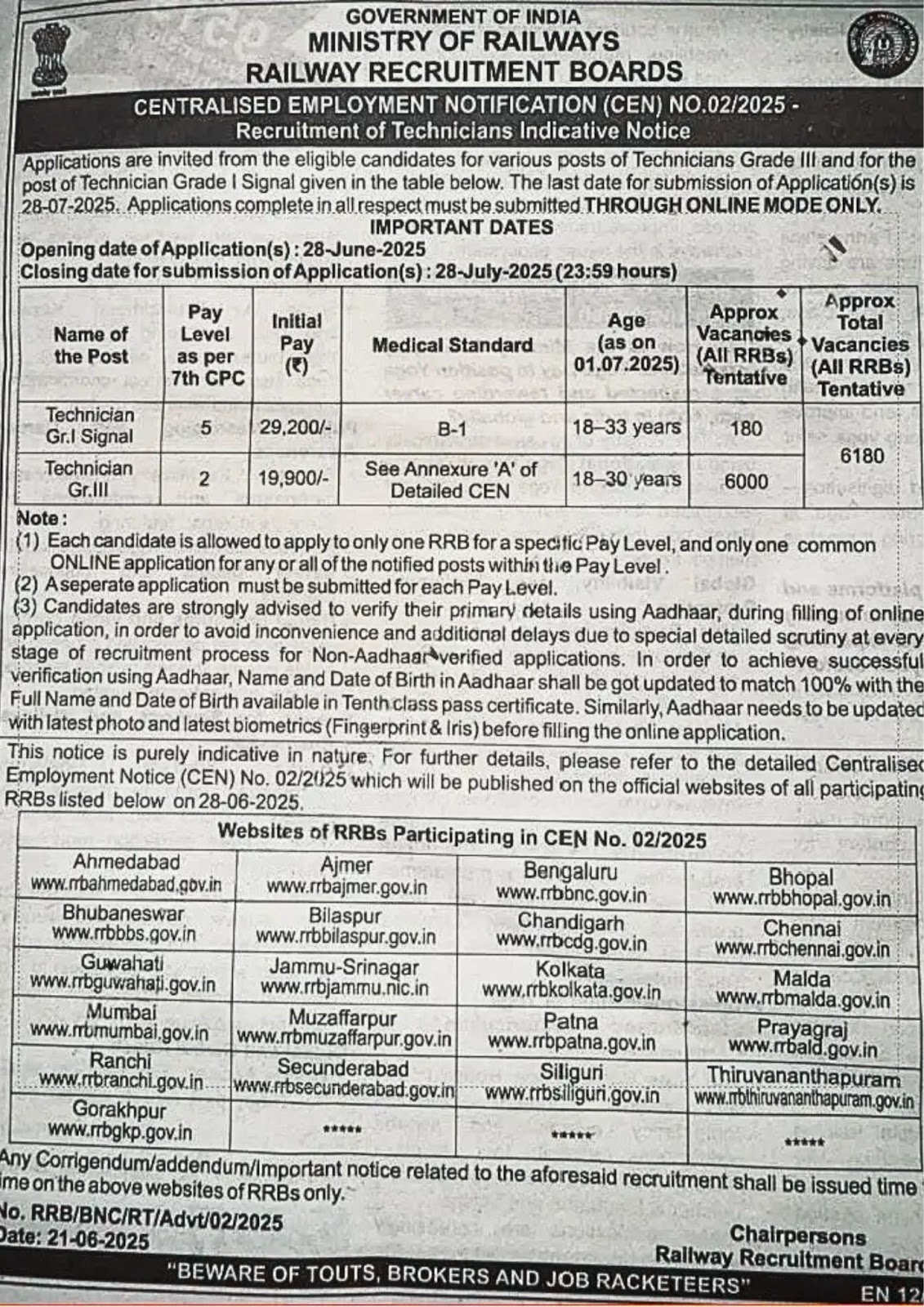
RRB Technician Notification 2025: If you’re waiting for the railway job vacancy then the wait is over as the RRB Technician Notification has been released now. If you’re interested in a technical job posting in the railway sector, you can apply now. Online application starts from 28 June, candidates should fill the form before 28 July 2025. There are a total of 6180 posts for the technician Grade-I & Grade-III.
The short notice for railway recruitment has been released. You can check the notification for the Grade–1 & Grade–3 Technician posts. Candidates who have been waiting should now prepare for the examination because the online application will start soon. The competition is high so you must prepare well to beat the process and get selected.
RRB Technician Key Dates
Notification date
June-2025
Application starts
28-June-2025
Application ends
28-July-2025
Fee submission last date
28 July 2025
Admit Card
Updated Soon
Exam Date
Updated Soon
Eligibility for RRB Technician Post
Grade–1 Technician
BE/B.Tech in Engineering, Diploma Or Equivalent
B.Sc in engineering Or equivalent
Grade–3 Technician
10th Passed + ITI
Equivalent or diploma
For more Detailed Information Download the Notification
Category
Age Limit
Grade–1
18–33 years
Grade–3
18–30 years
Salary for RRB Technician 2025
Salary for Grade–1
Rs. 52,297 – Rs. 46,457
Salary for Grade–3
Rs. 35,654 – Rs. 31,674
Selection Process for the RRB Technician 2025
The Railway recruitment board will start the application form on 28-June-2025. The registered candidate will have to attempt the written examination online. The shortlisted candidates will be selected for further process of document verification and medical examination. The process is a gateway to the post so candidates must pass through this. Candidates must have passed all three stages only then their name will come on the final selection List.
RRB RPF New Vacancy Notification 2026 is still not released yet but it will come soon. Candidates who wanted to apply for RPF Constable post should check the official website for the official notification regularly to not miss the details and date for application form. 8000+ vacancies are expected to be released in this recruitment drive.
But before applying for this post, interested candidates must know every detail from educational qualification to selection process. Understanding these details will help you prepare to crack the examination and secure your position.
Major Change For RPF Constable Recruitment 2026
Railway Recruitment Board (RRB) was conducting RPF Constable recruitment for years but now the conducting is changed. The examination taken under the Staff Selection Commission (SSC) authorities.
RRB RPF Constable 2026 Breakdown
Job Profile & Duties
Maintaining law and order on the train and railway station to keep the passengers and railway employees safe. There’s different types of violent people — thieves, killers, attackers and keeping the normal public safe from them is RRB RPF Constable duty.
Not only people, but the system also should work smoothly without interruption, collecting information, and tracking railway security issues also comes under RPF Constable responsibility.
This is not a 9 to 5 scheduled job, it’s a field job with an attentive mind. Controlling and maintaining the most crowded place in India is not that easy. Whether you are on the patrolling duty on the station or responding to emergencies, you will face new challenges everyday.
Eligibility Criteria
Criteria
Details
Nationality
Indian Citizen
Education
10th Pass / Matriculation from a recognized board
Age Limit (General)
18 to 25 years
Age Relaxation Category-Wise
Category
Age relaxation
SC / ST
5 years
OBC-NCL
3 years
Ex-servicemen
Service period deducted, plus relaxation as per category rules
Widowed OR divorced women
2 years for UR/EWS, 5 years for OBC-NCL, 7 years for SC/ST
Central govt employees with 3 years regular service / J&K domicile special case
5 years for UR/EWS, 8 years for OBC-NCL, 10 years for SC/ST
Physical standards
Category
Male height
Female height
Male chest
UR / OBC
165 cm
157 cm
80 cm unexpanded, 85 cm expanded
SC / ST
160 cm
152 cm
80 cm unexpanded, 85 cm expanded
Exam Pattern (CBT)
You have to finish the 120 questions that come from Arithmetic, Reasoning, & General Awareness within a given time. Practice mock tests daily to maintain your accuracy and speed for finishing the paper in 90 minutes. But your answer must be accurate because if not, 1/3rd marks is going to be deducted for each wrong answer.
Subject
Questions
Marks
General Awareness
50
50
Arithmetic
35
35
General Intelligence & Reasoning
35
35
Total
120
120
PET pattern
PET includes sports in which your body endurance will be measured like 1600 m run for men and 800 m run for women. The exam is not hard if you practice daily for 1 hour, the exam also consists of high jump and long jump.
Task
Male
Female
Run
1600m in 5 min 45 sec
800m in 3 min 40 sec
Long Jump
14 feet
9 feet
High Jump
4 feet
3 feet
Selection Process
This is not a single-stage process, the selection process for RPF Constable 2026 has three stages to pass by the candidates.
First stage: Computer Based Test in which your knowledge is tested through an exam. The questions come at 10th class difficulty level from Math, General Knowledge, and Logical.
Second stage: You will be called for the second stage if you clear out the first stage with a good score. Candidates get only one chance to clear the PET & PMT.
Third stage: After passing these two stages, shortlisted candidates based on merit are called for document verification.
After DV, candidates
RPF Constable 2026 Application Process
RPF Constable 2026 application will be available on the official site of RRB or SSC soon.
Visit the site and register yourself.
Remember that credentials to login again and fill the form.
Education qualification, personal details, and ID document will be uploaded along with the application in which you have filled these details.
Continue to submit with the requisite amount of fee then download the application form for proof.
RPF Constable Salary & Allowances
RPF Constable Salary is under Level 3 of the 7th CPC, so the basic pay is ₹21,700 per month which increases additional allowances such as DA, HRA, and Transport Allowance.
City Class
Monthly In-Hand Salary
Class X (Metro — Delhi, Mumbai, Kolkata)
~ Rs. 39,000
Class Y (Mid-size cities)
~ Rs.37,420
Class Z (Small towns/villages)
~ Rs. 32,766
RPF Constable Career Growth & Promotions
Candidates who are in the Constable position can get a senior role as Head Constable then apply for Assistant Sub-Inspector (ASI) through departmental examination but most of the constables get promoted after years of experience.
The highest positions are Sub-Inspector (SI) and Inspector where your salary also increases and you get other perks but overall responsibilities are also increased as of the senior post.
Candidates not getting immediate promotion like in the private sector but they will get promoted based on their years of service, qualifying departmental exams, and Consistent performance appraisal.
Constable get their salary increases over time after 3 or 5 years on the same service. They also provide continued training to polish your skills.
RRB RPF Constable 2026 is an excellent opportunity for candidates who want to build their career in the government sector and have a bright future along with providing respect and security in their life. From safeguarding railway passengers to ensuring law and order within one of the world’s biggest railway systems, the position carries a big responsibility and pride.
RRB RPF New Vacancy Notification 2026 will be released soon by RRB for recruitment of Male and Female candidates. Now you must aware about the RRB RPF exam pattern which includes different stages exam pattern to complete analysis of the examination. With proper guidance and determination, getting selected as an RPF Constable can be a stepping stone to a flourishing career in railway security.