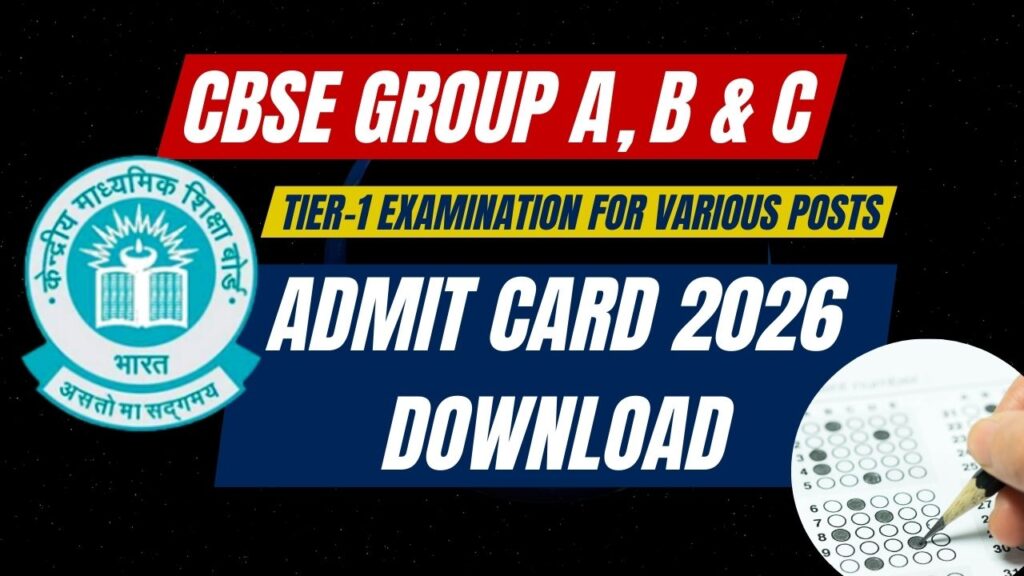
CBSE Group A, B & C Admit Card 2026 Download Link, Exam Date

CBSE Group A, B & C Admit Card

Central Board of Secondary Education (CBSE) is going to hold the Group A, B & C Tier-1 examination for various posts including Racing Officer, Assistant Secretary, Assistant Director, Accounts Officer, Junior Translation Officer, Junior Accountant, Junior Assistant, Assistant Professor and Superintendent. From 31 January 2026 To 01 February 2026. Candidates who will qualify the examination will be recruited for these posts as per the final result to be declared by CBSE. 

In December 2025, the application form was filled and candidates who are waiting for the exams can now check their admit card. If the link is still not open then check again after a few hours on the official website of cbse.nic.in

To download these, candidates will need the Application Number and Date of Birth. And no need to carry the exam hall ticket after downloading it for the exam. 

CBSE Group A, B & C Important Dates

EventDate
Notification Date02/December/2025
Application Start02/December/2025
Apply Online Last Date27/December/2025 (Extended)
Fee Payment Date27/December/2025
Correction Date29 & 30/December/2025
Exam City Date (Tier-1)17/January/2026
Admit Card Date (Tier-1)Before Exam
Exam Date (Tier-1)31/January/2026 to 01/February/2026
Result DateNotify Later

CBSE Group A, B & C Recruitment – Age Limit

CriteriaDetails
Minimum Age18 Years
Maximum Age27 / 30 / 35 Years (Post-wise)
NoteFor detailed age relaxation rules, read the official CBSE Notification 2025

Group A Posts – Vacancy & Eligibility

Post NameVacanciesStudy
Assistant Secretary08Undergraduate Required
Assistant Professor & AD (Academics)12PG Degree (55% marks) or equivalent from a recognised university (category-wise relaxation applicable)
Assistant Professor & AD (Training)08PG Degree or equivalent from a recognised university
Assistant Professor & AD (Skill Education)07PG Degree or equivalent from a recognised university
Accounts Officer02Graduate/postgraduate in Economics, Commerce, Accounts, Finance, Business Studies or Cost Accounting or any other professional qualification like MBA (Finance), CA, ICWA. 

Group B Posts – Vacancy & Eligibility

Post NameVacanciesStudy
Superintendent27Bachelor’s degree in any discipline having basic knowledge of computer and typing speed 35 WPM in English or 30 WPM in Hindi. 
Junior Translation Officer09PG Degree in Hindi or English or equivalent

Group C Posts – Vacancy & Eligibility

Post NameVacanciesStudy
Junior Accountant16Intermediate Marksheet; Necessary Subjects including Accountancy / Commerce / Economics / Business Studies / Finance with good typing speed
Junior Assistant35Intermediate Marksheet; speed of typing should be 35 WPM in English or 30 in WPM in Hindi. 
CategoryGroup A PostsGroup B & C Posts
Gen / OBC / EWS₹1750/-₹1050/-
SC / ST / ESM / PH / All Female₹250/-₹250/-
Total Posts124

Read More 👉 RBI Bank Office Attendant Recruitment 2026: Notification, Apply Online & Details

CBSE Group A, B & C Admit Card 2026 Download 

How To Download Your CBSE Group A, B & C Admit Card 2026?

1. Visit the official CBSE website or tap on the direct link given below.

2. Search and click on the link for CBSE Group A, B & C Admit Card/Hall Ticket 2026 Download.

3. Fill in your Application Number and Date of Birth in the given column.

4. Press “Submit”.

5. Your admit card will be displayed on the screen. Save it or take a print out for future reference.

6. Bring with you a hard copy of your admit card and a valid photo ID when you appear for the examination and submit the same at the examination centre. 

Apply nowClick Here
Admit CardLink Activate Soon
Official WebsiteClick Here

Leave a Comment

Your email address will not be published. Required fields are marked *

BPSC AEDO Syllabus, Recommended Books, Pattern, Job Profile & Skills Required

BPSC AEDO

BPSC AEDO Syllabus: It gives me immense pleasure to believe that a graduate can make such a difference by choosing to be in the education sector or education administration and directly impacting the lives of so many students. The Bihar Public Service Commission (BPSC) has recently made the entry for the position of Assistant Education Development Officer (AEDO). With 935 posts available, this is a golden chance for the candidates who want to get permanent and reputed government jobs in Bihar. l

But clearing a state level competitive exam is not a cakewalk. It needs a very strategic planning, strong study schedule and well understanding of examination pattern. Decoding the BPSC AEDO Syllabus is your starting line and most vital step, however attaining the job also depends on knowing fully the position that you are going to fill. 

This is the complete guide for BPSC AEDO syllabus in which you can get each and every information regarding this exam. From understanding the job profile and expected salary to analyzing the syllabus and best books, this article is your guide for everything you should know. 

What is the BPSC AEDO Job Profile?

The reality of the job must be understood before beginning preparation. The Assistant Education Development Officer (AEDO) post is a combined administrative and supervisory post. The AEDO is the vital link between the state’s education department and the schools at the ground level. 

As an Assistant Education Development Officer, you ensure the execution of educational policies and keep a watch on schools in that area to see if they adhere to the minimum standards of education and infrastructure. 

Key Responsibilities of an AEDO:

  • Educational Supervision: AEDO officers must check the working of government schools in their region consistently to speed things.
  • Scheme Implementation: Monitoring every government schemes to be implemented properly.
  • Analysis & Reporting: To generate believable reports with information such as student enrollments, attendance rates, dropout rates, and pass rates for students across courses.
  • Administrative Mediation: Redressing grievances of teaching staff, resolving logistical issues, ensuring adequate supplies and proper functioning of schools.
  • Quality Control: To conduct inspections for up keep the good quality in teaching and to ensure the syllabus is covered as per the state board. 

There is no typical desk day in this position. You’ll need to be out in the field or on campus, talking regularly with staff at schools, and taking the lead on identifying and addressing any administrative roadblocks. 

Salary and Perks: Why is the AEDO Role Highly Sought After?

Apart from the prestige and societal level impact associated with the post, the BPSC AEDO post provides very good salary and excellent job security. 

Salary is given under the Pay Level 5 as the government’s pay matrix.

Basic Pay: ₹29,200 per month.

Allowances:

  • Dearness Allowance (DA), 
  • House Rent Allowance (HRA), 
  • Travel Allowance (TA), 
  • Medical Allowances

The initial in-hand salary ranges between ₹40,000 to ₹45,000 per month.

Growth/Promotion: One can become a DEO or take up other high administrative posts in the Bihar Education Department from an AEDO with the experience of years and departmental promotions. 

Eligibility Criteria and Essential Skills Required

Educational & Age Criteria:

CategoryMinimum AgeMaximum Age
Educational QualificationAny Stream’s Bachelor’s Degree in any discipline from a recognized university 
Unreserved (UR) Male21 years37 years
Women (All Categories)21 years40 years
OBC/EBC21 years40 years
SC/ST21 years42 years

Essential Skills for Success:

  • Fluency in Hindi and English: You need to have good communication skills in Hindi and English while dealing with teachers, government officials and the public.
  • Analysis: Reporting requires you to collect data on student enrollment, for example, or financial records then analyze that information to come to conclusions.
  • Leadership and Mediation: You may need to negotiate disputes within administration to hold the line on discipline and maintain orderly learning conditions.
  • Versatility: You were to expect to go and work at different blocks, and more than you expects at getting curve balls in logistics. 

Complete BPSC AEDO Syllabus and Exam Pattern

Understanding the exam pattern very well will only help you to crack the written exam. Here is a brief about BPSC AEDO exam pattern 

The BPSC AEDO papers are in the objective type questions (MCQs) format spread over three papers. The two-hour papers are of 100 marks each. 

Guideline on Negative Marking: 1/3rd of the mark allocated to the question will be deducted for each wrong answer. Precision is just as important as the number of tries. 

PaperSubjectTotal MarksDurationNature of Exam
Paper 1General Language (English – 30, Hindi – 70)1002 HoursQualifying (Min. 30% in both separately)
Paper 2General Studies1002 HoursEvaluated for Merit
Paper 3General Aptitude1002 HoursEvaluated for Merit

The Detailed BPSC AEDO Syllabus

A focused plan of preparation depends on the exclusive understanding of the given official BPSC AEDO Syllabus. Let us now discuss each paper:

Paper 1: General Language (Qualifying)

This exam is to check your basic grammar knowledge. You will have to obtain a minimum score of 30% in both English and Hindi parts minimum for your other papers to be evaluated. 

English (30 Marks): 

  • Basic Grammar, 
  • Vocabulary, 
  • Synonyms & Antonyms, 
  • Idioms & Phrases, 
  • Sentence Correction, 
  • Reading Comprehension.

Hindi (70 Marks): 

  • Hindi Vyakaran (Grammar), 
  • Sandhi, 
  • Samas, 
  • Paryayvachi Shabd (Synonyms), 
  • Vilom Shabd (Antonyms), 
  • Muhavare (Idioms), 
  • Unseen passages.

Paper 2: General Studies (Merit-Based)

  • History: Indian History both old and new. Bihar contribution in Independence of India. 
  • Geography: Indian Geography. Focus on Bihar economic and physical geography which covers Drainage, soil and mineral wealth of Bihar. 
  • Indian Polity & Economics: Indian Constitution, governance and Policies implemented by the Central Government. 
  • Basic Science: Biology, Physics, and Chemistry of 10th class. 
  • Current affairs & General Knowledge: Big events and global summit of India specifically current events of Bihar in last 10-12 months. 

Paper 3: General Aptitude (Merit-Based)

General Quantitative Aptitude should best be learned by building your fundamentals with clear concepts of class 6th to 8th level books that are worked on in a very plain and simple way on all the necessary things. Concentrate on the following Chapters – Number Systems, Ratio and Proportion, Simplification, Averages, Profit and Loss, Percentages, Simple and Compound Interest, Time and Work, Speed and Distance and some Basic of Mensuration (2D and 3D). 

Also, reasoning plays a vital role, so you must practice topics like Number and Alphabet Series, Analogies, Coding Decoding, Blood Relations, Syllogism and non-verbal reasoning topics like Mirror Images & Paper Folding on a regular basis. 

The data interpretation is also very important aspect in the exams, where you have to frame questions on the basis of tabular data, pie chart and bar graph and solve them, so on these fronts you need along with gre speed you also require gre accuracy. 

Best Books for BPSC AEDO Preparation

With so much information out there, it’s natural to feel intimidated about where to start. The trick is to have a small number of dependable books, go through them a few times and not to hoard too much revision material. Below are some of the best books recommended for each section: 

For General Language:

  • Objective General English by S.P. Bakshi (Arihant Publications)
  • Samanya Hindi by Lucent Publications

For General Studies:

  • General Knowledge by Lucent Publications
  • Bihar Samanya Gyan by Manohar Pandey or Crown Publications
  • NCERT Books (Class 6th to 12th)
  • Monthly Current Affairs Magazines or News Paper

For General Aptitude:

  • Quantitative Aptitude for Competitive Examinations by R.S. Aggarwal (S. Chand)
  • Fast Track Objective Arithmetic by Rajesh Verma (Arihant)
  • A Modern Approach to Verbal & Non-Verbal Reasoning by R.S. Aggarwal

Pro Preparation Strategy to Crack the Exam

Having the right textbooks and knowing the syllabus is only half the battle. How you organize your daily study routine, now that’s the killer, that’s what’s really going to make or break you.

Don’t Disregard Paper 1: Many students end up underestimating the language paper because it is “acting as a gatekeeper”. But if you are not getting minimum 30 per cent in both Hindi and English, you will be disqualified no matter how many marks you are getting in others papers. Form a habit of completing at least 45 minutes language sessions daily.

Concentrate on Bihar-centric issues: Geography, history and current affairs of Bihar carry more weightage in GS. Consider “Bihar Special” as a separate paper and study accordingly. 

Be good at managing your time: You have 100 questions in the Aptitude section to be solved in 120 minutes. It provides you 1 minute for each question. Practice learning to skip the harder and more time-consuming questions and answering the simpler questions first. 

Mock Tests are non-negotiable: Start taking full-length mock tests not later than 2 months prior to the exam. It will get you used to the 1/3rd negative marking pattern. Analyze the questions you get wrong to see where you are weak and to improve your guessing. 

Revise Consistently: Use your weekends to go over everything you learned during the week. Keep your notes brief and clear so you can quickly review them in the last weeks.  

Read More :- UPSSSC Excise Constable Recruitment 2026 Complete Guide to Prepare Early

Conclusion

BPSC AEDO exam is a good way to get a respected and secure job in government service. The competition will be hard but well disciplined based on complete knowledge of BPSC AEDO Syllabus and Exam Pattern will make you ahead from the rest. Get your material, prepare a realistic timetable and start your preparation now. To qualify the state level public service exams, constancy counts more than severity. 

Leave a Comment

Your email address will not be published. Required fields are marked *

Meet the Best Hindi Teacher for Competitive Exams Who Can Boost Your Success

Best Hindi Teachers for Competitive Exams – SSC, UPSC, Railway & State Level

Best Hindi Teacher: If you aim to clear the competitive exams like SSC, UPSC, RRB, & state-level exam, right guidance for best scoring is important. And for that, the choice of a teacher matters. While preparing for other subjects likeGeneral Knowledge, Mathematics, Reasoning, and English. Don’t forget to focus on Hindi because it is most important in many government exams. Hindi teachers not only help you by providing the core syllabus but they will prepare strategically for the exam. These teachers have a unique teaching style that will help you understand grammar, comprehension, Letter Writing, Unseen Passages and vocabulary.  

Aspirants can learn easily through their guidance including exam pattern, mock test, and shortcut methods that will help you to memorize. Few teachers provide live sessions, recorded videos, notes, and quizzes, so you can easily prepare for the examination. 

Mock test series will help you in revision and remember that every teacher has their unique way to explain hindi. Take a demo class to select the right teacher whose explanation reaches into your mind. 

Explore best Hindi teachers, they are known for their deep knowledge, best teaching style and make complex concepts of grammar easy for students.

Nitin Sir

Nitin Sir from Study91 is known for clear explanations with a practical approach. He doesn’t just explain from books but tries to relate with real-life examples from newspapers or stories to make the hardest grammar rules easy for students to understand.

Nitin Sir Hindi Teacher Study91

Students easily memorize it, but most importantly they understand why grammar rules are used. He also gives plenty of questions to practice which is the real key to success.

Vivek Sir

Vivek Sir’s creative style of teaching makes him one of the best Hindi teachers in India. Hindi is a language of culture and creativity, according to Vivek Sir. That clearly showed his mastery of story-based teaching style which makes grammar memorable. He uses humour, short stories that don’t make students bored in Hindi classes.

Vivek Sir Hindi Teacher for SSC, Railway, TET

Ideal for those who don’t memorize anything easily and it’s hard for preparing Hindi for exams like Railway, SSC or TET. His method is effective to recall in exams quickly, so these techniques will make students remember even under pressure.

Dr. Ajay Anurag

Dr. Ajay Anurag is a best educator of Study IQ and reputed for his deep knowledge in Hindi grammar and literature. Students looking for one teacher who can teach them both grammar and literature, Ajay Sir is the best choice.

His concept-based teaching makes you understand each topic easily in minimum duration. But he doesn’t rush topics, he explains “why” behind every grammar rule.

Students who don’t just want to learn but understand Hindi topics can easily access his systematic and well-structured lessons. He also provides study material which is so detailed and exam-focused that it makes it easier for the students who are preparing for government exams.

Jitendra Soni (KGS – Khan Global Studies)

He is the best educator of KGS who is extremely popular for his Hindi Foundation Batch. Jitendra Soni is focused on friendly-tone, conduct doubt-clearing sessions, and handwritten notes.

Jitendra Soni Hindi Teacher KGS

Students can simply understand every topic due to his explanation of lengthy stories, complex topics of grammar, and comprehension. Once you have taken his demo class or follow on YouTube, you will know how interactive and energetic his sessions are.

Vishal Sir (Mission Selection) 

Vishal Sir is a well-known Hindi teacher on the growing platform Mission Selection. Vishal Sir is popular among the students because of his exam-oriented preparation method. His short explanations are impactful, he helped many students with shortcuts, tricks, and practical approaches.

Vishal Sir Hindi Teacher Mission Selection

He is the best teacher for Police, SSC GD, Railway, Constable, and state-level exams preparations. Students who want to complete this subject within less time, they can follow Vikas Sir.

Arun Sir

Arun Sir is an excellent teacher who teaches many students for the competitive exams. He focuses on Hindi grammar complex topics to provide a detailed explanation which can help students to understand Hindi in more depth. His command over vocabulary, comprehension, and writing are valuable for the exams like SSC, Railway, and UPSC. 

Arun Sir Hindi Teacher for SSC and UPSC

Students can easily understand his way of teaching as breaking complex topics into simpler parts including real-life examples. He helps students to practice mock tests and previous year questions for building their strong foundation on Hindi.

Naveen sir

Naveen Sir is a master of answer writing, if you are preparing for UPSC or state exam then you should make your descriptive writing good in Hindi. You will become an expert in essay writing, letter writing, and precise writing in Hindi with his consistent training.

Naveen Sir Hindi Teacher for UPSC Answer Writing

He is an ideal teacher for students who want to improve their writing skills and present their answers in clean, structured, and detailed.

Other Recommended Hindi Teachers

Apart from the above names, there are a few more respected teachers who can provide you best lessons for Hindi in competitive exams:

Dr Vikas Divyakirti (Drishti IAS) – He teaches Hindi Literature with depth and clarity, making him ideal for UPSC aspirants.

Alok Sir (Adda247) – Alok Sir is focused on short-trick and not go for lengthy explanations that makes him ideal for SSC aspirants

Ritesh Sir – he also helps students to prepare for the SSC exam because he makes Hindi grammar easy through continuous practice.

Read More 👉 Meet the Best Current Affairs Teacher for SSC CGL Who Can Boost Your Score

Why these teachers stand out

Apart from their unique teaching styles, they have the same common qualities that make them best Hindi teachers.

Simple explanation – they explain every topic in easy language that helps every student to understand easily.

Practical Approach – their style including examples from newspapers, current events, and daily-life that make Hindi more understandable.

Focus on Practice – continuous practice of questions from previous year and test series, they ensure that every student solves enough questions to mentally prepare for the exam.

Motivation & Support – Hindi is so difficult for some students who came from convent schools, these teachers inspire them to make learning enjoyable.

Read More: Best Online Coaching for Bank Exam: Master Every Topic for Success

Final Thoughts

When students are focusing on tough subjects to clear competitive exams, they often forget to prepare Hindi to fuel their score. With the right teacher, Hindi can become your strongest subject. These Best Hindi Teachers for Competitive Exams have already taught many successful students now you could become next.

If you give you full potential for your exam with their guidance, you can clear the most toughest exams. They focus on exam patterns and important topics that need to be prepared well for government exams.

Leave a Comment

Your email address will not be published. Required fields are marked *

Best Courses for Business Analyst: Learn, Certify & Grow

Best Courses for Business Analysts

There are various courses for Business Analyst that will help you understand what Business Analyst is and why it is used in today’s changing world. This field is profitable for those who are interested in numbers and understand insights because analysing data and making strategic decisions to grow a company or business on a higher level is a responsibility of a Business Analyst.

Why Business Analysts Are in Demand Right Now

The numbers tell the story. It is witnessing a high compound annual growth rate (CAGR) of 35.8% during the forecast period of 2025 to 2030 The booming market for the Indian data analytics in 2025 The expanding Indian data analytics market in 2025. The U.S. Bureau of

 Labor Statistics, which projects a growth rate of 11% for business analyst jobs through 2032, is significantly higher than the average growth rate for all occupations. Simply put, there are more positions for business analysts open than there are qualified professionals to fill them. 

this is not only a matter of having jobs. It’s about how much you can make and whether you enjoy your work. In India, the average salary for a business analyst starts from ₹3–7 lakhs per year for freshers and can go up to ₹25–40 lakhs per annum for senior professionals. The average business analyst salary in the US is about $109k a year, with top money earners moving beyond $132k in tech hubs such as San Francisco. These are not small numbers—to the contrary, they represent real, stable, good-paying career opportunities and all that sort of thing. 

Understanding What a Business Analyst Actually Does

Before you start taking courses, you should have a clear sense of what this job is about. Business analysts are, at their core, the intermediary between business challenges and technology solutions. They are also professional problem solver where they day by day activities are getting requirements from stakeholders, analyze the business procedures, find inefficiencies, recommend solutions based on data to enhance the performance of a business.

On any given day, a business analyst might be:

  • Performing deep-dive stakeholder interviews to gain a clear view of the business needs and requirements
  • Querying and analyzing data with tools like Excel, Power BI, Tableau to uncover trends and insights
  • Building reports, presentations, dashboards, flow charts to share findings
  • Working with IT teams to delivery and support technical solutions
  • Delivering insight and recommendations on courses of action to senior leaders and key decisions makers  

The position commands a unique blend of technical knowledge and business acumen along with soft skills. You need to know about data analysis and databases, but you also need to talk to non-technical stakeholders. And it’s the ability to do all three that makes the role so valuable — and so in demand. 

Best Bachelor’s Degrees to Become a Business Analyst

Bachelor’s degree is required by most business analyst jobs. The good part is that the degree doesn’t have to be exactly the one in business analysis. Companies are flexible when it comes to your educational background as long as you have proven your knowledge and skills in the relevant fields. 

Bachelor’s degree with relevant field of study includes:

  • Business Administration or Management
  • Finance or Accounting
  • Economics
  • Information Technology (IT) or Computer Science (CS)
  • Data Analytics or Data Science
  • Statistics

If you have a bachelor’s in any of these subjects or even a ballpark related one—you’re already halfway there. A good number of individuals move into business analyst positions from related professions such as finance and data analysis, as well as project management.

For those seeking to make their mark at the senior level or as a business analytics leader, a master’s degree is often a big help. Dozens of professionals get their MBA, MBA in Business Analytics, or attend a specialized Master program in Data Analytics or Business Intelligence. These higher level qualifications will give you the technical know-how and open doors to more lucrative positions and quicker career advancement. 

Short-Term Certification Courses For Business Analyst

If you want to get into the field fast without spending years on a master’s degree, certification courses are your golden ticket. These courses are designed for business analysis practitioners and usually last between 6 weeks and 6 months, covering business analysis tools and techniques. 

IMS Proschool – Business Analytics Course is one of the leading analytics institute in India. They are known for effectively bridging the gap between theory and application and are well established with levels of comprehensive training with Excel, Power BI, SQL, and statistical analysis. They focus on hands-on learning so you work on real projects you can show to employers.

Simplilearn’s Business Analyst Course is IIBA (the International Institute of Business Analysis, the gold standard in the industry) compliant. They provide for everything: Excel, Power BI dashboarding, requirement analysis and agile methodologies. This course contains CBAP and CCBA exam prep, which are internationally recognized certificates. 

Short-Term Certification Courses
Image credit: Simplilearn

ExcelR – Business Analyst Certification Training is known for providing a good mix of theory and practical knowledge. The curriculum incorporates real case studies and projects, so you’ll finish the program with a portfolio that gets the attention of potential employers.

Techcanvass – Business Analyst Certification is best for if you are looking for IIBA aligned training. They provide a comprehensive learning path for ECBA (Entry Certificate in Business Analysis), CCBA (Certification of Competency in Business Analysis) and CBAP (Certified Business Analysis Professional) with weekend classes that are suitable for working professionals.

EdX – Business Analysis Professional Certificate (Lehigh University) is an excellent choice if you want a globally recognized credential from a good university. This is excellent if you want something internationally recognized and that too without leaving India. 

Mastering the Essential Tools and Skills

Perhaps the most compelling feature of contemporary business analyst training is the fact that you get taught the precise tools that companies want you to have. Here’s what you’ll typically cover:

Data Analysis and Visualization Tools:

  • Excel: Functions, pivot tables, Power Query, and VBA automation
  • Power BI enables users to connect to their data sources, transform the raw data into meaningful information, and then build interactive dashboards to visualize data. 
  • Tableau is also a great tool to create colorful visualizations and strategic dashboards that can be very informative in decisions making. 
  • Also, SQL is necessary if you want to query and work with databases directly, or perform any significant data manipulation, as it allows you to efficiently extract and manage your data. 

With these tools, you can analyze and visualize your data with great impact. 

Business Analysis Methodologies:

  • Gathering and writing requirements
  • Process mapping, business process improvement,
  • Stakeholder management and communication
  • Agile and Scrum methodologies
  • Strategic planning and SWOT analysis 

Soft Skills Development:

  • Critical thinking and problem-solving
  • Effective business communication
  • Project management fundamentals
  • Data storytelling and presentation skills

Global Recognition for Your Skills

If you want to be taken seriously in the industry, getting certified can help. These are not just nice to have, they are increasingly expected by current and future employers particularly for mid-level and senior roles.

IIBA Certifications (International Standard)

The International Institute of Business Analysis provides a tiered pathway for certification. IIBA certifications demonstrate to employers your dedication and skill in the field. Certified Professionals with these designations consistently report increased salaries and more job opportunities. The salaries of business analyst in India is also quite good, those who are CBAP certified can earn a lot more than their uncertified counterparts with the same years of experience.

ECBA (Entry Certificate in Business Analysis): Designed for novices and individuals looking to break into the field of business analysis. At least 900 hours of business analysis work must be verified. This certification attests that you are familiar with basic business analysis principles.

CCBA (Certification of Competency in Business Analysis): The intermediate level, which requires 3000 hours of business analysis within the last 5 years. It demonstrates the capability to apply business analysis techniques and concepts. 

CBAP (Certified Business Analysis Professional): The highest level certification, for which 7,500 hours of business analysis work experience in the prior ten years is required. It’s an industry best practice and that’s typically what translates into higher salaries, more leadership roles. 

Read More :- Top AI & ML Colleges in Delhi: Courses, Eligibility Fees & Placements

Salary Progression and Career Growth

In India, the starting salary of a business analyst is ₹3–7 LPA. This depends on your degree, certifications, city of work & Industry.

This is a genuine salary escalates in India:

Newbie (0–2 years): ₹3–7 lakhs per annum

Mid-level (3–5 years): ₹8–15 lakhs per year

Experienced (6+ years): 17–38.5+ lakhs per annum

But a paycheck isn’t just earned with experience. It’s much more to do with specialization and skills. Business analysts with experience in financial services (banks, insurance companies, investment firms), technology, or consulting industries tend to earn 10-20% more than those in other industries. Similarly, skills such as Python, R, advanced SQL, machine learning knowledge can supercharge your income. 

Average US Business Analyst salary: Entry level or beginner Business Analyst salaries ranged from $70,000 to $80,000 in 2014.41 Mid-career Business Analysts could expect to earn between $100,000 to $120,000 in the United States. Senior Business Analyst or Specialist pay is typically $138,000+. Location is also important; San Francisco, New York City, and Seattle pay much more than smaller cities.  

The Roadmap For Business Analyst

Phase 1: Foundation (Month 1-3)

Sign up for a business analyst certification training. Select one that best fits your learning style and schedule. Learn enough about Excel, the basics of business analysis and SQL to get started.

Phase 2: Specialization (Month 4-6)

Get your certification. Learn Power BI or Tableau. In case of a cream applicant is probably serious about the domain of the field you want to pursue an ECBA certification. Develop 2–3 projects from your course to create a portfolio.

The Roadmap For Business Analyst

Phase 3: Entry Level Role (6-12 months)

Apply for junior business analyst or business analyst associate roles. I will add: You don’t have to have perfect experience at this point – companies will train you on methodologies and domain knowledge. Go start earning experience in the field.

Stage 4: Growth (second and third years)

Go for the CCBA certification. Get more specialized in your niche. Progress to more complex assignments with more stakeholders to manage. You should expect your pay to escalate to ₹8-12 lakhs in India or $80,000-$95,000 in the U.S.

Step 5: Senior Role (Years 4+)

Get the CBAP qualification if it is upward career mobility you are seeking for. Progress to senior analyst positions, manage teams, or focus in fields such as product management, strategy, or technical business analysis. Senior positions will pay a lot more and have a wider impact on the rest of the company. 

Conclusion

The business analyst sector is growing rapidly, and with good reason. It’s mentally stimulating, well-paid, and ever more essential to the success of an organization. Take the short certificate course, a master’s degree or a combination of the two – whatever form of business analyst education you decide to invest in, the payoff will be well worth it.

Start the key is to. Don’t get analysis paralysis. Choose a good program, learn the core tools and concepts, and start building a portfolio with real projects if you want to get hired. The skills are important, but it’s your demonstrated ability to use those skills with real work that gets you hired. 

The business analyst position is ideal for a person who enjoys problem solving and working with data and who wants to have an influence in an organization’s decision making. If that describes you, take that first step today. The job prospects, the salary and the intellectual gratification at the end of it are more than worth it. 

Leave a Comment

Your email address will not be published. Required fields are marked *

MPESB Group 5 Paramedical Recruitment 2026: Complete Guide to 291 Government Jobs in MP

MPESB Group 5 Paramedical

After a long wait, it’s now or never for those aspiring for a government job in the healthcare and paramedical sector in Madhya Pradesh. The Madhya Pradesh Employees Selection Board — commonly referred to as MPESB has released the notification for its MPESB Group 5 Paramedical Recruitment 2026, and it is the one among the state’s highest job hirings this year. You definitely don’t want to snooze on this one – 291 vacancies are up for grabs in multiple departments.

Are you a just qualified diploma holder, an experienced lab technician, or a trained staff nurse seeking to go into government service, this MPESB Group 5 Paramedical Recruitment 2026

 has the right opportunity for you. Let’s break down all the details for you to understand.

What is MPESB?

Madhya Pradesh Employees Selection Board is also known as (MP Vyapam) and it is the right platform for the unbiased and merit based recruitment in Government Job in the State. Located in Bhopal – Chayan Bhawan, it conducts exams from Group 1 to Group 5 across various domains like education, healthcare, police and so on.

MPESB Group 5 Paramedical

It brings the notification, make the online registrations, issue the hall tickets, answer key and result – everything in the name of transparency. MPESB facilitates the recruitment process, From technical and administrative posts to health service and field posts, MPESB conducts thousands of recruitment every year.  

Quick Overview For MPESB Group 5 Paramedical Recruitment 2026

DetailInformation
Conducting BodyMadhya Pradesh Employees Selection Board (MPESB)
Recruitment NameMPESB Group 5 Paramedical Recruitment 2026 
Total Vacancies291 Posts
Application Start Date13/March/2026
Application End Date27/March/2026
Correction Window13/March/2026 – 01/April/2026
Exam Date15/April/2026 onwards
Official Websiteesb.mp.gov.in
Application ModeOnline Only

Posts Available and Vacancy Breakdown

The 291 posts are spread over 9 departments in Madhya Pradesh and consist of a good blend of clinical and non clinical work in the department of health. The following positions are available: 

Post NameDepartment/LocationTotal Vacancies
Ayurveda CompounderDirectorate of AYUSH125
Unani CompounderDirectorate of AYUSH30
Homeopathy CompounderDirectorate of AYUSH20
Lab AttendantGMC Ratlam/Vidisha18
Staff NurseESI Services Indore7
Pharmacist Grade-2Various15+
Others (Technician, Dresser, etc.)Multiple MCs/ESIRemaining 76

Who Can Apply? 

Qualification

Completed 12th grade with subjects including Phy, Che, and Bio and any diploma or certificate in the field of Paramedical by the recognized government of India.

This eligibility criteria makes sure that the aspirants have the basic academic as well as the professional training needed for paramedical field. 

MPESB Group 5 Paramedical Qualification

Further, you must have valid registration with the Madhya Pradesh Para-Medical Council (MP Sah-Chikitsiya Parishad). The detailed eligibility criteria are post-wise and are given in the official notification. 

Age Limit 

  • Age Minimum: 18 years (s) as on date of Advt.
  • Max Age: 40 years (General/Unreserved candidates)
  • Maximum Age Limit is 45 Years for SC, ST, OBC, Women, PwD, Gov. Employees, Home Guard of MP and Ex-Servicemen

The age has been calculated as per your date of birth mentioned in the High School or Higher Secondary certificate. No candidate shall be above 45 years of age as on the last date for receipt of application under any circumstance, except certain contractual employees and categories notified under Rule 14 of the MP government rules. 

Nationality

Under the MP Civil Services Recruitment Rules 1961, the candidate must be a citizen of India or a Citizen of Nepal. Non-MP resident candidates can apply only for OPEN/UR category posts and shall not be entitled to any kind of reservation or age relaxation. 

How to Apply — Step by Step

Application process is going online for MPESB Group 5 Paramedical Recruitment 2026, so you must follow these steps to apply:

  1. Open the official website of MPESB to apply for this recruitment.
  2. Join the recruitment tab and now click on the Recruitment Notification for the subject MPESB Group 5 Paramedical Post Recruitment 2026
  3. Sign up with your mobile number, Email ID, and some personal information
  4. Enter your name, parents’ name, education qualification and other required details in the application form.
  5. Upload a photograph, signature and your certificates if you are from a relevant category
  6. Make payment either online/offline for application/Examination fee.
  7. After submitting the form, keep your application no for future use. 

Read More:- BSc Emergency and Trauma Care

Application Fee

CategoryExam FeePortal FeeTotal
General/Other State₹500₹60₹560
SC/ST/OBC/PWD (MP Domicile)₹250₹60₹310
Direct BacklogNil₹60₹60

The fee is non-refundable and the fee amount is different for each category. You may pay online with Credit Cards, Debit Cards, Net Banking, IMPS, Cash Cards, or Mobile Wallets. 

How Will You Be Chosen?

The method of selection is simple and on the basis of meritorious:

  • Online Written Examination: The online written examination will consist of one objective type paper of 100 marks. The examination will be held from 15 April 2026 in two shifts.
  • Document Verification: The shortlisted candidates will be intimated for the verification of the original certificates.
  • The final candidates will have to go through a medical fitness test for the post as a part of the last selection stage.

There is no interview for this recruitment because selection is based on the Merit score of exam, so prepare well for the examination.

Exam Pattern & Syllabus

The test is a test of both general awareness and technical know-how. It has 100 questions and all questions carry 1 mark which means that the time duration of 2 hours would need to be utilized to solve a total of 100 questions. 

The exam is conducted in both online, or OMR sheets mode and the best part is that there is no negative marking, so go ahead and attempt every question without worrying about losing marks. 

General Section (25 Marks):

This section is for your general knowledge and talent. It contains questions from GK, Hindi, English, Maths, Science, Logical/Interest based reasoning. 

Technical Section (75 Marks):

This is the major part of the exam and tailors subject-specific knowledge of the post you have applied for. such as candidates applying for the posts of Lab Technician may get questions from Pathology and Biology or for Nursing candidates may ask questions from Anatomy, Pharmacology and other medical related subjects. 

In the GK section, questions are broadly asked from history and geography of mp and India, Govt. schemes, and Today Updates. 

Tips for Applicants

Here are some words of friendly advice so you don’t get caught up in this:­

  • Don’t wait for the last date, apply as soon as possible because there is a huge competition out there.
  • Verify all information twice before submitting. Corrections are allowed only up to 01.04.2026 with a fee for modification.
  • It is necessary to have that your MP Para-Medical Council Registration is Active and Valid before applying.
  • Before you begin, keep scanned copies of your photo, signature and all certificates ready.
  • Start preparing for the written exam – 100marks, objective type, no second chance after the window closes. 

Conclusion

MPESB Group 5 Paramedical Recruitment 2026 is indeed good news for all the healthcare professional and paramedical job seekers of Madhya Pradesh. It is not every day that you get an opening where there are 291 vacancies, a clean merit-based selection process, and the support of a reputable Government board.

Submit your application between 13 to 17/March/2026 and read the official notification properly and collect your documents then apply. Jobs in government health care are stable, provide a well-defined career path, and allow you to truly serve your community. This could be your moment.

Best of luck to everyone. Good preparation and no error in your application! 

Leave a Comment

Your email address will not be published. Required fields are marked *

UPSSSC PET Exam Date 2025 Announced – Syllabus, Eligibility & Full Schedule Inside!

UPSSSC PET Exam Date 2025

The UPSSSC PET Exam Date 2025 is announced for various Group B and C posts in Uttar Pradesh. The exam date notice was officially released on the official website of Uttar Pradesh Subordinate Services Selection Commission. You can check exam dates, syllabus and eligibility criteria for this exam in the article. 

Exam NameUPSSSC PET
Conducting BodyUttar Pradesh Subordinate Services Selection Commission
Exam Date6–7 September 2025
Exam LevelState-Level
Exam ModeOffline
Official WebsiteClick Here

UPSSSC PET Exam Date 2025 – Key Dates

Applications Starts On14/May/2025
Last Date For Application17/June/2025
Last Date For Fee Payment17/June/2025
Last Date For Correction24/June/2025
Exam Date06–07 September 2025

UPSSSC PET Exam Date 2025 Syllabus

The UPSSSC PET exam date is 6th and 7th of September in 2025. Students must prepare for the examination and check their admit card before the exam date. Shift timings for the exam are: 

  • 1st Shift – 10am to 12pm
  • 2nd Shift – 3pm to 5pm  

The syllabus for the PET Exam:

  • History of India
  • Geography 
  • Civics
  • Indian Economy
  • General Science
  • Basic Mathematics
  • Logic & Reasoning
  • Indian National Movement
  • Indian Constitution. 

Read More 👉 BTEUP Result 2025 Declared – Download Your Even Semester Scorecard Now!

UPSSSC PET Eligibility Details

  • 10th exam or have equivalent qualification is mandatory for the candidate to be eligible for Pre Examination Test 2025.
  • Or you must hold a higher qualification.
  • 18 years is the minimum age. 
  • 40 years is the maximum age for the candidates.
Application Fee
General/OBCRs. 185
SC/STRs. 95
PHRs. 25
Payment ModeOnline

UPSSSC PET 2025 Important Links

Apply OnlineClick Here
Download Exam NoticeClick Here
Notification DownloadClick Here
Official WebsiteClick Here

Leave a Comment

Your email address will not be published. Required fields are marked *

Scroll to Top