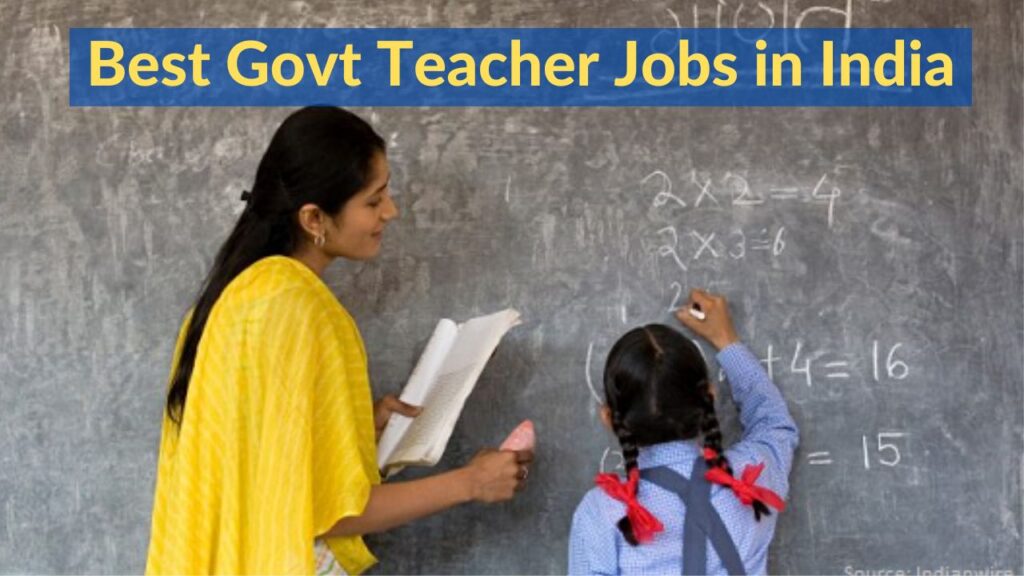
Best Govt Teacher Jobs in India You Shouldn’t Miss in 2025

Best Govt Teacher Jobs in India

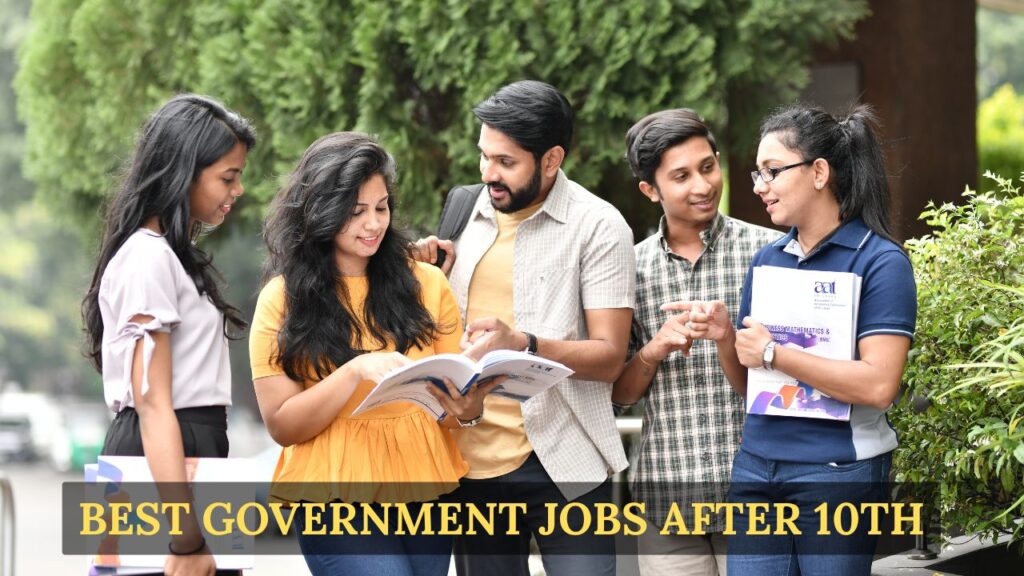
If you are considering teaching as a career option, here are some of the best govt teacher jobs you can look into. Government teachers are very respectable and offer high salaries with career stability. You can choose this profession if you are interested in teaching, there are several opportunities for aspiring teachers you can explore in this article. First of all, government jobs provide high perks such as a large pay scale, job security, promotions, and pensions. Second, it is not a very hectic profession. You can easily educate youngsters on specific subjects.

Top Government Teacher Jobs in India

1. Primary School Teachers (PRT)

EligibilityB.Ed is compulsory or D.Ed
CTET-qualified or STET-qualified
SalaryStarting pay from ₹30,000 to ₹40,000 per month.
Allowance benefit

Recruitment Process for Primary School Teachers

If you are eligible to be a primary school teacher, you can apply for this position after passing the eligibility test conducted by the government. This is a written exam that includes the basics of the subjects. After passing the exam the next stage is document verification and interview. The interview is taken by the school or college directly after the document verification. 

2. Trained Graduate Teachers

EligibilityGraduate with any relevant subject
B.Ed degree and CTET certification. Both are required 
SalaryStarting pay from ₹40,000 – ₹55,000 per month.
Dearness Allowance and House Rent Allowance

Requirement Process

The organizations like DSSSB, KVS, and state education are taking the exam for this role. Only the qualified teachers are eligible to teach in the Schools. If you are planning to establish a career as a government teacher then start preparing for the exam and beat the competition for securing a job role. 

3. Post Graduate Teachers 

EligibilityPost-graduate degree in a specific subject
B.Ed qualification 
CTET preferred in some states
SalaryStarting pay from ₹60,000 – ₹80,000 per month.

Recruitment Process

By clearing the National-Level exams like KVS, NVS, or any other state-specific, you can get a position as the post-graduate teacher in a school. It depends on your subject choice which teacher you can become and how much teaching experience you have. 

Specialized Teaching Roles

Assistant Professors in Colleges

Assistant Professor is the first stage position as a teacher in any college or university. The candidate has to gain experience through this position for teaching as an associate professor. The requirement of experience is required in some colleges but a master’s degree is compulsory for this position. The qualification of PhD is mandatory, if you clear the NET are eligible for this role without the PhD. The NET/SLET qualified candidates are eligible for this position. 

EligibilityMaster’s degree with at least 55% marks
NET or PhD qualification 
SalaryStarting pay from ₹70,000 – ₹1,20,000 per month.
Research opportunity

Recruitment Process

The selection process for Assistant Professors in Colleges happened after clearing the UGC-NET exam or state-level exam. You will be selected for the next stage for an interview directly from college. Both stages are mandatory for assistant professor positions in any college.

Special Education Teachers

The special teachers are delivering education to those students who do not understand easily as they have a lack of development, intelligence, and emotional disabilities. The aim is to support these children in learning and help the students achieve their full potential in academic and social settings. 

EligibilityBachelor’s/Master’s degree with at least 55% marks in Special education 
RCI registration (Rehabilitation Council of India)
SalaryStarting pay from ₹45,000 – ₹60,000 per month.

Recruitment Process

The recruitment for the special education teacher is conducted by the state board or CBSE. NGOs are involved in this process too. This role requires teaching certification of specific special education, maybe it is not required by some states. Training is preferred for assessing knowledge of various disabilities like autism, dyslexia, or ADHD because it helps teachers to understand the child problem.

Centralized Teaching Jobs

Kendriya Vidyalaya Sangathan Teacher

The Kendriya Vidyalaya Sangathan is the organization under the government of India. The KVS teachers are responsible for this education system of all the schools under the central government, sometimes we call KVS teachers the heart of this system.

EligibilityPRT: Graduation in a relevant subject (B.Ed/D.Ed, CTET)
TGT: Graduation with a B.Ed/D.Ed, CTET
PGT: Post-Graduation in a relevant subject + B.Ed
Age: 18-40 years
SalarySalaries are as per the 7th pay commission, ranges between 40,000 to 90,000
Other benefits such as allowance and medical coverage is given to the teachers

Recruitment Process

The candidates have to take the written examination test for this position. The PRT, TGT, and PGT positions are require some specific examination clearance. You must clear the written exam then you go to the interview stage if you are selected in these two stages only then come on to the next stage which is the Skill Test. The Skill test is based on the specific post you are applying for like music, dance teacher, or any other category.

Navodaya Vidyalaya Samiti Teachers

The Navodaya Vidyalaya Samiti is also under the Ministry of education, which is the central government organization specializing in providing quality education to children from rural areas. This is a free education providing talented children. The motive of the teacher is to develop academic excellence in every area of the country.

EligibilityTGT: Graduation with B.Ed/D.Ed, CTET
PGT: Post-Graduation in any relevant subject + B.Ed
Age: 18-50 years
SalarySalary range between 40,000 to 85,000
Other benefits like allowance, and professional development

Recruitment process

You have to take the written examination that evaluates subjects of knowledge in aptitude, reasoning, and general awareness. The next step is an interview, if you are selected in the first step you are eligible for the interview. The last and final stage is a skill test which is taken for specific posts like music, art, or physical education. The recruitment for this position is published on the NVS official website.

State Government Teaching Jobs

State Education Board Teachers

The various state governments in India are recruiting teachers for the state education board education. The State Education Board Teacher has a responsibility to teach students according to the syllabus and exam pattern. The students came from urban and rural areas on this board. Teachers must maintain lesson plans and assist in implementing state-level education initiatives. 

Types of State Education Board Teachers

Primary School Teachers Teach students from 1 to 5
Upper Primary School TeachersTeach students from 6 to 8
Secondary and Higher Secondary TeachersTeach grades 9 to 12 specialized subjects such as Mathematics History, English, etc
Prepare them for the state exam

Recruitment Exams for Teacher Jobs

Central Teacher Eligibility Test (CTET)This test is taken by the CBSE for PRT and TGT teachers.
State Teacher Eligibility Test (TET)This exam is a state-specific exam taken under the state board like UPTET, HTET, etc.
Other Exams:DSSSB (Delhi Subordinate Service Selection Board)KVS/NVS examsUGC-NET 

Conclusion

There are a plethora of govt teacher jobs in India for you, whether you aim for teaching or government jobs, this is the best opportunity for you to teach in either school, college, or university. Check the eligibility criteria and selection process before applying for the teaching job. Keep track of the application process through the official website https://www.ncs.gov.in/ for these job roles.

Leave a Comment

Your email address will not be published. Required fields are marked *

How to Take Admission in Delhi University in 2025 – Full Process Explained!

How to Take Admission in Delhi University

Delhi University is a great university for UG, PG and doctoral programs which attracts thousands of candidates from all over the country. If you are planning to take admission to the most popular university then you must know about the admission process. So, here’s a guide for you which helps you get ready for the procedure.

DU offers a plenty of programs for Arts, Science, and Commerce students. First, know your interest that aligns with the future goal. It will help you select the field of study and decide which program you have to take admission. Admission process is same but eligibility criteria and cutoff marks is different on most of the programs.

DU offers multiple courses in every stream through the entrance exams for the particular field. So, score well in exams to get a admission in Delhi University, here are the following exams: 

  • CUET Examination

DU offers UG courses such as BA, B.Com, B.Sc, BBA, MA, MCA, M.Sc, and B.Ed through the Common University Entrance Test.  

  • JEE Main

Candidates who are willing to take admission in the Engineering programs such as B.Tech have to appear in the JEE examination.

  • CAT Examination

DU offers an MBA program through the CAT examination, you must appear in the examination and score well in that to get an admission.

  • CLAT Examination

For LLB and LLM programs, candidates have to pass the CLAT exam.

  • UGC NET/CSIR NET/NTA 

These are the examinations for admission in PhD.

Candidates must have cleared the entrance exam for their courses then register for CSAS. Its full form is Common Seat Allocation System and this is the stage where you have to fill your college preferences and courses.


This round takes time because it’s a lengthy process, seat allotment based on your scores of the entrance exam, preference you fill, and category you belong to. Seat availability is critical in some cases, you can freeze your seat if you are satisfied with the given seat or wait for the next round.

Once you freeze the seat which is offered by the university. Your admission is confirmed after your acceptance. 

Read More 👉 Top 10 MBA Colleges in Lucknow You Shouldn’t Miss in 2025

Check your eligibility for the particular program you are choosing to take admission. For UG courses you must pass 12th class, for PG courses, it requires a graduation marksheet. Admission in PG courses may require a CUET PG score.

  1. Visit the official website of DU
  2. Search for the SOL admission portal, when you click on that the registration page will appear then click on the registration link.
  3. Enter your information in the form carefully to complete the registration.
  4. Log in with your registration number and password.
  5. Fill out the rest of the details with correct information to further proceed.
  6. Carefully fill in the details, so it cannot be incorrect.
  7. Attach the required documents required for the application in your admission.
  8. Submit application fee then download the copy.
  9. You can check application status from your account.

DU offers plenty of programs for students to study higher education. DU offers programs in streams like Arts, Science, Commerce, Management, Law, and Engineering. The admission in these streams through their entrance exams respectively.

If you are a working professional, parent, or any other responsibilities, you can pursue degrees such as BA, B.Com, MA, M.Com, and M.Sc without any entrance exam. SOL is beneficial for most of the students who can’t attend the college regularly due to any reason. 

NCWEB is designed specially for women who cannot attend full time courses due to responsibilities, work, or any other reasons. Women who prefer weekends or evening classes to complete their education can take admission but it happens through merit score. 

Students who want specializations in any field can also think of Delhi University as the best option for them. The various fields of specializations which DU offers are – English, Hindi, Economics, and Political Science, Physics, Chemistry, Mathematics, Law, and Management.

Delhi University primarily takes students through entrance exams but there are certain programs and modes of study where students can take admission without appearing in the entrance exam. 

SOL – It is designed to provide education for students who cannot attend the regular classes due to work, distance, or any other reason. SOL offers many UG & PG programs without an entrance exam.

CoursesAdmission processMode
BA, B.Com, MA, M.Com, M.ScAdmission is based on MeritDistance education

Some UG Courses based on Merit – DU affiliated colleges are offering some UG programs like B.Com, BA, and many other courses without an entrance exam.

Read More 👉 Top Government Jobs After MBA | Best Careers 2025 Guide

Course NameWho Can Apply?How Selection Happens?
BA OR BA (Hons)10+12th from any stream  (50% score minimum)Through CUET UG + CSAS Counselling
B.Sc OR B.Sc (Hons)10+12th (50% score minimum) in science streamThrough CUET UG + CSAS Counselling
B.Com OR B.Com (Hons)Passed 12th (50% score minimum) in commerce streamThrough CUET UG + CSAS Counselling
B.Tech Passed 12th with PCM, minimum 60% marksJEE Main + JAC Counselling
BA LLB / BBA LLBAccomplish 12th or equivalent (50% score minimum) CLAT UG + CLAT Counselling
BBA10+12th or equivalent (50% score minimum) Through CUET UG + CSAS Counselling
B.El.EdAccomplish 12th or equivalent with 50%Through CUET UG + CSAS Counselling
BFAAccomplish 12th or equivalent (45% score minimum)Through CUET UG + CSAS Counselling
B.Lib.I.ScAccomplish 12th or equivalent (45% score minimum)Through CUET UG + CSAS Counselling
Course NameWho Can Apply?How Selection Happens?
MABachelor’s degree (50% score minimum)CUET PG + CSAS Counselling OR Merit-Based
M.ComB.Com/B.Com (Hons) (50% score minimum)CUET PG + CSAS Counselling
M.ScB.Sc in relevant subject with at least 50% marksCUET PG + CSAS Counselling
MBABachelor’s degree in any discipline CUET PG + Group Discussion & Interview 
MCABCA or equivalent degreeCUET PG + CSAS Counselling
B.EdGraduation degree (50% score minimum)CUET PG + CSAS Counselling
LLBUG OR PG degree in any with at least 50% marksCUET PG + CSAS Counselling
LLMLLB (3-year or 5-year) (50% score minimum)CUET PG + CSAS Counselling
M.TechB.Tech/BE in relevant field (60% score minimum)CUET PG + CSAS Counselling
M.EdB.Ed/B.El.Ed or equivalent (60% score minimum)CUET PG + CSAS Counselling
Points Details
Who can apply?– Master’s degree (55% score minimum) marks – 5% relaxation for reserved category
How do you get selected?First Option  – Through UGC-NET, UGC-CSIR NET, DBT-JRF, ICMR-JRF, once you pass this, you can appear directly for an interview.Second Option  – You must appear for the CUET-PhD entrance test. If you don’t want to take the first option.  – Next step for selected candidates is an interview.  – Everyone (including exempted candidates) must attend the interview.
What happens after selection?– Merit list is prepared based on entrance and interview performance.- Selected candidates must verify original documents in person at the department.- Seats are filled as per department’s decision and university norms.
Other important points– Final subject relevance is decided by the Departmental Research Committee (DRC).- No PhD through distance mode at DU.

Leave a Comment

Your email address will not be published. Required fields are marked *

Indian Revenue Service: India’s Most Underrated Career Path

Indian Revenue Service

When you are dreaming about passing the Indian Revenue Service exam, many of them aspire to three letters: IAS. But among the tens of thousands of them, there is a quieter, sharper posse that it looks like the mainstream hasn’t quite tuned into yet – the Indian Revenue Service could well be the best career choice in the entire civil services ecosystem. 

What is the Indian Revenue Service?

When most people hear Indian Revenue Service they think of someone sitting with a bunch of papers behind a dusty desk, stamping tax returns. That couldn’t be further from the truth.

The Indian Revenue Service is, at bottom, a law enforcement and policy-making juggernaut. It is also the financial backbone of India — the body that raises the funds that pay for hospitals, highways, schools, and defence. The service was formed in its current style in 1953 and is divided into two significant arms, the IRS (Income Tax) and the IRS (Customs and Indirect Taxes). 

Nearly 9,775 officers, the two branches of the chargeable revenue service are testament to a cadre that pervades nearly every facet of the Indian economy. 

Eligibility

  1. Applicants must be Indian citizens or belong to certain categories of Persons of Indian Origin (PIO) to apply for the IRS. 
  2. The basic educational qualification is a Bachelor’s degree in any stream from any recognized university by the Government. 
  3. UPSC is quite flexible in this regard as it permits the students pursuing the final year of University to appear in the Preliminary examination for the CSE examination on a provisional basis, however, they are required to submit the passing certificates before joining the Mains exam. 
  4. The age limit is 21 — 30 years, you can check further below. 
Applicant CategoryMinimum AgeMaximum Age LimitPermitted Examination Attempts
General21 Years32 Years6 Attempts
Economically Weaker Section (EWS)21 Years32 Years6 Attempts
Other Backward Classes (OBC)21 Years35 Years9 Attempts
Scheduled Castes / Scheduled Tribes (SC/ST)21 Years37 YearsUnlimited (up to maximum age limit)
Persons with Benchmark Disability (PwBD – General/EWS)21 Years42 Years9 Attempts
Disabled Defence Services Personnel / Ex-Servicemen21 Years35 to 37 Years9 Attempts

Work Responsibility

These are the people who appear and plunder the offices of billionaires at the break of dawn. They follow cryptocurrency tracks across borders. They capture drugs off the shore. They bust shell companies that hide thousands of crores in black money. And yes, they also sit in hearings, argue byzantine tax law before tribunals and help shape the very policies that dictate how India earns its revenue.

This is not a desk job. This is one of the most intellectually challenging, operationally thrilling and financially rewarding career in Indian public service. 

Participate & Crack IRS

Hacking the Indian Revenue Service is tough but then, nothing good ever is. The only avenue of entry is through the UPSC Civil Services Examination, which is attempted by about 1.1 million aspirants every year. The exam takes place in three stages, all tough. 

  • The first is the Preliminary exams – a two-paper objective test to weed out the unprepared. 
  • Then there is Mains, nine descriptive papers penned down over a period of a few days, examining one on history and geography, ethics and economics, and so on. 
  • A final interview by a panel of seasoned bureaucrats and scholars. 
Mains Examination PaperSubject Focus and Syllabus ParametersMaximum Marks
Paper I (Essay)Multiple topics requiring analytical and philosophical discourse.250
Paper II (GS I)Indian History, national Geography and geo of the World and culture.250
Paper III (GS II)Law & Constitution, Social Science, and International Affairs.250
Paper IV (GS III)Tech, hacking, Economic Development, Bio-diversity, and crisis management.250
Paper V (GS IV)Ethics, Integrity, and Aptitude (Case studies on administrative morality).250
Paper VI (Optional I)Subject chosen by the candidate from a predefined list of 48 disciplines.250
Paper VII (Optional II)Second paper of the chosen Optional Subject.250

Top Recommendations for Exam Preparation

The whole process, beginning to end, can take years of preparation. Most of the toppers are second-time IAS aspirants and they spend 2-4 years mugging up the NCERT textbooks, M Laxmikanth Indian Polity, Ramesh Singh Indian Economy and reading daily newspapers like The Hindu. They write answers daily in practice. Join offline coachings or attend world-class online platforms such as Vision IAS or Vajiram & Ravi from wherever they live. 

Cutoff Marks Needed for Selection

A candidate from general category is usually required to rank between 239-379 to get IRS (Income Tax). For IRS (Customs and Indirect Taxes), the range is a little wider — something like 265 to 497. They are excellent ranks, well within the top 0.5% of all candidates. But unlike the IAS cut-off which is near impossible, the IRS is a realistic and achievable target for those who seriously prepare. 

ServiceGeneral Category (Last Rank)OBC Category (Last Rank)SC Category (Last Rank)ST Category (Last Rank)
IAS (2024 Trends)78 —- 96435 —- 457567—- 629528 —- 625
IPS (2024 Trends)225 — 252480 —-656638 — 865645 — 867
IRS (Income Tax)239 — 379485 — 706602 — 969674 — 1032
IRS (Customs & IT)265 —- 497515 — 823649 — 970680 —- 1053

The “big three” services—consisting of the Indian Administrative Service (IAS), the Indian Foreign Service (IFS) and the Indian Police Service (IPS)—are in the topmost Tier 1 class. These services traditionally take the bulk of the top 150 candidates. The IAS is the undisputed king of the civil services, with unparalleled executive powers, while the IFS has the glamour of global diplomatic representation, and the IPS has the unmatched power of the uniform.

The Indian Revenue Service holds the very prestigious Tier 2 bracket and is known for its unbeatable power in financial affairs along with a good urban living. With a bigger cadre size and distinct preference pattern giving priority to metro stability rather than rural administration, the IRS (IT) and IRS (C&IT) take a large chunk of the successful candidates which are ranked between 240 and 650 in the general category. 

What Happens After the IRS Exam?

IRS (Income Tax) officers are on their way to Nagpur’s National Academy of Direct Taxes (NADT) — a sprawling green-fitted campus, where a 16-month professional course converts the generalist officers into financial experts. The content is demanding: income tax law, corporate accounting, forensic investigation, international taxation, transfer pricing. It’s not just classroom theory, either. Officers labor months in the trenches, conducting real assessments and audits with seasoned veterans.

IRS (Customs and Indirect Taxes) officers are trained at the brand new NACIN campus in Palasamudram, Andhra Pradesh — a breathtaking 500-acre establishment which also serves as a World Customs Organization regional training centre for the Asia-Pacific region. The syllabus here includes GST, customs law, border management, narcotics control and contemporary areas such as data analytics and artificial intelligence.

Holistic development is taken seriously in both academies. Morning physical training, evening cultural programmes and personal hobbies. The objective is to produce officers who are not just technically competent but mentally tough, well rounded human beings who can manage in high-pressure environments without losing their cool. 

Read More:- Railway RRC WR Apprentice Recruitment 2026 – Apply Online

Pay Scale and Future Opportunities

The pay of IRS officers is very good and is governed by the 7th central pay commission (CPC). Financial estimates for the 8th CPC, as the pay commission is next in line, indicate a possible 2.25 multiplier to the basic pay, which would again make being in the service financially attractive. Officers join the service at Pay Level 10 ( Junior Time Scale ) and can rise in 30 years of service through the ranks to the Apex Scale at Pay Level 17. 

The following outlines the elaborate and comprehensive financial and hierarchical system: 

IRS DesignationPay LevelBasic Pay (7th CPC)Estimated Gross Monthly SalaryCareer Timeline (Approx.)
Assistant CommissionerLevel 10Rs 56100Rs 85000 0 – 4 Years
Deputy CommissionerLevel 11Rs 67700Rs 100,000 5 – 8 Years
Joint CommissionerLevel 12Rs 78800Rs  1,25,0009 – 12 Years
Additional CommissionerLevel 13Rs 118500Rs 1,60,000 13 – 16 Years
CommissionerLevel 14Rs 1,44,200Rs 2,00,00017 – 20 Years
Principal CommissionerLevel 15Rs 1,82,200Rs 2,40,00020+ Years
Chief CommissionerLevel 16Rs 2,05,400Rs 2,80,000 25+ Years
Principal Chief CommissionerLevel 17 (Apex)Rs 2,25,000Rs 3,20,000Apex Career Stage

In cases where government accommodation is either not available or refused within the government-officer circle, the officers are paid a handsome House Rent Allowance (HRA) of 8% to 24% of their basic pay based on the tier categorization of the city in which they are posted. 

Conclusion

Indian Revenue Service is not just a career option but a vocation for those who want to make a real difference and are willing to work in the shadows and not in the spotlight. It is a combination of power and responsibility, brain and brawn, permanence and challenge. IRS officers at the national and state level are, quite literally, the core of India’s power but theirs is an unobtrusive, unshowy, and often unacknowledged influence.

In a culture where the IAS, IPS and IFS reign supreme in public imagination, the IRS gets overlooked not because it does not hold enough power or prestige or purpose but because it doesn’t shout about it. And yet, for those with the time to can see its nuances, it provides one of the most rounded existences in Indian public service — professional esteem, financial security, urban postings, intellectual stimulation, and tangible national outcomes. 

GovUpdatewala is your trusted source for real-time updates on government exams and jobs in India. We provide verified info on SSCUPSCBankingRailwaysDefense, and Teaching exams. From syllabus and patterns to important dates and career tips — we support aspirants at every step.

Leave a Comment

Your email address will not be published. Required fields are marked *

JEE Main Result 2026 – Eligibility, Syllabus, Dates, Pattern Explained

JEE Main Result

The JEE Main 2026 exam has been made the necessary academic test for Indian engineering aspirants since now for the engineering aspirants. On 16th February 2026, candidates who appeared for the exam will be able to check the JEE Main Result 2026 for January session. JEE Main is a system that requires one to be mentally strong, strategically enduring and regulation-tight  not only about ability. 

JEE Main Result the gateway exam for prestigious technical institutions in the country including the National Institutes of Technology (NITs), Indian Institutes of Information Technology (IIITs), and Centrally Funded Technical Institutes (CFTIs) the exam goes through a scale of participation that is unprecedented globally. Because it also serves as the single entrance path to the JEE Advanced, it represents a major turning point for the Indian education system. 

The information shows a strong increase in registrations with more than 1.35 million candidates for Session 1 alone. This demographic bulge requires a granular analysis of the test’s structural elements, including eligibility rules and the statistical normalization of scores. 

NTA Reforms & Administrative Changes in JEE Main 2026

In a bid to ensure the sanctity of the procedure, the NTA has brought in game changing measures:

  • Biometric Security : Now there is a “Live Photograph” taken during application that restricts impersonation.
  • Operative Changes: The test will be given on multiple dates and will require an advanced statistical “normalization” process to equate different levels of difficulty.
  • JEE Main Result Timeframes: Although administrative delays such as the Session 1 result postponement from February 12 to February 16, 2026 — do induce stress, they are vital for thorough validation of data. 

Examination Schedule and Timeline 

The NTA has adopted a two-tier system for the hour long sessions, offering candidates a tactical cushion. This enables students to view the January attempt as a baseline and the April attempt as a fine-tuning move.

The JEE Main Result 2026 Session 1 

Paper 1 (B.E. / B.Tech) was held on January 21, 22, 23, 24, and 28 over multiple days, while Paper 2 (B.Arch/Planning) was held on January 29.

The JEE Main Result delay is due to the complexity of the normalization process, it is now expected on February 16. For the NTA to be fair, it must normalize the scores within the millions of data points. 

Session 2 Dates 

EventSession 1 (January)Session 2 (April)
Application WindowConcluded1—25/Feb/ 2026
Exam Dates21–29/Jan/20262–9/Apr/2026
JEE Main Result Declaration16/Feb/202620/Apr/2026 (Expected)

Eligibility Architecture: The 75% Rule and Beyond

It is necessary to know the funnel of eligibility to avoid getting disqualified in the stage of admission process.

Age and Attempts Age: There is no upper age limit for JEE Main, however some institutions may have their own fixed limits.

The Three-Year Window: You should have passed Class 12 in 2024, 2025 or appearing in 2026.

Attempts: The exam can be attempted for three consecutive years by the candidates. 

The Performance Threshold

But the access to NITs, IIITs and CFTIs is limited by eligibility criteria that includes:

General/OBC-NCL/EWS: Minimum 75% in aggregate in class 12th.

SC/ST: 65% aggregate minimum.

Option 2: Be in the Top 20 percentile of your respective Board. 

State of Eligibility

Your ‘Home State Quota’ will be decided on the basis of the state of examination of your Class 12, not your residential status. For example, a student of Bihar coaching in Kota (Rajasthan) will come under Rajasthan Home State quota. 

Read More:- Railway RRB ALP Admit Card 2026: Download Now From Direct Link

Examination Pattern For JEE Main

AspectDetails
Exam ModeComputer-Based Test (CBT); focuses on application and speed.
Total Marks300
Duration3 Hours
SubjectsPhysics, Chemistry, Mathematics (each with two sections)
Section A20 Mandatory MCQs per subject
Section B10 Numerical Value Questions (NVQs) per subject; attempt any 5
Penalty Rule-1 negative marking for both MCQs and NVQs; precision required

Subject-Wise Syllabus Breakdown

Mathematics, Physics and Chemistry have strategic places where one must focus to improve performance:

Mathematics:  

Learn Calculus and Algebra well as they are the basics.Don’t ignore Vectors and 3D Geometry as these are very easy and carry good amount of marks in examinations.Also focus on Coordinate Geometry, Matrices and Statistics for high yield.

Physics:  

Concentrate on concepts and the use of the formulas. Modern Physics, Semiconductors = very good marks, not much calculation. Things are inevitably going to move around in your lab, so you need to be comfortable with experimental skills, especially Vernier Calipers and Error Analysis, handy points as well.

Chemistry:  

Chemistry is a very efficient subject for which you could save a lot of time and spend more time in Mathematics.  

Physical Chemistry: Be good at numericals to do well.  

Inorganic Chemistry: Be good in p-block trends;solidify your knowledge of Coordination Compounds.  

Organic Chemistry: Learn the reaction mechanisms and Biomolecules,bcoz they are very important.

Your study time can be better used and your score can be higher by focusing on these areas with the greatest yield. 

Post-Session 1 Roadmap to April

Reviewing how you did in January is the first step towards doing well in April.

  • Category A (98+ Percentile): Begin dedicating 70% of your time to JEE Advanced questions.
  • Category B (90-98 Percentile): Look for “low-hanging fruit.” Earn higher accuracy in Physics and Chemistry to enter the elite group.
  • Category C (<90 Precentile): Go back to basics. Concentrate your efforts on the most common chapters that ask questions instead of covering all the syllabus. 

The “Golden Window”

To Those Who Are Taking Boards In Feb-March The gap between the last Board exam and JEE on April 2 is crucial. Prepare Board to learn NCERT concepts which are directly used in the questions of Inorganic Chemistry and theoretical Physics. 

JoSAA & CSAB Counselling Process 2026

Admissions counselling for engineering in India is not limited to just ranking, as the Centralised Joint Seat Allocation (JoSAA) Authority in six rounds of seat allotment. Candidates may opt Freeze to accept and confirm their seat, Float to accept their seat and appear for seat updation in subsequent rounds, or Slide to retain the seat and try for an improved branch in the same institute. If there are still vacant seats after the JoSAA rounds, the procedure is continued by CSAB through special rounds which tend to be the last chance for many students with lower ranks to get an admission in a reputed NITs and other top institute. 

Conclusion

JEE Main 2026 is not just a good entrance exam—it is a good portal to sift through all the engineering institutes in the top Indian engineering colleges. Success is based on more than just knowledge: you also need to have a plan, be consistent, and make smart decisions. From understanding the exam pattern and eligibility criteria to utilising both attempts to the maximum and managing JoSAA–CSAB counselling effectively, every step will determine your outcome. Clarity, discipline, long term vision and direction in studying helped these students not only to qualify, but to open the right “doors” for their future. 

Leave a Comment

Your email address will not be published. Required fields are marked *

Railway RRB Technician Exam Date 2026: CBT Schedule & Latest Updates

RRB Technician Exam Date

Railway RRB Technician Exam Date 2026: If you are waiting for the RRB Technician Grade 1 and Grade 3 post exam then be ready, as the Railway Recruitment Board has revealed the CBT dates — held from 05 to 09 March 2026. People who submitted their applications for these posts can start their preparations from now on and for more information about the examination refer to the official notification. 

The exam dates have been announced officially, there is no more space for procrastination. If you are aiming for Technician Grade 1 or Grade 3, begin to formulate your preparation strategy now. General Intelligence & Reasoning, General Science and General Awareness are the subjects to be focused for Grade 3 and you should make a habit of solving previous year question papers and mock tests regularly. 

Mark Your Calendars

The First Stage Exam RRB Technician (CEN 02/2025) Computer-Based Test(e-CBT) will be conducted from 5th to 9th March, 2026. Yes, you read it right the examination will be conducted for five days, and your exam city and category date and time slot will be considered as the assign of the date and slot. 

This huge recruitment is to fill a staggering 6,238 vacancies which includes 183 posts for Technician Grade 1 Signal and 6,055 for Technician Grade 3 in multiple railway zones. 

Important Dates You Can’t Afford to Miss

Application Dates28th June — 9th August 2025
City Intimation 10 days before exam date (expected 23/February/2026)
Admit Card 4 days before exam date (Expected 1/March /2026)
Exam Date 20265th to 9th March 2026
Application Fee
SC / ST / Ex-Serviceman / PWDsRs. 250/-
Gen / OBC / EWSRs. 500/-

Exam Pattern For RRB Technician

The exam is simple in format featuring 100 multiple choice questions accounting for 100 marks. You will be given 90 minutes to write it. One-third of a mark will be deducted for every incorrect answer – so be accurate! 

Read More 👉 Aerospace Engineering Courses: Complete Guide to Soar into the Sky with the Right Education

Age Limit For Technician Post

Technician Grade 118 to 33 years
Technician Grade 318 to 30 years
Useful Links
Exam Date NoticeClick Here
Apply LinkClick Here
Extended NoticeClick Here
Official WebsiteClick Here

Leave a Comment

Your email address will not be published. Required fields are marked *

Meet the Best History Teacher for Competitive Exams Who Can Boost Your Score

Best History Teachers in India for Competitive Exams UPSC SSC RRB

Aspirants of competitive exams like UPSC, SSC, RRB, State PSC think history is the hardest subject, the truth, it is hard without the right guidance. To understand the facts behind the history instead of rote learning, you need the best history teachers for competitive exams. History is an important subject among all other subjects because it demonstrates the past events across the country, generations and world. 

History is divided into its past in three periods — Ancient, Medieval, and Modern, so if you are preparing for a government exam then consider History is an important role in prelims, mains, and even interviews.

And the right teacher will simplify timelines, connect events and make you remember the logic behind every topic. This will help you remember quickly during the exam or interviews. 

Let’s explore the details of these teachers to understand why they are the best:

Praveen Sir

Praveen Sir is the top ranked teacher for providing best lectures of History online. Many students cleared their exams because his clear explanations and structural approach is quite helpful. Students understand easily because he breaks down complex topics into simple storytelling with factual accuracy. 

Praveen Sir teaching online History lecture for competitive exams.

He makes hard topics like cultural development, Mughal administration, and freedom movement remembered with systematic notes and practical examples. 

Abhishek Suman

Abhishek Suman explaining modern history concepts in classroom.

Abhishek Suman is a popular History teacher and is growing his numbers by providing interesting History Lectures. He makes boring topics become interesting with his explanation of events, he elaborates them with reasoning and connecting them with the present. Students appreciate him for clearing small doubts, especially in modern history. 

Khan Sir 

Khan Sir delivering a humorous yet informative History lecture.

Every aspirant knows Khan Sir from Patna because he is the most famous and growing teacher for the preparation of competitive exams. His teaching style is funny but effective, using real life relatable examples and humour to make every tough topic easier. Students praised his lectures that helped them to understand world history & Modern History. 

Awadh Ojha Sir

Awadh Ojha Sir teaching Modern Indian History to UPSC aspirants.

Awadh Ojha Sir is ideal for UPSC aspirants who struggle to understand modern Indian History. His deep analysis and straightforward teaching style make every student attentive through his lecture. Students admire his passion and dedication for Modern History. His in-depth explanation and motivation pushes students to stay consistent.

Rishabh Sir

Rishabh Sir giving structured history lessons for competitive exams.

Rishabh Sir is also a best history teacher, he focuses on strategically preparing for the government exam. He teaches in a structured way to get students ready for the History Exam. ideal for those students who don’t want to give big time for history but cover up every important topic. He also provides compact notes and highlights on youtube for Ancient, Medieval, and Modern History.

Kumar Gaurav

Kumar Gaurav teaching chronological history events to students.

Kumar Gaurav’s methodological and calm teaching style is connecting events chronologically, it helps students to understand events without getting lost. He is the best for those who are not good with dates and events. 

Dr. Vikas Divyakirti

Dr. Vikas Divyakirti conducting a history lecture integrating culture, society, and polity.

Dr. Vikas Divyakirti is a founder of Drishti IAS, he motivates students to stay consistent. He emphasizes every event in History, connecting them with culture, society, and polity which makes it easier for students to understand easily. His deeper knowledge of history and integration with philosophy and polity make lectures a key success to interview stages. 

Sumit Sir

Sumit Sir providing exam-oriented history revision classes.

Sumit Sir is focusing on exam-oriented teaching, stressing on previous year question practice to ensure students are aligned with the exam pattern. He helped clear the student’s confusion in difficult parts. He also provides exam notes and takes revision classes which is extremely useful before exams.

Why Choosing the Right History Teacher Matters

There is no single answer for the right teacher because it depends on the student’s mind and thinking. Some students get irritated or sleepy during History lessons because they get bored and don’t even understand the topic’s heading. The right teacher comes when you find the lessons more interesting and easy rather than difficult and boring. 

These factors can help you find your right mentor

Teaching Style: Take a demo class of a few teachers and check which teacher’s explanation you understand better. Find the right mentor whose style aligns with your preparation needs.
Exam Orientation: You prefer to study according to the exam pattern.
Resources: Good teachers always provide concise notes, practice questions.
Motivation: beyond just a teacher, they also inspire students to stay consistent.

Read More👉 Meet the Best Hindi Teacher for Competitive Exams Who Can Boost Your Success

Conclusion

History is not just a subject of delusion and theory, it is the journey of society, culture, and politics from years to years. The right teacher can make this interesting rather than boring events which makes it hard to remember. 

Choose the right one in the list of Best History Teachers for Competitive Exams because he can make the burden go away. With the strong preparation in History can help you score high in any competitive exams.

Leave a Comment

Your email address will not be published. Required fields are marked *

Scroll to Top