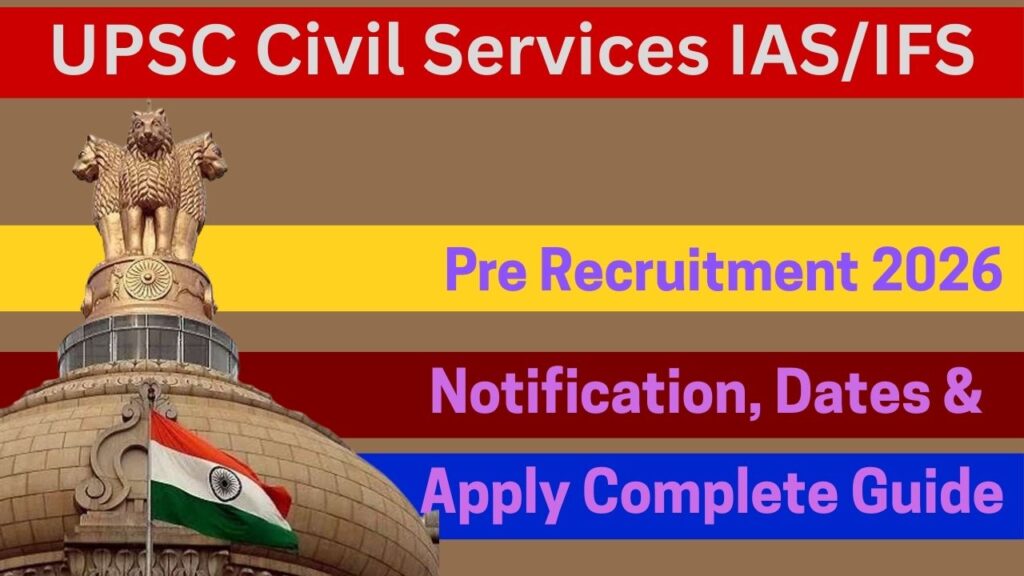
UPSC Civil Services IAS/IFS Pre Recruitment 2026:  Notification, Dates & Apply Complete Guide

UPSC Civil Services IAS IFS

Union Public Service Commission (UPSC) has released the Civil Services (IAS) and Indian Forest Service (IFS) Prelim 2026 notification, now apply for 933 prestigious Union Government posts in Civil Services (IAS) and IFS 2026.

The online application process to fill up the posts began on February 04, 2026. Eligible candidates who aspire to join India’s top administrative services can apply through the official website on or before February 24, 2026. 

Prelims will be held on 24 May 2026, Admit cards to be issued soon. Mains follow in August, but focus on Prelims first. 

Follow These Event Dates For UPSC Civil Services IAS/IFS Pre Recruitment 2026

EventDate
Online Apply Start Date04/February/2026
Last Date for Fee Payment24/February/2026
Pre Exam Date24/May/2026
Admit CardBefore Exam
Result DateUpdated Soon
Application Fees
General/OBC/EWS,₹100
SC/ST/PwD/womenNIL

Eligibility Essentials

  • You should have a bachelor’s degree from a recognized university. 
  • Age Limit: The age of the applicants for this post should be between 21 to 32 Years (as on 01/August/2026) i.e. they should not be born before 02 August 1994 and after 01/August/2005.
  • Age Relaxation: As per Govt. Norms, the relaxation in age will be given- 3 yrs for OBC candidate, 5 yrs for SC/ST candidate, more relaxation would be admissible for PwD and Ex-servicemen candidates. 
  • Citizenship: The rules are applicable for Indian citizens or as. 

Read More:- BSc Medical Laboratory Technology (MLT): Course, Fees, Career & Scope in India

How to Apply: Step-by-Step

  1. Go to the official website (upsc.gov.in) to apply. or upsconline.nic.in. 
  2. Apply through the pre-registration (One-Time Registration or OTR) if new
  3. Complete Part I (personal information) and Part II (upload photograph and signature, pay fee). 
  4. Charges: ₹100 for General/OBC/EWS, no charge for SC/ST/PwD/women. 
  5. Verify all before you submit the application. 
  6. Print the form for future reference

What is Exam Pattern

Prelims consists of two papers: GS Paper I (200 marks, counts for merit) and CSAT (qualifying). There is also negative marking, so approach is important. It’s your way to Mains — only rankers move ahead. 

Useful Links
Apply NowClick Here
Download NotificationClick Here
Official WebsiteClick Here

Leave a Comment

Your email address will not be published. Required fields are marked *

Latest UPSC Notification & Exam Pattern Changes For 2025

UPSC Notification & Exam Pattern Changes

If you are preparing for the UPSC exam then getting every update for the exam is necessary to appear in the exam and achieve your goal. Get UPSC Notification for UPSC CSE 2025 Exam which will happen in 3 phases—Prelims, Mains, and Interview. Aspirants should prepare according to the exam pattern. You can check the eligibility criteria, and exam pattern in this article.

Highlights Of The UPSC Exam

Conducting ByUnion Public Service Commission
Exam NameUPSC Civil Service Exam
PostsGroup A & B Officers
Vacancy1129
Selection ProcessPrelims, Mains, Interview
Starting SalaryRs. 56,100 per Month
Notification Release22/January/ 2025
Application Starts On 22/January/ 2025
Application Ends On11/February/ 2025
UPSC Prelims Exam Date25/ May/ 2025
UPSC Mains Exam Dates 22, 23, 24, 30, & 31/August/2025
Final Result Update Soon

Exam Pattern for UPSC Exam 2025

Prelims: General Studies and CSAT, the two objective types of paper are conducted in prelims. Candidates must complete the first paper within 2 hours, the same duration applies to 2nd paper 2 too. Each paper is holding 200 marks, negative marking of 1/3 for every wrong answer. 

CSAT Qualifying: 33% is the least to get in Paper 2 (CSAT) for clearing the exam and there is no change in the marking scheme. 

Mains: Nine papers descriptive in terms 3 hours each, total marks 1750. 

Interview: Personality Test is conducted of 275 marks

No major changes: In exam pattern for 2025, just procedural changes happen this year and you can find the updates on the official website.

Read More 👉 RBI Grade B Admit Card 2025 – Direct Download Link, Exam Date & Instructions

Eligibility Criteria

Age LimitGeneral: 21 to 32 years
Age Relaxation for Reserved categoryOBC: up to 35 yearsSC/ST: up to 37 yearsPwBD: up to 42 years
Education QualificationGraduate degree or final-year students eligible but they must provide proof of their education until Mains stage
Attempts6 (General), 9 (OBC), unlimited for SC/ST

Useful Links

NoticeClick Here
NotificationClick Here
Official WebsiteClick Here

Leave a Comment

Your email address will not be published. Required fields are marked *

IAS Preparation Roadmap: Step-by-Step UPSC Strategy That Actually Works

IAS Preparation Roadmap

After deciding to become an IAS officer, you have scanned through the UPSC notification, go through IAS Preparation Roadmap, watched numerous toppers interviews on Youtube, and may have argued with your parents that “art degrees are a waste of time and civil service is the path for glory.” 

I imagine you must be very scared and excited and overwhelmed right now. That’s normal. The Union Public Service Commission (UPSC) exam is more than just an exam, it is a marathon that changes you. If you’re starting now for the 2026 cycle, you have something most aspirants do not: Time. 

But time has two edges. Three years ~ 30-36 months is enough to learn all of the syllabus, yet it’s enough to get measured by complacency, boredom, or swallowed up by the sea of study materials.

This is not some robotic strategy cooked up by an AI. This explores you assuming that you are a person who has bad days, gets distracted by Netflix, and sometimes you just want to sleep in. Let’s look into this guide to prepare accordingly.

Phase 1: The First 6 Months That Matter Most

Objective: Start with basic for foundation

It looks like a mountain when you begin the syllabus. Don’t try to climb it in a day.

1. Stop Collecting, Start Reading:

The biggest mistake most beginners make is the “Library Syndrome” – they get every stock book that is suggested on the market, 50 GB of PDFs, and take every test series. Stop. Not yet, you don’t need them.

In your first six months, your only friends are NCERTs. Read History, Geography, Polity, Science and Economy from Class 6 to Class 12. Because they give you the basic topics of UPSC. They build the narrative. Read them as a storybook not as a textbook. 

2. The Newspaper Habit:

Start reading in The Hindu, or in The Indian Express. You are not going to get it all on Day 1. You look up ‘international relations’ and find yourself bewildered. That’s okay. The point is not to remember — it’s to notice. Spend 45 minutes to an hour every day. This is not for the exam yet; it’s to train your mind to the world around you. 

3. Decode the Syllabus:

Print out the UPSC syllabus. Paste it on your wall. Read it every Sunday. Treat it like your Bible. Whenever you read an article in a newspaper, try to relate it to a topic in the syllabus. This “linking” game is the secret sauce of a topper. 

Phase 2:  Strengthening Your IAS Preparation (Months 7-12)

Objective: Going into more Knowledge from General to Specific Concepts.

Once the Phase 1 beginning is over, the business of beginning is beginning. It is at this point you move from a layman to an aspiring.

1. Standard Textbooks (the “mains” core):

Start with the regular reference books: Laxmikanth for Polity, Ramesh Singh for Economy and Spectrum for Modern Indian History. Read them slo­wly. Take notes. But here is the human tip: Don’t take notes just for the sake of taking notes. If you know a topic, just highlight it. Just write down what you need to remember. If your notes are just the book copied down, you are wasting time. 

2. Selecting Your Optional (The Big Decision):

You will have to choose your optional subject by the end of this year. This is crucial. Don’t take Sociology because your buddy took it. Go through the syllabus, go through with the questions from the last year and ask yourself a question “I am I able to stick to this for 3 years without thinking about pulling my hairs out?” If the answer is yes, go for it.

3. Begin the CSAT Practice:

Most people neglect their CSAT (Paper II) till a month before the exam. Don’t be that guy. You don’t need to prep hardcore, but work an hour a week on some basic math and reading puzzles. It keeps your mind sharp. 

Phase 3: The “Deep Dive” – Mains Orientation (Year 2)

Objective: Shifting From “What” to “Why” in and “How”.

Halfway through your second year (mid-2025) you will be finished with your static reading. Now you have to be a writer. UPSC Mains is not what you know; it’s how you put it.

1. Answer Writing:

Yes this is the scary part. You will write bad answers. Your handwriting might look messy. Any thoughts on this? Good. Start now. Join a test series or start self-evaluation. Choose 2-3 questions daily and write out. This exercises the muscle memory that you’ll need to write 4,000 words in three hours on the real exam.

2. Integrating Current Affairs:

So now your static knowledge (books) has to meet dynamic knowledge (current affairs). When a budget is announced, don’t just read the highlights. Read the fine print and relate it to the articles in the Constitution you studied in Laxmikanth.

3. The Optional Intensive:

This is your year for your Optional subject. Plunge deep. Cover the syllabus entirely. Start writing answers for your optional. It is the optional subject where you can secure maximum marks; so treat it as such. 

Phase 4: Prelims For IAS Preparation Roadmap

Objectives: Accuracy in all work, Reassessment of answers and Mental Composure.

The atmosphere goes from “learning” to “revising” if this is your exam year.

The Prelims Mission (Feb – May): For the first five months of 2026, enter “Monk Mode.” Your focus should be solely on General Studies Paper 1 and CSAT.”

  • Revision: Revise your notes 5 times. Yes, 5 times.
  • Mock Tests: Take a test every other day. Analyze the test more than you take it. Don’t cry if you fail a mock. Learn why you got it wrong. Was it a silly error? Concept gap? Or lack of revision?” “I think that helped.”
  • Elimination: Learn to eliminate “wrong” answers. That’s how you crack Prelims. 

The Quick Turnaround (June – Sept): After the Prelims are over, relax. Maybe 3-4 days. Then, it’s off to Mains. You have somewhere between 100-120 days. This is where your answer writing practice from last year pays off. You don’t have to learn to write, you have to polish your material.

The Personality Test (Post-Mains): If you get to the interview, remember: they aren’t testing what you know. They tested that in Mains. Now, they will test you — Are you honest? Do you have integrity? Can you handle pressure? Be yourself. Don’t fake it. 

Read More:- RRB Isolated Categories Recruitment 2026 Exam: Posts, Eligibility & Salary

The “Human” Survival Guide To Become IAS

The above plan is all well and good on paper, but life is messy. So, here’s how to make it through like a person instead of a robot. 

1. The Comparison Trap:

You open Telegram or Instagram and see someone posting, “I studied for 14 hours today.” You could have studied for six. That’s fine. UPSC is a qualitative exam, not a quantitative. Four hours of distracted-free, intent study will trump 10 hours of looking at a page and then picking up your phone. Concentrate on your own race.

2. Burnout is Real:

There will be days, even weeks when you won’t lay a finger on a book. You are going to feel guilty. Strip away the guilt. Rest is productive. If you are burnt out, go for a walk, see a movie, hang out with a friend (not one who wants to know how you “have been preparing”). The tired mind cannot learn. 

3. A Social Life?

Yes, you can have one (they’re just a tad different). Obviously you’re not going to any late night parties, but you can still go for coffee with friends. You will need to keep your evenings and mornings free for studying. Tell your friends it’s a “busy spell.” Real friends will understand it. 

4. The “Why”:

Write down on a piece of paper why you want to be an IAS officer. Is it to make a difference? Is it for the challenge? Is it for the uniform? Whatever it is, keep that paper safe. When you want to give up (and you will), that “Why” is your fuel. 

Conclusion

IAS Preparation Roadmap journey is not even close. That’s the biggest advantage you have. No need to rush. You don’t have to start cramming 15 hours a day tomorrow.

Consistency over intensity. Daily consistency of 4 hours for 3 years beats 12 hours for 1 month and then disappears a million times over.

So start slow on a IAS Preparation Roadmap. Take that NCERT. On the first page. You have a long, beautiful, difficult road ahead of you, and the view from the summit is worth every step. Good luck, future officer. We are rooting for you. 

Leave a Comment

Your email address will not be published. Required fields are marked *

Top 10 List of Exams Conducted by UPSC After Graduation in 2025

Top 10 List of Exams Conducted by UPSC After Graduation in 2025

If you’re recently completed your graduation you can appear in these top 10 list of exams conducted by UPSC after graduation. UPSC is responsible for recruitment in various government positions all over India. To secure a stable future and a good income salary, you can apply for the government job by cracking the exam. 

List of Exams Conducted by UPSC After Graduation

1. Civil Services Examination (CSE)* – IAS, IPS, IFS

This is the most popular exam of UPSC. A lot of candidates start preparing for this exam after high school because it is the toughest exam all over the world. Candidates are highly passionate to attempt the exam. The IAS and IPS positions are highly respected and consist of policymaking, welfare, public security, and administration.

Category: Group A
Eligibility: Any Graduation pass candidate with any recognised board.
Age Limit: It is based on the category of the candidates – General category: 21 to 32 years, OBC: max 32 years, SC/ST: max 37 years
Exam Stages: Prelims, Mains, and Interview

2. Indian Forest Service Examination (IFS)

The duty of IFS officers is the protection and conservation of forest around the region. Candidates who are interested in wildlife or have a wish to protect forests for the conservation of forest can choose this field as their career. It provides stability and their interest in work but working hard to clear this exam is mandatory.

Purpose: Recruitment for Forest Service Officers
Eligibility: Graduation in Science or Engineering streams.
Age Limit: 21 to 32 years
Exam Stages: Prelims (with CSE), Mains, and Interview

3. Combined Defence Services Examination (CDS)

Building a career in defense you need to be physically healthy and have good stamina. If you’re fine and playing sports, this career will be your best choice to secure a permanent job. It is conducted twice a year and offers permanent commission in the armed forces.

Purpose: For joining the Indian Army, Navy, and Air Force
Eligibility: It depends on the job position, For Army sector (Any Stream). For Air Force, (B.E/B.Tech) is mandatory
Age Limit: 19 to 25 years
Exam Stages: Written Exam and SSB Interview

4. Central Armed Police Forces (CAPF) Examination

Those who want to serve in Forces such as CRPF, BSF, CISF, and ITBP can take this exam and join. It’s also required for your fitness test and medical test so your body must be fit and fine to join these forces. 

Purpose:  Recruitment of Assistant Commandants 
Category: Group A
Eligibility: Any graduate
Age Limit: 20 to 25 years
Exam Stages: Written, Physical Test, and Interview

5. Engineering Services Examination (ESE/IES)

You have completed engineering and now you wish to join the government sector or having a government job will help you to secure a better future in IES or ISE. IES officers duties in the departments like Railways, CPWD, and Defence. This is one of the most reputed exams for engineering candidates. 

Purpose: Recruitment of engineers in government departments
Eligibility: B.E./B.Tech in relevant subjects
Age Limit: 21 to 30 years
Exam Stages: Prelims, Mains, and Interview

6. Indian Economic Service (IES)/Indian Statistical Service (ISS)

After Post Graduation you can apply for this position. The IES and ISS duties require the knowledge of statistical knowledge of analyzing data and representing it in a manner.  These officers handle policy-making based on economic data.

Purpose: Recruitment for economics and statistics roles in central services
Eligibility: Postgraduate in Economics/Statistics
Age Limit: 21 to 30 years
Exam Stages: Written Exam and Interview

7. Combined Geo-Scientist Examination

Geo-Scientist examination for the role of geologist and related roles. Candidates who pass graduation with science stream then later continue in higher studies. If they wish to enter in the research-oriented government roles can take this exam be eligible for the job role

Purpose: Recruitment for geologists, hydrogeologists, and related roles
Eligibility: Master’s in Geology, Chemistry, Live science
Age Limit: 21 to 32 years
Exam Stages: Prelims, Mains, and Interview

8. Indian Statistical Service (ISS) Examination

Those who are best in the data analyzing and taking great responsibilities on their accuracy of the analytical work. The field is rare but has a high value of work. The job has a high paying salary so if you’re studying statistics as a subject you must consider this job role as a great future for your future.

Purpose: Recruitment in various statistical departments of the government
Eligibility: Bachelor’s with Statistics + Postgrad with same field
Age Limit: 21 to 30 years
Exam Stages: Written Exam and Interview

 9. UPSC EPFO (Enforcement or Accounts Officer)

This is a semi-administrative government job with regular hours. Those who want a stable job and not wishing to join private sectors must consider high paying salary job in government sector. If you are interested in the administration role, you can appear in this examination after graduation with any field. 

Purpose: Recruitment in the Employees’ Provident Fund Organisation
Eligibility: Any graduate
Age Limit: 21 to 30 years
Exam Stages: Written Exam and Interview

10. UPSC Combined Medical Services (CMS) Exam

Medical graduates can appear in this examination for securing a government job in medical practices. CMS is the best option for candidates who are interested in the medical field and have graduated with an MBBS degree. They have plenty of options but joining the government sector means ensuring the stability and growth for the career.

Purpose: Recruitment of doctors in various central government organizations
Eligibility: MBBS Degree
Age Limit: 32 years
Exam Stages: Written Exam and Interview

Why Consider UPSC Exams After Graduation?

It is the hardest exam around the globe but has great value for those who clear this exam. Who crack this exam can enter the government sector and have a great life with high salary, bonuses, Job security and respect in society. You are working for the nation eventually and Scope for growth and promotion and also there are Wide range of services and job roles.

Conclusion

Top 10 List of Exams Conducted by UPSC After Graduation in 2025. So, after graduation you can take these exams mentioned in this article, some may require the masters but most of them are eligible for the graduate candidates. However, if you are interested in any of the works or departments you wish to join then take the exams and grab the opportunity to secure your position, stable career and growth. Choose wisely for the career because it depends on the knowledge and eligibility for the exam.

Leave a Comment

Your email address will not be published. Required fields are marked *

Indian Police Service IPS: How to Crack and Become IPS Officer

Indian Police Service

If you’re dreaming about the Indian Police Service (IPS) standing tall as a law and peace officer in the Indian Police Service. Whatever got you started on this dream, pursuing it in real life is more than just a passion to do. It requires a sharp strategy to prepare accordingly and what’s right to study. Not everything is important. 

Instituted in 1948 as a successor to the British colonial-era Indian Imperial Police, the IPS is the ground holder of India’s internal security system. But the reality check is that every year lakhs of candidates chase this dream and only a few hundred come out successful. So what separates those who make it and those who don’t? More often than not, it is the preparation strategy. 

Understanding the Battlefield: The Three-Stage War

Know what you are getting into before you go to the books and notes. The UPSC Civil Services Examination (CSE) is a rigorous three-tiered exam which tests not only your knowledge but stamina, analytical abilities & character. 

First Level— The Preliminary Examination 

Think of the Prelims as the bouncer at the door to that exclusive club — it sifts out the wheat from the chaff. It consists of two objective papers, each of two hours duration and carrying 200 marks. 

Paper – I is General Studies—current events, history, geography, polity, economy, environment and general science. The Civil Services Aptitude Test (CSAT), now known as Paper II, tests your concepts on comprehension, logical reasoning, decision making and basic numeracy. It is qualifying in nature and it just needs 33% to pass.  

Do not make the mistake to understand that Prelims score is gonna add in the final merit list, it’s important to score for going into the next stage but it doesn’t hold final value. So don’t get that to take it lightly because 97-98% of candidates are eliminated at this stage. 

Second Level: The Main Examination 

If Prelims is a sprint, Mains is like running a marathon. Nine descriptive papers across a few days with a total of 1750 marks designed to push how well you know what you know and how well you can express complex thoughts when you’re under a lot of stress.

The pattern is: two qualifying papers (English and an Indian language), one Essay paper (250 marks), four General Studies papers ranging from Indian heritage to ethics and integrity (250 marks each), and two papers on your chosen Optional subject (250 marks each).

The hard copy elective also has an impact on your total score with a weightage of 500 marks. Choosing the appropriate subject is very important. Although you have a whole bunch of popular subjects like Geography, History, Public Administration, Political Science etc, it is always advisable to go with the subject you are really interested in rather than seeing what others have taken up. 

Third Level: The Personality Test (The Interview)

The remaining 275 marks are given in the Personality Test, during which an UPSC panel evaluates your mental alertness, critical thinking, communication skills, leadership potential, and moral uprightness. They don’t want to know-your-everything; they want well-rounded people who can manage the enormous burden of public service. 

Check Your Eligibility For Indian Police Service

Nationality

IPS is only open to Indian citizens. The UPSC CSE permits Nepali, Bhutanese and Tibetan refugees (who came before 1 January 1962) to apply for certain services like IAS and IFS, the Indian Police Service, however, is limited to Indian citizens. 

Qualification

You must have a bachelor’s degree from a recognized university – all streams are acceptable.  If you’ve studied English Literature, Engineering or Zoology, you can apply.

Important caveat for final-year students: You may apply for the Preliminary examination as a final year student, but you need to submit degree certificate before going in for the Mains.  Don not count on your provisional certificate to arrive in time—make your plans accordingly.

Final MBBS students can also apply, but they have to submit a certificate from their university. 

Age Limit

CategoryAge LimitCut-off Birth Date (for 2026 exam)
General/EWS21-32 years2/August/1993 to 1/August/2005
OBC21-35 years (3 years relaxation)2/August/1990 to 1/August/2005
SC/ST21-37 years (5 years relaxation)2/August/1988 to 1/August/2005
PwBD21-42 years (10 years relaxation)2/August/1983 to 1/August/2005
Ex-servicemen5 years relaxation2/August/1988 to 1/August/2005

Attempts Restrictions

CategoryNo. of Attempts
General/EWS6 attempts
OBC9 attempts
SC/STUnlimited (until age 37)
PwBD9 attempts (until age 42)

The Physical Reality: More Than Just Books

Unlike IAS, Indian Police Service has certain physical eligibility condition which you need to fulfill. Male candidates should have a minimum height of 165 cm (160 cm for ST and some other categories) and must have chest measurements of 84 cm along with expansion. Female applicants need 150 cm height (145 cm for ST) .

Myopia shall not be more than minus 4.00D and hypermetropia shall not be more than plus 4.00D. Color blindness is a disqualification as well as squint. Begin training for your physical fitness right away — don’t wait until you have the written exam behind you. 

Height Requirements category-wise:

CategoryMaleFemale
General/OBC/SCMinimum 165 cmMinimum 150 cm
ST (except SC/OBC)Minimum 160 cmMinimum 145 cm
Gorkhas, Garhwalis, etc.Minimum 160 cmMinimum 145 cm

Read More:- AIIMS Nursing Officer Recruitment (NORCET-10) – 3600+ Vacancies, Eligibility, Exam Date & Apply Online

Application Process To Apply

  1. Stay tuned to the official UPSC website for the latest updates/notification of IPS. 
  2. After the notification is released, download it carefully and go through all the instructions and wait for the online process to start.  
  3. Check all the dates and fill the application before the deadline. 
  4. Fill valid and correct details in the form and then attached requisite documents with the application.
  5. Submit the form and the application fee is applicable.
  6. Print it for the proof in future and prepare yourself for the toughest examination.
CategoryFee
General/EWS/OBC (Male)₹100
SC/ST/PwBD/Female (All categories)Exempt (₹0)

Conclusion

Becoming an Indian Police Service officer is not only about passing an exam, it’s about dedicating oneself to a life of discipline, service, bravery, and accountability. Everything about the process, from meeting the eligibility and physical criteria to surviving one of the most competitive exams in the country, requires one to be consistent, resilient and long-term driven. Luck or short-cuts don’t make you succeed in this path- it takes strategy, smart preparation, mental toughness and commitment.

If you really want to see yourself in that uniform, leading from the front and serving the country, begin today—lay your groundwork, condition your body and mind, and approach preparation as a way of life, not a phase. The road to IPS is tough, but to those who make it through, it is one of the most dignified and influential careers in India. 

GovUpdatewala is your trusted source for real-time updates on government exams and jobs in India. We provide verified info on SSC, UPSC, Banking, Railways, Defense, and Teaching exams. From syllabus and patterns to important dates and career tips — we support aspirants at every step.

Leave a Comment

Your email address will not be published. Required fields are marked *

UPPSC APO Admit Card 2026 Out: Check Exam Center and Date

UPPSC APO Admit Card 2026

The wait has ended for thousands of law graduates in Uttar Pradesh. UPPSC APO Admit Card 2026 Out – Download Uttar Pradesh Public Service Commission Assistant Prosecution Officer Hall Ticket at official website of UPPSC. If you’ve been studying the books, memorizing sections of the newly written laws, and keeping track of every notification, this is the “green light” you’ve been waiting for.

The post of Assistant Prosecution Officer (APO) is among the most prestigious posts in the state’s legal system, and with 182 vacancies this year, the competition is fierce as ever. This is your ultimate guide to everything on the admit card, about the exam and how to survive the last days of your preparation. 

Key Dates for UPPSC APO 2026

EventImportant Date
Admit Card Release Date12/March/2026
Exam Date22/March/2026
Exam Timing9:00 AM – 11:30 AM (Single Shift)
Official WebsiteClick Here

UPPSC APO eligibility

Candidates should have done LLB from a recognised university by UGC and approved by Bar Council of India. They should be citizens of India (or in case of special provisions for subjects of Nepal/Bhutan, Tibetan refugees prior to 1962, or certain migrants). The reservation benefits are applicable for the Uttar Pradesh Domicile holders only, rest of the candidates will be treated in unreserved category. 

Age Criteria

From 21-40 years old candidates are allowed for this exam and age relaxation detail given below: 

CategoryAge RelaxationMax Age
SC/ST/OBC (UP)+5 years45
PwD (UP)+15 years55
Women (UP domicile)+5 years45
Ex-servicemenService yearsPer 

The 2026 Exam Pattern

This year is crucial as the syllabus is revised to include the repeal of old colonial-era laws and their replacement with the new Indian legal regimes. The Prelims are a screening test, your marks for them will not get added to your final merit list, but you will have to clear the cut-off for them to be eligible for Mains. 

Prelims Structure (150 Marks)

General Knowledge (50 Marks): This section includes Indian History, National Movement, World Geography and Current Affairs.

Law (100 marks): The big change here is you’re no longer tested on the old IPC, CrPC and Evidence Act, but on the Bharatiya Nyaya Sanhita (BNS), Bharatiya Nagarik Suraksha Sanhita (BNSS) and Bharatiya Sakshya Adhiniyam (BSA).

Add U.P. Police Act and the Indian Constitution both for better preparation.

Beware of Negative Marking! There is a penalty or mark deduction of 0.33 (1/3rd) for every incorrect answer. If you don’t know the answer, you’re usually better off not guessing blindly. 

Follow These Steps to Download Your UPPSC APO Admit Card 2026

The process has been made digital and is fairly simple to execute through the One-Time Registration (OTR). How to download hall ticket without any glitch:-

  1. Go to the Portal: Visit the website of UPPSC.
  2. Locate the Link: Find the “Important Alerts” section. A link will be available to Download UPPSC APO Admit Card 2026.
  3. Input Your Information: To retrieve your hall ticket, you must have OTR number, Date of Birth and Gender.
  4. Confirmation: Type Captcha as is or select Captcha as you are told to from the screen.
  5. Download, Print and Save: As soon as your admit card is displayed on your screen, download it. 
  6. Pro-tip: Print at least 2–3 copies. Put one in your bag, one in your house for backup. 
CategoryFee (₹)
General/OBC/EWS125
SC/ST/Ex-Servicemen65
PwD25

Selection Stages

  • Preliminary Exam: Paper objective type with negative marking (150 marks, 2 hours) on General Knowledge and Law; only for screening, with 0.33 negative marking.
  • Mains Exam: 500 marks of question paper came which you have to solve in Descriptive manner. It contains law and general studies questions and its important one as the marks are included in the final merit list.
  • Interviews (50 marks) are given on the basis of their interview which is conducted mostly on legal knowledge, communication and suitability.

Read More:- Indian Navy Agniveer SSR / MR Recruitment 2026: Eligibility, Dates, Salary & Apply Online

Merits Stage-Wise

StageMarksPurpose
Prelims150 (qualifying)Screening
Mains500Core evaluation
Interview50Personality 

Success Roadmap

Next StepsAction
TodayDownload/print admit card (OTR no. + DOB needed)
Daily (Mar 16-21)2 mocks + weak area revision (new laws priority)
Exam DayCarry ID and Admit Card, Arrive on Time

Preparation Tips

It’s important to prepare well for 150-mark prelims as it’s an entry gate for the mains and avoid guesses because of 0.33 negative marking. After prelims, focus on descriptive Mains (500 marks) where your legal depth will shine, and an interview of 50 marks that tests clarity and conviction. You’ve already the qualification, and you have paid the fees, and you’ve cleared the first hurdle — now take the plunge with discipline for one of 182 most coveted legal posts in UP. 

Conclusion

The UPPSC APO Admit Card 2026 release is coming near and it is a final chance for those follower who is wants to get 182 APPO post in Uttar Pradesh. The exam is set to be held on March 22, so candidates can now gear up for their last phase of preparation by revising important legal concepts, attempting mock tests, and making sure that they have all the requisites for the exam day. 

Leave a Comment

Your email address will not be published. Required fields are marked *

Scroll to Top