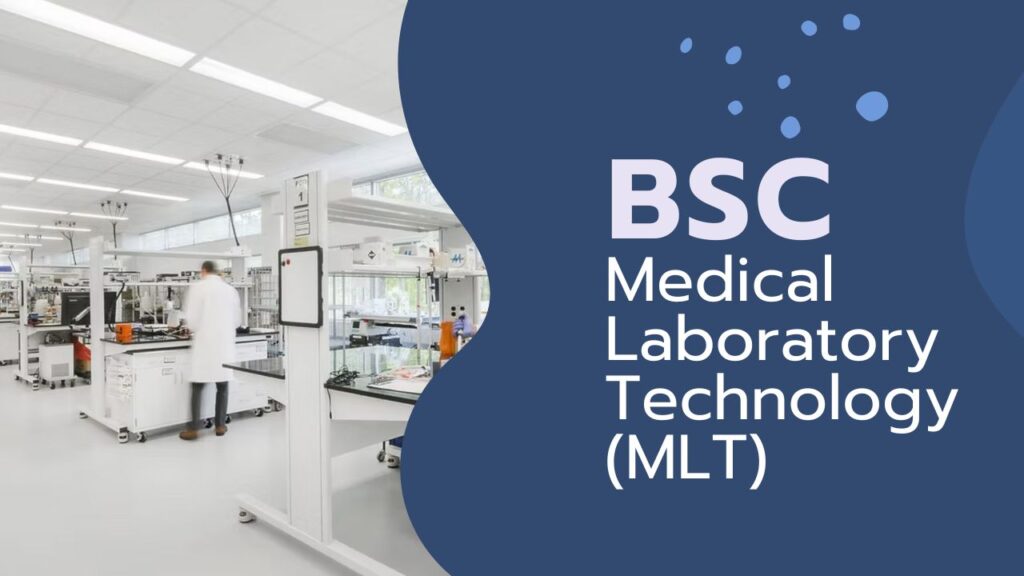
BSc Medical Laboratory Technology (MLT): Course, Fees, Career & Scope in India

BSc Medical Laboratory Technology

Imagine being the silent crusader for every correct diagnosis, working your magic inside blood samples, body fluids and tissue slides to find secrets that physicians need to know to save lives. That is the magic of BSc Medical Laboratory Technology (MLT). If you are scientific, you love precise work, and want a solid and stable career in health care, but don’t want the frenetic pace of working directly with patients, this degree could be just right for you. 

In India, where healthcare is booming, MLT professionals are highly sought after. So, here we go through all you need to know to be able to dig in to this sleeper powerhouse discipline. 

What is BSc Medical Laboratory Technology (MLT)?

The BSc MLT course is basically a three years long undergraduate course (six-month internship in some colleges) which is designed to make you a medical lab technologist. You’ll learn the art and science of analyzing body fluids, tissues, cells and microbes in clinical laboratories. Consider it detective work in a white coat: gathering samples, running tests on machines such as microscopes, analyzers and polymerase chain reaction (PCR) units, and producing results that influence treatments for everything from infections to cancer. 

The curriculum is a mix of biology, chemistry and technology. 

  • Year 1 involves Fundamentals such as human anatomy, physiology and biochemistry. 
  • Clinical microbiology, hematology (study of blood), and immunology by year 2. 
  • The final year is a rush with supplements such as histopathology (study of tissues), blood banking and molecular diagnostics. Practical laboratory sessions constitute 40-50 per cent of the course, so prepare for a lot of practicals. 
  • The best of institutions like AIIMS Delhi, Manipal University, Jipmer Pondicherry provide it with world class facilities, often including certification in lab automation. 

Who Can Jump In? Eligibility and Admission Scoop

You are considered eligible if you have obtained at least 50% in Physics, Chemistry, and Biology (PCB) from a recognized board – relaxed to 45% for reserved categories. Most private colleges don’t require NEET, while government ones may require state-level exams like KCET or MHT-CET. Most private unis are merit-based or have their own tests.

The admission season is followed after 12th boards, May-July. Apply online on the college portals– application fees range between Rs 500 to Rs 2000. Pro tip: Create a beachhead profile with science projects or volunteer work in labs; it shines in interviews. 

Fees, Scholarships, and ROI

  • Cheap but really beneficial—that’s BSc MLT for you. The fee of government colleges range around 10,000–50,000 per year, so the total fees of the course would be approximately 30,000 — 1.5 lakh.
  • The cost of private colleges is high and ranges between 1–3 lakh per year (rough 3–9 lakh in total). 4-5 lakhs can be charged by the top class institutes such as Symbiosis, Pune. In the range of ₹50,000 — ₹1 lakh per annum will be your hostel and books additional cost. 
  • Scholarships reduce the burden: Post-Matric for SC/ST from the State and Central government, merit scholarships from AICTE. 
  • Most of the institutions have 20-50% waivers for the toppers. ROI is stellar, starting salary ₹3-6 LPA, scaling to ₹8-15 LPA in 5 years. Compare that with the cost of the course, and it’s quite a smart bet. 

Skills You’ll Gain From BSc MLT Course 

This isn’t just book learning, it’s skill-building gold. You’ll learn phlebotomy (blood drawing), use high-tech equipment such as flow cytometers, learn quality control and even bioinformatics for genetic testing. 

Soft skills: Accuracy, good attention to detail, and ethics required—there is potential for misdiagnosis if a single mistake is made. 

A day in the life: Mornings are often spent collecting samples, then running tests such as CBC, ELISA, and cultures. The position also requires calibration of instruments and result reporting via LIS software. 

Hospital shifts can be demanding (8–12 hours), whereas diagnostic labs usually provide ordinary 9 to 5 hours office-based positions. 

Read More 👉 CTET Exam 2026: Check Exam City, Notice, Exam Dates, Syllabus and Eligibility Information

Future Opportunities For Students

Graduates are not left in labs for eternity. 70% of alumni are hired as lab techs or supervisors (₹25k-50k/month in the beginning) by hospitals (Apollo, Fortis). 

₹30k-60k work offer with diagnostics like Dr. Lal PathLabs or Metropolis. 

Government jobs through ssc, esic or state health services are also there with a good package of ₹35k+ along with benefits, crack exams ssc, junior paramedical.

So what about Advanced options? 

You may select from choices such as MSc MLT, PGDM in Hospital Management, or a PG Diploma in Cytotechnology, Histopathology or Forensics. A Salary of ₹10–20 LPA is possible. On the international front, the US and Canada are among the top seekers of certified MLTs. Professionals are able to make $50,000 or more per year by passing the ASCP exams. 

Career RoleAvg Starting Salary (₹ LPA)Top Employers
Lab Technician3-5Hospitals, Clinics
Medical Lab Supervisor5-8Diagnostic Chains
Blood Bank Technologist4-6Red Cross, Govt Hospitals
Research Associate4-7ICMR, Pharma Cos
Quality Control Analyst5-9Biotech Firms

Challenges and the Bright Side

There are also challenges including long hours, exposure to biohazards (so the right PPE is the must), and having to keep pace with new technology, including AI-driven diagnostics. But the advantages are clearly more than the disadvantages. 

The fact that healthcare jobs are expanding rapidly (at about 15% each year, according to NITI Aayog), private labs provide a superior work-life balance, and the soft assurance that your work really helps people, even if it’s behind the curtains. 

Conclusion

In a society that worships doctors and nurses, BSc Medical Laboratory Technology (MLT) is the silent force behind 70% of medical decisions. If you are detail oriented, love science, and want to future proof your career, then go for it. India’s healthcare industry requires an additional two million laboratory professionals by the year 2030, your spot awaits.

Check NAAC-accredited colleges and start prepping. This degree is more than just a credential, it is the key to a fulfilling life that is recession-proof in healthcare. 

Leave a Comment

Your email address will not be published. Required fields are marked *

NEST Result 2025 Declared – Download Scorecard & Check Rank Now!

NEST Result 2025 Declared – Download Scorecard & Check Rank Now!

Candidates can now check their NEST score as it is released on the official website. If you have also given the NEST exam in 2025, you can check the result. The entrance exam is mandatory for admission to the National Institute of Science Education and Research, Bhubaneswar, and University of Mumbai – Department of Atomic Energy Centre for Excellence in Basic Sciences (UM-DAE CEBS), Mumbai. 

Eligibility for Admission 

Candidates must pass the 12th class for the admission in the university with a 60% score from a recognized board in India. They should clear the NEST Exam to be eligible for admission.

SMAS Scores for the NEST Result

SubjectsGen/EWS/JKOBCSC/ST/PWD
Biology 8.6527.784.32
Chemistry 9.6468.684.83
Mathematics9.8378.854.91
Physics9.818.824.90

Read More 👉 Rajasthan High Court Peon Recruitment 2025 Out for 5670 Posts – Apply Online Now!

Guide to Download the Result for NEST 2025

  1. The result link is given on the official website, candidates can visit there.
  2. Click on the link “Nest 2025 Result”.
  3. Log in with your credentials.
  4. Click on the submit button, the result will appear on the screen. 
  5. You can download and print it out.
Important Links
Check ResultClick Here
Information BrochureClick Here
Official WebsiteClick Here

Leave a Comment

Your email address will not be published. Required fields are marked *

PNB LBO Application Form 2025 — Apply Online For Local Bank Officers 

PNB LBO Application Form 2025

Punjab National Bank (PNB) has officially released the notification for the recruitment of Local Bank Officers (LBO) for 2025. Candidates who are waiting for this position can apply now through the official website of PNB. Application Schedule, What is the Application Schedule for BO 2025? This recruitment drive is 750 vacancies. For the eligibility criteria, age limit, education, job profile, syllabus, exam pattern and other important information, the candidates should go through the detailed notification. 

A direct link for notification download and further updates on recruitment process will be provided on the official website. Applicants are advised to submit their applications at the earliest and ensure that they fulfill all the criteria as mentioned in the notification. 

Quick Info About PNB LBO Recruitment

OrganizationPunjab National Bank
Exam NamePNB LBO 2025
PostBank Officers
Post Vacancy750
Application Last Date23/November/2025
Official WebsiteClick Here

General Dates For PNB Local Bank Officers Recruitment

EventDate 
Application Begin03/November/2025
Application Ends On23/November/2025
Last Date for Fee Payment23/November/2025
PNB LBO Admit Card AvailableBefore Exam
PNB LBO Exam DateDecember 2025 OR January 2026
PNB LBO Result 2025Update Soon

Category Wise Application Fee

CategoryFee
General / OBC / EWSRs. 1180
SC / ST / PHRs. 59

Read More:- RPF Sub-Inspector Exam: Your Complete Guide to 2025 Recruitment

Guide To Apply Online For PNB LBO Recruitment

Candidates need to read the official notification and apply for PNB recruitment 2025. Candidates must have a graduation degree in any course and age criteria must meet the age limit (20–30 years) of this post.

  • You must read the notification before you start to apply. 
  • To avoid errors, candidates are recommended to ensure that they fill in all required information including name, parents’ names, date of birth, address and educational qualifications properly in the application form. 
  • Ensure you upload all the documents in the right size and format( pdf or jpeg) if required by the application form. 
  • Before you submit the form, check that all the details you have entered and the documents you have uploaded are correct. 
  • When you have submitted your application successfully, it is advised to take print out of application form or save in pdf format for future reference. 

The following tips will make your Punjab National Bank Recruitment 2025 application easier. 

Useful Links
Apply OnlineClick Here
Download NotificationClick Here
Official WebsiteClick Here

Leave a Comment

Your email address will not be published. Required fields are marked *

Latest UPSC Notification & Exam Pattern Changes For 2025

UPSC Notification & Exam Pattern Changes

If you are preparing for the UPSC exam then getting every update for the exam is necessary to appear in the exam and achieve your goal. Get UPSC Notification for UPSC CSE 2025 Exam which will happen in 3 phases—Prelims, Mains, and Interview. Aspirants should prepare according to the exam pattern. You can check the eligibility criteria, and exam pattern in this article.

Highlights Of The UPSC Exam

Conducting ByUnion Public Service Commission
Exam NameUPSC Civil Service Exam
PostsGroup A & B Officers
Vacancy1129
Selection ProcessPrelims, Mains, Interview
Starting SalaryRs. 56,100 per Month
Notification Release22/January/ 2025
Application Starts On 22/January/ 2025
Application Ends On11/February/ 2025
UPSC Prelims Exam Date25/ May/ 2025
UPSC Mains Exam Dates 22, 23, 24, 30, & 31/August/2025
Final Result Update Soon

Exam Pattern for UPSC Exam 2025

Prelims: General Studies and CSAT, the two objective types of paper are conducted in prelims. Candidates must complete the first paper within 2 hours, the same duration applies to 2nd paper 2 too. Each paper is holding 200 marks, negative marking of 1/3 for every wrong answer. 

CSAT Qualifying: 33% is the least to get in Paper 2 (CSAT) for clearing the exam and there is no change in the marking scheme. 

Mains: Nine papers descriptive in terms 3 hours each, total marks 1750. 

Interview: Personality Test is conducted of 275 marks

No major changes: In exam pattern for 2025, just procedural changes happen this year and you can find the updates on the official website.

Read More 👉 RBI Grade B Admit Card 2025 – Direct Download Link, Exam Date & Instructions

Eligibility Criteria

Age LimitGeneral: 21 to 32 years
Age Relaxation for Reserved categoryOBC: up to 35 yearsSC/ST: up to 37 yearsPwBD: up to 42 years
Education QualificationGraduate degree or final-year students eligible but they must provide proof of their education until Mains stage
Attempts6 (General), 9 (OBC), unlimited for SC/ST

Useful Links

NoticeClick Here
NotificationClick Here
Official WebsiteClick Here

Leave a Comment

Your email address will not be published. Required fields are marked *

Top Courses After 12th Arts With High Salary – Best Career Paths Revealed!

Top Courses After 12th Arts With High Salary – Best Career Paths Revealed!

Students might get confused with their career after completing 12th. If you’ve completed your 12th with Art’s stream then here are the top courses after 12th arts that will enhance the knowledge required for the competitive exams. It ensures job security, career stability and high salary. For a brighter future, you must choose the right career for yourself.

Other courses offer a lot of opportunities for high salaries. After 12th arts students can select the course that aligns with their interest. Whether you’re interested in journalism, fashion designing, or social working, the pay scale is higher than any corporate jobs.

Before introducing the top courses, I want to clear one thing for you, if you’re interested in a government job then these courses will help you learn the concepts which also help you clear the exams. By developing particular skills that are required for your path can help get a high salary. 

The course involves a syllabus related to the governance and public administration which is crucial to understand for the government department. Students must learn about the operations of government institutions, policies, and administrative processes. 

Career Opportunities: After BA in Public Administration can open up many career paths for you. This opens up for you a chance to be an IAS officer or IPS officer, it is not just a job but a pride to serve a nation, there are a lot of opportunities for you. 
Government Roles: IAS, IPS, IFS come in civil services, Government Administrative Services, Public Relations Officer, Administrative Officer, Public Policy and Research.
Salary Expectations: starting pay for the roles is ₹50,000 and rise up with experience to ₹2,50,000 per month

This course improves the understanding of management processes in the government department. Students must learn and focus on tasks and functions in the economics foundation so that they can understand these concepts and clear the recruitment process while the government bodies conduct competitive exams for various post related managerial departments.

Career Opportunities: You can work in both government or non-government organizations. But working in a government organization will enhance your chance of additional perks and future stability, management and entrepreneurship roles are required in the organizations to handle larger projects.

Government Roles: Administrative Officer, Finance Officer, Clerk, Assistant Manager, and Project Coordinator.
Salary Expectations: Starting Pay is ₹30,000 with level of positions, salary will increase to 1,00,000 per month

A law degree is very beneficial and has a lot of opportunities for career growth in the government sector. Students who are interested in law and justice can pursue this degree. It involves the legal system and laws.

Career Opportunities: From Advocacy in courts to the legal advisory in state government, there are multiple roles with higher salaries. Law and governance are big paths to achieve but focusing on the preparation for the exam can help you achieve your goal.

Government Roles: Judge, Magistrate, Legal Officer, Legal Advisor, Law Officer, Advocate for Central or State Government.
Salary Expectations: Salary is around ₹50,000 and raises to ₹1,00,000 per month.

If you want to become a teacher in a government school, you can pursue a Bachelor of Education which allows you to become a professional in teaching and make a stable career. This job pays on a high scale with additional benefits. Students can consider choosing this path with a specific subject so that they can teach in higher standards. This degree developed teaching skills and support with placement from many colleges.

Career Opportunities: Teaching roles in school, colleges, and universities, consultancy, administrative position in institutions. 
Government Roles: Primary Teacher, Assistant Professor, Lecturer, Trained Graduate Teacher, Post Graduate Teacher, Principal.
Salary Expectations: ₹40,000 to ₹70,000 per month. With experience it will increase up to  ₹1,50,000 per month.

Read More 👉 Top 10 High Salary Courses After 12th Science Without NEET – No Medical Exam Needed

Students who are interested in broadcasting, engaging in writing, observing, and also debating can choose this path. It requires people who investigate and write about it in an eye-catching way. However, old traditional ways for reporting news are changed now. Students more often have knowledge on digital media such as social platforms, web portals, or any other channel to report and engage in broadcast journalism.

Job Roles: Reporter, editor, News anchor, Photojournalist, Media Director, Social media manager, and Content writer.
Salary Expectations: 4-10 LPA, based on the experience and level of the journalists. 

Bachelor of Design (B.Des)

Students with the creative mind and designing skills can focus on this degree. It offers multiple opportunities in government departments dealing with culture programs, urban planning, and designs. Specializations include interior design, fashion design, and many more.

Government Roles: Designer required for heritage projects, cultural projects, Urban Planner.
Salary Expectations: ₹40,000 to ₹1,00,000 per month.

Students can pick this course, if they want to work for poor childrens and disabled people. It prepares students for roles to handle welfare programs and events for any organizations that helps to achieve their motives of building community.

Government Roles: Social Welfare Officer, Community Development Officer.
Salary Expectations: ₹30,000 to ₹75,000 per month.

The key is to align your career goals with your interests and natural skills. It totally depends on the efforts, strength, and your weaknesses. Research about the job roles and career scope with particular courses. Whether it is BA, BBA, Law, or Journalism without knowing the scope you can’t decide. 

Take career counselling, it helps many students to choose the right path for themselves. Don’t waste time by pursuing a degree with no scope for you.

By getting this, you can choose the right course and prepare for the path so you can beat their examination for entering into the field. Sometimes the path is tough to clear out but with the focus and right pattern, you can achieve your goal.

By choosing the right course and preparing for the competitive exam, Arts students can achieve their goal. For high salary roles students must have developed their skills under these programs so they can build a rewarding career with job security and financial stability. 

Leave a Comment

Your email address will not be published. Required fields are marked *

Allied Medical Courses Roadmap 2026: Eligibility, NEET, Courses & Career Scope

Allied Medical Courses Roadmap 2026: Eligibility, NEET, Courses & Career Scope

In the constantly changing healthcare environment, the focus is changing. Doctors and nurses may be the public face of medicine, but there is a whole engine room of professionals holding the system together: the Allied Health Professionals. To become one, you need to break down the Allied Medical Courses Roadmap.

If you have ever asked yourself questions like “who runs that fancy MRI machine?”, “who handles the complex chemistry of a pathology lab?”, or “who assists a runner to walk again after a devastating injury?”, you have now become the proud owner of a glimpse into the world of Allied Health. 

As the 2026 Union Budget announced the addition of ten new allied health disciplines and targets to train one lakh professionals in five years, there is no better time to chart your path in this domain. 

What are Allied Medical Courses?

Allied Health Sciences (AHS) are career options in the healthcare sector where professionals work in tandem with doctors and provide diagnostic, technical, therapeutic and other support services. These courses are specialized rather than comprehensive like an MBBS. They’re the hands-on, practical side of medicine—taking the technology and therapy and making them work to save lives. 

Who Can Choose Allied Medical Courses?

These are the courses that are available for science stream students after 12th, and they consist of theory, practicals and also internships. Unlike MBBS, they are open (3-4 years), cheap (₹50k-₹5 lakhs total), and now NEET-compulsory under NCAHP for uniformity. Perfect for students looking at colleges like King George’ Medical University or the privates. 

Allied Medical Courses Roadmap

Charting a course for this vocation from high school to the hospital is going to be a bit of a balancing act, particularly with new rules set to be implemented in 2026. 

1. The Foundation (Class 12)

Allied health programs require a science core including physics, chemistry, and biology (PCB). Although certain diploma courses earlier admitted students from other streams, the drift in 2026 is towards making science a single stream for clinical jobs. 

2. The Entrance Era (NEET 2026 onwards)

As per the notification of National Commission for Allied and Healthcare Professions, NCAHP dated 31st May 2023 NEET UG is going to be made compulsory for admissions in various undergraduate allied courses from 2026-27. It implies that the “non-NEET” option to some of the best institutes is being gradually closed, which will help enhance the quality and professional recognition of the graduates. 

3. Choosing Your Path: Degree vs. Diploma

Bachelor’s Degree (B.Sc./BPT): Normally 3 to 4.5 years. They offer more theoretical knowledge and are oftentimes necessary for obtaining work permits in other countries.

Diploma (DMLT/DRT): 2 years in general. These “accelerated” tracks offer a practical focus on talent for students interested in moving quickly into the workforce. 

Read More:- UPSC Civil Services IAS/IFS Pre Recruitment 2026:  Notification, Dates & Apply Complete Guide

Top Allied Medical Specializations for 2026

CourseFocus AreaRole
BSc (MLT) — Medical Lab Technology Studying samples like blood, tissue, and other body fluids.Lab Technologist
Bachelor of Physiotherapy — BSc (BPT)Helping in regaining strength through Physical rehabilitation Physiotherapist
BSc with Radiology & ImagingScanning through X-rays, CT scans, and MRIs to detect injuriesRadiology Technologist
B.Sc. Anaesthesia & OT TechSupporting surgeons and managing ICUs.OT Technician
B.Sc. Cardiac Care TechnologyMonitoring heart health and ECGs.Cardiac Technician

Why Choosing an Allied Medical Courses Roadmap is Right?

Entry to workforce more quickly

While an MBBS requires 5.5 years (plus specializations), most allied health programmes make you career-ready within 3 to 4 years. This is your lane if you just want to start making a difference and earning sooner.

High Demand

There is a massive demand for healthcare technicians worldwide and skilled professionals capable of meeting that demand are difficult to find, making it a path to high opportunity around the globe. Expansion of the Regional Medical Hubs (introduced in 2026 Budget) is expected to generate thousands of jobs in diagnostics and rehabilitation in India alone. 

Technological Integration

If you’re a gadget geek or tech enthusiast, then Allied Health is the way to go. You don’t just read charts, you’re running some of the most sophisticated AI-enabled machines on the earth. 

Future Scope and Salary

The era when Allied Health was considered a “plan B” is behind us. By 2026, the starting salaries of freshers can vary from ₹2.5L per annum to ₹5L per annum based on the specialization. Specialized positions such as Perfusionists or Cardiac Technicians also attract even higher premiums.

Additionally these degrees have great international mobility. Countries such as the UK, the UAE and Canada have specific visa tracks for Allied Health workers, so this is really your ticket to a global career. 

Conclusion 

The Allied Medical Courses Roadmap isn’t a secret trail anymore — it’s a fast moving highway. With a government emphasis on skilling and the standardization of entrance exams, these professions are enjoying a newfound prestige.

If you love science but don’t want to go to medical school for ten years, the Allied Health track is a balanced, tech-forward, and profoundly satisfying way to go. 

Leave a Comment

Your email address will not be published. Required fields are marked *

Scroll to Top