UPSSSC Mukhya Sevika Salary 2025 – Check Pay Level, Job Profile & Perks

UPSSSC Mukhya Sevika Salary 2025

For those prospective female candidates, Uttar Pradesh Subordinate Service Selection Commission (UPSSSC) Mukhya Sevika post is a great chance. Choosing a career in government service can alter the course of an individual’s life. But even as of 2025 this role remains a highly prestigious and solid one and keeps on with professional development and welfare of community and women empowerment. With the 2025 updates of UPSSSC Mukhya Sevika Salary and official information, you can choose the right path. Here are all the details including benefits, job description, eligibility, and recruitment process.

Mukhya Sevika (female head supervisor) job, in Child Development Services and Nutrition Department in Uttar Pradesh. This post entails monitoring Anganwadi centers, implementing welfare schemes for children and women, and ensuring smooth functioning in districts. The recruitment is conducted by the UPSSSC and the process is only for female graduates and has excellent potential for societal good and job security. 

UPSSSC Mukhya Sevika Salary Structure

The application of UPSSSC Mukhya Sevika comes with an princely sum of benefits under the 7th Pay Commission, so you can say that the salary is another compelling reason to apply for this post.Here is the latest details for 2025: 

Pay Level5 (Pay Band-1)
Grade Pay₹2,800
Basic Salary₹29,200/month
Dearness Allowance (DA, 38%)₹11,096/month
House Rent Allowance (HRA, 27%)₹7,884/month
In-hand Salary (Min.)₹39,596/month
Gross Salary (Est.)₹42,000–₹45,000/month
After Deductions₹37,000–₹43,000/month

The salary consists of the basic pay, dearness allowance as applicable from time to time and house rent allowance as per city classification. It also includes other state allowances and deductions. After standard cuts for pensions or NPS contributions, take-home pay can land anywhere between ₹37,000 and ₹43,000 a month. This makes it one of the highest paying graduate jobs in social work. 

Benefits and Perks

  • Pension
  • Insurance Coverage
  • Leave Travel Concession
  • Medical Reimbursement
  • Leave Encashment
  • Official Transport Allowance
  • Other Allowances

Every month employees are also sent a detailed salary slip where the salary, allowances and deductions are mentioned - this is necessary for availing loans and for other official work. 

Job Profile of Mukhya Sevika

A Mukhya Sevika in 2025 will have a host of responsibilities to be fullfilled besides being an office administrator. It involves supervision of Anganwadi Centers under the assigned blocks and ensuring successful implementation of various state and central schemes for women and child welfare. Supervision of Mukhya Sevika is also responsible for organizing training programs for Anganwadi workers and helpers. 

Among their priorities, they run awareness drives in rural and semi urban pockets focussing on educating the community on education, nutrition and health. They have to monitor and follow up on key activities related to immunization, nutrition and education outreach to ensure timely implementation and progress. To keep transparency and accountability, data and updates need to be reported regularly to the higher authorities. The position requires working closely with government departments and health offices to coordinate and monitor that the general development and assistance schemes are adequately being delivered to target populations. 

Read More 👉 BTech CSE Fees at IIT Delhi – Latest Fee Structure and Scholarships

How You Get Selected

Eligibility: This position is only for female candidates. Candidates should have a degree in Arts with subjects like Sociology, Social Work, Home Science, Nutrition and Child Development. Age Limit: 21 to 40 years as on July, 2022. Reserved categories are given relaxation in age. 

Preliminary Eligibility Test is mandatory to apply.

Written (Mains) Exam: Candidates have to appear in an OMR-based written exam of 2 hours, 100 questions (1 mark each) is conducted in a paper, with a ¼ mark penalty for wrong answers.

Document Verification: All the documents to prove your previous qualification, identity, and cast are necessary to attach.

Final Merit List: After the exam, candidates are shortlisted according to their scores with category-wise cut offs

UROBCSCSTEWS
67+62+56+47+58+

Opportunities After Joining—Career Development

Promotion from Seniority: Advancement into senior supervisory and management positions within Child Development Services is based on strong performance and years of experience.

Departmental Exams: Successfully completing additional examinations at the departmental or state level facilitates advancement to senior administrative positions.

Professional Training The Government offers regular training modules on community health, nutrition, management and leadership.

Lead Larger Teams: Agencies may also offer their best employees the opportunity to become Senior Mukhya Sevika or Block Supervisor to lead larger teams, and so on.

Transfers within the Government and Variety in Posts: Staff can apply to transfer to other districts for family reasons or professional development. 

Conclusion

UPSSSC Mukhya Sevika is a good career in the government sector with good salary, job security and service to the society. Since 2025, the company is known for having the best entry-level salaries and benefits for college graduates. And the job also establishes stronger local communities, because so much of child and women’s welfare work is done there. There’s a transparent hiring process, predictable promotion trajectory, and strong perks. This role is ideal for females seeking meaningful work that makes a difference and enduring career success. If you are eligible, prepare to take the lead in ushering change in Uttar Pradesh. 
Leave a Comment

Your email address will not be published. Required fields are marked *

Indian Police Service IPS: How to Crack and Become IPS Officer

Indian Police Service

If you’re dreaming about the Indian Police Service (IPS) standing tall as a law and peace officer in the Indian Police Service. Whatever got you started on this dream, pursuing it in real life is more than just a passion to do. It requires a sharp strategy to prepare accordingly and what’s right to study. Not everything is important. 

Instituted in 1948 as a successor to the British colonial-era Indian Imperial Police, the IPS is the ground holder of India’s internal security system. But the reality check is that every year lakhs of candidates chase this dream and only a few hundred come out successful. So what separates those who make it and those who don’t? More often than not, it is the preparation strategy. 

Understanding the Battlefield: The Three-Stage War

Know what you are getting into before you go to the books and notes. The UPSC Civil Services Examination (CSE) is a rigorous three-tiered exam which tests not only your knowledge but stamina, analytical abilities & character. 

First Level— The Preliminary Examination 

Think of the Prelims as the bouncer at the door to that exclusive club — it sifts out the wheat from the chaff. It consists of two objective papers, each of two hours duration and carrying 200 marks. 

Paper – I is General Studies—current events, history, geography, polity, economy, environment and general science. The Civil Services Aptitude Test (CSAT), now known as Paper II, tests your concepts on comprehension, logical reasoning, decision making and basic numeracy. It is qualifying in nature and it just needs 33% to pass.  

Do not make the mistake to understand that Prelims score is gonna add in the final merit list, it’s important to score for going into the next stage but it doesn’t hold final value. So don’t get that to take it lightly because 97-98% of candidates are eliminated at this stage. 

Second Level: The Main Examination 

If Prelims is a sprint, Mains is like running a marathon. Nine descriptive papers across a few days with a total of 1750 marks designed to push how well you know what you know and how well you can express complex thoughts when you’re under a lot of stress.

The pattern is: two qualifying papers (English and an Indian language), one Essay paper (250 marks), four General Studies papers ranging from Indian heritage to ethics and integrity (250 marks each), and two papers on your chosen Optional subject (250 marks each).

The hard copy elective also has an impact on your total score with a weightage of 500 marks. Choosing the appropriate subject is very important. Although you have a whole bunch of popular subjects like Geography, History, Public Administration, Political Science etc, it is always advisable to go with the subject you are really interested in rather than seeing what others have taken up. 

Third Level: The Personality Test (The Interview)

The remaining 275 marks are given in the Personality Test, during which an UPSC panel evaluates your mental alertness, critical thinking, communication skills, leadership potential, and moral uprightness. They don’t want to know-your-everything; they want well-rounded people who can manage the enormous burden of public service. 

Check Your Eligibility For Indian Police Service

Nationality

IPS is only open to Indian citizens. The UPSC CSE permits Nepali, Bhutanese and Tibetan refugees (who came before 1 January 1962) to apply for certain services like IAS and IFS, the Indian Police Service, however, is limited to Indian citizens. 

Qualification

You must have a bachelor’s degree from a recognized university – all streams are acceptable.  If you’ve studied English Literature, Engineering or Zoology, you can apply.

Important caveat for final-year students: You may apply for the Preliminary examination as a final year student, but you need to submit degree certificate before going in for the Mains.  Don not count on your provisional certificate to arrive in time—make your plans accordingly.

Final MBBS students can also apply, but they have to submit a certificate from their university. 

Age Limit

CategoryAge LimitCut-off Birth Date (for 2026 exam)
General/EWS21-32 years2/August/1993 to 1/August/2005
OBC21-35 years (3 years relaxation)2/August/1990 to 1/August/2005
SC/ST21-37 years (5 years relaxation)2/August/1988 to 1/August/2005
PwBD21-42 years (10 years relaxation)2/August/1983 to 1/August/2005
Ex-servicemen5 years relaxation2/August/1988 to 1/August/2005

Attempts Restrictions

CategoryNo. of Attempts
General/EWS6 attempts
OBC9 attempts
SC/STUnlimited (until age 37)
PwBD9 attempts (until age 42)

The Physical Reality: More Than Just Books

Unlike IAS, Indian Police Service has certain physical eligibility condition which you need to fulfill. Male candidates should have a minimum height of 165 cm (160 cm for ST and some other categories) and must have chest measurements of 84 cm along with expansion. Female applicants need 150 cm height (145 cm for ST) .

Myopia shall not be more than minus 4.00D and hypermetropia shall not be more than plus 4.00D. Color blindness is a disqualification as well as squint. Begin training for your physical fitness right away — don’t wait until you have the written exam behind you. 

Height Requirements category-wise:

CategoryMaleFemale
General/OBC/SCMinimum 165 cmMinimum 150 cm
ST (except SC/OBC)Minimum 160 cmMinimum 145 cm
Gorkhas, Garhwalis, etc.Minimum 160 cmMinimum 145 cm

Read More:- AIIMS Nursing Officer Recruitment (NORCET-10) – 3600+ Vacancies, Eligibility, Exam Date & Apply Online

Application Process To Apply

  1. Stay tuned to the official UPSC website for the latest updates/notification of IPS. 
  2. After the notification is released, download it carefully and go through all the instructions and wait for the online process to start.  
  3. Check all the dates and fill the application before the deadline. 
  4. Fill valid and correct details in the form and then attached requisite documents with the application.
  5. Submit the form and the application fee is applicable.
  6. Print it for the proof in future and prepare yourself for the toughest examination.
CategoryFee
General/EWS/OBC (Male)₹100
SC/ST/PwBD/Female (All categories)Exempt (₹0)

Conclusion

Becoming an Indian Police Service officer is not only about passing an exam, it’s about dedicating oneself to a life of discipline, service, bravery, and accountability. Everything about the process, from meeting the eligibility and physical criteria to surviving one of the most competitive exams in the country, requires one to be consistent, resilient and long-term driven. Luck or short-cuts don’t make you succeed in this path- it takes strategy, smart preparation, mental toughness and commitment.

If you really want to see yourself in that uniform, leading from the front and serving the country, begin today—lay your groundwork, condition your body and mind, and approach preparation as a way of life, not a phase. The road to IPS is tough, but to those who make it through, it is one of the most dignified and influential careers in India. 

GovUpdatewala is your trusted source for real-time updates on government exams and jobs in India. We provide verified info on SSC, UPSC, Banking, Railways, Defense, and Teaching exams. From syllabus and patterns to important dates and career tips — we support aspirants at every step.

Leave a Comment

Your email address will not be published. Required fields are marked *

JEE Main Result 2026 – Eligibility, Syllabus, Dates, Pattern Explained

JEE Main Result

The JEE Main 2026 exam has been made the necessary academic test for Indian engineering aspirants since now for the engineering aspirants. On 16th February 2026, candidates who appeared for the exam will be able to check the JEE Main Result 2026 for January session. JEE Main is a system that requires one to be mentally strong, strategically enduring and regulation-tight  not only about ability. 

JEE Main Result the gateway exam for prestigious technical institutions in the country including the National Institutes of Technology (NITs), Indian Institutes of Information Technology (IIITs), and Centrally Funded Technical Institutes (CFTIs) the exam goes through a scale of participation that is unprecedented globally. Because it also serves as the single entrance path to the JEE Advanced, it represents a major turning point for the Indian education system. 

The information shows a strong increase in registrations with more than 1.35 million candidates for Session 1 alone. This demographic bulge requires a granular analysis of the test’s structural elements, including eligibility rules and the statistical normalization of scores. 

NTA Reforms & Administrative Changes in JEE Main 2026

In a bid to ensure the sanctity of the procedure, the NTA has brought in game changing measures:

  • Biometric Security : Now there is a “Live Photograph” taken during application that restricts impersonation.
  • Operative Changes: The test will be given on multiple dates and will require an advanced statistical “normalization” process to equate different levels of difficulty.
  • JEE Main Result Timeframes: Although administrative delays such as the Session 1 result postponement from February 12 to February 16, 2026 — do induce stress, they are vital for thorough validation of data. 

Examination Schedule and Timeline 

The NTA has adopted a two-tier system for the hour long sessions, offering candidates a tactical cushion. This enables students to view the January attempt as a baseline and the April attempt as a fine-tuning move.

The JEE Main Result 2026 Session 1 

Paper 1 (B.E. / B.Tech) was held on January 21, 22, 23, 24, and 28 over multiple days, while Paper 2 (B.Arch/Planning) was held on January 29.

The JEE Main Result delay is due to the complexity of the normalization process, it is now expected on February 16. For the NTA to be fair, it must normalize the scores within the millions of data points. 

Session 2 Dates 

EventSession 1 (January)Session 2 (April)
Application WindowConcluded1—25/Feb/ 2026
Exam Dates21–29/Jan/20262–9/Apr/2026
JEE Main Result Declaration16/Feb/202620/Apr/2026 (Expected)

Eligibility Architecture: The 75% Rule and Beyond

It is necessary to know the funnel of eligibility to avoid getting disqualified in the stage of admission process.

Age and Attempts Age: There is no upper age limit for JEE Main, however some institutions may have their own fixed limits.

The Three-Year Window: You should have passed Class 12 in 2024, 2025 or appearing in 2026.

Attempts: The exam can be attempted for three consecutive years by the candidates. 

The Performance Threshold

But the access to NITs, IIITs and CFTIs is limited by eligibility criteria that includes:

General/OBC-NCL/EWS: Minimum 75% in aggregate in class 12th.

SC/ST: 65% aggregate minimum.

Option 2: Be in the Top 20 percentile of your respective Board. 

State of Eligibility

Your ‘Home State Quota’ will be decided on the basis of the state of examination of your Class 12, not your residential status. For example, a student of Bihar coaching in Kota (Rajasthan) will come under Rajasthan Home State quota. 

Read More:- Railway RRB ALP Admit Card 2026: Download Now From Direct Link

Examination Pattern For JEE Main

AspectDetails
Exam ModeComputer-Based Test (CBT); focuses on application and speed.
Total Marks300
Duration3 Hours
SubjectsPhysics, Chemistry, Mathematics (each with two sections)
Section A20 Mandatory MCQs per subject
Section B10 Numerical Value Questions (NVQs) per subject; attempt any 5
Penalty Rule-1 negative marking for both MCQs and NVQs; precision required

Subject-Wise Syllabus Breakdown

Mathematics, Physics and Chemistry have strategic places where one must focus to improve performance:

Mathematics:  

Learn Calculus and Algebra well as they are the basics.Don’t ignore Vectors and 3D Geometry as these are very easy and carry good amount of marks in examinations.Also focus on Coordinate Geometry, Matrices and Statistics for high yield.

Physics:  

Concentrate on concepts and the use of the formulas. Modern Physics, Semiconductors = very good marks, not much calculation. Things are inevitably going to move around in your lab, so you need to be comfortable with experimental skills, especially Vernier Calipers and Error Analysis, handy points as well.

Chemistry:  

Chemistry is a very efficient subject for which you could save a lot of time and spend more time in Mathematics.  

Physical Chemistry: Be good at numericals to do well.  

Inorganic Chemistry: Be good in p-block trends;solidify your knowledge of Coordination Compounds.  

Organic Chemistry: Learn the reaction mechanisms and Biomolecules,bcoz they are very important.

Your study time can be better used and your score can be higher by focusing on these areas with the greatest yield. 

Post-Session 1 Roadmap to April

Reviewing how you did in January is the first step towards doing well in April.

  • Category A (98+ Percentile): Begin dedicating 70% of your time to JEE Advanced questions.
  • Category B (90-98 Percentile): Look for “low-hanging fruit.” Earn higher accuracy in Physics and Chemistry to enter the elite group.
  • Category C (<90 Precentile): Go back to basics. Concentrate your efforts on the most common chapters that ask questions instead of covering all the syllabus. 

The “Golden Window”

To Those Who Are Taking Boards In Feb-March The gap between the last Board exam and JEE on April 2 is crucial. Prepare Board to learn NCERT concepts which are directly used in the questions of Inorganic Chemistry and theoretical Physics. 

JoSAA & CSAB Counselling Process 2026

Admissions counselling for engineering in India is not limited to just ranking, as the Centralised Joint Seat Allocation (JoSAA) Authority in six rounds of seat allotment. Candidates may opt Freeze to accept and confirm their seat, Float to accept their seat and appear for seat updation in subsequent rounds, or Slide to retain the seat and try for an improved branch in the same institute. If there are still vacant seats after the JoSAA rounds, the procedure is continued by CSAB through special rounds which tend to be the last chance for many students with lower ranks to get an admission in a reputed NITs and other top institute. 

Conclusion

JEE Main 2026 is not just a good entrance exam—it is a good portal to sift through all the engineering institutes in the top Indian engineering colleges. Success is based on more than just knowledge: you also need to have a plan, be consistent, and make smart decisions. From understanding the exam pattern and eligibility criteria to utilising both attempts to the maximum and managing JoSAA–CSAB counselling effectively, every step will determine your outcome. Clarity, discipline, long term vision and direction in studying helped these students not only to qualify, but to open the right “doors” for their future. 

Leave a Comment

Your email address will not be published. Required fields are marked *

Railway RRB ALP Admit Card 2026: Download Now From Direct Link

Railway RRB ALP Admit Card 2026

The Railway RRB ALP Admit Card 2026 for the CBT 1 is live on the official website for the candidates who have applied for the post can now download the admit card from below and appear for the exam to get a dream job in the Indian Railways. Upon its schedule from 13 February 2026, the admit card is the official ticket telling off that you are going to the exam hall. 

If you have been studying for this exam for months, it’s time to calm down, stay focused, and get organized. Download your hall ticket well in advance and check all the particulars in it thoroughly and also make arrangements to link your transport to the examination centre. 

Now, with a total of 9,970 ALP vacancies to be filled and lakhs of candidates competing for them, every little step now matters — and it all begins with your hall ticket. 

Quick Exam Schedule Guide

StageDetailsTimeline/Status
CBT 1 ExamHeld RRB-wise for 9,970 total vacancies16—-18/February/2026 
CBT 1 Admit CardsReleased online via regional RRB sitesOut since Feb 9, 2026
CBT 1 ResultsMerit lists prepared with normalization for multi-shiftsExpected 2-3 weeks post-exams
CBT 2 ShortlistingAround 150,000 total candidates shortlistedBased on CBT 1 merit
CBT 2 City SlipAdvance info on exam city3-4 days before CBT 2 (pattern-based)
CBT 2 Admit CardDownload from regional sites3-4 days before test date
CBT 2 TentativePer RRB Calendar 2026March—April/2026

Railway RRB ALP Admit Card 2026 Release Update

The Railway RRB ALP Admit Card 2026 has been released on 09th February 2026 on all the regional websites of Railway RRB. This is in regard to the Computer Based Test (CBT 1) to be held on 13, 16, 17 and 18 February. There are no hard copies to be sent—it’s all online, so don’t wait till the last moment. Thousands of aspirants registered for a total of 9,970 vacancies, so this was a golden chance in Indian Railways. 

Read More 👉 BSc Radiology and Imaging Technology: Course, Eligibility, Fees & Career

Step-by-Step Download Guide

The process of downloading is simple, just make sure you follow the steps properly to avoid bugs:

  1. Go to your regional RRB site (like rrbcdg.gov.in for Chandigarh, rrbapply.gov.in for Hyderabad) or the consolidated link at rrb.digialm.com.
  2. Click on the ”RRB ALP CBT 1 exam admit card 2026″ link.
  3. Fill in the Registration Number/User ID and Password/Date of Birth.
  4. Hit “Submit” or “Login,” and your hall ticket will pop up.
  5. Check the details, download the PDF and take 2-3 printouts. Save your backups!

Pro tip : If you panic, forget your password, just click on “Forgot Password” right there. Test Your Login Early to Avoid Getting Clogged Up on Exam Eve. Test your login early to dodge any server rush issues on exam eve. 

What’s Inside Your Admit Card

DetailWhy It Matters
Candidate’s NameConfirms identity
Roll/Registration No.For entry and verification
Photo & SignatureMust match your ID
Exam Date & ShiftNote reporting time (usually 1-2 hrs early)
Centre AddressPlan your travel now
Duration & InstructionsCBT 1 is 60 mins, 75 questions
CEN No. (01/2025)Links to your application

Documents to Carry in Exam 

Remember to carry these following document as it is get you enter the examination hall:

  1. Bring a hard copy of your admit card and a recent passport size photograph. 
  2. a valid original photo ID for verification.
  3. Black or blue ballpoint pen.

Please note:

  • Accessories, bags, and eatables are strictly prohibited in the examination centre.
  • The gate will be shut prior to 8-9 AM, even if you have a late shift.
  • Further stages after CBT 1 are: CBT 2, CBAT, document verification (DV), and medical examination. 

Exam Pattern

PartSubjectsQuestionsMarksDurationNotes
AMathematics, Logic & Reasoning, General Science 10010090 minsQualifying cut-offs: 40% must secure by UR/EWS category candidates/ above 30% for OBC/SC/ 25% for ST 
BRelevant Trade (qualifying only)757560 minsMust pass Part B to proceed
Useful Links
Download Admit CardClick Here
LoginClick Here
Official WebsiteClick Here

Leave a Comment

Your email address will not be published. Required fields are marked *

Meet the Best Hindi Teacher for Competitive Exams Who Can Boost Your Success

Best Hindi Teachers for Competitive Exams – SSC, UPSC, Railway & State Level

Best Hindi Teacher: If you aim to clear the competitive exams like SSC, UPSC, RRB, & state-level exam, right guidance for best scoring is important. And for that, the choice of a teacher matters. While preparing for other subjects likeGeneral Knowledge, Mathematics, Reasoning, and English. Don’t forget to focus on Hindi because it is most important in many government exams. Hindi teachers not only help you by providing the core syllabus but they will prepare strategically for the exam. These teachers have a unique teaching style that will help you understand grammar, comprehension, Letter Writing, Unseen Passages and vocabulary.  

Aspirants can learn easily through their guidance including exam pattern, mock test, and shortcut methods that will help you to memorize. Few teachers provide live sessions, recorded videos, notes, and quizzes, so you can easily prepare for the examination. 

Mock test series will help you in revision and remember that every teacher has their unique way to explain hindi. Take a demo class to select the right teacher whose explanation reaches into your mind. 

Explore best Hindi teachers, they are known for their deep knowledge, best teaching style and make complex concepts of grammar easy for students.

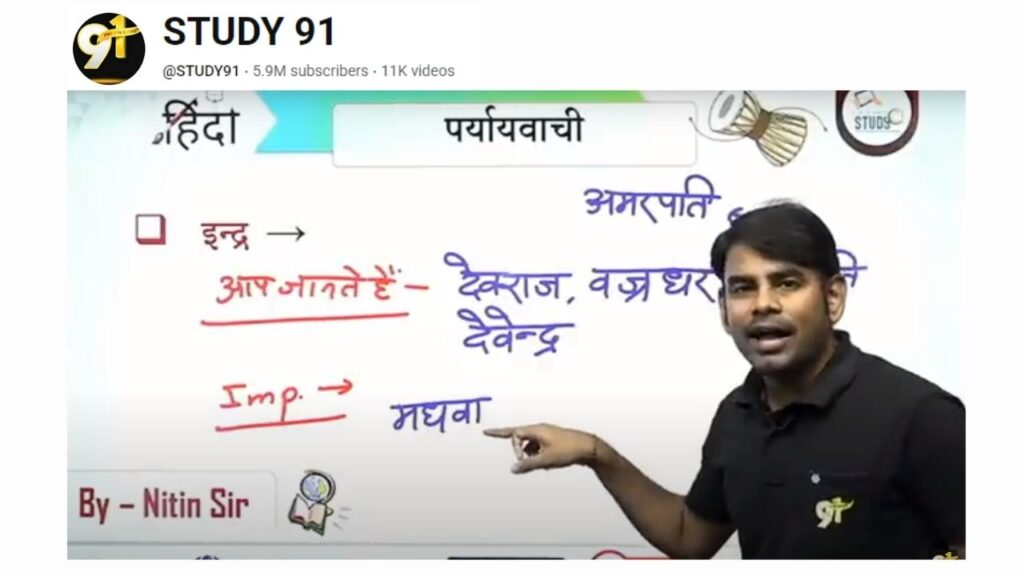
Nitin Sir

Nitin Sir from Study91 is known for clear explanations with a practical approach. He doesn’t just explain from books but tries to relate with real-life examples from newspapers or stories to make the hardest grammar rules easy for students to understand.

Nitin Sir Hindi Teacher Study91

Students easily memorize it, but most importantly they understand why grammar rules are used. He also gives plenty of questions to practice which is the real key to success.

Vivek Sir

Vivek Sir’s creative style of teaching makes him one of the best Hindi teachers in India. Hindi is a language of culture and creativity, according to Vivek Sir. That clearly showed his mastery of story-based teaching style which makes grammar memorable. He uses humour, short stories that don’t make students bored in Hindi classes.

Vivek Sir Hindi Teacher for SSC, Railway, TET

Ideal for those who don’t memorize anything easily and it’s hard for preparing Hindi for exams like Railway, SSC or TET. His method is effective to recall in exams quickly, so these techniques will make students remember even under pressure.

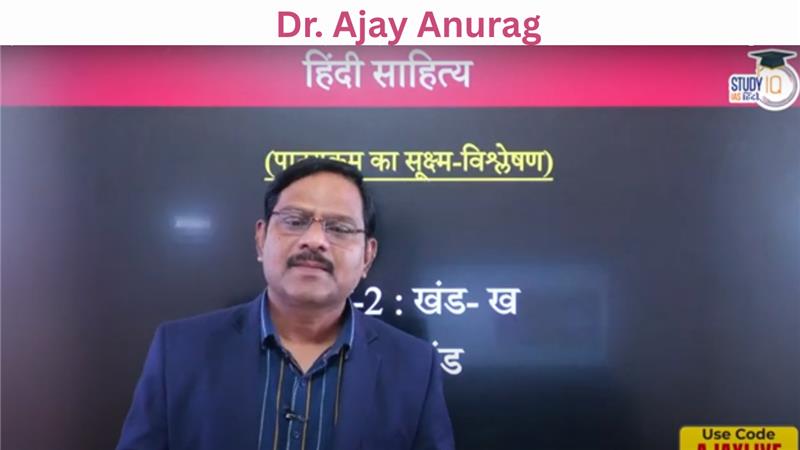
Dr. Ajay Anurag

Dr. Ajay Anurag is a best educator of Study IQ and reputed for his deep knowledge in Hindi grammar and literature. Students looking for one teacher who can teach them both grammar and literature, Ajay Sir is the best choice.

His concept-based teaching makes you understand each topic easily in minimum duration. But he doesn’t rush topics, he explains “why” behind every grammar rule.

Students who don’t just want to learn but understand Hindi topics can easily access his systematic and well-structured lessons. He also provides study material which is so detailed and exam-focused that it makes it easier for the students who are preparing for government exams.

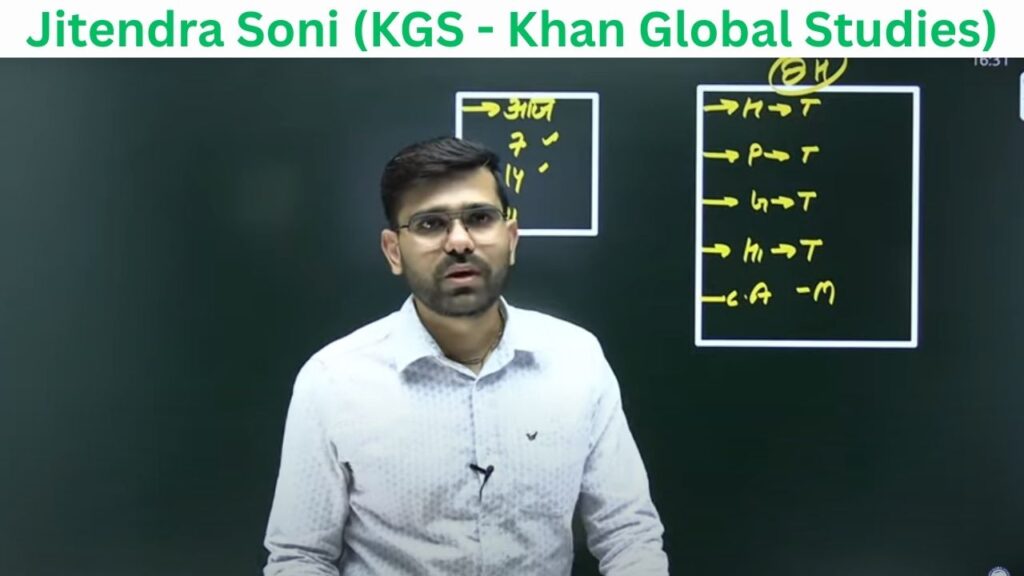
Jitendra Soni (KGS – Khan Global Studies)

He is the best educator of KGS who is extremely popular for his Hindi Foundation Batch. Jitendra Soni is focused on friendly-tone, conduct doubt-clearing sessions, and handwritten notes.

Jitendra Soni Hindi Teacher KGS

Students can simply understand every topic due to his explanation of lengthy stories, complex topics of grammar, and comprehension. Once you have taken his demo class or follow on YouTube, you will know how interactive and energetic his sessions are.

Vishal Sir (Mission Selection) 

Vishal Sir is a well-known Hindi teacher on the growing platform Mission Selection. Vishal Sir is popular among the students because of his exam-oriented preparation method. His short explanations are impactful, he helped many students with shortcuts, tricks, and practical approaches.

Vishal Sir Hindi Teacher Mission Selection

He is the best teacher for Police, SSC GD, Railway, Constable, and state-level exams preparations. Students who want to complete this subject within less time, they can follow Vikas Sir.

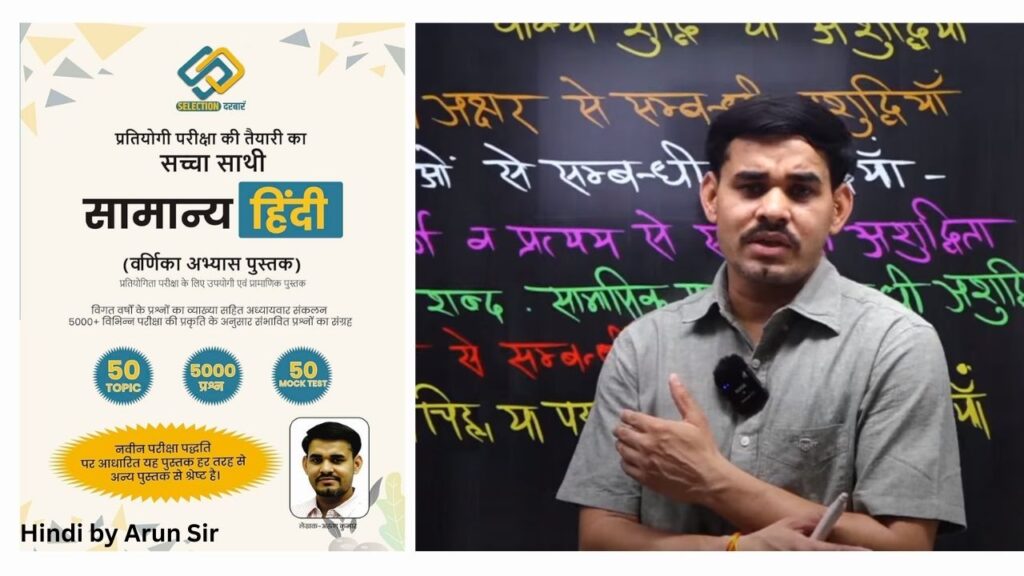
Arun Sir

Arun Sir is an excellent teacher who teaches many students for the competitive exams. He focuses on Hindi grammar complex topics to provide a detailed explanation which can help students to understand Hindi in more depth. His command over vocabulary, comprehension, and writing are valuable for the exams like SSC, Railway, and UPSC. 

Arun Sir Hindi Teacher for SSC and UPSC

Students can easily understand his way of teaching as breaking complex topics into simpler parts including real-life examples. He helps students to practice mock tests and previous year questions for building their strong foundation on Hindi.

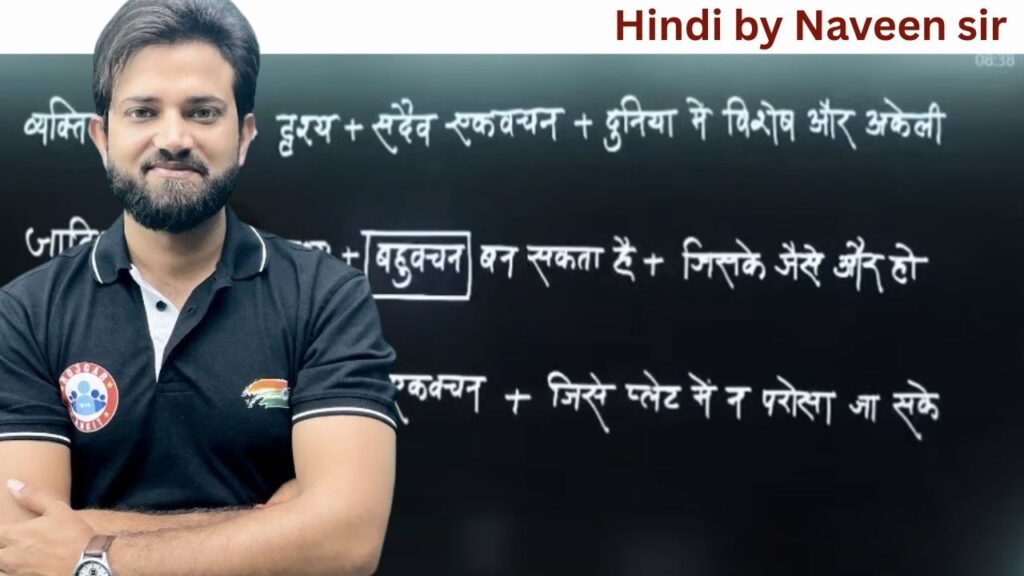
Naveen sir

Naveen Sir is a master of answer writing, if you are preparing for UPSC or state exam then you should make your descriptive writing good in Hindi. You will become an expert in essay writing, letter writing, and precise writing in Hindi with his consistent training.

Naveen Sir Hindi Teacher for UPSC Answer Writing

He is an ideal teacher for students who want to improve their writing skills and present their answers in clean, structured, and detailed.

Other Recommended Hindi Teachers

Apart from the above names, there are a few more respected teachers who can provide you best lessons for Hindi in competitive exams:

Dr Vikas Divyakirti (Drishti IAS) – He teaches Hindi Literature with depth and clarity, making him ideal for UPSC aspirants.

Alok Sir (Adda247) – Alok Sir is focused on short-trick and not go for lengthy explanations that makes him ideal for SSC aspirants

Ritesh Sir – he also helps students to prepare for the SSC exam because he makes Hindi grammar easy through continuous practice.

Read More 👉 Meet the Best Current Affairs Teacher for SSC CGL Who Can Boost Your Score

Why these teachers stand out

Apart from their unique teaching styles, they have the same common qualities that make them best Hindi teachers.

Simple explanation – they explain every topic in easy language that helps every student to understand easily.

Practical Approach – their style including examples from newspapers, current events, and daily-life that make Hindi more understandable.

Focus on Practice – continuous practice of questions from previous year and test series, they ensure that every student solves enough questions to mentally prepare for the exam.

Motivation & Support – Hindi is so difficult for some students who came from convent schools, these teachers inspire them to make learning enjoyable.

Read More: Best Online Coaching for Bank Exam: Master Every Topic for Success

Final Thoughts

When students are focusing on tough subjects to clear competitive exams, they often forget to prepare Hindi to fuel their score. With the right teacher, Hindi can become your strongest subject. These Best Hindi Teachers for Competitive Exams have already taught many successful students now you could become next.

If you give you full potential for your exam with their guidance, you can clear the most toughest exams. They focus on exam patterns and important topics that need to be prepared well for government exams.

Leave a Comment

Your email address will not be published. Required fields are marked *

SSC JE vs RRB JE: Which Govt Job Offers Better Salary, Growth & Stability in 2025?

SSC JE vs RRB JE

The debate between SSC JE vs RRB JE occurs between the engineering graduates who want government jobs. Both paths offer good packages with future growth. Aspirants must know about their selection process and job roles before stepping into the path. 

The Staff Selection Commission is conducting an exam for selecting candidates in Central government departments and ministries such as CPWD, CWS, and MES for the Junior Engineer role. The exam structure consists of two papers – Paper 1 & Paper 2 with 200 and 300 marks respectively.

Railway Recruitment Boards is conducting an exam for recruiting Junior Engineers for Indian Railways. This exam structure varies on – CBT 1, 2, document, and medical test for ensuring that you are able for field work or not. The competition is high in RRB JE recruitment so it is hard to beat it.

Understanding of Importance for SSC JE and RRB JE Comparison?

Both jobs have some similar benefits but there are other differences which makes them unique in their area of work. 

Similarities: Both RRB JE and SSC JE offer the same salary packages of around Rs. 50,000 to Rs. 60,000 (7th pay commission). Additional perks are the same including Housing Allowance, Dearness, Travel, Medical, Pension. A degree or diploma in engineering is required for these positions.

Differences: SSC JE engineering posted in departments of government while RRB JE works in Indian Railways. Frequent transfer, fast promotion, and field work mostly in the RRB. SSC offers slower promotion, desk & field work, no frequent transfers. 

Read More 👉 RRB JE Syllabus 2025: CBT 1 & CBT 2 Exam Pattern Explained

Major Departments Covered Under SSC JE and RRB JE

Every year SSC and RRB conduct exams for junior engineers recruitment for various departments. CPWD, MES, Central Water Commission, National Technical Research, BRO by the SSC. Indian Railways departments are in all zones from Northern to Southern and Eastern to Western.

Job Role & Work Environment

SSC JE roles are majorly related to the desk work with some supervision. If candidates have the ability to work in the office environment daily which needs skills such as planning, reporting, administrative then it is the best choice. Some tasks may need technical on-site work but not as much as RRB JE.

RRB JE offers field and operational work which is on-ground tasks. The engineers in the railway sector are expected to be involved in maintenance and operational duties.

Salary Structure in 2025

The salary structure for RRB JE and SSC JE in 2025 by level 6th (7th pay commission). Here is the detailed overview of the structure:

Pay LevelLevel 6 (Group B, Non-Gazetted)
Basic Pay₹35,400
Pay Scale Range₹35,400 – ₹1,12,400
Grade Pay (Old system)₹4,200
Dearness Allowance (DA)Around 17%-50% (varies; example 17% ≈ ₹6,000)
Travel AllowanceCities = ₹3,600Other Places = ₹1,800
Gross Salary RangeApprox. ₹46,000 to ₹63,700 (depending on city & allowances)
In-Hand Salary₹50,000 to ₹60,000 per month (after deductions such as PF, tax)

Career Growth & Promotions

SSC JE has more senior level positions and performance based promotion that offer you long-term benefit. Each promotion gives you an increment in your salary and offers diverse roles in various departments.

RRB JE is highly secure but offers fewer higher positions. Mostly need technical specialization within railways and promotion through different exams.

Posting Location & Transfers

SSC JE is less frequent in postings so it is best for those who want to settle down in one place with family. If you want fixed hours of working this path is guaranteed to provide you that. No changes in regular life but sometimes project-specific relocation happens in urban areas.

RRB JE postings are unpredictable as they can offer you rural areas and frequent changes in the location may be problematic for someone who doesn’t want regular changes in life. 

Job Stability & Security

SSC JE is a very stable job which offers security for the role and no elimination from the post until something serious misconduct occurs. RRB JE also offers job security because there are no layoffs in the government sector. And the need for staff is essential for safety and functioning Indian railways.

Read More 👉 RRB Group D Exam Date 2025 Out Soon – Check Syllabus, Admit Card & Hall Ticket Link

Work Culture & Facilities

SSC JE Work Culture

Most departments have fixed hours of working with professional, disciplined, and well-defined roles. Day-to-day responsibilities for reporting and documentation are basically a part of the job. Employees are satisfied with terms of stability, salary, promotions, and additional benefits. But what attracts them most is their work environment and professionalism. 

RRB JE Work Culture & Facilities

Working employees are showing satisfaction level while their passion meets with the largest sector of India. Technical and field workers experience additional perks of traveling and community culture which is not applicable in most of the jobs. But some people might have problems with disturbing locations.

Which is Better for You?

Seeing your friend or any relative working in SSC or RRB is good but making your life decision based on looking for them having a great life isn’t good. Try to find out your abilities and interests which are important to meet the needs of the job. 

If you are passionate about traveling and exploring new challenges while experiencing some issues such as away from hometown and not stable work-life balance. If you are okay with this then you can choose RRB JE job otherwise, go for the second option i.e. SSC JE. 

SSC JE offers stability and working in departments which offer mostly office-based technical jobs. You can have the same perks as railways but can actually have a life with your family.

What Should Aspirants Aim for?

Prefer SSC JE if:

  • You need to maintain balance in your work and personal life.
  • You are an engineer & a woman and want to have a good government job.
  • You want a mix of both on-ground and desk jobs.
  • Work culture is quite impressive, it is well-structured, faster promotions, and wider career growth.

Prefer RRB JE if:

  • You prefer to work in railways, field work, and fully operational duties.
  • You want a challenging life and are passionate about travelling.
  • Unique railways additional perks like medical facilities, and railway passes.

Conclusion

Both have vast opportunities for you and both are government jobs. It depends on you to choose which sector aligns with your interest and skills. The debate for SSC JE vs RRB JE is consistently growing as their salary and job security is high. In 2025, if you are deciding for your future after engineering then this guide will help you to explore details for both of them.

Leave a Comment

Your email address will not be published. Required fields are marked *

Scroll to Top