Top AI & ML Colleges in Delhi: Courses, Eligibility Fees & Placements

AI and ML Colleges in Delhi

If you are dreaming to write your own algorithm for faces, business trend predictions, automation power then artificial intelligence and machine learning from best AI and ML Colleges in Delhi is the best option for you. If you’re a student in Delhi preparing for engineering entrance exams, you’re in luck. Artificial intelligence, and machine learning are transforming entire industries, and Delhi boasts a few truly outstanding establishments to educate the future AI engineer.

Now let me take you on a complete tour of best AI and ML colleges in Delhi— the ones that are not only making engineers but innovators who have already started making ripples in global tech companies. 

Why AI & ML Education Matters Now More Than Ever

Before entering into colleges, let’s get why AI and ML are the hottest career them right now. So, you can find AI talent in every industry – healthcare, finance, automobiles, entertainment. Data scientists make somewhere between ₹6-10 lakh per year, ML engineers fetch ₹7-11 LPA, and niche AI engineers are making ₹8-12 LPA straight out of college. The top performers? They are getting packages in crores from the likes of Google, Microsoft and Goldman Sachs.

But here is the reality: that’s no guarantee that all college degrees are the same. Not only will the institute you choose impact what you learn, but also the opportunities that come your way. 

Delhi’s Top AI & ML Colleges
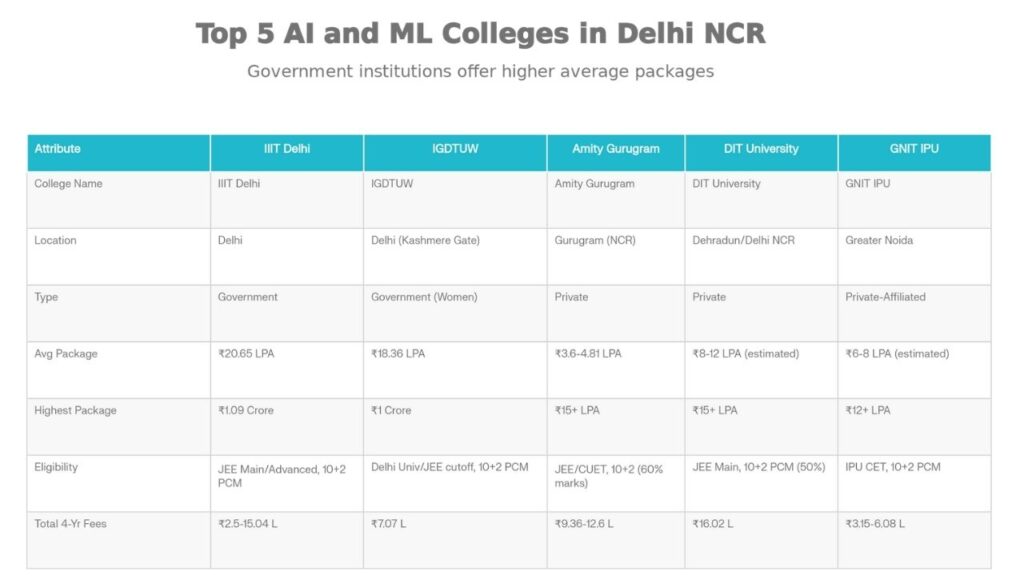
Delhi's Top AI & ML Colleges

Comprehensive Comparison of Top AI and ML Colleges in Delhi NCR

1. IIIT Delhi: The Gold Standard

If there’s one institute that is known for offering world class AI and IT education in Delhi, it would be IIIT Delhi. This New Delhi-based government institute is essentially the IIT for information technology — prestigious, rigorous, and without a doubt excellent.​

Why IIIT Delhi Stands Out:

IIIT Delhi is not simply offering instruction in AI, it is doing cutting-edge research in machine intelligence. With professors who are active researchers and the average batch size small enough to actually mentor the students, the exposure here is none other than a startup and not a classroom. 
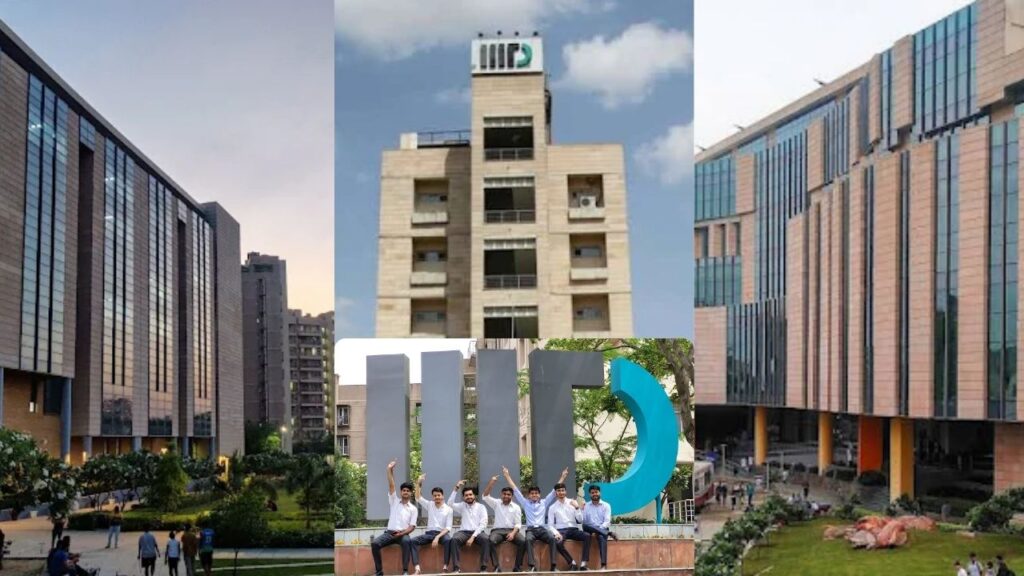
IIIT Delhi The Gold Standard

Academics & Curriculum:

The curriculum is demanding – involving data structures, algorithms, machine learning basics in Year 1-2, and then delving into deep learning, computer vision, and specialized options in Years 3-4. What makes it special? Real-world projects in which students solve meaningful problems, internships at such places as Google and Amazon, and an emphasis on research as well as engineering. 

Salary packages and Placement:

Average Package₹20.76 LPA
Highest PackageFrom ₹51.31 LPA to ₹1.09 Crore
Placement Rate89.32%
RecruitersMicrosoft, Adobe, Goldman Sachs, Google
Total 4-Year Cost₹2.5-15.04 lakhs

Admission

The IIIT Delhi admission cutoff is tough and it is usually based on a good rank in JEE Main/Advanced in the range of 1000-2000 for general category students. But the precise cutoff keeps on changing year to year.  

2. IGDTUW: The Rising Star for Women Engineers

Being at a very convenient location at Kashmere Gate , the IGDTUW (Indira Gandhi delhi Technical university for women) is the good government engineering college only for girls and is biting the dust some of the best engineers in delhi.

A Game Changer for Women in Tech:

IGDTUW is known for producing women engineers who are not content to take part in tech—they lead it. The B.Tech in AI & Machine Learning course in this university is contemporary and aligned with industry needs. 

Affordability: A 4-year degree will cost you just ₹7.07 lakhs—bringing quality AI education within your reach.

Excellent Placement Record : Highest package of ₹1 crore, average CTC of ₹18.36 LPA

Close-Knit Community: Denser batches bring better mentorship and community standardship

Government College Quality: Top faculty, rigorous curriculum, zero compromise on standards 
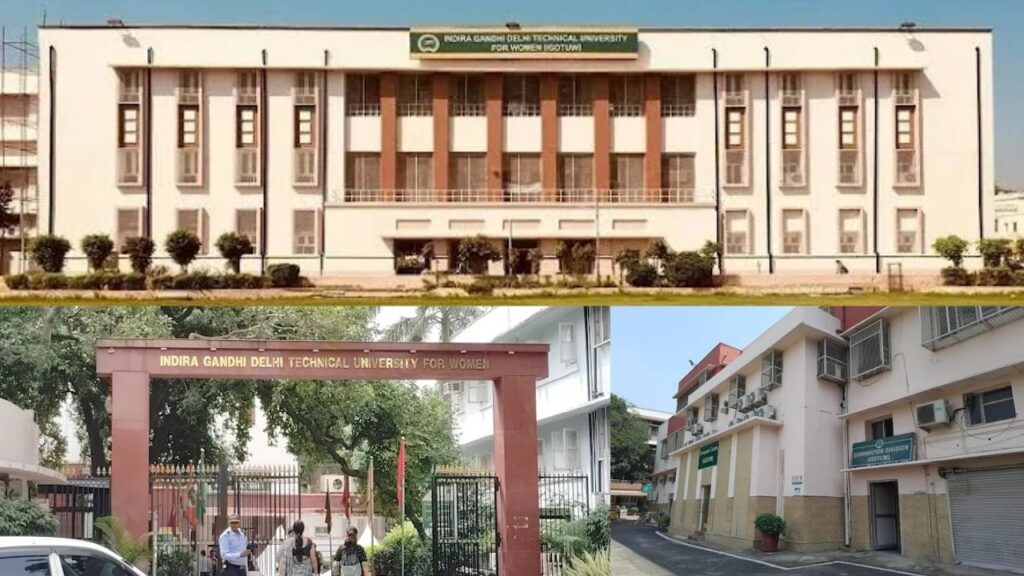
IGDTUW The Rising Star for Women Engineers

Placement Excellence

With full-time offers amounting to 463, pre-placement offers stacking to 128, and 95+ internship offers, IGDTUW is truly proving that government colleges can match the pace and offer of private institutes. 

Major recruiters: Amazon, Google, TCS and Infosys.

Admission: Delhi University entrance exam or JEE cut-off. 10+2 with PCM with minimum 50% marks.

Several students neglect to opt for IGDTUW considering government colleges are an old-age tag. Wrong. This place has state-of-the-art labs, faculty that is connected to the industry, and a record that shows women engineers from here are being hired by every single major tech company. 

3. Amity University Gurugram

If you want a private college that has a good industry connection with a flexible mode of learning, the B.Tech in AI & ML Amity offer in Gurugram (near Delhi) is one to check out.

What Amity Offers:

Amity boasts its corporate tie-ups and curriculum within the industry. The campus feels less like a traditional college and more like a corporate campus — with modern facilities, industry mentors and tech talks.

Course Structure:

The teaching includes Python, machine learning algorithms, deep learning, computer vision and hands-on projects starting from Year 1. They focus on theory as well as coding. 
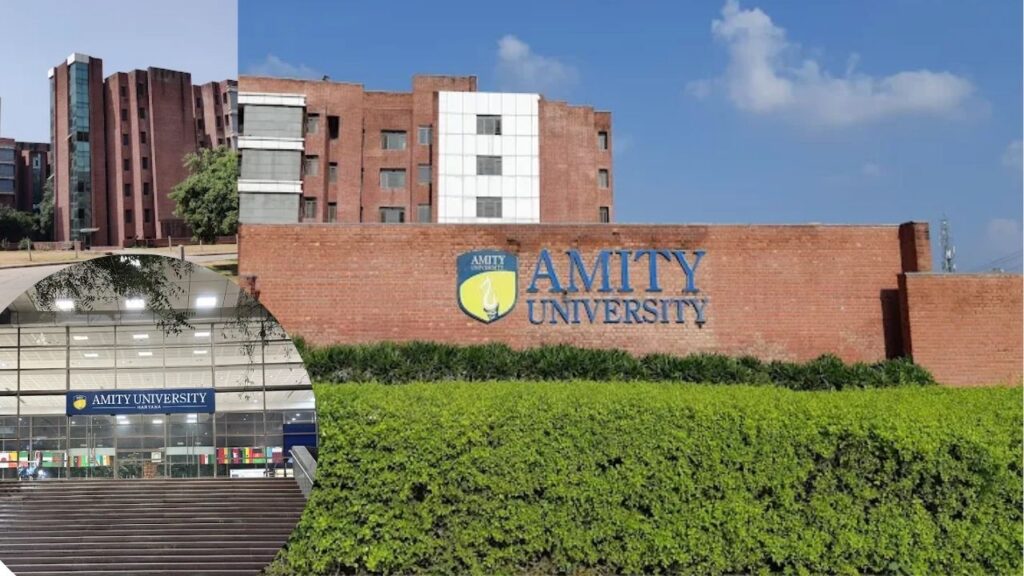
Amity University Gurugram

The Reality of Placements

Average Package₹4.8 LPA
Fee Range for entire course₹9.36-12.6 lakhs
IndustriesWipro, TCS, Amazon

Amity University is less stringent in terms of the admission process as compared to IIIT Delhi, IGDTUW etc. The average salary provided by Amity might be less but the university concentrates on different learning patterns and discourages students from multiple competitive entrance exams.  

Students can get admission through JEE Main, CUET or through merit-based with 60% in 12th class exam. This may be a good option for people who want to study at a reputable college but without the heat of entrance exams. 

4. DIT University (AI, ML & Robotics Focus)

Though located in Dehradun, DIT University emerged as a preferred foray for students from Delhi in the domain of AI, ML and Robotics. 

The curriculum here is specifically made for AI/ML/Robotics – so the electives and specializations are focused like a laser beam on making specialists, rather than generalists. 
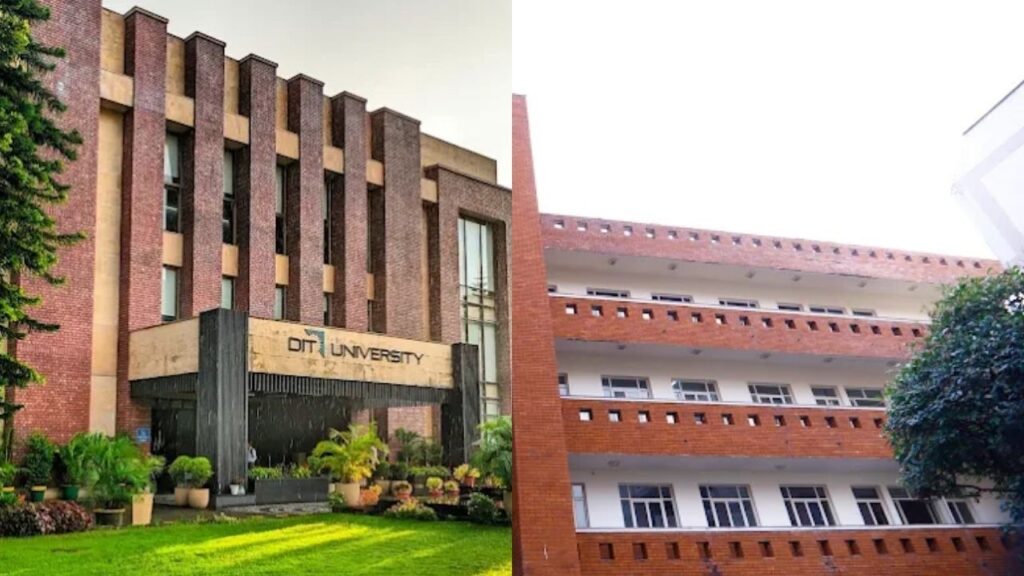
DIT University

Program Highlights:

  • Robotic integration from Year2
  • AI ethics and responsible AI (growing in importance)
  • Industry partners with tech startups
  • A full 4-year program spanning a variety of aspects 

Fees & Placements:

Fees₹16.02 lakhs
Scholarships14% for Uttarakhand domicile; merit-based scholarships available
Average Package₹8-12 LPA

5. GGSIPU Affiliated Colleges Network

Guru Gobind Singh Indraprastha University (GGSIPU) the nod to B.Tech AI & ML in its affiliated colleges in Delhi/NCR, and this has been one of the most affordable options for AI education.
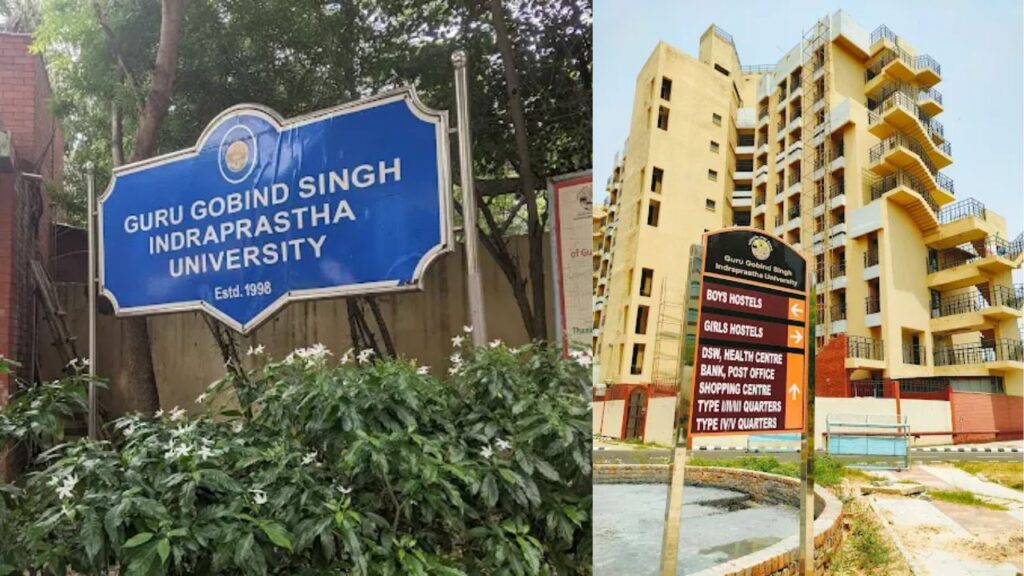
GGSIPU Affiliated Colleges Network

Popular GGSIPU Colleges:

Echelon Institute of Technology (Faridabad): GGSIPU affiliated, 17.5 acres campus, placements with TCS, Infosys, Wipro

GNIT IPU: (Greater Noida): Top 150, Modern Labs, Affordable Fees

MAIT (Maharaja Agrasen Institute): Established, well known GGSIPU college in delhi 

AdvantageBasic programming (C, Python, Java) (3)Machine learning algorithms such as Support Vector Machines, Random Forest, neural networks to analyze and model complex datasets.Advancements in Deep Learning have significantly enhanced capabilities in fields like Natural Language ProcessingMachine learning, computer vision and roboticsEthical considerations for AI.Practical projects in every term. 
Fees₹3.15-6.08 lakhs
Placement Range₹4-8 LPA , top performers can get up to Rs. 12 LPA
AdmissionIPU CET (entrance exam)/ merit-based

Admission Process For Government Colleges

  1. Clear JEE Main or appear for Delhi University cut off exam
  2. Participate in JoSAA counseling
  3. Submit choices, verify documents, pay seat confirmation fees
  4. Report to college

Admission Process For Private Colleges (Amity, DIT, GGSIPU):

  1. Take entrance exam (JEE Main, CUET or an exam conducted by college)
  2. A few colleges provide direct admission on basis of 12th marks
  3. Management quota seats are available with additional fees
  4. Installments for payments is generally available 

Read More :- Courses for Interior Designing in India: Admission, Colleges & Careers

Course Curriculum—-What You’ll Learn

Years 1-2 (Basics)Main Topic of Mathematics such as Calculus, Linear AlgebraStatisticsPhysics and ChemistryProgramming in C, fundamentals of computingBasic engineering concepts
Year 2 (Specialization Begins)DSA–Data Structures and AlgorithmsDatabase Management SystemsOOPsFoundations of Machine LearningIntroduction to AI
Year 3 (Core AI/ML)Vision & Neural StudyDeep Machine LearningNatural Language ProcessingOperating SystemsInternet of ThingsDesign and Analysis of Algorithms
Year 4 (Internship)Industry exposureAdvanced Computer VisionDifferent categories field such as Blockchain, Cyber Security, RoboticsMajor projects and internships

Fee Comparison Of AL & ML Colleges in Delhi

CollegeType4-Year Total FeeAffordability
IIIT DelhiGovernment₹2.5-15.04 LHighly Affordable
IGDTUWGovernment₹7.07 LMost Affordable
GGSIPU CollegesPrivate-Affiliated₹3.15-6.08 LVery Affordable
DIT UniversityPrivate₹16.02 LPremium
Amity GurugramPrivate₹9.36-12.6 LModerate

Breakdown of AI & ML Fee Structure

Study—materials₹20,000-30,000
Software—licenses₹10,000-15,000
Project equipment and competition participation₹15,000-25,000
Hostel (if required)It will be ₹40,000 — 80,000 yearly

Scholarships Available

Fee Waivers – Merit based fee waivers are available for top JEE scorers ranging from 25-50% in fees. 

Also, read – How to apply for Government schemes scholarship for students on the National Scholarship Portal. 

Companies such as Tata Trusts and Aditya Birla Foundation also offer corporate scholarships. 

Placement After Graduation

Placements are everyone’s priority, so here is the Tier-wise list of the highest placement growth: 

Top Tier (IIIT Delhi)89%+ placement rate₹20.65 LPA averageEvery major tech company hires hereInternational opportunities common
Strong Tier (IGDTUW, Top GGSIPU Colleges)95%+ placement rate₹8-18 LPA averageGood mix of startups and MNCsGrowing international placements
Good Tier (Amity, DIT, Other GGSIPU)75-85% placement rate₹4-12 LPA averageMore startup heavySlower path to top-tier companies

Conclusion

The AI & ML revolution isn’t coming—it’s already here. Every company is creating an AI team – whether a startup or a Fortune 500. Where you go to college will affect your career path, but keep in mind: the college opens doors, but you have to walk through them.

Get good grades, build projects, contribute to open-source, and network with industry professionals. Whether you are studying at IIIT Delhi or a GGSIPU college, it is your hustle and curiosity, not the college name on your degree that will take you places.

The top AI & ML colleges in Delhi for you aren’t necessarily the most expensive or the most prestigious—it’s the one that fits your goals, your budget, and your learning style. Delhi has it all for every student. Make the right decisions, and put in your sweat, and who knows? You might just be the next AI engineer building the algorithms that change the world. 

Leave a Comment

Your email address will not be published. Required fields are marked *

Meet the Best Current Affairs Teacher for SSC CGL Who Can Boost Your Score

For the students preparing for the SSC CGL exam, the Current Affair section is important to cover up. Many students think that it is an easy section and it will get your score with a little preparation and strategy. These Best Current Affairs Teachers for SSC CGL will help you make every update remember their context. 

They’re not only helping you in keeping updated but they also gave you SSC CGL relevant current events which can come in the exam. Check news daily, read newspaper or e-news, follow social media news channels, read magazines and make revision for each topic.

Previous year papers might be not helpful so try mock quizzes and practice questions daily. These teachers have also shared a lot of MCQs, you can try and improve your speed and accuracy.

You better be consistent through your preparation, otherwise it won’t be helpful if you forgot everything you learn.

Gaurav Sir (Adda247)

Gaurav Sir (Adda247) best current affairs teacher for SSC CGL preparation

Gaurav Sir is known for his ability of connecting current events to static GK which help students to memorize everything. He encouraged a comprehensive understanding of current events rather than just rote memorization. His engaging and interactive teaching style involves deep explanations and real-life examples to elaborate concepts that help understanding complex topics easily.

Ideal for those students who want to understand the “why” behind the news. Gaurav Sir will help you to understand every topic beyond the headline. He is teaching serious topics in a friendly way that will be remembered by every student with a deep understanding of context. He also provides revision classes to keep tracking the previous sessions.

Richa Sharma (Parcham Classes)

Richa Sharma is best to help SSC aspirants for concise and exam-oriented preparation. Richa Ma’am’s teaching style is clear and structured which helps every student to understand current events that are relevant to SSC CGl. She specifically makes point-to-point notes for easy memorization and applies other techniques such as mnemonics to help in revision.

Richa Sharma (Parcham Classes) best current affairs teacher for SSC CGL

She is best for those students who prefer to prepare the current affair section with less time & efforts. It’s hard for many students to remember dates, names, and numbers. Richa Ma’am fits them because she uses simple flowcharts and bullet points to simplify the topic. You can easily remember them and cover all the topics within a short period of time.

Bhunesh Sharma (Class24)

Bhunesh Sharma is experienced and popular for his lucid explanation which helps to understand complex topics of current affairs easily. He uses visuals and diagrams in its teaching to memorize every concept. Most importantly, it’s easily available for every student who is preparing for the SSC CGL Exam. 

Bhunesh Sharma (Class24) best current affairs teacher for SSC CGL

If you have a problem in understanding current affairs then Bhunesh Sir is best, he simplifies every topic with his friendly teaching style. Be ready for the In=depth analysis on a complex topic which can help you understand its core reasons, making you able to solve every question confidently.

Gaurav Maurya from Testbook

For daily current affairs updates, watch Gaurav Maurya sir lectures because he gives updates in a very good explanation which helps many students to understand it. The factual accuracy and exam relevant topic in his sessions makes it a more precise choice for SSC CGL aspirants. He will prepare you for the exam in a short period of time.

Gaurav Maurya from Testbook best current affairs teacher for SSC CGL

He focuses on relevant information which can come in the SSC’s objective exam. Students can score well in current affairs sections if they cover all the Gaurav Maurya sessions. He prepares students for the competition with quizzes and practice questions in his classes. You can get all the daily information in one place. 

Krati Ma’am by SSC Wallah

Krati Ma’am by SSC Wallah best current affairs teacher for SSC CGL

Krati Ma’am is a perfect teacher for students who get bored easily. Her intrusive way of teaching can help SSC CGL aspirants to memorize each current affairs topic with interactive elements and discussion. She keeps you motivated for your preparation and guides you through the entire session. 

Her fun and energetic session is excellent for students who get distracted easily. Krati Ma’am focuses on motivating and encouraging students to follow their journey with focus and positivity. Her teacher methods including storytelling, playing quizzes, and interactions are excellent. 

Finding Your Ideal Current Affairs Guru: A Personalized Approach

It is hard to find the best teacher for current affairs. This section seems easy but it is not, many students try so hard to remember each event but can’t help themselves. A short guide to help you make a right choice:

Know Your Needs

Level of Understanding: Current affairs is your weakness or you are a  beginner then understanding each and every thing with deep-analysis is important.

Time Commitment: Each subject needs time but decide how much time you can give to the Current Affairs section to cover every topic.

Learning Style: Know which teaching style helps you understand complex topics easily — engaging, visualising, or quick facts.

Exam Focus: These SSC CGL focused teachers can help you prepare fast and easily, you just have to know which one can simplify fast for you. 

Explore and Experiment

Watch Demo Lectures: if you are still confused which one is right for you, watch demo sessions of a few teachers so you can see their teaching style.

Check Reviews and Testimonials: Many students who have already taken their lectures have shared their feedback on social media. You can have their opinion.

Consider Multiple Sources: once you select any teacher, it doesn’t mean you can’t access another teacher’s resources or study material. You can take one or two teachers’ lessons and notes to get well-rounded daily updates.

Evaluate Effectiveness

Assess Your Retention: practice questions and solve test series to know about your memorization. It helps to understand if you forgot the information taught by the teacher.

Track Your Progress: observing changes in your current event knowledge and performance in mock test

Stay Updated on Exam Trends: It’s important that your teacher prepares you for the SSC CGL new exam pattern. 

Conclusion

If you are thinking about clearing SSC CGL examination and score well, focus on every section including current affairs is important. Best Current Affairs Teacher for SSC CGL will help you get ahead on the preparation and enhance your chances of success in the examination. You must understand the fact that each teacher brings a unique strength to the table and the “best” one for you is the one that aligns with your preferences. 

Leave a Comment

Your email address will not be published. Required fields are marked *

ITI Admission Fees in Government College: Complete Fee Structure Guide

ITI Admission Fees in Government College: Complete Fee Structure Guide Are you interested in Technical and Vocational Education Training (TVET) as a career option? A good Industrial Training Institutes(ITI) is a great way to learn a practical skill and get a job in a short span of time. How much does it really cost to join a government ITI? is probably among the most frequent questions that are buzzing in your mind if you have been looking for ITI courses. So let's get started with the full ITI Admission Fees in Government College details before jumping on the admission portal. Quick Overview of Fee Breakdown This is the fee structure in short for an Electrician course at a typical government ITI to make your career brighter. This will help you understand the budget of the two year course. Charge Amount Admission Fee –Given one time ₹100 Registration Fee –Given one time ₹50 Monthly Tuition ₹2,400 (₹100 × 24 months) Caution Money – given back later ₹250 Examination Fees ₹200 Student Welfare Funds ₹300 Total Approximate Cost ₹3,300 Note: The caution deposit is refundable on successful completion and your effective expenditure comes to approximately ₹3,050 for two years — Now that’s reasonably priced! Understanding the ITI Fee Structure The nice thing about government ITIs is that they are hilariously cheap when compared to private ones. With private ITI colleges charging fees ranging from ₹5,000 to more than ₹1,000,000 per year, fees of the government ITI colleges are affordable and it goes from ₹1,000 to ₹20,000 per year. So, students from all financial backgrounds can get quality technical education. But it's not just a single figure for the fee structure to pay and forget about it. The fees in government ITIs are divided into several heads, each of which is for a certain purpose. Knowing what all these entails will allow you to plan your finances so you don’t get a shock when it is time for admission. Tuition Fee: The Core Cost The tuition fee is the staple of your yearly outgoings. It is from ₹100 to ₹150 per month at most government ITIs in India which works out to be from ₹1,200 to ₹1,800 per year. For reference, the West Bengal government ITIs charge a total fee of ₹30 per month as a tuition fee, implying that you will be spending only ₹180 for the entire six-month course. These vary from state to state and institution to institution, so be mindful!​ The annual tuition fee for regular trainees, however, is Rs 1,800 (Rs 150 per month) at some government institutions such as the National Skill Training Institute (NSTI) in Patna. Yet if you are from SC/ST, you pay a lot less – just Rs 600 per year (Rs 50 per month). It is indicative of the government’s resolve to open the door of education to the underprivileged sections of the society. Admission Fee: One-Time Payment Consider the entry to the admission fees for the institution you are wants to apply. This is a one-time fee that you pay once you join and not every year. The admission fee is usually around ₹100 to ₹300 for most government ITIs. This is phenomenally low, and includes the cost of processing your application, verification of your documents, and the registration procedures.​ Interestingly, some institutes offer concessions to SC/ST students. For example, SC/ST students will have to pay Rs 25 instead of Rs 100 as admission fee. Registration Fee There is also a registration fee separate from the admission fee and the registration fee is usually between ₹30 to ₹200. This is for registering your enrolment with the records of the institute and getting you listed with the official registers. It’s a non-refundable fee which is paid generally at the time of verification of admission.​ Again, if you belong to SC/ST category you may get waived off from paying this fee in some institutes. Caution Money: A Security Deposit Important to understand: Caution money isn’t a fee that you are wasting. It’s a security deposit that is refunded. You pay it once (usually between ₹ 100 to ₹ 500) while admitting and you get it on successfully completing the course. This sum of money serves as a kind of insurance to keep students finishing their training and disciplined. Additional Funds and Charges In addition to the basic fees, the Govt ITI s also levies different student welfare and infrastructure enhancement funds which may be used for welfare activities of the students, for up-gradation or improvement in infrastructure. These might include: Gymkhana Fee Up to ₹100 To get along with sports and extracurricular activities Student Welfare Funds ₹50 to ₹375 Contributing to overall student development programs Placement Registration Fee Approximately ₹50 Helping the institute organize campus placements Smart Card Fund Around ₹200 For issuing digital identity cards Examination Fee At the time of examination, an institute usually levies a test fee of ₹25 to ₹100 per attempt. This includes the cost of holding exams, drafting question papers and conducting tests. Total Annual Cost For ITI Government Add all this up and see what the real number you’re looking at is. For a normal engineering trade class (say Electrician or Fitter) in a government ITI. First Year Fee is in range between ₹2,400 — ₹3,500 Subsequent Years As it vary on state, ₹1,500 to ₹2,000/year Delhi institute registration fee is Rs.200, so if you are applying there then this is the amount you have to pay at the time of verification along with the other applicable fees, which is quite nominal. Special Provisions and Exemptions For Girl Students A large number of Government ITIs provide relaxation to female trainees. Girl students are exempted from tuition fees as well as examination fees at institutes such as Patna's NSTI, rendering the course free for girls (the only exception being other compulsory deposits and fees). A few states have adopted similar policies to incentivize women to take up technical trades. For Reserved Categories There are hefty discounts for students who belong to the SC, ST, OBC or EWS category. Tuition is often waived or discounted to a token sum. In the ITIs of Odisha, the admission fees are waived for the trainees from SC, ST and women category whose family annual income is less than `2.5 lakhs, they have to pay only the caution money. For Persons with Disabilities (PwD) The government ITIs are said to extend exemptions and concessions to the special needs students, because 'they are handicapped and the financial burdens of study should be thrown off from their shoulders'. State-Wise Variations For the Fee of ITI One should note that the ITI fees vary according to states since education is a subject of state in Indian federalism. For instance, in Tamil Nadu, government ITIs charge anywhere between ₹5,000 and ₹7,000 per year, while in Himachal Pradesh, they charge between ₹6,000 and ₹8,000. With competition fees, states such as Bihar, Uttar Pradesh, and Rajasthan have the biggest network of government ITIs. Conclusion When you take into account that you are learning practical skills that are directly applicable to jobs in the public and private sectors, that is a huge amount of bang for your buck. Whether you are just finishing school and want to start your career or are planning a career change, government ITI courses provide a cost-effective, quality route to technical proficiency. The best way to get the most update on ITI Admission Fees in Government College is to go on your state’s ITI official website, check under what category you fit under for exemptions and email the best would be to the lucky one you want to attend for any questions. Your path to a rewarding career might be more affordable than you think! Meta title : ITI admission fee in government college. full fee guide 2025 Meta desc : Complete guide on ITI admission fees in government colleges: tuition, admission, exam fees, concessions for girls and reserved categories. Cost details for full 2 ​​years. Url : iti-admission-fees-in-government-college Focus Keyword : ITI Admission Fees in Government College Government ITI Fee Structure ITI Government College Fees 2025 ITI Course Fees in Government Institute ITI Fees for Girls & Reserved Category

Are you interested in Technical and Vocational Education Training (TVET) as a career option? A good Industrial Training Institutes(ITI) is a great way to learn a practical skill and get a job in a short span of time. How much does it really cost to join a government ITI? is probably among the most frequent questions that are buzzing in your mind if you have been looking for ITI courses. So let’s get started with the full ITI Admission Fees in Government College details before jumping on the admission portal.

Quick Overview of Fee Breakdown

This is the fee structure in short for an Electrician course at a typical government ITI to make your career brighter. This will help you understand the budget of the two year course.

ChargeAmount
Admission Fee –Given one time₹100
Registration Fee –Given one time₹50
Monthly Tuition ₹2,400 (₹100 × 24 months)
Caution Money – given back later₹250
Examination Fees₹200
Student Welfare Funds₹300
Total Approximate Cost₹3,300

Note: The caution deposit is refundable on successful completion and your effective expenditure comes to approximately ₹3,050 for two years — Now that’s reasonably priced! 

Understanding the ITI Fee Structure

The nice thing about government ITIs is that they are hilariously cheap when compared to private ones. With private ITI colleges charging fees ranging from ₹5,000 to more than ₹1,000,000 per year, fees of the government ITI colleges are affordable and it goes from ₹1,000 to ₹20,000 per year. So, students from all financial backgrounds can get quality technical education.

But it’s not just a single figure for the fee structure to pay and forget about it. The fees in government ITIs are divided into several heads, each of which is for a certain purpose. Knowing what all these entails will allow you to plan your finances so you don’t get a shock when it is time for admission. 

Tuition Fee: The Core Cost

The tuition fee is the staple of your yearly outgoings. It is from ₹100 to ₹150 per month at most government ITIs in India which works out to be from ₹1,200 to ₹1,800 per year. For reference, the West Bengal government ITIs charge a total fee of ₹30 per month as a tuition fee, implying that you will be spending only ₹180 for the entire six-month course. These vary from state to state and institution to institution, so be mindful!​

The annual tuition fee for regular trainees, however, is Rs 1,800 (Rs 150 per month) at some government institutions such as the National Skill Training Institute (NSTI) in Patna. Yet if you are from SC/ST, you pay a lot less – just Rs 600 per year (Rs 50 per month). It is indicative of the government’s resolve to open the door of education to the underprivileged sections of the society. 

Admission Fee: One-Time Payment

Consider the entry to the admission fees for the institution you are wants to apply. This is a one-time fee that you pay once you join and not every year. The admission fee is usually around ₹100 to ₹300 for most government ITIs. This is phenomenally low, and includes the cost of processing your application, verification of your documents, and the registration procedures.​

Interestingly, some institutes offer concessions to SC/ST students. For example, SC/ST students will have to pay Rs 25 instead of Rs 100 as admission fee. 

Read More 👉 CAT 2025 Exam Analysis: Difficulty Breakdown for VARC, DILR & QA

Registration Fee

There is also a registration fee separate from the admission fee and the registration fee is usually between ₹30 to ₹200. This is for registering your enrolment with the records of the institute and getting you listed with the official registers. It’s a non-refundable fee which is paid generally at the time of verification of admission.​

Again, if you belong to SC/ST category you may get waived off from paying this fee in some institutes.

Caution Money: A Security Deposit

Important to understand: Caution money isn’t a fee that you are wasting. It’s a security deposit that is refunded. You pay it once (usually between ₹ 100 to ₹ 500) while admitting and you get it on successfully completing the course. This sum of money serves as a kind of insurance to keep students finishing their training and disciplined.

Additional Funds and Charges

In addition to the basic fees, the Govt ITI s also levies different student welfare and infrastructure enhancement funds which may be used for welfare activities of the students, for up-gradation or improvement in infrastructure. These might include: 

Gymkhana FeeUp to ₹100To get along with sports and extracurricular activities
Student Welfare Funds₹50 to ₹375Contributing to overall student development programs
Placement Registration FeeApproximately ₹50Helping the institute organize campus placements
Smart Card FundAround ₹200For issuing digital identity cards

Examination Fee

At the time of examination, an institute usually levies a test fee of ₹25 to ₹100 per attempt. This includes the cost of holding exams, drafting question papers and conducting tests. 

Total Annual Cost For ITI Government

Add all this up and see what the real number you’re looking at is. For a normal engineering trade class (say Electrician or Fitter) in a government ITI. 

First YearFee is in range between ₹2,400 — ₹3,500
Subsequent YearsAs it vary on state, ₹1,500 to ₹2,000/year 

Delhi institute registration fee is Rs.200, so if you are applying there then this is the amount you have to pay at the time of verification along with the other applicable fees, which is quite nominal.  

Special Provisions and Exemptions

For Girl Students

A large number of Government ITIs provide relaxation to female trainees. Girl students are exempted from tuition fees as well as examination fees at institutes such as Patna’s NSTI, rendering the course free for girls (the only exception being other compulsory deposits and fees). A few states have adopted similar policies to incentivize women to take up technical trades. 

For Reserved Categories

There are hefty discounts for students who belong to the SC, ST, OBC or EWS category. Tuition is often waived or discounted to a token sum. In the ITIs of Odisha, the admission fees are waived for the trainees from SC, ST and women category whose family annual income is less than `2.5 lakhs, they have to pay only the caution money. 

For Persons with Disabilities (PwD)

The government ITIs are said to extend exemptions and concessions to the special needs students, because ‘they are handicapped and the financial burdens of study should be thrown off from their shoulders’. 

State-Wise Variations For the Fee of ITI

One should note that the ITI fees vary according to states since education is a subject of state in Indian federalism. For instance, in Tamil Nadu, government ITIs charge anywhere between ₹5,000 and ₹7,000 per year, while in Himachal Pradesh, they charge between ₹6,000 and ₹8,000. With competition fees, states such as Bihar, Uttar Pradesh, and Rajasthan have the biggest network of government ITIs. 

Conclusion

When you take into account that you are learning practical skills that are directly applicable to jobs in the public and private sectors, that is a huge amount of bang for your buck. Whether you are just finishing school and want to start your career or are planning a career change, government ITI courses provide a cost-effective, quality route to technical proficiency. 

The best way to get the most update on ITI Admission Fees in Government College is to go on your state’s ITI official website, check under what category you fit under for exemptions and email the best would be to the lucky one you want to attend for any questions. Your path to a rewarding career might be more affordable than you think! 

Leave a Comment

Your email address will not be published. Required fields are marked *

Bihar BSSC Inter Level Online Form 2025: Apply Online, Dates & Eligibility

Bihar BSSC Inter Level

For the large number of 12th pass candidates in Bihar, the BSSC: Bihar Staff Selection Commission Inter Level Recruitment 2025 will be a great opportunity to get a government job. With 23,175 vacancies to fill in various departments, this is the biggest employment drive for intermediate-holders this year. The extended deadline allows applicants more time to work on their applications and apply strategically.

The booking procedure is simple and you can complete it in just a few minutes from online. Candidates need to visit the official BSSC portal for one time registration they need to enter personal and educational details, upload necessary documents (photograph, signature and certificate) and pay the application fee of Rs.100 through online payment mode. What makes this recruitment even more attractive is the fact that the fee is the same for all categories and hence it is affordable for all the candidates who are eligible to apply. 

Important Dates For BSSC Inter Level Online Form

EventDeadline
Application Start15/October/2025
Last Date to Register & Pay Fee15/January/2026
Final Application Submission18/January/2026
Preliminary ExamUpdate Soon

Eligibility Requirements For this Post

CriteriaDetails
Educational Qualification12th Pass (Intermediate)
Age (General Male)21–37 years
Age (General Female)21–40 years
Reserved CategoriesAge relaxation of 3–5 years applicable

Exam Pattern

The tier 1 exam consists of 2 hours 15 minutes duration and there are 150 questions on General Studies, Science, Mathematics and Mental Ability with multiple choice format. Shortlisted candidates are eligible to appear in mains examination and then document verification. 

Read More:- Best Government Jobs for Engineers in India 2026

Guide to Fill Online Form For BSSC Inter Level

  1. First of all, you should read the Bihar BSSC Inter Level Notification 2025 PDF thoroughly.
  2. Then click on the Apply Online link provided below or visit the bssc.bihar.gov.in the official website.
  3. Complete your BSSC Inter Level 2025 Online Application Form.
  4. Upload all necessary documents.
  5. Submit the fee as it’s demanded.
  6. At last, take the print of the application form for the future reference. 

Don’t miss out on this opportunity. The deadline is extended till January/2026 and a number of thousands of candidates are getting ready. Keep your documents ready, verify eligibility, and apply before the deadline. 

The basic pay level is Pay Level-4 with great pay of Rs 1900 to Rs 2,400, it lies upon a pay scale between Rs. 5200 to Rs 20,200 per month.

Apply OnlineClick Here
Download NotificationClick Here
Official WebsiteClick Here

Leave a Comment

Your email address will not be published. Required fields are marked *

Supreme Court Law Clerk Recruitment 2026 Notification Details

Supreme Court Law Clerk Recruitment 2026

Supreme Court Law Clerk Recruitment 2026 of India announced notification released on 20 January 2026 and opened the portal to receive applications for Law Clerk-cum-Research Associate (LCRA) for the year 2026, marking a fantastic opportunity for budding legal minds. Supreme Court Law Clerk Recruitment is a paid position with 200 seats available and the stipend amounting to ₹80,000 per month, making it a prestigious and fulfilling experience.

The applications started on February 7, 2026 and should be sent through the official website of the Supreme Court of India (sci.gov.in). Interested candidates are advised to send their application before the last date 10th March 2026. This is an extraordinary opportunity to acquire priceless experience in the legal industry. 

Date Schedule for Supreme Court Law Clerk Recruitment

PhaseDate/Details
Notification20/January/2026
Application Window20/January —- 7/Feb 
Exam10/March/2026 
InterviewsJune/2026
JoiningAugust/2026

Quick Eligibility Check

  • You can apply if you are a fresh LLB graduate from the 3-year or 5-year program with a cumulative score of 55% across all years and have a degree from a University/Institute recognized by NLU or from the top-10 NIRF ranked law schools (2020-2024).
  • In the academic department, the standard is well defined and just: you require 55% marks in graduation minimum, with relaxation to 50% for SC/ST candidates. 
  • Age: As on 01/08/2026 Candidate should be under 32 years and above 20 years.
  • There’s no experience required but you have to go full-time no side hustles.

Its merit-based magic: shortlisting will be on the basis of a written exam (objective + subjective on law/constitution) followed by an interview for the toppers. Question on constitutional, IPC, current affairs. 

Read More👉 Allied Medical Courses Roadmap 2026: Eligibility, NEET, Courses & Career Scope

Selection Process

Candidates have to fill out the application form to access the admit card for the examination. Follow the three phase selection process for Law Clerk Recruitment 2026, online MCQ test, Written test then prepare yourself for interview. 

How to Fill Application and Fees

  1. You need to register yourself on the official website of SCI.
  2. Login with your credential to fill the entire details required to complete the form and check again.
  3. Submit Rs. 750 via online payment to complete the process 
  4. Print out your form for offline reference.
Useful Links
Download NotificationClick Here
Apply NowClick Here
Official WebsiteClick Here

Leave a Comment

Your email address will not be published. Required fields are marked *

PNB LBO Application Form 2025 — Apply Online For Local Bank Officers 

PNB LBO Application Form 2025

Punjab National Bank (PNB) has officially released the notification for the recruitment of Local Bank Officers (LBO) for 2025. Candidates who are waiting for this position can apply now through the official website of PNB. Application Schedule, What is the Application Schedule for BO 2025? This recruitment drive is 750 vacancies. For the eligibility criteria, age limit, education, job profile, syllabus, exam pattern and other important information, the candidates should go through the detailed notification. 

A direct link for notification download and further updates on recruitment process will be provided on the official website. Applicants are advised to submit their applications at the earliest and ensure that they fulfill all the criteria as mentioned in the notification. 

Quick Info About PNB LBO Recruitment

OrganizationPunjab National Bank
Exam NamePNB LBO 2025
PostBank Officers
Post Vacancy750
Application Last Date23/November/2025
Official WebsiteClick Here

General Dates For PNB Local Bank Officers Recruitment

EventDate 
Application Begin03/November/2025
Application Ends On23/November/2025
Last Date for Fee Payment23/November/2025
PNB LBO Admit Card AvailableBefore Exam
PNB LBO Exam DateDecember 2025 OR January 2026
PNB LBO Result 2025Update Soon

Category Wise Application Fee

CategoryFee
General / OBC / EWSRs. 1180
SC / ST / PHRs. 59

Read More:- RPF Sub-Inspector Exam: Your Complete Guide to 2025 Recruitment

Guide To Apply Online For PNB LBO Recruitment

Candidates need to read the official notification and apply for PNB recruitment 2025. Candidates must have a graduation degree in any course and age criteria must meet the age limit (20–30 years) of this post.

  • You must read the notification before you start to apply. 
  • To avoid errors, candidates are recommended to ensure that they fill in all required information including name, parents’ names, date of birth, address and educational qualifications properly in the application form. 
  • Ensure you upload all the documents in the right size and format( pdf or jpeg) if required by the application form. 
  • Before you submit the form, check that all the details you have entered and the documents you have uploaded are correct. 
  • When you have submitted your application successfully, it is advised to take print out of application form or save in pdf format for future reference. 

The following tips will make your Punjab National Bank Recruitment 2025 application easier. 

Useful Links
Apply OnlineClick Here
Download NotificationClick Here
Official WebsiteClick Here

Leave a Comment

Your email address will not be published. Required fields are marked *

Scroll to Top