Courses for Interior Designing in India: Admission, Colleges & Careers

Courses for Interior Designing in India

If you are the type of person who regularly moves your furniture around, cleans windows to get the perfect paint color, or critiques lighting in every restaurant you dine in, maybe you have a calling. Your Search for Courses for Interior Designing starts when the question pops up: How do you get paid to have that passion? 

In these days, interior design is no longer just about “making things look pretty.” It is a complex mix of architecture, psychology, technology, and art. Whether you are a high school graduate looking to pursue a degree or a working professional residing in Lucknow wanting to make a creative pivot, this guide is your blueprint. Let’s talk about everything you need to know to about the interior design courses, colleges, and careers. 

Why Formal Education Matters

Let’s be real for a second. You may have a great eye for decorating, but professional interior design is a whole other story. It deals with strength of materials, building codes, ergonomics, and space planning.

A formal course will teach you the “grammar” of design. You are taught to talk with contractors, architects and clients. You go from saying, “I think this blue looks nice,” to, “This particular shade of teal offsets the warm undertones of the timber flooring and captures the natural light coming in from the north-facing window.” 

Types of Courses

Course TypeDurationEligibilityWhat You’ll Get
Bachelor’s —B.Des / B.Sc3-4 YearsB.Sc Or B.Des require 10th & 12th marksheet from Science StreamIn-depth technical knowledge related to Designing
Diploma / Advanced Diploma1-2 YearsKey Formula for fast entry in careerFocused on Practical more than theory, Skill Polishing
Certificate Courses3-6 MonthsHobbyists or professionals adding a specific skill (like CAD or V-Ray).Specific skills only. Prefer for less professional people
Professional Level (M.Des / M.Sc)2 YearsAfter having a degree of B.Des/B.Arch. These masters courses offered for specific specializationResearch-oriented, higher leadership roles, and teaching opportunities.

Top Colleges 

  • NID—National Institute of Design
  • CEPT University—Ahmedabad
  • IIT Delhi, Bombay
  • VIT
  • IIAD—Indian Institute of Art & Design
  • IMS Design
  • Amity University, Lucknow
  • Integral University
  • Gov. Girls Polytechnic
  • Babu Banarasi Das University 

What Will You Actually Learn?

Your course will probably be part art and part engineering. There’s a chance that you will be spending your first year hours hand-sketching and studying Color Theory. In your final year, you will be making hyper-realistic 3D renders that look like photographs. 

The “Hard” Skills (Tech You Need to Master in 2025):

To make it in the business these days, you have to know your way around a computer. These are the software tools you’ll probably end up knowing inside and out when you graduate:

AutoCAD - 2D blueprints industry standard It’s non-negotiable.

SketchUp: The Simplest 3D Building Tool Out There. Consider it as digital clay.

Revit / BIM – essential on large commercial jobs where you need to work closely with architects.

AI Homestyler: more recent and cloud based AI tools that are rising in popularity as they render fast. 

Read More :- UP Police Computer Operator Grade-A Online Form 2025: Apply, Dates & Eligibility

The “Soft” Skills:

  • Client Management: How to tell a client their idea won’t work without offending them.
  • Budgeting: planning of champagne dreams on a beer budget.
  • Project Management: Getting the plumbers, electricians and carpenters to not kill each other. 

Career Scope & Salary

Driven by an expanding middle class and real estate boom, India is witnessing an upsurge in the interior designing industry.

Various paths for a Interior Designers:

Residential Designer: Homes, apartments, villas. (High emotional connection with clients).

Commercial/Corporate Designer: Offices, co-working spaces. (Higher budgets, strict deadlines).​

Hospitality Designer: Hotels, cafes, restaurants. (Very creative, high visibility).

Set Designer: Design sets for movie or tv (Big in Mumbai/Hyderabad). 

Salary Expectations

Entry-level compensation can be humdrum, but expansion is meteoric once you acquire a portfolio. Specialized positions, particularly in Luxury or Commercial sectors, offer much greater pay.
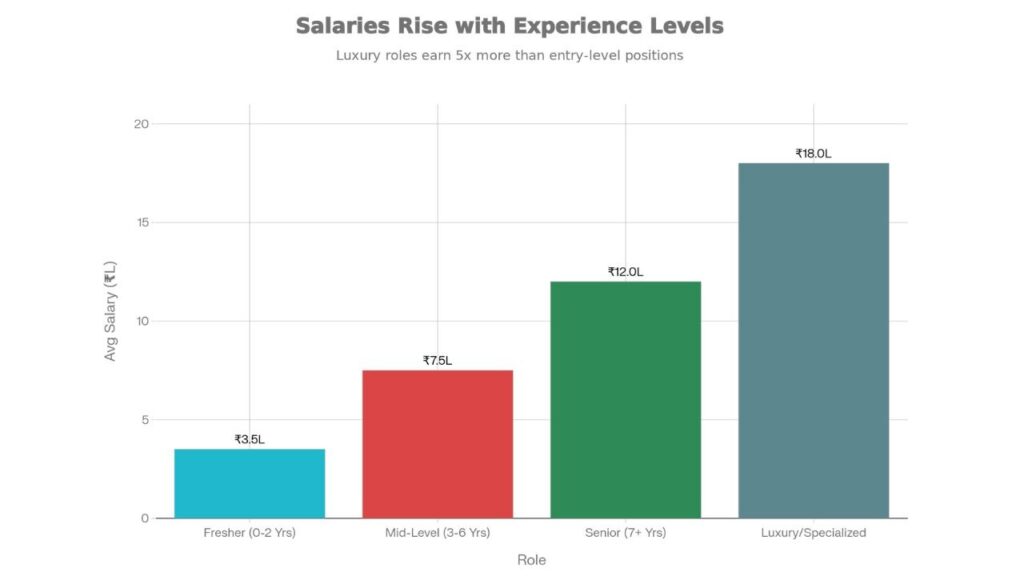
The chart exhibits how, even though you may begin as a junior at about ₹3.5 Lakhs per annum, it does pay off after all. A Senior Designer with 7+ years of experience can earn comfortably north of ₹12 Lakhs, and if you start your own firm or get into luxury consulting, the sky’s the limit (₹18 Lakhs+).

Admission Procedure For B.Des/M.Des in Major Colleges

For premiere govt colleges (like NID) you will have to appear for entrance exams like NID DAT or UCEED. They test your drawing ability, creativity, and spatial logic.

In case of private universities (such as Amity or Integral in Lucknow), admissions are essentially on the basis of marks secured in 12th and DAT (Design Aptitude Test) or portfolio review. 

And build a portfolio, even if you’re not studying design. Draw a corner of your room. Redesign your kitchen on paper. Capture the textures you like. Your potential and passion matters, not perfection.

Conclusion

Courses for Interior designing are not for the weak hearted. Dusty job sites, demanding clients, and nights spent staring at a computer screen. But it is also hugely gratifying. There is a unique thrill in walking into a space you designed — watching people live, laugh and work in a place that began as a sketch in your notebook.

If you like to mix creativity with logic, and art with engineering, this is the year to look forward to for starting out. Whether you opt for a degree from Amity Lucknow or a diploma to begin your career at the earliest, the world is holding its breath for your designs. 

Leave a Comment

Your email address will not be published. Required fields are marked *

PhD Entrance Exam Eligibility 2025: Everything You Must Know About Qualifications, Age Limit & Admission Rules

Are you ready to dive headfirst into the world of research and academia? If you are planning for a PhD in 2025, then be ready to know about the PhD Entrance Exam Eligibility 2025! This guide will offer you all the information regarding Phd entrance exam eligibility. From fundamental academic qualifications to the newest information on entrance exams, so you should prepare according to the eligibility criteria and entrance exams. Whether you’ve just graduated and wanted to get into the research field and make your future brighter, or you’re a working professional thinking about a part-time PhD, we’ve got your back. Let us decode the eligibility criteria for you and help you pave your path for a doctorate!

Core Academic Qualification

The applicant should have one of the following qualifications from a recognized board/institution:

  • 2-year/ 4-semester Master’s degree post a 3-year Bachelor’s degree or a 1-year/ 2-semester Master’s degree post a 4-year Bachelor’s degree.
  • Comparable foreign qualifications if recognized by the relevant bodies.
  • The M.Phil. is also being at least partly phased out in select instances M.Phil. degree holders may apply directly for PhD programmes, albeit. 

Minimum Marks Required

55% marks in aggregate (or its equivalent grade in the relevant subject(s) of study). 

Reserved category relaxation 5% relaxation in the marks (i.e. minimum 50%) is applicable to SC/ST/OBC (non-creamy layer)/PWD/EWS and other similar categories as per UGC policy. 

New Direct Admission Pathways

If you are a 4-year bachelor’s degree holder and sold a minimum of 75%, you are lucky! You can go directly for the PhD without Doing a master’s degree. The catch? You just have to crack the entrance exam to get the seat. So if you’re eager to go right into researching after your undergrad, this might be a good way to skip ahead in your academic career. Just make sure you’re prepared and your grades are good! 

Entrance Exam Requirement For PhD

Major National-Level Entrance Exams for PhD Admission — From 2025 on, the majority of universities and institutes in India will adopt UGC NET scores for PhD admissions, instead of institutional entrance exams. Science, Engineering and Medical PhD- Exam like CSIR NET, GATE, ICMR JRF, DBT JRF, JEST is still flagged. 

Also, some institutions may consider GRE/GMAT scores for management-related disciplines. This change will also help in unifying the process of admission throughout the country. 

Exemption Provision — Those candidates who have qualified national fellowship like NET-JRF, CSIR-JRF, GATE, etc. are usually not required to write the entrance exam but they need to take the interview. 

Interview and Proposal

Admission to PhD programs is usually followed by a personal interview where the research potential and preparedness of the student is assessed, and where the student is questioned about his/her Statement of Purpose (SOP) or a draft research proposal. 

Age Limit

No upper age limit: Adopting a relaxation for the age bar for pursuing a PhD, all those having the requisite academic qualifications will be able to apply for a PhD in India in 2025, there is no age bar for UGC NET or institution-based examinations.

Certain courses or universities (for instance, a few IIMs) may have an upper age limit (typically 40 years).

Part-Time and Full-Time PhD 

Part-time PhD programs are indeed recognized, especially for working professionals, as long as they can provide a No Objection Certificate (NOC) from their employer. 

However, full-time PhD programs demand regular attendance on campus so students must attend regular classes, the minimum 75% attendance is mandatory. Most universities offer hostel accommodations to support students during their studies.

Read More:- Best Books & Online Resources for Banking Exam Preparation 2025

Coursework and Duration for PhD

  • Minimum length of stay: 3 years (coursework included).
  • Maximum Duration: 6 years (up to one year extension in exceptional circumstances for full-time students). 
  • Compulsory propaedeutic course work on research methodology and core courses in the first terms.

Recent UGC Updates for 2025

NET score is compulsory for the admission from the session 2025, replacing the majority of university-level entrance examinations.

Professional/part-time mode with NOC with distance education allowed.

Direct PhDs from four-year undergraduate studies for deserving students. 

Important Takeaways for 2025 Applicants

Most phd admissions are focused on NET scores.

  • It is mandatory to have a Master’s degree with an aggregate of 55% marks or equivalent, else the maximum marks will be relaxed by 5% for reserved categories.
  • There is no age limit for applying for most of the courses.
  • The provisions for Part-Time and Interdisciplinary Research are being promoted under NEP-2020.
  • Interviews and research proposals are required following preliminary screening.
  • Please refer to the individual university portals for detailed and discipline oriented parameters.
  • Regulations are evolving; always check university details before applying. 

Conclusion

Remembering this as you gear up for your PhD journey: the ground is always shifting. Two new direct admission options, and a common entrance test for all, make 2025 the year to watch out for all research aspirants. Keep up with developments, watch out for your marks and check out to universities for fresher information. The dream of having a PhD is a bit nearer for you, and with a little guidance about PhD Entrance Exam Eligibility 2025, you will be able to take a first step towards making your mark in the world of academics. So, get excited, stay motivated and you know what it’s time to make that PhD dream a reality! 

Leave a Comment

Your email address will not be published. Required fields are marked *

UGC NET June 2025 Result Date Revealed – Check When & How to Download Your Scorecard!

UGC NET June 2025 Result Date

The NTA has announced the release of the UGC NET June 2025 results on its official website. Candidates who have taken the UGC NET exam to secure a career as Assistant Professor, Junior Research Fellows, and admission to PhD programs can check their results on the official website once it is released.

To qualify, the National Testing Agency has set some rules – 40% marks is the least to qualify for this exam by general category candidates. However, a minimum of 35% marks is needed to qualify for the UGC NET exam if you belong to the OBC-NCL, SC, ST, PWD category.

Highlights for UGC NET June 2025

Exam NameUGC NET
Conducting BodyNational Testing Agency
Result ModeOnline
PostsJunior Research Fellowship, Assistant Professor, PhD Admission
Exam HappensTwice a year – June & December
Result Date22 July 2025
Official WebsiteClick Here

Important Date for UGC NET June 2025

Exam Date25–29/June/2025
Answer Key Date06/July/2025
Last date for challenge fee payment08/July/2025
Result date22/July/2025

Guide to Download the Result

  1. Kindly visit the NTA website, link is mentioned in the article.
  2. Find and click on the “UGC NET June 2025” link to access the scorecard.
  3. The page will open to log in, fill in your roll number and password.
  4. Try to “forget password” and OTP will be sent to your registered number. In case, you don’t remember your password.(optional)
  5. Once you put the right details to log in, the result will show up.
  6. Download and save your result for future preference.
Important Links
Download Provisional Answer Key NoticeClick Here
Login HereClick Here
Official WebsiteClick Here

Leave a Comment

Your email address will not be published. Required fields are marked *

O Level Course 2025: Complete Guide to Fees, Syllabus, Duration & Job Benefits

O Level Course 2025

Students who are interested in the Technical Field can achieve great heights in their career after pursuing NIELIT ‘O’ Level. It opens up the door in both private and government sectors as the requirement of an IT employee is needed everywhere. The world is evolving more into digitalization which has made this field wider and open more vacancies for the candidates. If you also want to make your career stable with a good career path, high-salary, and less hectic job then grab this course now.

Why NIELIT ‘O’ Level Matters in the Digital Age

Chasing after stable and well-paying jobs in India, job-seekers are often driven towards the public sector, where security of jobs and strong perks are widely considered as givens. In today’s increasingly digitised world, being in possession of a recognized and accredited Information technology qualification is not just an advantage – it is a requirement. The NIELIT ‘O’ Level course is at the Midnight of this requirement. 

It is officially considered the same as a Foundation Level CA course. This government approval is really important and gives you the edge that private not accredited courses can never get. The value of this certification is further ratified with its inclusion in the national framework, having been recognized under the National Skills Qualifications Framework (NSQF) at Level 4. 

What Job Roles Can You Get After NIELIT ‘O’ Level

The O Level was structured in such a way as to be responsive to the short-term technical needs of the then contemporary public and private sectors. The stated goal is to prepare students with the skills needed to work in today’s IT-enabled jobs. Among these targeted profiles are User Interface (UI) Designer, Web Designer, Web Publication Assistant, Office Automation Assistant, and IoT Application Integrator.These intentional integration with operational IT rather than simple clerical data entry clearly situates the course as a practical instrument for aspirants to take on current digital workplace requirements. 

Detailed Eligibility Criteria

The basic eligibility criteria require either passing 10+2, or holding a one-year ITI Certificate after Class 10, along with a minimum of one year of experience in the area related to the IT industry. 

The applicants who have passed second year of polytechnic engineering diploma after 10th standard from a government recognized institute are also eligible to apply. 

O’Level Course Duration 

The six-month timeline for graduates enables them to get this commonly required IT credential quickly, thereby reducing the amount of career time lost while waiting for certification. Hence, the ‘O’ Level serves as an important means for enhancing one’s eligibility in a short span of time after the completion of the degree. However, this registration remains valid for five years.

Why Is O’Level Course Value Increasing Day-By-Day?

Mastery in the Revised Syllabus

The importance of NIELIT ‘O’ Level certification in the present high technology world is that O level syllabus is regularly revised and updated which in turn helps to keep the students updated with the latest information and technology available. This syllabus is much beyond the basic knowledge of computing which is now considered old to cater to the demand of the industry for the skills and the industries supported the potential of having high paying jobs. 

Structure and Examination Pattern

The course is staffed with four core theoretical modules, the compulsory practical component, and a project. The four theory modules are:

M1-R5: Information Technology Tools and Network Basics

M2-R5: Web Designing & Publishing

M3-R5: Programming and Problem Solving through Python

M4-R5: Internet of Things and its Applications 

Detailed Module Analysis

All theory subjects will be assessed by a three hours written examination carrying 100 marks. Besides these theory papers candidates are required to pass one full practical examination (PR1-R5) based on the contents of all 4 theory modules, also carrying 100 marks and of three hours duration. Practical work is usually done at the institutionally approved places offering the course. A Project Work (PJ1-R5) is also necessary for certification. 

Read More 👉 Which Entrance Exam Is Best for MBA Abroad in 2025?

Official NIELIT Fees 

The cost a candidate has to bear when applying directly through NIELIT (without availing external tuition) is surprisingly small:

  • Registration Fee is Rs.500 and this registration is valid for 5 years. 
  • A Fee of ₹100.00 is applicable for processing exam applications per examination cycle.
  • The O’ level course fees for each module in the Revision 5 is 1,000 Rs. The total of four modules fee is Rs 4,000.
  • O Level Project Fee (once only for PJ1-R5 submission) The compulsory O Level project fee PJ1-R5 is only ₹100. 

Candidates pursuing O’Level courses from private institutions can get different fees or entire course fees. So, check the total fees amount for this course from the institutions you choose.

Career Pathways in the Private Sector and High-Paying Roles

The NIELIT O Level certification is an address both for private and government jobs. Although the public sector is considered to be the most stable, the private sector has many points of entry and is an important source of early career experience. 

Target Job Profiles 

The level of competence proven through ‘O’ Level is very applicable. There are plenty of O level benefits in government jobs. The roles targeted include vital gating roles such as UI Designer, Web Designer and IoT Application Integrator. Outside these roles, the certification still strongly validates the holder’s knowledge of key IT skills, such as being computer literate, managing data efficiently, using office automation tools, creating simple web applications, and handling databases. These skills are necessary for help desk, IT support, and web maintenance positions in a broad range of private industry. 

Salaries Offered by IT Sector

The average O level course jobs salary in the Private Sector after doing NIELIT ‘O’ Level is around 3 LPA (Lakhs Per Annum). This base figure amounts to roughly ₹ 25,000 per month which is considered as the minimum expectation for blue-collar jobs at the level of data entry operators, junior IT support, or clerical jobs with some know-how of office automation. 

However, In the government sector, For certain technical posts, including Scientific Assistant and some Assistant Programmer positions, that require or consider the O Level equivalency, the Basic Pay can be as high as ₹35,400 even at the entry level. The resulting In-Hand Salary typically settles between ₹45,000 and ₹50,000 per month.  

The Future After O’Level Course 

The NIELIT ‘O’ Level is not a standalone qualification, but it is the essential beginning in a standardized, government-approved system of IT certification that focuses on sustained career advancement. This Systematic faire up Turn is called the DOEACC octuplet. 

From ‘O’ to ‘A’ Level: Advanced Diploma Equivalence

Students may take NIELIT ‘A’ Level after successful completion of ‘O’ Level based on NIOS. This allowed the applicants to expand their skill set to a great extent in specialized areas like Advanced Post Graduate Diploma in Computer Application (APCDCA) or Advanced Diploma (AD) in Computer Hardware Maintenance and Networking. Passing of ‘A’ Level also allows access to mid-level private sector work and makes one more eligible for higher grade government technical posts. 

‘B’ Level and MCA Equivalence

For aspirants to senior management, software developer or research positions the NIELIT route ends with the B Level course. The ‘B’ Level is the high-end among the course level certifications of NIELIT and is professionally recognized by MHRD to be equivalent to Master of Computer Applications (MCA) Degree Course. 

Conclusion

The NIELIT ‘O’ Level is the anchor, pocket friendly and the only entry-level based examination for aspirants who aim at getting a high paying job along with stable income from Indian Public Sector IT for immediate term. It is the basic qualification that enables the accredited path to further study that is comparable to a Master’s degree, so a career begun in government IT isn’t just safe, it has a well-defined and boldly optimistic path for growth. 

Leave a Comment

Your email address will not be published. Required fields are marked *

How to Join Indian Army — Your Complete Guide to Serving the Nation

How to join Indian Army

How to join Indian Army: It’s not just a job, a profession or a service, it’s a way of life to be in the Indian Army and a lifetime commitment to the nation. For millions of young Indians, the olive-green uniform stands for honor, meaning and pride that far surpasses any regular jobs. But the path to joining the Indian Army isn’t a smooth one it requires vision, preparation, stamina and the knowledge of different entry points available. 

Whether you are a 10 or 12 student, a graduate or one aspiring to get commissioned, the Indian Army has multiple avenues to make that dream a reality. Unique in this sense, this guide shows you everything from entry schemes, through selection stages, fitness, documents, medical standards, ensuring that you can prepare as best you can to help you realise your own dream to serve the nation with pride.  

Understanding Your Entry Options

There are hardly any rigid models for recruitment of the Indian Army. The company understands that people with potential can come from anywhere educationally and that is why it has different entry schemes. If you are a class 12 passer, the Agniveer scheme is for you. If you’re a graduate or an engineer, you can apply for the Short Service Commission (SSC) or the Technical Graduate Course (TGC). For people still in class 12 with strong academics, the NDA is a well-known route that leads to officer-level commissions.

What I like about Indian Army recruitment is its open door policy. For soldiers and officers, technical and manpower roles for that matter, there is something for everyone. Your starting point might be different from your colleague’s, but the destination – serving the nation – is the same. 

The Most Popular Route: Agniveer Scheme

For most hopefuls it has become like the Agniveer scheme and this is the only option going forward. Introduced to recruit a younger, more dynamic force into the Armed Forces, the scheme is available for men and women aged 17.5 to 21 years. You must have passed class 10th/12th from a recognized board with minimum 50% marks in aggregate.

The submission of the application is easy. Go to the official site joinindianarmy.nic.in and register providing your basic details, e-mail and mobile number. You will fill up application details with your 10th certificate with as per rules. After you have submitted, you will be given a registration number—hold on to this, it is the key to the next step. 

Read More 👉 UPSSSC Lekhpal Online Form 2025: Apply Online for 7,994 Revenue Posts

The Three-Phase Selection Gauntlet

After the registration you must prepare yourself for three intense stages. The first state is the Common Entrance Exam (CEE), a written test conducted offline. This test examines your understanding of General Knowledge, Mathematics, Science and Reasoning. It’s not like you need to memorize stuff, the exam is on your logical thinking and problem solving skill.

If you clear the CEE, then you will be invited for the second stage: the Recruitment Rally. This is your physical fitness moment! The rally comprises a Physical Fitness Test (PFT) which is truly exhausting. You must run 1.6 km in 5 minutes and 45 seconds, do at least 6 pull-ups, jump a 9-foot ditch, and complete a zig-zag balance test. They’re not just random drills, they’re meant to test whether or not your body can keep up with the rigors of military life.

The third stage is the medical test and document confirmation. Medical examinations are extensive – they examine your vision, hearing, bone density, heart health, and your general well-being. The Army needs soldiers who aren’t just strong but also medically able to go where it’s hard to go. 

Physical Fitness

Being physically fit matters, and you really can’t ignore your way through it. If you really want to join, start your fitness regimen now. Running is your foundation—start with distances you can handle and slowly increase your speed and distance. Do interval training by alternating between high-intensity bursts and recovery intervals.

For pull-ups, who you are is more important than how many you can do right now. If you have no pull-ups yet, use resistance bands/assisted pull-ups or work on negatives to start building strength. Add push-ups, sit-ups and squats for full body strength. Flexibility and balance are also important for many candidates don’t realise, but it is this which is tested in the zig-zag test. Add yoga and agility drills to your training.

Nutrition-related matters are just as vital/nutrition matters are just as vital/nutrition is just as vital Nutrition & hydration are equally important Nutrition Jones in Sydney opined: “it is not only the training [that is important], nutrition is [also]. Fuel your body with protein, complex carbohydrates, fruits and vegetables. Keep hydrated as you train, and stay away from junk food that zaps your energy. 

The Officer Route: A Different Path

If you are a class 12 student with good academic record and want to join Indian Army, consider the Technical Entry Scheme (TES for NDA) or the National Defence Academy (NDA). The NDA is conducted by the Union Public Service Commission (UPSC) and the applicants must be aged between 16.5 and 19.5 years have qualified 10+2 to be eligible. The competition is stiff with only 5 to 10 percent getting selected but the reward is a three year training at the National Defence Academy and then a permanent commission in the Indian Army.

​For graduates, the Combined Defence Services (CDS) exam, which leads to Indian Military Academy (IMA). Male and female candidates who are graduates are also eligible and the selection procedure consists of a written exam and then the infamous Services Selection Board (SSB) interview.

The SSB Interview: The Ultimate Test

If there is a stage that divides the dreamers and the doers it is the SSB interview. This isn’t your run-of-the-mill job interview; you’ll be subjected to a five-day psychological and personality test to determine how officer-like you are. You will be having the Officer Intelligence Rating (OIR) test, Picture perception and discussion (PPDT), psychological tests, group discussions, outdoor tasks and a personal interview.

Leadership, teamwork, bravery, and the capacity to think on your feet are the qualities that the SSB wants. It evaluates the consistency between what you think, what you say and what you do — an idea based on the ancient “Manasa, Vacha Karmana” principle. The interviewing officer will question your background, your motivation for enlisting, your knowledge of current events, and your capacity to stress. 

Documents Required For This Position

  • 10th and 12th mark sheets and certificates
  • Domicile certificate with photograph
  • Caste certificate
  • Religion certificate
  • School character certificate
  • Unmarried certificate (if below 21 years)
  • Aadhar card or ID proof
  • 20 passport-size color photographs
  • Any NCC certificates or sports achievements

The Medical Examination

After passing the physical and mental evaluations, you will have a full medical check-up. The Army requires its soldiers to withstand harsh environments, so the standards are tough. After you cross this last barrier, you will get your joining letter and will be sent to the respective training academy. 

Conclusion

Enrolling in the Indian Army is not just about getting a job and a stable source of income. You’d be serving your country, joining a brotherhood that has stayed vigilant over the nation for generations, and doing something that’s bigger than you are. The path is tough, the competition is fierce and the training will test you to your limits.

But here is what makes it so worthwhile: the privilege of wearing the uniform, the gratification of serving one’s country, and the realization that you are a member of an organization that has influenced the future of the nation. If you have the passion, if you have the resolve, and if you can run – the Indian Army awaits you. Start today, hold fast, and who knows maybe, just maybe, a year from now you’ll be standing tall in that uniform, serving the nation with pride. 

Leave a Comment

Your email address will not be published. Required fields are marked *

UPSSSC Lekhpal Online Form 2025: Apply Online for 7,994 Revenue Posts

UPSSSC Lekhpal Online

UPSSSC Lekhpal Online: If you are busy preparing for government exams in Uttar Pradesh, now is the time for good news. The wait for one of the most awaited recruitments is finally over! The Uttar Pradesh Subordinate Services Selection Commission (UPSSSC) has started the UPSSSC Lekhpal Online Recruitment 2025

With a whopping 7,994 vacancies, this is not just a job alert, it’s a golden chance for thousands of aspirants like you to get a high paying government job. The application link has been activated from yesterday i.e. December 29 2025, so let’s get straight to the point and have a look at what all you need to know to grab this opportunity. 

Key Dates & Details at a Glance

EventDate
Application Start Date29/December/2025
Last Date to Apply28/January/2026
Fee Payment Deadline28/January/2026
Correction Window Closes4/February/2026
Application Fee₹25 (For all categories)
Age Limit18–40 Years

Vacancy Breakdown For Lekhpal

Knowing the rival is the first step. The commission has made available a clear breakdown of the 7,994 seats for various categories. Look out the chart whether you are from the General category or seeking a reservation? Here is the breakup of posts: 

Vacancy Breakdown For Lekhpal

Distribution for UPSSSC Lekhpal in a Category-wise

Firstly, the General (UR) Category is on the top with more than 4000 seats and then there is an almost equal split between OBC and SC candidates. This huge number of vacancies will make the cutoff competitive yet manageable with good preparation.  

Are You Eligible?

Before you hurry to the cyber cafe or switch on your laptop, let us confirm your eligibility. The rules are simple but hard:

Educational Qualification: The candidate should have completed 10+2 from any recognized board.

Top PET Requirement: And this is the most important part. You must hold a valid score card from UPSSSC PET 2025. The Mains exam will be short listed solely on your PET 2025 normalised score. 

Read More:- Best Courses for Business Analyst: Learn, Certify & Grow

How to Apply For UPSSSC Lekhpal Online

  1. Visit the official website of UPSSSC Lekhpal Online
  2. Click on the live notice link of Lekhpal recruitment.
  3. Sign in with your PET 2025 Registration Number. Most of your details will be auto-filled.
  4. Post your recent passport size D.O.B. & signature if not already posted.
  5. Make the application processing fee of ₹25.
  6. Apply and keep a print out of the form for future reference. 
Useful Links
Apply OnlineClick Here
Download NotificationClick Here
Official WebsiteClick Here

Leave a Comment

Your email address will not be published. Required fields are marked *

Scroll to Top