On November 26, 2025, the BSEB Bihar DElEd Result 2025 was formally announced by the authority. Candidates who filled the applications in a period from January 11, 2025, to February 5, 2025 can check their result for Bihar D.El.Ed 2025 from the link given below. You need the date of birth and roll number to access the scorecard. Now the result is here of those applicants, so visit the official website to download the scorecard and check merit list/cut off marks or copy the link given below & paste it in the new tab of the window.
Application Start Date
11/January/2025
Application Last Date
05/February/2025
Fee Payment Last Date
06/February/2025
Correction Date
13 —- 17 May/2025
Exam Date
26/August/2025
Answer Key Date
11 —- 13/October/2025
Result Date
26/November/2025
Eligibility & Application Fee Key Details For BSEB DElEd
The two-year Bihar DElEd course is open to the candidates who have passed 12th standard or an equivalent examination from a recognized board or institution in India. Candidates who are above 17 years old can apply and there is no age limit.
Reserved category candidates are required to pay ₹760, and those belonging to the General/OBC/EWS categories are required to pay ₹960. It is advised to read BSEB Bihar DElEd Exam Notification 2025 for full fledged details.
The result of the diploma is on The Bihar School Examination Board (BSEB) Patna official website. For the marks print out you need to kindly follow these steps:
1. Go to the official website which is mentioned in the below section.
2. Link with naming “BSEB Bihar DElEd Result 2025” is posted, you can find and click on it.
3. Fill in the roll number/ application number and date of birth.
4. Press the “Submit” button.
5. Now BSEB Bihar DElEd Result 2025 will be appeared on your screens.
6. Download and take a printout of your scorecard or keep it for future reference.
Make sure to have all the necessary credentials in order to make the process hassle-free.
Candidates with a Psychology degree or a B.Ed. have a golden chance to secure a stable and well-paying job right now. ITBP Head Constable (Education & Stress Counsellor) post application form is active until 27 October 2026. Apply early to hold your seat because the Indo-Tibetan Border Police Force announced only 16 available positions.
Everything about ITBP Head Constable from schedule to how to fill the form is given below. Read and check the official notification before applying for this post.
Overview of ITBP Head Constable Recruitment 2026
Detail
Information
Post
Head Constable (Education & Stress Counsellor), Group C, Non-Gazetted
Don’t confuse this with the other ITBP Head Constable drive from the same month, for Motor Mechanic. That one is male-only and has 21 posts. Women can apply here, and that’s the main reason this notification is worth a closer look.
Who Can Apply for ITBP Head Constable (Education & Stress Counsellor)?
You need a bachelor’s degree with Psychology as a subject, or a bachelor’s degree plus a B.Ed. or Bachelor of Teaching. One is enough. A history graduate with a B.Ed. is eligible. A BA Psychology graduate can also apply without a teaching qualification. Final-year students don’t, because the degree must be completed by the closing date.
The age band is 20 to 25 years as on 27 October 2026. That is narrower than the usual 18 to 25 for ITBP constable posts. The relaxations up to 28 for OBC (non-creamy layer) and 30 for SC/ST candidates, with extra relaxation for ex-servicemen. Confirm your relaxation period in the official notification PDF.
The application fee is reported as ₹100 for male General, OBC and EWS applicants, with women, SC/ST candidates and ex-servicemen exempt.
ITBP Head Constable Vacancy 2026
Fourteen seats are for men and two for women. Beyond that, the category-wise split is unclear. The two women’s seats make that category the tightest on a per-seat basis. The pool of applicants is also smaller than for a general constable drive, since the role needs a specific degree. Smaller doesn’t mean easy, though. Sixteen seats is sixteen seats.
ITBP Head Constable Selection Process: Physical Tests Come First
The order is Physical Efficiency Test (PET), Physical Standard Test (PST), written examination, document verification, then a Detailed Medical Examination, with a Review Medical Examination available on appeal. Putting the physical stages before the written paper is the opposite of what many exam-takers expect. A candidate who scores well on psychology and fails the run is out.
PET Standards
Category
Race
Long Jump
High Jump
Male
1.6 km in 7 minutes 30 seconds
11 feet
3.5 feet
Female
800 metres in 4 minutes 45 seconds
9 feet
3 feet
Written Examination
This is a Computer-Based Mode exam with 100 objective questions and each mark carries one mark. There is no negative marking and you are given only two hours to complete it. The paper is prepared in bilingual language so it won’t be difficult to understand the question.
Qualifying this exam is important to go to the next stage of the selection process. ITBP prepares merit lists according to written examination scores.
Documents and Medical Test
At document verification, candidates must produce original certificates, including educational qualification proof—such as a recognised degree with Psychology, or a degree along with B.Ed./B.T.—along with matriculation, category and domicile documents where applicable.
The final stage is the DME, conducted under CAPF medical guidelines. Candidates found medically unfit may be considered for the RME, where applicable.
None of the later dates are out yet. PET/PST, the written exam, document verification and the medical will be announced separately on the ITBP portal. The exam pattern, number of questions and negative marking aren’t public either.
ITBP Head Constable Salary
The selected candidates get a job and their starting salary at ITBP Head Constable is ₹25,500 and a ceiling of ₹81,100. It is disbursed under Pay Level 4 on the 7th CPC matrix. The allowances including Dearness, house, posting-based allowance are also added in the salary.
Postings can include border and high-altitude locations, which carry extra allowances. A newly appointed candidate at the starting basic pay of ₹25,500 will generally receive a monthly gross salary above the basic pay after allowances, while net pay depends on deductions
How to Apply for ITBP Head Constable Education & Stress Counsellor 2026
Open the official website of ITBP and register yourself first with the correct Email and Mobile number. Then login to fill the Head Constable (Education & Stress Counsellor) application form.
Fill the exact details asking in each box of application form, upload your documents along with your photo, sign, and pay the fee to process the application.
Before submitting, review every detail carefully, because edits aren’t allowed afterwards. Download the confirmation page.
Keep ready your 10th certificate (for date of birth), your degree marksheets, your Psychology proof or B.Ed. certificate, and your category certificate if you’re claiming reservation.
If you’re relying on an “equivalent” to a B.Ed., expect to produce an equivalence certificate at document verification.
One prep tip: start your running now, before you open any psychology notes. The PET comes first and failing it ends your application regardless of your marks.
Apply if you meet either degree route and fall within the age band. The competition is thinner than for a mass constable drive, and Level 4 pay is secure central government pay. Skip it if your degree has neither Psychology nor a B.Ed., because document verification is where those applications end.
If you’re a woman with a qualifying degree, apply early. Two seats won’t wait for the last week. Submit at least three days before 27 October so a portal crash doesn’t decide your future.
A Bangalore family recently signed collateral papers for a ₹42 lakh loan to send their daughter to a Canadian university — three months before Canada cut its 2026 study permit intake by 7% and tightened who qualifies for a post-graduation work permit. Nobody at the bank mentioned it. The loan got sanctioned anyway, because the bank’s job is to assess your repayment capacity, not your visa odds. That gap between “the loan is approved” and “the degree pays for itself” — is where most families researching an MBBS or Master’s abroad get their planning wrong.
This piece walks through what six years of MBBS or two years of a Master’s actually costs by country in 2026, what banks and NBFCs will actually lend you, which government subsidy schemes are real versus discontinued, and one tax rule that changes whether you should even self-fund if you can afford to.
MBBS Abroad Costs in 2026 — Country-Wise Breakdown
An MBBS costs around ₹60 lakh to ₹1.5 crore for the full course of 4-5 years in any private Indian medical college. It is precisely the reason why 25,000 Indian students leave every year for Russia, Uzbekistan, US, Canada, and Georgia instead.
For more than 22 lakh NEET applicants per year, India has about 1.28 lakh MBBS seats is a second reason to leave for study abroad.
Country
Total 6-year cost (tuition + hostel + basic living)
Kazakhstan
₹15–25 lakh
Uzbekistan / Kyrgyzstan
₹15–25 lakh
Philippines (5.5 years)
₹15–25 lakh
Russia
₹18–40 lakh
Georgia
₹20–35 lakh
Ukraine
₹18–35 lakh
United States
₹1.5–3.0+ crore (tuition + living; varies widely)
United Kingdom
₹2.0–4.7 crore total
Canada
₹1.1–3.0+ crore total (CAD 20k–80k/year tuition; top schools higher)
Australia
₹2.5–4.5+ crore total
Germany
₹60 lakh–1.2+ crore total
Armenia
₹17–40 lakh (private to top government like YSMU)
Two facts matter more than the fee sticker. First, the National Medical Commission lays down several conditions for students planning to study medicine abroad. There are rules that require a minimum 54 months into the course, be taught entirely in English, and include a 12-month internship at the same institution.
More importantly, students must qualify NEET-UG before leaving India and clear Next test after returning to practice medicine in India.
Recent NExT/FMGE pass rates for foreign medical graduates have hovered around 18–30%. Budget for NExT coaching (₹50,000–₹1.5 lakh) as a separate line item, and start preparing from year one of the course, not the final semester.
Second, any agency quoting a full six-year package under ₹10 lakh is almost certainly hiding hostel, insurance, or exam-coaching costs — verify the NMC-approved college list and the all-in fee in writing before you sign anything.
Master’s Abroad Costs in 2026
The country-wise spread for a Master’s is wider than most students expect, and the headline annual tuition number often hides how long you’re actually paying it.
Country
Common Courses
Programme length
Total cost (tuition + living)
Germany
MS/ MSc /MBA
2 years
₹17–28 lakh
UK
MSc/MA /MBA
1 year
₹35–60 lakh
Canada
MS/MASc/MEng / MSc / MBA/ MFin, MGMT
2 years
₹50–80 lakh
Ireland
MSc / MBA
mostly 1 year
₹45–70 lakh
Australia
MS/Master of Engineering / Master of Data Science, AI, IT / MBA
2 years
₹55–90 lakh
USA
MS / MBA
2 years
₹65 lakh–1.8 crore
Germany’s number looks like an outlier until you understand why: public universities charge close to zero tuition for most Master’s programmes, with students paying only a semester contribution of €150–350. That’s also why Germany is drawing more Indian applicants who’d otherwise have defaulted to the UK or Canada purely on cost.
The UK’s one-year format keeps its total lower than Canada or Australia despite a higher per-year cost — worth factoring in if you’re comparing total loan exposure rather than annual fees.
Also built in currency risk: the rupee has moved from roughly ₹70/USD in 2021 to the ₹85–88/USD range through 2026, and that alone has added 20%+ to effective costs for anyone who was locked in a budget a few years ago.
Education Loan Limit For Study Abroad
The base case under RBI/IBA guidelines hasn’t changed: any bank will give you an unsecured loan up to ₹7.5 lakh with no collateral. Everything above that is where the real decision-making happens.
Lender
Unsecured limit
Secured limit
Starting rate (floating, indicative 2026)
SBI (Global Ed-Vantage)
Up to ₹50 lakh (collateral‑free for premier overseas institutions)
Up to ₹3 crore (with collateral)
~8.65%–9.15% for secured; ~9.15% for unsecured
HDFC Credila
Up to ₹75–80 lakh (USA); ~₹50 lakh for many other countries
Up to ₹1.5 crore+ (no hard cap with strong collateral/profile)
~9.95% secured; ~10.25%+ unsecured (profile & college‑linked pricing; can go higher)
Avanse
Up to ~₹1–1.25 crore (varies by country/course; often comparable to Credila)
Up to ~₹1.25 crore+ (case‑by‑case)
~10%–13%+ effective; base rate around 14.55% with discounts, so final rate depends heavily on profile
ICICI Bank
Up to ₹1 crore (for “Premium Select” universities; otherwise ₹20–50 lakh)
Up to ₹2–3 crore (collateral; depends on scheme)
~9%–10.5% for best‑tier unsecured; ~10.5%–12.75%+ for others; secured ~9%–11%
Bank of Baroda (Baroda Scholar)
Up to ₹7.5 lakh (standard collateral‑free threshold)
Up to ₹1.5 crore (premier institutions) / ~₹60 lakh (others)
~8.7%–10.45% for abroad (floating; female concession ~0.5%)
Axis Bank
Up to ₹7.5 lakh (typical unsecured threshold)
Up to ₹1–1.5 crore (varies by scheme & profile)
~9.5%–12%+ floating for abroad
IDFC FIRST Bank
Up to ₹7.5–20 lakh (unsecured, profile dependent)
Up to ₹1–1.5 crore (secured)
~10.5%–13%+ floating for overseas education
Punjab National Bank / Canara Bank / other PSUs
Typically ₹7.5 lakh unsecured
Up to ₹1–1.5 crore (secured, scheme dependent)
~8.5%–11% floating for abroad (often slightly above SBI/BoB best rates)
There are a few details that education-loan brochures often leave out. SBI’s secured education loans require collateral which needs to be near 90% of the loan value. For instance, a ₹60 lakh loan needs roughly ₹54 lakh in pledged assets.
While female applicants get a concession of 0.5% from public sector banks and co-applicant with a CIBIL score above 750 also get a chance for 0.25 – 0.5% off.
Processing fees have a huge difference:SBI charges a flat ₹10,000, loan size doesn’t matter as it’s a processing fee for all. On a ₹50 lakh loan size, Credila charges 1–1.25% plus GST, Avanse put 1.25–1.75% plus GST. So, when you calculate the percentage on the amount of loan it will be around ₹60,000–₹1 lakh which is way over a ₹10,000 fee at SBI.
NBFCs earn that gap back in speed: sanction in 7–15 days against 3–4 weeks at a public bank, which matters when your visa interview is already booked.
One RBI change from January 1, 2026 is worth building into your strategy: floating-rate loans to individual borrowers can no longer carry foreclosure or prepayment penalties. That makes a two-stage approach viable — take the faster NBFC loan now to lock in your visa timeline, then refinance into a cheaper public-bank loan later once your collateral or profile is stronger, with zero penalty for closing the first loan early. A 100-basis-point rate cut on a ₹50 lakh, 15-year loan saves roughly ₹7.5 lakh in total interest, so this isn’t a marginal optimization.
One Active Government Schemes That Offers Education Loan For Study Abroad
Students must check every scheme validity before signing anything. The Padho Pardesh scheme is closed now, which gave full interest subsidies on loans to students who belong to minority communities for study abroad.
The PM-Vidyalaxmi scheme is live where you can search and visit online since it offers collateral-free loans up to ₹10 lakh with a 3% interest. Students with ₹8 lakh a year family income can assess this loan but it’s for admission to Quality Higher Education Institutions in India, not abroad.
The Central Sector Interest Subsidy Scheme (CSIS), a 100% interest subsidy on loans up to ₹10 lakh for families earning under ₹4.5 lakh, is also India-only.
For study abroad, this is the only government scheme Dr Ambedkar Central Sector Scheme, which offers OBCs (family income ₹3 lakh) and EBC (₹2.5 lakh income) students interest subsidy. While general-category students going abroad are financing at full market rates through the Vidya Lakshmi portal’s partner banks.
Tax Rule That Can Change Your Study‑Abroad Budget
Under the Liberalised Remittance Scheme, self-funded education remittances above ₹10 lakh now attract 2% TCS from April 1, 2026 (down from 5% previously). But remittances funded through a qualifying education loan from a specified financial institution — one that qualifies for Section 80E interest deduction — carry zero TCS, regardless of amount. This is reclaimable against your tax liability if you do pay it, so it isn’t lost money, but it is a cash-flow hit at the exact moment you’re wiring tuition.
If your family can technically self-fund but the loan route avoids an upfront 2% TCS bite on a ₹50 lakh remittance — that’s ₹1 lakh running at least part of the cost through a bank loan is worth pricing against the interest cost before deciding to pay cash.
Loan Approval Isn’t the Same as ROI
A 15-year loan assumes years of post-study foreign income to service comfortably, and the post-study runway for Indian students has been shrinking across the destinations people borrow the most for.
US F-1 visa refusal rates for Indian applicants were reported at around 61% in 2025, up from roughly 36% two years earlier. The UK’s Graduate Route, currently 24 months of post-study work, shrinks to 18 months for anyone starting from January 2027. Canada capped 2026 study permits at 408,000 — a 7% cut from 2025 and narrowed PGWP eligibility toward specific fields rather than any programme. Australia has tightened its subclass 485 post-study visa caps in parallel.
None of this means don’t borrow — it means don’t build your repayment plan on the assumption that you’ll be working abroad within a year of graduating. Model your EMI against an India-return salary as the conservative case, not the best case.
How to Choose the Right Education Loan For Study Abroad
If cost and visa stability matter more than prestige, Germany for a Master’s and Kazakhstan or Uzbekistan for MBBS (with rigorous NMC-list verification) carry the lowest financial and immigration risk.
If you’re set on the US, UK, Canada, or Australia, price in the shrinking post-study work window before you sign a ₹50 lakh-plus loan, and structure it in two stages — a fast NBFC sanction to meet your visa deadline, refinanced into a cheaper bank loan once you’re settled, using the RBI’s new zero-penalty prepayment rule.
Confirm your actual eligibility for the Dr Ambedkar scheme before assuming no subsidy applies to you, and ignore anything that still mentions Padho Pardesh. Get at least three loan quotes through the Vidya Lakshmi portal before committing to the first one your consultant recommends — on a 15-year loan, a half-percent difference in rate is worth lakhs.
Conclusion
Choosing to study abroad in 2026 is no longer hard and student visa is not an actual obstacle, its financing decision for tuition fees, living cost, and rising currency movement among countries. check post-study work window, loan interest rates, and repayment options is mandatory before signing anything.
For an MBBS, Kazakhstan and Uzbekistan is best if you wanna keep the fees cost lower but university should meet NMC requirements. For MBA, MS, MSc in finance, economics, engineering, data science, AI, etc. Germany stands out on total cost, while the UK’s one-year format can limit the overall amount you need to borrow.
On taking education loan, compare everything from 2-3 lenders then decide so you don’t have to suffer later. Most importantly, don’t confuse loan approval with affordability. Build your repayment plan around a conservative scenario. Don’t think after a degree, you get a job abroad and repay the amount quickly, verify every government-scheme claim, and calculate the full cost in rupees before signing the loan papers.
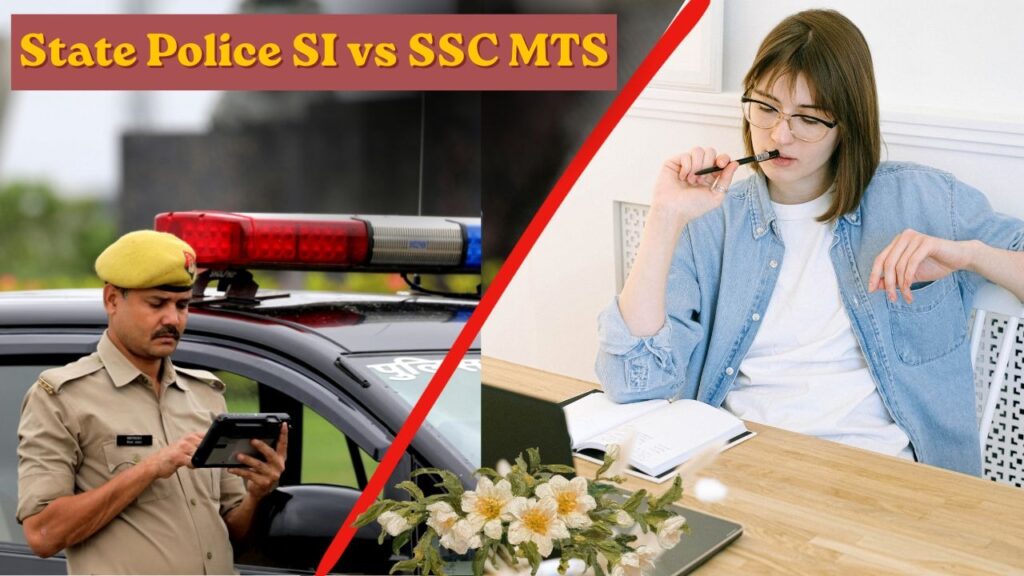
The hype and excitement for government jobs in India is vast and often overwhelming. People cut off everything just to clear competitive exams. Two most big names that pop up frequently are State Police Sub-Inspector (SI) and SSC Multi-Tasking Staff (MTS). At first glance, comparing State Police SI vs SSC MTS is like comparing apples to oranges. One is a field power stuffed job and other is a desk job as administrator.
Many students get confused to choose their field because they don’t know the responsibilities and real-time work, they’re just watching money. Ask a single question and do yourself a favor for finding the right answer.
Do you want the power and prestige of the uniform, or the stability and work-life balance of a central government desk job?
Let’s understand this through this guide which breaks down every detail from these two paths to let you decide which job aligns with your lifestyle.
Job Roles and Responsibilities in Real
State Police Sub-Inspector (SI)
A person is going to work under Police regulations at the lowest rank position. Going to the scene of a crime report or checking who breaks the law as the first investigating officer, and filing a charge sheet in court is Sub-Inspector responsibility. This position comes in Group B (Non-Gazetted) or Group C Jobs.
It is a desired job for a person who has a bulky body and good physical strength with a sense of justice, and a desire for social status. It’s a 24/7 job, changing shifts, and responsible to maintain public safety, law and order, and investigate crime scenes.
SSC Multi-Tasking Staff (MTS)
All the paperwork is required to maintain that the system works properly, MTS employees are responsible for maintaining files, photocopying, delivering couriers to provide essential support in various Central Government Ministries, Departments, and Offices.
It is a desired job for quiet and routine seeking people who want a secure position at government desk with minimal stress and ample time to prepare for higher exams (like UPSC or SSC CGL). It comes under Group C posts.
Why Compare These Two?
The comparison becomes necessary when students get confused because of Entry Barriers and Aspirant Demographics.
SSC MTS: Students can take entry in the government sector after 10th pass and take a tag on their resume.
State Police SI: Wait for the graduation to complete and then apply to take authority in their local area.
Tip: You can apply for both and become a government employee.
Eligibility and Selection Process
The requirements are different for these two positions because their responsibilities are opposite. Physical standards also matter for the SI job. Let’s take a deep look:
Feature
State Police SI
SSC MTS
Educational Qualification
Graduation (Any Stream)
10th Pass (Matriculation)
Age Limit
21 – 28 years (Varies by state)
18 – 25 or 18 – 27 years
Physical Standards
High (Height, Chest, Vision)
None (Except for Havaldar posts)
State Police SI conduct two tests — Prelims and Mains to check your knowledge in GS, Maths, Reasoning, and Language (Hindi/English). After clearing the written examination, candidates who are shortlisted will go to the next phase of Physical Efficiency Test and Physical Standard Test. These tests will check your endurance capacity while running, long jump, and high jump along with height and chest measurement.
Medical Examination for checking eyesights, flat feet and knock-knees are also mandatory to allow you to take the field job.
SSC MTS has a streamlined selection process which starts with an objective-type exam. This Computer Based Examination divided into two sessions —
Session I
Numerical and Mathematical Ability & Reasoning
Session II
General Awareness & English Language
CBT follows PET/PST but only for havaldar posts, and it has only walking test and physical measurement. You will be called for document verification once you finish all these tests.
Salary and Benefits
Most of the students decided their career according to the salary and benefits. State Police SI pay at Level 6 which means basic pay is ₹35,400. It can be around ₹55,000 to ₹75,000 total salary by including other allowances. Salary varies based on the city/state of the person.
SSC MTS pays at the Level 1 scale, basic pay is around ₹18,000 with additional benefits it can sum up to ₹28,000 to ₹32,000.
Choose wisely, because your choices impact on your lifestyle, perks and your mindset.
Preparation Strategy to Compete in Exam
Few subjects are common in both State Police SI vs SSC MTS exams. You can prepare yourself for both exams if you are still in 10th grade.
Mathematics, Reasoning, and General Awareness are mandatory subjects for both exams.
Make your basics clear by practicing on Basic arithmetic, percentages, profit & loss, and interest etc.
Try a mock test online and buy books in which Coding-decoding, blood relations, and syllogisms questions are presented.
Read newspapers and follow famous personas and good channels on youtube for Current affairs, History, Geography, and Polity.
Analyze Previous Year Questions to obtain Extreme Speed and Accuracy in every answer. Physical activity is required for SI selection, so dedicate 1 hour every morning to any game and running outside.
Career Growth and Promotions
State Police SI
Sub-Inspector (SI)
Inspector
Deputy Superintendent of Police (DSP)
Additional Superintendent of Police (ASP)
In some cases, top performers reach the rank of SP (IPS level) near retirement.
SSC MTS
Multi-Tasking Staff
Lower Division Clerk (LDC) – via Departmental Exams
Upper Division Clerk (UDC)
Assistant Section Officer (ASO)
The MTS profile is often seen as a stepping stone. Most candidates clear CGL or State PSCs while working as MTS.
Need Help To Choose Your Right Path?
Take paper and pen for side-by-side comparison for both SI and MTS jobs. In those comparison right your pros and cons:
What is your “Why”?
Pros
Cons
State Police SI
Power, uniform, field action, high paying
24/7 job, vary shifts, transfer different states, crime scenes, stressful
SSC MTS
Stable job, grow family, decent work, prepare for IAS
Low salary, ton of preparation to clear exam
If you choose SI then prepare yourself for facing crime scenes & handling dead bodies, political pressure, and angry crowds. Maintain physical stamina and strength with regular exercise.
If you choose MTS then prepare yourself for preparation for the next rank for higher posts but it is a decent job and requires less stress to manage.
The State Police SI role is a “Life Style.” It offers high pay with great authority which makes you become a man with power that has a direct impact on society. SSC MTS is a desk job for people who maintain discipline and want a peaceful life.
My advice is don’t lose the chance, if you are in 10th grade you can apply for SSC MTS and take the hit while preparing for other other options like IAS or State Police SI. you can decide after your graduation but if you are graduated then choose accordingly.
Regardless of your choice, the key is consistency. Start your preparation today, pick your syllabus, and don’t stop until you crack the examination.
Are you interested in Technical and Vocational Education Training (TVET) as a career option? A good Industrial Training Institutes(ITI) is a great way to learn a practical skill and get a job in a short span of time. How much does it really cost to join a government ITI? is probably among the most frequent questions that are buzzing in your mind if you have been looking for ITI courses. So let’s get started with the full ITI Admission Fees in Government College details before jumping on the admission portal.
Quick Overview of Fee Breakdown
This is the fee structure in short for an Electrician course at a typical government ITI to make your career brighter. This will help you understand the budget of the two year course.
Charge
Amount
Admission Fee –Given one time
₹100
Registration Fee –Given one time
₹50
Monthly Tuition
₹2,400 (₹100 × 24 months)
Caution Money – given back later
₹250
Examination Fees
₹200
Student Welfare Funds
₹300
Total Approximate Cost
₹3,300
Note: The caution deposit is refundable on successful completion and your effective expenditure comes to approximately ₹3,050 for two years — Now that’s reasonably priced!
Understanding the ITI Fee Structure
The nice thing about government ITIs is that they are hilariously cheap when compared to private ones. With private ITI colleges charging fees ranging from ₹5,000 to more than ₹1,000,000 per year, fees of the government ITI colleges are affordable and it goes from ₹1,000 to ₹20,000 per year. So, students from all financial backgrounds can get quality technical education.
But it’s not just a single figure for the fee structure to pay and forget about it. The fees in government ITIs are divided into several heads, each of which is for a certain purpose. Knowing what all these entails will allow you to plan your finances so you don’t get a shock when it is time for admission.
Tuition Fee: The Core Cost
The tuition fee is the staple of your yearly outgoings. It is from ₹100 to ₹150 per month at most government ITIs in India which works out to be from ₹1,200 to ₹1,800 per year. For reference, the West Bengal government ITIs charge a total fee of ₹30 per month as a tuition fee, implying that you will be spending only ₹180 for the entire six-month course. These vary from state to state and institution to institution, so be mindful!
The annual tuition fee for regular trainees, however, is Rs 1,800 (Rs 150 per month) at some government institutions such as the National Skill Training Institute (NSTI) in Patna. Yet if you are from SC/ST, you pay a lot less – just Rs 600 per year (Rs 50 per month). It is indicative of the government’s resolve to open the door of education to the underprivileged sections of the society.
Admission Fee: One-Time Payment
Consider the entry to the admission fees for the institution you are wants to apply. This is a one-time fee that you pay once you join and not every year. The admission fee is usually around ₹100 to ₹300 for most government ITIs. This is phenomenally low, and includes the cost of processing your application, verification of your documents, and the registration procedures.
Interestingly, some institutes offer concessions to SC/ST students. For example, SC/ST students will have to pay Rs 25 instead of Rs 100 as admission fee.
There is also a registration fee separate from the admission fee and the registration fee is usually between ₹30 to ₹200. This is for registering your enrolment with the records of the institute and getting you listed with the official registers. It’s a non-refundable fee which is paid generally at the time of verification of admission.
Again, if you belong to SC/ST category you may get waived off from paying this fee in some institutes.
Caution Money: A Security Deposit
Important to understand: Caution money isn’t a fee that you are wasting. It’s a security deposit that is refunded. You pay it once (usually between ₹ 100 to ₹ 500) while admitting and you get it on successfully completing the course. This sum of money serves as a kind of insurance to keep students finishing their training and disciplined.
Additional Funds and Charges
In addition to the basic fees, the Govt ITI s also levies different student welfare and infrastructure enhancement funds which may be used for welfare activities of the students, for up-gradation or improvement in infrastructure. These might include:
Gymkhana Fee
Up to ₹100
To get along with sports and extracurricular activities
Student Welfare Funds
₹50 to ₹375
Contributing to overall student development programs
Placement Registration Fee
Approximately ₹50
Helping the institute organize campus placements
Smart Card Fund
Around ₹200
For issuing digital identity cards
Examination Fee
At the time of examination, an institute usually levies a test fee of ₹25 to ₹100 per attempt. This includes the cost of holding exams, drafting question papers and conducting tests.
Total Annual Cost For ITI Government
Add all this up and see what the real number you’re looking at is. For a normal engineering trade class (say Electrician or Fitter) in a government ITI.
First Year
Fee is in range between ₹2,400 — ₹3,500
Subsequent Years
As it vary on state, ₹1,500 to ₹2,000/year
Delhi institute registration fee is Rs.200, so if you are applying there then this is the amount you have to pay at the time of verification along with the other applicable fees, which is quite nominal.
Special Provisions and Exemptions
For Girl Students
A large number of Government ITIs provide relaxation to female trainees. Girl students are exempted from tuition fees as well as examination fees at institutes such as Patna’s NSTI, rendering the course free for girls (the only exception being other compulsory deposits and fees). A few states have adopted similar policies to incentivize women to take up technical trades.
For Reserved Categories
There are hefty discounts for students who belong to the SC, ST, OBC or EWS category. Tuition is often waived or discounted to a token sum. In the ITIs of Odisha, the admission fees are waived for the trainees from SC, ST and women category whose family annual income is less than `2.5 lakhs, they have to pay only the caution money.
For Persons with Disabilities (PwD)
The government ITIs are said to extend exemptions and concessions to the special needs students, because ‘they are handicapped and the financial burdens of study should be thrown off from their shoulders’.
State-Wise Variations For the Fee of ITI
One should note that the ITI fees vary according to states since education is a subject of state in Indian federalism. For instance, in Tamil Nadu, government ITIs charge anywhere between ₹5,000 and ₹7,000 per year, while in Himachal Pradesh, they charge between ₹6,000 and ₹8,000. With competition fees, states such as Bihar, Uttar Pradesh, and Rajasthan have the biggest network of government ITIs.
Conclusion
When you take into account that you are learning practical skills that are directly applicable to jobs in the public and private sectors, that is a huge amount of bang for your buck. Whether you are just finishing school and want to start your career or are planning a career change, government ITI courses provide a cost-effective, quality route to technical proficiency.
The best way to get the most update on ITI Admission Fees in Government College is to go on your state’s ITI official website, check under what category you fit under for exemptions and email the best would be to the lucky one you want to attend for any questions. Your path to a rewarding career might be more affordable than you think!
BPSC AEDO Syllabus: It gives me immense pleasure to believe that a graduate can make such a difference by choosing to be in the education sector or education administration and directly impacting the lives of so many students. The Bihar Public Service Commission (BPSC) has recently made the entry for the position of Assistant Education Development Officer (AEDO). With 935 posts available, this is a golden chance for the candidates who want to get permanent and reputed government jobs in Bihar. l
But clearing a state level competitive exam is not a cakewalk. It needs a very strategic planning, strong study schedule and well understanding of examination pattern. Decoding theBPSC AEDO Syllabus is your starting line and most vital step, however attaining the job also depends on knowing fully the position that you are going to fill.
This is the complete guide for BPSC AEDO syllabus in which you can get each and every information regarding this exam. From understanding the job profile and expected salary to analyzing the syllabus and best books, this article is your guide for everything you should know.
What is the BPSC AEDO Job Profile?
The reality of the job must be understood before beginning preparation. The Assistant Education Development Officer (AEDO) post is a combined administrative and supervisory post. The AEDO is the vital link between the state’s education department and the schools at the ground level.
As an Assistant Education Development Officer, you ensure the execution of educational policies and keep a watch on schools in that area to see if they adhere to the minimum standards of education and infrastructure.
Key Responsibilities of an AEDO:
Educational Supervision: AEDO officers must check the working of government schools in their region consistently to speed things.
Scheme Implementation: Monitoring every government schemes to be implemented properly.
Analysis & Reporting: To generate believable reports with information such as student enrollments, attendance rates, dropout rates, and pass rates for students across courses.
Administrative Mediation: Redressing grievances of teaching staff, resolving logistical issues, ensuring adequate supplies and proper functioning of schools.
Quality Control: To conduct inspections for up keep the good quality in teaching and to ensure the syllabus is covered as per the state board.
There is no typical desk day in this position. You’ll need to be out in the field or on campus, talking regularly with staff at schools, and taking the lead on identifying and addressing any administrative roadblocks.
Salary and Perks: Why is the AEDO Role Highly Sought After?
Apart from the prestige and societal level impact associated with the post, the BPSC AEDO post provides very good salary and excellent job security.
Salary is given under the Pay Level 5 as the government’s pay matrix.
Basic Pay: ₹29,200 per month.
Allowances:
Dearness Allowance (DA),
House Rent Allowance (HRA),
Travel Allowance (TA),
Medical Allowances
The initial in-hand salary ranges between ₹40,000 to ₹45,000 per month.
Growth/Promotion: One can become a DEO or take up other high administrative posts in the Bihar Education Department from an AEDO with the experience of years and departmental promotions.
Eligibility Criteria and Essential Skills Required
Educational & Age Criteria:
Category
Minimum Age
Maximum Age
Educational Qualification
–
Any Stream’s Bachelor’s Degree in any discipline from a recognized university
Unreserved (UR) Male
21 years
37 years
Women (All Categories)
21 years
40 years
OBC/EBC
21 years
40 years
SC/ST
21 years
42 years
Essential Skills for Success:
Fluency in Hindi and English: You need to have good communication skills in Hindi and English while dealing with teachers, government officials and the public.
Analysis: Reporting requires you to collect data on student enrollment, for example, or financial records then analyze that information to come to conclusions.
Leadership and Mediation: You may need to negotiate disputes within administration to hold the line on discipline and maintain orderly learning conditions.
Versatility: You were to expect to go and work at different blocks, and more than you expects at getting curve balls in logistics.
Complete BPSC AEDO Syllabus and Exam Pattern
Understanding the exam pattern very well will only help you to crack the written exam. Here is a brief about BPSC AEDO exam pattern
The BPSC AEDO papers are in the objective type questions (MCQs) format spread over three papers. The two-hour papers are of 100 marks each.
Guideline on Negative Marking: 1/3rd of the mark allocated to the question will be deducted for each wrong answer. Precision is just as important as the number of tries.
Paper
Subject
Total Marks
Duration
Nature of Exam
Paper 1
General Language (English – 30, Hindi – 70)
100
2 Hours
Qualifying (Min. 30% in both separately)
Paper 2
General Studies
100
2 Hours
Evaluated for Merit
Paper 3
General Aptitude
100
2 Hours
Evaluated for Merit
The Detailed BPSC AEDO Syllabus
A focused plan of preparation depends on the exclusive understanding of the given official BPSC AEDO Syllabus. Let us now discuss each paper:
Paper 1: General Language (Qualifying)
This exam is to check your basic grammar knowledge. You will have to obtain a minimum score of 30% in both English and Hindi parts minimum for your other papers to be evaluated.
English (30 Marks):
Basic Grammar,
Vocabulary,
Synonyms & Antonyms,
Idioms & Phrases,
Sentence Correction,
Reading Comprehension.
Hindi (70 Marks):
Hindi Vyakaran (Grammar),
Sandhi,
Samas,
Paryayvachi Shabd (Synonyms),
Vilom Shabd (Antonyms),
Muhavare (Idioms),
Unseen passages.
Paper 2: General Studies (Merit-Based)
History: Indian History both old and new. Bihar contribution in Independence of India.
Geography: Indian Geography. Focus on Bihar economic and physical geography which covers Drainage, soil and mineral wealth of Bihar.
Indian Polity & Economics: Indian Constitution, governance and Policies implemented by the Central Government.
Basic Science: Biology, Physics, and Chemistry of 10th class.
Current affairs & General Knowledge: Big events and global summit of India specifically current events of Bihar in last 10-12 months.
Paper 3: General Aptitude (Merit-Based)
General Quantitative Aptitude should best be learned by building your fundamentals with clear concepts of class 6th to 8th level books that are worked on in a very plain and simple way on all the necessary things. Concentrate on the following Chapters – Number Systems, Ratio and Proportion, Simplification, Averages, Profit and Loss, Percentages, Simple and Compound Interest, Time and Work, Speed and Distance and some Basic of Mensuration (2D and 3D).
Also, reasoning plays a vital role, so you must practice topics like Number and Alphabet Series, Analogies, Coding Decoding, Blood Relations, Syllogism and non-verbal reasoning topics like Mirror Images & Paper Folding on a regular basis.
The data interpretation is also very important aspect in the exams, where you have to frame questions on the basis of tabular data, pie chart and bar graph and solve them, so on these fronts you need along with gre speed you also require gre accuracy.
Best Books for BPSC AEDO Preparation
With so much information out there, it’s natural to feel intimidated about where to start. The trick is to have a small number of dependable books, go through them a few times and not to hoard too much revision material. Below are some of the best books recommended for each section:
For General Language:
Objective General English by S.P. Bakshi (Arihant Publications)
Samanya Hindi by Lucent Publications
For General Studies:
General Knowledge by Lucent Publications
Bihar Samanya Gyan by Manohar Pandey or Crown Publications
NCERT Books (Class 6th to 12th)
Monthly Current Affairs Magazines or News Paper
For General Aptitude:
Quantitative Aptitude for Competitive Examinations by R.S. Aggarwal (S. Chand)
Fast Track Objective Arithmetic by Rajesh Verma (Arihant)
A Modern Approach to Verbal & Non-Verbal Reasoning by R.S. Aggarwal
Pro Preparation Strategy to Crack the Exam
Having the right textbooks and knowing the syllabus is only half the battle. How you organize your daily study routine, now that’s the killer, that’s what’s really going to make or break you.
Don’t Disregard Paper 1: Many students end up underestimating the language paper because it is “acting as a gatekeeper”. But if you are not getting minimum 30 per cent in both Hindi and English, you will be disqualified no matter how many marks you are getting in others papers. Form a habit of completing at least 45 minutes language sessions daily.
Concentrate on Bihar-centric issues: Geography, history and current affairs of Bihar carry more weightage in GS. Consider “Bihar Special” as a separate paper and study accordingly.
Be good at managing your time: You have 100 questions in the Aptitude section to be solved in 120 minutes. It provides you 1 minute for each question. Practice learning to skip the harder and more time-consuming questions and answering the simpler questions first.
Mock Tests are non-negotiable: Start taking full-length mock tests not later than 2 months prior to the exam. It will get you used to the 1/3rd negative marking pattern. Analyze the questions you get wrong to see where you are weak and to improve your guessing.
Revise Consistently: Use your weekends to go over everything you learned during the week. Keep your notes brief and clear so you can quickly review them in the last weeks.
BPSC AEDO exam is a good way to get a respected and secure job in government service. The competition will be hard but well disciplined based on complete knowledge of BPSC AEDO Syllabus and Exam Pattern will make you ahead from the rest. Get your material, prepare a realistic timetable and start your preparation now. To qualify the state level public service exams, constancy counts more than severity.