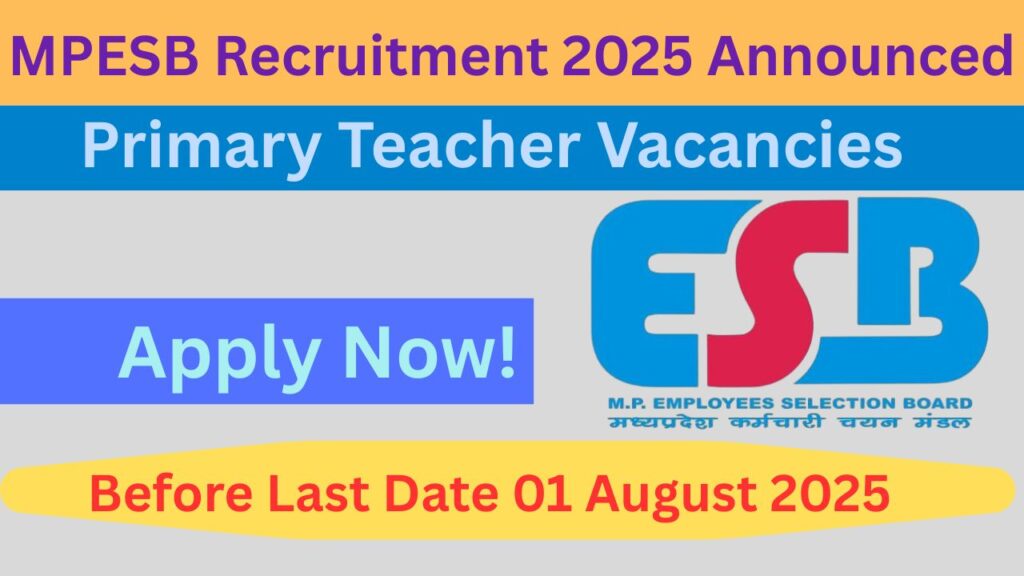
MPESB Recruitment 2025: Primary Teacher Vacancies Announced – Apply Now!

Candidates who want to apply for a Primary School Teacher job can now apply online through the official website. MPESB recruitment 2025 starts on 18 July 2025, and the portal will open until 01 August, 2025. There are several posts for Primary School Teachers, Apply now to secure the position. This post’s salary range is nearly Rs. 25,300 with additional benefits.

The minimum age limit is 21 years and the maximum is 40 years. Age relaxation of 5 years will be given to reserved categories. Read the official notification for full eligibility information.

MPESB Recruitment 2025 Highlights

ExamPrimary School Teacher Selection Test
BoardMadhya Pradesh Employees Selection Board
PurposeMPESB is conducting an exam w is mandatory for Primary School Teachers. Recruitment will be based on merit list.
Vacancies13089
Selection ProcessWritten Exam, Merit List, and Document Verification
Official WebsiteClick Here

MPESB Recruitment 2025 Key Dates

Application Starts18/July/2025
Application Last Date01/July/2025
Fee Payment Last Date01/August/2025
Correction Last Date06/August/2025
Exam Date31/August/2025
Admit CardBefore The Exam

Read More 👉 Agniveer Answer Key 2025 Out – Download From Direct Link

Steps to Apply MPESB Recruitment 2025

Official website for the MPESB recruitment is added in the article. You can go to the website or apply directly from here.

  1. Check out the Application Link on the official website.
  2. Click on the link then the registration page will appear.
  3. Fill in the required details to register. 
  4. Attach the documents if needed then pay the application fee.
  5. Click on submit once you re-check the details.
  6. Download the copy of the application for future use.
Application Fee
Gen/EWS/Other stateRs. 560
OBC/SC/STRs. 310
Payment ModeOnline

MPESB Recruitment 2025 Important Links

Apply NowClick Here
Download RulebookClick Here
Official WebsiteClick Here

Leave a Comment

Your email address will not be published. Required fields are marked *

How to Take Admission in Delhi University in 2025 – Full Process Explained!

How to Take Admission in Delhi University

Delhi University is a great university for UG, PG and doctoral programs which attracts thousands of candidates from all over the country. If you are planning to take admission to the most popular university then you must know about the admission process. So, here’s a guide for you which helps you get ready for the procedure.

DU offers a plenty of programs for Arts, Science, and Commerce students. First, know your interest that aligns with the future goal. It will help you select the field of study and decide which program you have to take admission. Admission process is same but eligibility criteria and cutoff marks is different on most of the programs.

DU offers multiple courses in every stream through the entrance exams for the particular field. So, score well in exams to get a admission in Delhi University, here are the following exams: 

  • CUET Examination

DU offers UG courses such as BA, B.Com, B.Sc, BBA, MA, MCA, M.Sc, and B.Ed through the Common University Entrance Test.  

  • JEE Main

Candidates who are willing to take admission in the Engineering programs such as B.Tech have to appear in the JEE examination.

  • CAT Examination

DU offers an MBA program through the CAT examination, you must appear in the examination and score well in that to get an admission.

  • CLAT Examination

For LLB and LLM programs, candidates have to pass the CLAT exam.

  • UGC NET/CSIR NET/NTA 

These are the examinations for admission in PhD.

Candidates must have cleared the entrance exam for their courses then register for CSAS. Its full form is Common Seat Allocation System and this is the stage where you have to fill your college preferences and courses.


This round takes time because it’s a lengthy process, seat allotment based on your scores of the entrance exam, preference you fill, and category you belong to. Seat availability is critical in some cases, you can freeze your seat if you are satisfied with the given seat or wait for the next round.

Once you freeze the seat which is offered by the university. Your admission is confirmed after your acceptance. 

Read More 👉 Top 10 MBA Colleges in Lucknow You Shouldn’t Miss in 2025

Check your eligibility for the particular program you are choosing to take admission. For UG courses you must pass 12th class, for PG courses, it requires a graduation marksheet. Admission in PG courses may require a CUET PG score.

  1. Visit the official website of DU. 
  2. Search for the SOL admission portal, when you click on that the registration page will appear then click on the registration link.
  3. Enter your information in the form carefully to complete the registration.
  4. Log in with your registration number and password.
  5. Fill out the rest of the details with correct information to further proceed.
  6. Carefully fill in the details, so it cannot be incorrect.
  7. Attach the required documents required for the application in your admission.
  8. Submit application fee then download the copy.
  9. You can check application status from your account.

DU offers plenty of programs for students to study higher education. DU offers programs in streams like Arts, Science, Commerce, Management, Law, and Engineering. The admission in these streams through their entrance exams respectively.

If you are a working professional, parent, or any other responsibilities, you can pursue degrees such as BA, B.Com, MA, M.Com, and M.Sc without any entrance exam. SOL is beneficial for most of the students who can’t attend the college regularly due to any reason. 

NCWEB is designed specially for women who cannot attend full time courses due to responsibilities, work, or any other reasons. Women who prefer weekends or evening classes to complete their education can take admission but it happens through merit score. 

Students who want specializations in any field can also think of Delhi University as the best option for them. The various fields of specializations which DU offers are – English, Hindi, Economics, and Political Science, Physics, Chemistry, Mathematics, Law, and Management.

Delhi University primarily takes students through entrance exams but there are certain programs and modes of study where students can take admission without appearing in the entrance exam. 

SOL – It is designed to provide education for students who cannot attend the regular classes due to work, distance, or any other reason. SOL offers many UG & PG programs without an entrance exam.

CoursesAdmission processMode
BA, B.Com, MA, M.Com, M.ScAdmission is based on MeritDistance education

Some UG Courses based on Merit – DU affiliated colleges are offering some UG programs like B.Com, BA, and many other courses without an entrance exam.

Read More 👉 Top Government Jobs After MBA | Best Careers 2025 Guide

Course NameWho Can Apply?How Selection Happens?
BA OR BA (Hons)10+12th from any stream  (50% score minimum)Through CUET UG + CSAS Counselling
B.Sc OR B.Sc (Hons)10+12th (50% score minimum) in science streamThrough CUET UG + CSAS Counselling
B.Com OR B.Com (Hons)Passed 12th (50% score minimum) in commerce streamThrough CUET UG + CSAS Counselling
B.Tech Passed 12th with PCM, minimum 60% marksJEE Main + JAC Counselling
BA LLB / BBA LLBAccomplish 12th or equivalent (50% score minimum) CLAT UG + CLAT Counselling
BBA10+12th or equivalent (50% score minimum) Through CUET UG + CSAS Counselling
B.El.EdAccomplish 12th or equivalent with 50%Through CUET UG + CSAS Counselling
BFAAccomplish 12th or equivalent (45% score minimum)Through CUET UG + CSAS Counselling
B.Lib.I.ScAccomplish 12th or equivalent (45% score minimum)Through CUET UG + CSAS Counselling
Course NameWho Can Apply?How Selection Happens?
MABachelor’s degree (50% score minimum)CUET PG + CSAS Counselling OR Merit-Based
M.ComB.Com/B.Com (Hons) (50% score minimum)CUET PG + CSAS Counselling
M.ScB.Sc in relevant subject with at least 50% marksCUET PG + CSAS Counselling
MBABachelor’s degree in any discipline CUET PG + Group Discussion & Interview 
MCABCA or equivalent degreeCUET PG + CSAS Counselling
B.EdGraduation degree (50% score minimum)CUET PG + CSAS Counselling
LLBUG OR PG degree in any with at least 50% marksCUET PG + CSAS Counselling
LLMLLB (3-year or 5-year) (50% score minimum)CUET PG + CSAS Counselling
M.TechB.Tech/BE in relevant field (60% score minimum)CUET PG + CSAS Counselling
M.EdB.Ed/B.El.Ed or equivalent (60% score minimum)CUET PG + CSAS Counselling
Points Details
Who can apply?– Master’s degree (55% score minimum) marks – 5% relaxation for reserved category
How do you get selected?First Option  – Through UGC-NET, UGC-CSIR NET, DBT-JRF, ICMR-JRF, once you pass this, you can appear directly for an interview.Second Option  – You must appear for the CUET-PhD entrance test. If you don’t want to take the first option.  – Next step for selected candidates is an interview.  – Everyone (including exempted candidates) must attend the interview.
What happens after selection?– Merit list is prepared based on entrance and interview performance.- Selected candidates must verify original documents in person at the department.- Seats are filled as per department’s decision and university norms.
Other important points– Final subject relevance is decided by the Departmental Research Committee (DRC).- No PhD through distance mode at DU.

Leave a Comment

Your email address will not be published. Required fields are marked *

BTech vs BSc vs BA in 2025: Which Degree Offers the Best Future Scope?

BTech vs BSc vs BA in 2025: Which Degree Offers the Best Future Scope?

In today’s world, students must choose their field in which they have interest. Whether you choose BTech vs BSc vs BA in 2025, the future scope is consistently growing, if you follow the right direction. The right direction means if you are interested in teaching then BSc and BA is a good option but if you want to grow in the tech industry then BTech is the right option for you. Focus and the right college is also a matter to build your established career. 

Graduation is the first step in your career so take it wisely. The primary focus of BTech is Engineering & Technology. While BSc opens a path for you in science and research areas. BA is leading you towards further education to get a specialization in any specific subject. Students who are preparing for government exams can also pursue BA after 12th but many posts require other degrees. Before taking any action, you must check eligibility carefully for your future scope. 

Tips To Choose the Field for Graduation

Remember your passion, what you want to become in future? By acknowledging these questions, you can find the answer within yourself and then check the path to reach there. Once you know where to go, you will not get confused about your education. BA and BSc are easy courses, meanwhile BTech is hard, so if you want to become an engineer then you must pursue a BTech degree. 

If you want to become a Teacher, Journalist, Social Worker, HR, or Government Employee then BA is the best option for you. You can pursue other Technical courses and Specializations after BA. If you are interested in Teaching Science, Research, Nursing, or Higher Degrees, you can pursue a BSc. 

Comparison of BTech vs BSc vs BA

BTech (Bachelor of Technology), BSc (Bachelor of Science), and BA (Bachelor of Art) are highly demanding careers which offer a wider range of opportunities to the students. Their comparison is primarily focused on the career scope, course duration, course fees, eligibility and course curriculum.

Course Content of BTech vs BSc vs BA

BTech is a professional degree to deliver hands-on learning for engineering and technology. To advance technology with innovative minds is the motive of the industries. Colleges maintain their curriculum of BTech with application-based skills to get their students industry ready. It covers technical and applied aspects of specific engineering disciplines such as Mechanical, Civil, Computer Science, Chemical, Electrical, and Information Technology.

BSc is a graduation degree with more theoretical education in pure science like Physics, Chemistry, Zoology, Botany, Computer Science, IT, Statistics, Economic, Aeronautics, etc. It offers core concepts on the theories of science & technologies which get you focused on more research methodologies and theoretical understanding.

BA is involved in more Literature, History, Economics, Psychology, Sociology, Political Science, Geography, Journalism, Public Administration, and Social Work. It focuses on more theoretical concepts, creative writing and analytical skills, that is why it is perfect for those who want to become a professor in any of the subjects.

Read More:- SSC JE vs RRB JE: Which Govt Job Offers Better Salary, Growth & Stability in 2025?

Courses Duration 

  • BTech is entirely four years with one year internship. 
  • Standard BSc is a three year course which can be extended in specific programs such as Integrated program or BSc Honors.
  • BA standard degree is a total of three years course but BA honors is extended for four years. 

Eligibility for BTech, BSc, BA Courses

BTech & BSc graduation requires a 10+2 marksheet with science subjects including Physics, Chemistry, Biology & Mathematics. Admission in BSc can be done through an entrance test or direct admission. During BTech admission, you may have to clear JEE Mains/ Advanced which is hard to score well.

Students can take admission in BA after completing their 10+2 in any stream. It is not necessarily important to come from a science or commerce background. Students from arts, commerce, or science are eligible for BA.

Best Future Scope for BTech vs BSc vs BA

BTech Graduates are developing skills in engineering roles in departments of IT, Manufacturing, Chemical, Electrical, Production, Civil, Biomedical. After BTech, students can get a high salary in engineering roles from the top companies like Tata, IBM, Amazon, TCS, Infosys, Cisco, Godrej, and Siemens.

BSc Graduates are offering students a diverse range of opportunities to become job ready but for a higher scope, you should consider a master’s degree after BSc. There are some other specializations in technical courses, data science, and machine learning that can be helpful for getting a job in tech industries. You can also pursue higher education in pure science to become a lecturer or professor.

BA degree is offering many opportunities in further education for research, teaching, nursing, and creative arts & writing. Students can take a BA degree to establish a career in any specific field of subject. It offers many opportunities in the departments like HR, Media & Journalism, Social Work, Event Management, Hotel Management, Content Writer, Digital Marketing, Business Analyst, and Government Sector. Some of these require a diploma or certificate course for applying to the particular role.

How Can You Choose the Best Course?

There is a final answer for that because it all depends on your interest and budget. Let’s start from the lower budget course to the highest budget course:

Choose BA if:

  • You want to become a teacher, professor, analyst, content creator, digital marketing, sales executive, owning a business or preparing for a government job. 
  • You can’t afford the heavy expenses of the course.
  • You are working professionally and want to continue your education.
  • You want to pursue another degree (MA, BEd, LLB) or diploma and don’t want to burden yourself with a ton of syllabus.

Choose BSc if:

  • You are interested in science and want to research into this field.
  • You want to become a professor in a science subject.
  • You cannot afford BTech so you can choose BSc with a technical subject.
  • You are not prepared for the entrance tests, direct admission can happen in BSc.
  • You want further studies after graduation.

Choose BTech if:

  • You want to become an Engineer, interested in Physics, Chemistry, and mathematics.
  • You can afford to study from a recognized college.
  • You want the highest salary package after graduation.
  • You want a structured program to grab industry opportunities. 
  • Higher education like MTech for leadership roles in tech-driven industries. 

How do BTech, BSc, and BA degrees differ in career prospects

A comparison table will be good to observe the differences easily among them:

DegreeKey Career ProspectsTypical RolesSalary and Opportunities
BTechTechnology, engineering, IT, manufacturingSoftware engineer, mechanical engineer, data scientist, IT consultantHigher starting salaries, strong industry demand, direct recruitment in technical roles
BScResearch, academia, pharmaceuticals, environment, governmentResearch scientist, lab technician, data analyst, teacherModest starting salaries, very good with advanced qualifications, flexible career paths
BAHumanities, social sciences, media, civil servicesJournalist, teacher, public relations officer, civil servantGenerally requires higher studies for career growth, diverse but less technical roles

Conclusion

Whether it is a debate of BTech vs BSc vs BA, you can choose your degree according to your interest and need for your career scope. Let’s explore the differences in each degree’s details and career scope which can help you to decide the right degree for you. It’s a turning point of your life after 12th, you can’t decide just in a second. You have to list out your choices, interest, and budget then come back to this article to explore every detail for the BTech, BSc, and BA degree future scope.

Leave a Comment

Your email address will not be published. Required fields are marked *

Difference Between Central Government and State Government Jobs – Full Comparison Revealed!

Difference Between Central Government and State Government Jobs

If you are seeking a job in the public sector, it may be useful to know that there are some differences between central government and state government jobs. This guide is for you to understand these differences, Government employees are responsible for controlling and monitoring public rights, administration, and discipline within the country. State government employees work for the individual state and central government employees act at the national level. 

The government employee acts under the service laws that regulate the conditions of work including authority, recruitment, promotion, transfer, and other perks. The recruitment bodies for central government employees are UPSC, RRB, and SSC, and for state governments are UPPSC, TNPSC, and MPPSC, etc.

In the central government, employees can be transferred across the country but state government employees can serve within the state. Transfers typically happen.

State Government Objectives:

  • State governments function at the regional level, operating within the boundaries of individual states.
  • They handle police, agriculture, and public order by implementing laws.
  • According to the state’s situation, a legislative body can pass the law.
  • Each state has a Chief Minister, who leads the administration of the state.
  • He is the highest authority of an individual state that manages the budget, expenditure, and ensures the development projects run smoothly.
  • States can make their own rules but it doesn’t mean that they can violate any central laws. 
  • They have to align with the legal boundaries and National objectives.

Central Government Objectives:

  • The central government functions at a national level and administers the entire nation.
  • It makes laws on union list topics under the Constitution such as defense, foreign relations, and banking among others.
  • The prime minister is responsible for national administration as he is the executive head and holds the highest authority. 
  • State governance works have been monitored by the central government under the constitution. 
  • Central government develops and executes policies at the national level. Supports national budgets, funds, and foreign issues.

Read More 👉 Madras University Result 2025 Declared – Download Scorecard & Direct Link

Difference Between Central Government and State Government

Authority: Central government employees get more power than the state-level employees because the state-level are set to rule the state and region of the country. The central government covers the whole country’s operations.

Legal Powers: According to the Indian constitution, the state government can work in the department for the items that come under the state list. Meanwhile, the central government can take action under national security, foreign affairs, and banking. 

Powers that both have: Some powers are given to both for some important areas like healthcare, education, and criminal laws. They work together as they share responsibility and the coordination helps to run operations smoothly.

Central Government JobsState Government Jobs
Indian Administrative ServiceState Administrative Service: Tehsildar, Sub-Divisional Magistrate 
Indian Police ServiceState Police Service (DSP, SI, Constable)
Indian Revenue Service (IRS) OfficerState Public Service Commission (PSC) – Administrative & Technical posts
Indian Foreign Service (IFS) OfficerState Education Department: Government School Teacher, Lecturer, Principal
Banking Sector: Probationary Officer (PO), Clerk, Specialist Officer (SO) in nationalized banks (IBPS, SBI)State Health Department: Medical Officer, Nurse, Pharmacist, Lab Technician
Railways: Assistant Loco Pilot, Junior Engineer, Ticket Collector, Group D postsJob for State Forest: Assistant Conservator, Guard, Wildlife officer, Forest Ranger
Defence Services: Indian Army, Air Force, Indian NavyState Transport Department: Traffic Management, Transport Sub Inspector, licensing
Through Staff Selection Commission: Junior Engineer, Income Tax Officer, Multi-Tasking Staff, Lower Divisional Clerk, Translator, Assistant Section Officer,  Assistant Sub-Inspector, JSAIn the State Judiciary department: Judges, Court Clerk, Legal Assistant, Stenographer
Public Sector Undertakings: Trainee, Managers, Executive roles, Engineer, OfficersState Revenue Department: Officer, Revenue Inspector, Lekhpal, Deputy, Clerk
Central Departments: Assistant Director, Scientist, specialist, Engineer, Regional OfficerState PSUs: Engineer, Technician, Assistant in state-run corporations
Postal Services: Assistant, PostmanLocal Bodies: JE, Clerk, Sanitary Inspector
Teaching: Central University Faculty, Professor, School teacher.Agriculture Department: Agriculture Officer, Development Officer, and Extension Officer

Why Central Government Jobs Offer Better Career Growth Than State Jobs

When it comes to professional growth for long-term development and a high salary, central government jobs often have the upper hand over state-level positions. Let’s look into the factors that backed up this statement: 

1. Wider Career Scope

Central government employees usually get the chance to work on nationwide projects and schemes. The nationwide projects provided larger benefits such as expanding their work experience, providing a diverse and high-level career path for their professional growth. So, these perks come with central government jobs, not from state departments. 

2. Faster and Transparent Promotions

The larger project initiatives often provide a quality of experience to the person that can help in fast promotion. Internal promotions through departmental examination often happen and deserving candidates can usually get the chance to climb the career ladder faster. In many state services where the process can be slower or less systematic.

3. National Recognition of Experience

Another major point is that the experience of central government employees is more valued than state department employees. If someone decides to switch roles and departments then it is harder for a state-level employee than a central-level employee as it carries more weight in their resume. 

4. Exposure to a Global Network

Working in the central government, dealing with foreign affairs sometimes opens a wider range of interactions and helps build a network from various departments. This act helps them develop their mind with administrative skills and also helps build valuable connections that can support future growth and collaborations.

5. Pay Scale

State government jobs have followed the central pay commission. It may vary depending on the state’s financial growth and decisions. Meanwhile, central government jobs have to pay under the 7th Pay Commission.

Conclusion 

Whether you are preparing for a job as an engineer or officer in the government sector. You can decide which job you can apply for that aligns with your future goal after learning the difference between central government and state government jobs. Their salaries, posts, authorities, and many more. You must know the differences between the two for your career growth.

Leave a Comment

Your email address will not be published. Required fields are marked *

SSC Exam Calendar 2026–27: Complete SSC Exam Schedule

SSC Exam

If you’re a hopeful civil servant or job seeker looking for government employment, consider the SSC Exam Calendar 2026–27 as your BFF. It’s your personal schedule that tells you when to study, when to apply, and when to take your exams. The Staff Selection Commission has been released by the Staff Selection Commission 8th January 2026 we’ll decipher every minute detail for you in the simplest way. 

The SSC Calendar acts as your guide-walking tool on your government job journey, It informs you about the dates for release of notifications, when you can submit the online applications, the last date to submit applications, and most importantly, the date on which you have to appear in exams. The government issues over 80,000 vacancies every year at different levels (10th pass, 12th pass, and graduation), so missing even one crucial date could mean the loss of a golden opportunity. 

SSC Exam Calendar 2026: Notifications Come Out?

Different SSC exams have different dates. It began in March 2026 exams like Combined Graduate Level (CGL), Junior Engineer (JE), selection post phase-XIV release their notifications. If you’re applying to these, watch for March 2026. 

In April, there will be notifications for other popular exams such as the Combined Higher Secondary (CHSL), Stenographer, and Junior Hindi Translators (JHT).

Aspirants who are looking for Multi-Tasking (Non-Technical) Staff and Havaldar posts should wait for June 2026. In the meantime, there will be a Notification for Sub-Inspector (SI) Delhi Policy/CF in May 2026. 

Complete SSC Exam Schedule

Exam NameNotification MonthApplication Deadline
JSA/LDC Grade Limited Departmental Exam, 202516/March/20267/April/2026
SSC CGL 2026March/2026April/2026
Junior Engineer—JEMarch/2026April/2026
Selection Post Phase-XIV 2026March/2026April/2026
SSC CHSLApril/2026May/2026
SSC Stenographer Grade C & D April/2026May/2026
SSC Combined Hindi Translators April/2026May/2026
SSC—MTS & Havaldar June/2026July/2026
SSC Central Police OrganisationMay/2026June/2026
SSC GD Constable September/2026October/2026

When Will the SSC Exams 2026 Actually Happen?

The CGL exam, which comes under the most desired post in the SSC, will be held from May to June 2026. For those seeking to begin an engineering career, the Junior Engineer test is also conducted in May to June 2026. Candidates looking at CHSL (Combined Higher Secondary) level may expect it around July – September 2026.

The recruitment for Constables in CAPFs will surely be at the end, Exam dates in January to March 2027, so that will be among the last exams in this series. 

Stenographer and Hindi Translator (For words and typing speed per minute refer point 8 of ADD2) are also scheduled on August to September 2026. The Multi-Tasking Staff and Havaldar posts, which students eagerly flock towards, will hold examinations between September to November 2026. And if you are eyeing the Sub-Inspector post in Delhi Police or CAPF, you should be ready for October to November 2026. 

Read More 👉 Railway RRB Technician Exam Date 2026: CBT Schedule & Latest Updates

Ongoing SSC Exams 2026

There are a few exams Ă®n progress or are about to commence. The Delhi Police Head Constable (Ministerial) exam was conducted between 7th to 12th January 2026 and Delhi Police AWO/TPO exam was held from 15th to 22nd January 2026. The eagerly awaited SSC CGL Tier-II exam was held on 18 and 19 January, 2026. Starting from 4th February 2026, the SSC MTS exam is now in progress and recruitment for the post of SSC GD Constable has also begun from 23rd February 2026. 

Delhi Police Head Constable07—12/January/2026
Delhi Police AWO/TPO15—22/January/2026
SSC CGL Tier-II18 and 19/January/2026
SSC MTS04 / February / 2026
SSC GD Constable23 / February / 2026

Application Process Date For SSC Exams 

Usually, there is about a one month period from the release date of the notification to the last date for submitting an application. So when the notification comes out, don’t procrastinate! Register immediately, these deadlines are firm and you won’t get extensions because you forgot. Mark those days on your calendar, set your phone alarms and be sure to send before time runs out. 

Conclusion

The SSC Exam Calendar 2026 – 2027 is not only a timetable, it is your strategic planning guide. As there are many examinations conducted in a year, you can get a number of chances to get a dream government job. Maintain your organization and concentration and keep in mind that Every successful SSC aspirant was a Calendar-junkie. Take it along with you everywhere and success will be waiting for you. The official schedule can be downloaded from the SSC website at ( ssc.gov.in ) for more information. 

Download Official SSC Exam Calendar 2026

Download Calendar Click Here
Official WebsiteClick Here

Leave a Comment

Your email address will not be published. Required fields are marked *

ICET Result 2025 Live: TS TG Rank Card Out, Download Your Scorecard Now!

ICET Result 2025 Live: TS TG Rank Card Out, Download Your Scorecard Now!

TSCHE has announced the result of the examination held on 8 June and 9 June, Candidates can now check their results online. This exam is an entrance key for admission to MCA and MBA programs across Telangana. Candidates can find the link to the official website in the article to check their results. 

If you don’t know how to download your result, there is a step-by-step guide to check and download your ICET result. After the result declaration, shortlisted candidates can now prepare for the counselling round. It will be announced later on the website. Keep checking for updates on the counselling process.

Details For The ICET Result 2025 

Conducting BodyTelangana State Council of Higher Education
Exam NameIntegrated Common Entrance Test
PurposeThe Telangana government conducts this exam as an entrance exam for admission in Universities and affiliated colleges across Telangana.
Total candidates64,398
Cut-Off score25%
Result release date 07/July/2025
Check ResultClick Here
Official WebsiteClick Here

Read More 👉 BBAU PG Admission 2025: Dates, Fees, Eligibility & Offered Courses Revealed!

How to Check TC ICET 2025 Result

  1. You can click on the link “Check Result”.
  2. Page appears on the official website on your browser.
  3. Enter your credentials to check the result. (Registration number, DOB)
  4. Result will show up on the screen.
  5. You save and download it for a hard copy.

Minimum Marks for ICET 2025

TSCHE has set some limitations for the examination qualifying marks. According to their rule, minimum qualifying marks for general and OBC candidates must be at least 50 marks out of 200. Meanwhile, there are no minimum marks for reserved categories like SC/ST. 

These minimums will have to be acquired by the students to secure admission in universities for MCA and MBA programmes. 

Leave a Comment

Your email address will not be published. Required fields are marked *

Scroll to Top