GSEB HSC Supply Result 2025 is released today. If you also appeared in the 12th science examination held from 23 June to 30 June, 2025 then check it out on the official website. You can follow the steps to check the result of Gujarat Board examination 2025.
GSEB HSC Supply Result 2025 Check Now
Students can follow a step-by-step guide to check the GSEB HSC supply result 2025. Students can also check their result from the direct link provided in the article.
Go to the official website, link is given in the article.
When you appear on the website, click on the link “HSC Supply Result 2025”.
Enter the details such as roll number and password and click on enter.
Post 12th Government exams are the best means to get a lucrative job in the government sector in India. Due to high salaries, job security, and lifetime benefits, these exams are dream of lakhs of students. In 2026, as we look to the future, several big recruitment cycles in Railways, SSC, Banking, Defence and Police departments are expected to be announced, which will once again pour in its biggest ever recruitment for 12th pass candidates.
Whether you are going to appear for RRB, SSC CHSL, MTS, Police or Defence services i.e. NDA or Navy, you can get complete information about Eligibility, Salary, Age Limit, Exam Pattern. If you have been looking for Govt exams for 12th pass 2026 then what you are reading is the most exhaustive 2026 roadmap for government jobs after 12th you will find online.
Railway Exams (RRB)
RRB NTPC is one of the most popular railway recruitment to apply for jobs in Commercial Cum Ticket Clerk, Accounts Clerk Cum Typist, Junior Clerk Cum Typist etc.
Image Creadit : govupdatewala
3,058 Posts are notified with the pay scale between ₹ 19,900 to ₹ 35,400.
12th pass or equivalent with 50% marks in aggregate is minimum eligibility.
Selection Process: The selection will be two CBT (CBT 1 & CBT 2), typing skill test and document verification.
Age Limit: 18-30 years.
RRB Group D is one of the biggest recruitment by Indian Railways. Amidst the ongoing exams from November 2025 to January 2026, the recruitment process will extend to 2026. This exam can be appeared by both 10th and 12th pass candidates and it will be about 1 lakh of vacancy every year. Posts such as Track Maintainers, Helpers and more under Level 1 category. Salary ranges from ₹18,000 to ₹35,000, in most cases. The selection includes CBT, PET, Document Verification, Medical Examination.
SSC (Staff Selection Commission) Exams
SSC CHSL (10+2) 2022 is conducted for the posts of LDC (lower division clerk), DEO (data entry operator). As per the 2025-26 calendar, this exam is generally held in September with the dates of the exam scheduled from 8-18 September 2025 and the following cycles continuing in 2026. The minimum qualification is 12th pass in from a recognized board.
SSC MTS (Multi-Tasking Staff) is a non-technical post but the pay is lucrative. As per SSC schedule, notifications are usually issued in the month of June with exams in the month of September-October cycles. The pay scale is between ₹18,000 and ₹29,200 according to the post and experience.
Image Creadit : govupdatewala
Recruitment for 2026 will be conducted in January-February 2026 with an expected 25,000-50,000 vacancies. The age limit is 18-23 years and the aspirants must be 12th pass. The selection procedure is Computer-Based Test (CBT), Physical Standard Test (PST), Physical Efficiency Test (PET) and Medical Test.
SSC Stenographer (Grade C & D) is a 12th class level exam of SSC that requires good typing skills in English or Hindi. These are usually published around June-July and later in the year the exam is conducted.
IBPS Banking Exams
IBPS RRB Clerk has Pre (Online) examinations on 06, 07, 13 & 14 December 2025 and IBPS RRB Clerk Mains 2025 on 01 February 2026. These roles generally offer pay per packages from ₹18,000 per month upwards. Age limits for the candidates is 18 to 28 years depending on the post.
Image Creadit : govupdatewala
The IBPS PO 2026 will probably follow the pattern of former cycles, the notifications to be released around August 2026, application process in August-September 2026, Preliminary Exam in October 2026, and Mains in November 2026. Applications are invited from eligible candidates to fill the posts of Electronic Engineer (EE) for this position PO requires generally a graduate degree; however, watch the notifications as for some posts the eligibility is 12th pass.
Police & Armed Forces Recruitment
SSC Delhi Police Constable Recruitment 2020 is out @ssc.nic.in, Apply online for 7565 posts via 10+2 or equivalent. Age Limit 18-25 years. Selection Procedure is Computer Based Examination (CBE), Physical Endurance Test (PE&MT) and Document Verification. Candidates should possess a valid driving license (2-wheeler or 4-wheeler) for LMV (Motorcycle/Car). Salary Generally Salary ₹25,000-40,000 Per month.
Recruitment for the police is state dependent The State Police in most states recruit for the position of Constable in the year 2026. The Age limit is generally between 18-25 years with relaxations for reserved categories. Education qualification is 10th/12th pass. Written Exam, Physical Efficiency Test (PET), Physical Standard Test (PST), Medical Test and Document Verification are the part of selection procedure.
Image Creadit : govupdatewala
12th Pass From a Recognized Board is Required for Indian Navy (Sailor SSR) Recruitment. Sailor jobs are the highest paying in this country to compete with salary packages. Age is usually 17.5 to 21 years.
Indian Coast Guard Navik GD (General Duty) is for those candidates who have passed 12th with Physics and Mathematics. The age limit is 18-22 years for 260 vacancies declared for 01/2026 and 310 for 02/2026.The selection process consists of Written Exam(Stage I), Physical Fitness Test, Document Verification and Medical Examination.
Indian Coast Guard Navik DB (Domestic Branch) is not only for the 10th pass candidates but 12th pass students can also apply. This is a little more within reach for the 12th pass candidates.
NDA (National Defence Academy)
It happens two times a year, usually in April and September.
The minimum age is 16.5, Candidates born between January 2, 2008, and January 1, 2011 are eligible to apply for 2026.
For Air Force and Naval Wings you need to have passed 12th with Physics & Chemistry as compulsory subjects.
There is no age relaxation in any category.
The selection procedure consists of Written Exam( Mathematics and General Ability Test), SSB Interview and Medical Test.
Choose the examinations according to your interests and strengths, do not attempt all at once. Stability and pension benefits are the other advantages of the railway jobs. It’s competitive to clear the Banking exams but the salary growth is amazing.
A study planner will help you to schedule every topic for a limited time. You must focus on subjects including quantitative aptitude, reasoning, English, general awareness.
Previous year question papers & Mock Test helps to understand the pattern and importance of the particular topic.
Keep track of the notifications on the official website for the latest updates regarding exam date/pattern.
Exam
Eligibility
Age Limit
Starting Salary
Highest Pay
Selection Process
RRB NTPC
12th Pass with 50%
18–30 yrs
₹19,900
₹35,400
CBT 1 & 2, Typing, DV
RRB Group D
10th / 12th Pass
18–33 yrs
₹18,000
₹35,000
CBT, PET, DV, Medical
SSC CHSL
12th Pass
18–27 yrs
₹25,500
₹81,100
CBT 1, CBT 2, Skill Test
SSC MTS
10th / 12th Pass
18–23 yrs
₹18,000
₹29,200
CBT, PET, PST, Medical
SSC Stenographer C & D
12th Pass + Typing
18–30 yrs
₹25,000
₹81,100
CBT + Skill Test
IBPS RRB Clerk
12th / Graduation (varies)
18–28 yrs
₹18,000+
–
Prelims + Mains
Delhi Police Constable
12th Pass + Driving License
18–25 yrs
₹25,000
₹40,000
CBE, PET, PMT, DV
State Police Constable
10th/12th Pass
18–25 yrs
₹20,000
₹45,000
Written + PET + Medical
Indian Navy SSR
12th PCM
17.5–21 yrs
₹35,000
₹45,000
Written, PFT, Medical
Indian Coast Guard Navik GD
12th with PCM
18–22 yrs
₹25,000
₹35,000
Written, PFT, DV, Medical
NDA
12th PCM
16.5–19.5 yrs
Stipend + Officer Pay
–
Written + SSB + Medical
Conclusion
The preparation for government exams in the 12th standard itself is a smart move to secure a bright future. Well with thousands of job vacancies expected in 2026, Railways, SSC, Police, Defence, Banking you name it is raining vacancies, the wait is finally over and it is time for aspirants to start structured preparation.
Pick your exam wisely based on interest and strength, uniformed services, clerical posts, railways, defence and stick with practice tests and mock exams. If you want a job that’s solid with long-term perks, this is the time to go. Begin at the right time, maintain your focus and the right opportunity will be yours.
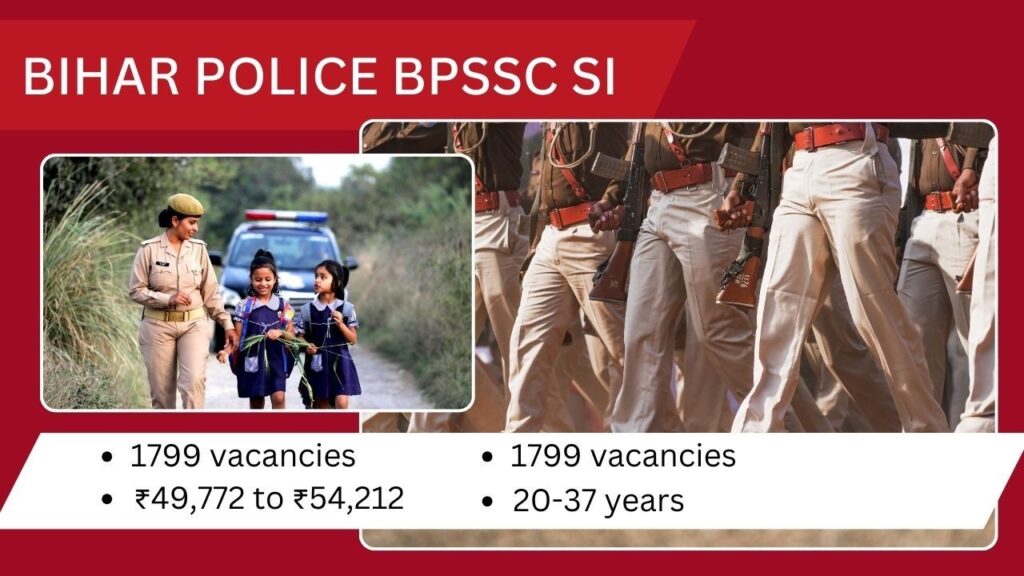
Bihar Police SI: Are you dreaming of Serving your State as a Police? The Bihar Police Subordinate Services Commission (BPSSC) SI recruitment is your best shot at securing a prestigious and well-paid job in the police department. With 1799 Vacancies Released under Advt. This is the high time to apply, as this is to best government jobs in bihar. Let me take you through all the information you need about the SI post from How To Apply to Salary Structure and Career Opportunities.
What Exactly is a Sub Inspector in Bihar Police?
The Sub Inspector (SI), also known as “Daroga” in Hindi, is an important office in the police force that is scathing about peace, social security, and law in their areas of jurisdiction. Consider them as the police station department of operations. They’re not just desk jockeys — SI’s participate in field operations, investigations, and oversee junior officers.
They tend to have their hands in all sorts of things like registering First Information Reports (FIRs), investigating crimes, maintaining law and order, and even supervising constables. From conducting raids, to building relationships with the community, to litigating cases in court, SI’s work is ever-changing and requires one to be physically and mentally strong.
What Does an SI Actually Do?
Let me give you the drab realities of what your daily life as an SI looks like. You’ll have multiple critical jobs to do:
Crime Investigation: After investigating the crimes registered in your jurisdiction, you will be required to register FIRs and collect evidence.
Supervision: You will also be responsible for the supervision of constables and other junior staff, who you will deploy for patrols and duties.
Law and Order: Conducting patrolling at regular intervals so as to check on illegitimate activities and to keep the peace intact.
Court Appearances & Litigation Liaison: Handle routine court appearances and day-to-day inquiries from the court, and monitor court administrative compliance.
Community Relations: Establishing reports with the public and keeping in contact with those who live in an area.
Paper Trail: Recordkeeping, report writing and office work.
Raids & Operations: You will be part of the raids and operations on criminals, but under senior officers.
Basic Eligibility Requirements
Before you start dreaming about recruiting, let’s make sure you meet a couple of very basic eligibility requirements. The good news is that the criteria are straightforward and relatively broad.
Educational Qualification
You are required to have a bachelor’s degree in any stream from a recognized university. It doesn’t matter whether in any stream – arts, science, commerce or else. All that is required is that you have a valid graduation certificate. You can apply if you are in your final year too, but you will have to submit your degree certificate at the time of document verification.
Age Limit
Category
Males
Females
General
20-37 years
Up to 40 years
OBC/EBC
Up to 40 years
Up to 40 years
SC/ST
Up to 42 years
Up to 42 years
Nationality & Other Requirements
you should be an Indian citizen. There is no explicit ban on how many times you can try, just keep in mind you should be within the age limit for each time you apply.
Note: You will be disqualified by the BPSSC at any stage if you are found ineligible.
How to Apply For Bihar Police Subordinate Services Commission (BPSSC) SI?
The Application Process is completely online. Here are the steps:
Step 1: Registration
Then go to the official website bpssc.bihar.gov.in and on the Apply Online link for Sub Inspector (SI) recruitment to apply. Register with your e-mail ID and mobile number and then enter basic details like name, date of birth and address.
Step 2: Pay the Application Fee
The application fee is only ₹100 for all categories, including male, female, and transgender candidates. You have the option to pay by credit card, debit card, net banking or UPI.
Step 3: Complete Your Application
Now we’ll get to the bottom line. Fill in your educational qualifications, address details etc and upload your photograph and signature. Make sure your photo is 3.5cm × 4.5cm and meets the above requirements. You will also need to upload your certificates and documents applicable to that notification.
Step 4: Submit and Save
After reviewing everything, submit. Make a printout of the application form and retain it for your records.
Exam Pattern and Syllabus
To get selected as SI in Bihar police you need to pass through different phases of examination which include your knowledge, physical fitness and your suitability to be the police officer.
Stage 1: Preliminary Written Examination
Prelims is your first step in the race. It is an objective examination having 100 multiple choice questions in the paper worth 200 marks, with 2 marks allotted for each question. You have two hours to take it. The entire examination is based on General Knowledge and Current Affairs and has questions on:
Indian History,
Geography of India,
Indian Polity,
Indian Economy,
Science and Technology,
Art and Culture,
Sports, Awards and recent national and international News.
There’s negative marking – 0.2 marks get deducted for every wrong answer. You must obtain a minimum of 30% marks to be eligible. Around 20 times the number of vacancies (about 35,980 candidates for 1799 posts) will be shortlisted for the mains examination.
Stage 2: Mains Written Examination
Once you clear the prelims, a main examination is held which is tougher and more comprehensive in nature.The mains has two papers, 200 marks each:
Paper I: General Hindi is Preliminaries level to be computed from the following items: grammar, comprehension, vocabulary, synonyms, antonyms and sentence correction. You get 2 hours.
Paper II: General Studies is the second and lengthier paper assessing your knowledge in a wide array of subjects namely Civics, Indian History, Indian Geography, General Science, Economics, Current Affairs, and Mathematics with Mental Ability. This paper also duration of two hours.
All in all, you would be taking 200 questions from both the papers, carrying 400 marks altogether. The qualifying nature of mains is merit based and about 6 times the number of vacancies are called for the physical test.
Stage 3: Physical Efficiency Test (PET) and Physical Standard Test (PST)
Category
Height (cm)
Chest (cm) Min
Weight Requirement
Males (General/OBC/EBC/EWS)
168
79
Proportionate to height
Males (SC/ST)
160
79
Proportionate to height
Females
155
–
Minimum 48 kg
Transgender
As determined
As determined
As determined
Stage 4: Document Verification and Medical Examination
Finally, after you pass the physical standards, you will be subjected to the document verification at which you must bring all your original certificates, and a medical examination to prove that you are physically and mentally capable to perform police duties. The health check includes vision, hearing and general health.
Exam Dates of Bihar Police SI
Remember to appear in The Bihar Police SI Prelims Exam will be held on 18 & 21/January/2026. Two sessions will be conducted on both days:
First Shift: 10:00 AM to 12:00PM (Report at 08:30 AM)
Second Shift: 2:30 PM to 4:30 PM (Report at 1:00 PM)
The admit cards were released on 30th december 2025 so download it from the official website.
Basic Salary Structure
Allowance
Amount (₹)
Basic Pay
35,400 per month
Dearness Allowance (DA)
4,248
House Rent Allowance (HRA)
2,124 to 5,664
Ration Money Allowance
3,000
Transport/City Aid
600 to 1,500
Medical Allowance
1,000
Uniform Allowance
900
Vehicle Allowance
2,500
All these factors combine to result in a monthly salary of ₹49,772 to ₹54,212.
Salary Growth Over Time
The interesting thing is your payslip doesn’t stay the same. You will get yearly bumps to your pay that will keep increasing your basic pay every year. After 5 years of service, with the consideration of increments and possible revisions in DA, your salary in hand may be around ₹58,000 to ₹62,000 per month and more than this with a promotion.
Career Growth of SI
It’s not just the starting salary that makes the job attractive, the role is a springboard to a very rewarding career. The promotion ladder is simple and hierarchical:
SI → Inspector → Deputy Superintendent of Police (DSP) → Additional SP (ASP) → Superintendent of Police (SP)
You advance to a greater pay matrix level with each promotion resulting in tremendous salary hikes. For instance if you are promoted to Inspector your basic pay could rise to a higher stage with which you also get increments in all the allowances.
Promotion is on merit performance on seniority experience and departmental examinations. Good work, solving cases, and maintaining a clean record can fast-track your career.
Conclusion
To be a BPSI is not only a government job but also it is a duty to serve in the society, uphold the law and order and a career opportunity to earn good name with good growth. The pay is good, the work is steady, and the potential for promotion is significant. Here is your opportunity to bring about a change with 1799 vacancies to be filled.
If you are eligible and interested to work hard then no one can stop you from applying. Begin your preparation today, keep on pace and best of luck. The dream to become a Daroga and to make you proud Bihar Police is definitely within your reach!
If you are an agriculture graduate from UP and want to grab a secure government job, then UPSSSC Agriculture Technical Assistant Preparation is crucial to get this golden opportunities. With 3,446 posts announced recently in the recruitments, this Group-C job with the Department of Agriculture not only offers you secure job in India’s largest state but also a meaningful work in serving the farmers of the state.
But here is the reality check: clearing this exam is not just about being B.Sc. The competition is stiff, the syllabus is vast and the exam pattern itself has some quirks that can take you by surprise. Having reviewed the new notification and strategies adopted by the successful candidates, I have tried to make this guide exhaustive to help you in your preparation journey.
Are You Qualified?
You must fulfill the UPSSSC Eligibility Criteria to apply for the UPSSSC. As on the date of notification, your age should be 21 years to 40 years. But the SC/ST/OBC candidates are allowed to get the relaxation on age as per the rule of the state government. Applications received from ineligible candidate(s) will be rejected, so check your eligibility before applying.
Degree: Graduation in the Agricultural field is required as your knowledge is beneficial for a job. It must come from a recognized university or college.
List of course are good choice for your degree:
B.Sc. (Hons.) Agriculture
B.Sc. Horticulture / B.Sc. (Hons.) Horticulture
B.Sc. Forestry / B.Sc. (Hons.) Forestry
B.Tech (Agriculture Engineering)
B.Sc. (Hons.) Science from a University of Agriculture and Technology
The PET catch: Since 2022, UPSSSC has made the UP Preliminary Eligibility Test (PET) mandatory for every candidate to pass this exam with required score then applying for any main exam of AGTA.
Exam Pattern Decoded
There are no multiple phases for the AGTA, you just have to clear this one and the powerful UPSSSC Agriculture Technical Assistant recruitment exam with document verification and grab your chance for a government job.
Total Questions: 100 objective-type MCQs
Total Marks: 100
1 Question = 1 Mark
Duration: 2 hours
For incorrect answer, ¼ mark will be deduct
This marking system indicates that you need accuracy in your answer rather than attempting.
Subject-wise Distribution
Subject
Questions
Marks
Crop Science
25
25
Biotechnology, Plant Breeding & Crop Physiology
10
10
Soil & Water Conservation
15
15
Agriculture Extension
5
5
Agriculture Economics & Schemes
5
5
Dairy & Animal Husbandry
5
5
Computer Concepts & IT
15
15
General Information of Uttar Pradesh
20
20
TOTAL
100
100
What You Actually Need to Study
Part 1: Core Agriculture (65 Marks)
Crop Science involves the Study of various cereals, pulses, and oilseeds and also covers modern agricultural practices such as integrated, natural and organic farming. So you have to know about seed production, about pest management, about post-harvest technology and storage systems. Let’s get real—what is a field officer going to tell farmers?
Biotechnology & Plant Breeding covers Genetics Concepts, Photophosphorylation, Respiration, and Plant Metabolism. ISE don’t memorize definitions; actually understand what biotechnology is and how it works, and how it’s used in agriculture now.
Soil & Water Conservation involves Master soil properties, erosion control, fertilizer classification, irrigation, and watershed management.. I think the 15 questions are generally easy if you have your basics clear.
Agriculture Extension covers rural development concepts, farmer’s schemes issued by the Government, and training methods. This ties right into what you’re doing in your future job.
Agricultural Economics has MBA contents such as MSP (Minimum Support Price) of various Crops, Agriculture commodities trading, import-export strategies and UP’s One Trillion Economy plan. Be a regular user of agri policies.
Dairy & Animal Husbandry includes a lot of practical training but what’s the right way to do Animal Breeds, Feed management, Milk production, Poultry farming, Diseases management. Even if you were a crop science major, don’t sleep on this 5-mark question.
Part 2: Computer and IT (15 Marks)
This isn’t just basic computer know-how anymore. The syllabus cover crucial IT related questions which means you need study hard:
It involves from Hardware, software and operating system to MS Word and MS Excel operations
Internet Protocol and Email Management
Digital financial instruments and e-Governance
New technologies – AI, Machine Learning, Big Data, IOT and India’s IT feats
You don’t have to think that new technologies are not needed, the first rule for the tech engineer is opting for new technologies every year. So, AI and Machine Learning are now part of an agriculture exam. The UPSSSC needs officers with a flair for technology who can put traditional farming together with digital India.
Part 3: UP General Knowledge of 20 marks
To succeed in this field, one should have deep knowledge of history, culture, art and architecture of Uttar Pradesh. A good understanding of its physical geography with its climatic differences, soil groups, forest, wild life and mineral resources, will be found helpful.
Also, a good knowledge of the state economy in terms of agriculture, industry and commercial conditions is essential. Keeping abreast with the day’s news and the work of the state government you shall further enrich yourself and make yourself even more capable.
Selection Process
After clarifying the written test, candidates need to verify their documents (ID, Marksheets, DOB certificate, etc). The written test passing score is depending on your category. Final merit list will be made upon these scores not on interview as there is no interview.
Crop Science and Soil Science is a very important part as they hold maximum marks in the exam. So, prepare well with understanding, not rote learning. BSc notes and NCERT agriculture textbooks are very helpful as resources for your study.
After clearing your basics, dive deeper with “A Textbook of Agricultural Field Crops” by V. Venkataraman to prepare for the Crop Science subject.
And “Soil Science” by D.K. Das is a perfect option for Soil Science.
Many students recommended “Uttar Pradesh General Knowledge” by Dr. C.L. Khanna for increasing UP knowledge.
Try Youtube or free resources online to learn about Computers assets and other new techs related to the agriculture field.
The last Months 4-6 is given for the Practice & Revision of previous year papers for making a speed to solve fast in the exam. Weekly mock tests are best for your preparations. Everything is available on the internet, so do not stress about the resources. To avoid mark deduction, master to Maintain an error log.
There is a strategy and of course general scoring strategies are applicable too that candidates must follow to win in this agriculture based exams. What several candidates tend to miss is the fact there are non-agricultural parts like Computer (15 marks) and UP GK (20 marks), which have a big weightage of marks. Disregarding these can drastically hit your overall results.
How to approach the Stage II exams, Time Management is very helpful for Effective preparation. Although two hours is more than enough time, candidates often find themselves stuck on difficult questions, for instance in biotechnology, with not enough time left at the end to tackle items such as UP GK. so that way you can avoid that.
Also, academic knowledge from one’s degree is no place to rely on. The focus is not on theoretical understanding, but on practical application and problem-solving at field level.
Before you start preparing for the AGTA exam, you must be aware that you must meet all the eligibility requirements (like qualifying the PET) for the same. Non-compliance of such requisites may result in jeopardizing a candidate’s whole preparation and risk that nothing has been achieved in all those years toiling. A complete scan of the eligibility dates is hence highly recommended to avoid any last minute surprises.
Conclusion
The UPSSSC Agriculture Technical Assistant is one such post which will help in this regard. The active UPSSSC Agriculture Technical Assistant Recruitment 2026 Advertisement is a good opportunity for the job seekers. You should go for 6-8 Months UPSSSC Agriculture Technical Assistant Preparation to increase your chances of selection and should Follow the Syllabus Strictly. Your position on the merit list can be decided by the marks obtained. Get started on your preparation now with full dedication and consistency to get success in this very competitive selection.
Preparing for an MBA program to establish your career in the management sector might be tough but possible with the right college. Top colleges can give you a lot of opportunities right after completing your MBA program. CAT vs CMAT is a common debate that generated from the confusion among students. CAT (Common Admission Test) and CMAT (Common Management Admission Test) are entry tickets for great business schools. There is a slight difference in both exams, IIMs accept only CAT highest scores. So, it might be difficult to achieve the highest scores among lakhs of students.
Other top business schools can accept both CAT and CMAT scores for admission. The best way to achieve the best scores in these exams is the right strategy for preparation.
Get deeper details of their exams to clear out and get into yourself in the top business schools of India.
The CAT: Gatekeeper to the Elite
CAT is one of the tough exams for students who have eyes on a top-tier management career can start preparing for this exam. Students who work hard and learn properly are able to beat the competition. This exam is designed in three sections — Verbal & Reading Comprehension, Data Interpretation & Logical Reasoning, and Quantitative Aptitude.
Prestige and Recognition: CAT is an entrance exam to most of the reputed colleges, especially IIMs. IIM colleges are given to those students who got the highest scores. Beyond IIMs, other colleges also take the CAT score as mandatory procedure for the admission in MBA programs.
Test your True Potential: This test is not just a normal test but it checks your ability to think under pressure. Questions are tough and based on the purpose of assessing a candidate’s analytical ability and problem solving skills. CAT is a well-known test of your management aptitude.
Gateway to Top Placements: Business schools provide opportunities to their students with higher offers from top companies. Business schools who accept CAT scores for admission have a highly valuable and strong alumni network that can be helpful to find good jobs.
The CMAT: Smart & Strategic Choice
CAT is a risky but high-rewarding exam, it will open the gates to bigger opportunities. But if you are unable to clear, CMAT is a smart and strategic choice for those students. It also opens a wider range of opportunities for your career. It is easier than CAT but comes with five sections including Quantitative & Data Interpretation, Logical Reasoning, Language Comprehension, General Knowledge, Innovation & Entrepreneurship.
Why CMAT Matters
Wider Acceptance: there are 1000+ colleges in India accepting CMAT scores for admission. AICTE-approved thousands of colleges offering various programs, especially management.
Less Intense Competition: students who take CAT exams but not get selected for the IIM college, this is the best option because the competition for top seats is less intense. CMAT is a huge advantage for good students who aim for broader opportunities.
Focus on All-Round Knowledge: General Awareness is included in the CMAT exam which tests your ability of current world knowledge. The Innovation & Entrepreneurship section tests students’ ability for forward thinking that will be helpful in the business world.
Feature
CAT (Common Admission Test)
CMAT (Common Management Admission Test)
Difficulty
Very High
Moderate
Acceptance
IIMs & other Top-Tier B-Schools (FMS, MDI)
1,000+ AICTE-approved colleges (JBIMS, GIM)
Exam Pattern
3 sections with strict sectional time limits
5 sections with no sectional time limits
Skills Tested
Deep analytical, logical, and verbal skills
Foundational aptitude plus general knowledge
Career Prospects
Higher average salary, top placements
Good placements, strong ROI, broader options
CAT or CMAT: Which Exam is For You?
The decision is yours in the end because it depends on your strength and aim to clear these exams.
CAT is the right option for those who want to get into IIM or most reputed top Indian business schools. Students having confidence in their analytical skills, able to give proper time to establish a command on analytical thinking. Sure to clear the CAT exam with your preparation journey, so it will maximize your chances of high-paying jobs.
CMAT is a great and smart option for students to get admission in top business schools across India. Students can easily crack the exam without the stress of high competition. A wider range of options is a great benefit for students. A strong general knowledge is countable in a great skill that will make a huge impact.
Conclusion
It’s not fixed that there is only one exam you can take, you can take both CAT vs CMAT exams. CMAT is a solid backup for the CAT exam, many students are unable to clear CAT, they have a second option to enter into the management. The common thing is preparation, the only way for admission in an MBA program. It’s a journey for self-improvement and achieving your success with the right strategy.
If you have ever been curious as to how the planes you ride on stay in the air or how a rocket can travel all the way to space, then you think like an aerospace engineer. From Aerospace Engineering Courses, eligibility criteria to future scope and interesting specializations available, this all you need to know guide will help you make an informed decision which you take for pursuing aerospace engineering course in India.
The Indian aerospace industry is booming. ISRO, DRDO, HAL, and a host of private companies are actively hunting for talented engineers to design, build and fly planes and spacecraft. With increasing demand and attractive salary packages, this is the way to your dream career.
What Exactly is Aerospace Engineering?
Aerospace engineering is the primary engineering discipline concerned with the design, construction, science and technology of aircraft and spacecraft. It is a combination of physics, mathematics, materials science, and advanced tech that address real life problems in the fields of aviation and space travel.
The range of activities in this field is so broad that it divides into four key specializations:
Aeronautics — This pertains to air within the atmosphere and includes such things as commercial jets, military planes, helicopters, drones (UAVs), and blimps. Aeronautical engineers study flow-air, aircraft design, motion, and propulsion.
Astronautics — A subject of business such as astronauts, rockets, satellites and all the stuff that goes beyond the atmosphere. Astronautical engineers specialize in orbital mechanics, satellite communications, rocket propulsion, and space exploration missions.
Avionics — These are the electronics and computers used in an aircraft and spacecraft. Avionics engineers create the system software of navigation, communication and autopilot systems, etc., in raw air borne machines.
Defense Technologies — This area concentrates on military, and its ability to develop and deploy new systems involving missiles, defense technologies, military drones and weaponized technology. This is important part of national security and defense system.
Aerospace Engineering Courses
Now let’s move on to the various types of courses under aero space engineering. Whether you are a high school beginner or already have a bachelor’s degree, there is a path for you.
1.Diploma in Aerospace Engineering (3 Years)
If you are looking forward to pursue a career in aerospace engineering, you can opt for the Diploma in Aerospace Engineering from a reputable board after 10th class.
This is good to start if you have done your 10th grade. It is not really theoretical but ‘practical’ which provides aerospace technologies experience.
Aspect
Details
Duration
3 years
Eligibility
10th pass with Mathematics and Science (minimum 50% marks)
Focus
Practical skills and industry-ready training
Career Path
Can pursue B.Tech (lateral entry) or start working
Average Fees
₹2-4 Lakh for the entire program
2. Bachelors in Aerospace Engineering — B.Tech (4 Years)
It serves the largest client base and is considered the gateway course for professional aerospace. It is a bachelor’s degree course and the eligibility is 10+2 with Physics, Chemistry and Mathematics (PCM).
Aspect
Details
Duration
4 years (8 semesters)
Eligibility
12th pass with PCM (minimum 50-60% depending on college)
Admission
Based on JEE Main Score, state-level exams, or direct merit
Average Fees
₹ 2-2.5 Lakh/year in government; ₹5-10 Lakh/year in Private colleges
Total Program Cost
₹4-40 Lakh depending on college type
The B.Tech is an all-inclusive course which includes theory and practical based knowledge. Subjects like mathematics, physics, and general engineering will be included in your first two years for foundation then you can choose specializing in aerospace-related subjects in your third year.
3. M.Tech in Aerospace Engineering (2 Years)
M.Tech in Aerospace suits better for those who want a higher level of education in aerospace engineering. Building a professional level career internationally, you must need this degree.
Aspect
Details
Duration
2 years (4 semesters)
Eligibility
B.Tech/BE in Aerospace or related field with 55% minimum marks
Admission
Through GATE exam (for government colleges) or merit-based (private)
Average Fees
₹40,000-1 Lakh/year in Government; ₹2-4 Lakh/year in Private colleges
Career Advantage
Higher salaries, research opportunities, senior positions
Job opportunities for M.Tech graduates are applicable in research, designing and higher level management. Top companies and research centres look for M.Tech holders for their specialised projects.
4. Ph.D. in Aerospace Engineering (3-5 Years)
“This Is for the Research and Innovative Curious”. It’s the top aerospace engineer qualification for those who want to know how to research and innovate.
Aspect
Details
Duration
3-5 years
Eligibility
M.Tech or equivalent with GATE qualification
Focus
Original research and innovation
Opportunity
Teaching, research at ISRO, universities, private labs
5. Aerospace Engineering Few Months Certification Courses
In just 6 months to 1 year duration, you can enhance knowledge or skills in certain areas. It is best for hands-on experience in a specific field.
Course Type
Duration
Cost
Suitable For
CAD and Aircraft Design
6 months
₹20,000-50,000
Working professionals, students
Avionics Systems
6-8 months
₹30,000-60,000
Interested in Electronics
Propulsion Systems
3-6 months
₹15,000-40,000
Engineers wanting specialization
Aerospace Materials
4-6 months
₹25,000-50,000
Manufacturing professionals
B.Tech Aerospace Engineering Core Subjects
Year
Semesters
Essential Subjects
1st Year
Sem 1-2
Mathematics/Physics/Chemistry help develop problem-solving skillsEngineering Mechanics/Thermodynamics/Fluid Mechanics/ and Basic Electronics introduce how physical laws apply to real engineering systems.
2nd Year
Sem 3-4
Gas Dynamics and Aerodynamics, which explain how air behaves around aircraftPropulsion and Aircraft Structures teach how engines work and how aircraft are builtStrength of Materials and Computer Programming strengthen technical and analytical skills.
3rd Year
Sem 5-6
You study higher-level aerodynamics, flight dynamics, and structural analysis Heat Transfer and Avionics.
4th Year
Sem 7-8
You learn advanced tools like Computational Fluid Dynamics (CFD)Aircraft Design and Systems
Aerodynamics describes how air moves around air and is an important factor in the level of efficiency of airflow around the wings.
Propulsion: Discussion of jet engines, rockets, turboprops
Structures deals with building an aircraft to be as strong as possible but still as light as possible.
Stability and control the motion of an aircraft.
CFD Computational Fluid Dynamics: Uses computers to emulate airflow — a modern necessity
Aircraft Design: All of the above are brought to bear on realistic, total aircraft design projects.
Most B.Tech courses will involve a lot of lab work, wind tunnel testing, simulators and a capstone design project where you actually design an aircraft or spacecraft.
Who Are Eligible For Aerospace Engineering
B.Tech (Undergraduate)
Need to pass 12th class with PCMB or PCB and should have obtained 50 to 60% marks Meet the age criteria of 17 to 28 yearsEntrance exams such as JEE Main, State Level Exam etc
M.Tech (Postgraduate)
Hold a valid B.Tech/BE degree in Aerospace or equivalent with 55% marks Valid GATE score (for government colleges)
Diploma
After 10th with Mathematics and Science having 50% marks as a minimum15 years as a minimum age
Lateral Entry to B.Tech
3-year engineering diplomaBSc in Physics, Chemistry, Mathematics
Where Will Aerospace Engineers Work?
Organization
Type
Specialization
Salary Range (Fresh)
ISRO
Government
Satellites, space missions, rocket development
₹8-10 LPA
DRDO
Government
Defense systems, missile technology
₹7-10.5 LPA
HAL (Hindustan Aeronautics)
Government
Aircraft manufacturing, defense
₹7-9.5 LPA
Boeing India
International
Aircraft systems, defense solutions
₹8-12 LPA
Airbus India
International
Aircraft manufacturing, maintenance
₹7-10 LPA
GE Aviation
International
Aerospace engine design
₹7-9 LPA
Rolls-Royce India
International
Propulsion systems
₹8-11 LPA
Tata Advanced Systems
Private
Aircraft components, defense
₹7-11 LPA
Godrej Aerospace
Private
Space and defense hardware
₹5.5-7.5 LPA
Salary & Career Growth
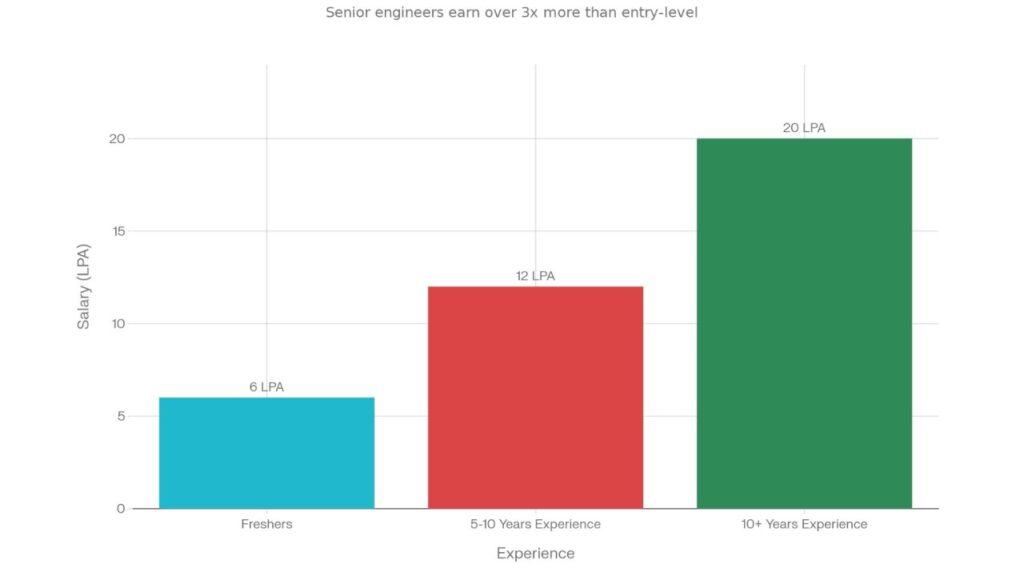
Aerospace Engineering Salary Progression in India
Levels
Salary — LPA
Monthly Income
Stages
Fresher (0-1 year)
₹4.5-7
₹37,500-58,333
Graduate joining first job
2-5 years
₹8-12
₹66,667-1,00,000
Intermediate engineer
5-10 years
₹8-15
₹66,667-1,25,000
Senior engineer or team lead
10+ years
₹15-25+
₹1,25,000-2,08,000+
Manager, specialist, researcher
Salary by Sector:
Sector
Fresher Package
Experienced Package
Government (ISRO, DRDO, HAL)
₹7-10 LPA
₹20+ LPA
Private Indian Companies
₹5-9 LPA
₹12-18 LPA
International Companies (Boeing, Airbus)
₹8-12 LPA
₹20-28+ LPA
Startups & Newer Companies
₹4.5-6.5 LPA
₹10-14 LPA
The Future Looks Bright
India’s aerospace engineering salary will increase by 20-25% by 2030 and is highly influenced by demand in electric aircraft, AI integration, space exploration, and green aviation related technologies, suggest the industry projections. .
The initial two years are dedicated to core subjects such as mathematics, physics and general engineering. These years are tough, but necessary. If you have a strong base in these stuff, then you can understand high level stuff in aero easily later on.
Year 3: Where Aerospace Engineering Gets Exciting
In year 3, the real aerospace journey begins. You then go on to such specialised areas as aerodynamics, propulsion and aircraft structures.
Year 4: Major Project and Real-World Problem Solving
Senior year is spent mostly on a senior project. You could design an airplane, build spacecraft systems, or even study a real problem in aerospace engineering. Many of these projects are sponsored by industry, giving students real-world experience and making them more employable.
Internships: The Key to Career Growth
The majority of aerospace engineering programs require 2 to 3 internships, such as summer and at times semester-long training. Top organizations including ISRO, HAL and Boeing hire interns on a regular basis. This hands on experience is invaluable and it contributes a lot in building a strong resume and career in future.
Choose Your Specializations
Specialization
Focus
Scope
Preferred Companies
Aerodynamics
Airflow, drag reduction, aircraft efficiency
Aircraft design, research
ISRO, Airbus, NASA etc
Propulsion
Engines in Jet engines, space rockets
Engine design, space missions
GE Aviation, Rolls-Royce, ISRO
Flight Dynamics & Control
Aircraft stability, autopilots, guidance systems
Control systems, UAVs
Boeing, HAL, Airbus
Aircraft Structures
Materials, stress analysis, lightweight design
Design Structure, & aerospace manufacturing
Airbus, HAL
Avionics
Radio System, navigation, Electronics
UAVs & Avionics
Boeing, DRDO
Best Aerospace Engineering Colleges in India
College
Type
Location
Specialization
IIT Bombay
Government
Mumbai
All specializations
IIT Madras
Government
Chennai
Aircraft & Space
IIT Kharagpur
Government
West Bengal
All specializations
IIT Kanpur
Government
Uttar Pradesh
All specializations
Mahindra University
Private
Hyderabad
Comprehensive curriculum
SRM IST
Private
Chennai
Modern labs & industry focus
Chandigarh University
Private
Punjab
Industry-driven curriculum
Ramaiah Institute
Private
Bangalore
Well-equipped facilities
Manipal Academy
Private
Bangalore
Research-oriented
Conclusion
Aerospace Engineering Courses aren’t simple, it’s a journey through innovation, precision and human ability. Whether you want to design the next generation of commercial planes, put satellites into space, or work on autonomous drones, this is a field with limitless options.
The Indian aerospace industry is poised for growth. With ISRO’s ambitious space programs, HAL’s indigenous aircraft development and international partnerships with Boeing and Airbus, there is no dearth of opportunities. And if you are in the top performers, the world is your sky.