DSSSB MTS Recruitment 2026: Apply Online for Multi-Tasking Staff Posts

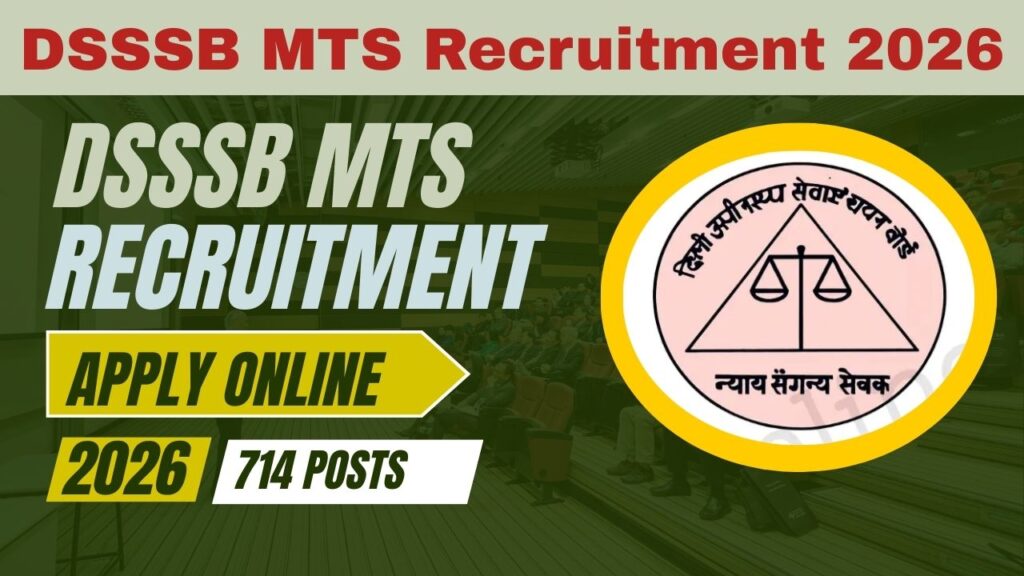
DSSSB MTS Recruitment 2026

DSSSB MTS Recruitment 2026: The Delhi Subordinate Services Selection Board (DSSSB) has released the Notification for the Recruitment of Multi Tasking Staff (MTS) vacancies for the Year 2026. There are 714 posts in all. The application form submission will start from 17th December, 2025 and will end on 15th January, 2026. Eligible and interested candidates may apply online from the official DSSSB website. Candidates can check the detailed notification for eligibility criteria, application fee, age limit, salary, selection procedure, etc. 

Follow the link to download the detailed notification and to apply. Hope you apply if you qualify. Information regarding eligibility criteria, application fee, age limit, salary and selection process is provided in the notification. Make sure you have gone through the official notification before you apply. 

Details of DSSSB MTS Recruitment at a Glance

OrganizationDelhi Subordinate Services Selection Board
PostMulti Tasking Staff
Vacancy 714 
Min Age to apply18 years
Max Age to apply27 years
Salary Lie Between ₹18,000 to ₹56,900/- Per Month
Official WebsiteClick Here

Dates To Remember For Application Process

EventDate
Notification Date11/December/2025
Application Start17/December/2025 
Last Date Apply Online15/January/2026 
Last Date Fee Payment15/January/2026 
Correction DateAs Per Schedule 
Admit CardUpdate Soon 
Exam DateUpdate Soon 

Read More:- SSC Exam Calendar 2026–27: Complete SSC Exam Schedule

Follow These Steps To Apply 

DSSSB MTS Notification 2026 has been published on 30 September 2025 for 5159 vacancies. of MTS has been released on 17/December/2025. 

To Apply Online for Multi Tasking Staff, Follow These Steps:

1. Observe the DSSSB MTS Notification 2026 PDF for complete details.

2. Go to the Official site at dsssb.delhi.gov.in or click below to Apply Online.

3. Fill in the DSSSB MTS Online Application Form 2026 with the necessary details.

4. Upload the required files to prove your claimed information.

5. Submit the requisite fee via the mode of payment mentioned.

6. Print a copy of your application form after you have submitted it.

If you’d like, you can also check out reasoning ability practice tests’, exam preparation courses’, and time management techniques’ for more help. 

Useful Links
Apply NowClick Here
Download NotificationClick Here
Official WebsiteClick Here

Leave a Comment

Your email address will not be published. Required fields are marked *

SSC Exam Calendar 2025-26: Check Full Schedule, Upcoming Exam Dates and Notifications

SSC Exam Calendar 2025-26

The SSC has announced the SSC Exam Calendar 2025–26 on its official website, so start preparing for the upcoming exams. More than 10 lakh candidates appear out of 50 exams conducted by the SSC every year after 10th, 12th or graduation for jobs in various central government departments and ministries.

This year SSC Calendar (Important Dates) for SSC Exam 2025 (20, 25, 26) contains all info regarding SSC Exams for CGL, CHSL, JE GD Constable, Delhi Police, Steno orga, Stenographer post holders. Candidate can check important events such as notification release date, application dates, exam dates from the schedule to know about the upcoming events which should be useful in your preparation. 

Check Out The SSC Exam Calendar 2025-26

More than five million candidates take the SSC exams for government jobs once in a year after either 10th, 12th or graduation. The revised SSC calendar includes all notification, application, and exam dates for the 2025-26 cycle, providing transparency and a clear path for the candidates. 

Exam NameSchedule Period
SSC Constable (Driver)-Male in Delhi Police ExamJuly to December 2025
Head Constable (Ministerial) in Delhi PoliceJuly to December 2025
Head Constable (AWO/TPO)July to December 2025
Constable (Executive) July to December 2025
Grade C Stenographer July to February 2026
Constables and Rifleman in Assam October to February 2026
JSA/LDC January to March 2026
SSA/UDCJanuary to March 2026
ASO January to March 2026

Key Details for Aspirants

  • All SSC examinations are held at the designated centers across all over India in Online mode only.
  • Updates are posted on the official SSC website (https://ssc.gov.in). Aspirants are advised to track the notifications and deadlines for application.
  • Dates of the examination are liable to change due to unforeseen circumstances, keep watching official notifications for updates if travelling or taking study leaves. 
  • There are more levels/phases to the selection process; CGL, CHSL and JE have additional rounds after Tier 1. 
  • Admit cards, syllabus and other directions for the candidates are issued just before the exam, so keep visiting the official website of SSC regularly. 

Follow the Guide to Download the SSC Exam Calendar 2025-26 

1. Go To The Official Website of SSC, which is mentioned in this article. 

2. Now Search for the SSC exam calendar in the Notification on SSC Exam Schedule 2025-26. 

3. Open the link and download the calendar in pdf file OR you can just download it directly from the link section of this article. 

4. Download the pdf file in your device. 

5. Keep this file save or print for future uses. 

The SSC timetable for the 2025-26 session is designed as per the pattern of previous years and it clearly indicates that there are 5 stages in the exam process.Changes or modifications, if any, will be notified on the official website of SSC. 

Useful Links
Download SSC Exam CalendarClick Here
Official WebsiteClick Here


Leave a Comment

Your email address will not be published. Required fields are marked *

PFRDA Grade A Recruitment 2025 Out – Apply Online for Assistant Manager Post

PFRDA Grade A Recruitment 2025

The application process for PFRDA Grade A Recruitment 2025 ends on 6th August 2025. Fill out the form before the last date of application. The portal is open on 23rd June 2025 to apply online and the link will activate soon. Official notification has been released, you can download it through the link mentioned in the article. A total of 20 vacancies for the Assistant Manager which you can apply for. If you are willing to build your career in the government sector, it is time to fill out an application on the official website.

Pension Fund Regulatory and Development Authority selects candidates through a 3-stage selection process. Candidates should pass the Preliminary exam (1st stage), Main Exam (2nd stage), and Interview (3rd stage). Those candidates who clear out these three stages will be selected for the Assistant Manager Post.

OrganizationPension Fund Regulatory and Development Authority 
PostAssistant Manager
Number of Vacancies20
Apply OnlineClick Here
Official websiteClick Here

Dates To Remember For PFRDA Grade A Recruitment

Notification Date23rd June 2025
Application Starts On23rd June 2025
Application Ends On6th August 2025
Fee Submission Last Date6th August 2025
Exam Date6th September 2025
Application Fee
General/EWS/OBCRs. 1000/-
SC/ST/PWD/Female0/-

Read More 👉 Top Courses After 12th Arts With High Salary – Best Career Paths Revealed!

Vacancy For Assistant Manager PFRDA 2025

StreamsVacancies
General 8
Finance & Accounts2
Information Technology2
Research (Statistics)2
Research (Economics)1
Actuary2
Legal2
Official Language1
Total20

Eligibility for PFRDA Grade A Recruitment

Age Limit 
Minimum Age18 years
Maximum Age30 years
Education Required
GeneralPost Graduation in any relevant subject, Graduate in Law/Engineering from any recognized board, ACA/FCA from ICAI, ACS/FCS from ICSI, CFA from the institute, OR ACMA/FCMA from ICMAI
Information TechnologyUG with Engineering (cs, electrical, electronics), PG with Computer Application, UG with any discipline + PG in CS/IT, OR UG/PG/Diploma in AI & ML 
Finance & AccountsUG with ACA/FCA from ICAI, ACS/FCS from ICSI,  CFA from CFA institute, ORACMA/FCMA from ICMAI.
Research (Statistics)Post Graduation in Finance/Economics/Statistics
Research (Economics)Post Graduation in Statistics/Economics/Commerce
ActuaryBachelor’s in Core subjects of Actuaries of India examination
LegalGraduation in Law from any recognized college.
Official LanguageUG & PG with Hindi, English OR Mater’s in Sanskrit/Economic/Commerce with Hindi as a subject at Bachelor’s level from any recognized college.

Important Links for PFRDA Grade A Recruitment

Apply OnlineClick Here
Join Telegram ChannelClick Here
Official websiteClick Here

Leave a Comment

Your email address will not be published. Required fields are marked *

Top Best Private MBA Colleges in India With Great Placements and Low Fees

Best Private MBA Colleges in India

Selecting the appropriate MBA college is the most important decision in your career path. You can get quality management education in India without emptying your pockets. A number of good private MBA colleges provide a fantastic combination of pocket friendly fees, excellent placements and industry relevant curriculum which can truly transform your career. 

The MBA Dream Doesn’t Have to Be Expensive

The Indian MBA domain has changed dramatically over the years. Although prestigious institutions like ISB Hyderabad charge anywhere from ₹35 lakhs, there is a whole ecosystem of private MBA colleges that offer great value for money. This is the message we are seeing from these schools, they are saying that you can have great education and great value for money. 

The trick is to find those schools that have developed strong ties with industry, that are academically rigorous, and that have consistent placement results. 

FMS Delhi: The Benchmark for Value

Talking about best MBA colleges in India for a good placement that are also not too heavy on pocket, Faculty of Management Studies Delhi leads the pack. FMS is affiliated to Delhi University and it has nominal fees of just ₹2.32 lakh for the full two years’ MBA program which is one of the cheapest anywhere in the country. What makes this truly remarkable is FMS Delhi, which regularly has 100% placements with a package of ₹34.1 LPA – a figure that is comparable to top-level schools. 

FMS Delhi

The FMS placement witnessed 283 offers being made to the batch in which more than 80 companies participated. In the consulting and general management areas, top recruiters such as McKinsey, Bain, BCG, Deloitte, Amazon, and Microsoft were actively recruiting FMS graduates. FMS Delhi is just unmatchable if you’re a student looking for the best return on your investment. 

SIBM Pune: Premium Quality at Reasonable Costs

Symbiosis Institute of Business Management Pune is a great option for those who want quality and can afford to compromise a bit on the cost. With a fee of around ₹18.5-22 lakh for two years, SIBM Pune comes as a breath of fresh air on the cost structure amongst the best private business schools. The placement narrative is no less dramatic. 

SIBM Pune

During the placement drive in 2025, SIBM Pune had an highest package of ₹53.58 LPA and the average package was ₹28.83 LPA. The institute has witnessed participation from almost 109+ companies from various sectors. The data for placements shows healthy upward trend with an average package rising from Rs 17.48 LPA in 2019 to Rs 28.83 LPA in 2025 – an indicator of the growing industry relevance of the Institute and growing competitiveness of its students. 

SPJIMR Mumbai: The Excellence Quotient

S.P. Jain Institute of Management and Research (SPJIMR) Mumbai The has the honour of being placed amongst the best MBA colleges in India. Though the fees is between ₹24-26 lakhs, the placement result makes it worth it. SPJIMR witnessed yet another successful pan India recruits 100% during 2025 placements with average domestic package of ₹33 LPA and highest package of ₹81 LPA. 

SPJIMR Mumbai

Why is SPJIMR the best? Here’s the good news, the institute finds itself ranked among the top 50 business schools in the world as per the master in management rankings of the Financial Times! Its curriculum focuses on consulting skills and top recruiters, including BCG, Accenture Strategy, and many other global consulting firms, come to the campus. 

NMIMS Mumbai: Balanced Approach to Education

Narsee Monjee Institute of Management Studies Mumbai is a great option for MBA seekers. With a fee of around ₹19-23 lakhs, NMIMS has kept its placement results competitive with the average package hovering around ₹26.63 LPA. NCC accepts NMAT scores and has established itself as a leader in numerous industry sectors, including finance, consulting and technology.

NMIMS Mumbai

The vast NMIMS alumni base facilitates a strong industry network and leading recruiters like JP Morgan, KPMG, IBM, and Deloitte among others visit the campus on a regular basis for recruitment. The alumni edge better placements and career progression for today’s students. 

XLRI Jamshedpur

Here are a few noteworthy names, comers and goers, to watch out for, in human resources and business leadership, India’s Xavier School of Management (XLRI) in Jamshedpur should not be overlooked. XLRI’s average package is ₹27 LPA and its fee ranges between 25-27 lakhs, with a large number of graduates finding jobs in HR and general mgmt domain.​

XLRI Jamshedpur

This specialization in HR can be the difference for candidates aspiring to make a career in organizational development, talent management, or leadership consulting. The placement drive is represented by Fortune 500 companies on a regular basis in search of HR talent. 

Emerging Gems: Cost-Effective Alternatives

Outside the top-tier private colleges, a handful of new-age colleges give you mind-blowing value for money. Christ University Bangalore is an unaided University, it attracts a nominal fees of ₹4.75 — 7.5 lakhs for the MBA program and the university has had placement records with average packages reaching around ₹7 LPA which is a great deal of delivering quality education for such an affordable fee.​

Likewise, Birla Institute of Technology Mesra anticipates ₹5.55 lakhs in fees for MBA with average placements of ₹10.10 LPA and PIBM Pune expects ₹8.75 lakhs with average placements of ₹12 LPA. These colleges show that you can get quality education and decent placements even if the fees are lower. 

Making the Right Choice

When you are considering MBA colleges, think about a number of things apart from just the fees and average packages. Check the placement rate (should be 100%), type of recruiting companies, specialization options, and whether your career goals match the strength areas of the college.

In your budget and for consulting jobs only, SPJIMR or FMS Delhi should be your #1. For candidates who want to work in finance, SIBM Pune or NMIMS are good choices. If you are looking at value for money education, Christ University or Birla Institute of Technology are two such places where you need not second-in your mind, the quality is there. 

Conclusion

The Indian MBA arena now provides the budding managers with more windows of opportunity than ever before. Now, it’s not a choice between affordable or quality. Top tier private MBA colleges like FMS Delhi, SIBM Pune, SPJIMR Mumbai, NMIMS Mumbai have proven time and again , that you can get world class education, industry relevant training and impeccable placement support without shelling out an arm and a leg.

Remember, your MBA is an investment in your future, and they’ll make sure you get a great return on it. With so many low-cost quality MBA programs available in India, money should never come between you and quality business education. 

Leave a Comment

Your email address will not be published. Required fields are marked *

What Is Distance Education? Benefits, Learning Programs, and Career Opportunities

what is Distance Education

Distance Education offers a degree without attending regular classes which makes it easier for students who are working professionals, homemakers or living abroad. Sometimes it’s hard to keep your study going with any of these circumstances, so Distance Learning is the best option to learn and grow in your interested career. But you must understand it properly before applying for it.

In this guide, we’ll learn about distance education, is it meaningful or not, which programs are worth your time, and where it can take your career. 

What Is Distance Education?

Distance education is a different way of learning the same curriculum as in regular studies. In this mode, you must become responsible for your studies and exams because nobody is going to push you or motivate you for it. Students and Instructors are physically separated from each other but connected through online groups. All the lecture videos, study material, and exams conducted on a digital platform in Distance education. 

This concept was practiced back in the days when universities began offering correspondence courses through postal mail. But everything becomes so quick and easy by accessing the internet. Now, distance education is backed by the government and offered undergraduate, postgraduate, diploma, and certificate.

“Distance education is not about removing the classroom — it’s about removing the barriers that stop people from entering one.”

Distance Education vs. Online Education

Some people think these are the same but both have differences. Distance Education is a bigger level learning concept which includes proper online classes, various courses, and hybrid modes. 

Meanwhile, Online education is free and paid both, but it delivers lessons online only live or pre-recorded lectures.  

In India, institutions like IGNOU offer recognised distance education degrees that are accepted the same as regular university degrees for most government and private sector jobs.

How Does Distance Education Work?

At its core, attendance won’t matter so you can study in your free time. You must know how typical distance education journey works:

Enrollment & Study Material

Students enroll online or through physical study centres. After admission, they receive study material access with downloadable PDFs and e-books. The material is designed in a way that anyone can understand easily and learn independently, without a teacher explaining every concept in real time.

Learning Platforms & Digital Tools

Most modern distance education programs now use a Learning Management System (LMS) — platforms like Moodle, Blackboard, or custom university portals. These platforms host video lectures, assignment portals, notice boards, and sometimes even live sessions with faculty.

Assignments & Exams

Students submit regular assignments and Term End Examinations online or designated exam centres. Online proctored exams are also available in many courses which allow students to complete from anywhere. 

Contact Sessions & Study Centres

Some programs include optional or mandatory contact sessions — short workshops or doubt-clearing sessions held at study centres. These are especially helpful for subjects requiring practical training or face-to-face interaction.

Read More👉 7 Tips to Get a Scholarship as an Indian Student That Actually Work in 2026

Benefits of Distance Education

There are many benefits for students who take a distance education degree when it’s hard to get a regular one. This is a smart choice for millions of students:

Flexibility in Schedule: Open study material and start studying at your own free time. No need to rush for 8’o clock class. 

More Affordable: Regular degrees are more expensive than Distance degrees. No hostel fees, no transport costs, fewer hidden expenses.

Access from Anywhere: Many top universities offer distance courses which are valuable in your career. And it can be accessible from anywhere.

Work While You Study: The biggest benefit of distance learning is that working professionals can earn a degree without quitting their jobs.

Wide Course Selection: From graduation in B.Com to Masters in MBA, there are hundreds of programs are now available in distance mode.

Recognised Degrees: UGC-approved distance degrees are recognised by employers, government bodies, and higher education institutions.

Benefits for Working Professionals

One of the biggest wins of distance education is for people already in the workforce. People who want to level up their position in a multinational company or government sector, they need a masters degree but can’t leave their jobs. So, Distance Education offers them a chance to upskill themselves in their profession. To switch industries, or add a specialisation — all while holding down a full-time job.

Read More 👉 CBSE vs State Board: Choose the Right Board For Primary Education

Benefits for Homemakers & Returning Learners

Life doesn’t always follow a straight academic path. Whether you had to pause your education due to family responsibilities, financial constraints, or health — distance education gives you a genuine second chance. There’s no age bar in most programs, no pressure of daily attendance, and no commute to manage.

Distance Learning Programs Available in India

The variety of programs available through distance education has expanded dramatically. You’re no longer limited to a handful of arts and commerce degrees. 

ProgramDurationPopular CoursesLevel
Bachelor’s Degree (BA/B.Com/BCA)3 YearsBA English, B.Com, BCA, BA SociologyUG
Master’s Degree (MA/MBA/MCA)2 YearsMBA, MA Psychology, MCA, MSc ITPG
B.Ed / M.Ed2 YearsBachelor & Master of EducationProfessional
Diploma Programs6–12 MonthsJournalism, Event Mgmt, HR, NutritionDiploma
Certificate Courses3–6 MonthsCyber Security, Digital Marketing, TEFLCertificate
Ph.D. / Research Programs3–5 YearsManagement, Humanities, Social SciencesDoctoral

Top Institutions Offering Distance Education

Choose the right institution for your distance degree because recognition of the institution matters a great deal. The most trusted universities are:

  • IGNOU (Indira Gandhi National Open University) — First and prestigious university in India which offers more that 200 distance programs in different streams. 
  • Annamalai University — This one is the oldest but private open university, its degrees hold real values.
  • Symbiosis Centre for Distance Learning (SCDL) — Known for top-tier MBA and business programs.
  • Osmania University Distance Learning — A strong option for South Indian students seeking commerce and science degrees.
  • NMIMS Global Access — Highly regarded for MBA and management programs in the private sector.

Always verify that the institution is approved by UGC-DEB (University Grants Commission – Distance Education Bureau) before enrolling. This ensures your degree is legally recognised.

Career Opportunities in Distance Education

Distance degree will help you in almost every sector:

Corporate Sector & Management Roles

A distance MBA from a recognised university allows the applicant to apply for various roles such as HR, marketing, operations and finance in the corporate world. Many organizations do not differentiate between full-time and distance learning MBA graduates for mid and senior level positions. 

Teaching & Academic Careers

A B.Ed or M.Ed distance education course is the requisite qualification to be able to teach in schools. Along with UGC-NET, distance PG programmes can also lead you to the posts of college lectureship. 

Government & Public Sector Jobs

Government recruitment boards such as SSC, UPSC, and state PSCs, accept degrees earned through distance education from recognised universities. Your distance degree is as valid as any regular degree for these exams. 

IT & Technology Careers

BCA, MCA, and B.Sc IT through distance mode are popular routes into the tech industry. Many software companies hire on the basis of skill and certification portfolios, making a distance IT degree a perfectly valid entry point. 

Media, Journalism & Communication

In this fast paced digital world, skills matter more than degree. So, distance programs are a good choice for candidates who want to join mass communication, journalism, and public relations. Even skilled students can take a degree while working in PR agencies, digital marketing firms, and content creation for switching to other companies. 

Freelancing & Entrepreneurship

Distance education is ideal for graphic design, digital marketing, content writing, and event management jobs as it provides a certificate to add value in your resume for getting freelance work and launching small businesses. 

Social Work & NGO Sector

MSW (Master of Social Work) and related degrees offered through distance mode prepare students for roles in NGOs, community development, government welfare departments, and international organisations like UNICEF. 

Read More 👉 Skill Development Courses For Indian Students

Tips to Succeed in Distance Learning

Distance education gives you freedom — but with freedom comes the responsibility of self-discipline. Here’s what actually works:

Set a Fixed Study Schedule: Take your time for studies daily and stick to it. Even two focused hours a day will take you far over a semester.

Don’t Wait for the Last Minute: Don’t wait for the exam dates, stay consistent and complete your entire study material until exams are around the corner. Break your syllabus into monthly and weekly targets from day one.

Use Online Communities: Join other students online through college groups for exchanging notes and guidance. You’ll find past papers, important updates, and peers who are going through the same journey.

Take Advantage of Contact Sessions: Some programs offer saturday and sunday classes, go and join if you are free or through an online platform. Clear your doubts and seek opportunities.

Supplement with Online Courses: Platforms like Coursera, Simplilearn, and Swayam offer free courses that perfectly complement most distance education syllabuses. Pairing your degree with relevant certifications makes your profile significantly stronger in the job market.

Conclusion 

Distance education is no longer a Plan B. For millions of students such as working professionals, homemakers, students in remote towns, and people switching careers — it is the most practical, accessible, and respectful route toward a degree and a brighter future.

The world is changing rapidly. Skills are more important than ever and the good news is that you don’t have to be in the right city or have the right amount of time to access “high-quality” education anymore. Distance learning has flung those doors wide, you just have to walk through them. 

Leave a Comment

Your email address will not be published. Required fields are marked *

UPPSC APO Admit Card 2026 Out: Check Exam Center and Date

UPPSC APO Admit Card 2026

The wait has ended for thousands of law graduates in Uttar Pradesh. UPPSC APO Admit Card 2026 Out – Download Uttar Pradesh Public Service Commission Assistant Prosecution Officer Hall Ticket at official website of UPPSC. If you’ve been studying the books, memorizing sections of the newly written laws, and keeping track of every notification, this is the “green light” you’ve been waiting for.

The post of Assistant Prosecution Officer (APO) is among the most prestigious posts in the state’s legal system, and with 182 vacancies this year, the competition is fierce as ever. This is your ultimate guide to everything on the admit card, about the exam and how to survive the last days of your preparation. 

Key Dates for UPPSC APO 2026

EventImportant Date
Admit Card Release Date12/March/2026
Exam Date22/March/2026
Exam Timing9:00 AM – 11:30 AM (Single Shift)
Official WebsiteClick Here

UPPSC APO eligibility

Candidates should have done LLB from a recognised university by UGC and approved by Bar Council of India. They should be citizens of India (or in case of special provisions for subjects of Nepal/Bhutan, Tibetan refugees prior to 1962, or certain migrants). The reservation benefits are applicable for the Uttar Pradesh Domicile holders only, rest of the candidates will be treated in unreserved category. 

Age Criteria

From 21-40 years old candidates are allowed for this exam and age relaxation detail given below: 

CategoryAge RelaxationMax Age
SC/ST/OBC (UP)+5 years45
PwD (UP)+15 years55
Women (UP domicile)+5 years45
Ex-servicemenService yearsPer 

The 2026 Exam Pattern

This year is crucial as the syllabus is revised to include the repeal of old colonial-era laws and their replacement with the new Indian legal regimes. The Prelims are a screening test, your marks for them will not get added to your final merit list, but you will have to clear the cut-off for them to be eligible for Mains. 

Prelims Structure (150 Marks)

General Knowledge (50 Marks): This section includes Indian History, National Movement, World Geography and Current Affairs.

Law (100 marks): The big change here is you’re no longer tested on the old IPC, CrPC and Evidence Act, but on the Bharatiya Nyaya Sanhita (BNS), Bharatiya Nagarik Suraksha Sanhita (BNSS) and Bharatiya Sakshya Adhiniyam (BSA).

Add U.P. Police Act and the Indian Constitution both for better preparation.

Beware of Negative Marking! There is a penalty or mark deduction of 0.33 (1/3rd) for every incorrect answer. If you don’t know the answer, you’re usually better off not guessing blindly. 

Follow These Steps to Download Your UPPSC APO Admit Card 2026

The process has been made digital and is fairly simple to execute through the One-Time Registration (OTR). How to download hall ticket without any glitch:-

  1. Go to the Portal: Visit the website of UPPSC.
  2. Locate the Link: Find the “Important Alerts” section. A link will be available to Download UPPSC APO Admit Card 2026.
  3. Input Your Information: To retrieve your hall ticket, you must have OTR number, Date of Birth and Gender.
  4. Confirmation: Type Captcha as is or select Captcha as you are told to from the screen.
  5. Download, Print and Save: As soon as your admit card is displayed on your screen, download it. 
  6. Pro-tip: Print at least 2–3 copies. Put one in your bag, one in your house for backup. 
CategoryFee (₹)
General/OBC/EWS125
SC/ST/Ex-Servicemen65
PwD25

Selection Stages

  • Preliminary Exam: Paper objective type with negative marking (150 marks, 2 hours) on General Knowledge and Law; only for screening, with 0.33 negative marking.
  • Mains Exam: 500 marks of question paper came which you have to solve in Descriptive manner. It contains law and general studies questions and its important one as the marks are included in the final merit list.
  • Interviews (50 marks) are given on the basis of their interview which is conducted mostly on legal knowledge, communication and suitability.

Read More:- Indian Navy Agniveer SSR / MR Recruitment 2026: Eligibility, Dates, Salary & Apply Online

Merits Stage-Wise

StageMarksPurpose
Prelims150 (qualifying)Screening
Mains500Core evaluation
Interview50Personality 

Success Roadmap

Next StepsAction
TodayDownload/print admit card (OTR no. + DOB needed)
Daily (Mar 16-21)2 mocks + weak area revision (new laws priority)
Exam DayCarry ID and Admit Card, Arrive on Time

Preparation Tips

It’s important to prepare well for 150-mark prelims as it’s an entry gate for the mains and avoid guesses because of 0.33 negative marking. After prelims, focus on descriptive Mains (500 marks) where your legal depth will shine, and an interview of 50 marks that tests clarity and conviction. You’ve already the qualification, and you have paid the fees, and you’ve cleared the first hurdle — now take the plunge with discipline for one of 182 most coveted legal posts in UP. 

Conclusion

The UPPSC APO Admit Card 2026 release is coming near and it is a final chance for those follower who is wants to get 182 APPO post in Uttar Pradesh. The exam is set to be held on March 22, so candidates can now gear up for their last phase of preparation by revising important legal concepts, attempting mock tests, and making sure that they have all the requisites for the exam day. 

Leave a Comment

Your email address will not be published. Required fields are marked *

Scroll to Top