BSc Radiology and Imaging Technology: Course, Eligibility, Fees & Career

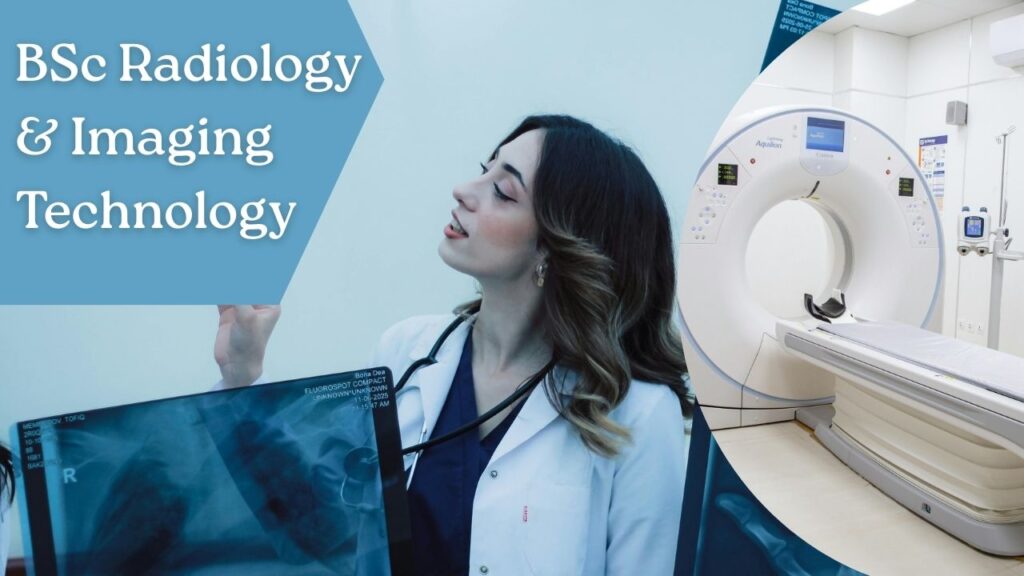
BSc Radiology and Imaging Technology

BSc Radiology and Imaging Technology is a three-year program (with one-year internship that is mandatory in most of the institutions) that equips the students with the knowledge of medical imaging. The core science portion of the curriculum (focusing on physics, chemistry, and biology) is integrated with clinical imaging courses including: anatomy and pathology, radiographic procedures, sonography techniques, ultrasound physics, computed tomography (CT), magnetic resonance imaging (MRI), and radiation protection. 

The Bachelor of Science in Medical Radiology and Imaging Technology is becoming the backbone of diagnostic medicine today. This transformation is being driven by three coalescing factors: the full enforcement of National Commission for Allied and Healthcare Professions (NCAHP) Act 2021, the adoption of advanced artificial intelligence (AI) in diagnostic workflow, and the growing world-wide need for expert imaging technologists. 

The course is intended to prepare competent technologists (“radiographers”) who will be well versed in the operation of contemporary imaging equipment and have a solid foundation in the science of diagnostic radiology. 

Who is a Radiology Technologist?

The Radiology Technologist/Radiographer is a clinical scientist who holds at least a B.Sc. or M.Sc. degree in Radiography. They don’t just know how to run the machines, they understand the physics behind the formation of images, the physiological basis of pathology and the important issues surrounding patient safety and radiation protection. 

Why Has This Course Become Important in Diagnostics?

Imaging is at the heart of diagnostics, which are critical to contemporary medicine; more than 80% of hospital care relies on them. B.Sc. In addition to machinery handling the Technician holder needs to perform a large part in the day to day imaging workflow by the year 2026 MRIT graduates holders can expect to be involved with state of the Art technology like PET-MRI, SPECT-CT, Protocol Optimization, Post Processing, QC. 

Also this line job is work during recession. There is a long-term demand for skilled radiographers, particularly those trained in PACS and RIS, as the population of India grows older, lifestyle ailments become more common, and digital healthcare is enhanced under the ‘Ayushman Bharat Digital Mission’. 

Entrance Exams & Eligibility Details For Admission 

NEET UG 2026

National Eligibility cum Entrance Test (NEET UG) shall be the single entrance examination for admission to all the undergraduate allied and healthcare courses like BSc Radiology and Imaging Technology from the academic year 2026-27, according to NCAHP. 

AIIMS — 2026 Paramedical Entrance Test

Along with NEET, there is the AIIMS entrance Test which is held by AIIMS for paramedical courses leading to B.Sc. and M.Sc. The date of AIIMS B.Sc. Paramedical 2026 exam is tentatively on 30 May 2026. 

Note:- Candidates are requested to cross-check this with official notification as some calendars mention July for Examination, however May is the only projected window as per academic calendar.

How to apply:

  • Basic Registration: The schedules released in 2026 March/April. You can create a Registration ID.
  • Final Registration: Involves the generation of a Unique Code (RUC), payment of application fee, usually in May 2026.

Test Format: This computer-based test will consist of 90 multiple-choice questions (MCQs) on biology/mathematics, chemistry, and physics and will last for 90 minutes. Any wrong answer can take away ⅓ marks.

Admissions at JIPMER & PGIMER

JIPMER (Puducherry): B.Sc admissions The admissions to the B.Sc shall be The Allied Health Science at JIPMER (Puducherry) for the year 2026 will be on the basis of the NEET UG scores. JIPMER normally holds its own counseling for these seat(s). 

PGIMER (Chandigarh): The institution holds a separate CBE, these are usually conducted in the months of August/September. The process of application normally commences in June. 

State and Private University Tests

CUET (Common University Entrance Test): Central universities, such as Banaras Hindu University (BHU), utilise the CUET. The essential subject combination for Radiology is Physics, Chemistry, and Biology / Mathematics.

Manipal: in MAHE, Phase 1 is scheduled for April 2026 for admission test, and the next Phase 2 for May 2026. 

CMC Vellore: It is a tough Institute level CBT (Computer Based Test) followed by a Step-2 evaluation (Practical tests and interviews.) 

Eligibility Criteria 2026

Educational qualification: Should be passed class 12th board with physics, chemistry and biology (pcb) and English. Some of the institutes like AIIMS allow mathematics (pcm) for Radiology courses.

Minimum Marks: For the general/EWS/OBC category, it is 50% aggregate and for the SC/ST category, it is 45%.

Read More:- Supreme Court Law Clerk Recruitment 2026 Notification Details

List of Colleges For BSc Radiology and Imaging Technology

There are 140+ colleges around India that offer BSc Radiology and Imaging Technology without taking too much fees, especially in government colleges. If you have interest in lab technologies or figuring out body structures and making reports then take admission for securing your career in this field.

CollegeLocationApprox. FeesNotes 
AIIMS—New DelhiDelhi₹4,500Elite training facility as it is Top-ranked college
PGIMERChandigarh₹10,500Members are mindful and placements opportunities
JIPMERPuducherry₹94,000Excellent internships
AIIMS—RishikeshUttarakhand₹46,000High packages up to ₹24L
GMCHChandigarh₹39,000Affordable govt option
Integral UniversityLucknow, UP₹3.15LGood infra, local pick
Parul UniversityVadodara₹4.6LPrivate, placements ₹6L avg
SGT UniversityGurgaonVariesModern facilities

Academic Curriculum for the Course 

Theory and laboratory practice are included in the curriculum of BSc Radiology and Imaging Technology. The following topics were covered: Human anatomy/physiology, Imaging Physics, General Radiography, Ultrasound Imaging, CT Scanning, MRI Basics, Radiobiology and Radiation Protection, Digital Image Processing, and General Patient Care. 

BSc Radiology and Imaging Technology is a four year degree course. The first three years were spent attending didactic lectures, practical laboratory courses, and clinical observations. The fourth year is a required, full-time clinical internship during which the student serves as a student technologist at a hospital. 

PhaseDurationFocus Areas
Year 1Semesters 1-2Basic Medical Sciences, Communication Skills, Computer Basics
Year 2Semesters 3-4Core Radiography, Radiation Physics, Conventional Imaging
Year 3Semesters 5-6CT, MRI, USG, etc Interventional Radiology
Year 4Semesters 7-8Clinical Internship, Logbook, Project Work

The 2026 Curriculum is intended to establish progressively developing competencies. 

Year 1: The Foundation

The goal is to give the student a foundation in the human body and the hospital setting.

  • Human Anatomy & Physiology: This Is Not a “Fly By” Tour Students are required to study detailed osteology (bones) to learn how to position for radiographic.
  • They are taught body systems physiology to understand how to administer contrast media.
  • General Physics: The basic laws of physics applicable to the production of radiation.
  • Clinical Pathology & Biochemistry: Basics of blood tests (creatinine, urea) which are important prior to contrast administration.
  • English & Communication: Necessary to describe techniques to patients and to calm them. 

Year 2: The Core

Students access the realm of diagnostic imaging in BSc Radiology and Imaging Technology.

  • Radiation physics: The production of X-rays, their interaction with matter, and the design of X-ray tubes.
  • Radiographic Positioning, the science and art of positioning the patient to radiograph the body part (i.e. Towne’s view for skull, Skyline view for patella).
  • Darkroom to Digital: Darkrooms may be a thing of the past, but knowing the history is key. Emphasis is placed upon Computer Radiography (CR) and Direct Digital Radiography (DR) modalities.
  • Radiation Protection: Students learn the ALARA (As Low As Reasonably Achievable) concept along with shielding and dose limit for worker and patient. 

Year 3: The Advanced Frontier

This is the year when the high-end modalities that shape contemporary radiology are covered.

  • Computed Tomography (CT): CT Physics, generations of scanners, helical vs. axial scanning, and protocols for different body regions.
  • Magnetic Resonance Imaging (MRI): Principles of the complicated physics of nuclear magnetic resonance, safety issues related to ferromagnetic materials, and pulse sequences.
  • Ultrasonography (USG): Essentials of acoustics, transducer design, and the technologist’s function in the operation of the sonographer.
  • Interventional Radiology (IR): Orientation to the Cath Lab Sterility and Equipment utilized in Angiography.   
  • Radiation and Radioactivity in Nuclear Medicine Basics of PET-CT Handling of Radioisotopes including Technetium-99m. 

Year 4: The Internship

The purpose of the internship is to transition a student to a worker. Interns rotate through different departments, including X-ray, CT, MRI, Emergency and ICU. They need to keep a logbook of cases they have done, and are evaluated on their technical skills and dealing with patients. 

BSc Radiology and Imaging Technology Career Scope & Salary

Skilled radiographic professionals are sought after in India’s growing healthcare sector. Radiology technicians also work in public and private hospitals, diagnostic laboratories (pathology and imaging centres), government health schemes, private practitioners and emerging digital health platforms including teleradiology and artificial intelligence (AI) imaging start-ups. 

BSc Radiology and Imaging Technology

Clinical Roles

  • Radiologic Technologist: The typical baseline position. Duties are to perform x-rays, triage patients and maintain radiation safety .
  • CT Technologist: So, what’s the place in the hierarchy. Knowledge of cross-sectional anatomy and contrast administration is required.
  • MRI Technologist: A step up. MRI scanners are complicated, and patient safety (screening for metal) is critical. The technologists here typically make 20-30% more than a general radiographer.
  • IR Technologist: The Cath Lab Experience. In a stressful environment, high volume dealing with cardiac and vascular interventions. You’ve got to wear thick lead aprons for long hours – but when you’re done, you’re king and you’ve got money in your pocket.
  • Mammographer: Expert in breast imaging. Because of the sensitive nature of the exam, female technologists are preferred for this position. 

Sector & Role Wise Salary (2026)

RoleExperienceSectorApprox. Monthly Salary (INR)
Jr Technologist0-2 YearsPrivate sector Hospital Rs 18–25k
Jr Technologist0-2 YearsAIIMS/Govt (Contract)Rs 25–35k
Sr Technologist5+ YearsCorporate HospitalRs 45–60k
MRI Specialist3-5 YearsDiagnostic ChainRs 35–50k
Application Specialist2-5 YearsMedical Device Co.Rs 50–80k + other allowance
Govt. PermanentEntry LevelGovernmentRs 45–55k (Initial + Allowance)

Who is Ideal For this Course?

BSc Radiology and Imaging Technology course is for students who like science and technology and want to work in the health sector. The ideal candidate: is detail oriented, is able to follow protocols which are critical for safety, is comfortable using computers and complex machinery, and can interact with patients (explain procedures, position patients). A BSc radiology student should be well versed with biology and physics and should also be calm and responsible because any mistake in imaging can impact the diagnosis. 

Future Value of BSc Radiology and Imaging in Healthcare

In India’s upcoming healthcare scenario, BSc Radiology and Imaging Technology are a must-have. With the proliferation of private hospitals and diagnostic chains in Tier II/III cities, the need for imaging services is on the rise.

Technologies, such as AI-based image analysis, hybrid imaging (e.g. PET/CT), etc, indicate that the profession will continue to be hitech. So BSc (Hons) in Radiography graduates will play a vital role in connecting technology and patient care. The course produces practical professionals who can contribute immediately to hospitals’ diagnostic teams, which is critical in a country like India, where there is a shortage of doctors. 

Conclusion

In a day and age when technology and medicine are coming together closer than ever, the Radiology Technologist is at the controls of the medical world’s most powerful machines. For individuals who are detail-oriented, have a caring nature, and technical mind, BSc Radiology and Imaging Technology offers a fulfilling, stable and ever-changing career. 

Leave a Comment

Your email address will not be published. Required fields are marked *

GSEB HSC Supply Result 2025 OUT – Here’s How to Check Now at gseb.org

GSEB HSC Supply Result 2025 is released today. If you also appeared in the 12th science examination held from 23 June to 30 June, 2025 then check it out on the official website. You can follow the steps to check the result of Gujarat Board examination 2025.

GSEB HSC Supply Result 2025 Check Now

Students can follow a step-by-step guide to check the GSEB HSC supply result 2025. Students can also check their result from the direct link provided in the article. 

  1. Go to the official website, link is given in the article.
  2. When you appear on the website, click on the link “HSC Supply Result 2025”.
  3. Enter the details such as roll number and password and click on enter.
  4. Results will be shown on the screen.
  5. You can download and save it.
Number of CandidatesStatus
19,251Applicants
16,789Appeared in Exam
6,978Passed

Read More 👉 CG Fire Department Form 2025 Released – Apply Now for 295 Vacancies at Gov Update Wala

Pass Percentage
Group A46.32%
Group B40.47%
Group AB37.50%
Useful Links
Download NotificationClick Here
Check ResultClick Here
Official WebsiteClick Here

Leave a Comment

Your email address will not be published. Required fields are marked *

Top IT Government Jobs in India You Must Apply for in 2025

Top IT Government Jobs in India

If you are an IT graduate or tech enthusiast looking for a well-paying and stable career then you can consider IT Government Jobs in India. This is the best option for job security and competitive salaries but also offers career growth and work-life balance. There are top  IT government jobs in India that you should know before applying and check the eligibility criteria, salary, and the selection process for each job. If you are scared from sudden layoffs in the private sector or no retirement benefits. You can choose this path for an excessive amount of perks.

Best IT Government Jobs in India 

Scientist/Technical Assistant – National Informatics Centre (NIC)

This is the top-tier position in the government involving high-end projects for national development. IT professionals are selected by the NIC in the government sector. Vacancy notice is presented on the NIC official website. The job roles are Scientific Officer, Technical Assistants, Scientist-B, these roles offer a great salary and benefits.

DepartmentMinistry of Electronics & Information Technology
RoleSoftware Development, System Management, Cybersecurity
EligibilityProfessional degree is required for this roleB.TechMasters in Computer Application (MCA)M.Sc (IT or CS)
Career GrowthPromotion to Scientist ‘C’,  Scientist ‘DProgression to Senior Technical Assistant or Scientist roles 

Important Skills

  • Candidates should be experts in coding.
  • Command on concepts of cybersecurity, cloud computing, and AI.
  • Ability to Collaborating with teams.
  • Problem-solving and analytical thinking are mandatory skills for this role.

Selection Process

Written ExaminationObjective test focusing on logical reasoning, quantitative aptitude, and IT/Computer Science
Skill TestShortlisted candidates has to give Hands-on assessment of IT skills 
InterviewAssessment of domain expertise, problem-solving skills, and understanding of IT solutions.

Assistant Programmer OR Data Processing Assistant 

This post is filled through the competitive exams like SSC CGL or SSC Selection Post. The positions come under the Group B or C but have fixed hours, growth, posting, or promotion to the next level and also increase salary according to the level. 

DepartmentSSC (Staff Selection Commission)
RoleSoftware coding, troubleshooting, database maintenance
EligibilityBachelor’s in Computer Science/IT, Certifications in programming, networking.
ExperienceFreshers are eligible for entry-level positions
Age LimitGenerally between 18 to 30 years
Career GrowthPromotion to Senior Programmer, System Analyst, Data Manager and Technical Officer roles

Important Skills

  • Expert in programming languages like PHP, Java, Python.
  • Understanding of MYSQL or Oracle.
  • Candidates should be able to solve IT issues within a minimum time period.
  • Problem-solving and analytical thinking.

Selection Process

Written ExaminationObjective test focusing on logical reasoning, quantitative aptitude, and Computer Science
Skill TestShortlisted candidates has to give technical assessment 
InterviewOn technical skills and job responsibility

ISRO Scientist/Engineer – SC (Computer Science)

ISRO is one of the top popular IT developers because it has developed top level projects. The job in ISRO required professional skills in a specific field. The recruitment process occurs to fill the vacancies and is completed by the written test and interview.  IT Professional’s top-notch choice for their career as a ISRO Scientist. There are opportunities for the ISRO workers such as Work on Space, Excellent training programs, Growth, housing, and medical allowances.

DepartmentIndian Space Research Organisation
RoleSoftware development, control systems, data analytics
EligibilityB.E/B.Tech in CS or IT with 65%+
Age LimitMaximum 28 years for Gen, SC/ST has 5 years relaxation, OBC has 3 years relaxation
Career GrowthPromoted to Higher scientific roles, Promotions are based on years of experience and performanceOpportunity for Specialization in space applications, AI, cybersecurity

Important Skills

  • Good knowledge in software development tools and environments.
  • Candidates should be proficient in programming languages.
  • Candidates should be Expert in networking, and cybersecurity.
  • Problem-solving and analytical thinking.
  • AI and ML knowledge would be good for understanding current time tasks.

Selection Process

Written ExaminationObjective test focusing on Operating Systems, Networking, and DSA.
InterviewTechnical round and HR round
Medical ExaminationCandidates must meet ISRO’s medical and fitness standards

Read More 👉 Top Government Jobs After MBA in 2025 You Shouldn’t Miss!

DRDO – Scientist ‘B’ or Technical Officer

If you can clear the GATE exam and get a high score then you can be considered a DRDO scientist or technical officer. Just apply through the official website of DRDO for these job roles, there are a large number of vacancies for technical officers. You can also take the CEPTAM exam for this job role. You can get a chance to work on High-tech defence-related IT project. The Research-oriented environment is actually the impressive Secure government job with attractive pay.

DepartmentDefence Research & Development Organisation
RoleSecure AI/ML-based projects
EligibilityB.Tech/M.Tech in any field like electronics or mechanical
Age LimitGenerally up to 35 years
Career GrowthScientist ‘B’ promoted to Scientist ‘C’, ‘D’, Technical Officers promoted to Senior Technical Officer and Chief Technical Officer positions.

Selection Process

Written ExaminationTechnical paper based on IT concepts
InterviewShortlisted candidates are called for an interview. This process checks the ability in their technical expertise 

IB ACIO (Assistant Central Intelligence Officer) – Tech

The Assistant Central Intelligence Officer is a high position in the IB, you have to maintain your technical skills for this role. You must have technical expertise as the role demands advanced skills to handle the government task related to intelligence and security. Position also involves strategic-level cybersecurity work, management of technical equipment, Handsome salary with risk allowances, and coordinated intelligence efforts.

DepartmentIntelligence Bureau
RoleCyber surveillance, network monitoring, IT analysis
EligibilityB.Tech in Computer Science/IT/ECEKnowledge of cybersecurity, networking, or Command on computer language
Age Limit18-27 years (age relaxation for reserved category)
Career GrowthPromotion to senior level deputy positions

Important Skills

  • Good knowledge of networking and cybersecurity.
  • Candidates should be able to handle data analysis tools.
  • Have a good knowledge in surveillance technologies.
  • Ability to work under pressure in confidential and high-stakes scenarios.

Selection Process

Written ExaminationA technical paper based on the expertise mention by the candidate
InterviewShortlisted candidates are called for an interview. This process checks the ability in their Skills
Medical Fitness TestIB has some medical standards, candidates should meet the requirement.

Tips to Crack IT Government Exams in 2025

Check out the official website of government recruitments for these job roles. Notices updated on the website to fill the vacancies.

Prepare yourself for technical and aptitude tests. Most of the exams have the same topic like reasoning, GK, and technical topics.

Prepare with online resources because they offer great test series.

Code consistently for coding roles, Especially for NIC, ISRO, and DRDO roles.

Conclusion

IT government jobs will come in a large number of vacancies. Grab the opportunity now for the technical roles in the government sector as soon as possible and enjoy the lifetime freedom from private sectors incapability of providing high salaries to the developers or engineers. If you are good in coding or IT concepts you should consider the government roles for better career growth and also start preparation to beat the interview and skill test to get selected for the job roles.

Leave a Comment

Your email address will not be published. Required fields are marked *

MPESB Group 5 Paramedical Recruitment 2026: Complete Guide to 291 Government Jobs in MP

MPESB Group 5 Paramedical

After a long wait, it’s now or never for those aspiring for a government job in the healthcare and paramedical sector in Madhya Pradesh. The Madhya Pradesh Employees Selection Board — commonly referred to as MPESB has released the notification for its MPESB Group 5 Paramedical Recruitment 2026, and it is the one among the state’s highest job hirings this year. You definitely don’t want to snooze on this one – 291 vacancies are up for grabs in multiple departments.

Are you a just qualified diploma holder, an experienced lab technician, or a trained staff nurse seeking to go into government service, this MPESB Group 5 Paramedical Recruitment 2026

 has the right opportunity for you. Let’s break down all the details for you to understand.

What is MPESB?

Madhya Pradesh Employees Selection Board is also known as (MP Vyapam) and it is the right platform for the unbiased and merit based recruitment in Government Job in the State. Located in Bhopal – Chayan Bhawan, it conducts exams from Group 1 to Group 5 across various domains like education, healthcare, police and so on.

MPESB Group 5 Paramedical

It brings the notification, make the online registrations, issue the hall tickets, answer key and result – everything in the name of transparency. MPESB facilitates the recruitment process, From technical and administrative posts to health service and field posts, MPESB conducts thousands of recruitment every year.  

Quick Overview For MPESB Group 5 Paramedical Recruitment 2026

DetailInformation
Conducting BodyMadhya Pradesh Employees Selection Board (MPESB)
Recruitment NameMPESB Group 5 Paramedical Recruitment 2026 
Total Vacancies291 Posts
Application Start Date13/March/2026
Application End Date27/March/2026
Correction Window13/March/2026 – 01/April/2026
Exam Date15/April/2026 onwards
Official Websiteesb.mp.gov.in
Application ModeOnline Only

Posts Available and Vacancy Breakdown

The 291 posts are spread over 9 departments in Madhya Pradesh and consist of a good blend of clinical and non clinical work in the department of health. The following positions are available: 

Post NameDepartment/LocationTotal Vacancies
Ayurveda CompounderDirectorate of AYUSH125
Unani CompounderDirectorate of AYUSH30
Homeopathy CompounderDirectorate of AYUSH20
Lab AttendantGMC Ratlam/Vidisha18
Staff NurseESI Services Indore7
Pharmacist Grade-2Various15+
Others (Technician, Dresser, etc.)Multiple MCs/ESIRemaining 76

Who Can Apply? 

Qualification

Completed 12th grade with subjects including Phy, Che, and Bio and any diploma or certificate in the field of Paramedical by the recognized government of India.

This eligibility criteria makes sure that the aspirants have the basic academic as well as the professional training needed for paramedical field. 

MPESB Group 5 Paramedical Qualification

Further, you must have valid registration with the Madhya Pradesh Para-Medical Council (MP Sah-Chikitsiya Parishad). The detailed eligibility criteria are post-wise and are given in the official notification. 

Age Limit 

  • Age Minimum: 18 years (s) as on date of Advt.
  • Max Age: 40 years (General/Unreserved candidates)
  • Maximum Age Limit is 45 Years for SC, ST, OBC, Women, PwD, Gov. Employees, Home Guard of MP and Ex-Servicemen

The age has been calculated as per your date of birth mentioned in the High School or Higher Secondary certificate. No candidate shall be above 45 years of age as on the last date for receipt of application under any circumstance, except certain contractual employees and categories notified under Rule 14 of the MP government rules. 

Nationality

Under the MP Civil Services Recruitment Rules 1961, the candidate must be a citizen of India or a Citizen of Nepal. Non-MP resident candidates can apply only for OPEN/UR category posts and shall not be entitled to any kind of reservation or age relaxation. 

How to Apply — Step by Step

Application process is going online for MPESB Group 5 Paramedical Recruitment 2026, so you must follow these steps to apply:

  1. Open the official website of MPESB to apply for this recruitment.
  2. Join the recruitment tab and now click on the Recruitment Notification for the subject MPESB Group 5 Paramedical Post Recruitment 2026
  3. Sign up with your mobile number, Email ID, and some personal information
  4. Enter your name, parents’ name, education qualification and other required details in the application form.
  5. Upload a photograph, signature and your certificates if you are from a relevant category
  6. Make payment either online/offline for application/Examination fee.
  7. After submitting the form, keep your application no for future use. 

Read More:- BSc Emergency and Trauma Care

Application Fee

CategoryExam FeePortal FeeTotal
General/Other State₹500₹60₹560
SC/ST/OBC/PWD (MP Domicile)₹250₹60₹310
Direct BacklogNil₹60₹60

The fee is non-refundable and the fee amount is different for each category. You may pay online with Credit Cards, Debit Cards, Net Banking, IMPS, Cash Cards, or Mobile Wallets. 

How Will You Be Chosen?

The method of selection is simple and on the basis of meritorious:

  • Online Written Examination: The online written examination will consist of one objective type paper of 100 marks. The examination will be held from 15 April 2026 in two shifts.
  • Document Verification: The shortlisted candidates will be intimated for the verification of the original certificates.
  • The final candidates will have to go through a medical fitness test for the post as a part of the last selection stage.

There is no interview for this recruitment because selection is based on the Merit score of exam, so prepare well for the examination.

Exam Pattern & Syllabus

The test is a test of both general awareness and technical know-how. It has 100 questions and all questions carry 1 mark which means that the time duration of 2 hours would need to be utilized to solve a total of 100 questions. 

The exam is conducted in both online, or OMR sheets mode and the best part is that there is no negative marking, so go ahead and attempt every question without worrying about losing marks. 

General Section (25 Marks):

This section is for your general knowledge and talent. It contains questions from GK, Hindi, English, Maths, Science, Logical/Interest based reasoning. 

Technical Section (75 Marks):

This is the major part of the exam and tailors subject-specific knowledge of the post you have applied for. such as candidates applying for the posts of Lab Technician may get questions from Pathology and Biology or for Nursing candidates may ask questions from Anatomy, Pharmacology and other medical related subjects. 

In the GK section, questions are broadly asked from history and geography of mp and India, Govt. schemes, and Today Updates. 

Tips for Applicants

Here are some words of friendly advice so you don’t get caught up in this:­

  • Don’t wait for the last date, apply as soon as possible because there is a huge competition out there.
  • Verify all information twice before submitting. Corrections are allowed only up to 01.04.2026 with a fee for modification.
  • It is necessary to have that your MP Para-Medical Council Registration is Active and Valid before applying.
  • Before you begin, keep scanned copies of your photo, signature and all certificates ready.
  • Start preparing for the written exam – 100marks, objective type, no second chance after the window closes. 

Conclusion

MPESB Group 5 Paramedical Recruitment 2026 is indeed good news for all the healthcare professional and paramedical job seekers of Madhya Pradesh. It is not every day that you get an opening where there are 291 vacancies, a clean merit-based selection process, and the support of a reputable Government board.

Submit your application between 13 to 17/March/2026 and read the official notification properly and collect your documents then apply. Jobs in government health care are stable, provide a well-defined career path, and allow you to truly serve your community. This could be your moment.

Best of luck to everyone. Good preparation and no error in your application! 

Leave a Comment

Your email address will not be published. Required fields are marked *

Allahabad High Court HJS Admit Card 2025 Released – Direct Link and Full Details by Gov Update Wala

Allahabad High Court HJS Admit Card 2025 has been released on the official website of the High Court of Judicature at Allahabad. Candidates must download and print out their admit card before the exam. If you want more details about the examination, you can download the official notification of admit card & exam through the direct link. 

To fill 83 District Judge vacancies through this examination. Candidates have to pass the three stages of selection – prelims, Mains, and interview to get the position. 

Conducting byHigh Court of Judicature at Allahabad
Post NameHigher Judicial Services
Vacancies83
Admit Card Date11 July 2025
Exam Date20 July 2025 
Selection ProcessPrelims, Mains, Interview
Official WebsiteClick Here

Read More 👉 How to Take Admission in Delhi University in 2025 – Full Process Explained!

How to Download UPHJS Admit Card 2025

You can download your admit card through the official website of the Allahabad High Court. Therefore, you can find the official website link or download it directly from the link provided here.

  1. Click on the official website link and the page will appear on your screen.
  2. Select the UPHJS 2025 Admit card in the section of Recruitment.
  3. Enter your roll number and password to get the admit card.
  4. Once you submit, the admit card will show.
  5. Download and save it for a hard copy.

Admit Card Details

Candidate’s roll number, name, exam date, time, photograph, sign, exam centre, and other instructions for the examination hall. Candidates are allowed to enter the examination if they have their admit card. That is why it is mandatory to get the admit card before the exam.

Important Links
Download NotificationClick Here
Download Prelim Admit Card NotificationClick Here
Download Admit CardUpdate Soon
Official WebsiteClick Here

Leave a Comment

Your email address will not be published. Required fields are marked *

UP Police Constable Recruitment 2026: Apply Online for 32,679 Posts

UP Police Constable Recruitment 2026

The UP Police Constable Recruitment 2026 Board has published a new UP Police Constable Recruitment for the year 2026 in Uttar Pradesh. There are 32,679 posts that need to be filled. Dec 31, 2025 Last date for online submission of applications Jan 30, 2026. Interested candidates can download the application form and detailed notification from the official website of UPPRPB.

You can check all the details including eligibility, application fee, age limit, pay scale & selection procedure before applying. Ensure that you apply within the deadline so that you do not miss this opportunity. For more details and updates, login the official portal. 

OrganizationUP Police Recruitment Board
Post UP Police Constable
Vacancies32,679
Last Date30/Jan/2026
Application FeeRs 400—500
Age Limit18—22 years;18—25 years
Official WebsiteClick Here

Dates To Remember For Apply To This Position

Notification Date31 December 2026
Application Start Date31 December 2026
Last Date to Apply30 January 2026
Fee Payment Last Date30 January 2026
Exam DateUpdate Soon

Who Is Eligible for This Position?

The qualification condition is quite simple and easy to understand. You should have cleared 12th standard (10+2) from a known board. Male candidates can apply till an age of 25 years and female candidates can apply till an age of 28 years, relaxation in upper age limit will be provided as per category. This means if you are studying for competitive exams presently, or just finished your 12th, you’re just about right. 

Read More :- How to Join Indian Army — Your Complete Guide to Serving the Nation

The Application Process

UPPRPB has started a revolutionary “One Time Registration (OTR)” system for the convenience of the applicants. These days where you no longer have to fill in the same forms over and over again for every recruitment — you just register once, and your data is saved for use in future applications. It is a reflection of the board’s dedication to making the process candidate-friendly.”  

  1. Visit the Official Site: Go to uppbpb.gov.in and search for the notification link related to UP Police Constable Recruitment 2026.
  2. ​Complete OTR Registration: Fill in your Preliminary information like name, father’s name, date of birth, contact details and education qualifications.
  3. Submit the Application: After the registration is complete, login and submit the application form with the necessary details.
  4. Upload Documents: You will be required to upload a passport-size photo and signature in the specified format.
  5. Submit the Application Fee: Pay the fee via debit/credit card, net banking and UPI. 

Salary Package Receive For Constable Position

As a newly selected UP Police Constable, you will receive the basic pay of ₹21,700 per month with the grade pay of ₹2,000. Your salary per month would be something between Rs 30,000 to 40,000 so far as you hold the gross (with all the allowances like DA, HRA, TA etc) salary.

This salary scale is not just frozen, it increases with time. After years of diligent service and good performances, you can get paid up to ₹69,100. Plus the government has been pursuing the implementation of the 8th Pay Commission that might increase your earnings by 20-30% in the next few years. 

Important Links
Apply NowClick Here
Download NotificationClick Here
Official WebsiteClick Here

Leave a Comment

Your email address will not be published. Required fields are marked *

Scroll to Top