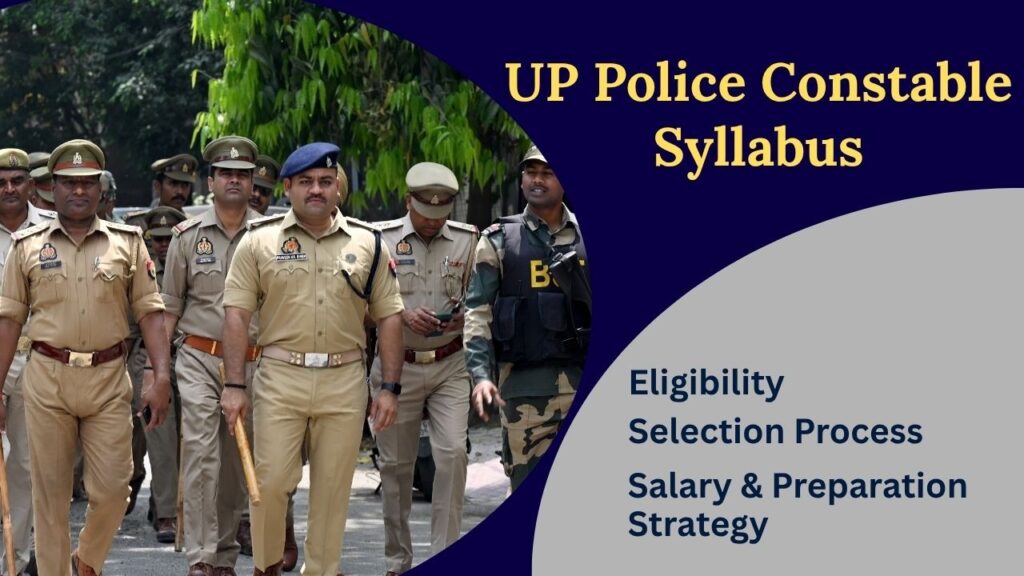
UP Police Constable Syllabus, Salary & Preparation Strategy 

UP Police Constable Syllabus

Getting a government job in India isn’t a cakewalk, and UP Police Constable exam is no exception to it. Every year, thousands of applicants vie for handful vacancies, which is making it one of the popular and toughest exams in the state. With a right approach toward UP Police Constable syllabus, and with persistent preparation, this target is of course achievable. 

If you want to put on the khaki with pride or if you want a stable career with good salary and benefits, this exam could be your ticket. But these benefits asked you to work harder and get it. This breakdown—eligibility, selection process, syllabus, salary, and a practical preparation plan of UP Police Constable will help you plan to crack this exam.

Eligibility Requirement For UP Police Constable

You need to check eligibility requirements before buying books for studying UP Police Constable syllabus and doing push ups. UPPRPB is recruiting candidates for this post under strict guidelines. So you must follow before applying: 

Educational Qualification 

No fancy degrees are required for a UP Police Constable. Candidates must acquire 12th standard (Intermediate) marksheet from any recognized board in India. 

Age Limit 

Male Candidates (General) 18 to 25 years 
Female Candidates (General) 18 to 28 years 

Reserved category candidates can get age relaxation but you must check the latest recruitment official notification to know age relaxation. 

Physical Standards (PST) 

CategoryUR/OBC/SCST
Height for Males168 cm160 cm
Chest for Males79–84 cm77–82 cm
Height for Females152 cm147 cm
Weight for FemalesMinimum 40 kgMinimum 40 kg

UPPRPB Selection Process For UP Police Constable

It’s not just one written exam here, you must pass all the stages to reach that position. It requires commitment and hard work for securing an honourable government job for the nation.

Stage 1: The Written Examination

It’s a written offline OMR-based exam. Candidates have to get above the cut off marks by answering all the MCQs accurately then you move on to the physical rounds. Questions come from the four main subjects (GK, Hindi, Mathematics, Reasoning).

Stage 2: Verify Docs And Physical Standard Test (PST)

Once you qualify stage 1 with preparation and hard work, you need to provide documents– 10th/12th mark sheets, caste certificates, domicile papers for verification. And your body measurements like height, weight and chest (men) will be taken to pass you on to the next stage of selection.

Stage 3: Physical Efficiency Test (PET)

PET is a mandatory exam for candidates without getting marks. This final round can throw you out of the list if you fail. 

  • Running for a 4.8 km run in 25 minutes is a mandatory test for male candidates. 
  • If you are a woman then you must be able to run 2.4 km in 14 minutes.

Stage 4: Detailed Medical Examination (DME)

Physical and mental health matters for this job, it has regulations if you have weak eyesight, color blindness, hearing, flat feet, knock knees. 

UP Police Constable Syllabus Breakdown

The written test contains 150 questions which is of 300 marks (2 marks per question). But be careful, there’s negative marking!  

The written exam is divided into four main subjects which you can qualify with right preparation on the syllabus.

I. General Knowledge (38 Questions)

Knowing about the world revolves around you, especially Uttar Pradesh is necessary. GK tests you based on the questions based on national and international current affairs, History/Civics, Geography, Science and Finance of India.

II. General Hindi (37 Questions)

If you attended a Hindi-medium school, this is your section to score. Even if you didn’t, you can get good marks by doing some basic grammar practice. Focus on Hindi Grammar (Vyakaran) , Unseen Passage, Famous writers & their work, Synonyms, Antonyms, Idioms and Phrases (Muhavare). 

III. Numerical and Mental Ability (38 Questions)

Question comes from basic mathematics of 9th and 10th, if you are good at maths then practice daily on Number systems, Percentages, Profit & Loss, Ratio and Proportion, Simple & Compound Interest, Time, Work & Distance, Mensuration and Data Interpretation (Tables and Graphs). 

IV. Mental Aptitude, IQ & Reasoning Ability (37 Questions)

This part examines your mind and thinking ability, and also tells you how you could potentially think in police work situations. Coding-decoding, Series, Blood Relation, Direction Sense, Syllogism, Venn Diagram, Non-Verbal (Pattern and Figure). There will also be situation based questions to test your attitude towards public interest, laws and order, communal harmony and police force. 

How to Prepare For A Police Constable

Avoid beginning to study with difficult mock tests. Instead, strengthen your foundation with standard books like Lucent GK, R.S. Aggarwal (Math & Reasoning) and a good hindi grammar book.

Keep practicing last year’s question papers. They give you a clear idea about the exam level and the types of questions that are asked. UPPRPB also has a penchant for posing questions similar (even a same question sometimes) to what they had already asked. 

Once you have completed about 60-70% of the syllabus, begin attempting full-length mock tests. Use a timer when you practice so you can work on your speed and accuracy. Check your mistakes to correct them each day. 

Don’t neglect physical fitness. Most candidates qualify the written exam but they are unable to clear the 4.8 km run. Something as simple as a 30-minute jog each day will smoke out your stale lungs and build your stamina. 

So, for the present events keep it simple. Just subscribe to a good monthly magazine (eg. the Economist) or a decent Youtube channel and don’t bother with the dailies. 

Salary and Perks After Getting a Job

UP Police pays its constables quite a good salary with additional perks that makes it worth the struggle to secure a position.

CategoryAmount
Pay ScaleRs. 5,200 – 20,200
Grade PayRs. 2,000
Basic Pay MatrixRs. 21,700

Under the 7th Pay Commission, the salary is distributed but other allowances also given to the constable which sum up to Rs. 27,000 to Rs. 32,000 per month.

  • Dearness Allowance (DA)
  • House Rent Allowance (HRA)
  • Travel Allowance (TA) & City Compensatory Allowance.
  • Ration Money & Uniform Allowance

Career Growth & Promotions 

A government job is not just a job, it is a career for a lifetime. Joining as a Constable does not imply that you will retire with that rank. The UP Police is providing a transparent path for promotions along the years of services, departmental exams and your performance record. 

  1. Police Constable (Your starting point)
  2. Senior Constable
  3. Head Constable
  4. Assistant Sub-Inspector (ASI)
  5. Sub-Inspector (SI)
  6. Inspector

If you have the ambition, you can appear for departmental exams for Sub-Inspector which will speed up your promotion rather than waiting wholly on seniority. An honest and sincere police officer can easily get retired as Inspector and in some rare cases even as DSP (Deputy Superintendent of Police) from the post of Constable with the blessing of the Almighty. 

Read More:-  Banking Job vs SSC Job: Details On The Top Government Jobs 

Conclusion

Passing the UP Police Constable exam is a challenge for mind and body. It needs a balanced approach, practicing math and checking daily news then getting up to run on the track. 

Focus on UP Police Constable Syllabus and your health to secure your position. The large number of applicants is not to be discouraging. You just need to prepare yourself for one seat.

The salary and additional perks are good with lifetime growth opportunities in the department, so there’s a golden door, you just need to jump long.
Leave a Comment

Your email address will not be published. Required fields are marked *

Railway RRB ALP Admit Card 2026: Download Now From Direct Link

Railway RRB ALP Admit Card 2026

The Railway RRB ALP Admit Card 2026 for the CBT 1 is live on the official website for the candidates who have applied for the post can now download the admit card from below and appear for the exam to get a dream job in the Indian Railways. Upon its schedule from 13 February 2026, the admit card is the official ticket telling off that you are going to the exam hall. 

If you have been studying for this exam for months, it’s time to calm down, stay focused, and get organized. Download your hall ticket well in advance and check all the particulars in it thoroughly and also make arrangements to link your transport to the examination centre. 

Now, with a total of 9,970 ALP vacancies to be filled and lakhs of candidates competing for them, every little step now matters — and it all begins with your hall ticket. 

Quick Exam Schedule Guide

StageDetailsTimeline/Status
CBT 1 ExamHeld RRB-wise for 9,970 total vacancies16—-18/February/2026 
CBT 1 Admit CardsReleased online via regional RRB sitesOut since Feb 9, 2026
CBT 1 ResultsMerit lists prepared with normalization for multi-shiftsExpected 2-3 weeks post-exams
CBT 2 ShortlistingAround 150,000 total candidates shortlistedBased on CBT 1 merit
CBT 2 City SlipAdvance info on exam city3-4 days before CBT 2 (pattern-based)
CBT 2 Admit CardDownload from regional sites3-4 days before test date
CBT 2 TentativePer RRB Calendar 2026March—April/2026

Railway RRB ALP Admit Card 2026 Release Update

The Railway RRB ALP Admit Card 2026 has been released on 09th February 2026 on all the regional websites of Railway RRB. This is in regard to the Computer Based Test (CBT 1) to be held on 13, 16, 17 and 18 February. There are no hard copies to be sent—it’s all online, so don’t wait till the last moment. Thousands of aspirants registered for a total of 9,970 vacancies, so this was a golden chance in Indian Railways. 

Read More 👉 BSc Radiology and Imaging Technology: Course, Eligibility, Fees & Career

Step-by-Step Download Guide

The process of downloading is simple, just make sure you follow the steps properly to avoid bugs:

  1. Go to your regional RRB site (like rrbcdg.gov.in for Chandigarh, rrbapply.gov.in for Hyderabad) or the consolidated link at rrb.digialm.com.
  2. Click on the ”RRB ALP CBT 1 exam admit card 2026″ link.
  3. Fill in the Registration Number/User ID and Password/Date of Birth.
  4. Hit “Submit” or “Login,” and your hall ticket will pop up.
  5. Check the details, download the PDF and take 2-3 printouts. Save your backups!

Pro tip : If you panic, forget your password, just click on “Forgot Password” right there. Test Your Login Early to Avoid Getting Clogged Up on Exam Eve. Test your login early to dodge any server rush issues on exam eve. 

What’s Inside Your Admit Card

DetailWhy It Matters
Candidate’s NameConfirms identity
Roll/Registration No.For entry and verification
Photo & SignatureMust match your ID
Exam Date & ShiftNote reporting time (usually 1-2 hrs early)
Centre AddressPlan your travel now
Duration & InstructionsCBT 1 is 60 mins, 75 questions
CEN No. (01/2025)Links to your application

Documents to Carry in Exam 

Remember to carry these following document as it is get you enter the examination hall:

  1. Bring a hard copy of your admit card and a recent passport size photograph. 
  2. a valid original photo ID for verification.
  3. Black or blue ballpoint pen.

Please note:

  • Accessories, bags, and eatables are strictly prohibited in the examination centre.
  • The gate will be shut prior to 8-9 AM, even if you have a late shift.
  • Further stages after CBT 1 are: CBT 2, CBAT, document verification (DV), and medical examination. 

Exam Pattern

PartSubjectsQuestionsMarksDurationNotes
AMathematics, Logic & Reasoning, General Science 10010090 minsQualifying cut-offs: 40% must secure by UR/EWS category candidates/ above 30% for OBC/SC/ 25% for ST 
BRelevant Trade (qualifying only)757560 minsMust pass Part B to proceed
Useful Links
Download Admit CardClick Here
LoginClick Here
Official WebsiteClick Here

Leave a Comment

Your email address will not be published. Required fields are marked *

CTET Exam 2026: Check Exam City, Notice, Exam Dates, Syllabus and Eligibility Information

CTET Exam 2026

The golden opportunity is announced for all the Teachers in India through CTET exam 2026. Organized by CBSE, this country level examination is for teaching jobs in government and private schools for Class 1 to 8. Candidates who apply in December 2025 for this examination should get ready for the exams.

Notification Details

Exam notice is released for CTET exam 2026, you can also get official notification on the official website for all the details about the exam. Candidates who filled the forms in November — 18 December 2025 can prepare themselves for the examinations in prior time to avoid panic at the end.

CTET February 2026 Exam Dates and Format 

FeatureDetails
Exam Date7 & 8 /February /2026 (Saturday & Sunday)
Mode of ExamOffline (Pen & Paper / OMR Sheet)
Number of Cities132 to 140 Cities Nationwide
Total PapersFor 1-5 Standard: Paper I;  For 6-8 standard: Paper II
Question Type150 Multiple Choice Questions 
Total Marks150 Marks per paper
Duration150 Minutes (2.5 Hours)
Negative MarkingNone
Language OptionsBilingual (Hindi/English) + 20 Regional Languages

Syllabus Overview

Paper 1 consists of questions from Child Development & Pedagogy, Language I & II, Science (for Science group), Social Studies (for Social studies group), Mathematics, and Environmental Studies, the emphasis is primarily on assessing the capability to teach at mali-ly school children. 

Paper 2 deals with Child Development, Language I and II and options such as Maths/Science or Social Studies for senior levels. 

Subjects stress pedagogy, theories of learning, and content of subjects based on guidelines of NCTE. 

Pass requirement is 60% for general (55% for reserved). 

Education and Age Limit Rule

  • There is no age limit here—everyone is welcome to apply, if you are Indian or you have Indian roots. 
  • For Paper 1, you should have a minimum of 50% in 10+2 with a 2-year Diploma in Elementary Education (D.El.Ed) or graduation with B.Ed. 
  • Paper 2: Graduation with minimum 50% marks and B.Ed or its equivalent like B.Ed (Special Education) is essential. . 
  • Reserved Category (SC/ST/OBC/PwD) Candidates can get Relaxations of 5% less in qualifying marks. 
  • Candidates who are appearing in the last year of their course are also eligible. 

CTET exam 2026 Admit Card Download Step-by-Step Instructions

  1. Go to the Important links section below and click on the Admit Card option.
  2. Enter your login details correctly to avoid interruptions and download your admit card
  3. Admit Card will appear 3-4 days before the exam, kindly wait for it.
  4. After the CTET admit card has been issued, get print out from here to carry a copy with you to the exam centre. 
Important Links
Exam NoticeClick Here
Date & City of examClick Here
Admit CardClick Here
Official WebsiteClick Here

Leave a Comment

Your email address will not be published. Required fields are marked *

NEET PG 2025 City Slip Released: Check Your Exam Centre Now!

NEET PG 2025 City Slip Released

The NEET PG exam city slip has been released with only the details of the city, the exact location of the exam centre will be provided later. Candidates can download NEET PG 2025 exam city slip from the official website of National Board of examination in Medical Sciences. The admit card will be released on 31/July/2025 for more details of the exam. You can download your exam city slip and admit card from the official website.

Exam NameNational Eligibility cum Entrance Test Postgraduate 
Exam Conducting BodyNational Board of Examination in Medical Sciences
Status Exam City Slip Released
PurposeEntrance exam for admission in postgraduate medical courses like MD or MS.
Official WebsiteClick Here

NEET PG 2025 City Slip – Important Dates

Test City Slip Date21/July/2025
Admit Card Date31/July/2025
Exam Date03/Aug/2025
Result Date03/Sept/2025

Steps to Download The Exam City Slip 2025

  1. You can download the exam city slip by visiting the official website.
  2. Navigate the NEET PG section and click on it.
  3. Click on the application link → click on “To Login” → the new log in page will appear.
  4. Please enter valid and correct details before clicking on submit.
  5. Exam city slip will be shown, you can download and save it.

Eligibility Criteria for NEET PG 2025

Education: NMC recognized degree of MBBS.

Certification: Internship certificate after MBBS, State Medical Council registration certificate.

Age Limit: No maximum age is declared. 

Number of Attempts: No limit

Selection Process 

After qualifying the exam, candidates are eligible for the next stage which is a counselling process for seat allocation. The NEET PG Counselling conducts on various stages – Registration, Choice filing, Seat Allotment, then reporting. After the seat allotment candidates must confirm the seat to complete the admission process

Important Links
Log inClick Here
Download InformationClick Here
Official WebsiteClick Here

Leave a Comment

Your email address will not be published. Required fields are marked *

Medical Courses After 12th PCB in India: Complete Roadmap, NEET, MBBS & Career Options

Medical Courses After 12th PCB in India

To become a medical sciences professional in India, students have to opt for the Bachelor of Medicine, Bachelor of Surgery (MBBS) degree, which is an arduous and comprehensive five-year program that aims to develop the students into healthcare professionals. But the path to Medical Courses After 12th PCB in India is a confusing maze of courses and entrance exams (the most important is National Eligibility-cum-Entrance Test (NEET).

NEET entrance exam has played a pivotal role in making the process of admission of MBBS more transparent and ensuring the method of admission on merit basis and curbing malpractices in India. 

The usual path through medical training is to go straight from medical school into a foundation program, then core training, higher specialty training and then either general practice or hospital specialist/consultant. This lengthy, complex training process exists to make certain that doctors have the critical foundational knowledge, the practical skills unique to their specialty, and the clinical understanding needed to safely contribute to patient care. 

Other than MBBS, there are plenty of other medical and paramedical courses out for students PCB which are Bachelor of Dental Surgery (BDS), Bachelor of Ayurvedic Medicine and Surgery (BAMS) and Bachelor of Homeopathic Medicine and Surgery (BHMS)

Medical Courses After 12th PCB in India

Most Popular and Hard-Level Courses

These courses offer a variety of specializations in the healthcare domain for the interested and the ambitious. For example, MBBS is a course on allopathic medicine while BAMS and BHMS are courses on Indian and homeopathy systems of medicines respectively which have profound history in India. Such classic systems, such as Ayurveda, are conceptually coherent and dynamically insightful intellectual traditions with unique theories of physiology.  

The content in medical education is constantly being updated to reflect advances in science and to prepare students adequately for clinical practice. For instance, personalized medicine is more and more being implemented in undergraduate medical education by using spiraled learning approaches. This design exposes undergraduates to evidence-based and clinically pertinent personalized medicine principles during all four years in medical school. 

Easy Courses in Biomedical Science

In the same vein, growing awareness of the need to incorporate artificial intelligence (AI) – a tool that enhances patient management and care in specialties like radiology and pathology in biomedical science education to foster healthcare education advancement is emerging. 

EBM Courses in Medical Courses After 12th PCB

Today’s medical education demands that students gain scientific foundational knowledge and not only practical exposure and clinical reasoning skills. Pragmatic EBM courses, such as the one at our institution, are intended to prepare students to sift through large bodies of evidence to answer clinical questions preparing them for the transition from undergraduate to graduate medical education. 

Cultivating systems thinking in medical education may contribute to educating scientists and clinicians of the future by counteracting dwindling interests in science through early involvement, hands-on experience, and improved coordination between educational phases. 

Professional Exams — Membership of the Royal Colleges of Surgeons

Medical education is organized into levels that sequentially increase in complexity. Following primary medical education, a phase of practical training under supervision, e.g. postgraduate residency training, is essential in order to convert theoretical knowledge into applied skills in the delivery of care to patients. 

This stage is said to be a formalised apprenticeship, to guarantee that practitioners are ready to work on their own. Passing professional exams, such as the Intercollegiate Membership of the Royal Colleges of Surgeons (MRCS) exam, is required for candidates to begin advanced specialty training in a number of specialties. 

Practical Specialization in Medical Science

Practical Specialization in Medical Science

The number of specialties open to students is huge and they can focus on general practice or pursue a highly specialised field. For instance, these are pediatric rehabilitation medicine physicians who are subspecialists working to optimize the health and function of children with disabilities across the lifespan. 

Specialties can also provide their own focus training on particular aspects, such as behavioral health, as behavior disorders are frequently seen in children and pediatric residency training in India is now having integrated behavioral health modules. Consideration is also being given to global health challenges of the future, for example increasing paediatric surgery provision in low and middle-income countries. 

Other Specializations Paths

There are also other specialist routes besides the core medical degrees. The radiation biology, dosimetry, and imaging aspects of medical physics intertwine with biology, anatomy, and physiology, and are subject to the rigorous education and training that is needed for safe and quality patient care. 

Medical physics educational programs range from undergraduate to doctoral level to facilitate the collaborative practice of physicists and physicians in a clinical environment. Likewise, clinical chemistry and biochemistry are recognized specialties requiring dedicated postgraduate training.

Choosing The Right Path in Medical is Important

Becoming a health care provider is challenging, and continuous learning and adaptation are necessary. Medical education curricula are regularly revised to be more integrated and competency based with an emphasis on the application of knowledge and on the development of problem-solving skills. This prepares future clinicians to manage complex medical knowledge and varied patient demands. 

Students need to be provided with necessary information to help them make right decisions regarding their career option after 12th class as choosing the right course is a crucial decision which will determine their future. 

In addition to MBBS being a popular-choice, it is also important to know different career options in healthcare and non-healthcare fields. Different admissions routes are being introduced into Medical Courses After 12th PCB, which enable students from under-represented groups to access medicine and aim to widen participation in the selection process are being developed. 

Conclusion

The path of Medical Courses After 12th PCB in India is the jack of all trades’ requiring preparation for entrance exams like NEET and dedication towards lifelong specialized training. The curriculum is changing as constantly evolving science, including personalized medicine and AI, is being introduced and the next generation of healthcare professionals will take on the challenges of the modern medical field. 

The option isn’t only MBBS, now there are other streams like dentistry, Ayurveda, Homeopathy and scientific specializations under Medical Courses After 12th PCB which can be integrated into healthcare. 

Leave a Comment

Your email address will not be published. Required fields are marked *

BSc Physiotherapy (BPT): Course Details, Eligibility, Fees & Career Scope

BSc Physiotherapy

BSc physiotherapy is a 4-year undergraduate professional course, that can be opted by those students who wish to pursue a career in healthcare services or wish to provide care to patients through physical rehabilitation and therapeutic care. The course gives you a thorough knowledge of human body anatomy, movement science and modern physiotherapy techniques as medical science and clinical practice. Due to increasing emphasis on physical well-being, rehabilitation, and sports medicine, physiotherapy has become a well-established and sought after profession and BSc Physiotherapy is a particularly good academic option for students who take interest in patient care, science of recovery and holistic health. 

Overview of BSc Physiotherapy

The bachelor’s degree in physiotherapy is an application of clinical and science based physiotherapy. This course is conducted for four years both for theoretical sessions and practical training where the course participants learn basics of anatomy and physiology as well as methodology of physical therapy. 

Students also complete clinical placements or internships where they have the opportunity to work with patients who have a range of bodily ailments. This practical experience is key to acquiring the skills you need to become a physiotherapist. 

Course Curriculum for BSc Physiotherapy

The BSc Physiotherapy course combines theory and practice in equal measure to develop sound clinical and professional competence. It begins with core modules in anatomy, physiology, biochemistry, pharmacology, assessment techniques, research methodologies, and communication skills in order to build a robust base.

Students also take higher-level courses in rehabilitation techniques, therapeutic interventions, sports physiotherapy, kinesiology, and biomechanics in the second year. It also involves clinical training with practical placements, enabling students to put their knowledge into practice in real-life healthcare environments. Assessment of learning in physiotherapy is by written papers and practical examinations and project work, all of which are designed to ensure students’ all-round competence in the practice of physiotherapy. 

Eligibility for BSc Physiotherapy

The requirements for admission to a Bachelor of Science (BSc) in Physiotherapy would vary from one institute to another and is subject to the individual decisions of the institute. 

Basic academic requirement: candidates generally should have completed their 12th-grade higher secondary education with not less than 50% aggregate in science stream. 

Eligibility for BSc Physiotherapy

Requirements for Subjects: Apart from the total percentage, he/she has to compulsorily pursue some core subjects in class 12. The essential subjects to be studied usually are:

  • Physics
  • Chemistry
  • Biology

These are important subjects because they help you learn basics which are required to know the human body, its functions and scientific rules which are applied in physiotherapy. 

Further Information: Vocational qualifications such as BTECs may be accepted by some institutions in addition to or in place of equivalent qualifications, subject to their individual application requirements. 

The best universities might also have additional requirements such as entrance examinations (NEET, CUET, or state-level exams) or interviews to assess candidates. 

Admission Process in Best Universities of India

Admission for the BSc Physiotherapy course is based on entrance exam conducted either by individual colleges or through centralized examination system. 

These are the most common entrance exams: 

  • NEET 
  • CUET 
  • KCET 
  • IPU CET 
  • LPU NEST 

Application Process

  1. Get/Download the Application Form: Students can either download the application form for the respective college or university from the official website or they can get the application form from the college or university itself by visiting the institute. 
  2. Submission of Documents: Documents to be submitted are usually the Class 10 and Class 12 mark sheets, photographs, identity proof, etc. as per the norms of the institution.
  3. Entrance Exam: Aspirants need to take the designated entrance test by the specified deadlines of the college/university.
  4. Cut-off list/Interview: When the entrance examinations are over, the college may announce a cut-off list/interview for finalizing the admission on the basis subject and other criteria.
  5. Confirm Admission: After this, the qualified candidates have to confirm their admission by submitting the requisite fee and the formalities for the same are provided by the concerned institution. 

Fees Range in India’s Best Colleges

In India, the BSc Physiotherapy course fees in the top institutes are generally in a range of INR 50,000 – 3,00,000 per year depending on whether it is a government or private institution. 

Some of the top ranks such as All India Institute of Medical Sciences (AIIMS) and Christian Medical College (CMC) can command fees on the higher end of this, while others have much lower overall costs of training due to government subsidies.

All in all, the expenditure of Bsc Physiotherapy Education varies in different countries and institutions and it is recommended to explore each college for further information about tuition fee and living expenditure. 

Future Opportunities

Career Focus with BSc Physiotherapy in India

BSc Physiotherapy is a good career option and has a very bright future in India as the demand of qualified physiotherapists is increasing all over the world. Graduates have several options to choose from, including options that are designed to work with patients that have different needs and in different healthcare environments. 

Clinical Physiotherapy

One of the primary career opportunities is that of a Clinical Physiotherapist, which allows the graduates to work in hospitals, clinics and rehabilitation centers. Physiotherapists assess and treat patients in institutions, but may also be employed as independent consultants. Students can assess as orthopedics, neurology, pediatrics, geriatrics, and cardiopulmonary physiotherapy. 

Sports Physiotherapy

Another important area is Sports Physiotherapy which relates the treatment and prevention of sports injuries. Sports physiotherapists work with athletes to improve performance and prevent injuries and they may be found working with sports teams and gymnasiums. 

Rehabilitation Therapy

Rehabilitative is a key discipline the physiotherapists are concerned with rehabilitation and restoration of motion and function to people. Physiotherapy is important for post operative rehabilitation after surgery. It helps to regain function, manage pain and discourage complications, which are essential elements in the promotion of the best recovery. 

Academic and Research Opportunities

The graduates can also go for academics, and teach the candidates in Physiotherapy in colleges and universities. Opportunities for higher education like MPT (Master of Physiotherapy) or even PhD will also add on to career options. 

Government and Private Sector

BSc Physiotherapy graduates can apply for jobs in both the government and private sector. Qualified physiotherapists are in demand in government hospitals, health campaigns, non-governmental organizations (NGO), but they also have important positions in private clinics, companies, health care programs and sports clubs. 

Career Focus with BSc Physiotherapy Abroad

Working abroad can increase chances of finding a job for physiotherapy graduates. Countries like Australia, Canada, Germany and Switzerland are very friendly to international physiotherapists and in many cases allow for foreign trained professionals to obtain licensure.

Professional Growth

Professional development is necessary in the field of physiotherapy. Additional to the physiotherapy degree, many physiotherapists also get specialised qualification/education in the field of paediatric physiotherapy, geriatrics or rehabilitation to name a few.

Work within international physiotherapy organizations and/or attend workshops or conferences in a foreign country to further your career development and to acquire a competitive advantage make you more marketable as a graduate when you’re seeking employment. 

Salary Expectations

In India, a physiotherapist’s average annual salary is INR 1,018,527 (USD 12,300). Fresher physiotherapists are paid around INR 15,000 to 25,000 per month (varies as per employer and city conditions) or can get a stipend from the higher education institute from where they had studied. 

With more experience, salaries are estimated at INR 50,000 – 80,000 per month. 

Canadian physiotherapists can count on earning from $70,000 to 85,000 USD, which is quite a high salary when compared to that of other countries. Newly graduated physiotherapists in Australia generally earn a salary of around AUD 65,000 which grows significantly for more finding its way to up to around AUD 140,000 in senior positions or clinical educators.

Physiotherapists in Gulf countries like Saudi Arabia, UAE, Qatar, also enjoy good pay scales. Staff physical therapists in these areas typically make between USD 3,500 and 5,000, while senior therapists could be paid up to 6,000 USD or more per month.

The salary forecasts for physiotherapists indicate a wide range depending on region of work, sector specialisation and level of experience. 

BSc Physiotherapy Comparison with BPT

The BSc physiotherapy is more a scientifically based approach covering a wide range, but the Bachelor of Physiotherapy (BPT) is also mixed with a considerable amount of practical training, which focuses on the therapeutic procedures and assessment methods required in the industry. BPT courses may also focus on the use of physiotherapy in different clinical areas so graduates can find employment there too. 

BSc Physiotherapy Comparison with BPT

The BPT course is innovatively crafted which equips students not only with theoretical knowledge but also with practical expertise required to evaluate, diagnose and treat various physical disorders, thus it is a good option for students who want to pursue a career in which they help patients regain mobility and quality of life vision enabled by physical rehabilitation. 

Overall, BSc and the BPT in physiotherapy provide different routes to a career in physiotherapy BSc offers a wider scientific base and BPT concentrates more on clinical aspects and therapeutic procedures. Both courses could lead to rewarding careers in the ever changing area of physiotherapy, specific to the interests and talents of the graduates. 

Conclusion

BSc Physiotherapy is a great opportunity to explore what a rewarding healthcare career could be like, with well-rounded knowledge in sciences, clinical practice and career types. Physiotherapy today is a dynamic and expanding profession all over the world including our country with multifaceted activities starting from hospital, sports rehabilitation to research, academic and international exposure.

Whether students are going into clinical practice, further education, or opportunities abroad, they will graduate from this program with the knowledge, skills and confidence to guide their growth. In essence, BSc Physiotherapy it not just a degree—it is a journey to a rewarding career dedicated to improving mobility, health and quality of life. 

Leave a Comment

Your email address will not be published. Required fields are marked *

Scroll to Top