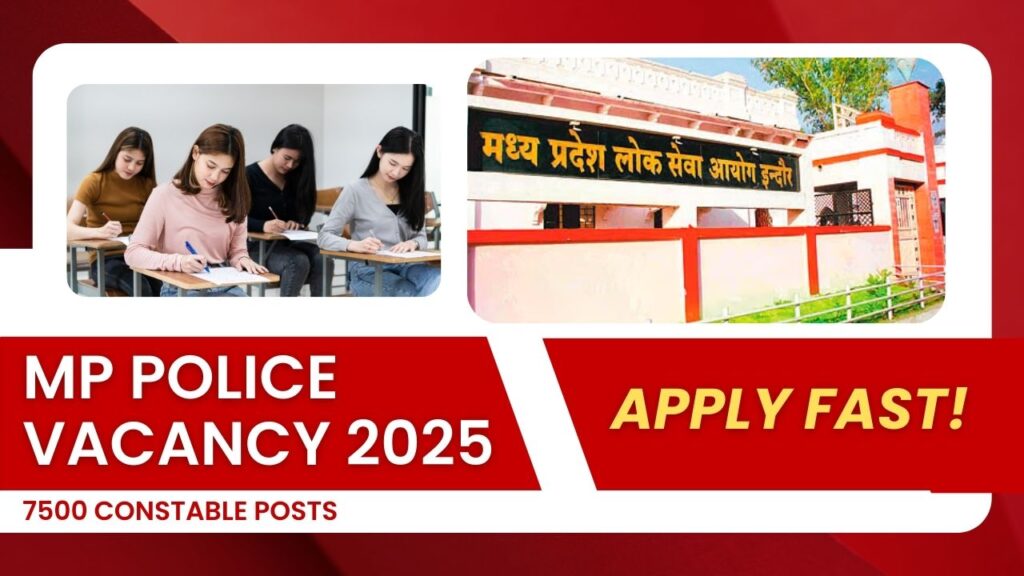
Candidates can fill the application form of MP Police Vacancy 2025 for Constable posts. Candidates will apply online until the last date of submission. You can download the official notification to check every detail according to this selection. There are several vacancies around 7500 that will be filled through this selection process. Please check the eligibility criteria and age limit before applying for the constable post (General Duty).
Candidates must be physically fit and have no health issues because after the written examination you are summoned for the physical and medical test. It is mandatory to pass these tests for the job role.
MP Police Vacancy 2025 Highlights and Important Dates
Organization
Madhya Pradesh Employee Selection Board
Post
Constable
Number of Vacancies
7500
Last date of Application
29th September 2025
Selection Process
Written Exam → Physical → Fitness Test Medical Test
Instructions to Fill The MP Police Constable Application
Before applying for the MP Police Constable Bharti in 2025, candidates should know the instructions and eligibility criteria. This application will register your name for the examination that will happen in October. You will get selected after clearing this examination and then you are summoned for the next procedure.
Let’s read this instruction to apply online:
Visit on the official website where the link of the application is open.
Click on that link and add your details in the form that appears on your screen on MPESB website.
Attach your valid documents with the application form and click to submit.
Before the final submit, check all the filled details of yours to make sure everything’s correct.
Save the copy of the application for your future reference.
Agniveer Answer Key 2025 : The Agniveer Answer Key has now been released by the Indian Army under the recruitment process for Agniveer General Duty position. This is a common Entrance test for the Agniveer Posts which exams held from 30-June-2025 to 3 July 2025. Candidates who wish to work in uniforms can apply for this post. Be prepared to see the answer and download it to compare your answers. The link will be provided soon for the answer key once it activate on the official website. This recruitment has various roles in the armed forces, you have to check the eligibility criteria for each post in the official notification. Physical strength is necessary for these jobs, that is why a physical test is a mandatory test in the selection process.
Highlights for the Agniveer Post 2025
Exam
Agniveer Exam
Conducting Body
Indian Army
Exam Purpose
Candidates who aspire to join the armed forces as Agniveers are recruited by this exam.
Selection Process
Written Test, Physical Fitness, and Medical Fitness
If you are an agriculture graduate from UP and want to grab a secure government job, then UPSSSC Agriculture Technical Assistant Preparation is crucial to get this golden opportunities. With 3,446 posts announced recently in the recruitments, this Group-C job with the Department of Agriculture not only offers you secure job in India’s largest state but also a meaningful work in serving the farmers of the state.
But here is the reality check: clearing this exam is not just about being B.Sc. The competition is stiff, the syllabus is vast and the exam pattern itself has some quirks that can take you by surprise. Having reviewed the new notification and strategies adopted by the successful candidates, I have tried to make this guide exhaustive to help you in your preparation journey.
Are You Qualified?
You must fulfill the UPSSSC Eligibility Criteria to apply for the UPSSSC. As on the date of notification, your age should be 21 years to 40 years. But the SC/ST/OBC candidates are allowed to get the relaxation on age as per the rule of the state government. Applications received from ineligible candidate(s) will be rejected, so check your eligibility before applying.
Degree: Graduation in the Agricultural field is required as your knowledge is beneficial for a job. It must come from a recognized university or college.
List of course are good choice for your degree:
B.Sc. (Hons.) Agriculture
B.Sc. Horticulture / B.Sc. (Hons.) Horticulture
B.Sc. Forestry / B.Sc. (Hons.) Forestry
B.Tech (Agriculture Engineering)
B.Sc. (Hons.) Science from a University of Agriculture and Technology
The PET catch: Since 2022, UPSSSC has made the UP Preliminary Eligibility Test (PET) mandatory for every candidate to pass this exam with required score then applying for any main exam of AGTA.
Exam Pattern Decoded
There are no multiple phases for the AGTA, you just have to clear this one and the powerful UPSSSC Agriculture Technical Assistant recruitment exam with document verification and grab your chance for a government job.
Total Questions: 100 objective-type MCQs
Total Marks: 100
1 Question = 1 Mark
Duration: 2 hours
For incorrect answer, ¼ mark will be deduct
This marking system indicates that you need accuracy in your answer rather than attempting.
Subject-wise Distribution
Subject
Questions
Marks
Crop Science
25
25
Biotechnology, Plant Breeding & Crop Physiology
10
10
Soil & Water Conservation
15
15
Agriculture Extension
5
5
Agriculture Economics & Schemes
5
5
Dairy & Animal Husbandry
5
5
Computer Concepts & IT
15
15
General Information of Uttar Pradesh
20
20
TOTAL
100
100
What You Actually Need to Study
Part 1: Core Agriculture (65 Marks)
Crop Science involves the Study of various cereals, pulses, and oilseeds and also covers modern agricultural practices such as integrated, natural and organic farming. So you have to know about seed production, about pest management, about post-harvest technology and storage systems. Let’s get real—what is a field officer going to tell farmers?
Biotechnology & Plant Breeding covers Genetics Concepts, Photophosphorylation, Respiration, and Plant Metabolism. ISE don’t memorize definitions; actually understand what biotechnology is and how it works, and how it’s used in agriculture now.
Soil & Water Conservation involves Master soil properties, erosion control, fertilizer classification, irrigation, and watershed management.. I think the 15 questions are generally easy if you have your basics clear.
Agriculture Extension covers rural development concepts, farmer’s schemes issued by the Government, and training methods. This ties right into what you’re doing in your future job.
Agricultural Economics has MBA contents such as MSP (Minimum Support Price) of various Crops, Agriculture commodities trading, import-export strategies and UP’s One Trillion Economy plan. Be a regular user of agri policies.
Dairy & Animal Husbandry includes a lot of practical training but what’s the right way to do Animal Breeds, Feed management, Milk production, Poultry farming, Diseases management. Even if you were a crop science major, don’t sleep on this 5-mark question.
Part 2: Computer and IT (15 Marks)
This isn’t just basic computer know-how anymore. The syllabus cover crucial IT related questions which means you need study hard:
It involves from Hardware, software and operating system to MS Word and MS Excel operations
Internet Protocol and Email Management
Digital financial instruments and e-Governance
New technologies – AI, Machine Learning, Big Data, IOT and India’s IT feats
You don’t have to think that new technologies are not needed, the first rule for the tech engineer is opting for new technologies every year. So, AI and Machine Learning are now part of an agriculture exam. The UPSSSC needs officers with a flair for technology who can put traditional farming together with digital India.
Part 3: UP General Knowledge of 20 marks
To succeed in this field, one should have deep knowledge of history, culture, art and architecture of Uttar Pradesh. A good understanding of its physical geography with its climatic differences, soil groups, forest, wild life and mineral resources, will be found helpful.
Also, a good knowledge of the state economy in terms of agriculture, industry and commercial conditions is essential. Keeping abreast with the day’s news and the work of the state government you shall further enrich yourself and make yourself even more capable.
Selection Process
After clarifying the written test, candidates need to verify their documents (ID, Marksheets, DOB certificate, etc). The written test passing score is depending on your category. Final merit list will be made upon these scores not on interview as there is no interview.
Crop Science and Soil Science is a very important part as they hold maximum marks in the exam. So, prepare well with understanding, not rote learning. BSc notes and NCERT agriculture textbooks are very helpful as resources for your study.
After clearing your basics, dive deeper with “A Textbook of Agricultural Field Crops” by V. Venkataraman to prepare for the Crop Science subject.
And “Soil Science” by D.K. Das is a perfect option for Soil Science.
Many students recommended “Uttar Pradesh General Knowledge” by Dr. C.L. Khanna for increasing UP knowledge.
Try Youtube or free resources online to learn about Computers assets and other new techs related to the agriculture field.
The last Months 4-6 is given for the Practice & Revision of previous year papers for making a speed to solve fast in the exam. Weekly mock tests are best for your preparations. Everything is available on the internet, so do not stress about the resources. To avoid mark deduction, master to Maintain an error log.
There is a strategy and of course general scoring strategies are applicable too that candidates must follow to win in this agriculture based exams. What several candidates tend to miss is the fact there are non-agricultural parts like Computer (15 marks) and UP GK (20 marks), which have a big weightage of marks. Disregarding these can drastically hit your overall results.
How to approach the Stage II exams, Time Management is very helpful for Effective preparation. Although two hours is more than enough time, candidates often find themselves stuck on difficult questions, for instance in biotechnology, with not enough time left at the end to tackle items such as UP GK. so that way you can avoid that.
Also, academic knowledge from one’s degree is no place to rely on. The focus is not on theoretical understanding, but on practical application and problem-solving at field level.
Before you start preparing for the AGTA exam, you must be aware that you must meet all the eligibility requirements (like qualifying the PET) for the same. Non-compliance of such requisites may result in jeopardizing a candidate’s whole preparation and risk that nothing has been achieved in all those years toiling. A complete scan of the eligibility dates is hence highly recommended to avoid any last minute surprises.
Conclusion
The UPSSSC Agriculture Technical Assistant is one such post which will help in this regard. The active UPSSSC Agriculture Technical Assistant Recruitment 2026 Advertisement is a good opportunity for the job seekers. You should go for 6-8 Months UPSSSC Agriculture Technical Assistant Preparation to increase your chances of selection and should Follow the Syllabus Strictly. Your position on the merit list can be decided by the marks obtained. Get started on your preparation now with full dedication and consistency to get success in this very competitive selection.
Imagine being the silent crusader for every correct diagnosis, working your magic inside blood samples, body fluids and tissue slides to find secrets that physicians need to know to save lives. That is the magic of BSc Medical Laboratory Technology (MLT). If you are scientific, you love precise work, and want a solid and stable career in health care, but don’t want the frenetic pace of working directly with patients, this degree could be just right for you.
In India, where healthcare is booming, MLT professionals are highly sought after. So, here we go through all you need to know to be able to dig in to this sleeper powerhouse discipline.
What is BSc Medical Laboratory Technology (MLT)?
The BSc MLT course is basically a three years long undergraduate course (six-month internship in some colleges) which is designed to make you a medical lab technologist. You’ll learn the art and science of analyzing body fluids, tissues, cells and microbes in clinical laboratories. Consider it detective work in a white coat: gathering samples, running tests on machines such as microscopes, analyzers and polymerase chain reaction (PCR) units, and producing results that influence treatments for everything from infections to cancer.
The curriculum is a mix of biology, chemistry and technology.
Year 1 involves Fundamentals such as human anatomy, physiology and biochemistry.
Clinical microbiology, hematology (study of blood), and immunology by year 2.
The final year is a rush with supplements such as histopathology (study of tissues), blood banking and molecular diagnostics. Practical laboratory sessions constitute 40-50 per cent of the course, so prepare for a lot of practicals.
The best of institutions like AIIMS Delhi, Manipal University, Jipmer Pondicherry provide it with world class facilities, often including certification in lab automation.
Who Can Jump In? Eligibility and Admission Scoop
You are considered eligible if you have obtained at least 50% in Physics, Chemistry, and Biology (PCB) from a recognized board – relaxed to 45% for reserved categories. Most private colleges don’t require NEET, while government ones may require state-level exams like KCET or MHT-CET. Most private unis are merit-based or have their own tests.
The admission season is followed after 12th boards, May-July. Apply online on the college portals– application fees range between Rs 500 to Rs 2000. Pro tip: Create a beachhead profile with science projects or volunteer work in labs; it shines in interviews.
Fees, Scholarships, and ROI
Cheap but really beneficial—that’s BSc MLT for you. The fee of government colleges range around 10,000–50,000 per year, so the total fees of the course would be approximately 30,000 — 1.5 lakh.
The cost of private colleges is high and ranges between 1–3 lakh per year (rough 3–9 lakh in total). 4-5 lakhs can be charged by the top class institutes such as Symbiosis, Pune. In the range of ₹50,000 — ₹1 lakh per annum will be your hostel and books additional cost.
Scholarships reduce the burden: Post-Matric for SC/ST from the State and Central government, merit scholarships from AICTE.
Most of the institutions have 20-50% waivers for the toppers. ROI is stellar, starting salary ₹3-6 LPA, scaling to ₹8-15 LPA in 5 years. Compare that with the cost of the course, and it’s quite a smart bet.
Skills You’ll Gain From BSc MLT Course
This isn’t just book learning, it’s skill-building gold. You’ll learn phlebotomy (blood drawing), use high-tech equipment such as flow cytometers, learn quality control and even bioinformatics for genetic testing.
Soft skills: Accuracy, good attention to detail, and ethics required—there is potential for misdiagnosis if a single mistake is made.
A day in the life: Mornings are often spent collecting samples, then running tests such as CBC, ELISA, and cultures. The position also requires calibration of instruments and result reporting via LIS software.
Hospital shifts can be demanding (8–12 hours), whereas diagnostic labs usually provide ordinary 9 to 5 hours office-based positions.
Graduates are not left in labs for eternity. 70% of alumni are hired as lab techs or supervisors (₹25k-50k/month in the beginning) by hospitals (Apollo, Fortis).
₹30k-60k work offer with diagnostics like Dr. Lal PathLabs or Metropolis.
Government jobs through ssc, esic or state health services are also there with a good package of ₹35k+ along with benefits, crack exams ssc, junior paramedical.
So what about Advanced options?
You may select from choices such as MSc MLT, PGDM in Hospital Management, or a PG Diploma in Cytotechnology, Histopathology or Forensics. A Salary of ₹10–20 LPA is possible. On the international front, the US and Canada are among the top seekers of certified MLTs. Professionals are able to make $50,000 or more per year by passing the ASCP exams.
Career Role
Avg Starting Salary (₹ LPA)
Top Employers
Lab Technician
3-5
Hospitals, Clinics
Medical Lab Supervisor
5-8
Diagnostic Chains
Blood Bank Technologist
4-6
Red Cross, Govt Hospitals
Research Associate
4-7
ICMR, Pharma Cos
Quality Control Analyst
5-9
Biotech Firms
Challenges and the Bright Side
There are also challenges including long hours, exposure to biohazards (so the right PPE is the must), and having to keep pace with new technology, including AI-driven diagnostics. But the advantages are clearly more than the disadvantages.
The fact that healthcare jobs are expanding rapidly (at about 15% each year, according to NITI Aayog), private labs provide a superior work-life balance, and the soft assurance that your work really helps people, even if it’s behind the curtains.
Conclusion
In a society that worships doctors and nurses, BSc Medical Laboratory Technology (MLT) is the silent force behind 70% of medical decisions. If you are detail oriented, love science, and want to future proof your career, then go for it. India’s healthcare industry requires an additional two million laboratory professionals by the year 2030, your spot awaits.
Check NAAC-accredited colleges and start prepping. This degree is more than just a credential, it is the key to a fulfilling life that is recession-proof in healthcare.
RRB RPF New Vacancy Notification 2026 is still not released yet but it will come soon. Candidates who wanted to apply for RPF Constable post should check the official website for the official notification regularly to not miss the details and date for application form. 8000+ vacancies are expected to be released in this recruitment drive.
But before applying for this post, interested candidates must know every detail from educational qualification to selection process. Understanding these details will help you prepare to crack the examination and secure your position.
Major Change For RPF Constable Recruitment 2026
Railway Recruitment Board (RRB) was conducting RPF Constable recruitment for years but now the conducting is changed. The examination taken under the Staff Selection Commission (SSC) authorities.
RRB RPF Constable 2026 Breakdown
Job Profile & Duties
Maintaining law and order on the train and railway station to keep the passengers and railway employees safe. There’s different types of violent people — thieves, killers, attackers and keeping the normal public safe from them is RRB RPF Constable duty.
Not only people, but the system also should work smoothly without interruption, collecting information, and tracking railway security issues also comes under RPF Constable responsibility.
This is not a 9 to 5 scheduled job, it’s a field job with an attentive mind. Controlling and maintaining the most crowded place in India is not that easy. Whether you are on the patrolling duty on the station or responding to emergencies, you will face new challenges everyday.
Eligibility Criteria
Criteria
Details
Nationality
Indian Citizen
Education
10th Pass / Matriculation from a recognized board
Age Limit (General)
18 to 25 years
Age Relaxation Category-Wise
Category
Age relaxation
SC / ST
5 years
OBC-NCL
3 years
Ex-servicemen
Service period deducted, plus relaxation as per category rules
Widowed OR divorced women
2 years for UR/EWS, 5 years for OBC-NCL, 7 years for SC/ST
Central govt employees with 3 years regular service / J&K domicile special case
5 years for UR/EWS, 8 years for OBC-NCL, 10 years for SC/ST
Physical standards
Category
Male height
Female height
Male chest
UR / OBC
165 cm
157 cm
80 cm unexpanded, 85 cm expanded
SC / ST
160 cm
152 cm
80 cm unexpanded, 85 cm expanded
Exam Pattern (CBT)
You have to finish the 120 questions that come from Arithmetic, Reasoning, & General Awareness within a given time. Practice mock tests daily to maintain your accuracy and speed for finishing the paper in 90 minutes. But your answer must be accurate because if not, 1/3rd marks is going to be deducted for each wrong answer.
Subject
Questions
Marks
General Awareness
50
50
Arithmetic
35
35
General Intelligence & Reasoning
35
35
Total
120
120
PET pattern
PET includes sports in which your body endurance will be measured like 1600 m run for men and 800 m run for women. The exam is not hard if you practice daily for 1 hour, the exam also consists of high jump and long jump.
Task
Male
Female
Run
1600m in 5 min 45 sec
800m in 3 min 40 sec
Long Jump
14 feet
9 feet
High Jump
4 feet
3 feet
Selection Process
This is not a single-stage process, the selection process for RPF Constable 2026 has three stages to pass by the candidates.
First stage: Computer Based Test in which your knowledge is tested through an exam. The questions come at 10th class difficulty level from Math, General Knowledge, and Logical.
Second stage: You will be called for the second stage if you clear out the first stage with a good score. Candidates get only one chance to clear the PET & PMT.
Third stage: After passing these two stages, shortlisted candidates based on merit are called for document verification.
After DV, candidates
RPF Constable 2026 Application Process
RPF Constable 2026 application will be available on the official site of RRB or SSC soon.
Visit the site and register yourself.
Remember that credentials to login again and fill the form.
Education qualification, personal details, and ID document will be uploaded along with the application in which you have filled these details.
Continue to submit with the requisite amount of fee then download the application form for proof.
RPF Constable Salary & Allowances
RPF Constable Salary is under Level 3 of the 7th CPC, so the basic pay is ₹21,700 per month which increases additional allowances such as DA, HRA, and Transport Allowance.
City Class
Monthly In-Hand Salary
Class X (Metro — Delhi, Mumbai, Kolkata)
~ Rs. 39,000
Class Y (Mid-size cities)
~ Rs.37,420
Class Z (Small towns/villages)
~ Rs. 32,766
RPF Constable Career Growth & Promotions
Candidates who are in the Constable position can get a senior role as Head Constable then apply for Assistant Sub-Inspector (ASI) through departmental examination but most of the constables get promoted after years of experience.
The highest positions are Sub-Inspector (SI) and Inspector where your salary also increases and you get other perks but overall responsibilities are also increased as of the senior post.
Candidates not getting immediate promotion like in the private sector but they will get promoted based on their years of service, qualifying departmental exams, and Consistent performance appraisal.
Constable get their salary increases over time after 3 or 5 years on the same service. They also provide continued training to polish your skills.
RRB RPF Constable 2026 is an excellent opportunity for candidates who want to build their career in the government sector and have a bright future along with providing respect and security in their life. From safeguarding railway passengers to ensuring law and order within one of the world’s biggest railway systems, the position carries a big responsibility and pride.
RRB RPF New Vacancy Notification 2026 will be released soon by RRB for recruitment of Male and Female candidates. Now you must aware about the RRB RPF exam pattern which includes different stages exam pattern to complete analysis of the examination. With proper guidance and determination, getting selected as an RPF Constable can be a stepping stone to a flourishing career in railway security.
The application process for PFRDA Grade A Recruitment 2025 ends on 6th August 2025.Fill out the form before the last date of application. The portal is open on 23rd June 2025 to apply online and the link will activate soon. Official notification has been released, you can download it through the link mentioned in the article. A total of 20 vacancies for the Assistant Manager which you can apply for. If you are willing to build your career in the government sector, it is time to fill out an application on the official website.
Pension Fund Regulatory and Development Authority selects candidates through a 3-stage selection process. Candidates should pass the Preliminary exam (1st stage), Main Exam (2nd stage), and Interview (3rd stage). Those candidates who clear out these three stages will be selected for the Assistant Manager Post.
Post Graduation in any relevant subject, Graduate in Law/Engineering from any recognized board, ACA/FCA from ICAI, ACS/FCS from ICSI, CFA from the institute, OR ACMA/FCMA from ICMAI
Information Technology
UG with Engineering (cs, electrical, electronics), PG with Computer Application, UG with any discipline + PG in CS/IT, OR UG/PG/Diploma in AI & ML
Finance & Accounts
UG with ACA/FCA from ICAI, ACS/FCS from ICSI, CFA from CFA institute, ORACMA/FCMA from ICMAI.
Research (Statistics)
Post Graduation in Finance/Economics/Statistics
Research (Economics)
Post Graduation in Statistics/Economics/Commerce
Actuary
Bachelor’s in Core subjects of Actuaries of India examination
Legal
Graduation in Law from any recognized college.
Official Language
UG & PG with Hindi, English OR Mater’s in Sanskrit/Economic/Commerce with Hindi as a subject at Bachelor’s level from any recognized college.