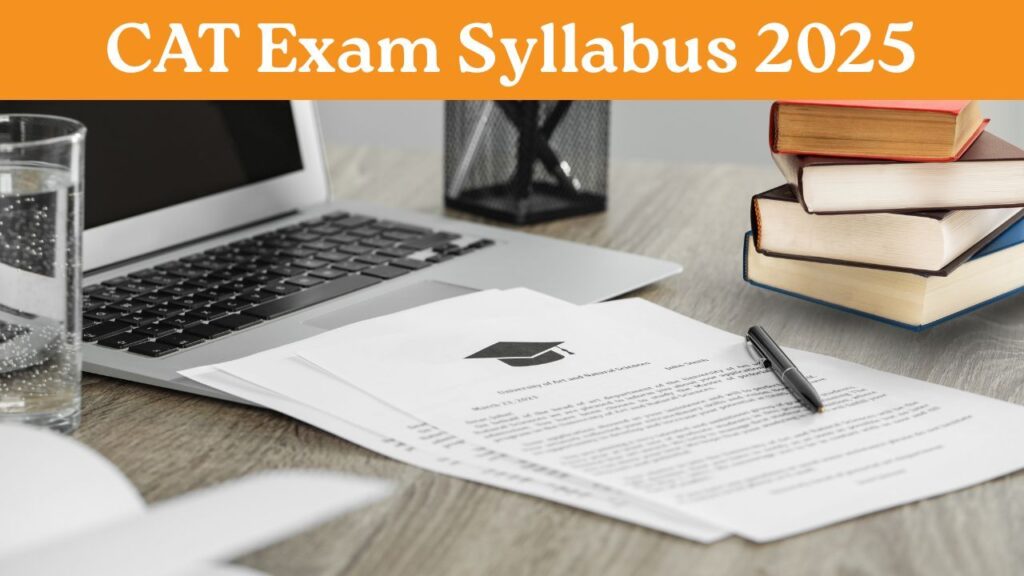
CAT Exam Syllabus 2025: Complete Section-Wise Guide to Crack the Test

The Common Admission Test can open the doors for India’s most prestigious colleges. Students get stressed with the syllabus most of the time and get confused, so it is important to know the CAT exam syllabus 2025 section-wise. This can help you understand the important topics that must be considered prior while preparing. The powerful strategy to prepare for any competitive exam is according to exam pattern. Read the full article to assess this knowledge which can help you beat the CAT exam. 

It’s not about a lot of time and resources, just the right planning to assess important knowledge is required. Whether you are an average student or brighter one but CAT is not that simple as you think. Masters from top colleges matter in your placement. If you really want to take admission in an MBA or other postgraduate program, you need to clear the CAT exam.

Exam Pattern Overview

CAT is conducted online through a computer-based test format. The total 68 questions come in the examination which get distributed into three sections. This 120 minutes exam carries 204 marks to decide your future in your education journey. However 40 minutes is given for each section with +3 marks if the answer is correct but negative marking of -1 for each wrong answer. There’s no negative marking for TITA (Type In The Answer) questions.

Section-wise Distribution

Verbal Ability & RC carries 72 marks for 24 question
Data Interpretation & Logical Reasoning carries 66 marks for 22 questions
Quantitative Aptitude carries 66 marks for 22 questions

Section 1: Verbal Ability & Reading Comprehension (VARC)

This section covers 36% of the paper. It focuses on RC more than grammar means 16 questions come from the Reading comprehension so it covers 66% of VARC section. While Verbal ability covers 33% of the section. The reading comprehensive features 4 passages with 4-5 questions per passage. The topic in these passages is almost relevant to niches like economics, psychology, literature, and current affairs. 

Verbality Ability comprises 8 questions From:

  • Para summary question
  • Para jumbles 
  • Odd sentence out
  • Sentence completion tasks

Section 2: Data Interpretation & Logical Reasoning (DILR)

This section 32% of the exam paper and considered most unpredictable questions come from the Data Interpretation & Logical Reasoning section. While the questions are in the sets of 3-4 questions, making it difficult to solve easily. 

Topics of Data Interpretation & Logical Reasoning questions:

Data InterpretationLogical Reasoning
Tables and charts analysisPuzzles and arrangements
Bar graphs and pie chartsSeating arrangements
Line graphs and scatter plotsBlood relations and family trees
Caselets with numerical dataCoding-decoding problems
Syllogisms and Venn diagrams

Section 3: Quantitative Aptitude (QA)

Quantitative aptitude holds 32% weightage in the paper. It covers Arithmetic and Algebra topics, making it the hardest section. 

Topics of Quantitative Aptitude Questions

Arithmetic (8-9 questions)Algebra (5-7 questions)Geometry (2-3 questions)Modern Mathematics
Ratios and ProportionsLinear equations and inequalitiesCoordinate geometryPermutations and combinations
Percentages and their applicationsQuadratic equationsMensurationProbability
Profit, Loss, and Simple/Compound InterestFunctions and graphsTriangles and circlesLogarithms and surds
Time, Work, and Distance problemsProgressions and series
Mixtures and Allegations

Topic-wise Weightage Analysis

Highest Priority Topics:

Reading Comprehension16 questions
Arithmetic8 questions
Algebra5-7 questions
Puzzles & Arrangements8-10 questions

Medium Priority Topics:

Data Interpretation8-9 questions
Geometry3 questions
Verbal Ability8 questions

Lower Priority Topics:

Modern Mathematics2-3 questions
Number Systems1-3 questions

Effective Preparation Strategy

Preparing for the CAT isn’t that easy but with right strategy planning you can clear out the exam. There is no need to rote memorization because these subjects require focus and proper time to understand every concept. 

CAT needs comprehensive preparation with proper time duration like 6 to 9 months. Know your weaknesses, so you can distribute your time more on that topic. Divide all three sections with specific duration to complete your preparation properly.

Read More 👉 Best BCA Data Science Colleges in Chennai for a Future-Ready Career

Daily Practice Target

  • Deep analysis and carefully 2-3 Reading comprehension daily is important
  • Solve 2-3 sets of Data Interpretation and logical reasoning to understand and filled in your brain
  • Daily solve at least 15-16 questions from the quantitative aptitude section. Try to solve easy problems first then go to the hard topics.

Mock Test Strategy

After preparing for 2 months, get ready to take mock tests section-wise and extend your mock test practice before the exam. Because analyzing every question helps you keep remembering the concepts and maintain your confidence.

Resource Selection

Choose online resources to prepare fast because the latest notes and mock tests can help you a lot during preparation for the CAT exam. Stick to single quality resources, don’t switch every time and focus on concept clarity rather than multiple resources and question papers. 

Conclusion

Success in CAT requires strength, strategic preparation, and daily practice for clearing every doubt. Focus on high priority topics first then move on the medium priority to balance every section easily. Remember that quality study is more helpful to clear the exams rather than a lot of study material and wasting time on unnecessary topics. So, it is important to prepare according to the CAT exam syllabus 2025 section-wise for best outcome.

Leave a Comment

Your email address will not be published. Required fields are marked *

How to Take Admission in Delhi University in 2025 – Full Process Explained!

How to Take Admission in Delhi University

Delhi University is a great university for UG, PG and doctoral programs which attracts thousands of candidates from all over the country. If you are planning to take admission to the most popular university then you must know about the admission process. So, here’s a guide for you which helps you get ready for the procedure.

DU offers a plenty of programs for Arts, Science, and Commerce students. First, know your interest that aligns with the future goal. It will help you select the field of study and decide which program you have to take admission. Admission process is same but eligibility criteria and cutoff marks is different on most of the programs.

DU offers multiple courses in every stream through the entrance exams for the particular field. So, score well in exams to get a admission in Delhi University, here are the following exams: 

  • CUET Examination

DU offers UG courses such as BA, B.Com, B.Sc, BBA, MA, MCA, M.Sc, and B.Ed through the Common University Entrance Test.  

  • JEE Main

Candidates who are willing to take admission in the Engineering programs such as B.Tech have to appear in the JEE examination.

  • CAT Examination

DU offers an MBA program through the CAT examination, you must appear in the examination and score well in that to get an admission.

  • CLAT Examination

For LLB and LLM programs, candidates have to pass the CLAT exam.

  • UGC NET/CSIR NET/NTA 

These are the examinations for admission in PhD.

Candidates must have cleared the entrance exam for their courses then register for CSAS. Its full form is Common Seat Allocation System and this is the stage where you have to fill your college preferences and courses.


This round takes time because it’s a lengthy process, seat allotment based on your scores of the entrance exam, preference you fill, and category you belong to. Seat availability is critical in some cases, you can freeze your seat if you are satisfied with the given seat or wait for the next round.

Once you freeze the seat which is offered by the university. Your admission is confirmed after your acceptance. 

Read More 👉 Top 10 MBA Colleges in Lucknow You Shouldn’t Miss in 2025

Check your eligibility for the particular program you are choosing to take admission. For UG courses you must pass 12th class, for PG courses, it requires a graduation marksheet. Admission in PG courses may require a CUET PG score.

  1. Visit the official website of DU
  2. Search for the SOL admission portal, when you click on that the registration page will appear then click on the registration link.
  3. Enter your information in the form carefully to complete the registration.
  4. Log in with your registration number and password.
  5. Fill out the rest of the details with correct information to further proceed.
  6. Carefully fill in the details, so it cannot be incorrect.
  7. Attach the required documents required for the application in your admission.
  8. Submit application fee then download the copy.
  9. You can check application status from your account.

DU offers plenty of programs for students to study higher education. DU offers programs in streams like Arts, Science, Commerce, Management, Law, and Engineering. The admission in these streams through their entrance exams respectively.

If you are a working professional, parent, or any other responsibilities, you can pursue degrees such as BA, B.Com, MA, M.Com, and M.Sc without any entrance exam. SOL is beneficial for most of the students who can’t attend the college regularly due to any reason. 

NCWEB is designed specially for women who cannot attend full time courses due to responsibilities, work, or any other reasons. Women who prefer weekends or evening classes to complete their education can take admission but it happens through merit score. 

Students who want specializations in any field can also think of Delhi University as the best option for them. The various fields of specializations which DU offers are – English, Hindi, Economics, and Political Science, Physics, Chemistry, Mathematics, Law, and Management.

Delhi University primarily takes students through entrance exams but there are certain programs and modes of study where students can take admission without appearing in the entrance exam. 

SOL – It is designed to provide education for students who cannot attend the regular classes due to work, distance, or any other reason. SOL offers many UG & PG programs without an entrance exam.

CoursesAdmission processMode
BA, B.Com, MA, M.Com, M.ScAdmission is based on MeritDistance education

Some UG Courses based on Merit – DU affiliated colleges are offering some UG programs like B.Com, BA, and many other courses without an entrance exam.

Read More 👉 Top Government Jobs After MBA | Best Careers 2025 Guide

Course NameWho Can Apply?How Selection Happens?
BA OR BA (Hons)10+12th from any stream  (50% score minimum)Through CUET UG + CSAS Counselling
B.Sc OR B.Sc (Hons)10+12th (50% score minimum) in science streamThrough CUET UG + CSAS Counselling
B.Com OR B.Com (Hons)Passed 12th (50% score minimum) in commerce streamThrough CUET UG + CSAS Counselling
B.Tech Passed 12th with PCM, minimum 60% marksJEE Main + JAC Counselling
BA LLB / BBA LLBAccomplish 12th or equivalent (50% score minimum) CLAT UG + CLAT Counselling
BBA10+12th or equivalent (50% score minimum) Through CUET UG + CSAS Counselling
B.El.EdAccomplish 12th or equivalent with 50%Through CUET UG + CSAS Counselling
BFAAccomplish 12th or equivalent (45% score minimum)Through CUET UG + CSAS Counselling
B.Lib.I.ScAccomplish 12th or equivalent (45% score minimum)Through CUET UG + CSAS Counselling
Course NameWho Can Apply?How Selection Happens?
MABachelor’s degree (50% score minimum)CUET PG + CSAS Counselling OR Merit-Based
M.ComB.Com/B.Com (Hons) (50% score minimum)CUET PG + CSAS Counselling
M.ScB.Sc in relevant subject with at least 50% marksCUET PG + CSAS Counselling
MBABachelor’s degree in any discipline CUET PG + Group Discussion & Interview 
MCABCA or equivalent degreeCUET PG + CSAS Counselling
B.EdGraduation degree (50% score minimum)CUET PG + CSAS Counselling
LLBUG OR PG degree in any with at least 50% marksCUET PG + CSAS Counselling
LLMLLB (3-year or 5-year) (50% score minimum)CUET PG + CSAS Counselling
M.TechB.Tech/BE in relevant field (60% score minimum)CUET PG + CSAS Counselling
M.EdB.Ed/B.El.Ed or equivalent (60% score minimum)CUET PG + CSAS Counselling
Points Details
Who can apply?– Master’s degree (55% score minimum) marks – 5% relaxation for reserved category
How do you get selected?First Option  – Through UGC-NET, UGC-CSIR NET, DBT-JRF, ICMR-JRF, once you pass this, you can appear directly for an interview.Second Option  – You must appear for the CUET-PhD entrance test. If you don’t want to take the first option.  – Next step for selected candidates is an interview.  – Everyone (including exempted candidates) must attend the interview.
What happens after selection?– Merit list is prepared based on entrance and interview performance.- Selected candidates must verify original documents in person at the department.- Seats are filled as per department’s decision and university norms.
Other important points– Final subject relevance is decided by the Departmental Research Committee (DRC).- No PhD through distance mode at DU.

Leave a Comment

Your email address will not be published. Required fields are marked *

CBSE Group A, B & C Admit Card 2026 Download Link, Exam Date

CBSE Group A, B & C Admit Card

Central Board of Secondary Education (CBSE) is going to hold the Group A, B & C Tier-1 examination for various posts including Racing Officer, Assistant Secretary, Assistant Director, Accounts Officer, Junior Translation Officer, Junior Accountant, Junior Assistant, Assistant Professor and Superintendent. From 31 January 2026 To 01 February 2026. Candidates who will qualify the examination will be recruited for these posts as per the final result to be declared by CBSE. 

In December 2025, the application form was filled and candidates who are waiting for the exams can now check their admit card. If the link is still not open then check again after a few hours on the official website of cbse.nic.in

To download these, candidates will need the Application Number and Date of Birth. And no need to carry the exam hall ticket after downloading it for the exam. 

CBSE Group A, B & C Important Dates

EventDate
Notification Date02/December/2025
Application Start02/December/2025
Apply Online Last Date27/December/2025 (Extended)
Fee Payment Date27/December/2025
Correction Date29 & 30/December/2025
Exam City Date (Tier-1)17/January/2026
Admit Card Date (Tier-1)Before Exam
Exam Date (Tier-1)31/January/2026 to 01/February/2026
Result DateNotify Later

CBSE Group A, B & C Recruitment – Age Limit

CriteriaDetails
Minimum Age18 Years
Maximum Age27 / 30 / 35 Years (Post-wise)
NoteFor detailed age relaxation rules, read the official CBSE Notification 2025

Group A Posts – Vacancy & Eligibility

Post NameVacanciesStudy
Assistant Secretary08Undergraduate Required
Assistant Professor & AD (Academics)12PG Degree (55% marks) or equivalent from a recognised university (category-wise relaxation applicable)
Assistant Professor & AD (Training)08PG Degree or equivalent from a recognised university
Assistant Professor & AD (Skill Education)07PG Degree or equivalent from a recognised university
Accounts Officer02Graduate/postgraduate in Economics, Commerce, Accounts, Finance, Business Studies or Cost Accounting or any other professional qualification like MBA (Finance), CA, ICWA. 

Group B Posts – Vacancy & Eligibility

Post NameVacanciesStudy
Superintendent27Bachelor’s degree in any discipline having basic knowledge of computer and typing speed 35 WPM in English or 30 WPM in Hindi. 
Junior Translation Officer09PG Degree in Hindi or English or equivalent

Group C Posts – Vacancy & Eligibility

Post NameVacanciesStudy
Junior Accountant16Intermediate Marksheet; Necessary Subjects including Accountancy / Commerce / Economics / Business Studies / Finance with good typing speed
Junior Assistant35Intermediate Marksheet; speed of typing should be 35 WPM in English or 30 in WPM in Hindi. 
CategoryGroup A PostsGroup B & C Posts
Gen / OBC / EWS₹1750/-₹1050/-
SC / ST / ESM / PH / All Female₹250/-₹250/-
Total Posts124

Read More 👉 RBI Bank Office Attendant Recruitment 2026: Notification, Apply Online & Details

CBSE Group A, B & C Admit Card 2026 Download 

How To Download Your CBSE Group A, B & C Admit Card 2026?

1. Visit the official CBSE website or tap on the direct link given below.

2. Search and click on the link for CBSE Group A, B & C Admit Card/Hall Ticket 2026 Download.

3. Fill in your Application Number and Date of Birth in the given column.

4. Press “Submit”.

5. Your admit card will be displayed on the screen. Save it or take a print out for future reference.

6. Bring with you a hard copy of your admit card and a valid photo ID when you appear for the examination and submit the same at the examination centre. 

Apply nowClick Here
Admit CardLink Activate Soon
Official WebsiteClick Here

Leave a Comment

Your email address will not be published. Required fields are marked *

UPSSSC Excise Constable Recruitment 2026 Complete Guide to Prepare Early

UPSSSC Excise Constable Recruitment 2026 you are one who desires an opportunity to serve in a conservative but respectable and challenging government job in Uttar Pradesh, then this might very well be the dream you were waiting for. Uttar Pradesh Subordinate Services Selection Commission Notification: Uttar Pradesh Subordinate Services Selection Commission (UPSSSC) has released the notification for Excise Constable (Abkari Sipahi) Recruitment 2026 on 6th April 2026 — a ray of hope for thousands of job seekers. 

There are a total of 722 posts in this recruitment which gives an opportunity to eligible and aspiring candidates to join a prestigious organization like Excise Department of Uttar Pradesh. If you are a first time user of government job portals, you must be aware that having a complete knowledge of the recruitment process is very important. 

Let’s go deep into the every information you should know about this most expecting recruit – Important Dates, Eligibility, Physical Standards, Exam Pattern. 

Overview of the Recruitment

The Uttar Pradesh Subordinate Service Selection Commission (UPSSSC) recruits for the office of the Excise Commissioner, U.P., Prayagraj through its examination. There are 722 posts in all in the General and Special Recruitment category under both the heads. The following is a small report on the distribution of these vacancies: 

CategoryTotal
Unreserved (UR)246
Other Backward Classes (OBC)215
Scheduled Castes (SC)174
Scheduled Tribes (ST)26
Economically Weaker Sections (EWS)61

Important Dates to Remember

Deadline disaster is an aspirant’s worst nightmare ever. These dates are for your reference; make sure you mark them down so that you don’t encounter any last minute rush! 

EventDate
Official Notification Release Date06/April/2026
Online Application Start Date04/June/2026
Last Date to Apply Online24/June/2026
Last Date for Application Fee Payment24/June/2026
Last Date for Application Correction/Modification01/July/2026
Admit Card and Exam DateTo be announced soon

Don’t wait until June 24 to complete your form. Server traffic is known to spike dramatically in the last few days, which can cause panic and potential payment transaction failures. 

UPSSSC Excise Constable Recruitment 2026—Eligibility Criteria

There are certain eligibility criteria that the candidate needs to fulfill to apply for this post, as set by the UPSSSC. Prior to collecting your files, make certain that you really meet the following criteria: 

Educational Qualifications & The PET Mandate

The most essential list of academic qualifications is quite simple – you should have passed your Class 12th (Intermediate) examination from a recognized board of exat in India.

But here the actual door opener is going to be the UPSSSC PET (Preliminary Eligibility Test) 2025. You should have appeared in PET 2025 examination and possess a valid scorecard with a positive (more than zero) normalised score. If you didn’t take the PET 2025, then you can’t apply for this particular recruitment cycle. 

Age Limit

Below 18 Years are not allowed and age relaxation is given for reserved category candidates (SC, ST, OBC) after the maximum age of 40 Years is given for all category candidates.

Note: Having a NCC ‘B’ Certificate will increase your chances for the selection after the examination.

Physical Standards Must Match for Your Job Rules

Excise constables don’t have the luxury of working from the comfort of their desks. It also involves a lot of fieldwork, raids and active patrolling. So the physical standards are a must. 

Physical Measurement Test (PMT):

A male candidate should not be shorter than 167.6 cm. The chest size should be 80 cm when unexpanded and 85 cm when inflated (a minimum extension of 5 cm is rigorously enforced). Female Applicants: must have a minimum weight of 45 kg and a minimum height of 152 cm (147 cm for SC/ST categories). 

Physical Efficiency Test (PET – Running):

You must be physically fit to complete the given task. If you are giving hours to your study then workouts and running is also important for you to get selected. 

For men, 3 miles running complete in 25 minutes

For women, completing 1.5 miles running in 14 minutes

Wanting both the girls and boys to finish the run within a time that indicated their endurance and speed was nothing new. To make sure you are running close to the required standards, start training now. 

Selection Process for UPSSSC Excise Constable

The Abkari Sipahi wears the uniform in several rigorous phases of execution.

  • Your UPSSSC PET 2025 normalized score will solely decide your shortlist. The ones who get shortlisted for the written exam will be formally invited to appear in the Mains examination.
  • Main Written Exam: The major test on your specialized knowledge which tests your intellectual mettle.
  • Physical Measurement & Efficiency Test (PMT & PET) : As already told you that the condition of your physical for the post of handling position of will before you that you can bite in a very tough condition.
  • Checking of Documents and Medical Examination: The final administrative and medical examinations before the letter of appointment. 

Understanding the Exam Pattern

The Main Written Exam is intended to test your overall general awareness, general logical reasoning and specialized subject knowledge to a large extent. 

ParameterDetails
Total Questions100 Objective MCQs
Total Marks100
Duration2 Hours (120 minutes)
Negative Marking¼ deducted for each incorrect answer.

The syllabus is too broad. Part 1 includes History of India, Geography, Current Affairs, Data Interpretation, and a few legal issues related to the Policies of Uttar Pradesh excise. In Part 2 you are examined on your Computer and IT skills, and Part 3 is devoted to UP-specific General Knowledge. 

Step-By-Step Application Process

On 4th June 2026 the application window will be opened, follow these easy steps to apply for yours so effortlessly:

  1. Access the Official Website: Visit the official site of UPSSSC at upsssc.gov.in.
  2. Get the Notification: Check latest announcement for Excise Constable (Aabkari Sipahi) Recruitment 2026 for the available vacancies.
  3. Authentication: Sign In with your UPSSSC PET 2025 Registration Number. This is important, you basic information will be extracted and updated.
  4. Complete the Form: Write and recheck every information about education and personal details carefully to avoid any errors. 
  5. Upload the Documents: Photo and Signature must be in a mentioned formatted size to scan and upload.
  6. Fee Submission: The fee is astonishingly low—just ₹25 for all categories (General, OBC, EWS, SC, ST and PH). This basically works like an online processing fee. You can also make use of Credit/Debit card, Net Banking, UPI or SBI E-challan.
  7. Send once Finish: Check all your entries carefully. When you are perfect,submit the form and get the print out for your future reference. 

Read More:- CCRAS Group A B C Eligibility, Selection Process and Other Details

Winning Strategies to Crack the Exam

To crack the exam, you need to prepare yourself with the right strategies before applying for this post. So you can make a place for yourself among 722 people. Here are some pro tips to help you prepare: 

Equalize the Plane and the Bookcase: During study don’t forget about the material world. Intervals Start Adding To Your Running Stamina Early. One big mistake many candidates make is to start campaigning only after the written exam results are out.

As UP GK and state excise law covers major parts of the syllabus, you by reading specialized books on these topics can gain a good hand over other competing candidates in the examination. 

Accept Mock Tests: Blind guesses are detrimental since there’s 0.25 negative marking. Logical elimination will also be studied and time management by giving mock tests.

Keep Up: Allocate 30 minutes daily to read newspapers, focusing on national news and technical advancements as a portion of the syllabus to follow current affairs. 

Conclusion

The UPSSSC Excise Constable Recruitment 2026 is a great opportunity for all the candidates who have the PET 2025 scorecard and pass class 12th. That is a rare combination of work profile that is active, societal respect and job security.

The notification is already out and the application window will open in June, so the clock is ticking. Collect your required materials, plan your daily study routine and begin your physical training regimen now. All you need to do to take advantage of this opportunity and walk away with a fulfilling career for life is be consistent, disciplined, and have the right strategic thinking. 

Leave a Comment

Your email address will not be published. Required fields are marked *

B.Sc Agriculture Government Jobs – Career Options, Salary & Exams

B.Sc Agriculture Government Jobs

B.Sc Agriculture Government Jobs offers high salary, security, and professional growth then consider applying in the government sector. In India, government jobs offer many additional perks that private jobs can’t offer. BSc Agriculture opens you a vast range of options in the agricultural sector of India, it offers roles based on research, administration, and field officers.

But getting selected for one of the government jobs is really tough. By preparing hard and strategically, you can achieve your goal. 

Students who have a background in agriculture can be appointed to these roles including Agriculture Officer, Lab Assistant, Forest Officer, AFO, and Specialist. However, clearing out the competitive exams for these roles is still a big deal. 

There are various job opportunities in different sectors like rural development, agriculture research, and many more. Those who are interested in working in agricultural development can take these job roles. 

B.Sc Agriculture Government Jobs – Best Career Options

The field of agriculture offers many options for career, especially in the government sector. You can explore jobs in agriculture that offer stability, high salaries, and contribution to the nation’s development. B.Sc students can grab any of the options in which they find interest. But choosing the job which aligns with your skills is the right decision.

Agriculture Officer 

The Agriculture Officer works for agriculture production by providing techniques and advice to the farmers. To get potential output they implement government policies. 

ResponsibilitiesGood crop selection, pesticide control techniques, irrigation, agriculture development schemes implementation, and inspections.
Recruitment ExamIBPS SO or state-level exam
Salary RangeRs. 40,000 to Rs. 70,000 per month

National Seed Corporation Roles

In this category, there are various roles for BSc Agriculture graduates including Seed Analyst or Assistant Manager. But overall work is related to maintaining seed quality and production of the field.

ResponsibilitiesEnsuring Quality and production, Seed certification, and promoting certified seeds.
Recruitment ExamNSC recruitment exam
Salary RangeRs. 35,000 to Rs. 65,000 per month

Agriculture Research Scientist

Agriculture Research Scientists are very helpful to this industry, they focus on research to provide better options for farming and resolve problems in agriculture.

ResponsibilitiesResearching, innovating, developing varieties of crops, and experimenting with disease-resistant crops.
Recruitment ExamICAR ARS/NET recruitment exam
Salary RangeRs. 60,000 to Rs. 80,000 per month

Field Officer in Fertilizer and Agricultural Companies

There are multiple companies in the public sector that work for agriculture fertilizers and agri-inputs to ensure proper seeding of the crops. The field officer is responsible for distributing them properly in all the different lands. 

CompaniesIFFCO, NFL, and FCI 
Recruitment ExamCompanies recruit field officers through separate exams
Salary RangeRs. 35,000 to Rs. 60,000 per month

State Agricultural Department

Students after BSc in Agriculture can work in different roles for the state agricultural department. The work in these departments is rural development, implementing welfare schemes, and providing field support to farmers.

PostsTechnologists, Agriculture Officer, Development Officer
Recruitment ExamRecruitment through PSC exam
Salary RangeRs. 30,000 to Rs. 55,000 per month

Read More 👉 Government Job vs Private Job: Which Career Offers a Better Future in 2025?

Other Career Options After B.Sc Agriculture

Further Studies: Students can pursue a masters degree in agriculture for more professional growth. Acquire specialization in Agronomy, soil science, and plant breeding can help them solve bigger problems in the agriculture sector. 

Private Sector Jobs: Agro-based companies can hire candidates with a BSc in agriculture for food processing firms, and biotech-related roles.

Entrepreneurship: Start-up ideas are good in the agricultural sector, if you are interested in this, there are options like farming ventures, organic farming, and agritech businesses.

Competitive Exams: UPSC exams like IFS Indian Forest Service will help you get a better job in the government sector with a high salary and additional perks.

Additionally, BSc Agriculture graduates can work as Block Development Officers, Plantation Managers, Food Safety Officers, and Agricultural Banks. These roles can pay you enough to settle down but the starting salary range is not high, 3 to 7 lakh per annum for beginners, it will increase with experience.

Core Agricultural RolesAgricultural Officer, Field Officer, Plantation Manager, Agriculture Technologist
Research & InnovationICAR Scientist, Junior/Senior Research Fellow, Agricultural Research Assistant, Project Associate, Plant Breeder, Animal Breeder, Seed Technologist
Business & Market-FocusedAgricultural Analyst, Agricultural Sales Officer, Marketing Executive
Agricultural Bank JobsLoan Officer, Rural Development, Field Officer, Junior Associate, Probationary Officer.

Teaching and Research Scientist Government Jobs

Many students like to teach and research while being interested in agriculture or farming. Students can get a different post in government jobs. Becoming a teacher in agricultural universities is a great option but check the selection process to get every detail and be prepared. The Pay scale range is Rs. 40,000-70,000 per month. You can level up your position to senior lecturers or researchers. 

Why Pursue a BSc Agriculture

BSc Agriculture is designed to shape students’ skills to become professionals in their respective roles. To achieve your goal, whether it’s research, entrepreneurship, or field officer. You need to polish your skills to keep the agricultural industry on the right track. Providing the best options to minimize the risk and new challenges with crops.

High Demand: With growing demand for food, India has a very large production of food crops. So, it required advancement in the agricultural industry to fulfill the need for crops. 

Good Salary: The average salary package for technologists is 3 LPA and Agriculture Officer is around 9 LPA. The Indian population’s livelihood depends 40% on agriculture. 

Affordable Education: BSc Agriculture is a budget-friendly course. Anyone can afford it, the fee range is 15,000 to 1,00,000. 

Conclusion

BSc Agriculture Government Job is a seamless offer for students to make an impactful career. It opens up a gate to many roles from research and fieldwork to administration and entrepreneurship. This field is largely to secure a job in any role. Students can apply after graduation through competitive exams. These jobs not only provide financial security but a chance for professional growth and future security.

Leave a Comment

Your email address will not be published. Required fields are marked *

Medical vs Engineering: Which Career Will Make You More Successful in 2025

Medical vs Engineering

If you are an Indian student in Class 10, 11, or 12, chances are you’ve heard a version of this line at least a dozen times. The age-old battle between Medicine and Engineering is a part of our DNA. For generations, these two streams have been seen as the ultimate tickets to a successful, secure, and respectable life.

The world is rapidly changing in 2025 with a lot of new career options for students. But when it comes to choosing between two different careers, everyone gets confused: Which path is better? Medical or Engineering? 

It’s a big decision of your life, both careers need your full potential whether you are preparing for NEET or JEE. It affects your life and your parent’s life too. Choose your path which aligns with your interest and skills.

The First Hurdle: The Challenging Road of Education

Before you can even dream of a stethoscope or a high-tech lab, you have to cross the battlefield of entrance exams. This is the first and most critical difference.

NEET (for Medical): The Marathon of Memory

  • The Exam: This is a single entrance exam for admission in MBBS. In 2024, over 23 lakh students fought for just over 1 lakh MBBS seats. The competition is insane.
  • The Challenge: Tons of topics to cover in Physics, Chemistry, and especially Biology, inside and out. It’s less about complex problem-solving and more about incredible memory, accuracy, and speed.
  • The Journey: The path is long. The time period is 5.5 years for MBBS with an internship certificate. After becoming a doctor at beginner level. You must do a postgraduate degree (MD/MS) to become professional, which is another 3 years after clearing another tough entrance exam, NEET-PG.
  • The Cost: Government medical colleges are very affordable (a few lakhs for the entire course). But getting a seat is like winning a lottery. You must be ready to invest ₹50 lakh to over ₹1 crore for MBBS course and more for postgraduation.

JEE (for Engineering): The Sprint of Logic

  • The Exam: This is a two-step process. JEE Main is the first filter. If you clear it, you can get into NITs and other good colleges. Admission in IITs is tough, you need to clear JEE Advanced.
  • The Challenging Step: If you are interested and have deep understanding in Maths, chemistry and physics, preparing for JEE isn’t that hard for you. But you must prepare with right strategy to beat the competition and get a chance for better college option. Because without a valuable degree, you will not get a high package of jobs. 
  • The Journey: A B.Tech degree is 4 years long. After this, you are an engineer and can start working immediately. A postgraduate degree (M.Tech) is an option, not a necessity, unless you want to get into research or specialised teaching roles.
  • The Cost: The fee for IITs and NITs is around ₹8-12 lakhs for the entire course, which is much more affordable than private medical colleges. Private engineering colleges have a huge range, from a few lakhs to ₹20-25 lakhs.

The stress of Kota coaching factories, the pressure from family, the fear of “wasting a year” – it’s real for both aspirants. A medical journey requires your time and money to become a doctor. You have to make commitments for this career.

Read More 👉 Top Engineering Govt Jobs in India 2025 – High Salary

Career Scope & Opportunities in 2025?

Engineering: it offers a diverse range of opportunities on national and international level.

The word ‘engineer’ is broad. The opportunities in 2025 depend heavily on your branch.

  • Computer Science & IT: This is the king of the jungle right now. With AI, Machine Learning, Data Science, and Cybersecurity booming, a skilled software engineer from a good college can land a job even before their final exams. 
  • Electronics & Communication: This field also requires engineers for running a network, designing for semiconductors, and automation. ECE engineers can get a lot of opportunities with a good salary package.
  • Mechanical & Civil: These are ‘evergreen’ branches. If students have skills and ability to construct, manufacture, and renewable energy then they can pick this career for their career.
  • Abroad: IIT or NIT qualified engineers are well-respected globally. With the right skills you can work on large projects abroad such as the US, Europe, and Australia.

Medical: Job security, secure future, and Respect in society

With an increasing health crisis, everyone needs a doctor who can cure and treat them. After MBBS, Medical training is also mandatory for every student. India has a huge shortage of doctors, with a doctor-patient ratio far below WHO recommendations.

  • In India: A doctor will never be jobless. You can have plenty of options like your own clinic, work in government or private hospitals. After specialization (e.g., cardiologist, dermatologist, oncologist), you will be demanded everywhere. The respect you get from society is unparalleled.
  • Abroad: MBBS degree is a door to open many options abroad but to work in countries like the US or UK, you need to clear their licensing exams (USMLE for the US, PLAB for the UK). Indian doctors can apply for them after a few years of experience in India because it is tough and expensive but the financial rewards and quality of life can be extraordinary.

Salary & Financial Growth

This is where the paths differ significantly.

  • Engineering: if you have done engineering in computer science from a reputed college or IIT, you can get a good placement package from top companies. IITs can get a starting package of ₹20-30 LPA. For other branches and colleges, it might be in the ₹6-12 lakh range. Your professional growth depends on how fast you can update your skills.
  • Medical: The financial journey is a slow burn. During your internship and PG residency, you earn a stipend, not a salary (around ₹25,000 to ₹80,000 per month depending on the state and college). The real earning starts after you are nearly 30 years old. But once you are a specialist, your earning potential is immense and stable. A successful specialist in a city can earn lakhs per month, far surpassing most engineers.

The Verdict: Engineering gives you a 6-8 year head start in earning. Medicine promises higher and more stable lifetime earnings, but you have to wait for it.

Read More 👉 Top 10 Central Universities in India 2025 – NIRF Ranking with Full Details

Work-Life Balance & Job Satisfaction

Success isn’t just about your bank balance. It’s about being happy.

A Doctor’s Life:

Heavy responsibility of a patient, being available for emergencies. So, this is not just a regular desk job. You need deal with many new things:

  • The Bad: The hours are brutal. Health crises can happen anytime-anywhere but being a doctor it’s your responsibility to be available for your patients. There are no weekends or festivals when there’s an emergency. Be ready to deal with everyday life and death situations. The small mistake can cost a life, so being focused and emotionally stable is mandatory to handle.
  • The Good: The job satisfaction is on another level. The feeling of saving a life or healing someone is a reward that money can’t buy. The trust and respect you receive from your patients and community are profound.

An Engineer’s Life:

Being an engineer is about creating and solving problems.

  • The Bad: Especially in the IT sector, there’s pressure of deadlines, project delivery, and constantly learning new technologies to stay relevant. Burnout is a real risk. Your job security is often tied to the performance of your company and the economy.
  • The Good: You often have more predictable work hours (though this can vary wildly). You have your weekends off. The work sometimes gives you hard challenges, but a lot of benefits like you can start your own side business after years of experience. You get to build things that millions of people might use, which is a great feeling.

What Should YOU Choose?

Forget about your friend’s suggestions. Forget about what your relatives will say. Ask yourself these questions with an honest heart.

Choose Engineering if:

  • You are fascinated by how things work. You are able to solve complex problems within less time and have a logical and analytical mind.
  • You love to solve quizzes from Maths and Physics.
  • Quickly understands new technologies and skills throughout your life. You don’t have a problem with quick changes in your professional world.
  • You want a faster entry into the professional world and want to start earning relatively early.
  • You are a creator and a builder at heart, whether it’s software, machines, or bridges.

Choose Medical if:

  • You have a deep, genuine desire to help people directly. Your primary motivation is service.
  • You have incredible patience and are prepared for a decade-long educational journey before you are fully settled.
  • You have quickly memorized diagrams and names of the phenomenon. You must adapt a habit to study consistently for very long hours.
  • You love to care about others and have strength to handle the pressure of life and death situations calmly. 
  • You want lifelong respect and a long-term future for your career.

In the end, there is no “better” field. There is only a “better fit” for you. A happy and successful engineer will always do better in life than a frustrated and burnt-out doctor, and vice-versa.

Success in 2025 and beyond will not come from choosing the most popular or the highest-paying stream. It will come from choosing the path where your natural interests and skills lie. It will come from choosing a profession that you won’t just ‘do’ for a living, but one that you will be proud to live every single day. So, talk to your parents, talk to people from both fields, and most importantly, listen to your own heart. The right answer is right there.e-old battle between Medicine and Engineering is a part of our DNA. For generations, these two streams have been seen as the ultimate tickets to a successful, secure, and respectable life.

Leave a Comment

Your email address will not be published. Required fields are marked *

Scroll to Top