How To Prepare Current Affairs For Government Exams: A Complete Strategy

Current Affairs

Ask the former aspirants who cleared government exams about how they cracked the current affairs section, and they mostly advice to apply ‘read less and revise more’ strategy. While you are already dealing with tons of syllabus, don’t bother yourself with a question on How To Prepare Current Affairs for Government Exams because here you are going to understand what to cover, what to leave, and where you get to revise. 

Do not follow all at once such as daily newspapers, three YouTube channels, two monthly magazines, and a Telegram channel that posts forty notifications a day. By month three, you’re going to feel exhausted and still can’t recall what happened in January. Your memory is fine but processing information in the right way can be great.

This guide breaks down exactly which government exams test current affairs, what topics actually carry weight in each, and how to build a Current Affairs Preparation routine that survives contact with a real exam hall.

Which Government Exams Include Current Affairs?

Competitive Exam Current Affairs is not a field or a subject, it’s tested in every major government exam. The weightage and style of questions differ, but focus on updated events, schemes and development across India. These major exams have 

ExamSection NameApprox. Weightage
UPSC Civil Services (Prelims & Mains)General Studies (woven throughout)30-40% indirectly
SSC CGL / CHSL / MTSGeneral Awareness20-25 questions
IBPS PO / Clerk, SBI PO / ClerkGeneral Awareness (Banking & Static)40-50 questions (Mains)
RRB NTPC / Group D / ALPGeneral Awareness15-20 questions
State PCS (UPPCS, BPSC, etc.)General StudiesSignificant, scattered
UPSSSC (PET, Pharmacist, etc.)General Knowledge10-15 questions
Judiciary Exams (RO/ARO, court assistants)General KnowledgeModerate
NDA / CDSGeneral KnowledgeModerate
Teaching Exams (CTET, state TET)General Awareness (some states)Low-moderate

Notice the pattern: banking exams lean heavily on financial and economic current affairs, railway and SSC exams favor sports, awards, and government schemes, while UPSC and State PCS demand depth — they want you to connect a news event to its policy background, not just recall a date.

Read More 👉 SSC vs UPSC: The Ultimate Showdown for India’s Most Demanding Government Job Exams

Important Current Affairs Topics for Each Exam Type

1. UPSC Civil Services

  • Government schemes and policies (objectives, implementing ministry, budget allocation)
  • India’s relations with Foreign countries and organizations 
  • Updated Union Budget keypoints and Economic Survey
  • Environmental updates in India and national missions
  • Science and technology developments that affect government policies 
  • Global ranking and reports on hunger and development

2. SSC (CGL, CHSL, MTS)

  • Sports events, tournaments, and award winners
  • National and international days with themes
  • Important appointments (government and international bodies)
  • Books and authors released recently
  • New missile or mission under defence latest information
  • Connecting current events with static GK to expand your knowledge.

3. Banking Exams (IBPS, SBI)

  • RBI policy updates like repo rate changes 
  • New initiatives like digital banking in Banking that are in the news 
  • Latest financial schemes updates by the Government 
  • Large and new businesses updates in the news and how it impact on economic 
  • Basic rules of banking and new schemes on financial investments 

4. Railways (RRB NTPC, Group D, ALP)

  • Railway specific news including launch of new train, recent events and expansions 
  • Sports like cricket, football and olympics and their winners
  • Noble prizes, national films award and Padma
  • Government scheme names and launch details

5. State PCS and UPSSSC Exams

  • Budget news and new State government schemes updates
  • Current event and officers at state-level department
  • National news about the schemes that impact central departments
  • Cultural and heritage-related news tied to the state

Pro tip: State level exams are highly focused on state-specific news. Preparing current affairs which involve the state’s national policy that are going to affect the specific state is non-negotiable.

Read More 👉 Meet the Best Current Affairs Teacher for SSC CGL Who Can Boost Your Score

How to Prepare Current Affairs for Government Exams

This step-by-step Current Affairs Study Plan will help you understand how to cover Competitive Exam Current Affairs without loading too much on your head.

Step 1: Pick One Primary Source, Not Five

Getting information from too many sources that just repeat the same current affairs in different formats can confuse you. Stop making this mistake and choose only one verified source like a daily newspaper of Indian Express for UPSC/PCS aspirants; any standard Hindi daily like Dainik Jagran works fine for SSC/Railway-level prep and one monthly compilation magazine. That’s it. Stop adding more.

Step 2: Make Notes the Same Day, Not “Later”

Stick those relevant news cuttings from the daily newspaper in notebook or register so you don’t have to write it over, just highlight points to keep it remembered. When you open it daily for just 30 minutes, your mind captures one-line entries easily. So write them under categories: Schemes, Appointments, Awards, Sports, International, Economy. 

Step 3: Keep Revising for Competitive Exam Current Affairs

Do not just stick or write them in a notebook and wait to open them before the exam. You must give 15-30 minutes daily or one hour every Saturday to revise the entire week’s notes. So you get familiar with the events and schemes that will make you remember eventually.

Step 4: Use Monthly and Yearly Compilations Strategically

Don’t wait to read magazines 30 days before the exam. Instead, use them to fill gaps — if you’ve been making weekly notes consistently, the monthly compilation becomes a quick cross-check rather than a fresh reading exercise. Prepare your Competitive Exam Current Affairs with consistency.

Step 5: Practice with Quizzes, Not Just Reading

Reading creates familiarity; quizzes create recall. Attempt daily or weekly current affairs quizzes from a reliable source related to your specific exam. This forces active retrieval, which is what you’ll need under exam pressure, not passive recognition.

Step 6: Link News to Static GK

High-scoring aspirants don’t treat current affairs and static GK as separate boxes. If a new dam project is in the news, they revise the river system around it. If a country’s Prime Minister is in the news for visiting India, they quickly revise that country’s capital, currency, and basic facts. This linking technique multiplies the value of every current affairs item you read. That’s how they did Government Exam Preparation.

A Realistic Daily Time Allocation

  • Newspaper reading and note-making: 30-40 minutes
  • Quiz practice: 15-20 minutes
  • Weekly revision (once a week): 60 minutes

That’s roughly 45-60 minutes a day. If you’re spending more than that on current affairs alone while neglecting your core subjects, you’re over-investing in a section that, for most exams, carries less weightage than reasoning, quantitative aptitude, or your optional subjects.

Read More 👉 IIT vs NIT: Which Is Better for Placements, Curriculum & Career Growth?

Conclusion 

If you are panicking while thinking about how to prepare Current Affairs for a government exam then do not worry because this guide will help you understand where to focus and where to leave. Government Exam Preparation isn’t about who reads the most; it’s about who retains and recalls the most under exam conditions. 

Choose one source of News for Current Affairs Preparation and make notes. It is a way to keep your mind remembering without pressuring it too much. Revise it once a week and connect news to static facts. Keep doing this until you enter the exam hall with a current affairs section that feels less like a guessing game and more like familiar territory. 

Leave a Comment

Your email address will not be published. Required fields are marked *

Best Courses for Business Analyst: Learn, Certify & Grow

Best Courses for Business Analysts

There are various courses for Business Analyst that will help you understand what Business Analyst is and why it is used in today’s changing world. This field is profitable for those who are interested in numbers and understand insights because analysing data and making strategic decisions to grow a company or business on a higher level is a responsibility of a Business Analyst.

Why Business Analysts Are in Demand Right Now

The numbers tell the story. It is witnessing a high compound annual growth rate (CAGR) of 35.8% during the forecast period of 2025 to 2030 The booming market for the Indian data analytics in 2025 The expanding Indian data analytics market in 2025. The U.S. Bureau of

 Labor Statistics, which projects a growth rate of 11% for business analyst jobs through 2032, is significantly higher than the average growth rate for all occupations. Simply put, there are more positions for business analysts open than there are qualified professionals to fill them. 

this is not only a matter of having jobs. It’s about how much you can make and whether you enjoy your work. In India, the average salary for a business analyst starts from ₹3–7 lakhs per year for freshers and can go up to ₹25–40 lakhs per annum for senior professionals. The average business analyst salary in the US is about $109k a year, with top money earners moving beyond $132k in tech hubs such as San Francisco. These are not small numbers—to the contrary, they represent real, stable, good-paying career opportunities and all that sort of thing. 

Understanding What a Business Analyst Actually Does

Before you start taking courses, you should have a clear sense of what this job is about. Business analysts are, at their core, the intermediary between business challenges and technology solutions. They are also professional problem solver where they day by day activities are getting requirements from stakeholders, analyze the business procedures, find inefficiencies, recommend solutions based on data to enhance the performance of a business.

On any given day, a business analyst might be:

  • Performing deep-dive stakeholder interviews to gain a clear view of the business needs and requirements
  • Querying and analyzing data with tools like Excel, Power BI, Tableau to uncover trends and insights
  • Building reports, presentations, dashboards, flow charts to share findings
  • Working with IT teams to delivery and support technical solutions
  • Delivering insight and recommendations on courses of action to senior leaders and key decisions makers  

The position commands a unique blend of technical knowledge and business acumen along with soft skills. You need to know about data analysis and databases, but you also need to talk to non-technical stakeholders. And it’s the ability to do all three that makes the role so valuable — and so in demand. 

Best Bachelor’s Degrees to Become a Business Analyst

Bachelor’s degree is required by most business analyst jobs. The good part is that the degree doesn’t have to be exactly the one in business analysis. Companies are flexible when it comes to your educational background as long as you have proven your knowledge and skills in the relevant fields. 

Bachelor’s degree with relevant field of study includes:

  • Business Administration or Management
  • Finance or Accounting
  • Economics
  • Information Technology (IT) or Computer Science (CS)
  • Data Analytics or Data Science
  • Statistics

If you have a bachelor’s in any of these subjects or even a ballpark related one—you’re already halfway there. A good number of individuals move into business analyst positions from related professions such as finance and data analysis, as well as project management.

For those seeking to make their mark at the senior level or as a business analytics leader, a master’s degree is often a big help. Dozens of professionals get their MBA, MBA in Business Analytics, or attend a specialized Master program in Data Analytics or Business Intelligence. These higher level qualifications will give you the technical know-how and open doors to more lucrative positions and quicker career advancement. 

Short-Term Certification Courses For Business Analyst

If you want to get into the field fast without spending years on a master’s degree, certification courses are your golden ticket. These courses are designed for business analysis practitioners and usually last between 6 weeks and 6 months, covering business analysis tools and techniques. 

IMS Proschool – Business Analytics Course is one of the leading analytics institute in India. They are known for effectively bridging the gap between theory and application and are well established with levels of comprehensive training with Excel, Power BI, SQL, and statistical analysis. They focus on hands-on learning so you work on real projects you can show to employers.

Simplilearn’s Business Analyst Course is IIBA (the International Institute of Business Analysis, the gold standard in the industry) compliant. They provide for everything: Excel, Power BI dashboarding, requirement analysis and agile methodologies. This course contains CBAP and CCBA exam prep, which are internationally recognized certificates. 

Short-Term Certification Courses
Image credit: Simplilearn

ExcelR – Business Analyst Certification Training is known for providing a good mix of theory and practical knowledge. The curriculum incorporates real case studies and projects, so you’ll finish the program with a portfolio that gets the attention of potential employers.

Techcanvass – Business Analyst Certification is best for if you are looking for IIBA aligned training. They provide a comprehensive learning path for ECBA (Entry Certificate in Business Analysis), CCBA (Certification of Competency in Business Analysis) and CBAP (Certified Business Analysis Professional) with weekend classes that are suitable for working professionals.

EdX – Business Analysis Professional Certificate (Lehigh University) is an excellent choice if you want a globally recognized credential from a good university. This is excellent if you want something internationally recognized and that too without leaving India. 

Mastering the Essential Tools and Skills

Perhaps the most compelling feature of contemporary business analyst training is the fact that you get taught the precise tools that companies want you to have. Here’s what you’ll typically cover:

Data Analysis and Visualization Tools:

  • Excel: Functions, pivot tables, Power Query, and VBA automation
  • Power BI enables users to connect to their data sources, transform the raw data into meaningful information, and then build interactive dashboards to visualize data. 
  • Tableau is also a great tool to create colorful visualizations and strategic dashboards that can be very informative in decisions making. 
  • Also, SQL is necessary if you want to query and work with databases directly, or perform any significant data manipulation, as it allows you to efficiently extract and manage your data. 

With these tools, you can analyze and visualize your data with great impact. 

Business Analysis Methodologies:

  • Gathering and writing requirements
  • Process mapping, business process improvement,
  • Stakeholder management and communication
  • Agile and Scrum methodologies
  • Strategic planning and SWOT analysis 

Soft Skills Development:

  • Critical thinking and problem-solving
  • Effective business communication
  • Project management fundamentals
  • Data storytelling and presentation skills

Global Recognition for Your Skills

If you want to be taken seriously in the industry, getting certified can help. These are not just nice to have, they are increasingly expected by current and future employers particularly for mid-level and senior roles.

IIBA Certifications (International Standard)

The International Institute of Business Analysis provides a tiered pathway for certification. IIBA certifications demonstrate to employers your dedication and skill in the field. Certified Professionals with these designations consistently report increased salaries and more job opportunities. The salaries of business analyst in India is also quite good, those who are CBAP certified can earn a lot more than their uncertified counterparts with the same years of experience.

ECBA (Entry Certificate in Business Analysis): Designed for novices and individuals looking to break into the field of business analysis. At least 900 hours of business analysis work must be verified. This certification attests that you are familiar with basic business analysis principles.

CCBA (Certification of Competency in Business Analysis): The intermediate level, which requires 3000 hours of business analysis within the last 5 years. It demonstrates the capability to apply business analysis techniques and concepts. 

CBAP (Certified Business Analysis Professional): The highest level certification, for which 7,500 hours of business analysis work experience in the prior ten years is required. It’s an industry best practice and that’s typically what translates into higher salaries, more leadership roles. 

Read More :- Top AI & ML Colleges in Delhi: Courses, Eligibility Fees & Placements

Salary Progression and Career Growth

In India, the starting salary of a business analyst is ₹3–7 LPA. This depends on your degree, certifications, city of work & Industry.

This is a genuine salary escalates in India:

Newbie (0–2 years): ₹3–7 lakhs per annum

Mid-level (3–5 years): ₹8–15 lakhs per year

Experienced (6+ years): 17–38.5+ lakhs per annum

But a paycheck isn’t just earned with experience. It’s much more to do with specialization and skills. Business analysts with experience in financial services (banks, insurance companies, investment firms), technology, or consulting industries tend to earn 10-20% more than those in other industries. Similarly, skills such as Python, R, advanced SQL, machine learning knowledge can supercharge your income. 

Average US Business Analyst salary: Entry level or beginner Business Analyst salaries ranged from $70,000 to $80,000 in 2014.41 Mid-career Business Analysts could expect to earn between $100,000 to $120,000 in the United States. Senior Business Analyst or Specialist pay is typically $138,000+. Location is also important; San Francisco, New York City, and Seattle pay much more than smaller cities.  

The Roadmap For Business Analyst

Phase 1: Foundation (Month 1-3)

Sign up for a business analyst certification training. Select one that best fits your learning style and schedule. Learn enough about Excel, the basics of business analysis and SQL to get started.

Phase 2: Specialization (Month 4-6)

Get your certification. Learn Power BI or Tableau. In case of a cream applicant is probably serious about the domain of the field you want to pursue an ECBA certification. Develop 2–3 projects from your course to create a portfolio.

The Roadmap For Business Analyst

Phase 3: Entry Level Role (6-12 months)

Apply for junior business analyst or business analyst associate roles. I will add: You don’t have to have perfect experience at this point – companies will train you on methodologies and domain knowledge. Go start earning experience in the field.

Stage 4: Growth (second and third years)

Go for the CCBA certification. Get more specialized in your niche. Progress to more complex assignments with more stakeholders to manage. You should expect your pay to escalate to ₹8-12 lakhs in India or $80,000-$95,000 in the U.S.

Step 5: Senior Role (Years 4+)

Get the CBAP qualification if it is upward career mobility you are seeking for. Progress to senior analyst positions, manage teams, or focus in fields such as product management, strategy, or technical business analysis. Senior positions will pay a lot more and have a wider impact on the rest of the company. 

Conclusion

The business analyst sector is growing rapidly, and with good reason. It’s mentally stimulating, well-paid, and ever more essential to the success of an organization. Take the short certificate course, a master’s degree or a combination of the two – whatever form of business analyst education you decide to invest in, the payoff will be well worth it.

Start the key is to. Don’t get analysis paralysis. Choose a good program, learn the core tools and concepts, and start building a portfolio with real projects if you want to get hired. The skills are important, but it’s your demonstrated ability to use those skills with real work that gets you hired. 

The business analyst position is ideal for a person who enjoys problem solving and working with data and who wants to have an influence in an organization’s decision making. If that describes you, take that first step today. The job prospects, the salary and the intellectual gratification at the end of it are more than worth it. 

Leave a Comment

Your email address will not be published. Required fields are marked *

SSC Job List 2026: Complete Guide to SSC Posts, Exams and Eligibility

SSC Job List 2026

For decades, a government job has been the most lucrative career option in India. These SSC Job List 2026 will help you to take the right direction of your career. As we head into 2026, the Staff Selection Commission (SSC) still remains the dream gate for lakhs of aspirants to get their foot into stability, respect and serving the nation.

If you are preparing your career roadmap for this year, then getting to know about the huge range of SSC jobs is step one! From the Central Secretariat to paramilitary forces, desk-bound jobs to high-octane field jobs, the SSC 2026 calendar is bulging.

So, here is the detailed information of Your SSC Job List 2026 by Exams and Qualification. 

SSC Combined Graduate Level (CGL) 

The SSC CGL which is popularly known as ‘Mini-IAS’ exam is the most reputed exam for selection to Group B and C posts in various SSC Job List 2026 in ministries and departments. Candidates need to have a Bachelor’s Degree in any stream to be eligible. 

Some of the SSC Job List 2026 under SSC CGL are: 

1. Assistant Section Officers (ASOs) watchful policy realization in the Central Secretariat Service (CSS) in the Ministry of External Affairs (MEA), or Intelligence Bureau (IB) or the ASOs business is largely on one’s table at any rate!Desk based post of execution policy.

2. Roles in the Ministry of Finance related to taxation that are high-paying and profitable are Income Tax Inspector and GST Inspector.

3. AAO or Assistant Audit Officer – Indian CAG This is the Gazetted post In SSC CGL under the Indian Comptroller and Auditor General (CAG) and working with the Indian Comptroller & Auditor General this post is unique.

4. Sub-Inspector in CBI: This post is for those who are willing to serve in the National Investigative Agency. 

SSC Combined Higher Secondary Level

SSC CHSL is a great opportunity for 12th pass candidates to get an entry level post in the government sector. 

Job Roles:

1. These posts (Junior Secretariat Assistant and Lower Divisional Clerk) are the best paying jobs at entry level which are the backbone of office administration and are indispensable to the smooth working of the office.

2. Data Entry Operator (DEO): Hold the responsibility for maintenance of essential Government files, up-to-date and complete, with accuracy. 

This examination leads to secure and respectable employment within government organizations. 

SSC MTS & Havaldar 

This is an excellent opportunity to enter in the Multi Tasing Staff job role or Havaldar, 10th pass candidates can get a central government job/staff.

Job Roles:

MTS (Multi Tasking Staff): It serves as a kind of general office support, some such duties include, running files, pushing files from one desk to another, housekeeping in office space, across various government ministries.

Havaldar: Havaldar post Candidate Should belong to Central Board of Indirect Taxes & Customs (CBIC) and Central Bureau of Narcotics (CBN). The duties of the security personnel are all field-based i.e. they are related to security and watch and ward. 

SSC GD Constable

The SSC GD Constable 2026 Recruitment if you would like to serve in uniform and keep yourself physically fit, then consider it. The exam is held for recruitment to various Paramilitary forces like:

  • BSF —-Border Security Force  
  • CISF —-Central Industrial Security Force  
  • CRPF —-Central Reserve Police Force  
  • ITBP —-Indo-Tibetan Border Police  
  • SSB —-Sashastra Seema Bal  
  • AR —Assam Rifles  

Qualification Criteria: The applicants must have cleared 10th standard with some physical standards in order to be eligible for the recruitment. 

SSC CPO

The SSC CPO exam is a good chance for the ones who want to be a Sub-Inspector (SI). It is a tough but rewarding path to take. Candidates are required to have a graduation degree and Qualify Physical Endurance Test to be eligible. 

Selected candidate have the opportunity to serve in prestigious position like Sub-Inspector in Delhi Police (which is considered one of the most orderly police service) or Sub-Inspector in Central Armed Police Forces (CAPFs) – BSF, CRPF and more. 

SSC Specialized Exams

Stenographer (Grade C & D)

If you are good at shorthand typing and can crack SSC Exam then SSC Stenographer may be a door for you to enter into government jobs. 

Via this exam candidate is selected for the post of Stenographer in various ministries, departments and organizations of Government. 

The core responsibilities of this role involve providing dictation assistance to senior officials, drafting official documents, processing correspondence and carrying out administrative tasks. 

They frequently are called upon to assist higher-ranking officers, making it a key supporting position in the government system. You can get a great pay from this job role as it requires your skills. 

Junior Engineer 

The SSC Junior Engineer exam is disputed for the candidates who have a Diploma/Degree from the recognized board in a relevant field of engineering i.e. Civil, Mechanical, Electrical etc. 

The result of SSC Junior Engineer Exam contains qualified candidates who are selected for appointment in various government departments, organizations such as public works, infrastructure, etc. 

They also oversee such projects as cleaning and maintaining government buildings and roads, write technical reports, and verify that engineering projects conform to safety and quality requirements. 

SSC Selection Posts (Phase XIV):

The Staff Selection Commission Selection Post Exam is a good opportunity to get a government job for the person who has educational qualification of 10th pass 12th pass and Graduates. 

Unlike other SSC exams which appoint the candidates for common posts, this exam appoints candidates for distinct and specialised posts in various central government departments. 

These posts can be for Scientific Assistant or Laboratory Attendant or even Library Clerk, Data Entry Operator or Technical Assistant. Every post has different eligibility criteria and different skills that are needed as per the requirement of department. 

Due to the wide range of posts, the Selection Post examination is an ideal platform for the people who are having professional or vocational qualifications and interested to work in a particular domain in the government sector. 

Read More:- BSc Operation Theatre Technology: Course Guide, Fees, Career & Salary

Why SSC Job List 2026 is Important?

  1. Job Security: Students can rely on their jobs for lifetime as it is not like private jobs undisputed, particularly in times of economic downturn.
  2. Work-Life Balance: There are public holidays and weekends leave can be more relaxful and also on the weekdays you have to work only 9 to 5.
  3. Salary and Perks: The salary is very competitive with the 7th Pay Commission norms. Benefits such as HRA (House Rent Allowance), DA (Dearness Allowance) and medical benefits for family are some of the major highlights.
  4. Social Prestige: It is a centrally administered ministry, so it has a good standing in society to serve in it or the national police force. 

SSC Job List 2026 Exam Timeline

The SSC Job List 2026 exam timeline is given for the students to take an idea to begin their journey, accurate date and time are declared by the official website of SSC. Students who are interested in any of these job posts can check the official notice of the exam on the official website.

Exam Name (2026)Notification Date (Expected)Exam Month
CGL March/2026May—June/2026
CHSL April/2026July—Sept/2026
MTS June/2026Sept—Nov/2026
CPO May/2026Oct–-Nov/2026
GD Sept//2026Jan—March/2027

Conclusion

Whether you are a 10th-pass student or a postgraduate engineer, the SSC Job List 2026 has all the opportunities for you. The only question you must ask yourself is which post defines my personality better? If you love discipline and being outdoors, go for CPO or GD, if you love a quiet office and wielding admin powers, go for CGL. 

Leave a Comment

Your email address will not be published. Required fields are marked *

Indian Revenue Service: India’s Most Underrated Career Path

Indian Revenue Service

When you are dreaming about passing the Indian Revenue Service exam, many of them aspire to three letters: IAS. But among the tens of thousands of them, there is a quieter, sharper posse that it looks like the mainstream hasn’t quite tuned into yet – the Indian Revenue Service could well be the best career choice in the entire civil services ecosystem. 

What is the Indian Revenue Service?

When most people hear Indian Revenue Service they think of someone sitting with a bunch of papers behind a dusty desk, stamping tax returns. That couldn’t be further from the truth.

The Indian Revenue Service is, at bottom, a law enforcement and policy-making juggernaut. It is also the financial backbone of India — the body that raises the funds that pay for hospitals, highways, schools, and defence. The service was formed in its current style in 1953 and is divided into two significant arms, the IRS (Income Tax) and the IRS (Customs and Indirect Taxes). 

Nearly 9,775 officers, the two branches of the chargeable revenue service are testament to a cadre that pervades nearly every facet of the Indian economy. 

Eligibility

  1. Applicants must be Indian citizens or belong to certain categories of Persons of Indian Origin (PIO) to apply for the IRS. 
  2. The basic educational qualification is a Bachelor’s degree in any stream from any recognized university by the Government. 
  3. UPSC is quite flexible in this regard as it permits the students pursuing the final year of University to appear in the Preliminary examination for the CSE examination on a provisional basis, however, they are required to submit the passing certificates before joining the Mains exam. 
  4. The age limit is 21 — 30 years, you can check further below. 
Applicant CategoryMinimum AgeMaximum Age LimitPermitted Examination Attempts
General21 Years32 Years6 Attempts
Economically Weaker Section (EWS)21 Years32 Years6 Attempts
Other Backward Classes (OBC)21 Years35 Years9 Attempts
Scheduled Castes / Scheduled Tribes (SC/ST)21 Years37 YearsUnlimited (up to maximum age limit)
Persons with Benchmark Disability (PwBD – General/EWS)21 Years42 Years9 Attempts
Disabled Defence Services Personnel / Ex-Servicemen21 Years35 to 37 Years9 Attempts

Work Responsibility

These are the people who appear and plunder the offices of billionaires at the break of dawn. They follow cryptocurrency tracks across borders. They capture drugs off the shore. They bust shell companies that hide thousands of crores in black money. And yes, they also sit in hearings, argue byzantine tax law before tribunals and help shape the very policies that dictate how India earns its revenue.

This is not a desk job. This is one of the most intellectually challenging, operationally thrilling and financially rewarding career in Indian public service. 

Participate & Crack IRS

Hacking the Indian Revenue Service is tough but then, nothing good ever is. The only avenue of entry is through the UPSC Civil Services Examination, which is attempted by about 1.1 million aspirants every year. The exam takes place in three stages, all tough. 

  • The first is the Preliminary exams – a two-paper objective test to weed out the unprepared. 
  • Then there is Mains, nine descriptive papers penned down over a period of a few days, examining one on history and geography, ethics and economics, and so on. 
  • A final interview by a panel of seasoned bureaucrats and scholars. 
Mains Examination PaperSubject Focus and Syllabus ParametersMaximum Marks
Paper I (Essay)Multiple topics requiring analytical and philosophical discourse.250
Paper II (GS I)Indian History, national Geography and geo of the World and culture.250
Paper III (GS II)Law & Constitution, Social Science, and International Affairs.250
Paper IV (GS III)Tech, hacking, Economic Development, Bio-diversity, and crisis management.250
Paper V (GS IV)Ethics, Integrity, and Aptitude (Case studies on administrative morality).250
Paper VI (Optional I)Subject chosen by the candidate from a predefined list of 48 disciplines.250
Paper VII (Optional II)Second paper of the chosen Optional Subject.250

Top Recommendations for Exam Preparation

The whole process, beginning to end, can take years of preparation. Most of the toppers are second-time IAS aspirants and they spend 2-4 years mugging up the NCERT textbooks, M Laxmikanth Indian Polity, Ramesh Singh Indian Economy and reading daily newspapers like The Hindu. They write answers daily in practice. Join offline coachings or attend world-class online platforms such as Vision IAS or Vajiram & Ravi from wherever they live. 

Cutoff Marks Needed for Selection

A candidate from general category is usually required to rank between 239-379 to get IRS (Income Tax). For IRS (Customs and Indirect Taxes), the range is a little wider — something like 265 to 497. They are excellent ranks, well within the top 0.5% of all candidates. But unlike the IAS cut-off which is near impossible, the IRS is a realistic and achievable target for those who seriously prepare. 

ServiceGeneral Category (Last Rank)OBC Category (Last Rank)SC Category (Last Rank)ST Category (Last Rank)
IAS (2024 Trends)78 —- 96435 —- 457567—- 629528 —- 625
IPS (2024 Trends)225 — 252480 —-656638 — 865645 — 867
IRS (Income Tax)239 — 379485 — 706602 — 969674 — 1032
IRS (Customs & IT)265 —- 497515 — 823649 — 970680 —- 1053

The “big three” services—consisting of the Indian Administrative Service (IAS), the Indian Foreign Service (IFS) and the Indian Police Service (IPS)—are in the topmost Tier 1 class. These services traditionally take the bulk of the top 150 candidates. The IAS is the undisputed king of the civil services, with unparalleled executive powers, while the IFS has the glamour of global diplomatic representation, and the IPS has the unmatched power of the uniform.

The Indian Revenue Service holds the very prestigious Tier 2 bracket and is known for its unbeatable power in financial affairs along with a good urban living. With a bigger cadre size and distinct preference pattern giving priority to metro stability rather than rural administration, the IRS (IT) and IRS (C&IT) take a large chunk of the successful candidates which are ranked between 240 and 650 in the general category. 

What Happens After the IRS Exam?

IRS (Income Tax) officers are on their way to Nagpur’s National Academy of Direct Taxes (NADT) — a sprawling green-fitted campus, where a 16-month professional course converts the generalist officers into financial experts. The content is demanding: income tax law, corporate accounting, forensic investigation, international taxation, transfer pricing. It’s not just classroom theory, either. Officers labor months in the trenches, conducting real assessments and audits with seasoned veterans.

IRS (Customs and Indirect Taxes) officers are trained at the brand new NACIN campus in Palasamudram, Andhra Pradesh — a breathtaking 500-acre establishment which also serves as a World Customs Organization regional training centre for the Asia-Pacific region. The syllabus here includes GST, customs law, border management, narcotics control and contemporary areas such as data analytics and artificial intelligence.

Holistic development is taken seriously in both academies. Morning physical training, evening cultural programmes and personal hobbies. The objective is to produce officers who are not just technically competent but mentally tough, well rounded human beings who can manage in high-pressure environments without losing their cool. 

Read More:- Railway RRC WR Apprentice Recruitment 2026 – Apply Online

Pay Scale and Future Opportunities

The pay of IRS officers is very good and is governed by the 7th central pay commission (CPC). Financial estimates for the 8th CPC, as the pay commission is next in line, indicate a possible 2.25 multiplier to the basic pay, which would again make being in the service financially attractive. Officers join the service at Pay Level 10 ( Junior Time Scale ) and can rise in 30 years of service through the ranks to the Apex Scale at Pay Level 17. 

The following outlines the elaborate and comprehensive financial and hierarchical system: 

IRS DesignationPay LevelBasic Pay (7th CPC)Estimated Gross Monthly SalaryCareer Timeline (Approx.)
Assistant CommissionerLevel 10Rs 56100Rs 85000 0 – 4 Years
Deputy CommissionerLevel 11Rs 67700Rs 100,000 5 – 8 Years
Joint CommissionerLevel 12Rs 78800Rs  1,25,0009 – 12 Years
Additional CommissionerLevel 13Rs 118500Rs 1,60,000 13 – 16 Years
CommissionerLevel 14Rs 1,44,200Rs 2,00,00017 – 20 Years
Principal CommissionerLevel 15Rs 1,82,200Rs 2,40,00020+ Years
Chief CommissionerLevel 16Rs 2,05,400Rs 2,80,000 25+ Years
Principal Chief CommissionerLevel 17 (Apex)Rs 2,25,000Rs 3,20,000Apex Career Stage

In cases where government accommodation is either not available or refused within the government-officer circle, the officers are paid a handsome House Rent Allowance (HRA) of 8% to 24% of their basic pay based on the tier categorization of the city in which they are posted. 

Conclusion

Indian Revenue Service is not just a career option but a vocation for those who want to make a real difference and are willing to work in the shadows and not in the spotlight. It is a combination of power and responsibility, brain and brawn, permanence and challenge. IRS officers at the national and state level are, quite literally, the core of India’s power but theirs is an unobtrusive, unshowy, and often unacknowledged influence.

In a culture where the IAS, IPS and IFS reign supreme in public imagination, the IRS gets overlooked not because it does not hold enough power or prestige or purpose but because it doesn’t shout about it. And yet, for those with the time to can see its nuances, it provides one of the most rounded existences in Indian public service — professional esteem, financial security, urban postings, intellectual stimulation, and tangible national outcomes. 

GovUpdatewala is your trusted source for real-time updates on government exams and jobs in India. We provide verified info on SSCUPSCBankingRailwaysDefense, and Teaching exams. From syllabus and patterns to important dates and career tips — we support aspirants at every step.

Leave a Comment

Your email address will not be published. Required fields are marked *

AIIMS Nursing Officer Recruitment (NORCET-10) – 3600+ Vacancies, Eligibility, Exam Date & Apply Online

AIIMS Nursing Officer Recruitment

The AIIMS Nursing Officer Recruitment is the greatest Career option for the nursing candidates. The job notification dated 13-Feb-2026 contains 3,614 vacancies for Nursing Officers at different AIIMS across India and highlights the need for competent nursing professionals in the industry of healthcare. This isn’t a new government exam notification, it’s an entry point into the center of India’s most admired healthcare system, under the legendary All India Institute of Medical Sciences.

To thousands of nurses, NORCET-10 offers not just employment, but dignity, stability, advancement, and meaning in a profession tasked with the obligation of rescuing lives every day. 

Why AIIMS Nursing Officer Recruitment 2026 Truly Matters

The Indian public healthcare system is growing at a rate never seen before. Under national healthcare missions, new AIIMS campuses and tied up trauma centers are being established across the country. It’s a Nursing Officer behind every doctor, every ICU machine, every code red hospital protocol, who is the real backbone of hospital care.

In order to select these candidates in a just, transparent and merit-driven way, the Ministry of Health and Family Welfare (MoHFW) organizes a centralized national examination named NORCET (Nursing Officer Recruitment Common Eligibility Test).

The NORCET-10 (2026) will be the 10th edition of this exam, and it stands as the gold standard of nursing recruitment in India. It would anticipate 3,625–3,700 seats, a big fill new for the trauma centers and super-specialty wings. To the aspirants, particularly GNM or B.Sc. Nursing graduates, it’s an opportunity to get rid of private sector uncertainty and come under the central government umbrella. 

This one test is being held for recruitment to the posts of Nursing Officer in: 

  • Various AIIMS located in different parts of India
  • Top central government hospitals like
  • ESIC hospitals and associated medical institutions

One examination can provide you with different career options in the whole of India, That’s what it means. 

Schedule For AIIMS Nursing Officer Recruitment 2026

EventDate (2026)
Short Notification13/February 
Detailed NotificationBy 24/February​
Application Start24/February 
Application Close & Fee Payment16/March, 5:00 PM
Stage I (Prelims)11/April 
Stage I Results16/April 
Stage II (Mains)30/April 30
Final Results11/May 

Eligibility: Who Qualifies?

NORCET-10 is open to fresh graduates of B.Sc Nursing (Hons/Post Basic), experience not required and GNM certificate holders with 2 years post-qualification experience in a 50+ bed hospital. All the candidates must have a valid Nurse/Midwife registration with the INC or any State Nursing Council.

Age: 18–30 for UR/EWS (as on 16 March). Exemptions shall be applicable as under: 5 years for Ex-Servicemen 15 years(56 years) for SC/ST PwBD Category person.  

Application Fee

CategoryFee
General / OBC₹3000
SC / ST / EWS₹2400
PWBD₹0 (Free)

Massive Opportunities in 2026

With AIIMS Nursing Officer Recruitment 2026 NORCET-10, there is great scope for Nursing Officers, as a total of 3600+ posts are available across all AIIMS campuses, ESIC hospitals, and central government medical institutes. 

While this round of recruitment is not just replacing stagnation but also echoes a scale up of healthcare infrastructure – new ICU blocks, super speciality wings, trauma centres and regional AIIMS culturing. Notably, the growth is not metropolitan-centric and there are good job prospects in tier-2 and tier-3 cities as well. 

Vacancy Breakdown

CategorySeats%
UR1,46740.5
OBC1,02028.1
SC53614.8
EWS3539.7
ST2496.9

Exam Pattern: Two-Stage System

Preliminary 

Exam ParameterDetails
Total Questions100 MCQs
Total Marks100
Exam Duration90 minutes
SectionsBreakdown
General Knowledge & Aptitude20 questions
Nursing Subjects80 questions (covering nursing practices and theories)

Mains

Exam ParameterDetails
Total Questions160 MCQs
Total Marks160
Exam Duration3 hours
Focus AreasNursing principles, Image-based questions, Emergency care logic, ICU situations, Patient management decisions

Salary & Career Security

An AIIMS Nursing Officer is entitled to financial benefits under Pay Level 7 of 7th CPC. Their gross salary is ₹44,900 per month and the net salary is ranging from ₹65,000 to ₹72,000 per month. This works out a yearly package of ₹8–9 lakh. Other allowances include Dearness Allowance (DA), House Rent Allowance (HRA), Nursing Allowance, Uniform Allowance, Night Duty Allowance. 

This Job brings:

✔ Financial stability

✔ Government job security

✔ Pension benefits

✔ Medical facilities

✔ Social respect

✔ Family stability

Career Future Opportunities

Freshers

After the successful selection, candidates are appointed at the post of Junior Nursing Officer or Staff Nurse for the first time Nursing Officers commence their career. Initially, they get paid between INR 9,300 and 34,800 per month with a grade pay of INR 4,600. 

Skill Development and Specialization

The nursing officers are allowed to attend many training and workshops to upgrade their knowledge throughout their service. The specialization options allow nursing professionals to enhance their expertise and earn higher pay for taking on specialized roles and advanced positions for example in pediatrics, oncology or critical care. 

Promotions and Higher Roles

Through experience and skills growth, nursing officers can get promoted to the post of Charge Nurse, Nurse Manager or Clinical Nurse Specialist. These positions are usually more responsibility and more pay. For example, Nurse Managers can make a great deal more money, as they are leaders, managing teams of nurses and the day to day operations. 

Future Scope Of AIIMS NORCET Nursing officers who qualify through the AIIMS NORCET will be placed in a good position in a career that will only grow. With growing healthcare and a demand for trained nurses, there are plenty of opportunities to move into senior management or education roles. such as those concerned with supervising the practice of nursing or developing policies, or those that involve teaching. 

Read More:- HPSC Recruitment For PGT Post Graduate Teacher (PGT) Computer Science 2026

AIIMS Nursing Officer Application Process

The process to apply for the AIIMS Nursing Officer Recruitment 2026 is simple and involves few steps.

The online application process for the AIIMS NORCET 10 exam will be started from 24 February 2026. Submissions are due by March 16, 2026 and none will be accepted after 5:00 p.m.  

  1. Applicants are required to register on the official website of AIIMS by entering the requisite details.
  2. Application Form Submission: They will now be required to submit the application form along with their personal, educational and professional details.
  3. Document submission: Need to submit all required documents such as educational certificates and nursing registration with the application form.
  4. Payment of application fee: The application fee should be paid by the last date i.e. 16th March 2026. The fee information is usually available on the above section in this blog
  5. Final Submission: Print it out as it will be needed in the future after final submission with all the necessary documents. 

AIIMS Nursing Officer Recruitment 2026 (NORCET-10) Challenges

Pros: You can get:

  • Professional respect
  • Skill exposure
  • Advanced technology
  • Learning environment
  • Real impact on lives
  • Pride in service

Cons: Life in AIIMS is not easy:

  • Heavy patient load
  • Emergency pressure
  • Night shifts
  • ICU stress
  • Emotional challenges
  • Critical care responsibility

Conclusion

The AIIMS Nursing Officer Recruitment Common Eligibility Test (NORCET-10) for 2026 is more than just a regular recruitment, it is the cornerstone of quality maintenance in India’s top public health care system. By becoming one of the first exams in the country to make the change from ‘learning by rote’ to a highly secured two-level scenario based examination, AIIMS has raised the bar of cognitive abilities required in a nursing professional in India – bringing home recruitment at par with the most stringent clinical excellence globally. 

GovUpdatewala is your trusted source for real-time updates on government exams and jobs in India. We provide verified info on SSC, UPSC, Banking, Railways, Defense, and Teaching exams. From syllabus and patterns to important dates and career tips — we support aspirants at every step.

Leave a Comment

Your email address will not be published. Required fields are marked *

How to Apply for Bihar Police SI Recruitment 2026

Bihar Police SI

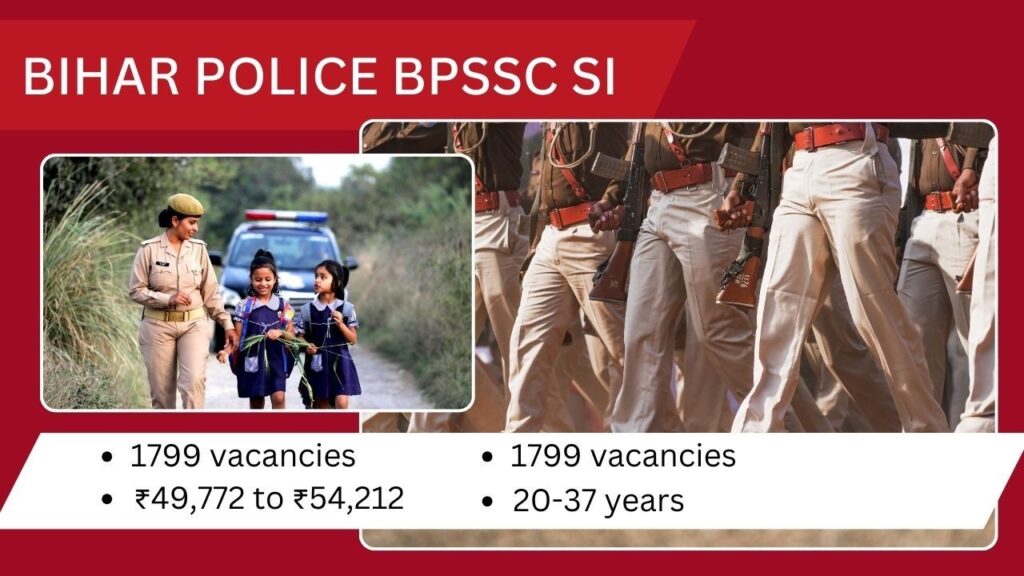
Bihar Police SI: Are you dreaming of Serving your State as a Police? The Bihar Police Subordinate Services Commission (BPSSC) SI recruitment is your best shot at securing a prestigious and well-paid job in the police department. With 1799 Vacancies Released under Advt. This is the high time to apply, as this is to best government jobs in bihar. Let me take you through all the information you need about the SI post from How To Apply to Salary Structure and Career Opportunities. 

What Exactly is a Sub Inspector in Bihar Police?

The Sub Inspector (SI), also known as “Daroga” in Hindi, is an important office in the police force that is scathing about peace, social security, and law in their areas of jurisdiction. Consider them as the police station department of operations. They’re not just desk jockeys — SI’s participate in field operations, investigations, and oversee junior officers. 

They tend to have their hands in all sorts of things like registering First Information Reports (FIRs), investigating crimes, maintaining law and order, and even supervising constables. From conducting raids, to building relationships with the community, to litigating cases in court, SI’s work is ever-changing and requires one to be physically and mentally strong. 

What Does an SI Actually Do?

Let me give you the drab realities of what your daily life as an SI looks like. You’ll have multiple critical jobs to do:

  • Crime Investigation: After investigating the crimes registered in your jurisdiction, you will be required to register FIRs and collect evidence.
  • Supervision: You will also be responsible for the supervision of constables and other junior staff, who you will deploy for patrols and duties.
  • Law and Order: Conducting patrolling at regular intervals so as to check on illegitimate activities and to keep the peace intact.
  • Court Appearances & Litigation Liaison: Handle routine court appearances and day-to-day inquiries from the court, and monitor court administrative compliance. 
  • Community Relations: Establishing reports with the public and keeping in contact with those who live in an area.
  • Paper Trail: Recordkeeping, report writing and office work.
  • Raids & Operations: You will be part of the raids and operations on criminals, but under senior officers.

Basic Eligibility Requirements

Before you start dreaming about recruiting, let’s make sure you meet a couple of very basic eligibility requirements. The good news is that the criteria are straightforward and relatively broad. 

Educational Qualification

You are required to have a bachelor’s degree in any stream from a recognized university. It doesn’t matter whether in any stream – arts, science, commerce or else. All that is required is that you have a valid graduation certificate. You can apply if you are in your final year too, but you will have to submit your degree certificate at the time of document verification. 

Age Limit

CategoryMalesFemales
General20-37 yearsUp to 40 years
OBC/EBCUp to 40 yearsUp to 40 years
SC/STUp to 42 yearsUp to 42 years

Nationality & Other Requirements

you should be an Indian citizen. There is no explicit ban on how many times you can try, just keep in mind you should be within the age limit for each time you apply. 

Note: You will be disqualified by the BPSSC at any stage if you are found ineligible. 

Read More 👉 DSSSB MTS Recruitment 2026: Apply Online for Multi-Tasking Staff Posts

How to Apply For Bihar Police Subordinate Services Commission (BPSSC) SI?

The Application Process is completely online. Here are the steps:

Step 1: Registration

Then go to the official website bpssc.bihar.gov.in and on the Apply Online link for Sub Inspector (SI) recruitment to apply. Register with your e-mail ID and mobile number and then enter basic details like name, date of birth and address. 

Step 2: Pay the Application Fee

The application fee is only ₹100 for all categories, including male, female, and transgender candidates. You have the option to pay by credit card, debit card, net banking or UPI. 

Step 3: Complete Your Application

Now we’ll get to the bottom line. Fill in your educational qualifications, address details etc and upload your photograph and signature. Make sure your photo is 3.5cm × 4.5cm and meets the above requirements. You will also need to upload your certificates and documents applicable to that notification. 

Step 4: Submit and Save

After reviewing everything, submit. Make a printout of the application form and retain it for your records. 

Exam Pattern and Syllabus

To get selected as SI in Bihar police you need to pass through different phases of examination which include your knowledge, physical fitness and your suitability to be the police officer. 

Stage 1: Preliminary Written Examination

Prelims is your first step in the race. It is an objective examination having 100 multiple choice questions in the paper worth 200 marks, with 2 marks allotted for each question. You have two hours to take it. The entire examination is based on General Knowledge and Current Affairs and has questions on:

  • Indian History, 
  • Geography of India, 
  • Indian Polity, 
  • Indian Economy, 
  • Science and Technology, 
  • Art and Culture, 
  • Sports, Awards and recent national and international News. 

There’s negative marking – 0.2 marks get deducted for every wrong answer. You must obtain a minimum of 30% marks to be eligible. Around 20 times the number of vacancies (about 35,980 candidates for 1799 posts) will be shortlisted for the mains examination. 

Stage 2: Mains Written Examination

Once you clear the prelims, a main examination is held which is tougher and more comprehensive in nature.The mains has two papers, 200 marks each: 

Paper I: General Hindi is Preliminaries level to be computed from the following items: grammar, comprehension, vocabulary, synonyms, antonyms and sentence correction. You get 2 hours.

Paper II: General Studies is the second and lengthier paper assessing your knowledge in a wide array of subjects namely Civics, Indian History, Indian Geography, General Science, Economics, Current Affairs, and Mathematics with Mental Ability. This paper also duration of two hours.

All in all, you would be taking 200 questions from both the papers, carrying 400 marks altogether. The qualifying nature of mains is merit based and about 6 times the number of vacancies are called for the physical test. 

Stage 3: Physical Efficiency Test (PET) and Physical Standard Test (PST)

CategoryHeight (cm)Chest (cm) MinWeight Requirement
Males (General/OBC/EBC/EWS)16879Proportionate to height
Males (SC/ST)16079Proportionate to height
Females155Minimum 48 kg
TransgenderAs determinedAs determinedAs determined

Stage 4: Document Verification and Medical Examination

Finally, after you pass the physical standards, you will be subjected to the document verification at which you must bring all your original certificates, and a medical examination to prove that you are physically and mentally capable to perform police duties. The health check includes vision, hearing and general health. 

Exam Dates of Bihar Police SI 

Remember to appear in The Bihar Police SI Prelims Exam will be held on 18 & 21/January/2026. Two sessions will be conducted on both days:

First Shift: 10:00 AM to 12:00PM (Report at 08:30 AM)

Second Shift: 2:30 PM to 4:30 PM (Report at 1:00 PM)

The admit cards were released on 30th december 2025 so download it from the official website. 

Basic Salary Structure

AllowanceAmount (₹)
Basic Pay35,400 per month
Dearness Allowance (DA)4,248
House Rent Allowance (HRA)2,124 to 5,664
Ration Money Allowance3,000
Transport/City Aid600 to 1,500
Medical Allowance1,000
Uniform Allowance900
Vehicle Allowance2,500

All these factors combine to result in a monthly salary of ₹49,772 to ₹54,212. 

Salary Growth Over Time

The interesting thing is your payslip doesn’t stay the same. You will get yearly bumps to your pay that will keep increasing your basic pay every year. After 5 years of service, with the consideration of increments and possible revisions in DA, your salary in hand may be around ₹58,000 to ₹62,000 per month and more than this with a promotion. 

Career Growth of SI

It’s not just the starting salary that makes the job attractive, the role is a springboard to a very rewarding career. The promotion ladder is simple and hierarchical:

SI → Inspector → Deputy Superintendent of Police (DSP) → Additional SP (ASP) → Superintendent of Police (SP)

You advance to a greater pay matrix level with each promotion resulting in tremendous salary hikes. For instance if you are promoted to Inspector your basic pay could rise to a higher stage with which you also get increments in all the allowances.

Promotion is on merit performance on seniority experience and departmental examinations. Good work, solving cases, and maintaining a clean record can fast-track your career.​ 

Conclusion

To be a BPSI is not only a government job but also it is a duty to serve in the society, uphold the law and order and a career opportunity to earn good name with good growth. The pay is good, the work is steady, and the potential for promotion is significant. Here is your opportunity to bring about a change with 1799 vacancies to be filled.

If you are eligible and interested to work hard then no one can stop you from applying. Begin your preparation today, keep on pace and best of luck. The dream to become a Daroga and to make you proud Bihar Police is definitely within your reach! 

Leave a Comment

Your email address will not be published. Required fields are marked *

Scroll to Top