Candidates can apply for the Trained Graduate Teacher post as DSSSB has opened a portal to accept online applications under the process of DSSSB Recruitment 2025 drive for TGT teacher. Don’t lose time because the last date to fill out the application is 07/Nov/2025. Once you fill the application, wait for the admit card and prepare for the examination that will help you get selected. Only shortlisted candidates are going to teach in public schools from class 6 to 8. The salary is good for this position, the starting earning is Rs 44,900 and it can go higher with experience.
Any candidate who has a graduate degree OR postgraduate degree in related subjects like Hindi, English, Science, etc with training degree like B.Ed or diploma D.El.Ed OR any equivalent degree from a recognized government board is required for this job. And CTET exam qualified.
Each section contains 20 questions, one mark per question and wrong answer will deduct 0.25 mark as negative marking. The time is given for 2 hours, candidates have to complete all the questions. There are General Intelligence & Reasoning Ability, General Awareness, Arithmetical, English Language & Comprehension, Hindi Language & Comprehension, and the concerned teaching subject section contains 100 questions for 100 marks. So the total marks of this examination is 200 marks.
Punjab National Bank (PNB) has officially released the notification for the recruitment of Local Bank Officers (LBO) for 2025. Candidates who are waiting for this position can apply now through the official website of PNB. Application Schedule, What is the Application Schedule for BO 2025? This recruitment drive is 750 vacancies. For the eligibility criteria, age limit, education, job profile, syllabus, exam pattern and other important information, the candidates should go through the detailed notification.
A direct link for notification download and further updates on recruitment process will be provided on the official website. Applicants are advised to submit their applications at the earliest and ensure that they fulfill all the criteria as mentioned in the notification.
Candidates need to read the official notification and apply for PNB recruitment 2025. Candidates must have a graduation degree in any course and age criteria must meet the age limit (20–30 years) of this post.
You must read the notification before you start to apply.
To avoid errors, candidates are recommended to ensure that they fill in all required information including name, parents’ names, date of birth, address and educational qualifications properly in the application form.
Ensure you upload all the documents in the right size and format( pdf or jpeg) if required by the application form.
Before you submit the form, check that all the details you have entered and the documents you have uploaded are correct.
When you have submitted your application successfully, it is advised to take print out of application form or save in pdf format for future reference.
The following tips will make your Punjab National Bank Recruitment 2025 application easier.
Candidates with a Psychology degree or a B.Ed. have a golden chance to secure a stable and well-paying job right now. ITBP Head Constable (Education & Stress Counsellor) post application form is active until 27 October 2026. Apply early to hold your seat because the Indo-Tibetan Border Police Force announced only 16 available positions.
Everything about ITBP Head Constable from schedule to how to fill the form is given below. Read and check the official notification before applying for this post.
Overview of ITBP Head Constable Recruitment 2026
Detail
Information
Post
Head Constable (Education & Stress Counsellor), Group C, Non-Gazetted
Don’t confuse this with the other ITBP Head Constable drive from the same month, for Motor Mechanic. That one is male-only and has 21 posts. Women can apply here, and that’s the main reason this notification is worth a closer look.
Who Can Apply for ITBP Head Constable (Education & Stress Counsellor)?
You need a bachelor’s degree with Psychology as a subject, or a bachelor’s degree plus a B.Ed. or Bachelor of Teaching. One is enough. A history graduate with a B.Ed. is eligible. A BA Psychology graduate can also apply without a teaching qualification. Final-year students don’t, because the degree must be completed by the closing date.
The age band is 20 to 25 years as on 27 October 2026. That is narrower than the usual 18 to 25 for ITBP constable posts. The relaxations up to 28 for OBC (non-creamy layer) and 30 for SC/ST candidates, with extra relaxation for ex-servicemen. Confirm your relaxation period in the official notification PDF.
The application fee is reported as ₹100 for male General, OBC and EWS applicants, with women, SC/ST candidates and ex-servicemen exempt.
ITBP Head Constable Vacancy 2026
Fourteen seats are for men and two for women. Beyond that, the category-wise split is unclear. The two women’s seats make that category the tightest on a per-seat basis. The pool of applicants is also smaller than for a general constable drive, since the role needs a specific degree. Smaller doesn’t mean easy, though. Sixteen seats is sixteen seats.
ITBP Head Constable Selection Process: Physical Tests Come First
The order is Physical Efficiency Test (PET), Physical Standard Test (PST), written examination, document verification, then a Detailed Medical Examination, with a Review Medical Examination available on appeal. Putting the physical stages before the written paper is the opposite of what many exam-takers expect. A candidate who scores well on psychology and fails the run is out.
PET Standards
Category
Race
Long Jump
High Jump
Male
1.6 km in 7 minutes 30 seconds
11 feet
3.5 feet
Female
800 metres in 4 minutes 45 seconds
9 feet
3 feet
Written Examination
This is a Computer-Based Mode exam with 100 objective questions and each mark carries one mark. There is no negative marking and you are given only two hours to complete it. The paper is prepared in bilingual language so it won’t be difficult to understand the question.
Qualifying this exam is important to go to the next stage of the selection process. ITBP prepares merit lists according to written examination scores.
Documents and Medical Test
At document verification, candidates must produce original certificates, including educational qualification proof—such as a recognised degree with Psychology, or a degree along with B.Ed./B.T.—along with matriculation, category and domicile documents where applicable.
The final stage is the DME, conducted under CAPF medical guidelines. Candidates found medically unfit may be considered for the RME, where applicable.
None of the later dates are out yet. PET/PST, the written exam, document verification and the medical will be announced separately on the ITBP portal. The exam pattern, number of questions and negative marking aren’t public either.
ITBP Head Constable Salary
The selected candidates get a job and their starting salary at ITBP Head Constable is ₹25,500 and a ceiling of ₹81,100. It is disbursed under Pay Level 4 on the 7th CPC matrix. The allowances including Dearness, house, posting-based allowance are also added in the salary.
Postings can include border and high-altitude locations, which carry extra allowances. A newly appointed candidate at the starting basic pay of ₹25,500 will generally receive a monthly gross salary above the basic pay after allowances, while net pay depends on deductions
How to Apply for ITBP Head Constable Education & Stress Counsellor 2026
Open the official website of ITBP and register yourself first with the correct Email and Mobile number. Then login to fill the Head Constable (Education & Stress Counsellor) application form.
Fill the exact details asking in each box of application form, upload your documents along with your photo, sign, and pay the fee to process the application.
Before submitting, review every detail carefully, because edits aren’t allowed afterwards. Download the confirmation page.
Keep ready your 10th certificate (for date of birth), your degree marksheets, your Psychology proof or B.Ed. certificate, and your category certificate if you’re claiming reservation.
If you’re relying on an “equivalent” to a B.Ed., expect to produce an equivalence certificate at document verification.
One prep tip: start your running now, before you open any psychology notes. The PET comes first and failing it ends your application regardless of your marks.
Apply if you meet either degree route and fall within the age band. The competition is thinner than for a mass constable drive, and Level 4 pay is secure central government pay. Skip it if your degree has neither Psychology nor a B.Ed., because document verification is where those applications end.
If you’re a woman with a qualifying degree, apply early. Two seats won’t wait for the last week. Submit at least three days before 27 October so a portal crash doesn’t decide your future.
LLB students should prepare themselves for MPPSC ADPO Recruitment 2026 because the notification was dropped by the Madhya Pradesh Public Service Commission. It’s already revised the vacancy count once and reopened the application window. Those students who missed the chance before can now apply and don’t miss the second chance. The application window will close soon.
Check all the details here before applying and be prepared for the exam.
MPPSC ADPO 2026 Notification
The original notification for the Assistant District Public Prosecution Officer post was published on 10 March 2026, and the online applications were available from 9 April 2026 to 8 May 2026. By then the number of vacancies was fixed at mere 17 posts.
Then, on 6 July 2026, MPPSC did something candidates should pay close attention to: it revised the vacancy count upward — dramatically to 107 posts, and reopened the application form from 10 July to 24 July 2026. So if you haven’t submitted your form yet, this is not a “check it out next week” situation.
In case you missed the deadline, you can submit an extra ₹3,000 late fee for submissions between 25–31 July 2026. So don’t lose it because if you lose and then after that, a steeper ₹25,000 late fee applies from 1 August through 23 September 2026. That second window is punishing but it exists only for those who are stuck in any situation.
The admit card will be released before the written exam which is scheduled for 18 October 2026.
Category
Application Fee
General / Other State Candidates
₹500
EWS / OBC / SC / ST / PwD (PH)
₹250
Late Fee (09–15 May 2026)
₹3,000
Late Fee (16 May–23 Sep 2026)
₹25,000
Correction Fee (if applicable)
₹50
One thing worth flagging honestly: several sources still describe the current vacancy revision and application reopening as based on limited official detail, with full notification specifics like sectional exam pattern and fee breakup expected to be confirmed alongside the final notification PDF. If you’re relying on this article weeks from now, cross-check the numbers against the notification hosted at mppsc.mp.gov.in before you finalize anything — MPPSC has already shown once this cycle that it will revise figures mid-process.
Eligibility: Who Can Actually Apply
The qualification bar is straightforward on paper but worth reading carefully.
You need a Bachelor’s Degree in Law (LLB) from a recognized university. That’s the baseline. Beyond that, candidates with a First Division in Law, or two or more years of completed legal practice, or a higher legal qualification, will be given preference at the final selection stage — so it’s not just a qualifying criterion, it can actually move your rank.
Age limits: students who are above 21 and below 40 years can apply, calculated as on 1 January 2027. Relaxation is given only to reserved category candidates under MP government rules; you can check the exact limit on official notification of MPPSC ADPO recruitment 2026 rather than believing in the previous cycle.
Category
Maximum Age Limit (years)
Relaxation (years)
General (Unreserved)
40
–
SC / ST / OBC (MP domicile)
45
+5
Women (MP domicile)
45
+5
Government Servants (MP)
45
+5
PwD (Persons with Disabilities)
As per govt rules
As per govt rules
Ex‑Servicemen
40 + service period + 3 years*
Service + 3 years
On domicile: reserved category vacancies (SC/ST/OBC/EWS/Women/Divyang) are applicable only to Madhya Pradesh domicile candidates, while out-of-state candidates will be considered only for unreserved posts. This matters if you’re a law graduate from outside MP hoping to use a reservation category — you can’t, for this recruitment.
Selection runs in two stages: a Computer-Based Test (CBT), followed by an Interview. The CBT is an objective exam testing general awareness and legal knowledge, and Part A of the paper has 50 questions worth 150 marks, weighted heavily toward Madhya Pradesh’s history, geography, politics, and economy. The law component forms the second part of the written test, though the exact question count and marks split for the law section hasn’t been confirmed in what I could find — don’t assume it mirrors GK proportionally without checking the syllabus PDF.
Salary: expect Pay Matrix Level 10, with basic pay ranging roughly from ₹56,100 to ₹1,77,500 per month, plus DA, HRA, and other standard allowances under MPPSC service rules. One older source lists an outdated pay-scale figure (₹9,300–34,800 grade pay), which reflects the pre-revised pay commission structure — go with the Pay Matrix figures, since those reflect the current system.
Important Update for This Year on MPPSC ADPO Recruitment 2026
Two things separate the MPPSC ADPO recruitment 2026 cycle from a routine annual notification.
First, the six-fold vacancy jump — from 17 to 107 — inside four months is unusual and suggests MPPSC recalibrated its Home Department requirement estimates mid-cycle, possibly to align with actual prosecutor shortages across MP’s districts.
Second, the syllabusfor this cycle is explicitly built around India’s new criminal codes: BNS, BNSS, and BSA now form the core of prosecution work, alongside Constitutional Law and MP-specific special legislation.
If you were preparing off IPC/CrPC/Evidence Act notes from a 2023 or earlier cycle, that material is now legacy reference at best because the exam is built on the replacement codes.
Don’t split your remaining prep time evenly across GK and Law.
With Part A alone carrying 150 marks concentrated on Madhya Pradesh-specific history, geography, and current affairs, and the law section demanding fluency in three brand-new codesmost law schools only started teaching seriously in the last two years, your highest-leverage move between now and October is building a tight comparison chart mapping old IPC/CrPC sections to their BNS/BNSS equivalents.
Coaching platforms like Drishti Judiciary have already publishedBNS-BNSS-BSA comparative material — use that as your spine rather than trying to reconstruct it from bare acts alone.
Conclusion
If you’re eligible and haven’t applied for MPPSC ADPO Recruitment 2026, today (24 July 2026) is your last day before late fees kick in. If you’ve already applied, your next concrete date is 8 October for the admit card and 18 October for the exam — everything in between is prep time, and the BNS/BNSS/BSA transition is where marks will actually be won or lost this cycle.
Keep the official MPPSC portal bookmarked; given how this notification has already changed once, treat every number here as current-as-of-today rather than fixed until the exam.
If you’re curious about what it takes to be a Human Resources (HR) professional, you’re in the right place. Over the past 10 years, the HR Professional Courses has undergone significant transformation, shifting away from an administrative role to gaining importance and recognition as a strategic business partner in organizational culture, employee satisfaction and business performance. This all-in-one resource will take you through the Need to Knows of building a fulfilling HR career in India, whether you are a fresher exploring career options or a career changer seeking a meaningful direction.
What Does an HR Professional Actually Do?
Before we get into courses and salaries, let’s demystify the day-to-day life of a HR professional. Despite the stereotype that human resources is just paperwork and policies, HR employees today wear many hats. You will participate in strategic talent acquisition to seek and recruit candidates aligned with company values and who will drive growth. You’ll design and deliver programs to upskill the employees, mentor junior staff, and help them grow their career within the company.
On the compliance and policy side, you will be monitoring the company’s compliance with labour laws, conducting employee relations with tact, mediating disputes equitably and managing the full spectrum of employee life from hiring to offboarding. Compensation and benefits policies are your domain too: You develop the strategies, coordinate the performance reviews, and you can even assist with organizational development by working with your leaders on future staffing and succession planning. In today’s world of data and analytics, many HR professionals are also utilizing analytics to monitor indicators such as employee engagement, retention rates and hiring effectiveness to drive additional business improvements.
The joy of human resources is that each day is different, with issues ranging from handling a difficult employee complaint to developing a creative new-hire program or spearheading an organization-wide change effort.
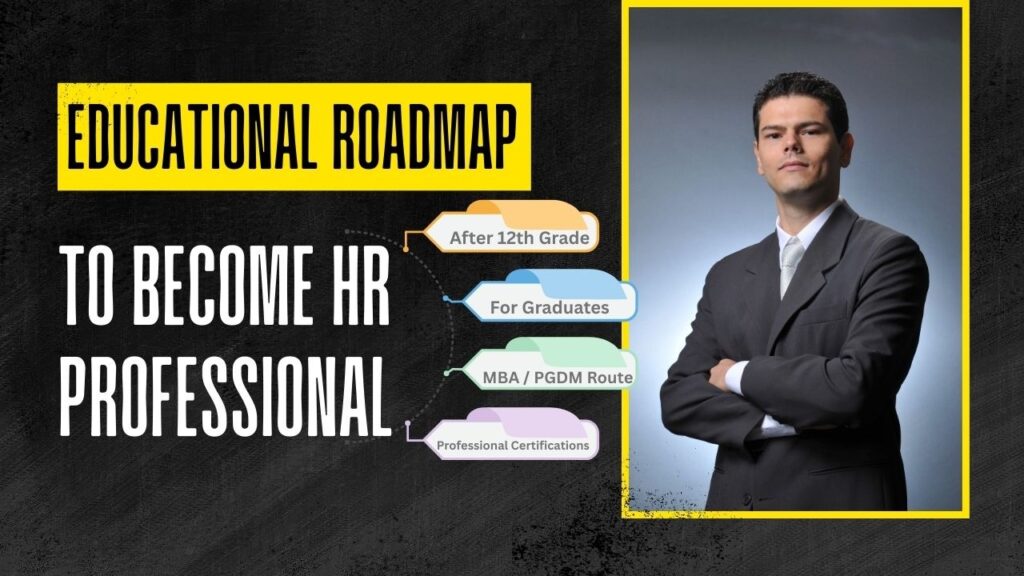
Educational Roadmap To Become HR Professional
The great thing about HR career paths is that there is no single “correct” path. To your education and current level of career aspirations, you can add several points of entry:
After 12th Grade
If you have completed the high school you can go for the Diploma in Human Resource Management. These 1-3 year courses are available at a cost of Rs 50,000 to Rs 2,00,000 according to the classification of institution as a government or a private one. Alternatively, you can do 3 years of Bachelor’s degree (BBA, BA, BS) in HR or something related. Government College fee is goes from ₹1-8.5 lakhs and for private college fee is from ₹3-16.25 lakhs.The eligibility criterion is generally 50-60% in 12th class.
For Graduates
If you already hold a bachelor’s degree (in any stream as per your undergraduate major), you can go forward for professional certificates or a post graduate diploma. A professional certificate of 6-12 months costs between ₹20,000 and ₹1,00,000, while a post graduate diploma for 1-2 years is valued at ₹50,000-₹1,20,000. These courses are great if you want to make a move into HR for then a full 2 year MBA.
MBA / PGDM Route
If you are looking for an overall business education with focus on HR, a 2 year MBA or PGDM in Human Resources fees vary from ₹ 2-27 lakhs based on the tier of the college and the location. These programs on the repel need entrance exams as CAT, SNAP, MAT, or XAT. Top tier institutions such as IIM, XLRI have higher fee yet provide excellent placement package and networking.
Professional Certifications
Professional certification is also valuable in addition to formal education. The popular certification include CHRG (Certified Human Resource Generalist) which has fees of ₹50,000-₹2, 00,000.
The CHRM (Certificate in Human Resource Management) is priced at ₹90,000-₹8,00,000 and the CHRP (Certified Human Resource Professional) costs ₹80,000-₹4, 00,000.Two globally-oriented credentials that also have value on an international basis are the SHRM-CP (Society for Human Resource Management Certified Professional) and the aPHR (Associate Professional in Human Resources) both of which are recognized by employers in many countries around the world.
Eligibility Requirements You Need to Know
For Diploma Courses: You need to pass 12th grade exam with minimum 45% in aggregate.
For Bachelor’s Degrees: Obtain 50-60% in 12 grade; some colleges require entrance exams.
For M.B.A. Directly after 10+2: Achieved a minimum of 60% in your 12th grade exams; passed entrance exams such as CAT, MAT, SNAP, or XAT.
HR-Related Certifications: Many certifications such as SHRM-CP have prerequisites of at least 3 years of HR work experience in an HR function, whereas entry-level aPHR caters to HR novices or individuals beginning their journey in HR.
Starting Salary For HR
Entry level HR professionals in India get a good pay as per market standard. An HR fresher gets a salary in the range of ₹15,000-₹30,000 per month, which comes around ₹3-5 LPA per annum. However, this might differ drastically depending on a few things such as:
By Role: HR recruiters and coordinators normally begin with salaries of ₹18,000–₹26,000 per month and HR analysts with good technical skills can make ₹25,000–₹35,000 per month from the very start.
By Education: Tier-1 MBA (HR) pass-outs have high salary prospects of ₹30,000–₹40,000 per month and BBA or BA grad can make ₹18,000–₹25,000 per month.
By Industry: It is not always that an HR company gives you a chance but you can get IT, finance and e-commerce industries offer for an HR with starting pay of ₹28, 000 to ₹35, 000.
By Location: Metrocities like Bengaluru and Delhi offer great pay to HR Professionals.
Career Growth
Indian HR salaries have increased 24% from 2019, this is higher compared to IT sector’s 6.5% CAGR. This signals the rising level of strategic importance that HR has in organizations.
Career Progression Timeline
Start as an HR Assistant or Coordinator (0-2 years), then advance to HR Generalist or Specialist (2-10 years) in areas such as L&D Manager or Recruiter, then go to HR Manager or HR Business Partner (5-10 years) and subsequently to executive positions which include Director, Head of HR, or CHRO (10+ years).
Salary Growth by Experience
A fresher can typically expect a starting salary of ₹3–5 LPA. As you gain more experience, this can be anywhere from ₹11-15 LPA at HR Manager level, ₹20-25 LPA in senior specialist roles and anywhere between ₹40-150+ LPA for CHRO of a large company. The steepest rise in salary is generally seen between 10 to 13 years of experience- whereby the median CTC varies around ₹38 LPA.
Emerging High-Growth Specializations
For maximum growth, strategic HR roles are the way to go. HR Analytics Managers earn ₹40-60 LPA, Salary & Benefits Managers earn ₹28-42 LPA, and Diversity & Inclusion Managers earn close to ₹20 LPA. These positions are growing at 15-22% per year because they have a direct effect on business results.
Conclusion
The Job growth of approximately 7% over the next ten years will add about 17,400 new jobs and is expected for the HR occupation. Instead of being automated out of existence like some admin jobs, strategic HR roles are increasingly precious. You get to work with people, solve truly complex organizational issues, shape company culture, and have a tangible impact on whether employees are happy at work.
”The investment, be it ₹50,000 for a diploma or ₹20 lakhs for an MBA, gets returned fast in the form of a competitive pay package and strong career growth. More than who you’re working for, it is the work, financial and personal fulfilment you are creating.
First, decide on the HR professional Courses that best matches your current qualifications and your career timeline, learn core HR skills to get started, and don’t overlook the impact certifications can have in helping you stand out.
Best Hindi Teacher: If you aim to clear the competitive exams like SSC, UPSC, RRB, & state-level exam, right guidance for best scoring is important. And for that, the choice of a teacher matters. While preparing for other subjects likeGeneral Knowledge, Mathematics, Reasoning, and English. Don’t forget to focus on Hindi because it is most important in many government exams. Hindi teachers not only help you by providing the core syllabus but they will prepare strategically for the exam. These teachers have a unique teaching style that will help you understand grammar, comprehension, Letter Writing, Unseen Passages and vocabulary.
Aspirants can learn easily through their guidance including exam pattern, mock test, and shortcut methods that will help you to memorize. Few teachers provide live sessions, recorded videos, notes, and quizzes, so you can easily prepare for the examination.
Mock test series will help you in revision and remember that every teacher has their unique way to explain hindi. Take a demo class to select the right teacher whose explanation reaches into your mind.
Explore best Hindi teachers, they are known for their deep knowledge, best teaching style and make complex concepts of grammar easy for students.
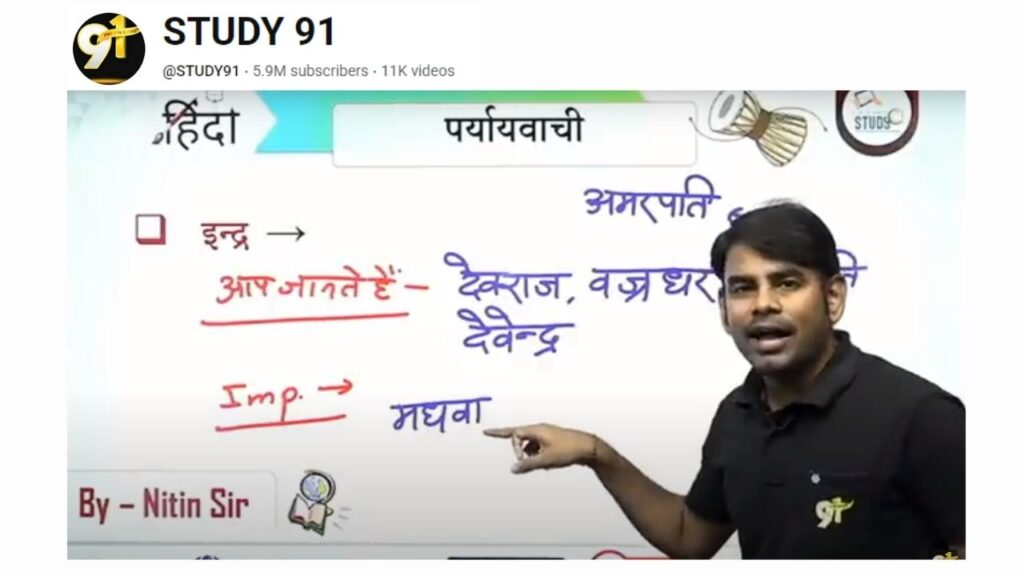
Nitin Sir
Nitin Sir from Study91 is known for clear explanations with a practical approach. He doesn’t just explain from books but tries to relate with real-life examples from newspapers or stories to make the hardest grammar rules easy for students to understand.
Students easily memorize it, but most importantly they understand why grammar rules are used. He also gives plenty of questions to practice which is the real key to success.
Vivek Sir
Vivek Sir’s creative style of teaching makes him one of the best Hindi teachers in India. Hindi is a language of culture and creativity, according to Vivek Sir. That clearly showed his mastery of story-based teaching style which makes grammar memorable. He uses humour, short stories that don’t make students bored in Hindi classes.
Ideal for those who don’t memorize anything easily and it’s hard for preparing Hindi for exams like Railway, SSC or TET. His method is effective to recall in exams quickly, so these techniques will make students remember even under pressure.
Dr. Ajay Anurag
Dr. Ajay Anurag is a best educator of Study IQ and reputed for his deep knowledge in Hindi grammar and literature. Students looking for one teacher who can teach them both grammar and literature, Ajay Sir is the best choice.
His concept-based teaching makes you understand each topic easily in minimum duration. But he doesn’t rush topics, he explains “why” behind every grammar rule.
Students who don’t just want to learn but understand Hindi topics can easily access his systematic and well-structured lessons. He also provides study material which is so detailed and exam-focused that it makes it easier for the students who are preparing for government exams.
Jitendra Soni (KGS – Khan Global Studies)
He is the best educator of KGS who is extremely popular for his Hindi Foundation Batch. Jitendra Soni is focused on friendly-tone, conduct doubt-clearing sessions, and handwritten notes.
Students can simply understand every topic due to his explanation of lengthy stories, complex topics of grammar, and comprehension. Once you have taken his demo class or follow on YouTube, you will know how interactive and energetic his sessions are.
Vishal Sir (Mission Selection)
Vishal Sir is a well-known Hindi teacher on the growing platform Mission Selection. Vishal Sir is popular among the students because of his exam-oriented preparation method. His short explanations are impactful, he helped many students with shortcuts, tricks, and practical approaches.
He is the best teacher for Police, SSC GD, Railway, Constable, and state-level exams preparations. Students who want to complete this subject within less time, they can follow Vikas Sir.
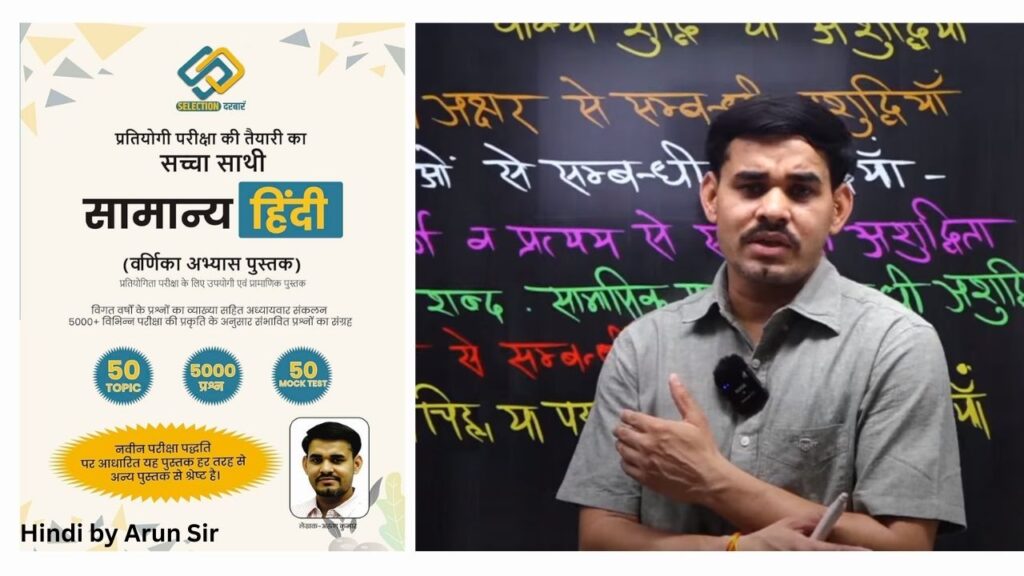
Arun Sir
Arun Sir is an excellent teacher who teaches many students for the competitive exams. He focuses on Hindi grammar complex topics to provide a detailed explanation which can help students to understand Hindi in more depth. His command over vocabulary, comprehension, and writing are valuable for the exams like SSC, Railway, and UPSC.
Students can easily understand his way of teaching as breaking complex topics into simpler parts including real-life examples. He helps students to practice mock tests and previous year questions for building their strong foundation on Hindi.
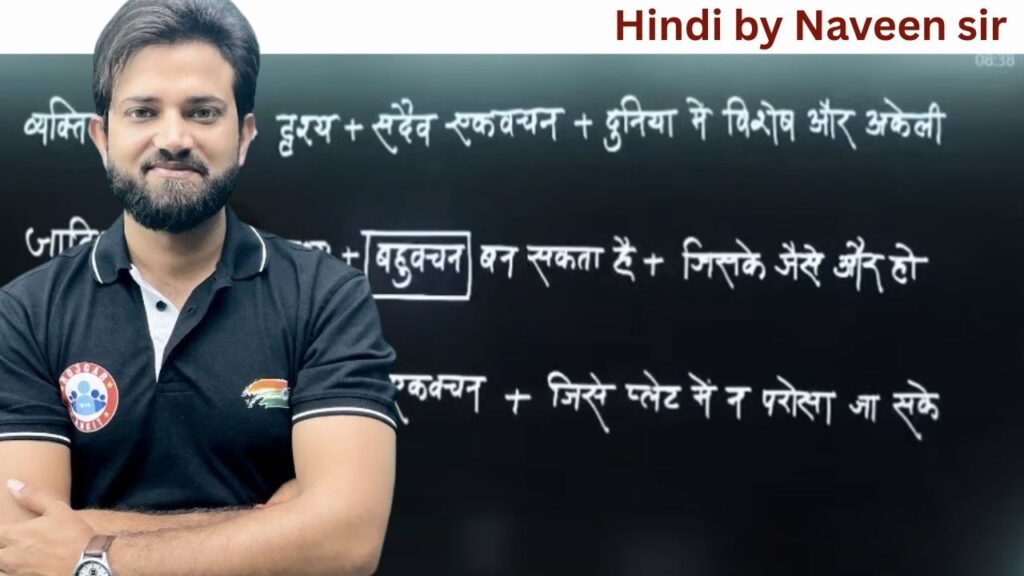
Naveen sir
Naveen Sir is a master of answer writing, if you are preparing for UPSC or state exam then you should make your descriptive writing good in Hindi. You will become an expert in essay writing, letter writing, and precise writing in Hindi with his consistent training.
He is an ideal teacher for students who want to improve their writing skills and present their answers in clean, structured, and detailed.
Other Recommended Hindi Teachers
Apart from the above names, there are a few more respected teachers who can provide you best lessons for Hindi in competitive exams:
Dr Vikas Divyakirti (Drishti IAS) – He teaches Hindi Literature with depth and clarity, making him ideal for UPSC aspirants.
Alok Sir (Adda247) – Alok Sir is focused on short-trick and not go for lengthy explanations that makes him ideal for SSC aspirants
Ritesh Sir – he also helps students to prepare for the SSC exam because he makes Hindi grammar easy through continuous practice.
Apart from their unique teaching styles, they have the same common qualities that make them best Hindi teachers.
Simple explanation – they explain every topic in easy language that helps every student to understand easily.
Practical Approach – their style including examples from newspapers, current events, and daily-life that make Hindi more understandable.
Focus on Practice – continuous practice of questions from previous year and test series, they ensure that every student solves enough questions to mentally prepare for the exam.
Motivation & Support – Hindi is so difficult for some students who came from convent schools, these teachers inspire them to make learning enjoyable.
When students are focusing on tough subjects to clear competitive exams, they often forget to prepare Hindi to fuel their score. With the right teacher, Hindi can become your strongest subject. These Best Hindi Teachers for Competitive Exams have already taught many successful students now you could become next.
If you give you full potential for your exam with their guidance, you can clear the most toughest exams. They focus on exam patterns and important topics that need to be prepared well for government exams.