There are numerous 12th Pass Government Jobs 2025 in India where students can secure their stable career in the specific sector including defense, banking, admin, and public sector undertakings (PSUs). Read the full article to know about job roles, salary, eligibility, and future scope for 12th-pass candidates.
Top 10 Government Jobs for 12th Pass
The government is spreading job vacancies for 12th-pass candidates in 2025. You can also secure your career in a specific sector.
There are the following job roles in various sectors:
Police and Defense
The defense sector has many job roles after 12th pass candidates
Police Constable
Police Sub-Inspector (some states may require graduation for this job role but some recruit after 12th)
National Defence Academy (NDA)
Technical Entry Scheme (TES) – Indian Army
Agniveer Scheme
Military Nursing Service (MNS)
Railway Jobs after 12th pass
Railway job offers a good salary to the candidates, you can apply after 12
Junior Clerk Cum Typist
Commercial Cum Ticket Clerk
Trains Clerk
Railway Group D Posts
Ticket Collector
Ticket Examiner
Banking Jobs after 12th pass
There are Government banks where candidates can apply after 12 but they must pass the exam with a good score. This sector provides long-term career stability.
Clerk
Data Entry Operator
Sales Executive
Banking Assistant
Cashier
Peon
Public Sector Undertakings (PSUs)
Junior Assistant/Apprentice
Technician
Fieldworker
Helper
SSC Jobs (Staff Selection Commission)
Data entry jobs
Lower Clerk
Postal
Assistant
Eligibility Criteria for Government Jobs After 12th-pass
Similar Eligibility Criteria across these Sectors
There is some eligibility for these roles in Railway, defense, SSC, PSU, and banking are same. Let’s talk about the common criteria for the job roles.
Nationality: Candidates must be the Indian Citizen Age Limit: The minimum age must be 18 years or older, and the maximum age should be exceeded by the sector and category of the person. You can check these exact eligibility requirements while applying for the specific role. Educational Qualification: Candidates should pass 10+12 with a 50% score in any stream.
Key Difference in Eligibility Criteria
Railway: For a Technical post in the Railway, the candidate must have an ITI/Diploma. Physical Tests are necessary for Group D positions.
Defense: Only Unmarried candidate apply for NDA post Candidate must have good health and pass the medical tests
SSC: Age Limit vary for some posts For Clerical post typing test will be included
Banking: The Bank Officer post requires graduation, candidates must have a degree in a similar field for this job role Computer skills are required in bank jobs
PSU: GATE score required for the technical posts The minimum age required in the range (21-27) may vary according to the various categories.
Government exams candidates take after 12th
There are some competitive exams which are conducted by the government for the various job roles in each sector. If you want a government job, you must pass the exam (every job role has different exams)
If you want a Job in the Indian Army, navy, or Air Force, You have to attempt the National Defense Academy (NDA) exam and score well to secure a job role.
For entry-level jobs in banking, you need to take the IBPS clerk exam.
If you want to go in Police jobs you must attempt State Police Constable Exams that are conducted by the state government.
For clerks, assistants, and data entry operator job roles candidates must pass the SSC CHSL.
Indian Railway offers jobs for the candidates who passed RRB NTPC.
Conclusion
You can apply for 12th Pass Government Jobs 2025 and secure the rewarding career for a lifetime. Every sector has different job roles, just stay focused and clear out the competitive exams. Stay updated with the official notification for latest vacancies in defense, railway, SSC, and PCU to apply early.
Educational boards have different advantages and disadvantages for students in India. Schools are the first stage for students to build their knowledge and shape their minds for a career. A student’s entire future depends on it. If you are a parent or educator then you must understand that when it comes to the classic debate of CBSE vs State Board, there is no one-size-fits-all answer.
There are factors including a student’s learning style, future goal, or central/state opportunities which can help you to decide the right one. So, let’s walk through this guide which explains the core differences between CBSE and State Board to help you make the right decision.
What is The CBSE Board?
CBSE offers a standard curriculum for students, schools authorized by CBSE board offer the same syllabus whether it is in Mumbai or Lucknow. This is best for students who change their cities frequently, so their studies won’t be disturbed. It is managed under the Union Government and heavily focused on Science and Mathematics. Schools offer both medium English and Hindi.
What is a State Board?
In India, every state has its own educational board for schools. The curriculum is designed to have one state’s language along with English as the primary language. For example, Hindi/Sanskrit in UP board and Marathi in Maharashtra board. It is focused heavily on the state’s geography, history, culture with leaning more towards science and mathematics.
Best board for students who are aiming for state-level government exams or jobs. The lessons are also easy and point-to-point that will help students to easily understand their topic within less time.
Core Differences in CBSE vs State Board
To understand which board is better, we need to compare them across several critical parameters.
1. Curriculum and Syllabus
CBSE: The syllabus has been designed considering NCERT curriculum which is more inclined towards integrated theory and practical aspects. Students who have high level of analytical thinking can easily handle the CBSE syllabus as it is not based on rote learning.
State Board: They punch a lighter syllabus but are heavily skewed towards a local language, history and geography. That curriculum would not be gone into with the same depth in CBSE.
2. Difficulty Level and Grading
CBSE: The exam structure is tough and built to test students’ reasoning skills. Scoring basically depends on continuous and multiple exams in a year which reduces the pressure of a single final exam. overall difficulty level is high in CBSE board for students.
State Board: Traditionally, this has come down to relatively simple calculations and memory-based tests. The end of year board examination is the most important one. In general, students consider that it is simpler to get high marks in the State Board exams as questions are more direct.
3. Alignment with Competitive Exams
If student wanted to make their career in government sector then choose accordingly.
CBSE: If the goal is to crack national-level entrance exams like the JEE or NEET as these are the biggest exams for engineering and medical students, CBSE board students have advantage because their exam curriculum are same as students’ high school syllabus.
If student is thinking about central government jobs like IRS or defence job, the analytical foundation built by CBSE gives them a distinct edge.
State Board: State boards are excellent if the target is state-level engineering and medical entrance exams (like UPSEE or MHT-CET). They are also highly beneficial for state civil services exams, as the localized curriculum provides a strong base in regional general knowledge.
4. Extracurriculars and Holistic Development
CBSE: There is an active promotion of academic and non-academic activities by the board. The majority of the CBSE schools possess strong infrastructure in sports, arts, and debate and consider them as part of the curriculum.
State Board: It’s all studied-based. There are some extracurricular activities, but these are generally subordinate and become dependent on the management of the particular school and what they can provide.
The decision ultimately boils down to what you envision for the student’s future.
Choose CBSE if:
You are moving all over India because of your parent’s job.
The student is targeting national-level exams (JEE, NEET) or central government jobs.
You need a syllabus that’s focused on concepts and their application, and not on memorising.
You want the best of both worlds, academically and extra-curricularly with the extracurricular side not taking a back seat.
You are looking for a balanced approach with equal focus on extracurricular development.
Choose State Board if:
You live in one state permanently and have no intention of moving.
The student intends to enter the civil service, but only in that particular state.
You want the student to be well versed in regional languages and local customs.
The student is involved heavily in passions outside of school (like competitive sports or music production) and needs a more forgiving academic schedule.
Conclusion
No board is naturally “best” or “worst.” They are just for different uses.
The CBSE board reigns supreme for national competitiveness and standardized pan-India education. It equips students for the tough national exams and is very analytical in its method of teaching. hly analytical approach to learning.
State Boards provide a localized, accessible, and culturally relevant education. They tend to be more flexible, granting students additional time to partake in outside activities or to prepare for opportunities at the state level.
Evaluate students’ strengths, talk about their long-term objectives and what board is best suited for their individual path. Choose the right one over the best.
IDBI Bank has officially announced the IDBI Bank Specialist Officer Recruitment 2026 in which Professionals who are looking for fresh opportunities in India’s leading private sector banks can apply. They are recruiting experienced candidates for multiple posts across multiple departments, including Information Technology, Audit, Legal, Risk Management, Infrastructure, and Security.
Candidates are shortlisted based on their qualifications, relevant work experience, and performance in the interview unlike the other banking recruitments where the selection process includes a written examination.
IDBI Bank released the notification on 10 July 2026 and the online application window opened on 14 July 2026 but only until 26 July 2026. That’s a short runway, so if this role fits your background, the smart move is to stop scrolling other job portals and get your documents in order today.
Event
IDBI Bank Specialist Officer Recruitment Dates
Applications open
14 July 2026
Last date to apply
26 July 2026
Total vacancies
31 Specialist Officer posts
Selection mode
No written exam — screening, GD/Interview, medical test
What This IDBI SO 2026 Recruitment Is Actually For
IDBI Bank is hiring 31 Specialist Officers across four functional areas: Audit (Information Systems), Infrastructure Management Department (Premises), Legal, and Security. The posts span three grades — Deputy General Manager (Grade D), Assistant General Manager (Grade C), and Manager (Grade B), which tells you this is a lateral entry drive built for people who already have domain experience, not fresh graduates hoping to break into banking.
That distinction matters more than most people realize. A lot of aspirants see “Bank Specialist Officer” and assume it works like the IBPS SO exam, complete with online tests and months of mock-paper practice. This one doesn’t. IDBI Bank is screening candidates directly on qualifications and verified work experience, then moving shortlisted applicants straight to Group Discussion and Personal Interview.
Post-Wise Vacancy Overview
Functional Area
Grade
Who Should Apply
Audit – Information Systems
Manager / AGM / DGM
IT, Computer Science, or Cyber Security background with IS audit experience
Infrastructure Management (Premises)
Manager / AGM / DGM
Civil or Electrical Engineers with infrastructure or project management experience
Legal
Manager / AGM / DGM
Law graduates with relevant banking or corporate legal experience
Security Officer
Manager (Grade B)
Candidates with a background in security operations, often ex-defence or law enforcement
Age requirements vary by post and grade, generally falling between 25 and 45 years as on 1 July 2026, with the usual government-mandated relaxations for reserved categories. What’s worth flagging is that age relaxation applies only to the IS Audit, IT & MIS, and Risk Management posts — it doesn’t extend to the Security Officer (Grade O) category, so double-check your eligibility window against the specific post you’re targeting rather than assuming a blanket rule applies.
On the qualification side, IDBI Bank has kept things fairly specific to each domain.
For Audit-IS roles, you’ll need a B.E./B.Tech in Information Technology, Computer Science, Electronics, or a closely related discipline, ideally paired with certifications and hands-on audit experience.
For IMD-Premises, a Civil or Electrical Engineering degree with real infrastructure project exposure is the baseline.
Legal posts expect a law degree along with courtroom or corporate legal experience relevant to banking.
And here’s something candidates often overlook: experience gained purely through internships, training programs, apprenticeships, graduate trainee roles, or contractual and outsourced payroll arrangements will not be counted. IDBI Bank wants confirmed, full-time professional experience, not project stints.
Selection Process: No Written Exam, But No Shortcuts Either
The absence of a written test doesn’t mean the process is easier — it just shifts where the pressure sits. IDBI Bank’s Specialist Officer selection unfolds in four stages, and each one filters harder than the last.
Preliminary Screening comes first, where the bank shortlists applications based on declared age, educational qualifications, and work experience. This is where an incomplete or vaguely worded application gets quietly dropped, so precision in how you describe your experience actually matters here.
Document Verification follows, checking every declared detail against your original certificates. Anything that doesn’t match on paper becomes a problem at this stage, which is exactly why the bank has been explicit that training, internship, or contractual experience won’t be accepted as valid.
Candidates who clear both stages move to Group Discussion and/or Personal Interview, where only a limited number are called based on how strong their qualifications and experience look on paper. This is genuinely where the selection gets decided — panels are typically senior bank officials assessing domain depth, not general aptitude.
Finally, there’s the Pre-Recruitment Medical Test (PRMT). Clearing the interview isn’t the finish line; your final offer still depends on being certified medically fit under the bank’s standards.
How to Apply for IDBI Bank Specialist Officer SO Recruitment 2026
The entire process runs online, and IDBI Bank has been clear that no other mode of application will be entertained.
Here’s how the steps break down in practice:
Start by visiting the IDBI Bank careers page and navigating to Current Openings, where you’ll find the notification titled “Recruitment of Specialist Officer – 2026-27 (Advt. No. 03/2026-27).”
Register using a valid personal email ID and mobile number — the bank will use these for all future communication, so it needs to stay active through the entire process.
Fill in your personal, educational, and experience details carefully, since this is the same data that gets checked line by line during document verification later.
You’ll then need to upload a photograph, signature, thumb impression, a handwritten declaration, and a scribe declaration if applicable, all in the exact size and format specified in the notification.
Once your form is complete, review it thoroughly before hitting final submit — IDBI Bank does not allow edits after that point. Pay the application fee online which is around Rs. 1050 for general and Rs. 250 for reserved category, wait for server confirmation, and save your e-receipt along with the Provisional Registration Number and password sent to your email and phone. Print your final application and confirmation for future reference, because you’ll likely need it at the document verification stage.
Candidates must know that they are allowed to apply for only one post and if they try to apply for multiple posts then it leads to outright rejection. The fee won’t be refunded. So if you see yourself eligible for more than one position then take a break to think which one suits your strongest experience before you apply.
Salary, Perks & Career Prospects
Beyond the pay scale attached to each grade, selected candidates get access to allowances, perquisites, and Performance Linked Variable Pay under the bank’s policy, which is periodically revised.
Every appointee joins on a one-year probation and gets covered under the IDBI Bank Ltd. New Pension Scheme (IBLNPS) Rules, 2011. It’s also worth knowing that IDBI Bank reserves the right to post you anywhere across its branches, offices, or associate institutions based on organizational need, and it can offer a grade one level lower than what you applied for depending on suitability and vacancy availability. Neither of these should be dealbreakers, but they’re worth factoring into your decision before you apply.
How to Actually Prepare for This Recruitment
Since there’s no written paper to study for, preparation here looks completely different from a typical bank exam. Your real work is making sure your professional story holds up under scrutiny because that’s exactly what the interview panel is going to test.
Go through your own experience letters and appointment records before you fill the form, and make sure the dates, designations, and responsibilities you’re about to declare match what’s on paper. Any mismatch surfaces during document verification, and there’s no recovering from it at that stage.
If you’re applying for the Audit-IS post, be ready to speak in depth about specific systems you’ve audited, frameworks you’ve worked with, and findings you’ve closed — vague answers don’t hold up against a panel of senior audit professionals. The same logic applies across Legal, Infrastructure, and Security roles: panels in specialist recruitment drives ask pointed, experience-based questions, not textbook definitions.
It also helps to read up on IDBI Bank itself — its recent financials, its position as a LIC-backed private sector bank, and any developments in the department you’re applying to. Interviewers often gauge genuine interest by asking why a candidate specifically wants to join IDBI Bank over sticking with their current organization, and a generic answer here tends to stand out for the wrong reasons.
The IDBI Bank Specialist Officer recruitment 2026 rewards people who’ve already put in the years, not people looking for an exam. If your background genuinely fits one of these four functional areas, then this opportunity is for you: a stable banking sector role, a defined pay scale, and a faster route than the traditional written-exam route most candidates are used to. The only real risk right now is running out of time before 26 July 2026, so if you’re eligible, get the application moving today rather than next week.
Almost 2 lakh nervous students are going to throng into exam centres across the country, their heartbeats racing for one of the most competitive entrance exams in India. The CAT 2025 Exam Analysis was held on November 30, 2025 in three slots. It was more difficult than last year and some parts were a lot harder. Let’s understand what exactly made these sections tick and why DILR turned out to be the section that had aspirants sweating bullets.
VARC: The Surprisingly Approachable Section
Starting with the section which allowed students a fighting chance—Verbal Ability and Reading Comprehension came in at 24 questions to be answered in 40 minutes. Here’s what made VARC the relative breeze compared to the others. The section continued the following pattern: 4 RC passages (reading comprehension question) with 16 questions, and 8 Verbal Ability questions based on parajumbles, para-summaries, and odd sentences out.
What took many students by surprise was that although VARC had a few tough passages, it was more-or-less the same as last year’s CAT. One highlight was a tract on the ill effects of dams that proved to be amperable, while tracts on AI ethics and The Forest Act 1982 presented mild difficulties with knotty questions and extended options.
No Rule-Breaking Surprises in the distribution of topics (or in the format). For those students planning to go for a decent percentile, somewhere close to 18-20 correct attempts out of 24 can easily take you till 85 percentile.
DILR: The Monster Everyone Feared
Now, let’s talk about the elephant in the room — DILR or as many started calling it, “the nightmare section.” With 22 questions distributed in five sets, this section turned out to be the toughest part of CAT 2025. DILR was reportedly “much harder” than the previous year, according to candidates across all three sessions.
There were about 11 Data Interpretation and 11 Logical Reasoning questions, and about 11–12 questions were to be Type In The Answer (TITA). But here’s the real kicker: DI sets were moderately solvable, LR sets were much more demanding in terms of analytical thinking and puzzle solving skills. One set on a pollution index using weighted averages left many candidates baffled, while simpler sets such as the Spider + Bar graph gave some relief.
The psychological effect was true. Students observed that in this section, smart question choice became an absolute must. 8–10 good questions with high accuracy was the realistic target to get 90 percentile, as against that year it might have been the need of similar accuracy in 10–12 questions. This was the part that really tested not only what you know, but how you prioritize when you’re under fire.
QA: Deceptively Moderate but Tricky
Quant may be described by experts as “medium-difficult having a flavor of difficulty and toughness. With 22 questions from the areas of Arithmetic (8), Algebra (5), Geometry (3), Modern Math (4), and Numbers (2), the pattern was pretty much the same. But this is where CAT 2025 surprised many aspirants—each question appeared doable, but a large number of them required multi-step thinking and fast computations while under heavy time pressure.
Geometry questions, though easier, could be answered quickly, but the other portions were more calculation-intensive and tested not only your speed but your accuracy. To score well, answering 12-15 questions correctly appeared to be the magic number, with somewhere around 13-14 potentially pushing you towards the 90 percentile.
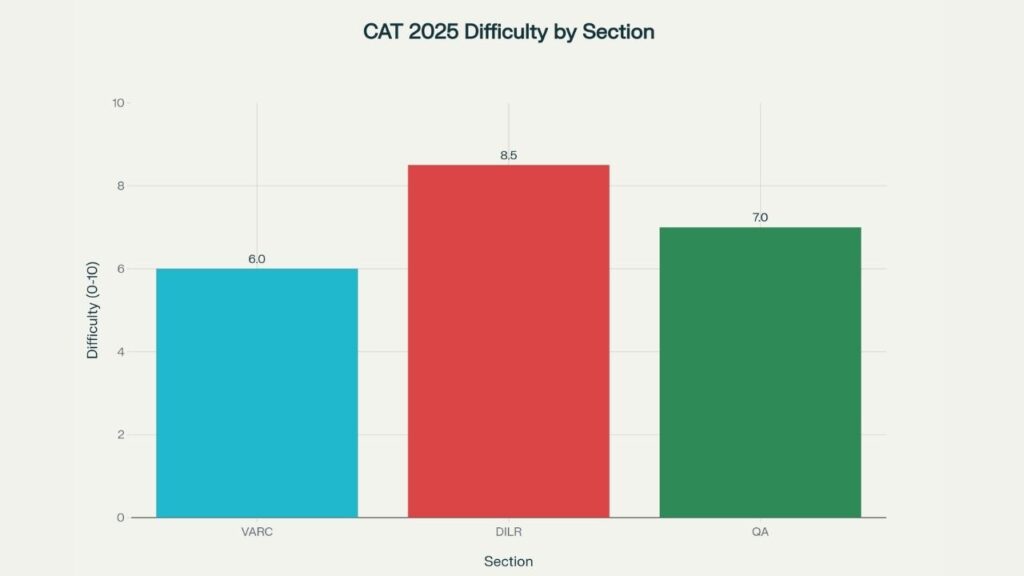
Here’s the hard truth about CAT 2025: the paper was overall a shade more challenging than CAT 2024. DILR took center stage as the villain in the storyline of this year, while VARC surprisingly ended up as the hero. QA swung to the challenging side, particularly in the afternoon and evening slots.
Section
Total Questions
Difficulty Level
Comparison to 2024
Good Attempts
Target Percentile
VARC
24
Moderate
Similar
18-20
85%
DILR
22
High
Tougher
8-10
90%
QA
22
Moderate-High
Slightly Tougher
12-15
90%
So What Does That Mean for You and Your Prep?
Quality trumps quantity Every bit as much as in volume matters in this area. Increased difficulty on all three positions also means as you go through the percentiles, the score ranges will be more condensed. You can’t let yourself be sloppy. Smart question selection Knowing when to skip and managing your time ruthlessly become your superpower.
CAT 2025 Section-Wise Difficulty Level Comparison
To those who are readying themselves for CAT 2026 or are giving it another shot, this is what I want you to take away — practice consistently, analyze your errors and know your weak links in each section, that is what will give you an edge. It’s not just testing what you know anymore, it’s testing how you think under pressure.
Conclusion
CAT 2025 was a testament to how this exam is not only about knowledge of concepts but also about stamina, being flexible and taking razor-sharp decisions under pressure. VARC was somewhat relaxing, DILR was the real game changer which stretched even the best candidates to the brink. QA struck a difficult calculation-heavy balance, rewarding calm precision.
For future aspirants, the biggest take away is simple — “Accuracy is the key, build strong basics and selective solving is the art”. As long as you keep your cool, read patterns fast and fight your battles wisely in the exam, you will always be having that extra edge – Whatever way CAT chooses to dance!
If you are in the last semester of B.Tech or you got the first internship, and it requires VS Code, three Docker containers, Android Studio’s emulator, and eighteen Chrome tabs open at once on a laptop your parents bought you in 2021 with 4GB of RAM. That’s the moment most Indian coders realise their machine is the bottleneck, not their skills. And they started looking for the Best Laptops for Coding and Programming.
A gaming laptop’s RTX 4070 is dead weight if you’re building REST APIs all day, and a fanless ultrabook will choke the moment you spin up a local Postgres instance alongside two VMs. What actually matters for most development work — web, app, backend, data — is RAM headroom, a fast NVMe SSD, sustained CPU performance, and a keyboard you can survive eight hours on. A dedicated GPU only earns its price tag if you’re doing CUDA-based ML work, training models locally, or running the Android Studio emulator constantly.
Make sure that your laptop has 16GB RAM, not 8GB — Chrome alone with dev tools open can eat 4-6GB. Picking 24-32GB when you’re running Docker and VMs together. If there are SDKs, node_modules folders, and Android SDK files that take up to 50 GB itself then pick 512GB NVMe SSD. The best CPUs of current-gen are Intel Core Ultra 5, AMD Ryzen 5/7, or Apple M-series and these are the best options for IDEs and compilers. Coders don’t need a higher-end chip unless they’re compiling large codebases consistently.
You must understand that laptop prices in India move fast, sometimes 8-10% within a few weeks around sale events. Every price below is what these models were listed at in the first half of August 2026 on Flipkart, Amazon, or the brand’s own India store — treat them as a strong reference point, not gospel, and check the live price before you check out.
Common Mistakes Indian Buyers Make When Choosing a Coding Laptop
The “i5 always beats i3” assumption costs people money every single sale season. Code compilation goes smoother in a 13th Gen Core i3 with 16GB RAM laptop than 11th Gen i5 with 8GB, because for coding, RAM headroom and SSD speed is more important than processor tag on it. Check the generation and RAM on it.
The second mistake is buying a gaming laptop “just in case” you need the GPU later. Unless you already know you’re headed into machine learning, computer vision, or heavy Android emulator work, that RTX card is dead weight adding to the price, the heat, and the battery drain — money better spent on RAM or storage.
The third mistake which most ‘students and I’ made was to pick a laptop with a good processor and ignore the screen size and keyboard which is necessary for coding. They bothered a lot when you sit for 8 hours with it and fix errors. If you are shopping online then check practical reviews or sit with it on a story.
This is the finest and most expensive laptop but offers excellent performance with Apple M4 chip, 16GB unified memory, 256GB SSD, that help running programs smoothly. It doesn’t get shut down when you are working in a campus because 18 hours of battery life makes it possible with no fan noise.
With price around ₹89,990-97,900, macOS delivers a Unix-based environment — a native terminal, Homebrew, and zero WSL workarounds. So there is no need for WSL during your production, you can just focus on your development tools. However, if you are installing Xcode, Docker Desktop, and multiple projects then a 256GB SSD is less than you need for your project. The files are big and you need more space so pick 512GB version if your budget allows.
Students enrolled in a Full-stack and iOS development programs that require macOS and not Windows can select this laptop for their best use.
2. ASUS Vivobook S16 OLED (Core Ultra 5 225H, 16GB/512GB)
ASUS offers not just a laptop but a digital book with 16-inch OLED display for ₹85,990. With Intel Core Ultra 5 225H processor, 16GB LPDDR5X, 512GB SSD, of space it runs every software and program very smoothly. You can use this machine for multi-tasking and production on a genuinely large, colour-accurate screen that helps in working in a single laptop with split-pane coding without an extra monitor on one side.
You must be aware that OLED panels are more prone to burn-in with static IDE toolbars left on screen for hours so be careful with that. Most people recommend to dim the brightness or use auto-hide dock settings. Otherwise it’s the best machine for developers who want big screens on work or on campus without lugging a 17-inch brick.
3. ASUS Zenbook 14 OLED (Core Ultra 7 255H, 32GB/1TB)
Raise the budget and buy ASUS Zenbook 14 OLED at ₹1,31,990. If you need to run large codebases and softwares likeDocker, two VMs, and a browser with 20 tabs simultaneously then you need a system that is built on Intel Core Ultra 7 255H, 32GB LPDDR5X, 1TB SSD. Not any other laptop is worth at this price point than ASUS with 14-inch 3K OLED, Thunderbolt 4.
There is no drawback than its premium price for a 14-inch laptop. But this is the best piece for Data Scientists and Backend Engineers doing heavy multitasking who are not planning to buy another laptop for the next four years.
4. Lenovo IdeaPad Slim 5 (Ryzen AI 5 330, 16GB/512GB)
If your budget allows, you can check out the Lenovo IdeaPad Slim 5 laptop specs. An AMD Ryzen AI 5 330 processor which gives excellent performance, 16GB RAM, 512GB SSD in ₹97,890. Best for coders with 14-inch display, and an integrated NPU for on-device AI tasks.
Its value is increasing day-by-day because AMD’s price-to-performance here beats most Intel equivalents at this exact price point. But the issue is RAM is soldered on some variants so carefully check the exact model and the upgradation system before you buy it. Either way this is the best laptop for developers who want better performance.
5. Lenovo ThinkPad E14 Gen 5 (13th Gen Core i5-1335U, 16GB/512GB)
If your budget is low and you want a laptop on which you can easily run large codebases then this ₹74,990 Lenovo ThinkPad E14 Gen 5 is best for you. It built on Intel Core i5-1335U and offering space of 16GB RAM, 512GB SSD which makes it perfect for backend and enterprise developers.
When you sit for hours on coding and typing then you realize ThinkPad keyboards with spill-resistant are amazing and 14-inch WUXGA IPS display for working on multiple softwares. But it won’t be good in integrated graphics and also plain IPS panels feel dated next to the OLED competition at this price.
6. HP OmniBook 3 (AMD Ryzen AI 300 series)
HP OmniBook 3 is available at just ₹69,999 with features that any coder needs for their production. AMD Ryzen AI 300 processor with a 50 TOPS NPU which remarkably out-performs every task and other laptop at this price point. The big display of 14-inch and 15.6-inch, both are available with FHD display, HP True Vision camera.
But the power that the display consumes is high, it tops out at 250 nits so this is not good for working outdoors where you can’t get a power source. Overall laptop performance is good enough for students and early-career developers who have less budget.
7. Dell Inspiron 15 3520 (12th Gen Core i5-1235U, 16GB/512GB)
Intel Core i5-1235U (12th Gen) laptop is fantastic for web developers or early backend developers who want the nearest service center and have less budget. It comes with 16GB DDR4, 512GB SSD which is good for handling compilation with a big screen of 15.6-inch but 120Hz brightness of display is not good enough to see for 8 hours or outside. That doesn’t matter for coders because they mostly do coding inside and in-office so modern AI-focused processor at this competitive price is a good choice.
8. Acer Aspire Lite AL15-41 (Ryzen 5 5625U, 16GB/512GB)
AMD Ryzen 5 5625U is good but the U series might get stuck during multi-tasking so it is good only for college students who started learning coding. Space is given for running IDE smoothly and compilation with 16GB DDR4, 512GB SSD but do not run any task simultaneously. The 15.6-inch FHD display and metal body is convenient for students to carry it for college.
One thing about the Acer Aspire Lite is good that they give a proper 16GB configuration, not 8GB at just ₹56,990. It is rare to find this kind of laptop which supportsDocker and multiple IDE instances open without raising any issue.
9. Acer Aspire 3 A324-53 (13th Gen Core i3, 16GB/512GB)
Acer Aspire 3 offers 13th Gen i3 with 16GB RAM, provides sufficient performance for coding and beats older i5 laptops in day-to-day development work. The newer processor matters more than the i5 badge because coding needs a system who handles new libraries and data. The tech evolves every year that’s why upgrades or new versions support more tasks and software easily than older models.
Specifications are Intel Core i3 13th Gen, 16GB RAM, 512GB SSD are given at ₹46,900 which is affordable for most of the students and new developers who need VS Code, Python, and Java to run smoothly. 15.6-inch FHD IPS is good for coding so it won’t affect on eyes but there is no discrete graphics and a plain plastic chassis, it’s designed for work rather than premium looks.
The RTX 4060 is a great pick for developers who are working for CUDA-based machine learning, local AI models, andAndroid Studio emulator running full-speed with hardware acceleration. As ML engineers, Android developers who lean on the emulator daily need AMD Ryzen 7 7435H, 24GB RAM, 512GB SSD, NVIDIA RTX 4060 8GB, all of it.
Anyone doing local AI/GPU work can afford it in ₹1,03,290. But it’s actually built for gaming purposes and battery life is shorter so it is difficult to work without sitting near a power source.
11. HP OmniBook 5 (Snapdragon X Elite, 16GB/1TB)
You can get a Qualcomm Snapdragon X Elite X1-26-100 processor, 16GB RAM, 1TB SSD for ₹87,990 from HP. don;t get confused because it uses an ARM-based processor so you can expect issues of compatibility while running some development tools. Its always-on connectivity, and Copilot+ PC support is amazing with excellent battery life that can easily last through a full workday. You can buy it if you work mostly in browser-based IDEs, lightweight scripting, or cloud-hosted dev environments but check your specific toolchain before buying.
MacBook Air M4 vs ASUS Vivobook S16 OLED: The Real Choice Most Buyers Face
Most people narrow this list down to “Mac or Windows,” so here’s the direct comparison:
MacBook Air M4 (16GB/256GB)
ASUS Vivobook S16 OLED (16GB/512GB)
Price
₹89,990-97,900
₹85,990
Storage
256GB (upgrade recommended)
512GB
Battery life
Up to 18 hours
Roughly 8-10 hours real-world
OS/tooling
macOS, native Unix terminal
Windows 11, WSL2 for Linux tooling
Best trade-off
Battery and build quality, less storage
More storage and screen real estate, shorter battery
And if your stack includes iOS, native Unix tools, or you’re often travelling without a charger, the MacBook Air wins. If you’re on Windows-only enterprise tools, need the extra storage right away, or want a larger screen for the same price, the Vivobook S16 is the superior purchase.
Which One Should You Actually Buy?
If you are a first year budget student then Acer Aspire 3 A324-53 is the decent option. Its 16GB RAM and price under ₹47,000 make it more appropriate for coding than a costlier i5 laptop with just 8GB RAM. If you want better all-round performance and more potential to grow, the Acer Aspire Lite AL15-41 or Lenovo IdeaPad Slim 5 are decent choices for Docker and running multiple IDEs without breaking the bank at under ₹80,000.
If you’re doing CUDA, local ML training, or heavy Android emulator work, skip everything else and get the Lenovo LOQ with the RTX 4060 — no other laptop here will keep up. And if you want a machine that will still feel fast in three years and don’t mind paying for it, it comes down to the MacBook Air M4 for Unix-native workflows or the ASUS Zenbook 14 OLED if you’re staying on Windows and want 32GB as standard.
A quick note on operating system, since it comes up in every comments section: Linux dual-boot is still viable on nearly every Windows laptop on this list if you’d rather skip WSL2 entirely, though ThinkPads and the Acer/Dell budget picks tend to have the smoothest driver support for that route.
macOS gives you native Unix without the dual-boot hassle, but locks you out of any Windows-only enterprise software your future employer might require — worth checking if you’re already targeting a specific industry like banking or government-adjacent IT, where Windows is still often mandated.
Check current pricing on Flipkart, Amazon.in, Croma, or the brand’s official India store before buying — several of these models moved 8% or more in the past month alone, in both directions. And if a listing shows a price noticeably below everything here, treat it as a flag to double-check the seller and warranty terms rather than an automatic win.
When you are searching for the Best Laptops for Coding and Programming, you are expecting one simple answer but it isn’t. The best one is the one which fits in your budget, works efficiently, and is durable to handle all your workload. So make a list of 2-3 laptops which come into your budget and work needs then compare their pricing and look for a special discount offer before buying it.
If you are buying online then check practical reviews and videos from people who have actually used it before and work on it so you can get an idea whether it is good for you or not.
In the constantly changing healthcare environment, the focus is changing. Doctors and nurses may be the public face of medicine, but there is a whole engine room of professionals holding the system together: the Allied Health Professionals. To become one, you need to break down the Allied Medical Courses Roadmap.
If you have ever asked yourself questions like “who runs that fancy MRI machine?”, “who handles the complex chemistry of a pathology lab?”, or “who assists a runner to walk again after a devastating injury?”, you have now become the proud owner of a glimpse into the world of Allied Health.
As the 2026 Union Budget announced the addition of ten new allied health disciplines and targets to train one lakh professionals in five years, there is no better time to chart your path in this domain.
What are Allied Medical Courses?
Allied Health Sciences (AHS) are career options in the healthcare sector where professionals work in tandem with doctors and provide diagnostic, technical, therapeutic and other support services. These courses are specialized rather than comprehensive like an MBBS. They’re the hands-on, practical side of medicine—taking the technology and therapy and making them work to save lives.
Who Can Choose Allied Medical Courses?
These are the courses that are available for science stream students after 12th, and they consist of theory, practicals and also internships. Unlike MBBS, they are open (3-4 years), cheap (₹50k-₹5 lakhs total), and now NEET-compulsory under NCAHP for uniformity. Perfect for students looking at colleges like King George’ Medical University or the privates.
Allied Medical Courses Roadmap
Charting a course for this vocation from high school to the hospital is going to be a bit of a balancing act, particularly with new rules set to be implemented in 2026.
1. The Foundation (Class 12)
Allied health programs require a science core including physics, chemistry, and biology (PCB). Although certain diploma courses earlier admitted students from other streams, the drift in 2026 is towards making science a single stream for clinical jobs.
2. The Entrance Era (NEET 2026 onwards)
As per the notification of National Commission for Allied and Healthcare Professions, NCAHP dated 31st May 2023 NEET UG is going to be made compulsory for admissions in various undergraduate allied courses from 2026-27. It implies that the “non-NEET” option to some of the best institutes is being gradually closed, which will help enhance the quality and professional recognition of the graduates.
3. Choosing Your Path: Degree vs. Diploma
Bachelor’s Degree (B.Sc./BPT): Normally 3 to 4.5 years. They offer more theoretical knowledge and are oftentimes necessary for obtaining work permits in other countries.
Diploma (DMLT/DRT): 2 years in general. These “accelerated” tracks offer a practical focus on talent for students interested in moving quickly into the workforce.
Studying samples like blood, tissue, and other body fluids.
Lab Technologist
Bachelor of Physiotherapy — BSc (BPT)
Helping in regaining strength through Physical rehabilitation
Physiotherapist
BSc with Radiology & Imaging
Scanning through X-rays, CT scans, and MRIs to detect injuries
Radiology Technologist
B.Sc. Anaesthesia & OT Tech
Supporting surgeons and managing ICUs.
OT Technician
B.Sc. Cardiac Care Technology
Monitoring heart health and ECGs.
Cardiac Technician
Why Choosing an Allied Medical Courses Roadmap is Right?
Entry to workforce more quickly
While an MBBS requires 5.5 years (plus specializations), most allied health programmes make you career-ready within 3 to 4 years. This is your lane if you just want to start making a difference and earning sooner.
High Demand
There is a massive demand for healthcare technicians worldwide and skilled professionals capable of meeting that demand are difficult to find, making it a path to high opportunity around the globe. Expansion of the Regional Medical Hubs (introduced in 2026 Budget) is expected to generate thousands of jobs in diagnostics and rehabilitation in India alone.
Technological Integration
If you’re a gadget geek or tech enthusiast, then Allied Health is the way to go. You don’t just read charts, you’re running some of the most sophisticated AI-enabled machines on the earth.
Future Scope and Salary
The era when Allied Health was considered a “plan B” is behind us. By 2026, the starting salaries of freshers can vary from ₹2.5L per annum to ₹5L per annum based on the specialization. Specialized positions such as Perfusionists or Cardiac Technicians also attract even higher premiums.
Additionally these degrees have great international mobility. Countries such as the UK, the UAE and Canada have specific visa tracks for Allied Health workers, so this is really your ticket to a global career.
Conclusion
The Allied Medical Courses Roadmap isn’t a secret trail anymore — it’s a fast moving highway. With a government emphasis on skilling and the standardization of entrance exams, these professions are enjoying a newfound prestige.
If you love science but don’t want to go to medical school for ten years, the Allied Health track is a balanced, tech-forward, and profoundly satisfying way to go.