The Admit card has been released for the Bihar Police Constable examination scheduled for 16 June 2025. You must download the admit card before the exam because without it, you cannot enter the examination hall. You can download the Bihar Police Constable Admit Card 2025 from the official website and print a hard copy to get into the examination hall.
The Admit Card contains information about your registration number, exam center, exam name, etc. You cannot download the admit card after 16 July at 10:30 AM. You can check & download the admit card for each exam, it is usually released four days before the exam.
You are required to enter your registration number, DOB, and phone number to access the card.
In 2025, government jobs are offering direct hiring on some positions which means there is no tough exam preparation for securing a government job. Many students after completing their graduation want to join the government sector because of additional perks and job security. The roles across various sectors in government ministries and departments, make every candidate accessible to work in the government sector across India.
Some of these jobs may require a small test for checking your ability and knowledge. Check out each job’s details and salary to select the right one for you. Usually candidates have to clear competitive exams like UPSC, SSC, Banking but there are certain jobs that don’t require any written exam.
Candidates are selected through merits, special quotas, or direct recruitment for these jobs. If you also want to enter the government sector without any exam then this guide will help you.
1. Sports Quota Jobs
Sports persons can get a job in various government departments based on their sports achievement and interviews. Valid certification in state or national level sports is required to apply for the position. If you are also a national or state-level sportsperson, you can get a chance to join the government department.
There are various government departments such as Indian Railways, Police, Defence forces, Income Tax Department that require sports personnel. They recruit through the interview process athletes every year. These jobs are an opportunity to represent their country or state in sports events while establishing a stable career.
Selection is based on sports achievements and trials/interviews
You must submit your sports certificates as proof
2. Cultural or Artist Quota Jobs
Doordarshan or the Ministry of Culture hire skilled artists who are passionate in their specific talent including music, dance, or instrument under a cultural quota. Candidates are selected through auditions and interviews for representing their talent on public screens or events.
Talented artists can also get a chance to secure a stable career with government jobs while contributing to culture development. If you also achieved in your talent including classical music, dance, theatre, or playing instruments, you can apply through cultural quota.
No exam is required for this job
Candidates are selected through an interview or auditions
Candidates must provide proof to acknowledge their achievements like national or state level certifications.
3. Compassionate Appointment
If a Government employee dies or becomes permanently disabled and isn’t able to work then a family member can get a position without any exam under the compassionate appointment. This path is old and very popular to enter in the government sector under the compassionate appointment.
If you are also a family member of the dead, you can apply and help your family to recover from the loss.
No competitive exam is necessary
Selection is done through interview or documents verification
But only one member of the family can enter in the government job through compassionate appointment
4. Contractual or Temporary Government Jobs
There are a lot of opportunities for contract based government jobs in India. Candidates can apply in several departments including ministry of corporate affairs, CCI, Ministry of Power, LIC, ICCR, NEGD, IIT. check vacancies regularly to apply for contract based jobs in your relevant field. It’s a great option for those who already serve several years in a government job and can switch their career to temporary work to minimize their workload.
Contract based employeesalso get huge benefits and experience within a fixed period of time. With a great response candidates can also get a permanent job after the completion of the contract based job. Candidates are selected based on their qualification and experience. No competitive exam but document verification and interview are done for selection.
5. Anganwadi and ASHA Worker Jobs
In rural areas, there are many women who are recruited for angadwadi helpers through the women and child development ministry. These roles are required for care, education support, and nutrition.
10th or 12th proof is required for the position
Local interview is done for selection but no written exam
These jobs are especially beneficial for women from rural backgrounds
Women who want to serve the community can apply for these roles to earn and make their life stable.
6. Apprenticeships in PSUs and Railways
Public Sector Undertakings (PSUs) and the Indian Railways offer apprenticeship roles for freshers to get experience. Students who have held the certificate or degree in ITI field can apply for this position.
Selection for this role is based on students’ educational performances in 10th, 12th, or diploma.
No competitive exam is required
Candidates get on-the-job training with a monthly stipend
Candidates can get permanent job recruitment letters after completing this training in their field.
7. Panchayat-Level and Local Government Posts
In rural areas of India, small government jobs like watchman, helper, sweeper, and chowkidar are filled through simple document verification or just normal interviews. It doesn’t require hard competitive exams, any 8th or 10th pass candidate can apply for these jobs. Selection sometimes happens on the recommendations by local authorities, or direct interviews.
These jobs come under the Group D level in the government hierarchy. Positions for chowkidar and watchmen in village recruitment are handled by local administrative officers such as Tehsildar, Deputy Commissioner, or District Magistrate. They watch a person’s police record and practicality.
No competitive exam is required for these posts, it usually depends on the background and qualification of the candidate. Such jobs are given in village offices, panchayats, or schools to help maximize employment for locals.
Conclusion
If you also want to enter a government department but are scared of the competitive exam then there are few government job without exam in 2025. Whether you are a 8th, 10th, 12th pass student or a graduated, post graduated, or working professional, there are several options for everyone.
Candidates can check the DFCCIL Answer Key 2025 on the official website of the Dedicated Freight Corridor Corporation of India Limited and raise an objection before the result. The DFCCIL Answer Key uploaded on the official website on 18 July 2025. The portal will open till 22 July 2025, download the Answer Key for MTS, Junior Manager, and Executive recruitment exam.
Candidates can download the answer key 2025 by login on the official website. You can find the direct login link in the Links Section of the article.
Post Name
Multi-Tasking Staff, Executive, Junior Manager
Exam Conducting Body
Dedicated Freight Corridor Corporation of India Limited
Click on the official website link to redirect on DFCCIL official website.
Click on Log in, the page will appear, enter your ID and Password.
Submit to log in with your account, the Answer Keywill appear on the screen.
Download the answer keyand match your responses.
Raise Objection for DFCCIL Answer Key
If you find any error, you can raise an objection only if you can prove the right answer with reliable sources or proof. You can raise an objection till the last date after that the final answer will be declared and no objection will be raised after that. The result will be declared after the objection has been reviewed.
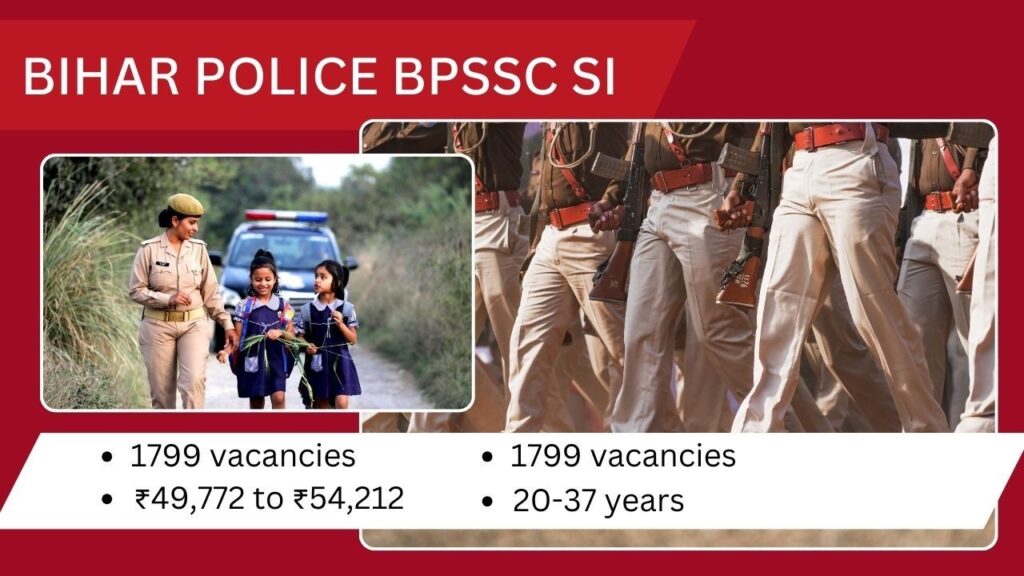
Bihar Police SI: Are you dreaming of Serving your State as a Police? The Bihar Police Subordinate Services Commission (BPSSC) SI recruitment is your best shot at securing a prestigious and well-paid job in the police department. With 1799 Vacancies Released under Advt. This is the high time to apply, as this is to best government jobs in bihar. Let me take you through all the information you need about the SI post from How To Apply to Salary Structure and Career Opportunities.
What Exactly is a Sub Inspector in Bihar Police?
The Sub Inspector (SI), also known as “Daroga” in Hindi, is an important office in the police force that is scathing about peace, social security, and law in their areas of jurisdiction. Consider them as the police station department of operations. They’re not just desk jockeys — SI’s participate in field operations, investigations, and oversee junior officers.
They tend to have their hands in all sorts of things like registering First Information Reports (FIRs), investigating crimes, maintaining law and order, and even supervising constables. From conducting raids, to building relationships with the community, to litigating cases in court, SI’s work is ever-changing and requires one to be physically and mentally strong.
What Does an SI Actually Do?
Let me give you the drab realities of what your daily life as an SI looks like. You’ll have multiple critical jobs to do:
Crime Investigation: After investigating the crimes registered in your jurisdiction, you will be required to register FIRs and collect evidence.
Supervision: You will also be responsible for the supervision of constables and other junior staff, who you will deploy for patrols and duties.
Law and Order: Conducting patrolling at regular intervals so as to check on illegitimate activities and to keep the peace intact.
Court Appearances & Litigation Liaison: Handle routine court appearances and day-to-day inquiries from the court, and monitor court administrative compliance.
Community Relations: Establishing reports with the public and keeping in contact with those who live in an area.
Paper Trail: Recordkeeping, report writing and office work.
Raids & Operations: You will be part of the raids and operations on criminals, but under senior officers.
Basic Eligibility Requirements
Before you start dreaming about recruiting, let’s make sure you meet a couple of very basic eligibility requirements. The good news is that the criteria are straightforward and relatively broad.
Educational Qualification
You are required to have a bachelor’s degree in any stream from a recognized university. It doesn’t matter whether in any stream – arts, science, commerce or else. All that is required is that you have a valid graduation certificate. You can apply if you are in your final year too, but you will have to submit your degree certificate at the time of document verification.
Age Limit
Category
Males
Females
General
20-37 years
Up to 40 years
OBC/EBC
Up to 40 years
Up to 40 years
SC/ST
Up to 42 years
Up to 42 years
Nationality & Other Requirements
you should be an Indian citizen. There is no explicit ban on how many times you can try, just keep in mind you should be within the age limit for each time you apply.
Note: You will be disqualified by the BPSSC at any stage if you are found ineligible.
How to Apply For Bihar Police Subordinate Services Commission (BPSSC) SI?
The Application Process is completely online. Here are the steps:
Step 1: Registration
Then go to the official website bpssc.bihar.gov.in and on the Apply Online link for Sub Inspector (SI) recruitment to apply. Register with your e-mail ID and mobile number and then enter basic details like name, date of birth and address.
Step 2: Pay the Application Fee
The application fee is only ₹100 for all categories, including male, female, and transgender candidates. You have the option to pay by credit card, debit card, net banking or UPI.
Step 3: Complete Your Application
Now we’ll get to the bottom line. Fill in your educational qualifications, address details etc and upload your photograph and signature. Make sure your photo is 3.5cm × 4.5cm and meets the above requirements. You will also need to upload your certificates and documents applicable to that notification.
Step 4: Submit and Save
After reviewing everything, submit. Make a printout of the application form and retain it for your records.
Exam Pattern and Syllabus
To get selected as SI in Bihar police you need to pass through different phases of examination which include your knowledge, physical fitness and your suitability to be the police officer.
Stage 1: Preliminary Written Examination
Prelims is your first step in the race. It is an objective examination having 100 multiple choice questions in the paper worth 200 marks, with 2 marks allotted for each question. You have two hours to take it. The entire examination is based on General Knowledge and Current Affairs and has questions on:
Indian History,
Geography of India,
Indian Polity,
Indian Economy,
Science and Technology,
Art and Culture,
Sports, Awards and recent national and international News.
There’s negative marking – 0.2 marks get deducted for every wrong answer. You must obtain a minimum of 30% marks to be eligible. Around 20 times the number of vacancies (about 35,980 candidates for 1799 posts) will be shortlisted for the mains examination.
Stage 2: Mains Written Examination
Once you clear the prelims, a main examination is held which is tougher and more comprehensive in nature.The mains has two papers, 200 marks each:
Paper I: General Hindi is Preliminaries level to be computed from the following items: grammar, comprehension, vocabulary, synonyms, antonyms and sentence correction. You get 2 hours.
Paper II: General Studies is the second and lengthier paper assessing your knowledge in a wide array of subjects namely Civics, Indian History, Indian Geography, General Science, Economics, Current Affairs, and Mathematics with Mental Ability. This paper also duration of two hours.
All in all, you would be taking 200 questions from both the papers, carrying 400 marks altogether. The qualifying nature of mains is merit based and about 6 times the number of vacancies are called for the physical test.
Stage 3: Physical Efficiency Test (PET) and Physical Standard Test (PST)
Category
Height (cm)
Chest (cm) Min
Weight Requirement
Males (General/OBC/EBC/EWS)
168
79
Proportionate to height
Males (SC/ST)
160
79
Proportionate to height
Females
155
–
Minimum 48 kg
Transgender
As determined
As determined
As determined
Stage 4: Document Verification and Medical Examination
Finally, after you pass the physical standards, you will be subjected to the document verification at which you must bring all your original certificates, and a medical examination to prove that you are physically and mentally capable to perform police duties. The health check includes vision, hearing and general health.
Exam Dates of Bihar Police SI
Remember to appear in The Bihar Police SI Prelims Exam will be held on 18 & 21/January/2026. Two sessions will be conducted on both days:
First Shift: 10:00 AM to 12:00PM (Report at 08:30 AM)
Second Shift: 2:30 PM to 4:30 PM (Report at 1:00 PM)
The admit cards were released on 30th december 2025 so download it from the official website.
Basic Salary Structure
Allowance
Amount (₹)
Basic Pay
35,400 per month
Dearness Allowance (DA)
4,248
House Rent Allowance (HRA)
2,124 to 5,664
Ration Money Allowance
3,000
Transport/City Aid
600 to 1,500
Medical Allowance
1,000
Uniform Allowance
900
Vehicle Allowance
2,500
All these factors combine to result in a monthly salary of ₹49,772 to ₹54,212.
Salary Growth Over Time
The interesting thing is your payslip doesn’t stay the same. You will get yearly bumps to your pay that will keep increasing your basic pay every year. After 5 years of service, with the consideration of increments and possible revisions in DA, your salary in hand may be around ₹58,000 to ₹62,000 per month and more than this with a promotion.
Career Growth of SI
It’s not just the starting salary that makes the job attractive, the role is a springboard to a very rewarding career. The promotion ladder is simple and hierarchical:
SI → Inspector → Deputy Superintendent of Police (DSP) → Additional SP (ASP) → Superintendent of Police (SP)
You advance to a greater pay matrix level with each promotion resulting in tremendous salary hikes. For instance if you are promoted to Inspector your basic pay could rise to a higher stage with which you also get increments in all the allowances.
Promotion is on merit performance on seniority experience and departmental examinations. Good work, solving cases, and maintaining a clean record can fast-track your career.
Conclusion
To be a BPSI is not only a government job but also it is a duty to serve in the society, uphold the law and order and a career opportunity to earn good name with good growth. The pay is good, the work is steady, and the potential for promotion is significant. Here is your opportunity to bring about a change with 1799 vacancies to be filled.
If you are eligible and interested to work hard then no one can stop you from applying. Begin your preparation today, keep on pace and best of luck. The dream to become a Daroga and to make you proud Bihar Police is definitely within your reach!
Nainital Bank Recruitment 2025: Nainital Bank invites applications from eligible candidates for the posts of Clerk CSA, PO and SO. The application process started on 12 December 2025 and the last deadline for applying is 01/January/2026. The candidates need to be 21 years old at least and the maximum age limit is 40 years. For more information visit the official website to see the notification.
Event
Date
Online Apply Start Date
12/December/2025
Online Apply Last Date
01/January/2026
Last Date for Fee Payment
02/January/2026
Exam Date
18/January/2026
Admit Card Release
Before Exam
CSA CLERK Form Fees
Rs. 1000
PO/SO Form Fees
Rs. 1500
The Eligibility For the Clerk CSA, PO and SO Recruitment
The age limit for different posts in Nainital Bank are: While the candidates for the posts of CSA, PO and IT officer must be aged between 21 to 32 years. The age limit for the posts of Manager IT and Manager Risk (Grade-II) is from 25 years to 35 years. Likewise, applicants for the posts of CA or Manager-Law (Grade-II) must be 25 to 40 years of age. Nainital Bank also grant the relaxation of age as per policy.
The agency has declared 175 jobs in different posts. These are 71 vacancies for the post of Customer Service Associate (CSA) / Clerk, 64 vacancies for Specialist Officers (SO) and 40 vacancies for Probationary Officers (PO). Eligible aspirants may apply for the posts applicable to them after reading the instructions.
Follow These Steps To Apply Online
Browse the official website of Nainital Bank and go to the Recruitment tab. Click on the link for Nainital bank Recruitment.
Log in with your username and password and fill out the multi-page form one relevant step at a time with your personal information, education, employment, and post preferences.
Kindly upload your latest passport size photograph and signature in the given format.
Attach you valid documents which support your claim of education qualifications and ID proof.
Pay the application fee online through various payment methods, and finalize the application by click on submit.
After completing your MBA, you may be confused about your career path. Here are the top Government Jobs After MBA, for which you can apply if you are passionate about working in that field. In government jobs you can be worry-less about sudden changes and layoffs in the company like in private jobs. It offers you great perks like professional growth, career stability, and high salaries. There are various roles in the department like HR, Manager, Operations leader, and more. You can choose the career path wisely and check the exams you can take for these roles.
Indian Administrative Services
If you are ready to take on tough challenges for your career then consider possessing the role of IPS, IAS. These roles are highly powerful but hard to get. As an MBA graduate you have already figured out about management, HR, and operations so being an IAS is a responsible role for the nation not just a job.
Eligibility
MBA
Roles
Policy-making, administration, law and order, governance
Salary
₹56,100 to ₹2,50,000/month
Public Sector Banks
It is not a regular desktop job but beyond this. The work related to this role is mostly in Finance or HR. This is a huge role and comes with high responsibility for a person who possesses this job. Public sector banks offer a great opportunity for MBA graduates. These job roles need minds that go beyond the desk job like decision-making and strategies in Finance, HR, and operations.
Exam
IBPS, SBI PO
Department
Risk, finance, HR, marketing
Salary
₹40,000 to ₹90,000/month + benefits
RBI Grade B Officer
RBI Grade B is the best option for MBA graduates as it offers unmatched professional growth. RBI is looking for a person who has great knowledge of your job role. Economics is mandatory because it contains the policies that work for the country. This job offers unparalleled professional growth which involves economic policy implementation, data analysis & financial market operations.
Exam
RBI Grade B
Department
Policy implementation, economic analysis
Salary
₹84,000/month approx + bonuses
PSUs
The Public Sector Undertakings recruitment occurs for various organizations like BHEL, NTPC, and IOCL. Before applying for the role check out everything about the work and exams conducted for this job. Don’t expect start-up thrills in this job but it is a stable and high-paying job. PSUs offer a unique combination of various perks like stability, financial security, and societal impact. If you are seeking a high-impact role then this will be the best option for you.
Exam
GATE
Role
Project Manager, Finance Analyst
Salary
₹60,000 to ₹1,80,000/month
SSC CGL – Group B & C Jobs
MBA grads can end up as Assistant Audit Officers or Income tax inspectors as it requires with their abilities and understanding more clearly their concepts, and experience level they have can get them recruited by the Ministry, CAG, or CBDT. Becoming an Income tax officer or assistant audit officer doesn’t matter because both roles have excessive perks and high salaries. If you want to work in Taxation or Finance, choose ITO for your career growth. Financial or accounting goes with the AAO role mostly.
Exam
SSC
Department
Finance Ministry, CAG
Salary
₹44,900 to ₹1,42,000/month
Indian Railways – Manager & Admin Jobs
The railway is not only about Engineers or technicians. They need a man who can handle the management, finance, or logistics so you might be the one that they’re looking for. Managing tasks in the sector is a high-paying job and also requires expertise in this field. It has diverse operations so work involves handling large-scale projects, and resources optimization. Recruitment for this role through RRB and UPSC exams.
Exam
RRB, UPSC
Role
Operations management
Salary
₹50,000 to ₹1,50,000/month
Defense Forces
If you want a little bit of adventure in your work then you can apply for a job in the Indian Army, Navy, or Air Force through CDS and AFCAT. You are eligible for the posts like Logistics, Accounts, or Administration branches. MBA graduates can take the exam to join the forces and serve in various roles. You can have excellent salary packages with yearly increments.
Exam
UPSC
Department
administrative, accounts, ASC
Salary
₹56,100+ allowances, healthcare, and travel concessions
LIC & Insurance Sector
Some government insurance companies hire MBA graduates for HR roles, and Marketing in government companies like LIC, GIC, AND NIACL. HR and marketing after MBA is a great choice but you handle these roles in the government with a lot of perks like unparalleled stability, competitive pay structure, and opportunity for diverse work exposure.
Exam
LIC AAO
Department
HR, marketing
Salary
₹40,000 to ₹90,000/month + Steady promotions
Indian Economic Services (IES)
This is the best career option for those who are interested in reshaping India’s economic policies and strategies. IES professionals work as economic advisors and planners. They contribute their advice for the financial development of the country. This is an influential job role that blends with intellectual ability to give real-world impact by knacking for economic and public finance.
Exam
UPSC
Department
finance, policy-maker
Salary
₹56,100+ allowances + Post-retirement benefits and pensions
How to Choose the Right Government Job After an MBA?
First of all, you have to match your specialization with your job role. Once you examine yourself with the abilities in which you are perfect, you can get the answer you’re looking for. After choosing the right role, know about the eligibility, exams, and selection process for that particular job role. Think about your aim for the long-term lifestyle.
Top Government Exams MBA Graduates Should Prepare For
UPSC Civil Services Exam
IBPS PO/SO
RBI Grade B
SSC CGL
GATE
AFCAT
CDS
State PCS Exams
Conclusion
You can get a job in the government sector after an MBA but every sector has its respective recruitment process. Check the notification regularly and stay updated with the notices from the official government site. Choose the right career path in HR, Finance, Accounting, Management, and Team leadership. Know your specialization then clear the exam for selection in a government job. Many Indians are preparing for years to get a job in the government sector because it has lots of perks that individuals cannot have in the private sector.