As per the Uttar Pradesh Public Service Commission, English & Biology LT Grade teacher result declaration was held on 24th feb 2026. The merit lists will be available for candidates who appeared in these examinations to check and download from the official website of uppsc. Candidates were required to authenticate the details on the portal in order to view their result. Candidates are suggested to evaluate their result and download it as soon as possible as the merit list will be accessible for a short duration.
Uttar Pradesh Public Service Commission Details at a Glance
Check the Official site of UPPSC: for Obtaining the notification when it is released.
Go to the Results Tab: At the official website, and click on the LT Grade Teacher result
Enter Details: To check your score, you must submit some information, including that related to you such as your Roll Number and Verification Code. (Make sure you submit the same information that was used in your UPPSC Application.
Save or Print Your Result: Obtain your results and take a print out for future reference.
Details Included in the Result
There are many important points of the UPPSC merit list through which the performance and eligibility of the candidates, who appeared in the examination, could be known effectively.
Candidate Roll Number: Providing the roll number of each candidate is a good practice as it facilitates verification and identification of the results.
Candidate Name: The names of qualified candidates in the merit list to be considered for the next rounds of selection process.
Category: The candidate’s category (General/ OBC/ SC/ ST) is also mentioned in the merit list which is considered while checking the rank and the eligibility of the candidate as per reservation policies.
Marks Obtained: This shows the marks obtained by each candidate in the examination, which is important for candidates to know how they performed in the exam and also for the sake of transparency.
Cut-off Marks: In addition, the cut-offs for each category are also provided, i.e., the minimum marks needed to qualify for further process.
Rank: Candidates are ranked on their performance, and such rank becomes the relative position amongst the other candidates.
GovUpdatewala is your trusted source for real-time updates on government exams and jobs in India. We provide verified info on SSC, UPSC, Banking, Railways, Defense, and Teaching exams. From syllabus and patterns to important dates and career tips — we support aspirants at every step.
UPSSSC Excise Constable Recruitment 2026 you are one who desires an opportunity to serve in a conservative but respectable and challenging government job in Uttar Pradesh, then this might very well be the dream you were waiting for. Uttar Pradesh Subordinate Services Selection Commission Notification: Uttar Pradesh Subordinate Services Selection Commission (UPSSSC) has released the notification for Excise Constable (Abkari Sipahi) Recruitment 2026 on 6th April 2026 — a ray of hope for thousands of job seekers.
There are a total of 722 posts in this recruitment which gives an opportunity to eligible and aspiring candidates to join a prestigious organization like Excise Department of Uttar Pradesh. If you are a first time user of government job portals, you must be aware that having a complete knowledge of the recruitment process is very important.
Let’s go deep into the every information you should know about this most expecting recruit – Important Dates, Eligibility, Physical Standards, Exam Pattern.
Overview of the Recruitment
The Uttar Pradesh Subordinate Service Selection Commission (UPSSSC) recruits for the office of the Excise Commissioner, U.P., Prayagraj through its examination. There are 722 posts in all in the General and Special Recruitment category under both the heads. The following is a small report on the distribution of these vacancies:
Category
Total
Unreserved (UR)
246
Other Backward Classes (OBC)
215
Scheduled Castes (SC)
174
Scheduled Tribes (ST)
26
Economically Weaker Sections (EWS)
61
Important Dates to Remember
Deadline disaster is an aspirant’s worst nightmare ever. These dates are for your reference; make sure you mark them down so that you don’t encounter any last minute rush!
Event
Date
Official Notification Release Date
06/April/2026
Online Application Start Date
04/June/2026
Last Date to Apply Online
24/June/2026
Last Date for Application Fee Payment
24/June/2026
Last Date for Application Correction/Modification
01/July/2026
Admit Card and Exam Date
To be announced soon
Don’t wait until June 24 to complete your form. Server traffic is known to spike dramatically in the last few days, which can cause panic and potential payment transaction failures.
There are certain eligibility criteria that the candidate needs to fulfill to apply for this post, as set by the UPSSSC. Prior to collecting your files, make certain that you really meet the following criteria:
Educational Qualifications & The PET Mandate
The most essential list of academic qualifications is quite simple – you should have passed your Class 12th (Intermediate) examination from a recognized board of exat in India.
But here the actual door opener is going to be the UPSSSC PET (Preliminary Eligibility Test) 2025. You should have appeared in PET 2025 examination and possess a valid scorecard with a positive (more than zero) normalised score. If you didn’t take the PET 2025, then you can’t apply for this particular recruitment cycle.
Age Limit
Below 18 Years are not allowed and age relaxation is given for reserved category candidates (SC, ST, OBC) after the maximum age of 40 Years is given for all category candidates.
Note: Having a NCC ‘B’ Certificate will increase your chances for the selection after the examination.
Physical Standards Must Match for Your Job Rules
Excise constables don’t have the luxury of working from the comfort of their desks. It also involves a lot of fieldwork, raids and active patrolling. So the physical standards are a must.
Physical Measurement Test (PMT):
A male candidate should not be shorter than 167.6 cm. The chest size should be 80 cm when unexpanded and 85 cm when inflated (a minimum extension of 5 cm is rigorously enforced). Female Applicants: must have a minimum weight of 45 kg and a minimum height of 152 cm (147 cm for SC/ST categories).
Physical Efficiency Test (PET – Running):
You must be physically fit to complete the given task. If you are giving hours to your study then workouts and running is also important for you to get selected.
For men, 3 miles running complete in 25 minutes
For women, completing 1.5 miles running in 14 minutes
Wanting both the girls and boys to finish the run within a time that indicated their endurance and speed was nothing new. To make sure you are running close to the required standards, start training now.
Selection Process for UPSSSC Excise Constable
The Abkari Sipahi wears the uniform in several rigorous phases of execution.
Your UPSSSC PET 2025 normalized score will solely decide your shortlist. The ones who get shortlisted for the written exam will be formally invited to appear in the Mains examination.
Main Written Exam: The major test on your specialized knowledge which tests your intellectual mettle.
Physical Measurement & Efficiency Test (PMT & PET) : As already told you that the condition of your physical for the post of handling position of will before you that you can bite in a very tough condition.
Checking of Documents and Medical Examination: The final administrative and medical examinations before the letter of appointment.
Understanding the Exam Pattern
The Main Written Exam is intended to test your overall general awareness, general logical reasoning and specialized subject knowledge to a large extent.
Parameter
Details
Total Questions
100 Objective MCQs
Total Marks
100
Duration
2 Hours (120 minutes)
Negative Marking
¼ deducted for each incorrect answer.
The syllabus is too broad. Part 1 includes History of India, Geography, Current Affairs, Data Interpretation, and a few legal issues related to the Policies of Uttar Pradesh excise. In Part 2 you are examined on your Computer and IT skills, and Part 3 is devoted to UP-specific General Knowledge.
Step-By-Step Application Process
On 4th June 2026 the application window will be opened, follow these easy steps to apply for yours so effortlessly:
Access the Official Website: Visit the official site of UPSSSC at upsssc.gov.in.
Get the Notification: Check latest announcement for Excise Constable (Aabkari Sipahi) Recruitment 2026 for the available vacancies.
Authentication: Sign In with your UPSSSC PET 2025 Registration Number. This is important, you basic information will be extracted and updated.
Complete the Form: Write and recheck every information about education and personal details carefully to avoid any errors.
Upload the Documents: Photo and Signature must be in a mentioned formatted size to scan and upload.
Fee Submission: The fee is astonishingly low—just ₹25 for all categories (General, OBC, EWS, SC, ST and PH). This basically works like an online processing fee. You can also make use of Credit/Debit card, Net Banking, UPI or SBI E-challan.
Send once Finish: Check all your entries carefully. When you are perfect,submit the form and get the print out for your future reference.
To crack the exam, you need to prepare yourself with the right strategies before applying for this post. So you can make a place for yourself among 722 people. Here are some pro tips to help you prepare:
Equalize the Plane and the Bookcase: During study don’t forget about the material world. Intervals Start Adding To Your Running Stamina Early. One big mistake many candidates make is to start campaigning only after the written exam results are out.
As UP GK and state excise law covers major parts of the syllabus, you by reading specialized books on these topics can gain a good hand over other competing candidates in the examination.
Accept Mock Tests: Blind guesses are detrimental since there’s 0.25 negative marking. Logical elimination will also be studied and time management by giving mock tests.
Keep Up: Allocate 30 minutes daily to read newspapers, focusing on national news and technical advancements as a portion of the syllabus to follow current affairs.
Conclusion
The UPSSSC Excise Constable Recruitment 2026 is a great opportunity for all the candidates who have the PET 2025 scorecard and pass class 12th. That is a rare combination of work profile that is active, societal respect and job security.
The notification is already out and the application window will open in June, so the clock is ticking. Collect your required materials, plan your daily study routine and begin your physical training regimen now. All you need to do to take advantage of this opportunity and walk away with a fulfilling career for life is be consistent, disciplined, and have the right strategic thinking.
The Common Admission Test can open the doors for India’s most prestigious colleges. Students get stressed with the syllabus most of the time and get confused, so it is important to know the CAT exam syllabus 2025 section-wise. This can help you understand the important topics that must be considered prior while preparing. The powerful strategy to prepare for any competitive exam is according to exam pattern. Read the full article to assess this knowledge which can help you beat the CAT exam.
It’s not about a lot of time and resources, just the right planning to assess important knowledge is required. Whether you are an average student or brighter one but CAT is not that simple as you think. Masters from top colleges matter in your placement. If you really want to take admission in an MBA or other postgraduate program, you need to clear the CAT exam.
Exam Pattern Overview
CAT is conducted online through a computer-based test format. The total 68 questions come in the examination which get distributed into three sections. This 120 minutes exam carries 204 marks to decide your future in your education journey. However 40 minutes is given for each section with +3 marks if the answer is correct but negative marking of -1 for each wrong answer. There’s no negative marking for TITA (Type In The Answer) questions.
Section-wise Distribution
Verbal Ability & RC carries 72 marks for 24 question Data Interpretation & Logical Reasoning carries 66 marks for 22 questions Quantitative Aptitude carries 66 marks for 22 questions
This section covers 36% of the paper. It focuses on RC more than grammar means 16 questions come from the Reading comprehension so it covers 66% of VARC section. While Verbal ability covers 33% of the section. The reading comprehensive features 4 passages with 4-5 questions per passage. The topic in these passages is almost relevant to niches like economics, psychology, literature, and current affairs.
Verbality Ability comprises 8 questions From:
Para summary question
Para jumbles
Odd sentence out
Sentence completion tasks
Section 2: Data Interpretation & Logical Reasoning (DILR)
This section 32% of the exam paper and considered most unpredictable questions come from the Data Interpretation & Logical Reasoning section. While the questions are in the sets of 3-4 questions, making it difficult to solve easily.
Topics of Data Interpretation & Logical Reasoning questions:
Data Interpretation
Logical Reasoning
Tables and charts analysis
Puzzles and arrangements
Bar graphs and pie charts
Seating arrangements
Line graphs and scatter plots
Blood relations and family trees
Caselets with numerical data
Coding-decoding problems
Syllogisms and Venn diagrams
Section 3: Quantitative Aptitude (QA)
Quantitative aptitude holds 32% weightage in the paper. It covers Arithmetic and Algebra topics, making it the hardest section.
Topics of Quantitative Aptitude Questions
Arithmetic (8-9 questions)
Algebra (5-7 questions)
Geometry (2-3 questions)
Modern Mathematics
Ratios and Proportions
Linear equations and inequalities
Coordinate geometry
Permutations and combinations
Percentages and their applications
Quadratic equations
Mensuration
Probability
Profit, Loss, and Simple/Compound Interest
Functions and graphs
Triangles and circles
Logarithms and surds
Time, Work, and Distance problems
Progressions and series
Mixtures and Allegations
Topic-wise Weightage Analysis
Highest Priority Topics:
Reading Comprehension
16 questions
Arithmetic
8 questions
Algebra
5-7 questions
Puzzles & Arrangements
8-10 questions
Medium Priority Topics:
Data Interpretation
8-9 questions
Geometry
3 questions
Verbal Ability
8 questions
Lower Priority Topics:
Modern Mathematics
2-3 questions
Number Systems
1-3 questions
Effective Preparation Strategy
Preparing for the CAT isn’t that easy but with right strategy planning you can clear out the exam. There is no need to rote memorization because these subjects require focus and proper time to understand every concept.
CAT needs comprehensive preparation with proper time duration like 6 to 9 months. Know your weaknesses, so you can distribute your time more on that topic. Divide all three sections with specific duration to complete your preparation properly.
Deep analysis and carefully 2-3 Reading comprehension daily is important
Solve 2-3 sets of Data Interpretation and logical reasoning to understand and filled in your brain
Daily solve at least 15-16 questions from the quantitative aptitude section. Try to solve easy problems first then go to the hard topics.
Mock Test Strategy
After preparing for 2 months, get ready to take mock tests section-wise and extend your mock test practice before the exam. Because analyzing every question helps you keep remembering the concepts and maintain your confidence.
Resource Selection
Choose online resources to prepare fast because the latest notes and mock tests can help you a lot during preparation for the CAT exam. Stick to single quality resources, don’t switch every time and focus on concept clarity rather than multiple resources and question papers.
Conclusion
Success in CAT requires strength, strategic preparation, and daily practice for clearing every doubt. Focus on high priority topics first then move on the medium priority to balance every section easily. Remember that quality study is more helpful to clear the exams rather than a lot of study material and wasting time on unnecessary topics. So, it is important to prepare according to the CAT exam syllabus 2025 section-wise for best outcome.
If you’re curious about what it takes to be a Human Resources (HR) professional, you’re in the right place. Over the past 10 years, the HR Professional Courses has undergone significant transformation, shifting away from an administrative role to gaining importance and recognition as a strategic business partner in organizational culture, employee satisfaction and business performance. This all-in-one resource will take you through the Need to Knows of building a fulfilling HR career in India, whether you are a fresher exploring career options or a career changer seeking a meaningful direction.
What Does an HR Professional Actually Do?
Before we get into courses and salaries, let’s demystify the day-to-day life of a HR professional. Despite the stereotype that human resources is just paperwork and policies, HR employees today wear many hats. You will participate in strategic talent acquisition to seek and recruit candidates aligned with company values and who will drive growth. You’ll design and deliver programs to upskill the employees, mentor junior staff, and help them grow their career within the company.
On the compliance and policy side, you will be monitoring the company’s compliance with labour laws, conducting employee relations with tact, mediating disputes equitably and managing the full spectrum of employee life from hiring to offboarding. Compensation and benefits policies are your domain too: You develop the strategies, coordinate the performance reviews, and you can even assist with organizational development by working with your leaders on future staffing and succession planning. In today’s world of data and analytics, many HR professionals are also utilizing analytics to monitor indicators such as employee engagement, retention rates and hiring effectiveness to drive additional business improvements.
The joy of human resources is that each day is different, with issues ranging from handling a difficult employee complaint to developing a creative new-hire program or spearheading an organization-wide change effort.
Educational Roadmap To Become HR Professional
The great thing about HR career paths is that there is no single “correct” path. To your education and current level of career aspirations, you can add several points of entry:
After 12th Grade
If you have completed the high school you can go for the Diploma in Human Resource Management. These 1-3 year courses are available at a cost of Rs 50,000 to Rs 2,00,000 according to the classification of institution as a government or a private one. Alternatively, you can do 3 years of Bachelor’s degree (BBA, BA, BS) in HR or something related. Government College fee is goes from ₹1-8.5 lakhs and for private college fee is from ₹3-16.25 lakhs.The eligibility criterion is generally 50-60% in 12th class.
For Graduates
If you already hold a bachelor’s degree (in any stream as per your undergraduate major), you can go forward for professional certificates or a post graduate diploma. A professional certificate of 6-12 months costs between ₹20,000 and ₹1,00,000, while a post graduate diploma for 1-2 years is valued at ₹50,000-₹1,20,000. These courses are great if you want to make a move into HR for then a full 2 year MBA.
MBA / PGDM Route
If you are looking for an overall business education with focus on HR, a 2 year MBA or PGDM in Human Resources fees vary from ₹ 2-27 lakhs based on the tier of the college and the location. These programs on the repel need entrance exams as CAT, SNAP, MAT, or XAT. Top tier institutions such as IIM, XLRI have higher fee yet provide excellent placement package and networking.
Professional Certifications
Professional certification is also valuable in addition to formal education. The popular certification include CHRG (Certified Human Resource Generalist) which has fees of ₹50,000-₹2, 00,000.
The CHRM (Certificate in Human Resource Management) is priced at ₹90,000-₹8,00,000 and the CHRP (Certified Human Resource Professional) costs ₹80,000-₹4, 00,000.Two globally-oriented credentials that also have value on an international basis are the SHRM-CP (Society for Human Resource Management Certified Professional) and the aPHR (Associate Professional in Human Resources) both of which are recognized by employers in many countries around the world.
Eligibility Requirements You Need to Know
For Diploma Courses: You need to pass 12th grade exam with minimum 45% in aggregate.
For Bachelor’s Degrees: Obtain 50-60% in 12 grade; some colleges require entrance exams.
For M.B.A. Directly after 10+2: Achieved a minimum of 60% in your 12th grade exams; passed entrance exams such as CAT, MAT, SNAP, or XAT.
HR-Related Certifications: Many certifications such as SHRM-CP have prerequisites of at least 3 years of HR work experience in an HR function, whereas entry-level aPHR caters to HR novices or individuals beginning their journey in HR.
Starting Salary For HR
Entry level HR professionals in India get a good pay as per market standard. An HR fresher gets a salary in the range of ₹15,000-₹30,000 per month, which comes around ₹3-5 LPA per annum. However, this might differ drastically depending on a few things such as:
By Role: HR recruiters and coordinators normally begin with salaries of ₹18,000–₹26,000 per month and HR analysts with good technical skills can make ₹25,000–₹35,000 per month from the very start.
By Education: Tier-1 MBA (HR) pass-outs have high salary prospects of ₹30,000–₹40,000 per month and BBA or BA grad can make ₹18,000–₹25,000 per month.
By Industry: It is not always that an HR company gives you a chance but you can get IT, finance and e-commerce industries offer for an HR with starting pay of ₹28, 000 to ₹35, 000.
By Location: Metrocities like Bengaluru and Delhi offer great pay to HR Professionals.
Career Growth
Indian HR salaries have increased 24% from 2019, this is higher compared to IT sector’s 6.5% CAGR. This signals the rising level of strategic importance that HR has in organizations.
Career Progression Timeline
Start as an HR Assistant or Coordinator (0-2 years), then advance to HR Generalist or Specialist (2-10 years) in areas such as L&D Manager or Recruiter, then go to HR Manager or HR Business Partner (5-10 years) and subsequently to executive positions which include Director, Head of HR, or CHRO (10+ years).
Salary Growth by Experience
A fresher can typically expect a starting salary of ₹3–5 LPA. As you gain more experience, this can be anywhere from ₹11-15 LPA at HR Manager level, ₹20-25 LPA in senior specialist roles and anywhere between ₹40-150+ LPA for CHRO of a large company. The steepest rise in salary is generally seen between 10 to 13 years of experience- whereby the median CTC varies around ₹38 LPA.
Emerging High-Growth Specializations
For maximum growth, strategic HR roles are the way to go. HR Analytics Managers earn ₹40-60 LPA, Salary & Benefits Managers earn ₹28-42 LPA, and Diversity & Inclusion Managers earn close to ₹20 LPA. These positions are growing at 15-22% per year because they have a direct effect on business results.
Conclusion
The Job growth of approximately 7% over the next ten years will add about 17,400 new jobs and is expected for the HR occupation. Instead of being automated out of existence like some admin jobs, strategic HR roles are increasingly precious. You get to work with people, solve truly complex organizational issues, shape company culture, and have a tangible impact on whether employees are happy at work.
”The investment, be it ₹50,000 for a diploma or ₹20 lakhs for an MBA, gets returned fast in the form of a competitive pay package and strong career growth. More than who you’re working for, it is the work, financial and personal fulfilment you are creating.
First, decide on the HR professional Courses that best matches your current qualifications and your career timeline, learn core HR skills to get started, and don’t overlook the impact certifications can have in helping you stand out.
Get ready to secure a UPSSSC Lower PCS job to enjoy purposeful life in Uttar Pradesh. UPSSSC UP Combined Lower Subordinate Services (Graduate Level) recruitment is live right now, you can fill the application now. But you must understand each phase of selection, eligibility and preparation to pass the exam.
With 2,285 vacancies up for grabs, this is one of the biggest opportunities of the year for graduates looking to secure a Group ‘C’ administrative foothold in the state.
What is UPSSSC Lower Subordinate Services? (Job Profile)
The Lower Subordinate Services recruitment fills different positions in state government offices. There are most common job roles such as executive, supervisory, and auditing that require candidates who can immediately step into the work to handle public services, implementing government schemes, and making sure rules and policies are followed properly.
The roles are just simple desk jobs, they offer executive authority to tackle every task. Depending on your qualification and ranking, you could land any of these roles:
Executive Officer (Municipal Administration): Manages urban local bodies, public civic amenities, and local revenue collection.
Mandi Supervisor / Amin: Oversees agricultural market regulations, auction fair play, and revenue reporting for the Mandi Parishad.
Assistant Consolidation Officer (Chakbandi): Resolves land disputes, manages agricultural land redistribution, and maintains accurate land maps.
Who Can Apply? (Eligibility Criteria)
Before you hit apply, ensure you tick all the structural requirements set by the UPSSSC:
Educational Qualification
Mandatory Foundation: You must hold a Bachelor’s Degree from a recognized Indian university.
The PET Gateway: The Main exam needs a valid PET scorecard otherwise they will not let you enter in the exam hall.
Post-Specific Extras:
For Auditor/Accountant: You must hold a B.Com degree.
For Mandi Supervisor: Degree in Agriculture, Commerce, or Economics with a minimum of 50% marks.
Executive Officer: A computer ‘O’ Level diploma is required for service confirmation.
Age Limit (As of July 1, 2026)
Minimum
21 years
Maximum
40 years.
Age relaxation given to reserved categories ( OBC, SC, ST, )and Ex-Servicemen
Important Dates & How to Apply
The application window is brief, so do not leave things to the final day when servers traditionally crawl to a halt.
Application Starts
29/May/2026
Last Date to Apply
18/June/2026
Correction Window Last Date
25/June/2026
Admit Card
Update Later
Step-by-Step Application Process
The Commission relies heavily on your existing PET data to make authentication seamless:
Authentication via PET: Go to the official portal at upsssc.gov.in. Use your PET-2025 Registration Number to login for UPSSSC Lower PCS.
Check Details: Information about your qualification, photograph, caste category are automatically filled from the PET database. Verify everything carefully and fill out any pending post-specific preferences.
Submit Processing Fees: Pay the standard online processing fee of ₹25 for all categories via net banking, UPI, or credit/Debit cards. Note: Shortlisted candidates will pay the structural Main Exam fee later.
Final Printout: Review your final application form, submit it, and download/print the confirmation form for verification rounds.
Vacancy Matrix (2,285 Posts)
The vacancies span several state departments, providing brilliant diversity in career paths. Here is how the open positions look across major segments:
Department / Board
Post Name
Vacancies
Directorate of Treasury, UP
Assistant Treasury Accountant
548
Cooperative Societies & Panchayat
Accounts Inspector / Auditor
419
State Agriculture Mandi Parishad
Amin / Auctioneer / Clerk
552
Municipal Administration Directorate
Executive Officer
238
Office of Consolidation Commissioner
Assistant Consolidation Officer
168
Other Allied Departments
Technical Assistants / Supervisors
360
Selection Process & Exam Pattern
Getting selected requires navigating a clear, objective framework. There are no interviews for these Group ‘C’ cadres. Your merit relies entirely on written execution.
Step 1: Get UPSSSC PET 2025 Scorecard first
Step 2: Give Main exam and secure good marks
Step 3: Document Verification to check all the information is valid in your application.
The Exam Blueprint
Prepare yourself with understanding the topics that are important in this exam, Lower PCS exam pattern includes:
General Intelligence & Reasoning: to test your logic ability and analytical thinking.
General Knowledge (GK): knowing about your Uttar Pradesh is important to handle any work regarding the state. So increase knowledge in Indian History, Geography, Polity, Economy, and Uttar Pradesh’s History, Administration, and Culture.
General Science & Arithmetic: basic level physics, chemistry, biology, and math.
General Hindi: Focuses on comprehensive reading, letter writing, grammar (Sandhi, Samas, Muhavare), and vocabulary translation.
Strategic Preparation Plan
The competition is high so you have to make a plan that helps you achieve good scores over fractions of marks. Here is a realistic roadmap:
Own the UP Specific Section: Knowledge of the state will let you secure 20-25% of GK questions. Research and keep updated with Uttar Pradesh’s budget, schemes, geography, and cultural folklore. Dedicate solid hours to local current affairs.
Do Not Avoid Hindi: General Hindi is highly scoring. Mastering basic grammar rules and practicing official letter formats can drastically push your score above average cut-offs.
Analyze Mock Tests Weekly: Build your speed and precision. Track where you lose marks to negative scoring and adjust your accuracy levels accordingly.
Let’s talk about the rewards. Apart from massive social prestige, these positions offer financial stability governed by the 7th Pay Commission.
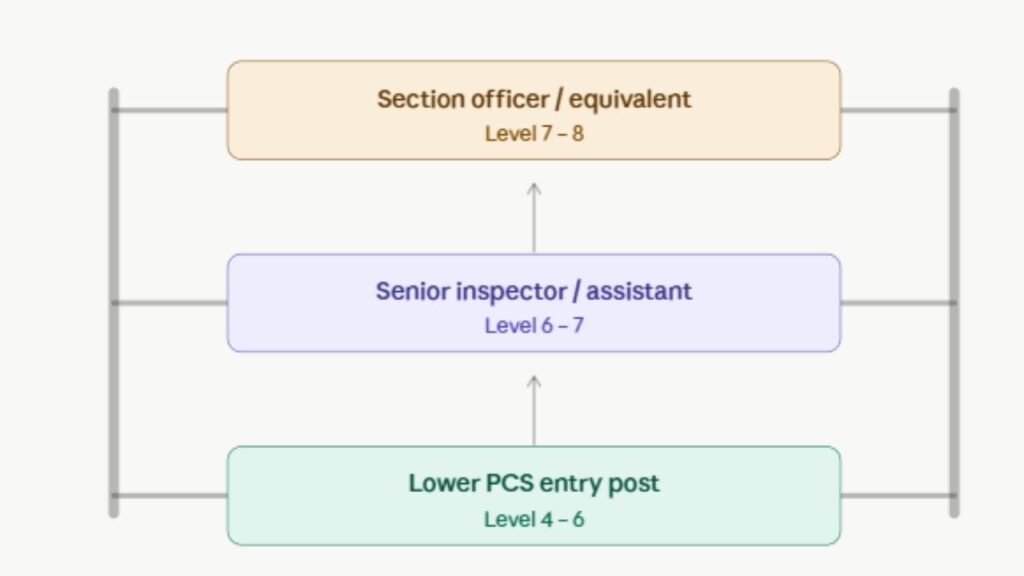
The salary of Uttar Pradesh. Combined Lower Subordinate Services (Graduate Level) are based on their job profile and experience but it ranges between Pay Level 4 to Level 6.
Level 4 (Clerks/Typists)
₹25,500 – ₹81,100
Level 5 (Accountants/Amin)
₹29,200 – ₹92,300
Level 6 (Executive Officers/ACO)
₹35,400 – ₹1,12,400
In-Hand salary will increase because of the multi allowance you will get once you are assigned to your job. So the entry-level gross salaries range from ₹35,000 to ₹55,000 per month depending on city tiers.
The Promotion Ladder
Your career trajectory doesn’t stall. Junior officers systematically advance through departmental reviews and service experience:
Conclusion
The UPSSSC UP Combined Lower Subordinate Services (Graduate Level) Recruitment is a cycle that ends in a few days and you need to fill the form if you don’t want to miss this opportunity to secure a career in Uttar Pradesh. The competition is very high for the 2,285 seats, so the right strategy to prepare for the exam is mandatory.
Ensure your application goes through successfully before June 18, lock down your study desk, and start structured preparation today. For a comprehensive breakdown of the syllabus, safe score metrics, and targeted departmental tactics, check out this detailed UPSSSC Lower PCS Strategy Guide which covers exactly how to maximize your score in the Mains exam.
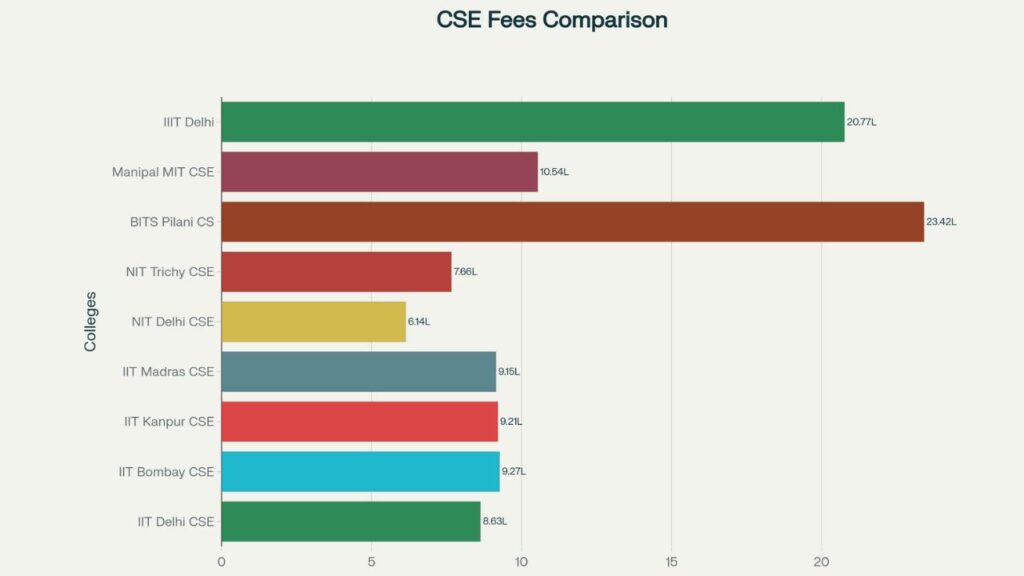
B.Tech CSE Fees at IIT Delhi is one of the best quality top engineering program in India which is given at a very affordable fee. It is the cheapest for the top tier IITs with an overall 4-year cost of ₹8.63 lakhs. For SC/ ST students and MCM scholarship holders, the amount could come down by the fee till ₹4.5 lakhs and 5.3 lakhs respectively. IIT Delhi offers great value for money in education, in comparison to private universities such as BITS Pilani (₹23.42 lakhs) and IIIT Delhi (₹20.77 lakhs).
Total Course Fees For IIT Delhi B.Tech CSE
Tuition Fee
8,00,000
Caution Deposit
8,000
Registration, Library, Exam Fees
54,550
Total Academic Fees
8,63,000
Full fee ₹2.28 lakh for the first year payable in installments at two end semesters. This covers tuition and a set of one-time fees. From the second year on, you will be required to pay around ₹2 lakh per year.
Total Cost For The Entire B.Tech Course From IIT Delhi
Category-Wise Fee Structure
General and OBC Students
₹8.63 lakhs for 4 years
SC/ST/PwD
₹62,550 for 4-year
The perks include a full waiver on the tuition fees, which is a saving of ₹8 lakhs. Also, the hostel seat rent is waived for the students whose family income is below Rs 8 lakhs per annum, thus assuring affordable accommodation. Added to this, basic free messing, which includes the core meals of the hostellers. In addition to this, there is also a pocket allowance of ₹1,000 a month to cover incidentals.
Hostel and Living Expenses
Old Hostels
38,580 for one Semester
New Hostels (Non-AC)
41,580 for one Semester
New Hostels (AC)
52,980 for one Semester
The rule for most first year students is to stay in hostels, and they are levied per semester with mess services included. Based on the hostel chosen, the fees for 4 years or 8 semesters are somewhere in the range of ₹3,10,000 to ₹4,20,000. It also includes a one time hostel deposit of ₹22,000 that has a refundable security deposit of ₹15,000 and a non-refundable BHM fee of ₹7,000.
Complete 4-Year Cost Estimate
Academics
8,63,000
Hostel
3,50,000
Grand Total
1,213,000
Various Scholarship Options For IIT Delhi Students
Merit-cum-Means Scholarship
Students who belong to the low income family and want to pursue B.Tech, M.A, M.Sc, and MPP can access this scholarship for their studies. A monthly stipend of Rs 4,000, or Rs 48,000 per year is given to almost 25% of students. The tuition fee waiver of 8 lakhs completely for the entire course is a huge support. The maintenance of the minimum CGPA or SGPA of 6.0 and a valid proof of income are the prerequisites for renewal of the financial aid. The aim of the program is to encourage bright and ambitious students to pursue higher education and reduce their financial difficulty.
Donor-Funded Scholarships
Scholarship Name
Annual Amount
Key Eligibility
ABB Scholarship
Up to ₹1,00,000
Merit & financial need
Bina Dewan Singh Scholarship
Up to ₹1,00,000
Female students, financial need
Budhwanti Mrig Memorial Award
Up to ₹1,00,000
Exceptional merit
Buti Foundation Scholarship
Up to ₹75,000
Specific criteria
CS&E 1998 Batch Scholarship
Varies
CSE students specifically
Keswani Scholarship
Up to ₹1,00,000
Merit-based
IITDAA Scholarship
Up to ₹1,00,000
Alumni-funded, merit-based
IIT Delhi vs Other Top Engineering Colleges Fees
B.Tech CSE Fees Comparison Across Top Engineering Colleges in India
IIT vs IIT Comparison
IIT
B.Tech CSE Tuition (₹L)
Total 4-Year Cost (₹L)
Rank
IIT Delhi
8.00
8.63
#1 (Most Affordable)
IIT Madras
8.00
9.15
#2
IIT Bombay
8.50
9.27
#3
IIT Kanpur
8.50
9.21
#4
IIT vs NIT Comparison
College
Total 4-Year Cost (₹L)
Average Placement (₹ LPA)
ROI Advantage
IIT Delhi CSE
8.63
₹20-25
Best balance
NIT Delhi CSE
6.14
₹15-18
Lower package
NIT Trichy CSE
7.66
₹14-17
Lower package
IIT vs Private Colleges Comparison
College
Total 4-Year Cost (₹L)
Cost Relative to IIT Delhi
IIT Delhi CSE
8.63
Baseline
BITS Pilani CS
23.42
272% Higher
IIIT Delhi BTech
20.77
240% Higher
Manipal MIT CSE
10.54
122% Higher
BITS Pilani is costly by ₹14.79 lakhs in comparison to IIT Delhi for the same course. BITS, which charges higher fees also does not have the global brand value or the placement numbers of IIT Delhi.
Fee Payment Schedule for semester-wise
To simplify budgeting for families, the fee is charged twice a year on a per semester basis. The tuition fees for 1st semester is ₹1,00,000. There are also one-time charges between ₹25,000 and ₹30,000.
The fees for students who choose hostel accommodation is from 38,580 to 52,980. So, the total charges for the first semester will be between ₹1,63,000 and ₹1,83,000. The main fees range is around ₹1,38,000 including hostel fees from the second semester because the tuition fee is Rs. 1,00,000 per semester and a one time charge of Rs. ₹25,000-30,000 is removed.
Similar structure continues for all the semester throughout the course.
IIT Delhi’s CSE Program Worth the Cost
Outstanding Placement Record
The top tech firms are known to offer packages in the ballpark of 70+ lakhs per annum, and the program has an amazing average package of 20-25 LPA which is among the best in India. It still has over 98% amazing placement with prestigious, elite firms. Graduates typically recoup their ₹8.63 lakh outlay by four to five months post-graduation, ensuring substantial returns on though investment (ROI). The alumni base is also global and large too, with alums working at top companies including Google, Microsoft, Apple, Amazon, Goldman Sachs, McKinsey, and the list goes on.
Research and Innovation Ecosystem
Students get access to world-class labs and research facilities Opportunities in AI, cybersecurity, cloud computing and other emerging tech areas. Partnerships with industry and government; externally funded research projects Industry collaborations and funded research projects.
Conclusion
IIT Delhi’s B.Tech CSE program provides the highest return on investment in India for all the engineering courses. While the total 4-year fee is a bargain at around ₹8.63 lakhs compared to the pricier private schools like BITS Pilani or IIIT Delhi, in exchange, students get world-class teaching, cutting-edge research and excellent placement opportunities.
Top recruiters are packing in an average of ₹20-25 LPA and up to ₹70 LPA. The B.Tech CSE at IIT Delhi is considered to be the best and most lucrative engineering degree in India owing to its high placement rate and affordable tuition fees.