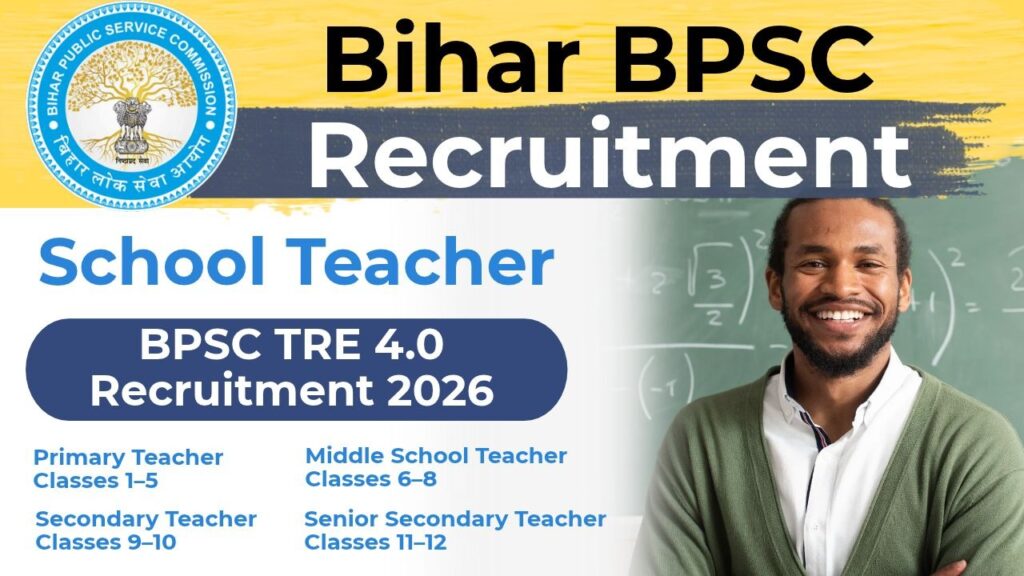
Candidates who still don’t fill the form of Bihar School Teacher Recruitment Exam 2026 can fill up now. The application window will be closed on 3 November 2026. Check if you fall into the eligible candidates, if not then apply when you get eligible. If yes, then don’t let this opportunity go away.
Check the vacancy breakdown, eligibility column, application fee, selection process and exam pattern to apply for BPSC TRE 4.0 Recruitment 2026.
Particulars
Details
Recruitment name
BPSC TRE 4.0 / School Teacher Recruitment Examination 2026
Conducting body
Bihar Public Service Commission (BPSC)
Advertisement number
15/2026
Posts
Primary, Middle, Secondary and Senior Secondary School Teachers
Classes covered
Classes 1–12
Total vacancies
33,320 posts, as per the revised/updated recruitment reports
Bihar BPSC School Teacher TRE Recruitment 2026 Dates
Event
Date
Official notification release
22 September 2026
Online application start date
25 September 2026
Last date to pay application fee
2 November 2026 (extended)
Last date to submit online application
3 November 2026 (extended)
Written examination
December 2026–January 2027, expected
Application Fee For Bihar School Teacher Recruitment Exam
Rs 100 for all the category students but there is ₹200 biometric fee which means the total fee amount will be Rs 300 to pay online to proceed with the application.
Candidates Post-wise Eligibility
There are four multiple level teaching posts which require that level of knowledge and education qualification so the table below mentions the necessary qualifications which must be in your resume to allow you for this exam.
Post
Key qualification
Primary Teacher
Class 12 with D.Ed/JBT/B.El.Ed and CTET/BTET Paper-I
Middle School Teacher
Graduation with B.Ed/B.El.Ed and CTET/BTET Paper-II
Secondary Teacher
Graduation with B.Ed/B.El.Ed and STET Paper-I
Senior Secondary Teacher
Postgraduate degree with B.Ed/B.El.Ed and STET Paper-II
Age is given to few categories as per Bihar government norms. But the age limit for Bihar School Teacher Recruitment Exam ranges between 21–37 years.
How to Apply For Bihar School Teacher Recruitment
Visit the official BPSC website and complete One-Time Registration (OTR).
Fill in personal, educational and category details.
Upload photograph, signature and required certificates.
Pay the application fee online by 2 November 2026.
Review and submit the application by 3 November 2026.
What is The Post-wise Vacancy Breakdown
There are a total 33,320 teacher posts under BPSC TRE 4.0 2026 recruitment drive. Check the post-wise vacancy breakdown to know the competition heat.
Teaching post
Classes
Vacancies
Primary Teacher
1–5
3,847
Middle School Teacher
6–8
8,563
Secondary Teacher
9–10
4,370
Senior Secondary / Higher Secondary Teacher
11–12
16,540
Total
1–12
33,320
BPSC revised the vacancy number with adding 493 posts for Classes 9–10 and 439 posts for Classes 11–12.
Selection Process and Exam Pattern
There are four stages in the Bihar School Teacher Recruitment selection process. First candidates have to pass the written test when they get a good score and find their name in the merit list, document verification and medical examination happen to verify your details you put in the application. fitness and health also require you to teach students.
You are notified through the official website of the recruitment organisation. The final merit list will be declared and if you have passed all three stages then you are eligible for teaching in a Bihar government school.
Bihar School Teacher Recruitment Exam pattern will help you understand how you are going to attempt the question and complete it on time. Also prepared according to the sections.
Teaching level
Paper structure
Questions / Marks
Duration
Primary Teacher, Classes 1–5
Language (qualifying) + General Studies
30 + 120 = 150
2 hours 30 minutes
Middle School Teacher, Classes 6–8
Language (qualifying) + General Studies + Concerned Subject
30 + 40 + 80 = 150
2 hours 30 minutes
Secondary Teacher, Classes 9–10
Language (qualifying) + General Studies + Concerned Subject
30 + 40 + 80 = 150
2 hours 30 minutes
Senior Secondary Teacher, Classes 11–12
Language (qualifying) + General Studies + Concerned Subject
30 + 40 + 80 = 150
2 hours 30 minutes
The language section carries 30 marks and it’s easy so you can secure it first.
General studies carries 40 marks for 6 — 12 classes teachers and 120 marks for primary teachers so keep yourself updated with the current events that especially happened in Bihar.
Concerned subject means your choice of subject which carries 80 for 6—12 marks teachers so prepare your preferred subject well enough to secure full marks.
All questions are multiple-choice/objective type.
Candidates should always check the notification updates and admit card release so they won’t miss anything.
If you are heading towards your teaching career then the Bihar School Teacher Recruitment Exam is an opportunity to secure a seat to become eligible to teach in a government school. But you must carry the necessary documents in your hand and be willing to beat the competition. Check instructions on how to apply for BPSC TRE 4.0 Recruitment 2026.
Law students in Uttar Pradesh can hurry to secure their prestigious job in the High Court of Judicature at Allahabad (Prayagraj). This is the most respected High Court in the country, now recruiting candidates for through Allahabad High Court RO / ARO / CA Recruitment 2026 drive for Review Officer which is a higher post among these two, Assistant Review Officer which also has a good salary but lower position than RO, and Computer Assistant (CA) posts.
You can apply until 21/June/2026 and the exam date will be announced soon. Check the official site of National Testing Agency (NTA) which conducted this exam for a total of 543 vacancies. Whether you’re a student, government job seeker, a working professional, this blog will help you understand if you are eligible, selection process, and pay scale.
The notification of Allahabad High Court RO / ARO / CA Recruitment 2026 covers three distinct administrative posts within the court. The Assistant Review Officer position has more empty seats to fulfil than the other two posts — Review Officer and Computer Assistant. Let’s look into Category-wise breakdowns.
Technical / IT Support PostComputer Assistant (CA)
Supervises and manages the work of AROs and other staff in the assigned branch of the High Court.
Works directly under the Review Officer and assists in day-to-day court administrative functions.
Ensure every system works properly from the High Court’s administrative to judicial departments.
Scrutinises legal files, case papers, and judicial orders for accuracy and completeness before they move up the chain.
Handles file movement, case listing, and maintenance of court diaries and cause lists.
Manage and maintain every data into the digital server to keep it secure.
Position requires experience and intellectual mind to assist judges and judicial officers in related cases.
Handling Review Officers documents, notices, and orders accordingly.
Operates and maintains any system or devices of the high court.
Prepares summary notes, reports, and dispatches official correspondence on behalf of the court.
Assists in maintaining legal records, dispatch registers, and correspondence files.
Online tracking of the case and court’s e-court maintained with CA’s help.
Working officially with registry, accounts, and record rooms to ensure smooth workflow.
Answers queries from lawyers and people of the particular case.
Supports in managing the court’s official website data, cause list uploads, and digital notices.
Every record is moved under the eye of RO as he/she responsible for official records of the branch.
Best for beginners to understand the judicial administration process.
Responsible for maintaining computer lab infrastructure and providing basic troubleshooting support to staff.
Career Path: ARO → RO → Senior RO → Deputy Registrar (via departmental promotion)
Career Path: ARO → Review Officer → Senior Section Officer
Career Path: Computer Assistant → Senior Computer Assistant → IT Officer
Eligibility Criteria – Who Are Eligible?
Submitting an application isn’t enough if you have missed any of the following from your resume. Check down the eligibility requirement one-by-one for all the posts then apply for the position that fits you.
Educational Qualification
For RO & ARO posts: Bachelor’s Degree with computer knowledge & O‑level/DOEACC certificate to work in the office.
Computer Assistant (CA): Any Bachelor’s degree along with Diploma in Computer Applications OR BSc (Computer Science)/BCA.
Knowledge of Hindi in Devanagari script is generally required for all posts.
Age Limit (as on 01 July 2026)
RO & ARO
21 — 35 years
Computer Assistant
18 — 35 years
SC/ST (UP): Upper age relaxation of 5 years (max 40 years)
OBC (UP): Upper age relaxation of 3 years (max 38 years)
Nationality & Domicile
Any Indian citizen can apply for the job.
OBC, SC, ST, EWS category candidates are applicable only to domicile residents of Uttar Pradesh.
Only the general category of other states can apply for this job.
Computer Proficiency
A basic computer proficiency certificate/diploma is generally required for RO and ARO posts as part of eligibility under the service rules.
For Computer Assistant, a proper knowledge and certificate of Diploma in Computer Applications (DCA) are mandatory OR any degree in computer science/IT.
Hindi & English typing speed must be fast because it tests on a selection stage for relevant posts.
Exam Schedule & Key Dates
On 1st June 2026, the application form started to fill out. If you want to apply, complete your application as soon as possible. Check all important dates announced so far. Exam dates for the written test and skill test will be communicated via admit cards on the NTA portal.
Notification Released & Online Application
01/June/2026
Last Date to Submit Online Application
21/June/2026
Last Date for Fee Payment
22/June/2026
Admit Card Download
To Be Announced
Examination
To Be Announced
How You Get Selected
The selection process for all three posts is difficult but once you understand that properful, your mind will be prepared for it. The multi-stage process starts from the written exam and important stage which shortlisted you for the following qualifying skill test and document verification.
Here’s how the process works:
Stage 1: MCQ-based exam as part one of the paper, conducted in CBT mode by NTA. It covers 200 questions for 200 marks, you must complete in 3 hours 20 minutes.
Stage 2: Computer Typing Test is the second part of the exam which is conducted on the same day as the written exam for RO/ARO and it gives 50 marks. Test your Hindi and English typing speed and accuracy.
Step 3: Part B only qualifies you but the merit list is prepared on Part A (CBT) scores, so prepare every topic well enough. Only candidates who clear the skill test (qualifying) are included in the final merit list.
Step 4: The next stage is document verification for the Shortlisted candidates. The authorities will check your certificates, adhaar, and category documents that must be produced.
Step 5: Candidates who clear all stages and are found medically fit are issued appointment letters by the High Court Registrar General’s Office.
Exam Pattern :
Exam Type
Single Stage Examination (2 Parts on the same day)
Part
Part I (Written)
Part Format
200 MCQs
Part I Marks
200 Marks
Part I Subjects
General Knowledge, Hindi, English, Legal Knowledge, Computer Awareness, General Science, History, Geography, Polity, Economy, Current Affairs
Part
Part II (Skill Test)
Part II Nature
Qualifying
Part II Marks
50 Marks
Negative Marking
Not confirmed yet — check the detailed notification
Application Form Step-by-Step Guide
Visit the official site to find “AHC RO/ARO/CA Recruitment 2026” links and click on it.
Make a new registration for yourself and put your valid email or number.
Your account is created after verification through OTP then login.
To enter the rest of the information about yourself, login with the same registration email.
Recheck your details – personal, educational qualifications, category, and the post you are applying for.
Scan required documents and upload it and pay the application fee – ₹1,200 for General/OBC candidates and ₹1,000 for SC/ST/EWS.
After successful payment, submit the form and download/print the confirmation page. Keep it safely for future reference.
The salary will be distributed under 7th Pay Commission structure. In addition to the basic pay, employees are entitled to multiple allowances which significantly boost the in-hand salary.
Review Officer (RO)
Asst. Review Officer (ARO)
Computer Assistant (CA)
₹47,600 – ₹1,51,100
₹44,900 – ₹1,42,400
₹25,500 – ₹81,100
Pay Matrix Level 8
Pay Matrix Level 7
Pay Matrix Level 4
Conclusion
The Allahabad High Court RO / ARO / CA 2026 is the highest Ranked job notification in the year in the state of Uttar Pradesh from the UPSC and any other central government agency. The State Judicial Services has notified 543 vacancies and it is one of the best paying jobs under 7th Pay Commission with the stability and prestige of a career in judicial sector, so the rewards and stakes are high.
Whether you are trying for the senior Review Officer position, the ARO job both entry level and extremely rewarding, or the computer-centric Computer Assistant job – the window to apply is open now and slamming shut in just three weeks. Start your preparation now, keep an eye on the official website and fill the application form accurately in every aspect.
If you began your preparation for the IBPS PO with the mock tests of the last year, then your syllabus is already out of date with yesterday’s blueprint. The IBPS PO MT XVI cycle for 2026 has evolved quite a bit in terms of number of vacancies, in the Mains exam, and even in the rounds after the interview, so aspirants who do not revise their strategy might find themselves sitting in the exam hall solving a paper that is no more.
Here are the real differences this time around and what that means for how you prepare.
What Changed in IBPS PO MT XVI 2026
The IBPS PO MT XVI detailed notification was published on 30 June and 01 July 2026 on ibps.in, inviting applications for the posts of Probationary Officer and Management Trainee in 11 participating public sector banks for the recruitment year 2027–28.
The total number of vacancies mentioned in the first notification was 6,715. That figure has since shifted — as per the 20 July 2026 update from IBPS, the number stands at 7,365, which is approximately 29% more than last year’s intake.
Two banks, UCO Bank and Union Bank of India, had not yet submitted their vacancy numbers as of this update, so the final count may change once more before the end of the process. Bank of Baroda, Canara Bank, and Bank of Maharashtra currently have the largest number of vacancies.
The date for application also got extended. It was initially scheduled to end on 21 July 2026 but IBPS extended the last date to 26 July 2026. This year also brings something new with effect: a two-day correction window post registration closure, so candidates who find an error in their form after submission are not doomed by it.
Important Dates for IBPS PO MT XVI Recruitment 2026
Milestone
Date
Detailed notification released
30 June – 1 July 2026
Online application window
1 – 26 July 2026 (extended from 21 July)
Preliminary exam
22 & 23 August 2026
Main exam
4 October 2026
Personality Test / Interview
To be announced
Treat the interview and personality test dates as provisional until IBPS confirms them closer to the Mains result — that stage of IBPS PO MT XVI typically gets scheduled bank-wise, so your call letter will carry the exact date and centre.
Eligibility Criteria
To apply for IBPS PO MT XVI Recruitment, you need a graduation degree in any discipline from a recognised university, with your mark sheet or provisional degree certificate in hand at the time of registration — IBPS doesn’t accept “result awaited” candidates.
The age bracket is 20 to 30 years as on 1 July 2026; the usual government relaxations for reserved categories apply, but confirm the exact slab-wise relaxation against the official notification PDF rather than assuming it mirrors last year’s, since IBPS has been known to revise fine print between cycles.
The application fee is ₹175 for SC/ST/PwBD candidates and ₹850for everyone else, payable online through the IBPS portal.
Salary and Pay Scale
An IBPS PO MT XVI Recruitment selected candidate shall begin at the basic pay of ₹48,480. When DA, HRA and other allowances are included, the salary comes to around ₹74,000-76,000 per month in-hand, although it may vary based on place of posting and allowances structure of individual banks.
The Exam Pattern For IBPS PO MT XVI Really Diverges From Last Year
Prelims remains the same. It’s still 100 questions for 100 marks on English Language, Quantitative Aptitude and Reasoning Ability, with 60 minutes for the duration which is divided into three separate timers of 20 minutes each. A ¼ mark will be deducted for each wrong answer and your Prelims score is only a qualifying hurdle — it is not taken into account for the final merit list.
Mains is what makes IBPS PO MT XVI Recruitment seem an altogether different exam. The objective paper has increased from 145 questions to 170 questions, while the total marks remain 200 in a duration of 160 minutes. The English Language now asks more questions but awards fewer marks – 20, down from 40, so that each English question is worth less than it ever was.
General/Economy/Banking/Digital/Financial Awareness has been increased to around 50 questions for 60 marks and is one of the heaviest sections in the exam and also Data Analysis & Interpretation has been given more marks.
The subjective paper remains 25 marks for 30 minutes, although sources vary on whether it’s essay writing and comprehension or if it includes letter writing — do confirm this with your admit card and the official notice when released, don’t take either version for your final source of information.
Selection Process: Four Stages, Not Three
Where IBPS PO MT XVI Recruitment used to run Prelims, Mains, and Interview, this cycle adds a fourth step: a Personality Test, conducted after Mains and before the interview. It’s mandatory for anyone shortlisted, but non-qualifying — its purpose is to hand the interview panel a personality profile rather than to filter candidates out on its own.
The interview itself is still conducted by the individual participating banks, and you’ll need at least 40% to qualify (35% for SC/ST/OBC/PwD candidates).
Final merit combines Mains and Interview scores in an 80:20 ratio — Prelims marks play no role beyond getting you through the door.
One Preparation Tip You Shouldn’t Skip
Don’t wait until after Prelims to deal with the Mains shift. Because Banking Awareness and Data Analysis & Interpretation now carry noticeably more weight in IBPS PO MT XVI’s Mains paper, block out a fixed weekly slot — even 30 minutes, three times a week for RBI circulars, recent monetary policy changes, and current banking-sector news, starting today rather than after Prelims is done.
Candidates who leave Banking Awareness for a last-minute cram before Mains are the ones most exposed by this year’s restructured weightage.
The vacancy count for IBPS PO MT XVI Recruitment isn’t fully locked yet, with two banks’ numbers still pending, and the interview-stage calendar hasn’t been released. Keep checking ibps.in directly rather than relying on secondhand vacancy figures as you get closer to results — in a cycle with this many moving parts, the official notification is the only version worth trusting completely.
Conclusion
The IBPS PO MT XVI Recruitment 2026 notification came with more vacancies and a new selection process, so it is a good chance to grab for banking aspirants. Check your eligibility, apply online, and start preparing for Prelims and the revised Mains exam today.
There might be updates for vacancies and schedules from IBPS’s side, so keep visiting the official site for the latest notifications and do not trust other websites.
If you are among the lakhs of aspirants who are going to appear in the UPSSSC PET Syllabus 2026 exam, you are already aware of the procedure — this exam is the filter. Clear it and a plethora of Group B and Group C government jobs in Uttar Pradesh awaits you. If you fail to clear it, and none of those Mains exams even become an option.
This is why having a proper understanding of the syllabus From day one is more important than just diving in and doing some random practice sets.
So, let’s analyze the UPSSSC PET Syllabus 2026. What is asked in the exam, marks distribution of each section and how you should prepare to crack the exam.
What Exactly Is UPSSSC PET?
UPSSSC PET refers to the Preliminary Eligibility Test, which is organized by the Uttar Pradesh Subordinate Services Selection Commission. Think of it less as a “final” recruitment test and more as a preliminary screen.
It’s compulsory — you cannot even fill out the application form without a valid PET scorecard. If you pass the PET test, your score is good for three years, so you can use it to apply for multiple positions during that period without having to retake the test.
The examination is offline on pen and paper using OMR sheet and it is for basic level aptitude and general awareness and not for anything very technical or domain specific.
Exam Pattern: The Numbers You Need to Know
Before diving into subjects, it helps to understand the shape of the paper:
Feature
Details
Total questions
100
Total marks
100 (1 mark per question)
Duration
2 hours
Negative marking
0.25 marks deducted for every wrong answer
Question type
Objective, multiple-choice with four options
That quarter of a mark negative marking is worth remembering — guessing blindly can damage your score, so accuracy is as important as speed here.
Subject-Wise Breakdown
The UPSSSC PET Syllabus is spread across roughly 15 sections, each with a fixed number of questions and marks. Here’s how it typically looks:
Indian History & Indian National Movement (5 questions, 5 marks each — 10 total) This spans a broad history, including the Indus Valley Civilization, Vedic culture, Jainism/ Buddhism, and leaves off at the Maurya, Gupta, Mughal dynasties and the freedom struggle. Questions on the Swadeshi Movement, Civil Disobedience Movement and the rise of revolutionary nationalism, the Quit India Movement, personalities like Netaji Subhash Chandra Bose and the Azad Hind Fauj.
Geography (5 questions, 5 marks) Topography of India and the world, lakes and rivers and their valleys, underground water, Himalayas, deserts, minerals, political mapping, weather conditions, India Times, and population trends and movements of people.
Indian Economy (5 questions, 5 marks) This is a narrative of India’s economic path from 1947 to 1991 and thereafter — the Five-Year Plans, the mixed economy model, the green revolution, bank nationalization, the 1991 economic reforms, and more recently GST and post-2014 structural/sector reforms.
Indian Constitution & Public Administration (5 questions, 5 marks) The Fundamental Rights and Duties, Directive Principles, parliamentary and federal system, relations between the Union and the States, the judiciary, and local government through Panchayati Raj institutions.
General Science (5 questions, 5 marks) Basic Physics, Chemistry, and Biology — roughly at a Class 12 difficulty level, so nothing too advanced, but you do need conceptual clarity.
Elementary Arithmetic (5 questions, 5 marks) Integers, percentages, basic calculations, square and cube roots, powers, means and such basic and general topics in math.
General Hindi (5 questions, 5 marks) Grammar-related — synonyms, antonyms, one-word substitutions, gender differentiation, homophones, idioms, and proverbs, frequent mistakes, and quizzes on famous writers and their productions.
General English (5 questions, 5 marks) Basic grammar rules along with an unseen passage to test comprehension.
Logical Reasoning (5 questions, 5 marks) A fairly mixed bag — blood relations, coding-decoding, number series, syllogisms, venn diagrams, direction sense, puzzles, statement-conclusion questions, and hysteresis. .
Current Affairs (10 questions, 10 marks) World and national events — that’s where being on top of the recent news really serves you well.
General Awareness (10 questions, 10 marks) A miscellany of neighboring countries, capitals and currencies, Indian states and UTs, national and international day, sports, art and culture, awards, famous books and authors and environment related issues.
Hindi Unseen Passages (10 questions, 10 marks) Two comprehension passages in Hindi to test reading and interpretation skills.
Graph Interpretation (10 questions, 10 marks) Two graphs, testing your ability to read and analyze data quickly.
Table Interpretation (10 questions, 10 marks) Similar to graph analysis, but with tabular data instead.
The following three sections — passages in Hindi, graphs and tables — carry 30 marks in total. That’s almost a third of your total marks, and it’s often the section that candidates underestimate the most.
Considering how dispersed this syllabus is, trying to learn everything at the last minute is just not going to cut it. A better way to think about this is to think of this as a marathon, not a sprint:
Prioritize the data interpretation sections. As graphs, tables and Hindi passages are for 30 marks, regular practice in this section can give you an advantage over other candidates who concentrate only on GK.
Don’t skip static GK for the sake of current affairs. History, geography, economy, and polity constitute 20 marks, and these topics remain static — once you study them thoroughly, they are yours forever.
Revise Hindi grammar rules actively. Many candidates, especially those confident in Hindi, tend to get careless here. Small grammatical nuances trip people up more often than expected.
Practice with a timer. Two hours for 100 questions sounds comfortable, but data interpretation and comprehension sections eat up time fast if you’re not used to them.
Use previous year papers. They’re one of the best ways to understand the actual difficulty level and question framing, rather than relying purely on assumptions about what “might” come.
The UPSSSC PET Syllabus isn’t designed to be intimidating — it’s designed to test whether you have a well-rounded, functional understanding of general knowledge, basic aptitude, and language skills. The trick isn’t studying harder in isolation; it’s studying smart, giving weight to sections based on their actual mark share, and revising consistently rather than in bursts.
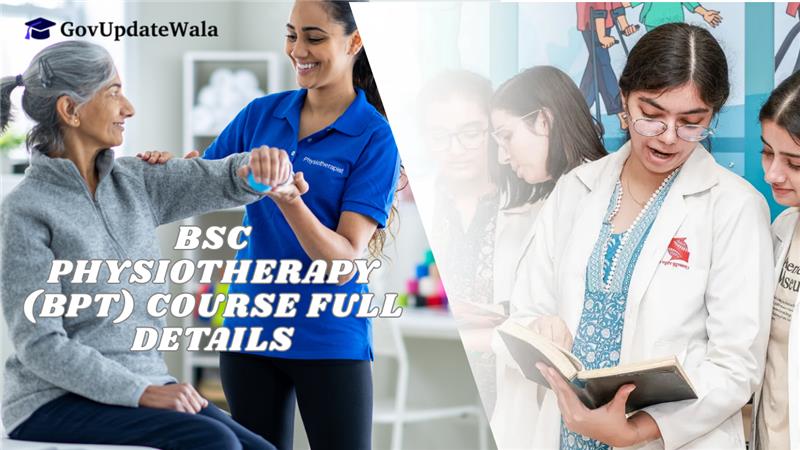
BSc physiotherapy is a 4-year undergraduate professional course, that can be opted by those students who wish to pursue a career in healthcare services or wish to provide care to patients through physical rehabilitation and therapeutic care. The course gives you a thorough knowledge of human body anatomy, movement science and modern physiotherapy techniques as medical science and clinical practice. Due to increasing emphasis on physical well-being, rehabilitation, and sports medicine, physiotherapy has become a well-established and sought after profession and BSc Physiotherapy is a particularly good academic option for students who take interest in patient care, science of recovery and holistic health.
Overview of BSc Physiotherapy
The bachelor’s degree in physiotherapy is an application of clinical and science based physiotherapy. This course is conducted for four years both for theoretical sessions and practical training where the course participants learn basics of anatomy and physiology as well as methodology of physical therapy.
Students also complete clinical placements or internships where they have the opportunity to work with patients who have a range of bodily ailments. This practical experience is key to acquiring the skills you need to become a physiotherapist.
Course Curriculum for BSc Physiotherapy
The BSc Physiotherapy course combines theory and practice in equal measure to develop sound clinical and professional competence. It begins with core modules in anatomy, physiology, biochemistry, pharmacology, assessment techniques, research methodologies, and communication skills in order to build a robust base.
Students also take higher-level courses in rehabilitation techniques, therapeutic interventions, sports physiotherapy, kinesiology, and biomechanics in the second year. It also involves clinical training with practical placements, enabling students to put their knowledge into practice in real-life healthcare environments. Assessment of learning in physiotherapy is by written papers and practical examinations and project work, all of which are designed to ensure students’ all-round competence in the practice of physiotherapy.
Eligibility for BSc Physiotherapy
The requirements for admission to a Bachelor of Science (BSc) in Physiotherapy would vary from one institute to another and is subject to the individual decisions of the institute.
Basic academic requirement: candidates generally should have completed their 12th-grade higher secondary education with not less than 50% aggregate in science stream.
Requirements for Subjects: Apart from the total percentage, he/she has to compulsorily pursue some core subjects in class 12. The essential subjects to be studied usually are:
Physics
Chemistry
Biology
These are important subjects because they help you learn basics which are required to know the human body, its functions and scientific rules which are applied in physiotherapy.
Further Information: Vocational qualifications such as BTECs may be accepted by some institutions in addition to or in place of equivalent qualifications, subject to their individual application requirements.
The best universities might also have additional requirements such as entrance examinations (NEET, CUET, or state-level exams) or interviews to assess candidates.
Admission Process in Best Universities of India
Admission for the BSc Physiotherapy course is based on entrance exam conducted either by individual colleges or through centralized examination system.
These are the most common entrance exams:
NEET
CUET
KCET
IPU CET
LPU NEST
Application Process
Get/Download the Application Form: Students can either download the application form for the respective college or university from the official website or they can get the application form from the college or university itself by visiting the institute.
Submission of Documents: Documents to be submitted are usually the Class 10 and Class 12 mark sheets, photographs, identity proof, etc. as per the norms of the institution.
Entrance Exam: Aspirants need to take the designated entrance test by the specified deadlines of the college/university.
Cut-off list/Interview: When the entrance examinations are over, the college may announce a cut-off list/interview for finalizing the admission on the basis subject and other criteria.
Confirm Admission: After this, the qualified candidates have to confirm their admission by submitting the requisite fee and the formalities for the same are provided by the concerned institution.
Fees Range in India’s Best Colleges
In India, the BSc Physiotherapy course fees in the top institutes are generally in a range of INR 50,000 – 3,00,000 per year depending on whether it is a government or private institution.
Some of the top ranks such as All India Institute of Medical Sciences (AIIMS) and Christian Medical College (CMC) can command fees on the higher end of this, while others have much lower overall costs of training due to government subsidies.
All in all, the expenditure of Bsc Physiotherapy Education varies in different countries and institutions and it is recommended to explore each college for further information about tuition fee and living expenditure.
Future Opportunities
Career Focus with BSc Physiotherapy in India
BSc Physiotherapy is a good career option and has a very bright future in India as the demand of qualified physiotherapists is increasing all over the world. Graduates have several options to choose from, including options that are designed to work with patients that have different needs and in different healthcare environments.
Clinical Physiotherapy
One of the primary career opportunities is that of a Clinical Physiotherapist, which allows the graduates to work in hospitals, clinics and rehabilitation centers. Physiotherapists assess and treat patients in institutions, but may also be employed as independent consultants. Students can assess as orthopedics, neurology, pediatrics, geriatrics, and cardiopulmonary physiotherapy.
Sports Physiotherapy
Another important area is Sports Physiotherapy which relates the treatment and prevention of sports injuries. Sports physiotherapists work with athletes to improve performance and prevent injuries and they may be found working with sports teams and gymnasiums.
Rehabilitation Therapy
Rehabilitative is a key discipline the physiotherapists are concerned with rehabilitation and restoration of motion and function to people. Physiotherapy is important for post operative rehabilitation after surgery. It helps to regain function, manage pain and discourage complications, which are essential elements in the promotion of the best recovery.
Academic and Research Opportunities
The graduates can also go for academics, and teach the candidates in Physiotherapy in colleges and universities. Opportunities for higher education like MPT (Master of Physiotherapy) or even PhD will also add on to career options.
Government and Private Sector
BSc Physiotherapy graduates can apply for jobs in both the government and private sector. Qualified physiotherapists are in demand in government hospitals, health campaigns, non-governmental organizations (NGO), but they also have important positions in private clinics, companies, health care programs and sports clubs.
Career Focus with BSc Physiotherapy Abroad
Working abroad can increase chances of finding a job for physiotherapy graduates. Countries like Australia, Canada, Germany and Switzerland are very friendly to international physiotherapists and in many cases allow for foreign trained professionals to obtain licensure.
Professional Growth
Professional development is necessary in the field of physiotherapy. Additional to the physiotherapy degree, many physiotherapists also get specialised qualification/education in the field of paediatric physiotherapy, geriatrics or rehabilitation to name a few.
Work within international physiotherapy organizations and/or attend workshops or conferences in a foreign country to further your career development and to acquire a competitive advantage make you more marketable as a graduate when you’re seeking employment.
Salary Expectations
In India, a physiotherapist’s average annual salary is INR 1,018,527 (USD 12,300). Fresher physiotherapists are paid around INR 15,000 to 25,000 per month (varies as per employer and city conditions) or can get a stipend from the higher education institute from where they had studied.
With more experience, salaries are estimated at INR 50,000 – 80,000 per month.
Canadian physiotherapists can count on earning from $70,000 to 85,000 USD, which is quite a high salary when compared to that of other countries. Newly graduated physiotherapists in Australia generally earn a salary of around AUD 65,000 which grows significantly for more finding its way to up to around AUD 140,000 in senior positions or clinical educators.
Physiotherapists in Gulf countries like Saudi Arabia, UAE, Qatar, also enjoy good pay scales. Staff physical therapists in these areas typically make between USD 3,500 and 5,000, while senior therapists could be paid up to 6,000 USD or more per month.
The salary forecasts for physiotherapists indicate a wide range depending on region of work, sector specialisation and level of experience.
BSc Physiotherapy Comparison with BPT
The BSc physiotherapy is more a scientifically based approach covering a wide range, but the Bachelor of Physiotherapy (BPT) is also mixed with a considerable amount of practical training, which focuses on the therapeutic procedures and assessment methods required in the industry. BPT courses may also focus on the use of physiotherapy in different clinical areas so graduates can find employment there too.
The BPT course is innovatively crafted which equips students not only with theoretical knowledge but also with practical expertise required to evaluate, diagnose and treat various physical disorders, thus it is a good option for students who want to pursue a career in which they help patients regain mobility and quality of life vision enabled by physical rehabilitation.
Overall, BSc and the BPT in physiotherapy provide different routes to a career in physiotherapy BSc offers a wider scientific base and BPT concentrates more on clinical aspects and therapeutic procedures. Both courses could lead to rewarding careers in the ever changing area of physiotherapy, specific to the interests and talents of the graduates.
Conclusion
BSc Physiotherapy is a great opportunity to explore what a rewarding healthcare career could be like, with well-rounded knowledge in sciences, clinical practice and career types. Physiotherapy today is a dynamic and expanding profession all over the world including our country with multifaceted activities starting from hospital, sports rehabilitation to research, academic and international exposure.
Whether students are going into clinical practice, further education, or opportunities abroad, they will graduate from this program with the knowledge, skills and confidence to guide their growth. In essence, BSc Physiotherapy it not just a degree—it is a journey to a rewarding career dedicated to improving mobility, health and quality of life.
This is not merely a comparison of two exams — SSC vs UPSC, it’s a life long career decision which makes you a completely different person in a very different category. But preparation for each exam is tougher than you can think of. So, if you are investing your time, money, mind and health in building something then choose wisely after a deep research.
Oh, I’ve seen people lose their mid-20s to these books. To assist you in determining which “beast” is worth your sanity, let’s take a look under the hood of what you will actually be asked to do on these exams in 2026.
The Nature of the Struggle
Government jobs are a result of both, but the type of mental strength needed is different.
UPSC: The Marathon of Depth UPSC isn’t an exam, it’s a personality overhaul. It wants you to have an opinion on the morality of AI and the irrigation regimes of the 16th century. This is a three-stage process which requires your ability to think.
SSC: The Sprint of Precision
SSC CGL is like being a human calculator with the reflexes of a pro gamer. It’s a “Group B” and a “Group C” race where velocity is primacy. Solving, strategic methods, and puzzle-like questions are given for UPSC to check the ability of candidates.
Numbers Matters in SSC vs UPSC
In SSC
The UPSC examination is considered the “rock face” in the mountain climbing of exam-taking required fortitude to overcome it. Whereas the SSC CGL is compared to a fast-flowing river, representing a different type of challenge because of the sheer number of applicants. With a mind boggling 15 to 20 lakh candidates competing for a mere 8,000 to 10,000 seats, the contest is cutthroat and requires equal parts of strategy and determination.
It’s like repulsive physics up here. There are a lot of competitors out there and you have to beat them (1000) to secure your space in UPSC but SSC have only 200 to beat. “Better odds,” right? Not exactly. Since the SSC syllabus is more “teachable,” the difference between the topper and the person who misses out is often as little as half a mark. One bad day, one slow calculation, and you’re out.
In UPSC
UPSC seems like a high-brow, high stakes game of poker. There are 10 to 12 lakh people applying every year. The final list is made up of only around 1,000. That equates to a success rate of 0.1%.
To give you some perspective, you are more likely to be struck by lightning in some parts of the world than to find your name in the PDF. It’s a “predictable brutality” — you know the mountain is cruel, you know most people fall off, and you accept heartbreak as part of the journey.
The Intellectual Demands
UPSC doesn’t matter whether you have memorised a date; it wants to know whether you know why that date changed history.
The Connection Game: You are not just learning Economics; you’re learning how a global oil crunch pinches a farmer in Vidarbha. You are not just studying Geography; you are seeing how climate change is redrawing political maps.
The “Mains” Marathon: Think 20 essay-style answers, in three hours — again, for five days in a row. You have to sound like a policy analyst, a philosopher and a centrist bureaucrat all at once.
Most former aspirants have said that It’s not the facts you need to know, It’s an opinion that sounds both brash and impeccably centrist. You have to give them exactly what they want and not make it look like you’re trying too hard.
If UPSC is a philosophical discussion then SSC is like 100 meter race. Raw, mechanical speed is far more important than intellectual “depth.”
The Human Calculator: In the Quantitative Aptitude section, you are required to solve 25 difficult problems in 15 minutes. There’s no time to “think” about the beauty of a formula; you either know the shortcut, or you’re out.
The “Autocorrect” Reflex: The English portion is not about enjoying literature. It’s about finding a grammatical mistake faster than a spell-checker.
It’s less about “understanding the world” and more about pattern recognition. You practice until your hands are faster than your mind.
The Duration of Torture
That is where SSC will tend to actually trump in “demanding” level status, ironically enough.
An informed crack at UPSC lasts 12 to 18 months. If you flop Prelims, you start the cycle all over next year. If you crash Mains, you wait for another year. It’s a sadistic but a defined loop.
The SSC exams in 2017 were also postponed to the year of 2022, that means you can be stuck for three years with no reason in just one attempt due to paper leaks and re-exams. The unpredictability as to when one’s work will be judged is in stark contrast to the regimented, mechanical routine of the UPSC exams, which prevent candidates from experiencing such wait-weariness.
Fees and Investments
Prepping for the UPSC is like holding a blue-chip stock that might plummet to zero. The Price Tag: Between coaching fees and the rent exploding in Delhi, you’re talking about ₹2-3 lakhs a year, no sweat.
The “Social Contract”: What it means for most families is a dowry or a deposit on a house. They’ll for 2 or 3 tries because the payoff—the white curtained car, the bungalow, the prestige—is the ultimate Indian trophy.
The Normalized Sacrifice: The ecosystem has made it “okay” to miss out on your mid-twenties making zero rupees as your parents raid their retirement accounts. It’s a visible, high-stakes investment.
SSC preparation is “cheaper” in theory, but it exacts a much higher price from you: your energy. An Income Tax Inspector or a CBI Sub-Inspector draws a decent, respectable income. But let’s get real: you don’t get the mandatory red beacon and the massive government complex that signify “success” in the local Whatsapp group.
As a result of the stakes feeling “lower,” a lot of SSC aspirants don’t have the luxury of studying for 12 hours in a library. They study on the Metro, they do math problems on lunch breaks at a soul-crushing 9-to-5, they record English vocabulary to listen to on their commutes.
The tiring juggle of working a dead-end job and studying for a high-speed competitive exam goes unseen. Nobody throws a party for the guy who hit the books after working a 10-hour day, but that mental fatigue is totally unbeatable.
Factor
UPSC Investment
SSC Investment
Financial Cost
High (Coaching + Living)
Low to Medium
Time Cost
3–5 years of “Gap”
1–2 years (often while working)
Social Payoff
Generational Shift
Upward Mobility
Safety Net
Usually Parent-funded
Usually Self-funded
Mental Health is Also at Risk
Above all the books and the balances, there is a still, psychological tax that these exams extract every day. It’s the sort of stress that doesn’t appear on a marksheet, but you can see it in the way an aspirant’s posture evolves over three years.
The UPSC doesn’t merely consume your days, it seeks to consume your spirit. After five years of informing relatives that you are “preparing,” you stop being a person who has hobbies, a favorite sport, or a personality. You become a “Potential Officer.” Your entire worth is tied to a PDF list that comes out once a year.
Losing is not just about getting fired; it feels like the universe is telling you that you’re not good enough. The Interview (Personality Test) is the ultimate mind-game. You sit opposite senior bureaucrats who will determine whether you possess “Officer Like Qualities” in a 30-minute conversation. It makes you question everything you say, every way you sit, and, eventually, who you really are.
While UPSC is a question of identity, SSC is a matter of looking over the shoulder all the time. It’s an anxiety rooted in volume and mathematical enigma.
The Notification Trap: CGL, CHSL, MTS, GD, Stenographer— the notifications never end. It seems like you’re always “missing out” on something. If you are not submitting it, you are running late. It’s what makes life feel like an endless assembly line of exams.
The “Normalization” Nightmare: This is where the despair kicks in. Comprising multiple rounds of examination in several shifts, the commission “normalizes” everyone’s scores. You could get 180/200 on a “hard” shift and 190/200 on an “easy” shift and still not know how you did.
Mathematical helplessness: You can calculate your raw marks the moment the answer key comes out, but you have no idea whether the “system” will lift you up or knock you down. It’s like running a race where you determine the finish line by how everyone else ran.
That’s what the coaching institutes don’t tell you: both exams are turning out to be less about merit and more about stamina. What separates someone who clears these exams from someone who doesn’t is often not intelligence, but the means to sit at a desk for 10 hours a day, to put off weddings and festivals, to see friends get promoted while you take mock tests.
The hardest exam is the one that you’re failing right now. That one that keeps you up at night wondering whether you burned out your best years. It’s the one that your parents increasingly ask “beta, backup plan kab banaoge?”.
In my opinion, do not move towards picking what others say, just analyze what’s right for you. Which type of job role you are interested in and the kind of life you want. UPSC gives you the authority to shape policy. SSC gives you the security to design your own life. Both are valid. Both are brutal. Both will take everything you have — and then ask you for more.
Conclusion
SSC vs UPSC If intellectual rigor and prestige pressure are what make the examination “demanding,” then UPSC wins hands down. You have to read newspapers as if they were religious texts, you have to learn subjects ranging from anthropology to zoology, and you have to gain the ability to talk about Indo-China relations with diplomatic nuance.
But if “demanding” means the intensity of competition, the unpredictability, and the absolute pain of outlasting millions, then SSC could be even more brutal these days. The exam has turned into a default choice for every graduate who wants a government job security without the elitist obstacle of the UPSC. The result is a bloodbath of competition, where even 99 percentile scores sometimes do not guarantee selection.