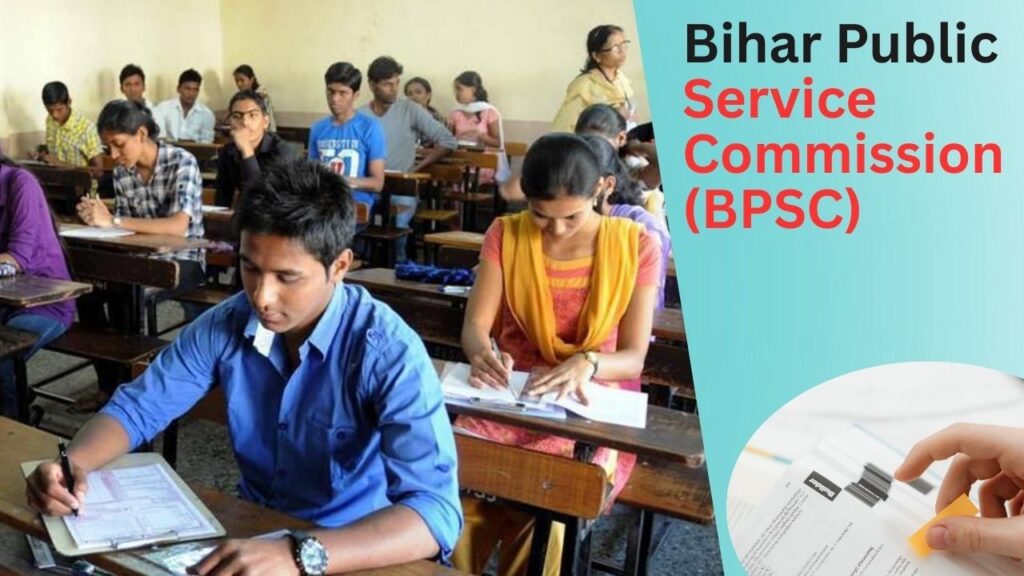
Bihar Public Service Commission (BPSC): Full Form, Exam, Eligibility & Selection Process

Bihar Public Service Commission (BPSC)

If you are among those dreaming for a Bihar government job then you must have heard about BPSC exams. Perhaps you observed some of your friends studying thick books or maybe you stumbled across those BPSC Toppers interviews that suddenly fill your YouTube recommendations list. You have to know that Bihar Public Service Commission will offer a great opportunity for various posts such as DSP, BDO, SDM and others.

So, let’s crack the details of Bihar Public Service Commission including Full Form, Exam, and Selection Process. 

What is BPSC?

Bihar Public Service Commission is a government organization in short BPSC. It’s essentially the gatekeeper to some of the best government jobs in Bihar. It was established in 1956 and functions as a constitutional body to select the eligible and suitable candidates for multiple state civil services and administrative positions.

The BPSC mostly refers to the BPSC Combined Competitive Examination, popularly known as BPSC CCE. This is the top exam for jobs like Sub-Divisional Magistrate (SDM), Deputy Superintendent of Police (DSP), Block Development Officer (BDO), and other posts under Class I and II officers. If you want to be the guy who actually runs district administrations, implements policies on the ground, or maintains law and order, this is your path in. 

The BPSC 2026 Exam

So, If you are going to participate in BPSC 2026 examination then this is for your information: Bihar Public Service Commission is a bit predictable when you compare it with some other state PSC. But “predictable” is not easy. It means you can plan better.

The BPSC CCE 2026 is expected to be conducted in a three-phase examination process established as the standard: 

Stage One: The Preliminary Examination

This is your screening test. It’s a single paper objective type 150 marks. The syllabus includes General Studies (History with special emphasis on Bihar, Geography, Polity, Economy, Current Affairs and General Science). 

Here’s the thing about BPSC Prelims: it’s qualifying in nature. Your marks here don’t count for the final merit list, but you have to clear this hurdle to move on. Bihar Public Service Commission cut-off changes every year according to number of vacancies and difficulty level but in general 105-115 out of 150 would keep you in safe zone. 

Stage Two: The Main Examination

Here is where the real contest takes place. BPSC Mains is quite straightforward in comparison to UPSC Mains which has nine papers:

  • General Hindi (Qualifying, 100 marks)
  • General Studies Paper I (300 Marks)
  • General Studies Paper II (300 Marks)
  • Optional Subject Paper I (300 marks)
  • Optional Subject Paper II (300 marks)

The General Studies is all pervasive: History, Geography, Indian Polity, Economy, Science & Technology and Current Events. But here’s a crucial tip: Bihar specific knowledge is given a lot of importance. The panel loves to quiz you on Bihar’s freedom struggle movements, its rivers and geography, state policies, and recent development schemes. 

Fifth subject (Optional Subject) is the one You can capitalize in your favor. Options include History, Geography, Political Science and Economics as well as Agriculture, Botany and Mathematics. Choose carefully—this is a topic you really like, because you will be writing two detailed papers on it. 

Stage Three: The Personality Test (Interview)

If you clear Mains, you will have to attend an interview for 120 marks. It’s not just a personality check; the panel also wants to gauge your administrative skills, knowledge of the socio-economic problems of Bihar and whether you’re capable of thinking on your feet. 

They may question you on a particular law and order issue in a district, your opinion of the education system in Bihar, or even the reason why you want to enter the civil services to begin with. 

Eligibility For the Bihar Public Service Commission

Age Limit

CategoryMinimum AgeMaximum Age
General20 years37 years
OBC20 years40 years
SC/ST20 years42 years

Qualification for Bihar Public Service Commission

Any graduation degree will work including BA, BSc, BCom, B.Tech, MBBS, etc. The commission does not differentiate for your graduation stream. Anyone who has completed their graduation is eligible to apply a graduate in history has the same eligibility as an engineering graduate. 

Physical Requirements

Posts such as DSP (Police) have physical requirements for height, chest measurements, as well as vision norms. These are not applicable for administrative posts like SDM, however.

Place of residence

Although the BPSC is a state commission, there is a catch. Some posts are filled on the basis of Indian domicile candidates while others are open for all Indian citizens. It will be mentioned in the notification very explicitly, so go through it carefully. 

Selection Process

Here is a bit of information that most aspirants do not get to know instantly: Clearing each stage of the BPSC examination is not the purpose. It’s just a matter of how high you get your ranking to achieve your preferred post.

After the Interview, your final merit list is prepared in the BPSC on the basis of your Mains marks (out of 800) + Interview marks (out of 120) – altogether 920 marks. It is of no consideration here, the Prelims score. Based on this merit list, seats are allotted and candidates have to opt for their preferred cadre (SDM, DSP, BDO etc.) as per their ranking and category reservation.

Read More:- Sashastra Seema Bal (SSB): Full Form, Role, Recruitment 2026 & Complete Guide

Conclusion

Preparing for BPSC 2026 is not a piece of cake but with a smart approach and genuine zeal to join in Bihar administration, everything is achievable. Understand the syllabus completely, read Bihar paper religiously, practice answer writing from day one for Mains & Current Affairs.

Keep in mind that Bihar Public Service Commission exam is taken by thousands every year but only a few become. It’s not intelligence that differentiates most of us – it’s consistency, the right guidance, and not giving up when the syllabus seems unmanageable.

Your path to becoming a Bihar civil servant begins with a single step: knowing what you’re getting into. Now that you do, the real prep starts. 
Leave a Comment

Your email address will not be published. Required fields are marked *

How to Crack State PSC Exams in First Attempt: Strategy & Resources

Govt. jobs are undoubtedly one of the most safe and respected career options in India and passing the State Public Service Commission (PSC) exam in first attempt is a dream for many aspirants. As the competition is rising and the syllabus is vast, it sometimes feels like a difficult mountain to scale. But, with the right approach, intelligent study techniques, and diligent efforts, passing the exam is not an impossible dream. The crux is to understand the syllabus in depth, follow the right resources and adhere to a disciplined schedule that would cover both prelims & mains preparation.

Quick Thoughts Gathering to Begin With

  1. Download official syllabus + all past papers of 8 years.
  2. Make a list of books you own/need (start with NCERTs).
  3. Select optional subject.
  4. Put together a weekly schedule you can live with.
  5. Create a one-pager daily current affairs file.
  6. Enroll in test series / good coaching (online/offline) and commit to weekly mocks.
  7. Start your NCERTs (goal: 2–3 chapters/day).

Big-picture study strategy (what to study & why)

Build bedrock knowledge first: NCERTs (6–12) for History, Geography, Economics, and Pol. These give a clean conceptual base.

Proceed to standard books for each subject (more below). Read for understanding, not rote.

Current affairs daily — newspaper + short notes. Link events to static syllabus.

Notes + revision cycle — Make short revision notes (1–2 pages) per topic; revise them frequently.

Practice smartly: MCQs for prelims + answer writing under time pressure for mains. Mains wins jobs — practice answer structure & linking facts to syllabus keywords.

Mocks & feedback: Do full length mocks and get answers evaluated (peer/mentor) and you improve your answer style and technique of scoring.

Recommended core resources (common, high-utility) 

(You will need to add in your state-specific books / local history that you must have from your state board / PSC Recommended Readings)

  1. Cover Basics 

NCERTs 6–12 — History, Geography, Pol. Science, Economics (start here).

Indian Polity — M. Laxmikanth (efficient + concise for governance & state-centred comparative questions).

Modern Indian History — Spectrum’s A Brief History of Modern India / Bipin Chandra (for depth).

Indian Economy — Ramesh Singh or any good concise economy book, supplemented with RBI / Economic Survey summaries.

Geography — Certificate Physical & Human Geography (G.C. Leong) or equivalent concise books.

Environment & Ecology — normal environment compendium/ class notes, track Recent Events.

State-specific history & polity — whatever books your PSC cites, in addition to local gazetteers and state government documents.

  1. Current affairs & general reading

One daily national newspaper (The Hindu / Indian Express) or their summaries. Government releases: Press Information Bureau (PIB), state government portals, official reports (for schemes and facts). Monthly magazines or current affairs compendiums (good for revision).

  1. Practice

Collection of previous years’ PSC papers (must have). A good questionbank or mock test series (free/paid) for practicing in time bound manner. Answer writing notebooks (keep one for mains answers). 

Sample schedules — choose according to the time you have

If you have 12 months

1st to 4th month: complete NCERTs + standard books for GS I–III fundamentals; decide optional & finish fundamentals.

Months 5 to 8: Complete other standard books + begin consolidating notes; begin on PYQs.

9th and 10th months: High-intensity test series – full-length prelim mock test every week; augments revision of weak topics.

Months 11–12: Final run through + daily PYQs + last-mile current affairs. Mains answer practice (if prelim cleared).

If you have 6 months

1st month: Preparation for NCERTs + syllabus mapping + optional selection.

2nd to 4th month: Read standard books, prepare short notes, solve MCQs and PYQs.

Month 5: Rigorous mock tests (prelim-benchmarked); Time management to be calibrated.

Month 6: Re-visit everything + frequent mock tests + current affairs wrap-up.

If you have three months

  • Fast NCERT reading + priority standard book chapters on some important subjects.
  • Study 7-10 hours a day: current affairs in the morning, theory in bulk in mid-day, MCQs + past papers in the evening.
  • Mocks repeatedly at intervals of 3-4 days Analyze each. 

Prelims strategy (objective test)

A good preparation strategy would be to start with the NCERTs along with one standard book per subject to establish a strong base. While learning content, same importance should be given to speed and accuracy by daily practicing MCQs gradually going to 500 – 1000 in a week. To gain maximum returns in minimum time, concentrate on high-yield topics such as Polity, the Constitution, Economy (primarily basic indices), Geography (with emphasis on map work), Environment, and Current Affairs. The Previous Year Questions (PYQs should be backbone of your preparation as it helps you to identify the areas/themes which the exam repeatedly tests). 

Also Read : Top 10 List of Exams Conducted by UPSC After Graduation in 2025

Mains strategy (subjective / descriptive)

Start writing answers from the early days of preparation, while upgrading yourself with the ability to write a good structured answer that has an introduction, a well-structured body (with headings or bullet points, if necessary) and a brief conclusion or way forward. Static knowledge and linking current affairs with theoretical knowledge need to be a part of answers as they give depth and relevance to answers. At the mid-stage of your preparation, doing a full answer paper every week – both essays and GS papers — is useful in developing regularity and you can increase the frequency as the exam comes closer. Regular assessment or peer review also is necessary, as it improves presentation as well as the density of content, leading to more effective answers. 

Interview / personality test

Prepare short biographical stories related to: accomplishments, academic projects, work experience and expertise in optional subjects. Stay informed on regional issues and national affairs. Conduct mock interviews with mentors or peers, concentrate on clear communication, serenity, and concise responses. 

Common Mistakes to Avoid

  • Learning everything superficially diminishes its utility; depth is much more valuable than breadth across different fields at surface level isn’t very rewarding.
  • Disregarding previous years’ papers is the biggest blunder as these papers bring out the themes that repeat, the patterns of questions and the areas to be concentrated.
  • Not timing yourself while you practise MCQs or while writing answers results in bad speed and poor accuracy in the exam.
  • Too many resources create noise and confusion, while focusing one’s attention on too few resources creates blind spots. A small set of high quality, reliable resources is the best bet for clarity and retention.
  • Avoiding regular revision destroys the power of retention; one should revise systematically and at frequenter intervals to be able to recite confidently and be assured of long term recall. 

Conclusion

How to Study Smart for First Attempt State PSC (Public Service Commission) Exam It is not about studying for countless hours, but it is about studying smart by keeping focus and being consistent. This trip requires a very clear mind, discipline, and a problem-solving attitude. Candidates with the right resources and guidance, along with consistent practice and revision, can not only cram for the exam but gain the confidence to ace at the Interview round. Wait for it… Success in the competitive exam is for those who start early, prepare strategically and have a firm belief till last that they will pass the exam. 

Leave a Comment

Your email address will not be published. Required fields are marked *

Railway RRC WR Apprentice Recruitment 2026 – Apply Online

Railway RRC WR Apprentice Recruitment 2026

The Railway RRC WR Apprentice Recruitment 2026 notification for the posts of RRC WR Apprentice by Railway Recruitment Cell of Western Railways has been released now, 5349 vacancies are available in this zone. This massive recruitment drive is part of Indian Railways’ continuing efforts to enhance skill development and provide real career options to young aspirants in the railway system.

You need to have class 10th marksheet and ITI certificate that is relevant for the job. Check the registration dates before applying because the portal will be closed on 23/March/2026 Candidates who are interested may apply online through the official site of Railway RRC WR Apprentice Recruitment 2026 or direct link given in this blog. 

DetailInformation
PostRRC WR Apprentice 
Vacancy5349
Notification Date18/February/2026
Application Start Date21/February/2026
Application Last Date23/March/2026
Application Fee Payment Deadline23/March/2026
Application Fee₹100 for General and OBC candidates
Age Limit15 to 24 years as of 23/March/2026 

Who can Apply for a Railway Apprentice?

The railway apprentice program asks for your 10th marksheet so you should have gained atleast 50% marks in aggregate & an ITI certificate in the concerned trade. These two are necessary qualifications for the job.

Applications are invited from the Students who cleared the National Apprenticeship Certificate (NAC) as well. Further, those who have pursued an Act Apprenticeship in any related field to this already, are eligible to participate in the Hiring. 

Candidates should meet other eligibility conditions as mentioned in the official recruitment notification besides the educational qualifications and age limits including good physical condition and having the required documents to justify their application. 

Read More:- Indian Police Service IPS: How to Crack and Become IPS Officer

Steps for Application Process

  1. Download the online application form from the official website of the Railway RRC WR Apprentice Recruitment 2026 Cell (RRC). If you are a new user, Please Register at the portal by furnishing all the required details and generating your login ID and password. 
  2. With all that set, sign in to the web site and complete your application. 
  3. Please Verify the authenticity of the information provided to your knowledge as even an iota of mistake may cause problems in subsequent processes. 
  4. Then, upload whatever documents are needed, usually it’s: 

Educational certificates in original and photocopy (attested).

ITI certificates

Caste certificate (if applicable)

Recent passport-size photograph

  1. Then, pay the fee online. The fee may differ for your category.

After checking everything and the documents, submit your application. Please make a photocopy of your application so you should possess proof for the future.

Selection Process

The aim of the Railway RRC WR Apprentice Recruitment 2026 is to ensure that the best and most suitable candidates are selected for 5,349 apprentices posts in various railway trades. There are a series of stages, starting with the simple checks for eligibility, with tests of know-how and practical skills. 

Stages of Selection

Check of Eligibility: First of all, the candidates should have the requisite qualification. It generally implies completing an ITI course in the relevant trade and also adhering to the specified age limit as mentioned in the official notification.

Written Exam: The first big hurdle is the written test. This exam assesses your general knowledge and abilities, and covers such topics as general knowledge, mathematics, reasoning and technical subjects related to your trade. It takes out those who have sound academic and technical knowledge. 

Interview Round: Candidates that qualify the written test are invited for an interview. This round is to test your communication, technical knowledge, confidence and your overall suitability for the apprentice position. It’s also where they can evaluate how much real-world know-how and practical experience you have in a trade.

Medical Examination: Selected candidates have to undergo a medical test after the interview. It ensures that they are fit to be employed in technical and operational railway posts, wherein health and fitness are vital for the safety and performance. 

List of Successful Candidates: A merit list is drawn on the basis of the written exam, interview and medical. Top scorers among the candidates are ranked highest and are selected for the apprenticeship posts. 

Useful Links
Download NotificationClick Here
Apply NowClick Here
Official NotificationClick Here

GovUpdatewala is your trusted source for real-time updates on government exams and jobs in India. We provide verified info on SSC, UPSC, Banking, Railways, Defense, and Teaching exams. From syllabus and patterns to important dates and career tips — we support aspirants at every step.

Leave a Comment

Your email address will not be published. Required fields are marked *

Railway RRB ALP Admit Card 2026: Download Now From Direct Link

Railway RRB ALP Admit Card 2026

The Railway RRB ALP Admit Card 2026 for the CBT 1 is live on the official website for the candidates who have applied for the post can now download the admit card from below and appear for the exam to get a dream job in the Indian Railways. Upon its schedule from 13 February 2026, the admit card is the official ticket telling off that you are going to the exam hall. 

If you have been studying for this exam for months, it’s time to calm down, stay focused, and get organized. Download your hall ticket well in advance and check all the particulars in it thoroughly and also make arrangements to link your transport to the examination centre. 

Now, with a total of 9,970 ALP vacancies to be filled and lakhs of candidates competing for them, every little step now matters — and it all begins with your hall ticket. 

Quick Exam Schedule Guide

StageDetailsTimeline/Status
CBT 1 ExamHeld RRB-wise for 9,970 total vacancies16—-18/February/2026 
CBT 1 Admit CardsReleased online via regional RRB sitesOut since Feb 9, 2026
CBT 1 ResultsMerit lists prepared with normalization for multi-shiftsExpected 2-3 weeks post-exams
CBT 2 ShortlistingAround 150,000 total candidates shortlistedBased on CBT 1 merit
CBT 2 City SlipAdvance info on exam city3-4 days before CBT 2 (pattern-based)
CBT 2 Admit CardDownload from regional sites3-4 days before test date
CBT 2 TentativePer RRB Calendar 2026March—April/2026

Railway RRB ALP Admit Card 2026 Release Update

The Railway RRB ALP Admit Card 2026 has been released on 09th February 2026 on all the regional websites of Railway RRB. This is in regard to the Computer Based Test (CBT 1) to be held on 13, 16, 17 and 18 February. There are no hard copies to be sent—it’s all online, so don’t wait till the last moment. Thousands of aspirants registered for a total of 9,970 vacancies, so this was a golden chance in Indian Railways. 

Read More 👉 BSc Radiology and Imaging Technology: Course, Eligibility, Fees & Career

Step-by-Step Download Guide

The process of downloading is simple, just make sure you follow the steps properly to avoid bugs:

  1. Go to your regional RRB site (like rrbcdg.gov.in for Chandigarh, rrbapply.gov.in for Hyderabad) or the consolidated link at rrb.digialm.com.
  2. Click on the ”RRB ALP CBT 1 exam admit card 2026″ link.
  3. Fill in the Registration Number/User ID and Password/Date of Birth.
  4. Hit “Submit” or “Login,” and your hall ticket will pop up.
  5. Check the details, download the PDF and take 2-3 printouts. Save your backups!

Pro tip : If you panic, forget your password, just click on “Forgot Password” right there. Test Your Login Early to Avoid Getting Clogged Up on Exam Eve. Test your login early to dodge any server rush issues on exam eve. 

What’s Inside Your Admit Card

DetailWhy It Matters
Candidate’s NameConfirms identity
Roll/Registration No.For entry and verification
Photo & SignatureMust match your ID
Exam Date & ShiftNote reporting time (usually 1-2 hrs early)
Centre AddressPlan your travel now
Duration & InstructionsCBT 1 is 60 mins, 75 questions
CEN No. (01/2025)Links to your application

Documents to Carry in Exam 

Remember to carry these following document as it is get you enter the examination hall:

  1. Bring a hard copy of your admit card and a recent passport size photograph. 
  2. a valid original photo ID for verification.
  3. Black or blue ballpoint pen.

Please note:

  • Accessories, bags, and eatables are strictly prohibited in the examination centre.
  • The gate will be shut prior to 8-9 AM, even if you have a late shift.
  • Further stages after CBT 1 are: CBT 2, CBAT, document verification (DV), and medical examination. 

Exam Pattern

PartSubjectsQuestionsMarksDurationNotes
AMathematics, Logic & Reasoning, General Science 10010090 minsQualifying cut-offs: 40% must secure by UR/EWS category candidates/ above 30% for OBC/SC/ 25% for ST 
BRelevant Trade (qualifying only)757560 minsMust pass Part B to proceed
Useful Links
Download Admit CardClick Here
LoginClick Here
Official WebsiteClick Here

Leave a Comment

Your email address will not be published. Required fields are marked *

CBSE Group A, B & C Admit Card 2026 Download Link, Exam Date

CBSE Group A, B & C Admit Card

Central Board of Secondary Education (CBSE) is going to hold the Group A, B & C Tier-1 examination for various posts including Racing Officer, Assistant Secretary, Assistant Director, Accounts Officer, Junior Translation Officer, Junior Accountant, Junior Assistant, Assistant Professor and Superintendent. From 31 January 2026 To 01 February 2026. Candidates who will qualify the examination will be recruited for these posts as per the final result to be declared by CBSE. 

In December 2025, the application form was filled and candidates who are waiting for the exams can now check their admit card. If the link is still not open then check again after a few hours on the official website of cbse.nic.in

To download these, candidates will need the Application Number and Date of Birth. And no need to carry the exam hall ticket after downloading it for the exam. 

CBSE Group A, B & C Important Dates

EventDate
Notification Date02/December/2025
Application Start02/December/2025
Apply Online Last Date27/December/2025 (Extended)
Fee Payment Date27/December/2025
Correction Date29 & 30/December/2025
Exam City Date (Tier-1)17/January/2026
Admit Card Date (Tier-1)Before Exam
Exam Date (Tier-1)31/January/2026 to 01/February/2026
Result DateNotify Later

CBSE Group A, B & C Recruitment – Age Limit

CriteriaDetails
Minimum Age18 Years
Maximum Age27 / 30 / 35 Years (Post-wise)
NoteFor detailed age relaxation rules, read the official CBSE Notification 2025

Group A Posts – Vacancy & Eligibility

Post NameVacanciesStudy
Assistant Secretary08Undergraduate Required
Assistant Professor & AD (Academics)12PG Degree (55% marks) or equivalent from a recognised university (category-wise relaxation applicable)
Assistant Professor & AD (Training)08PG Degree or equivalent from a recognised university
Assistant Professor & AD (Skill Education)07PG Degree or equivalent from a recognised university
Accounts Officer02Graduate/postgraduate in Economics, Commerce, Accounts, Finance, Business Studies or Cost Accounting or any other professional qualification like MBA (Finance), CA, ICWA. 

Group B Posts – Vacancy & Eligibility

Post NameVacanciesStudy
Superintendent27Bachelor’s degree in any discipline having basic knowledge of computer and typing speed 35 WPM in English or 30 WPM in Hindi. 
Junior Translation Officer09PG Degree in Hindi or English or equivalent

Group C Posts – Vacancy & Eligibility

Post NameVacanciesStudy
Junior Accountant16Intermediate Marksheet; Necessary Subjects including Accountancy / Commerce / Economics / Business Studies / Finance with good typing speed
Junior Assistant35Intermediate Marksheet; speed of typing should be 35 WPM in English or 30 in WPM in Hindi. 
CategoryGroup A PostsGroup B & C Posts
Gen / OBC / EWS₹1750/-₹1050/-
SC / ST / ESM / PH / All Female₹250/-₹250/-
Total Posts124

Read More 👉 RBI Bank Office Attendant Recruitment 2026: Notification, Apply Online & Details

CBSE Group A, B & C Admit Card 2026 Download 

How To Download Your CBSE Group A, B & C Admit Card 2026?

1. Visit the official CBSE website or tap on the direct link given below.

2. Search and click on the link for CBSE Group A, B & C Admit Card/Hall Ticket 2026 Download.

3. Fill in your Application Number and Date of Birth in the given column.

4. Press “Submit”.

5. Your admit card will be displayed on the screen. Save it or take a print out for future reference.

6. Bring with you a hard copy of your admit card and a valid photo ID when you appear for the examination and submit the same at the examination centre. 

Apply nowClick Here
Admit CardLink Activate Soon
Official WebsiteClick Here

Leave a Comment

Your email address will not be published. Required fields are marked *

NEET PG 2025 Admissions Exam Date Out – Check Eligibility, Syllabus & Apply Online Now!

NEET PG 2025 Admissions Exam

NEET PG 2025 Admissions Exam Date Out for the advanced programs in the medical field. If you want to prepare yourself for the National Eligibility cum Entrance Test for Postgraduate (NEET PG) 2025 check the exam pattern and syllabus. Check the admit card before the examination date. Check the official notification and stay updated about the exam details. Before applying candidates must meet eligibility criteria and hold the MBBS certificate. NEET PG 2025 is one the crucial examinations for post-graduation across India. The exam is scheduled for 3 August 2025, and thousands of candidates are preparing to appear in this exam for MS/MD/PG Diploma courses.

Highlights of NEET PG 2025

Exam Conducting BodyNational Board of Examination
Exam NameNEET PG 
PurposeEntrance Exam for MS/MD/PG Diploma
NEET PG 2025 Admissions Exam This is an entrance exam for advanced training programs for those who want growth in their medical field. You can appear in the exam if you have completed your MBBS.
Mode of ApplicationOnline
Mode of Exam Computer-Based Test
Application FeeNA
Apply OnlineClick Here
Official WebsiteClick Here
EventsDates
Notification Release16 April 2025
Application Starts17 April 2025
Application End Date7 May 2025
Admit Card Release31 July 2025
Examination Date3 August 2025
Result Release3rd September 2025
Application Fee
General / OBC3,750
SC / ST / PWD2,750

NEET PG 2025 Exam Eligibility Criteria

Candidates must hold an MBBS degree from the Medical Council of India. Better with the proof of Pass Certificate of MBBS for this exam. It is mandatory to complete a one-year rotating internship program before applying for NEET PG 2025. There is no upper age limit for this exam so anyone can take this exam but candidates who are interested in advanced medical courses must have a valid registration certificate issued by the MCI.

NEET PG 2025 Admissions Exam Details

Exam Pattern for the NEET PG 2025

SectionNo of QuestionsMarks
Clinical Subjects100400
Pre-Clinical Subjects50200
Para-Clinical Subjects50200

The duration is 3 hours & 30 minutes for the NEET PG 2025 paper. The marking of answer in the paper is +4 for the correct answer and -1 for the wrong answer as negative marking. Students should prepare well and efficiently for this examination as it is the entrance exam for the post-medical courses. Students get admission to Medical College/University after clearing this exam.

Perks of This Exam

  • Specialization Opportunities: For students who want to study advanced medical courses and wish for medical training in their specific field, this is the best option for them.
  • Prestigious Institutions: Offers a chance to study in reputed institutions.
  • Career Growth: To enhance the practical ability and concepts for better job roles and salaries. 

Selection Process

Written ExaminationResult DeclarationCounseling Process
The First stage of this exam is a computer-based objective-type question and the level of question is hard, exam covering the MBBS syllabusCheck the NBE portal on the day of result declaration, search your name in the merit list for qualified candidates.Counseling conducted by MCC for the qualified candidates for seat allocation in MS/MD/PG Diploma course 

Syllabus for NEET PG 2025

SectionKey topics
Clinical SubjectsGeneral Surgery, Gynecology and Pediatrics, and General Medicine 
Para-Clinical SubjectsMicrobiology, Pathology, and Pharmacology
Pre-Clinical SubjectsAnatomy, Biochemistry, and Physiology

Some Useful Links

Apply NowClick Here
Download Exam NotificationClick Here
Download Exam City ListClick Here
Telegram ChannelClick Here
Official WebsiteClick Here

Leave a Comment

Your email address will not be published. Required fields are marked *

Scroll to Top