Sashastra Seema Bal (SSB): Full Form, Role, Recruitment 2026 & Complete Guide

Sashastra Seema Bal

If you have been curious about the invisible line of defence that protects the tranquil borders of India with Nepal and Bhutan or you are aspiring to join India’s paramilitary forces, wait no more, this is for you. Sashastra Seema Bal is one of the Central Armed Police Forces (CAPF) of India which maintains the security levels to increase protection and defend against enemies. SSB is extremely important but relatively less known. 

So let’s get down to the details of what Sashastra Seema Bal is, eligibility to grab a job and how the selection process works. 

Full Form SSB?

SSB is an abbreviation for Sashastra Seema Bal (meaning “Armed Border Force” in English). But then, there’s an interesting snippet of history here. Prior to 2001 this agency was in fact called the Special Service Bureau . The change of name reflected a fundamental change of role — from being mainly an intelligence and internal security organisation to a specialized border guarding force. 

Many people get Sashastra Seema Bal and Services Selection Board (which is responsible for selecting the officers for Army, Navy and Air Force) mixed up, but they are two very different bodies.Though they both go by the acronym ‘SSB’, Sashastra Seema Bal comes under the Ministry of Home Affairs and not the Ministry of Defence. 

Critical Role of Sashastra Seema Bal in India

SSB has the pivotal task of securing India’s borders with Nepal and Bhutan – two of the most friendly neighbors of India but borders that need to be constantly kept under watch for smuggling, illegal immigration and other security threats.The force covers some 2,400 kilometers of border – about 1,751 with Nepal and 699 with Bhutan. 

These days, the force are armed with high-tech surveillance gadgets such as unmanned aerial vehicles (UAVs), micro UAVs, hand-held thermal imagers, CCTV systems integrated with automatic face recognition and auto number-plate recognition systems, and satellite phones. Over ₹5,001 crore was sanctioned for the modernization of the Sashastra Seema Bal, with ₹4,775 crore already spent during the period of 2015-16 and 2025-26. 

SSB Recruitment 2026

If you are planning to appear for SSB then 2026 brings good news for you. The organization declared the notice about huge recruitment for the various categories posts under the SSB Recruitment 2026.

Constable Recruitment 2026

The biggest vacancy notification dated 16/March/2026 is for a total of 827 posts of Constable in various trades and Driver posts. The online registration will be available from 21/March/2026 to 20/April/2026. 

PostVacancies
Constable (Driver)553 (Male only)
Constable (Veterinary)34
Constable (Washerman)74
Constable (Barber)43
Constable (Tailor)41
Constable (Gardener)41
Constable (Cobbler)25
Constable (Carpenter)7
Constable (Water Carrier)5
Constable (Waiter)3
Constable (Nursing Orderly)1

Head Constable Recruitment 2026

In addition to Constable recruitment, SSB has released a recruitment notification of 233 candidates for Head Constable. These are specialized Communication, Electrician, Steward and Veterinary posts etc. Also, there are 51 Sub-Inspector posts for the special medical and technical categories like Staff Nurse, Pioneer and Communication experts. 

Candidate’s Eligibility?

Students who passed their 10th this year can join this participation in order to achieve a government job. Constable (Tradesman/Driver) posts are a good entry level position for high-school students. But a heavy vehicle driving license is a must for the post of Driver. 

For the head constable, you need to have 10th and 12th class marksheet in your hand and lie between the age limit of 18 to 25 years for the post of Constable and 18 to 27 years for the post of Head Constable, relaxable for reserved categories in accordance with the government instructions. 

Selection Process

The rigorous and multilayered SSB selection process is meant to weed out candidates who are not physically fit, mentally alert and technically knowledgeable:

PET: It measures your physical endurance by making you run, do long jump, high jump and other tasks.

PST (Physical Standard Test): Measurement of height, chest expansion and weight according to norms.

Written Examination: It is an objective type test on content General Knowledge, Mathematics, Reasoning and Languages.

Skill Test/Trade Test: Practical test of your trade skill (driving, tailoring, etc)

Verification of documents: verification of educational certificates, dob proof, adhar card, etc., of identity proof category certificates

Medical Examination: A complete physical examination to ascertain whether or not the individual is fit enough to serve. 

Salary and Benefits

Sashastra Seema Bal provides good pay under 7th Central Pay Commission. The constables are in Pay Level-3 having a basic pay of ₹21,700 and Head Constables are given Pay Level-4 with a basic pay of ₹25,500. The salary may vary with respect to post and the posting place, as per them it lies somewhere between ₹30,000 to ₹45,000+ starting monthly salary with allowances which includes Dearness Allowance, House Rent Allowance, Transport Allowance and Border area allowances (special) also.

Other benefits include free medical facilities for the employee and family, leave travel concession, pension benefits, and the glory of serving the nation in a uniformed force. 

Read More:- PA, DEO, LDC & Steno Posts Exam Date 2026 is Out Check Bihar Vidhan Parishad Site

How to Apply

  1. Applications are to be filled up through online mode only at the official website of Sashastra Seema Bal. 
  2. So check on the SSB site for registration.
  3. After registration, you can fill your application form with correct details.
  4. Candidates should keep the scanned copy of their photograph, signature, educational certificates etc. and other category certificates handy before applying. 
  5. Attach these documents along with application and pay the requisite fees of the form.
  6. Click on submit and save a hard copy with yourself.

Tips for Aspiring Candidates

If SSB Recruitment 2026 is in your plans, here are some useful tips for you:

  • Begin your preparation early: Physical fitness is not like a candle which can be lit up or confined easily.
  • Start running and strength training at least two to three months before the PET. 
  • Trade in mind: If you are applying for the post of tradesman, you should work regularly at your trade.
  • Stay active: Regularly check the Sashastra Seema Bal site for notice and recent updates because they don’t connect you directly. 
  • Documents: Take all the valid documents in your hand within the proper format. 
  • Medical fitness: Have a pre-medical check-up to detect any potential trouble at an early stage. 

Conclusion

Sashastra Seema Bal provides a once in a lifetime chance to serve the nation and experience the thrills and gratification of paramilitary life. Whether you are 10th pass or12th pass, the 2026 recruitment drive is a golden chance for you. The application process is set to start on March 21, 2026, and with more than 1,000 vacancies notified, this is the time to apply. 

Keep in mind that Sashastra Seema Bal selection is not just for getting a job in the government department, but it is for joining a force that defends India and our Himalayan neighbor’s peace. If you are devoted, fit and committed to serve, Sashastra Seema Bal may be your door to a fulfilling career in service of the country. 

Leave a Comment

Your email address will not be published. Required fields are marked *

Best Courses for Business Analyst: Learn, Certify & Grow

Best Courses for Business Analysts

There are various courses for Business Analyst that will help you understand what Business Analyst is and why it is used in today’s changing world. This field is profitable for those who are interested in numbers and understand insights because analysing data and making strategic decisions to grow a company or business on a higher level is a responsibility of a Business Analyst.

Why Business Analysts Are in Demand Right Now

The numbers tell the story. It is witnessing a high compound annual growth rate (CAGR) of 35.8% during the forecast period of 2025 to 2030 The booming market for the Indian data analytics in 2025 The expanding Indian data analytics market in 2025. The U.S. Bureau of

 Labor Statistics, which projects a growth rate of 11% for business analyst jobs through 2032, is significantly higher than the average growth rate for all occupations. Simply put, there are more positions for business analysts open than there are qualified professionals to fill them. 

this is not only a matter of having jobs. It’s about how much you can make and whether you enjoy your work. In India, the average salary for a business analyst starts from ₹3–7 lakhs per year for freshers and can go up to ₹25–40 lakhs per annum for senior professionals. The average business analyst salary in the US is about $109k a year, with top money earners moving beyond $132k in tech hubs such as San Francisco. These are not small numbers—to the contrary, they represent real, stable, good-paying career opportunities and all that sort of thing. 

Understanding What a Business Analyst Actually Does

Before you start taking courses, you should have a clear sense of what this job is about. Business analysts are, at their core, the intermediary between business challenges and technology solutions. They are also professional problem solver where they day by day activities are getting requirements from stakeholders, analyze the business procedures, find inefficiencies, recommend solutions based on data to enhance the performance of a business.

On any given day, a business analyst might be:

  • Performing deep-dive stakeholder interviews to gain a clear view of the business needs and requirements
  • Querying and analyzing data with tools like Excel, Power BI, Tableau to uncover trends and insights
  • Building reports, presentations, dashboards, flow charts to share findings
  • Working with IT teams to delivery and support technical solutions
  • Delivering insight and recommendations on courses of action to senior leaders and key decisions makers  

The position commands a unique blend of technical knowledge and business acumen along with soft skills. You need to know about data analysis and databases, but you also need to talk to non-technical stakeholders. And it’s the ability to do all three that makes the role so valuable — and so in demand. 

Best Bachelor’s Degrees to Become a Business Analyst

Bachelor’s degree is required by most business analyst jobs. The good part is that the degree doesn’t have to be exactly the one in business analysis. Companies are flexible when it comes to your educational background as long as you have proven your knowledge and skills in the relevant fields. 

Bachelor’s degree with relevant field of study includes:

  • Business Administration or Management
  • Finance or Accounting
  • Economics
  • Information Technology (IT) or Computer Science (CS)
  • Data Analytics or Data Science
  • Statistics

If you have a bachelor’s in any of these subjects or even a ballpark related one—you’re already halfway there. A good number of individuals move into business analyst positions from related professions such as finance and data analysis, as well as project management.

For those seeking to make their mark at the senior level or as a business analytics leader, a master’s degree is often a big help. Dozens of professionals get their MBA, MBA in Business Analytics, or attend a specialized Master program in Data Analytics or Business Intelligence. These higher level qualifications will give you the technical know-how and open doors to more lucrative positions and quicker career advancement. 

Short-Term Certification Courses For Business Analyst

If you want to get into the field fast without spending years on a master’s degree, certification courses are your golden ticket. These courses are designed for business analysis practitioners and usually last between 6 weeks and 6 months, covering business analysis tools and techniques. 

IMS Proschool – Business Analytics Course is one of the leading analytics institute in India. They are known for effectively bridging the gap between theory and application and are well established with levels of comprehensive training with Excel, Power BI, SQL, and statistical analysis. They focus on hands-on learning so you work on real projects you can show to employers.

Simplilearn’s Business Analyst Course is IIBA (the International Institute of Business Analysis, the gold standard in the industry) compliant. They provide for everything: Excel, Power BI dashboarding, requirement analysis and agile methodologies. This course contains CBAP and CCBA exam prep, which are internationally recognized certificates. 

Short-Term Certification Courses
Image credit: Simplilearn

ExcelR – Business Analyst Certification Training is known for providing a good mix of theory and practical knowledge. The curriculum incorporates real case studies and projects, so you’ll finish the program with a portfolio that gets the attention of potential employers.

Techcanvass – Business Analyst Certification is best for if you are looking for IIBA aligned training. They provide a comprehensive learning path for ECBA (Entry Certificate in Business Analysis), CCBA (Certification of Competency in Business Analysis) and CBAP (Certified Business Analysis Professional) with weekend classes that are suitable for working professionals.

EdX – Business Analysis Professional Certificate (Lehigh University) is an excellent choice if you want a globally recognized credential from a good university. This is excellent if you want something internationally recognized and that too without leaving India. 

Mastering the Essential Tools and Skills

Perhaps the most compelling feature of contemporary business analyst training is the fact that you get taught the precise tools that companies want you to have. Here’s what you’ll typically cover:

Data Analysis and Visualization Tools:

  • Excel: Functions, pivot tables, Power Query, and VBA automation
  • Power BI enables users to connect to their data sources, transform the raw data into meaningful information, and then build interactive dashboards to visualize data. 
  • Tableau is also a great tool to create colorful visualizations and strategic dashboards that can be very informative in decisions making. 
  • Also, SQL is necessary if you want to query and work with databases directly, or perform any significant data manipulation, as it allows you to efficiently extract and manage your data. 

With these tools, you can analyze and visualize your data with great impact. 

Business Analysis Methodologies:

  • Gathering and writing requirements
  • Process mapping, business process improvement,
  • Stakeholder management and communication
  • Agile and Scrum methodologies
  • Strategic planning and SWOT analysis 

Soft Skills Development:

  • Critical thinking and problem-solving
  • Effective business communication
  • Project management fundamentals
  • Data storytelling and presentation skills

Global Recognition for Your Skills

If you want to be taken seriously in the industry, getting certified can help. These are not just nice to have, they are increasingly expected by current and future employers particularly for mid-level and senior roles.

IIBA Certifications (International Standard)

The International Institute of Business Analysis provides a tiered pathway for certification. IIBA certifications demonstrate to employers your dedication and skill in the field. Certified Professionals with these designations consistently report increased salaries and more job opportunities. The salaries of business analyst in India is also quite good, those who are CBAP certified can earn a lot more than their uncertified counterparts with the same years of experience.

ECBA (Entry Certificate in Business Analysis): Designed for novices and individuals looking to break into the field of business analysis. At least 900 hours of business analysis work must be verified. This certification attests that you are familiar with basic business analysis principles.

CCBA (Certification of Competency in Business Analysis): The intermediate level, which requires 3000 hours of business analysis within the last 5 years. It demonstrates the capability to apply business analysis techniques and concepts. 

CBAP (Certified Business Analysis Professional): The highest level certification, for which 7,500 hours of business analysis work experience in the prior ten years is required. It’s an industry best practice and that’s typically what translates into higher salaries, more leadership roles. 

Read More :- Top AI & ML Colleges in Delhi: Courses, Eligibility Fees & Placements

Salary Progression and Career Growth

In India, the starting salary of a business analyst is ₹3–7 LPA. This depends on your degree, certifications, city of work & Industry.

This is a genuine salary escalates in India:

Newbie (0–2 years): ₹3–7 lakhs per annum

Mid-level (3–5 years): ₹8–15 lakhs per year

Experienced (6+ years): 17–38.5+ lakhs per annum

But a paycheck isn’t just earned with experience. It’s much more to do with specialization and skills. Business analysts with experience in financial services (banks, insurance companies, investment firms), technology, or consulting industries tend to earn 10-20% more than those in other industries. Similarly, skills such as Python, R, advanced SQL, machine learning knowledge can supercharge your income. 

Average US Business Analyst salary: Entry level or beginner Business Analyst salaries ranged from $70,000 to $80,000 in 2014.41 Mid-career Business Analysts could expect to earn between $100,000 to $120,000 in the United States. Senior Business Analyst or Specialist pay is typically $138,000+. Location is also important; San Francisco, New York City, and Seattle pay much more than smaller cities.  

The Roadmap For Business Analyst

Phase 1: Foundation (Month 1-3)

Sign up for a business analyst certification training. Select one that best fits your learning style and schedule. Learn enough about Excel, the basics of business analysis and SQL to get started.

Phase 2: Specialization (Month 4-6)

Get your certification. Learn Power BI or Tableau. In case of a cream applicant is probably serious about the domain of the field you want to pursue an ECBA certification. Develop 2–3 projects from your course to create a portfolio.

The Roadmap For Business Analyst

Phase 3: Entry Level Role (6-12 months)

Apply for junior business analyst or business analyst associate roles. I will add: You don’t have to have perfect experience at this point – companies will train you on methodologies and domain knowledge. Go start earning experience in the field.

Stage 4: Growth (second and third years)

Go for the CCBA certification. Get more specialized in your niche. Progress to more complex assignments with more stakeholders to manage. You should expect your pay to escalate to ₹8-12 lakhs in India or $80,000-$95,000 in the U.S.

Step 5: Senior Role (Years 4+)

Get the CBAP qualification if it is upward career mobility you are seeking for. Progress to senior analyst positions, manage teams, or focus in fields such as product management, strategy, or technical business analysis. Senior positions will pay a lot more and have a wider impact on the rest of the company. 

Conclusion

The business analyst sector is growing rapidly, and with good reason. It’s mentally stimulating, well-paid, and ever more essential to the success of an organization. Take the short certificate course, a master’s degree or a combination of the two – whatever form of business analyst education you decide to invest in, the payoff will be well worth it.

Start the key is to. Don’t get analysis paralysis. Choose a good program, learn the core tools and concepts, and start building a portfolio with real projects if you want to get hired. The skills are important, but it’s your demonstrated ability to use those skills with real work that gets you hired. 

The business analyst position is ideal for a person who enjoys problem solving and working with data and who wants to have an influence in an organization’s decision making. If that describes you, take that first step today. The job prospects, the salary and the intellectual gratification at the end of it are more than worth it. 

Best Government Jobs in Ladakh

There are various posts in Ladakh, if you are willing to work as a government employee. This place is a good choice. The natural environment and additional benefits of working in a remote area are highly attractive with good salaries and allowances. Find out the best Government Jobs in Ladakh for unique opportunities and additional benefits.

S.NoJob TitleDepartment / OrganizationOfficial Website Name & Link
1Sub-Inspector (SI)Ladakh PoliceLadakh Police Dept., https://police.ladakh.gov.in
2Assistant ProfessorUniversity of LadakhUniversity of Ladakh, https://universityofladakh.org.in
3Junior Engineer (Civil/Mechanical)Public Works Department (PWD), LadakhPWD Ladakh, https://leh.nic.in or https://kargil.nic.in
4Staff NurseDirectorate of Health Services, LadakhHealth Dept., https://leh.nic.in
5Primary School TeacherSchool Education Department, LadakhEducation Dept., https://leh.nic.in
6Assistant Accounts OfficerFinance Department, UT of LadakhFinance Dept., https://ladakh.nic.in
7Forest GuardForest, Ecology & Environment Dept., LadakhForest Dept., https://ladakh.nic.in
8PatwariRevenue Department, LadakhRevenue Dept., https://ladakh.nic.in
9Junior Statistical AssistantDirectorate of Economics & Statistics, LadakhStats Dept., https://ladakh.nic.in
10ConstableLadakh PolicePolice Dept., https://police.ladakh.gov.in
11Veterinary Assistant SurgeonAnimal Husbandry Department, LadakhAH Dept., https://ladakh.nic.in
12PharmacistHealth Department, LadakhHealth Dept., https://leh.nic.in
13Block Development Officer (BDO)Rural Development DepartmentRDD Ladakh, https://ladakh.nic.in
14Junior AssistantVarious Departments, UT Administration of LadakhUT Admin, https://ladakh.nic.in
15Driver (Class IV)Transport Department, LadakhTransport Dept., https://ladakh.nic.in

SSC Exam Calendar 2025-26: Check Full Schedule, Upcoming Exam Dates and Notifications

SSC Exam Calendar 2025-26

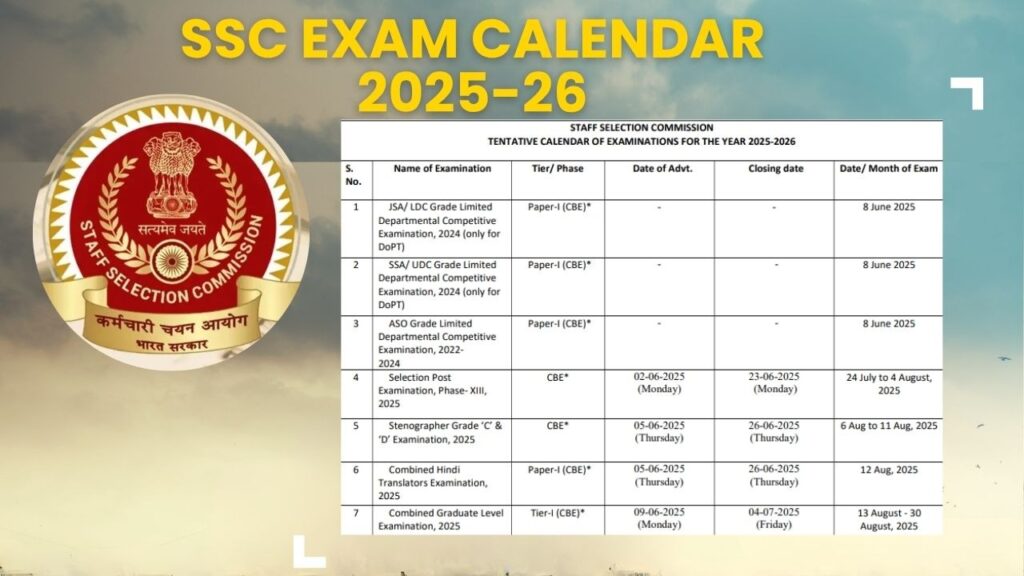
The SSC has announced the SSC Exam Calendar 2025–26 on its official website, so start preparing for the upcoming exams. More than 10 lakh candidates appear out of 50 exams conducted by the SSC every year after 10th, 12th or graduation for jobs in various central government departments and ministries.

This year SSC Calendar (Important Dates) for SSC Exam 2025 (20, 25, 26) contains all info regarding SSC Exams for CGL, CHSL, JE GD Constable, Delhi Police, Steno orga, Stenographer post holders. Candidate can check important events such as notification release date, application dates, exam dates from the schedule to know about the upcoming events which should be useful in your preparation. 

Check Out The SSC Exam Calendar 2025-26

More than five million candidates take the SSC exams for government jobs once in a year after either 10th, 12th or graduation. The revised SSC calendar includes all notification, application, and exam dates for the 2025-26 cycle, providing transparency and a clear path for the candidates. 

Exam NameSchedule Period
SSC Constable (Driver)-Male in Delhi Police ExamJuly to December 2025
Head Constable (Ministerial) in Delhi PoliceJuly to December 2025
Head Constable (AWO/TPO)July to December 2025
Constable (Executive) July to December 2025
Grade C Stenographer July to February 2026
Constables and Rifleman in Assam October to February 2026
JSA/LDC January to March 2026
SSA/UDCJanuary to March 2026
ASO January to March 2026

Key Details for Aspirants

  • All SSC examinations are held at the designated centers across all over India in Online mode only.
  • Updates are posted on the official SSC website (https://ssc.gov.in). Aspirants are advised to track the notifications and deadlines for application.
  • Dates of the examination are liable to change due to unforeseen circumstances, keep watching official notifications for updates if travelling or taking study leaves. 
  • There are more levels/phases to the selection process; CGL, CHSL and JE have additional rounds after Tier 1. 
  • Admit cards, syllabus and other directions for the candidates are issued just before the exam, so keep visiting the official website of SSC regularly. 

Follow the Guide to Download the SSC Exam Calendar 2025-26 

1. Go To The Official Website of SSC, which is mentioned in this article. 

2. Now Search for the SSC exam calendar in the Notification on SSC Exam Schedule 2025-26. 

3. Open the link and download the calendar in pdf file OR you can just download it directly from the link section of this article. 

4. Download the pdf file in your device. 

5. Keep this file save or print for future uses. 

The SSC timetable for the 2025-26 session is designed as per the pattern of previous years and it clearly indicates that there are 5 stages in the exam process.Changes or modifications, if any, will be notified on the official website of SSC. 

Useful Links
Download SSC Exam CalendarClick Here
Official WebsiteClick Here


UPSSSC PET Exam 2025 – Syllabus, Dates & Updates

UPSSSC PET Exam 2025

UPSSSC PET Exam 2025 is conducted by Uttar Pradesh Subordinate Service Selection Commission. Candidates can fill the application form for the job recruitment of Group C and Group D before the last day of registration. Candidates should check the syllabus of the examination through this article to prepare according to exam pattern. Candidates can fill the application form before 17 June 2025.

UPSSSC PET Exam 2025 Important Dates To Follow Up

Exam NamePre Examination Test UPSSSC PET 2025
Organization NameUttar Pradesh Subordinate Service Selection Commission
Mode of ExamOffline
Application Start14/05/2025
Last Date for Registration17/06/2025
Fee Payment Last Date17/06/2025
Application Correction End Date24/06/2025
Admit Card releaseTo Be Announced
Exam DateTo be Announced
Official WebsiteClick Here

UPSSSC PET Exam Pattern 2025

UPSSSC PET ExamExam Pattern
Total Questions100
TypeObjective Type
Total Marks100
Negative Marking1/4th  marks deducted for every incorrect answer
Duration of Exam2 hours
CategoryApplication Fee
Gen/OBC185
SC/ST 95
PWD25

Topic-Wise Subject for PET UPSSSC 2025

Subject Questions – each carry 1 markTopics
Hindi5Hindi Vyakaran, Vilom Shabd, Sandhi Vichkshed
English5English Grammar, Questions on Passages, Vocabulary
History5Civilizations: Vedic Civilization, Buddhism, Indus Valley Civilization
Geography5Water Resources, Forests and Glaciers, and Rivers.
Indian Economy5Indian Economy, Economic Reforms, GST, Economic Policies
General Science5Basic Physics, Basic Chemistry, Basic Biology
Arithmetic5Percentage, Simple Arithmetic Equations, Square and Square Roots
Indian Constitution and Public Administration5Indian Constitution, Fundamental Rights and Duties, Judicial Framework
Indian National Movement5Swadeshi and Civil Disobedience Movement, Revolutionary Movement
Logic and Reasoning5Blood Relations, Coding and Decoding, Cause and Effect
Current Affairs10National and International Current Affairs, Static GK
General Awareness10Countries, Capitals and Currencies, Indian Parliament
Analysis of Hindi Unread Passages102 Hindi passages
Table Interpretation and Analysis10Interpretation of 2 Graphs.
Graph Interpretation10Interpretation of 2 Tables
Total100

Useful Links For PET UPSSSC PET 2025

Apply Online
Download Notification
Download full Syllabus for Pet UPSSSC PET 2025
Official Website – UPSSSC Official 

UPSSSC PET Syllabus 2026 PDF: Subject-wise Topics & Exam Pattern

UPSSSC PET Syllabus

If you are among the lakhs of aspirants who are going to appear in the UPSSSC PET Syllabus 2026 exam, you are already aware of the procedure — this exam is the filter. Clear it and a plethora of Group B and Group C government jobs in Uttar Pradesh awaits you. If you fail to clear it, and none of those Mains exams even become an option. 

This is why having a proper understanding of the syllabus From day one is more important than just diving in and doing some random practice sets. 

So, let’s analyze the UPSSSC PET Syllabus 2026. What is asked in the exam, marks distribution of each section and how you should prepare to crack the exam. 

What Exactly Is UPSSSC PET?

UPSSSC PET refers to the Preliminary Eligibility Test, which is organized by the Uttar Pradesh Subordinate Services Selection Commission. Think of it less as a “final” recruitment test and more as a preliminary screen. 

It’s compulsory — you cannot even fill out the application form without a valid PET scorecard. If you pass the PET test, your score is good for three years, so you can use it to apply for multiple positions during that period without having to retake the test. 

The examination is offline on pen and paper using OMR sheet and it is for basic level aptitude and general awareness and not for anything very technical or domain specific. 

Exam Pattern: The Numbers You Need to Know

Before diving into subjects, it helps to understand the shape of the paper:

FeatureDetails
Total questions100
Total marks100 (1 mark per question)
Duration2 hours
Negative marking0.25 marks deducted for every wrong answer
Question typeObjective, multiple-choice with four options

That quarter of a mark negative marking is worth remembering — guessing blindly can damage your score, so accuracy is as important as speed here. 

Subject-Wise Breakdown

The UPSSSC PET Syllabus is spread across roughly 15 sections, each with a fixed number of questions and marks. Here’s how it typically looks:

Indian History & Indian National Movement (5 questions, 5 marks each — 10 total) This spans a broad history, including the Indus Valley Civilization, Vedic culture, Jainism/ Buddhism, and leaves off at the Maurya, Gupta, Mughal dynasties and the freedom struggle. Questions on the Swadeshi Movement, Civil Disobedience Movement and the rise of revolutionary nationalism, the Quit India Movement, personalities like Netaji Subhash Chandra Bose and the Azad Hind Fauj. 

Geography (5 questions, 5 marks) Topography of India and the world, lakes and rivers and their valleys, underground water, Himalayas, deserts, minerals, political mapping, weather conditions, India Times, and population trends and movements of people. 

Indian Economy (5 questions, 5 marks) This is a narrative of India’s economic path from 1947 to 1991 and thereafter — the Five-Year Plans, the mixed economy model, the green revolution, bank nationalization, the 1991 economic reforms, and more recently GST and post-2014 structural/sector reforms. 

Indian Constitution & Public Administration (5 questions, 5 marks) The Fundamental Rights and Duties, Directive Principles, parliamentary and federal system, relations between the Union and the States, the judiciary, and local government through Panchayati Raj institutions. 

General Science (5 questions, 5 marks) Basic Physics, Chemistry, and Biology — roughly at a Class 12 difficulty level, so nothing too advanced, but you do need conceptual clarity.

Elementary Arithmetic (5 questions, 5 marks) Integers, percentages, basic calculations, square and cube roots, powers, means and such basic and general topics in math. 

General Hindi (5 questions, 5 marks) Grammar-related — synonyms, antonyms, one-word substitutions, gender differentiation, homophones, idioms, and proverbs, frequent mistakes, and quizzes on famous writers and their productions. 

General English (5 questions, 5 marks) Basic grammar rules along with an unseen passage to test comprehension.

Logical Reasoning (5 questions, 5 marks) A fairly mixed bag — blood relations, coding-decoding, number series, syllogisms, venn diagrams, direction sense, puzzles, statement-conclusion questions, and hysteresis. .

Current Affairs (10 questions, 10 marks) World and national events — that’s where being on top of the recent news really serves you well. 

General Awareness (10 questions, 10 marks) A miscellany of neighboring countries, capitals and currencies, Indian states and UTs, national and international day, sports, art and culture, awards, famous books and authors and environment related issues. 

Hindi Unseen Passages (10 questions, 10 marks) Two comprehension passages in Hindi to test reading and interpretation skills.

Graph Interpretation (10 questions, 10 marks) Two graphs, testing your ability to read and analyze data quickly.

Table Interpretation (10 questions, 10 marks) Similar to graph analysis, but with tabular data instead.

The following three sections — passages in Hindi, graphs and tables — carry 30 marks in total. That’s almost a third of your total marks, and it’s often the section that candidates underestimate the most. 

Read More 👉 Best BTech Colleges in Lucknow: Fees, Placements, and Admission Reality for 2026

How to Approach Your Preparation

Considering how dispersed this syllabus is, trying to learn everything at the last minute is just not going to cut it. A better way to think about this is to think of this as a marathon, not a sprint: 

  • Prioritize the data interpretation sections. As graphs, tables and Hindi passages are for 30 marks, regular practice in this section can give you an advantage over other candidates who concentrate only on GK. 
  • Don’t skip static GK for the sake of current affairs. History, geography, economy, and polity constitute 20 marks, and these topics remain static — once you study them thoroughly, they are yours forever. 
  • Revise Hindi grammar rules actively. Many candidates, especially those confident in Hindi, tend to get careless here. Small grammatical nuances trip people up more often than expected.
  • Practice with a timer. Two hours for 100 questions sounds comfortable, but data interpretation and comprehension sections eat up time fast if you’re not used to them.
  • Use previous year papers. They’re one of the best ways to understand the actual difficulty level and question framing, rather than relying purely on assumptions about what “might” come.

Read More 👉 IBPS PO MT XVI Recruitment 2026: What Every Banking Aspirant Needs to Know

Conclusion

The UPSSSC PET Syllabus isn’t designed to be intimidating — it’s designed to test whether you have a well-rounded, functional understanding of general knowledge, basic aptitude, and language skills. The trick isn’t studying harder in isolation; it’s studying smart, giving weight to sections based on their actual mark share, and revising consistently rather than in bursts.

Scroll to Top