UPSSSC Lekhpal Online: If you are busy preparing for government exams in Uttar Pradesh, now is the time for good news. The wait for one of the most awaited recruitments is finally over! The Uttar Pradesh Subordinate Services Selection Commission (UPSSSC) has started the UPSSSC Lekhpal Online Recruitment 2025.
With a whopping 7,994 vacancies, this is not just a job alert, it’s a golden chance for thousands of aspirants like you to get a high paying government job. The application link has been activated from yesterday i.e. December 29 2025, so let’s get straight to the point and have a look at what all you need to know to grab this opportunity.
Key Dates & Details at a Glance
Event
Date
Application Start Date
29/December/2025
Last Date to Apply
28/January/2026
Fee Payment Deadline
28/January/2026
Correction Window Closes
4/February/2026
Application Fee
₹25 (For all categories)
Age Limit
18–40 Years
Vacancy Breakdown For Lekhpal
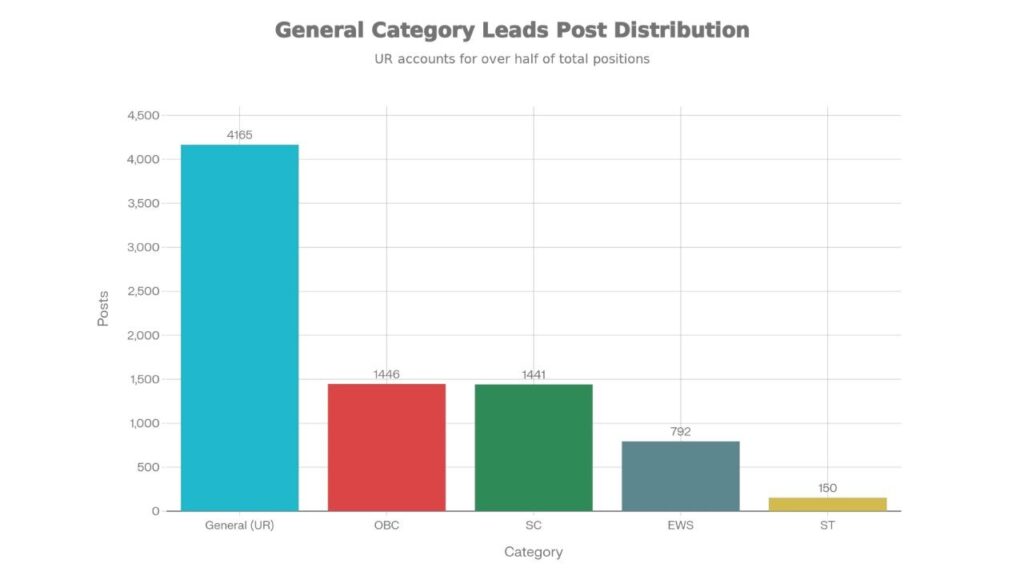
Knowing the rival is the first step. The commission has made available a clear breakdown of the 7,994 seats for various categories. Look out the chart whether you are from the General category or seeking a reservation? Here is the breakup of posts:
Distribution for UPSSSC Lekhpal in a Category-wise
Firstly, the General (UR) Category is on the top with more than 4000 seats and then there is an almost equal split between OBC and SC candidates. This huge number of vacancies will make the cutoff competitive yet manageable with good preparation.
Are You Eligible?
Before you hurry to the cyber cafe or switch on your laptop, let us confirm your eligibility. The rules are simple but hard:
Educational Qualification: The candidate should have completed 10+2 from any recognized board.
Top PET Requirement: And this is the most important part. You must hold a valid score card from UPSSSC PET 2025. The Mains exam will be short listed solely on your PET 2025 normalised score.
The PCS exam is the most hardest exam in India which offers many prestigious level jobs in the government sector. PCS Rank Wise Post is allotted according to the candidates marks in the exam. It offers many higher level administrative posts like SDM, DSP, BDP, CTO, and others. This exam is held annually to recruit thousands of candidates for different posts, and prepare strategically for higher rank posts.
Let’s explore the PCS exam and posts for understanding their authority and power in administration.
What Is The PCS Exam?
Provisional Civil Services offers a diverse range of posts in the government sector and is conducted by different State Public Services Commissions including UPPSC, BPSC, MPPSC, RPSC, etc. But the post name and exam pattern will be the same in all the states. Posts rank may slightly differ from each other but posts are related to state administration and law enforcement. The exam pattern includes:
Prelims
Mains
Interview
How Are Posts Allotted in PCS Exams?
There are various factors for allotting the post on different level, let’s look into these factors:
Final rank in the merit list (Mains + Interview). Selection is based on the PCS state-level exam rank. If the two candidates have the same score then the cast-category of the candidates will decide in the selection process. The third factor is the number of vacancies in that post.
PCS Rank Wise Post List 2025
Likely Rank
Post Name
1
Deputy Collector (Sub Divisional Magistrate/SDM)
2
Deputy Superintendent of Police (DSP)
3
Block Development Officer (BDO)
4
Assistant Commissioner (Commercial Tax)
5
District Commandant, Home Guards
6
Subordinate Revenue Officer
7
Assistant Regional Transport Officer
8
District Social Welfare Officer
9
District Panchayat Raj Officer
10
Accounts Officer
Special PCS Posts And Their Powers
Don’t you wonder? Why does the PCS Rank Wise Post matter? Because a candidate’s post determines their authority, power, responsibility, and salary within the state administrative system.
The powerful posts allotted to top rankers in the PCS exam. The top three posts are Sub Divisional Magistrate (SDM), Deputy SuperIntendent of Police, and Deputy Collector are all administrative powers and control district level operations directly impact governance and policy implementation.
Higher powers such as SDM, DSP, & CTO are placed on the top level of the government administration of the state because they are responsible for revenue management, development works, jurisdiction over law and order and public service delivery.
Meanwhile, lower ranked positions are also responsible for government department works and administrative jurisdiction but they have less authority and power for taking decisions.
Higher positions rankers get fast promotion while initial posting and lower rankers have to face slower growth to become on the post like Indian Administrative Services (IAS). The salary and additional perks are good on a higher level with social recognition, they have more prestiges compared to lower level.
Other Top Level Posts in PCS Exam
Block Development Officer
He has authority within the block in rural or semirural areas to lead administration for the development of projects for public welfare and implementation in government schemes. He supervises both state and central government policies in that area.
District Commandant, Home Guards
District Commandant is a head of Home Guard volunteers and works with the police and administration for law and order for handling disaster and public safety.
Subordinate Revenue Officer
He is responsible for collecting and saving the data of land in the sub-district. Government schemes implementation also comes under the Subordinate Revenue Officer responsibility for agriculture and land reforms. These decisions are directed by the higher revenue officials and SDMs.
Assistant Regional Transport Officer
He enforces public travel law and order to resolve issues of driving license, permission for transport, and registrations of vehicles. Assistant Regional Transport officer is responsible for road safety campaigns and accident investigations.
District Social Welfare Officer
District level authority and power to manage and implement welfare schemes for low cast and schedule tribes communities. Works as a mediator between communities and district administration for their well-being.
District Panchayat Raj Officer
Panchayat councils of villages are supervised by District Panchayat Raj Officer. Implantation for rural development schemes are monitored by him and he is responsible for these operations running smoothly in the area.
Account Officer
Account officer handling the government department’s account and financial administration to manage budget and deliver financial reports to the government administrations.
SDM vs DSP – Which Is Better?
SDM and DSP both positions are highly respectable but their work and authority is different from each other –
Sub Divisional Magistrate– SDM:
This is the highest administrative officer post in the department to ensure the governance runs smoothly under the law and order. This involves both desk and field duties and offering great professional growth to ADM then DM level.
Deputy Superintendent of Police – DSP:
He is the head of the police subdivision and has authority for law enforcement. A very respectable uniformed post, DSP is responsible for commanding over police stations and getting promoted to SP and DIG.
How to Get Top Rank for SDM or DSP Post?
The higher posts are responsible to change and implement governance that is why they are placed at the higher places in the state hierarchy.
Your rank must lie within top 100 to get SDM or DSP post.
To score on that level you must focus on high-scoring subjects.
Practice and learn consistently for Mains.
Improve english grammar and take mock tests daily.
Keep updated with events, current affairs, and government policies.
Conclusion
PCS Rank Wise Post is important to understand if you are preparing for PCS exams because your exam scores will decide your position. If your goal is SDM or DSP then you should get 70-100 rank (General Category) and 120-160 rank (reserved category). With the right strategy you can prepare smartly for this exam and get the position.
PCS rank not just decides your job but also your future of growth, salary, and authorities. So, start aiming your goal with smart strategy and hard work.
The Union Public Service Commission (UPSC) has notified the Combined Defence Services (CDS) Examination 1 for the year 2026. This recruitment is for a number of academies that are the Indian Military Academy (IMA), Indian Naval Academy, Air Force Academy and Officer Training Academy and the number of vacancies is 450+.
The application form filling process will start from 10th/December/2025 and the last date to apply for the UPSC CDS 1 2025 will be 30th/December/2025. Interested and Eligible candidates are advised to read the official notification before apply online for understand the eligibility, Application Fee, Age Limit, Salary, Selection Process before applying for it.
Candidates need to visit the UPSC official website for detailed information and application. Before the time ends, you need to make sure that each one of the necessary information is filled accurately.
Follow These Dates To Apply
Application Start
10/December/2025
Last Date For Application
30/December/2025
Fee Payment last date
30/December/2025
Correction Date
Update Soon
Admit Card Date
Update Later
Exam Date
12/April/2026
UPSC CDS 1 Age Limit & Application Fee
Category
Age Limit
Posts Expected
IMA & INA
19 — 24 years
450+
Air Force
20 —- 24 years
OTA
19 —- 25 years
Gen/ OBC/ EWS
₹200
SC/ ST
0
UPSC CDS 1 Vacancy & Educational Qualification
The courtesy details of UPSC CDS 1 Eligibility 2025 are mentioned below:
Indian Military Academy (IMA): The candidate will have to hold a Bachelor’s Degree in any discipline/stream from any recognized University/Institution in India.
Indian Naval Academy: The candidate must hold a Bachelor’s Degree in Engineering or equivalent from a recognized university/institute in India.
Air Force Academy: Candidate should have passed 10+2 with Physics and Mathematics in any stream from a recognized board or have a Bachelor of Engineering/Bachelor of Technology or similar qualification from recognized university.
Officer Training Academy: The Candidate must have a Bachelor’s degree in any Discipline/stream from any recognized university or Institution in India.
For more and latest updates you can go through the official UPSC CDS 1 Recruitment 2025 Exam Notification.
The candidate can earn up to Rs 1,77,500 per month with allowances as per government norms. The starting salary can be less with Rs 56,100 for entry level candidates.
Guide to Apply UPSC CDS 1 Online
How to Apply for UPSC CDS 1 Recruitment 2025: Apply Online through the official website of UPSC.
1. Know Details from UPSC CDS 1 Notification 2025 PDF.
2. Click on the “apply online” link or go to the Official UPSC website: upsc.gov.in.
3. Fill UPSC CDS 1 2025 Online Application Form.
4. Upload all the documents as per the notification.
5. Remit the requisite application fee by one of the modes available.
6. Take a print out of the application form once it is filled for your records.
IBPS PO/MT-XVI 2026 mains admit card and the Prelims scorecard are now out. If you took the exam, head over to the official IBPS website and download both as soon as you can. Those who cleared the Prelims can now move on to the Mains, which is scheduled for October 2026. This year’s drive has 7,365 vacancies for Probationary Officers and Management Trainees, so there’s plenty of opportunity for those who make it through.
You can download both admit card and scorecard from the same website. This scorecard marks will not be added in the final merit. Only Mains and Interview marks are accounted for, so start practicing mock tests to qualify the exam. Exam dates will be announced by the authority soon on the official IBPS website.
Important Date for IBPS PO/MT-XVI 2026
Stage
Date
Prelims scorecard
29 September 2026
Mains admit card
24 September 2026
Mains exam
October 2026
Mains result and scorecard
November 2026
Personality test
November 2026
Interview letter
November 2026
Interview
November/December 2026
Final result
January 2027
How to Download Mains Admit Card & Pre Scorecard
Use the same IBPS portal; different links appear under CRP PO/MT‑XVI. Officially, IBPS issues separate admit cards for Prelims, Mains, and Interview.
Log in with Registration No./Roll No. + Password/Date of Birth + Captcha.
Download and print 2–3 copies.
Prelims Scorecard (Pre Score Card)
On ibps.in, open CRP PO/MT‑XVI.
Click the Prelims Result/Mark link.
Log in with your credentials.
View/download the scorecard showing sectional marks, overall score, and qualifying status.
What to Carry on Mains Exam Day
Printed Mains admit card (call letter)
Original valid photo ID (Aadhaar/Passport/PAN/Driving Licence, etc.)
Black/Blue ballpoint pen; follow all instructions printed on the admit card.
What Should Qualified Candidates Do Right Now?
1. Check your result and download your scorecard. Log in to the official IBPS portal with your registration number and password or date of birth. Save a PDF and a printout of both the result and the scorecard.
2. Download your Mains admit card. Check the exam date, time, venue and reporting instructions carefully. Bring a valid photo ID and follow all document requirements.
3. Shift to Mains mode immediately. The Mains exam is only a few weeks away in October, and Prelims marks are typically used only for qualifying, so your Mains performance is what decides your rank. The Mains also includes a descriptive test, so start practicing letter and essay writing now.
What To DO If You Are Not Qualified?
If you are not qualified in this exam then don’t get stressed because other exams like SBI Clerk/PO and RBI Grade B are in a lineup. So apply for those exams since the syllabus and eligibility are almost similar. However, analyze your mistakes from the scorecard to correct your answers.
Quick Mains Preparation Strategy
Take full-length mocks weekly. Sectional practice is good, but the Mains is about stamina across sections.
Prioritize data interpretation and reasoning. These sections carry high weight and reward regular practice.
Collect daily current affairs and make notes related to banking awareness and economy news feed.
For fluency, write one essay and letter under a timer to enhance descriptive writing.
Improve English with reading comprehension and practice error spotting as a daily habit.
In the last week, start revising what you learn, do not start new topics.
IBPS PO/MT-XVI 2026 Selection Procedure
IBPS PO/MT‑XVI (2026) uses a three‑stage selection process: Prelims → Mains → Interview, followed by final merit list and provisional allotment.
Stage
Purpose
Nature
Preliminary Exam
Screening test; marks not counted in final merit
Qualifying only
Main Exam
Core selection test; marks used for final merit
Scored
Interview
Personality/fit assessment; marks added to Mains for final merit
Scored
How final selection is calculated
Prelims marks are NOT added to the final score but important to reach at Mains. Final merit is prepared using Mains score + Interview score where your interview also carries 100 marks
Provisional Allotment is based on final merit, your category, preferences, and vacancy availability, IBPS issues provisional allotment to participating PSBs.
Conclusion
The IBPS PO/MT-XVI 2026 admit card and preliminary scorecard are now available online. Candidates should download their documents and check their scores. Those who qualify for the next stage should keep track of the Mains exam dates and start preparing accordingly.
There are a total of 7,365 vacancies for Probationary Officers and Management Trainees and the current stage of the IBPS recruitment 2026 is a result of Prelims. The admit card for Mains is also released so download now. This recruitment cycle offers a real opportunity. Stay consistent, stay calm, and treat every mock test as a lesson.
The domain of paramedical sciences is an exciting path for students who have completed high school to explore the diverse aspects of the healthcare sector. In line with increasing need for trained personnel, Paramedical Courses Career Roadmap consist of specific training on diagnostics, emergency care, treatment and rehabilitation.
These Paramedical Courses aim not only to provide technical knowledge but also to train students to overcome professional challenges in an ever-changing healthcare environment, which is the reason why this is such a popular career path for young aspirants.
Here, we provide a full-fledge career guide for all the high school graduates who aspire to establish a career in paramedical services in the near future. Here, we will discuss your eligibility, the course, different specializations, the procedure to move into the sector and a variety of attractive career options after you complete it.
Why Choose a Paramedical Courses?
Types of paramedical jobs have also been included in the lists of healthcare occupations. What questions do you have about paramedics? They also play a vital role in critical diagnosis, emergency and outpatient treatment as well as in patient rehabilitation.Reasons to choose a job in paramedical science include:
In high demand: Health care is growing. The reports state that the need for paramedical technicians will increase by 20-25% over the next few years, especially in the developing countries.
Endless Career Paths: There are endless career paths in paramedic including Emergency Medical Technician (EMT), Medical Laboratory Technologist, or taking a leap into new-age disciplines like telemedicine and health informatics.
Personal and Social Satisfaction: In direct patient care and its positive impact on society, the paramedical professionals have the greatest chance for both professional fulfillment and job security permanently.
This has opened up a window of opportunity for high school graduates to make a career in the healthcare sector through paramedical courses.
Eligibility and Requirements for High School Graduates
The path to a good paramedical career begins with the right academic background. For class 12 board takers, the online eligibility criteria for admission are as follows:
Educational qualifications: A high school diploma with science subjects like biology, chemistry and physics is mandatory. Many paramedical centers have the expectation that students will excel in those subjects because they are the basis of the more difficult material taught in further courses.
Basic Certifications:You can get some extra certifications like basic life support (BLS) or CPR Training which can help you stand out. These credentials not only prepare candidates for the hands-on practical aspects of healthcare, but also attest to their dedication to the field.
Entry Exams and Selection Process: A few courses may have an entrance exam or an aptitude test, and have an admission process that involves showing your enthusiasm for the science and health care.
These essential qualifications allow high school graduates to pursue a variety of Paramedical Courses, and so the door is opened to a multifaceted education.
Courses and Specializations in the Paramedical Field
There are various types of Paramedical Courses that you can opt for—certificate and diploma courses to full degree courses. Theoretical as well as practical knowledge is imparted, so students gain a good understanding of what is required at workplaces in hospitals and other healthcare facilities.
Below is a table with a brief summary of some of the specializations with the work they do and place of work:
Specialization
Role
Work Settings
Medical Laboratory Technologist
Blood, Blood Fluids, Tissues Testing
Diagnostic center, Hospitals, Research Facility
Radiology Technician
X-rays, MRIs, CT scans using machines
Radiology Center
Emergency Medical Technician (EMT)
Provide First-Aid in Emergency
ER, Ambulance
Physiotherapist
Engage with Patients for Rehab and guide them
Rehabilitation Clinics and Hospitals
Anesthesia Technologist
Assisting with Anesthesia
Operation room
Other Roles (Optometrist, Dental Hygienist, Speech Therapist, Occupational Therapist)
Patient Special Care
Mostly private clinics
This table is a sample of the multiple occupations which are available for the paramedical candidates but, all of them may vary in their complexity and challenges. The courses in these disciplines usually consist of lectures and laboratories and/or clinical rotations and or paid or unpaid work placements that provide students with hands-on experience required to work in their chosen field.
Steps to a Successful Paramedical Career
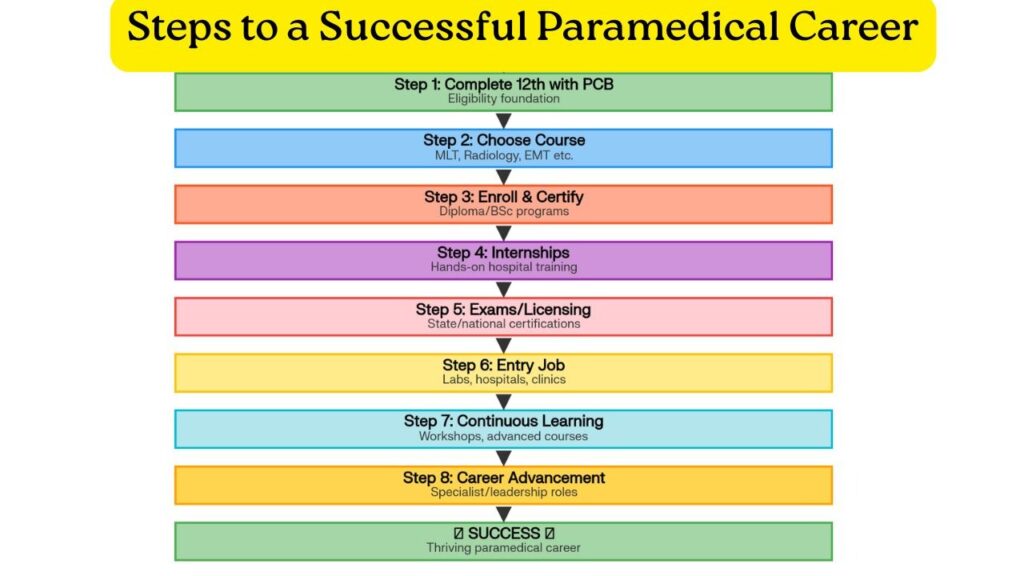
A step-by-step advance is necessary for a career in paramedical work. The given flowchart depicts the straightforward career opportunity for the regular high school pass outs:
The flowchart of Paramedical Courses shows the process step by step: Begin with a solid academic foundation, apply practical experience, get certified, and then specialize or move into management. Each phase relies on the previous one to build depth and breadth of skills in the professionals.
Career Opportunities in the Paramedical Courses
Paramedical professions have a wealth of options and opportunities that go well beyond the usual roles. After completing their education, students can work in multiple fields such as:
Hospital Environments: A large portion of paramedical professionals employed in hospitals include them in the diagnosis, patient care, and testing.
Diagnostic and Imaging Centers: Medical Laboratory Technologist, Radiology Technician and other allied health professionals play an essential role in identifying and diagnosing countless diseases.
EMS: EMTs and Paramedics are needed now as much as ever in ambulance services and emergency departments, where making split-second decisions in a pump-driven environment is part of the job.
Trend Trailers: As telemedicine and health informatics matures, more jobs are likely to emerge for people focused on the convergence of healthcare and technology.
Own Business: Many practitioners have transitioned from practicing to owning their own clinic, laboratory, or home healthcare service, and some contribute to the field by working in their own business while enjoying the personal freedom associated with being your own boss.
The positive growth in the healthcare industry along with technology enhancements is expected to create additional jobs, which makes it a promising field for people looking to build a career in this industry.
Benefits of a Paramedical Career
Benefits of a career in paramedics are numerous and high school graduates can look forward to a great future (Check out some of the pros and cons about joining this career below):
Employment Security: Increasing Paramedic jobs healthcare needs worldwide ensure a stable and promising future for paramedical practitioners.
High Salary: The salaries for a number of these positions are competitive, commensurate with their unique skill set and important responsibilities.
Variety of Opportunities: You can find job opportunities to suit your interest, whether that be hands-on with patient care, supporting diagnostics or working with new technology.
Personal Satisfaction: A career in paramedicine not only is financially rewarding, but it can positively affect the lives of thousands of patients and the community at large.
Career Advancement: Many health services have in place a career progression (e.g. the Paramedic Practice Advancement Ladder) to include rewarding experience and ongoing professional development.
Institutional Support for Aspiring Paramedical Professionals
There are many reputed colleges which offer good facilities and infrastructure for students who want to make a career in paramedical. For example:
Belarani Institute of Paramedical & Allied Sciences: The Training provided is more practical oriented by the experts with well experienced trainers and Placement Support to the students on completion of their Training.
LifeLine EMS: Nowhere is this more true than in Southern California where LifeLine EMS provides seamless EMT to Paramedic pathways, comprehensive training, mentorship programs and well-defined internal career promotion tracks.
Colleges like Foothill College and The George Washington University: The programs which run the gamut from short-term, intensive 11.5-month programs to long-term degree programs include classroom instruction, skills labs, clinical rotations and field internships designed to fully prepare students to meet the challenges of the profession.
These schools do more than train students in the latest tools and technology, they create cultures where a commitment to lifelong learning and professional success is ingrained.
Conclusion
Paramedical Courses Career Roadmap: High school graduates opting for a profession in paramedical sciences not only ensure a bright and stable career but also play an important role in the advancement of global healthcare. With the right skills and commitment, as the industry continues to grow, there will be countless opportunities for those dedicated to pursuing a career path with endless potential.
So whether you’re interested in the accuracy of laboratory diagnostics, the life-saving measures of emergency services, or the professional practice of physiotherapy and more, there’s no doubt that your career in the paramedical sector will be fulfilling and rich with opportunity. Begin your journey today and discover the opportunity to have a real impact on the lives of many.
The Common Admission Test can open the doors for India’s most prestigious colleges. Students get stressed with the syllabus most of the time and get confused, so it is important to know the CAT exam syllabus 2025 section-wise. This can help you understand the important topics that must be considered prior while preparing. The powerful strategy to prepare for any competitive exam is according to exam pattern. Read the full article to assess this knowledge which can help you beat the CAT exam.
It’s not about a lot of time and resources, just the right planning to assess important knowledge is required. Whether you are an average student or brighter one but CAT is not that simple as you think. Masters from top colleges matter in your placement. If you really want to take admission in an MBA or other postgraduate program, you need to clear the CAT exam.
Exam Pattern Overview
CAT is conducted online through a computer-based test format. The total 68 questions come in the examination which get distributed into three sections. This 120 minutes exam carries 204 marks to decide your future in your education journey. However 40 minutes is given for each section with +3 marks if the answer is correct but negative marking of -1 for each wrong answer. There’s no negative marking for TITA (Type In The Answer) questions.
Section-wise Distribution
Verbal Ability & RC carries 72 marks for 24 question Data Interpretation & Logical Reasoning carries 66 marks for 22 questions Quantitative Aptitude carries 66 marks for 22 questions
This section covers 36% of the paper. It focuses on RC more than grammar means 16 questions come from the Reading comprehension so it covers 66% of VARC section. While Verbal ability covers 33% of the section. The reading comprehensive features 4 passages with 4-5 questions per passage. The topic in these passages is almost relevant to niches like economics, psychology, literature, and current affairs.
Verbality Ability comprises 8 questions From:
Para summary question
Para jumbles
Odd sentence out
Sentence completion tasks
Section 2: Data Interpretation & Logical Reasoning (DILR)
This section 32% of the exam paper and considered most unpredictable questions come from the Data Interpretation & Logical Reasoning section. While the questions are in the sets of 3-4 questions, making it difficult to solve easily.
Topics of Data Interpretation & Logical Reasoning questions:
Data Interpretation
Logical Reasoning
Tables and charts analysis
Puzzles and arrangements
Bar graphs and pie charts
Seating arrangements
Line graphs and scatter plots
Blood relations and family trees
Caselets with numerical data
Coding-decoding problems
Syllogisms and Venn diagrams
Section 3: Quantitative Aptitude (QA)
Quantitative aptitude holds 32% weightage in the paper. It covers Arithmetic and Algebra topics, making it the hardest section.
Topics of Quantitative Aptitude Questions
Arithmetic (8-9 questions)
Algebra (5-7 questions)
Geometry (2-3 questions)
Modern Mathematics
Ratios and Proportions
Linear equations and inequalities
Coordinate geometry
Permutations and combinations
Percentages and their applications
Quadratic equations
Mensuration
Probability
Profit, Loss, and Simple/Compound Interest
Functions and graphs
Triangles and circles
Logarithms and surds
Time, Work, and Distance problems
Progressions and series
Mixtures and Allegations
Topic-wise Weightage Analysis
Highest Priority Topics:
Reading Comprehension
16 questions
Arithmetic
8 questions
Algebra
5-7 questions
Puzzles & Arrangements
8-10 questions
Medium Priority Topics:
Data Interpretation
8-9 questions
Geometry
3 questions
Verbal Ability
8 questions
Lower Priority Topics:
Modern Mathematics
2-3 questions
Number Systems
1-3 questions
Effective Preparation Strategy
Preparing for the CAT isn’t that easy but with right strategy planning you can clear out the exam. There is no need to rote memorization because these subjects require focus and proper time to understand every concept.
CAT needs comprehensive preparation with proper time duration like 6 to 9 months. Know your weaknesses, so you can distribute your time more on that topic. Divide all three sections with specific duration to complete your preparation properly.
Deep analysis and carefully 2-3 Reading comprehension daily is important
Solve 2-3 sets of Data Interpretation and logical reasoning to understand and filled in your brain
Daily solve at least 15-16 questions from the quantitative aptitude section. Try to solve easy problems first then go to the hard topics.
Mock Test Strategy
After preparing for 2 months, get ready to take mock tests section-wise and extend your mock test practice before the exam. Because analyzing every question helps you keep remembering the concepts and maintain your confidence.
Resource Selection
Choose online resources to prepare fast because the latest notes and mock tests can help you a lot during preparation for the CAT exam. Stick to single quality resources, don’t switch every time and focus on concept clarity rather than multiple resources and question papers.
Conclusion
Success in CAT requires strength, strategic preparation, and daily practice for clearing every doubt. Focus on high priority topics first then move on the medium priority to balance every section easily. Remember that quality study is more helpful to clear the exams rather than a lot of study material and wasting time on unnecessary topics. So, it is important to prepare according to the CAT exam syllabus 2025 section-wise for best outcome.