Madan Mohan Malaviya University (MMMU)of Technology in Gorakhpur, is highly known for its engineering university. More than thousands of students apply here each year. For the session 2025-26, MMMUT announced their B.Tech session 2025-26 cutoff list. Students who are waiting to see the cutoff list can check now. The total seats is 1089 in which applied students count is 4039. You can check B.tech seat allotment for various branches.
Total Applicants
4039
Total Seats
1189
For UP Students
1086 seats
Applicants from UP
3700
Applicants from Other States
339
MMMUT 2025 B.Tech Cutoff List Details
Branch
Seats
Seats for Computer Science
255
Seats for Electronics and Communication
180
Seats for Electrical Engineer
120
Seats for Civil Engineering
120
Seats for Information Technology
120
Total Seats
1089
MMMUT 2025 B.Tech Seat Allotment by Choice Order
First Choice
285
Second Choice
225
Third Choice
149
Fourth Choice
95
Fifth Choice
109
Sixth Choice
148
Seventh Choice
54
Eighth Choice
25
Branch-wise Opening And Closing Ranks
Branch
Uttar Pradesh
Other State
CSE
18091 – 62179
40229 – 66331
IT
62574 – 72492
66468 – 74765
ECE
35553 – 80967
65896 – 83366
IoT
73543 – 84249
83901 – 89347
EE
58540 – 97588
86406 – 99383
ME
76387 – 108446
86327 – 107423
CE
66915 – 120088
82024 – 120311
ChE
98938 – 122513
104671 – 116448
Key Insights in Post Allotment Process
Document Verification: continued till 2 July 2025 after the seat allotment.
Opening and Closing ranks: are highly competitive for CSE and IT branches.
Efficient Seat allotment: 60% students received one of their top three choices.
Majority of seats: allotted to the Uttar pradesh students.
When you are dreaming about passing the Indian Revenue Service exam, many of them aspire to three letters: IAS. But among the tens of thousands of them, there is a quieter, sharper posse that it looks like the mainstream hasn’t quite tuned into yet – the Indian Revenue Service could well be the best career choice in the entire civil services ecosystem.
What is the Indian Revenue Service?
When most people hear Indian Revenue Service they think of someone sitting with a bunch of papers behind a dusty desk, stamping tax returns. That couldn’t be further from the truth.
The Indian Revenue Service is, at bottom, a law enforcement and policy-making juggernaut. It is also the financial backbone of India — the body that raises the funds that pay for hospitals, highways, schools, and defence. The service was formed in its current style in 1953 and is divided into two significant arms, the IRS (Income Tax) and the IRS (Customs and Indirect Taxes).
Nearly 9,775 officers, the two branches of the chargeable revenue service are testament to a cadre that pervades nearly every facet of the Indian economy.
Eligibility
Applicants must be Indian citizens or belong to certain categories of Persons of Indian Origin (PIO) to apply for the IRS.
The basic educational qualification is a Bachelor’s degree in any stream from any recognized university by the Government.
UPSC is quite flexible in this regard as it permits the students pursuing the final year of University to appear in the Preliminary examination for the CSE examination on a provisional basis, however, they are required to submit the passing certificates before joining the Mains exam.
The age limit is 21 — 30 years, you can check further below.
Applicant Category
Minimum Age
Maximum Age Limit
Permitted Examination Attempts
General
21 Years
32 Years
6 Attempts
Economically Weaker Section (EWS)
21 Years
32 Years
6 Attempts
Other Backward Classes (OBC)
21 Years
35 Years
9 Attempts
Scheduled Castes / Scheduled Tribes (SC/ST)
21 Years
37 Years
Unlimited (up to maximum age limit)
Persons with Benchmark Disability (PwBD – General/EWS)
These are the people who appear and plunder the offices of billionaires at the break of dawn. They follow cryptocurrency tracks across borders. They capture drugs off the shore. They bust shell companies that hide thousands of crores in black money. And yes, they also sit in hearings, argue byzantine tax law before tribunals and help shape the very policies that dictate how India earns its revenue.
This is not a desk job. This is one of the most intellectually challenging, operationally thrilling and financially rewarding career in Indian public service.
Participate & Crack IRS
Hacking the Indian Revenue Service is tough but then, nothing good ever is. The only avenue of entry is through the UPSC Civil Services Examination, which is attempted by about 1.1 million aspirants every year. The exam takes place in three stages, all tough.
The first is the Preliminary exams – a two-paper objective test to weed out the unprepared.
Then there is Mains, nine descriptive papers penned down over a period of a few days, examining one on history and geography, ethics and economics, and so on.
A final interview by a panel of seasoned bureaucrats and scholars.
Mains Examination Paper
Subject Focus and Syllabus Parameters
Maximum Marks
Paper I (Essay)
Multiple topics requiring analytical and philosophical discourse.
250
Paper II (GS I)
Indian History, national Geography and geo of the World and culture.
250
Paper III (GS II)
Law & Constitution, Social Science, and International Affairs.
250
Paper IV (GS III)
Tech, hacking, Economic Development, Bio-diversity, and crisis management.
250
Paper V (GS IV)
Ethics, Integrity, and Aptitude (Case studies on administrative morality).
250
Paper VI (Optional I)
Subject chosen by the candidate from a predefined list of 48 disciplines.
250
Paper VII (Optional II)
Second paper of the chosen Optional Subject.
250
Top Recommendations for Exam Preparation
The whole process, beginning to end, can take years of preparation. Most of the toppers are second-time IAS aspirants and they spend 2-4 years mugging up the NCERT textbooks, M Laxmikanth Indian Polity, Ramesh Singh Indian Economy and reading daily newspapers like The Hindu. They write answers daily in practice. Join offline coachings or attend world-class online platforms such as Vision IAS or Vajiram & Ravi from wherever they live.
Cutoff Marks Needed for Selection
A candidate from general category is usually required to rank between 239-379 to get IRS (Income Tax). For IRS (Customs and Indirect Taxes), the range is a little wider — something like 265 to 497. They are excellent ranks, well within the top 0.5% of all candidates. But unlike the IAS cut-off which is near impossible, the IRS is a realistic and achievable target for those who seriously prepare.
Service
General Category (Last Rank)
OBC Category (Last Rank)
SC Category (Last Rank)
ST Category (Last Rank)
IAS (2024 Trends)
78 —- 96
435 —- 457
567—- 629
528 —- 625
IPS (2024 Trends)
225 — 252
480 —-656
638 — 865
645 — 867
IRS (Income Tax)
239 — 379
485 — 706
602 — 969
674 — 1032
IRS (Customs & IT)
265 —- 497
515 — 823
649 — 970
680 —- 1053
The “big three” services—consisting of the Indian Administrative Service (IAS), the Indian Foreign Service (IFS) and the Indian Police Service (IPS)—are in the topmost Tier 1 class. These services traditionally take the bulk of the top 150 candidates. The IAS is the undisputed king of the civil services, with unparalleled executive powers, while the IFS has the glamour of global diplomatic representation, and the IPS has the unmatched power of the uniform.
The Indian Revenue Service holds the very prestigious Tier 2 bracket and is known for its unbeatable power in financial affairs along with a good urban living. With a bigger cadre size and distinct preference pattern giving priority to metro stability rather than rural administration, the IRS (IT) and IRS (C&IT) take a large chunk of the successful candidates which are ranked between 240 and 650 in the general category.
What Happens After the IRS Exam?
IRS (Income Tax) officers are on their way to Nagpur’s National Academy of Direct Taxes (NADT) — a sprawling green-fitted campus, where a 16-month professional course converts the generalist officers into financial experts. The content is demanding: income tax law, corporate accounting, forensic investigation, international taxation, transfer pricing. It’s not just classroom theory, either. Officers labor months in the trenches, conducting real assessments and audits with seasoned veterans.
IRS (Customs and Indirect Taxes) officers are trained at the brand new NACIN campus in Palasamudram, Andhra Pradesh — a breathtaking 500-acre establishment which also serves as a World Customs Organization regional training centre for the Asia-Pacific region. The syllabus here includes GST, customs law, border management, narcotics control and contemporary areas such as data analytics and artificial intelligence.
Holistic development is taken seriously in both academies. Morning physical training, evening cultural programmes and personal hobbies. The objective is to produce officers who are not just technically competent but mentally tough, well rounded human beings who can manage in high-pressure environments without losing their cool.
The pay of IRS officers is very good and is governed by the 7th central pay commission (CPC). Financial estimates for the 8th CPC, as the pay commission is next in line, indicate a possible 2.25 multiplier to the basic pay, which would again make being in the service financially attractive. Officers join the service at Pay Level 10 ( Junior Time Scale ) and can rise in 30 years of service through the ranks to the Apex Scale at Pay Level 17.
The following outlines the elaborate and comprehensive financial and hierarchical system:
IRS Designation
Pay Level
Basic Pay (7th CPC)
Estimated Gross Monthly Salary
Career Timeline (Approx.)
Assistant Commissioner
Level 10
Rs 56100
Rs 85000
0 – 4 Years
Deputy Commissioner
Level 11
Rs 67700
Rs 100,000
5 – 8 Years
Joint Commissioner
Level 12
Rs 78800
Rs 1,25,000
9 – 12 Years
Additional Commissioner
Level 13
Rs 118500
Rs 1,60,000
13 – 16 Years
Commissioner
Level 14
Rs 1,44,200
Rs 2,00,000
17 – 20 Years
Principal Commissioner
Level 15
Rs 1,82,200
Rs 2,40,000
20+ Years
Chief Commissioner
Level 16
Rs 2,05,400
Rs 2,80,000
25+ Years
Principal Chief Commissioner
Level 17 (Apex)
Rs 2,25,000
Rs 3,20,000
Apex Career Stage
In cases where government accommodation is either not available or refused within the government-officer circle, the officers are paid a handsome House Rent Allowance (HRA) of 8% to 24% of their basic pay based on the tier categorization of the city in which they are posted.
Conclusion
Indian Revenue Service is not just a career option but a vocation for those who want to make a real difference and are willing to work in the shadows and not in the spotlight. It is a combination of power and responsibility, brain and brawn, permanence and challenge. IRS officers at the national and state level are, quite literally, the core of India’s power but theirs is an unobtrusive, unshowy, and often unacknowledged influence.
In a culture where the IAS, IPS and IFS reign supreme in public imagination, the IRS gets overlooked not because it does not hold enough power or prestige or purpose but because it doesn’t shout about it. And yet, for those with the time to can see its nuances, it provides one of the most rounded existences in Indian public service — professional esteem, financial security, urban postings, intellectual stimulation, and tangible national outcomes.
GovUpdatewala is your trusted source for real-time updates on government exams and jobs in India. We provide verified info on SSC, UPSC, Banking, Railways, Defense, and Teaching exams. From syllabus and patterns to important dates and career tips — we support aspirants at every step.
Changes in the world are happening so fast, and artificial intelligence is at the center of them all. If you are a Class 12 student considering your future course of study, the Bachelor of Business Administration in Artificial Intelligence (BBA in AI) is more than just a degree—it’s your chance to shape the future while earning a stable career in one of the most in-demand areas today. This programme stands for an exceptional blend of business management and state of the art AI technology that is transforming the business operations around the world.
Why BBA in AI Matters More Than Ever
You may have heard the term “artificial intelligence” (AI) thrown around a lot, but what does that actually mean for your job? AI isn’t some far-off science fiction concept anymore, it’s baked into the apps you use every day, from Netflix recommendations to banking fraud alerts. Businesses in every sector — healthcare, finance, manufacturing, e-commerce — are scrambling to adopt AI in their operations. That means there is a great opportunity for graduates with knowledge of business strategy and AI technologies.
Instead of traditional BBA programs that just teach the basics of business or engineering degrees that focus only on technical skills, a BBA in AI is really both. You study business principles such as management, finance, and marketing as well as machine learning, data analytics, and applications of AI. With this cross-domain training, you have an extremely strong value proposition to potential employers as you can convert AI technicalities to business use cases and create meaningful innovation.
Understanding the SET 2026 Pathway
If you want to pursue the BBA in AI through SET 2026, then here’s what you need to know. The Symbiosis Entrance Exam (SET) is your pathway to Symbiosis Artificial Intelligence Institute (SAII), IILM, IIMT, & many more. SET 2026 Exam will be held on 2nd May and 10th May 2026. There are approximately 760 seats in total through the SET at the Symbiosis institutes, which is a very competitive but rewarding process of selection. The application form from these universities is expected to be released From December 2025 to March 2026 for admission.
You should have passed Class 12 with at least 50% aggregate marks (45% for SC/ST students) to be eligible. The good news is that you can also apply if you have not got your Class 12 result, but will need to upload your certificate of passing later. The SET exam itself is simple – it’s a one-hour online test with multiple-choice questions (MCQs) in English and there’s no negative marking.
The syllabus includes the following: General English, Logical Reasoning, Quantitative Skills, and General Awareness. The application fee is INR 2,250, and the test is held in over 80 cities across the country, so you have no excuse for not knowing where you can take it.
The SAII BBA in AI program curriculum is well planned as per the NEP 2020 directives and it provides an exit policy which is flexible. This means you can earn qualifications progressively — a Certificate after Year 1, a Diploma after Year 2, or proceed to complete your full Bachelor’s degree after Year 3, with an option for Honours or Honours with Research in Year 4.
This isn’t just a matter of learning about theoretical concepts. Practicing real industry issues in project-based courses, obtaining hands-on experience in AI-specialized laboratories and studio spaces, receiving industry mentoring, and doing internships that connect the theory studied in classrooms and application in real industry.
Students can use the core curriculum to learn the basics of AI, machine learning, statistics and programming alongside more traditional business course topics. You will also study a number of specialist modules tailored to your individual interests, whether you want to work in healthcare technology, financial services, marketing analytics, or in the creative industries.
Career Opportunities After BBA in AI
BBA in AI pass outs are earning good salaries and have excellent career options. New graduates usually receive packages ranging from 6 to 10 LPA followed by huge pay hikes as they gain experience and specialization. AI/ML Researchers or Data Scientists at mid-level earn ₹7-14 LPA, and a senior AI/ML Architect commands ₹10-20 LPA or more.
The career options are extremely varied. I can imagine it as being either AI Business Analyst – making the data-driven business decisions for a company. You could be a Product Manager for AI platforms and guide the building of new solutions.
Digital Strategy Consultants With AI Credentials Are Especially Needed as Organizations Seek to Transform Digitally. Data Science to Business Strategy Business Intelligence Experts While there are numerous talented experts in business intelligence, few possess a robust knowledge of both data science and business strategy, making their services highly sought after in today’s economy.
More than 74% of Indian employers are expected to recruit freshers for AI jobs in 2025, witnessing a 22% year-on-year growth in fresher opportunities. Top companies including Amazon Web Services (AWS), Microsoft, Google Cloud, Meta, IBM, Infosys, TCS, HCLTech and Tech Mahindra are aggressively hiring freshers with skills in AI and business. Even startups and fintech firms are engaged in a bidding war for talent, paying lip smacking packages and offering work on bleeding edge projects.
The Skills You’ll Need
For this profession you need communication and technical skills. Technical background is having knowledge in programming languages, mainly python, the standard of the industry for AI and ML. You also have to be well versed in math, statistics, and data science. As a part of your toolkit, you will have to understand machine learning algorithms, deep learning methodologies and frameworks such as TensorFlow and PyTorch.
But it’s not all code and algorithms. You’ll also need to be a critical thinker, a problem solver, and an effective communicator — because at the end of the day you’ll be explaining some pretty complex AI concepts to non-technical stakeholders in business environments. Creativity and an open mind are critical since you will have to solve new problems that may not have textbook answers.
Fees and Financial Considerations
Cost transparency is important. BBA in AI from top Symbiosis institutes are between ₹1 lakh to 3 lakhs per annum but it depends on your chosen institute and mode of delivery. The range of total fees for 3 years for top institutions is around ₹ 3 lakhs and ₹ 9 lakhs but it varies from one institute to another. There are a few cheaper BBA programs through online or distance mode, where the entire program costs between ₹1.5 and ₹1.68 lakhs.
So important to add that most schools do provide scholarships/financial aid in some way for need or merit – so don’t let fees be the only thing that stops you from applying if this is your passion.
There are a number of colleges in India that provide BBA in Artificial Intelligence (AI)/ BBA in Data Analytics or BBA in Machine Learning, as per the demand in emerging field of business over the technology. Important information regarding fees, admission procedure, and recognitions including accreditations for particular colleges are mentioned in the following paragraphs, which are curated from authentic sources.
Note that fees are the estimated total tuition fees (excluding one-time fees such as registration fee), and are subject to change, please check with the official website.
Conclusion
Selecting a BBA in AI with SET 2026 is opting for an opportunity laden future. The blend of business and technology results in graduates who are in high demand in today’s market place. You’re not just earning a degree — you’re staking your claim at the convergence of two powerful currents: strategic business thought and transformative technology.
Generic graduates are not what the world needs—it needs industry-ready professionals who can leverage AI to solve business problems, bring innovations, and deliver business value. If you’re inquisitive, analytical, enjoy problem solving, and want to make a difference with a rewarding career, BBA in AI through SET 2026 may just be what you are seeking. Begin to prepare for SET today, and the future of business and technology.
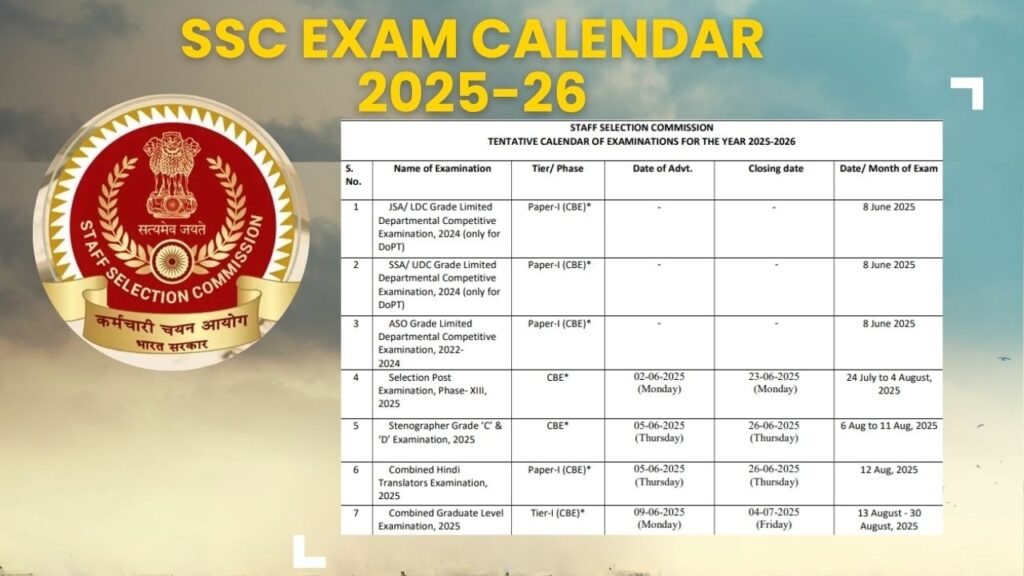
The SSC has announced the SSC Exam Calendar 2025–26 on its official website, so start preparing for the upcoming exams. More than 10 lakh candidates appear out of 50 exams conducted by the SSC every year after 10th, 12th or graduation for jobs in various central government departments and ministries.
This year SSC Calendar (Important Dates) for SSC Exam 2025 (20, 25, 26) contains all info regarding SSC Exams for CGL, CHSL, JE GD Constable, Delhi Police, Steno orga, Stenographer post holders. Candidate can check important events such as notification release date, application dates, exam dates from the schedule to know about the upcoming events which should be useful in your preparation.
Check Out The SSC Exam Calendar 2025-26
More than five million candidates take the SSC exams for government jobs once in a year after either 10th, 12th or graduation. The revised SSC calendar includes all notification, application, and exam dates for the 2025-26 cycle, providing transparency and a clear path for the candidates.
Exam Name
Schedule Period
SSC Constable (Driver)-Male in Delhi Police Exam
July to December 2025
Head Constable (Ministerial) in Delhi Police
July to December 2025
Head Constable (AWO/TPO)
July to December 2025
Constable (Executive)
July to December 2025
Grade C Stenographer
July to February 2026
Constables and Rifleman in Assam
October to February 2026
JSA/LDC
January to March 2026
SSA/UDC
January to March 2026
ASO
January to March 2026
Key Details for Aspirants
All SSC examinations are held at the designated centers across all over India in Online mode only.
Updates are posted on the official SSC website (https://ssc.gov.in). Aspirants are advised to track the notifications and deadlines for application.
Dates of the examination are liable to change due to unforeseen circumstances, keep watching official notifications for updates if travelling or taking study leaves.
There are more levels/phases to the selection process; CGL, CHSL and JE have additional rounds after Tier 1.
Admit cards, syllabus and other directions for the candidates are issued just before the exam, so keep visiting the official website of SSC regularly.
Follow the Guide to Download the SSC Exam Calendar 2025-26
1. Go To The Official Website of SSC, which is mentioned in this article.
2. Now Search for the SSC exam calendar in the Notification on SSC Exam Schedule 2025-26.
3. Open the link and download the calendar in pdf file OR you can just download it directly from the link section of this article.
4. Download the pdf file in your device.
5. Keep this file save or print for future uses.
The SSC timetable for the 2025-26 session is designed as per the pattern of previous years and it clearly indicates that there are 5 stages in the exam process.Changes or modifications, if any, will be notified on the official website of SSC.
BBAU counselling dates have been released for the PG programme 2025-26. Candidates are shortlisted in the merit list who have scored well in the entrance exams. Now they have to prepare for the next round of the counselling which is document verification and fee submission. Total of three phases of the admission process, those who cannot find their name in the first phase can wait for the second phase merit list. Candidates are advised to follow up on the important dates through notification. You can download it from the link mentioned below in the article.
BBAU PG Admission Procedure
The candidates should give the CUET PG exam, which is an entrance exam for admission to postgraduate programs. Students can get admission in BBAU according to their CUET PG score. Next step, candidates should register themselves on the admission portal and select their choices in the course. The merit list will be declared on the official website, and shortlisted candidates can verify their documents. Candidates who are selected according to their CUET score can submit their fees through the online SAMARTH portal.
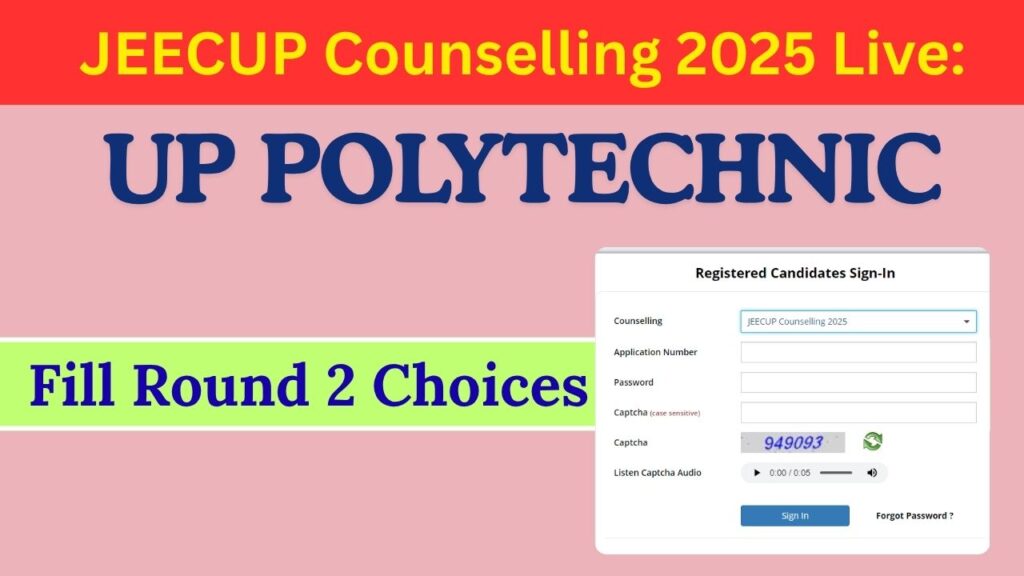
JEECUP Counselling 2025 Live! If you want to secure a seat in Diploma courses, fill your choice. Please ensure that you fill in your preferred choice before the last date. UP Polytechnic JEECUP 2025 choice filling starts on 9 July 2025; you must check the official website for more detailed information. You can find the link for the official website here.