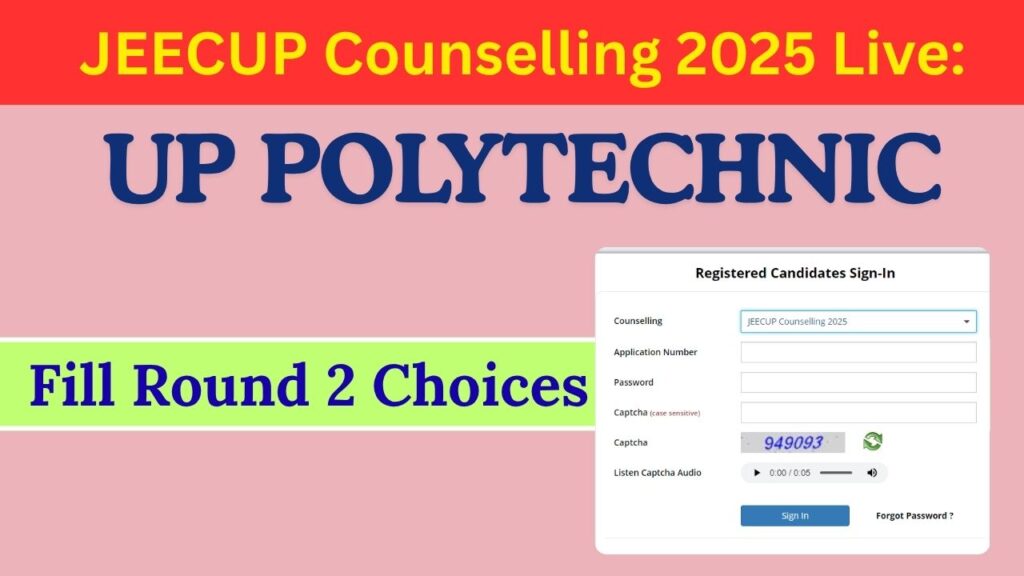
JEECUP Counselling 2025 Live! If you want to secure a seat in Diploma courses, fill your choice. Please ensure that you fill in your preferred choice before the last date. UP Polytechnic JEECUP 2025 choice filling starts on 9 July 2025; you must check the official website for more detailed information. You can find the link for the official website here.
Choosing the right educational path after 12th with any stream is confusing. Many students want to work while pursuing their higher education and some of them want to focus on their studies properly. Regular vs Distance Education is best in their own perspective, whether you have an educational background in science, commerce or arts. Let’s look into this topic further to differentiate both the topics in more detail. To resolve the confusion, analyze – Which one holds more value? Which option is best for your career?
I have seen many students and parents discussing this issue and get confused. Let me tell you one thing, it depends on your degree. Theoretical degree – you can get from distance but not MBBS or B.Tech because it requires practical experience.
In this article, we will look at both options by giving every detail of both education, so you can make a smart choice that fits your life, your goals, and your budget.
What is Regular Education?
Think of regular education as the traditional “college life” you see in movies. You have to:
Attend classes on a fixed schedule.
Go to a physical campus every day.
Talk and be responsive to your teachers and classmates face-to-face.
Some colleges are strict about the 75% attendance percentage.
Students who aim to learn not from just books but also from being part of a college community, participating in events, and living the campus life.
What is Distance Education?
Distance education, also known as Open and Distance Learning (ODL), is all about flexibility.
You study further in your choice of career from anywhere in India.
Take resources at your preference such as online materials, videos, and books.
You can study at your preferred time and have no issues with attending daily classes.
No face-to-face Interaction with teachers and students. Interaction happens mostly on online platforms or weekends.
You can manage work and study parallely.
Top government-recognized universities like IGNOU and private ones like Symbiosis are offering distance education in India.
Quick Comparison for Regular vs Distance Education
Feature
Regular Education
Distance Education
Location
Fixed Campus
Anywhere in India
Schedule
Daily classes
Flexible
Cost
Very High (Tuition + Living)
Very Low (Mainly tuition)
Interaction
Face-to-face with teachers/peers
Virtual (Online forums, email)
Discipline
Driven by teachers & timetable
Requires high self-discipline
Best For
Practical, lab-based courses
Theory-based courses, upskilling
Regular Education – Pros & Cons
Pros:
Networking Growth: You can have a chance to grow your network in the same field for more career benefits. Strong relations to both students and teaching can develop your communication skills.
Direct Teacher Guidance: You can respond to teacher’s questions and ask them individually to clear your doubt. Some teachers are good at encouraging students for their career.
Campus Life: Extra curricular activities and sports can be beneficial for your mental and physical health. Overall development is something you only get on campus.
Cons:
Expensive: Some students can’t afford college fees, but they need to hold the degree to grow in their career.
No Flexibility: You cannot work a full-time job if you are attending regular classes. Part-time jobs can give you any experience for your career. If you want to prepare for any competitive exam then distance education is a good option.
Relocation for Studies: Students who live in lower regions have to move out for studies and it will be difficult for them.
Affordable: Anyone can afford distance education fees because these are half of the regular degree fees.
Earn While You Learn: You can do both at the same time – working full time and take your lessons whenever you get free.
Prepare for Competitive Exam: You can also prepare for the competitive exams.
Accessible from Anywhere: A student from a small town can get a degree from a top university in Delhi without leaving their hometown.
Cons:
Needs Self-Discipline: You need to focus on self-study because there is no teacher to push you.
The Digital Divide: While Improving, Still many students do not have laptop or wifi access to their home for study.
Limited Practical Labs: You can pursue master degree or theoretical education from distance education but for engineering and medical, you need hands-on lab experience.
Who Should Choose Regular Education?
Recent School Pass-outs (12th Graders): If you are young and want the full college experience, and your family can afford it, regular mode is a great choice.
Students Pursuing Technical/Lab Courses: For degrees like B.Tech, MBBS, or pure sciences, the hands-on practical training in a regular college is essential. These courses are not valuable for career and UGC also prohibits them.
Structured Environment: Many students are not able to study on their own so they need big support from teachers to help them stay on track.
Who Should Choose Distance Education?
Working Professionals: If you are already in a job and want to upskill for a promotion (e.g., getting an MBA), distance education is perfect.
Homemakers: women who can’t afford to attend regular classes because of their responsibilities can choose to continue their study from distance education
Competitive Exam Aspirants: UPSC, SSC, Railways or banking aspirants often take a distance B.A. or B.Com degree to meet the eligibility criteria while focusing on their main preparation.
Students in Rural: They mostly need to move out for education and some students can afford this, they can get quality education at their doorstep.
Career Scope & Recognition in India
This is the most important part. The University Grants Commission (UGC), the main body for higher education in India, has officially stated that degrees from Regular, Distance (ODL), and Online modes are to be treated as equivalent.
This means if a job requires a B.Com degree, a B.Com from IGNOU is just as valid as a B.Com from Delhi University for applying to that job, including government jobs. In 2025, Indian companies care more about your skills and whether your degree is from a UGC-recognized university, not the mode you studied in.
There is no single answer for this confusion, you must think about the option that aligns with your career, situation and budget.
Choose Regular Education if:
You can afford
You are a recent school graduate
You want an immersive campus experience
Choose Distance Education if:
You need flexibility
want to study while working
limited budget
focused on a competitive exam.
In today’s India, both paths can give you a better career if you have developed skills in yourself. There is no 100% guarantee in both education that you can get a placement. What can give you guarantee is your hard work and improved skills. The right path is the one that takes you to your destination without derailing your life.
Every year, lakhs of students in Uttar Pradesh start their RO/ARO preparation the same way — by joining a coaching institute the moment they decide to attempt the exam. It feels like the safe choice. Everyone around you is doing it, the institutes promise structured guidance, and the fear of “missing something important” pushes you toward enrolling even before you’ve opened a single book on your own.
I can’t speak for your specific goals, but what a lot of successful RO/ARO candidates will tell you once they’ve actually passed the test is: coaching never made the difference. What mattered was whether they understood the exam, built a routine around it, and stayed consistent long enough to see results.
If you fall into the category of not being able to afford coaching or if you’re just an individual who likes to learn on his own terms, there’s no issue in attempting RO/ARO exams. You can start your preparations by yourself with the right guide. Proper syllabus, exam pattern, right schedule, responsibility are the core steps to take to prepare for the exam.
1. Understand Exam Pattern to Make the Right Strategy
You probably saw or heard that self-study failed many students not because they lacked intelligence but because they didn’t understand the exam’s purpose and importance. There are stages in the exams to clear and each one requires a different kind of preparation.
UPPSC RO/ARO has a Preliminary exam to check how well you know General Studies and General Hindi and it rewards speed and accuracy over depth.
The Mains, on the other hand, wants you to write with clarity and present arguments, not just recall facts.
And the Typing Test, ignored by most aspirants until the last month, has quietly ended the dreams of candidates who cleared both written exams but never practiced typing seriously.
Before you buy a single book, spend two or three days just going through the official syllabus and the last five years of question papers. You’ll notice patterns almost immediately — certain topics from Indian History, Indian Polity, and UP-specific General Knowledge repeat in some form every year. This is the kind of pattern-recognition that coaching institutes charge lakhs to hand you on a platter. You can get there yourself with a notebook and some patience.
2. Build a Study Routine That Doesn’t Depend on Motivation
Coaching institutes work partly because they impose a schedule on you — classes at fixed times force a kind of discipline that self-study doesn’t naturally have. When you’re preparing alone, motivation runs out fast, usually within the first three weeks. What replaces it is routine.
Pick a time of day when your mind is sharpest — for most people, that’s early morning — and treat that slot as non-negotiable, exam day or not. Break up your week so that you have each subject in a chunk of the day, instead of bouncing around among all of them every day. A general division that helps for RO/ARO is General Studies in the morning, Hindi grammar and comprehension in the afternoon, and revision and mock tests in the evening. The exact hours matter less than the consistency of showing up.
What trips up most self-study candidates isn’t laziness — it’s the absence of a feedback loop. In a coaching class, a teacher tells you when you’re falling behind. Alone, you have to build that feedback into your own routine. Keep a simple tracker, even a basic notebook works, where you log what you studied and how confident you feel about it. Revisit that tracker every Sunday and be honest about the gaps.
3. Choose the Right Books Instead of Too Many Books
One of the biggest traps for self-study aspirants is book overload. When you ask about which books toppers used, they might give you different answers. But each one of them has the topics which are frequently asked in the previous question papers. So, choose the book which you can understand when you read. Stick to that particular book per subject rather than jumping between multiple books hoping one of them “clicks.”
For General Studies, a common NCERT-based core syllabus in History, Geography, Polity and Economy is a much better option than jumping straight into exam-specific guides. Once your basics are solid, move to a UP-specific General Knowledge book, since a noticeable chunk of the RO/ARO paper focuses on state-level facts that national-level books simply don’t cover. For Hindi, focus heavily on grammar rules and previous year papers rather than generic Hindi literature books — the exam tests application, not literary depth.
Newspapers are non-negotiable, but read them with intent. Don’t read every article; scan for anything related to government schemes, UP-specific developments, and national events with policy implications. Ten focused minutes with a newspaper beats an hour of aimless reading.
4. Practice Like the Exam Is Already Tomorrow
Self-study candidates often make the mistake of treating mock tests as an afterthought — something to do once the syllabus is “finished.” In reality, mock tests should start early, even when you know only half the syllabus. Testing yourself regularly does two things coaching classes usually do for you:
It shows you where your weak areas actually are
And it trains your brain to work under time pressure
Solve at least one previous year’s paper or a full-length mock every week, and don’t just check your score — go through every wrong answer and understand why you got it wrong. Was it a factual gap, a silly mistake, or a comprehension issue? Each of these needs a different fix, and lumping them together as “I need to study more” won’t get you anywhere.
The typing test deserves its own separate practice schedule starting at least two months before your written exams are clear, not after. Waiting until results are declared to start practicing typing is one of the most common and avoidable mistakes RO/ARO aspirants make.
5. Find Your Community, Even Without a Classroom
The one genuine advantage of coaching is the peer group — people preparing for the same exam, sharing doubts, comparing notes, and keeping each other accountable. You can recreate this without paying for it. Online communities of RO/ARO aspirants, study groups on messaging apps, and even a couple of serious friends preparing for the same exam can replace this function almost entirely.
Use these groups to clarify doubts, share useful resources, and occasionally test each other. Just be careful they don’t turn into distraction hubs — the goal is accountability, not endless discussion about strategy that never converts into actual studying.
The Real Difference Between Coached and Self-Taught Candidates
Coaching gives structure to people who can’t build it themselves. If you can build that structure on your own — a study routine, the right books, regular self-testing, and a support system for accountability then there’s genuinely nothing coaching offers that you can’t replicate.
What ends up separating candidates who clear RO/ARO from those who don’t isn’t whether they paid for classes. It’s whether they stayed consistent long enough, tested themselves honestly, and treated every mock test result as information rather than judgment.
Self-study for RO/ARO isn’t the harder path. It’s simply the path that asks more of your discipline instead of your wallet — and for a lot of aspirants across UP, that trade has worked out just fine.
Conclusion — How to Crack UPPSC RO/ARO Without Coaching
Clearing the UPPSC RO/ARO exam without coaching is entirely achievable if you get started with the right attitude and strategy. The course, past year papers, textbooks, sample tests, and current affairs are all available online nowadays. Because in the end, your success is going to be determined by the work that you do every day, not by how much money you spend on prep. The real challenge isn’t finding resources—it’s using them consistently.
Most of the students after completing their graduation get more confused about their postgraduation than they were for the graduation. The most comparable degrees are MTech vs MBA in 2025, where both offer a well-opted career growth of Indian students. The postgraduate degree can open doors for more salary positions and knowledge if you have pursued it from the top college. BTech, BCA, and BSc (Computer Science) students get confused while choosing their higher education. Let’s make one thing clear — MTech vs MBA comparison is important because you must know the difference of value that both degrees hold in the industries.
MTech can offer you a wide range of fields such as Mechanical, Electrical, Computer Science, Civil, Electronics, Aerospace, AI, Data Science, Biotechnology, Chemical, and Cybersecurity. Whether you choose Mechanical or AI but know one thing that today’s world is evolving more into AI and cybersecurity. So, while selecting your career just check out the fastest growing field to fast career growth.
On the other hand, an MBA also offers a diverse range of fields such as management in marketing, operations, IT, Resources of the company. So, sometimes the same companies which can offer you an engineering position can also hire you as a manager because the company needs brilliant minds who can manage things to run everything smoothly.
Understanding Importance of MTech vs MBA in 2025
MTech can offer you a path as an engineer in the industry, while an MBA can offer you a position of assistant manager, manager, operation leader, and many more.
Closer Look to MTech
Candidates who are interested in Mathematics, Physics, and Chemistry can choose to opt this degree for building their career in engineering. The core skills for this field are technical, logical, critical which require your attention and full focus on the education.
Closer Look to MBA
MBA is a master of business administration for acquiring skills that need to manage and run operations in the industry. The core subjects in MBA are Managerial Economics, HR Management, Operation Management, Strategic and Accounting Management.
Is MTech Degree Worth in 2025?
In recent days, the world is evolving in tech, so the requirements of techies are increasing day-by-day. But MTech from top universities are worth the placement in top companies which offer you a great salary. MTech will get you ready for the cutting-edge products of the industries such as Artificial Intelligence, Electric Vehicles, or Semiconductors design. The sharp innovative minds are worth the value of an MTech degree.
How Valuable is an MBA in 2025?
An MBA from a top business school is worth it in 2025. This degree will increase your chances to a higher level position in the corporate companies. There are opportunities for you to join international companies. The departments like finance, consulting, and management can offer you a great path to reach for the high salary.
Career Opportunities & Top Companies
Now the difference starts between both the degrees. The role, companies, and responsibility are different for both fields.
For an MTech Graduates: There are various job roles in the companies like Design Engineer, R&D Engineer, AI/ML, Assistant Software Engineer, Senior Software Engineer, VLSI Design and Data scientist in the Google, Infosys, Wipro, Intel, Siemens, Tata, Mahindra, ISRO, and DRDO.
For MBA Graduates: Job roles are manager in consultant, Product, Marketing, Brand, Investment Banker, Financial Analyst, and Operation Head in top companies like BCG, Goldman Sachs, Morgan, Procter & Gamble, Hindustan Unilever, and Microsoft.
If you have noticed, some companies are mentioned in both because they hire M.Techs for core tech roles and MBAs for product management and business strategy roles.
Who Earns More in 2025?
It’s not that simple because it totally depends on the knowledge and skills of the candidates. The recent placement report from top MBA colleges (IIM, ISB) have shown the average package of MBA graduates is Rs. 28-35 LPA.
On the other hand, MTech graduates from top colleges (IIT, NIT) have a bit lower average salary package of around Rs. 20-28 LPA but candidates with polished skills in trendy departments like AI, VLSI design, can also get higher packages of around Rs. 40-50 LPA.
If you want to climb instantly with high income then MBA from top IIM colleges can help you get an average package of around Rs. 25 LPA. This can justify your massive investment for education that is why it is called an ROI program.
An M.Tech provides a rock-solid foundation for a career but you must have adapted expertise in tech. Your salary growth also depends on your skills and technical knowledge to build core products for the company to establish their growth. You will be heading towards your long-term financial rewards in technology-focused leadership roles.
Conclusion
Choose to Pursue MBA if:
You have great skills in communication, leadership, and strategic management.
You are interested in business, finance, and regular operation,
You want a good salary package from the start of your career.
Choose to Pursue MTech If:
You have command on core concepts of technical education.
You want to follow your passion in engineering.
You are a quick learner that helps you adapt to new technologies fast.
The choice does not depend on MTech vs MBA in 2025 but it’s all about passion vs management, depth vs breadth. Choose wisely because your career will become a part of your life. So, having a goal that aligns with your interest is important and worthy.
As per the Uttar Pradesh Public Service Commission, English & Biology LT Grade teacher result declaration was held on 24th feb 2026. The merit lists will be available for candidates who appeared in these examinations to check and download from the official website of uppsc. Candidates were required to authenticate the details on the portal in order to view their result. Candidates are suggested to evaluate their result and download it as soon as possible as the merit list will be accessible for a short duration.
Uttar Pradesh Public Service Commission Details at a Glance
Check the Official site of UPPSC: for Obtaining the notification when it is released.
Go to the Results Tab: At the official website, and click on the LT Grade Teacher result
Enter Details: To check your score, you must submit some information, including that related to you such as your Roll Number and Verification Code. (Make sure you submit the same information that was used in your UPPSC Application.
Save or Print Your Result: Obtain your results and take a print out for future reference.
Details Included in the Result
There are many important points of the UPPSC merit list through which the performance and eligibility of the candidates, who appeared in the examination, could be known effectively.
Candidate Roll Number: Providing the roll number of each candidate is a good practice as it facilitates verification and identification of the results.
Candidate Name: The names of qualified candidates in the merit list to be considered for the next rounds of selection process.
Category: The candidate’s category (General/ OBC/ SC/ ST) is also mentioned in the merit list which is considered while checking the rank and the eligibility of the candidate as per reservation policies.
Marks Obtained: This shows the marks obtained by each candidate in the examination, which is important for candidates to know how they performed in the exam and also for the sake of transparency.
Cut-off Marks: In addition, the cut-offs for each category are also provided, i.e., the minimum marks needed to qualify for further process.
Rank: Candidates are ranked on their performance, and such rank becomes the relative position amongst the other candidates.
GovUpdatewala is your trusted source for real-time updates on government exams and jobs in India. We provide verified info on SSC, UPSC, Banking, Railways, Defense, and Teaching exams. From syllabus and patterns to important dates and career tips — we support aspirants at every step.
The hype and excitement for government jobs in India is vast and often overwhelming. People cut off everything just to clear competitive exams. Two most big names that pop up frequently are State Police Sub-Inspector (SI) and SSC Multi-Tasking Staff (MTS). At first glance, comparing State Police SI vs SSC MTS is like comparing apples to oranges. One is a field power stuffed job and other is a desk job as administrator.
Many students get confused to choose their field because they don’t know the responsibilities and real-time work, they’re just watching money. Ask a single question and do yourself a favor for finding the right answer.
Do you want the power and prestige of the uniform, or the stability and work-life balance of a central government desk job?
Let’s understand this through this guide which breaks down every detail from these two paths to let you decide which job aligns with your lifestyle.
Job Roles and Responsibilities in Real
State Police Sub-Inspector (SI)
A person is going to work under Police regulations at the lowest rank position. Going to the scene of a crime report or checking who breaks the law as the first investigating officer, and filing a charge sheet in court is Sub-Inspector responsibility. This position comes in Group B (Non-Gazetted) or Group C Jobs.
It is a desired job for a person who has a bulky body and good physical strength with a sense of justice, and a desire for social status. It’s a 24/7 job, changing shifts, and responsible to maintain public safety, law and order, and investigate crime scenes.
SSC Multi-Tasking Staff (MTS)
All the paperwork is required to maintain that the system works properly, MTS employees are responsible for maintaining files, photocopying, delivering couriers to provide essential support in various Central Government Ministries, Departments, and Offices.
It is a desired job for quiet and routine seeking people who want a secure position at government desk with minimal stress and ample time to prepare for higher exams (like UPSC or SSC CGL). It comes under Group C posts.
Why Compare These Two?
The comparison becomes necessary when students get confused because of Entry Barriers and Aspirant Demographics.
SSC MTS: Students can take entry in the government sector after 10th pass and take a tag on their resume.
State Police SI: Wait for the graduation to complete and then apply to take authority in their local area.
Tip: You can apply for both and become a government employee.
Eligibility and Selection Process
The requirements are different for these two positions because their responsibilities are opposite. Physical standards also matter for the SI job. Let’s take a deep look:
Feature
State Police SI
SSC MTS
Educational Qualification
Graduation (Any Stream)
10th Pass (Matriculation)
Age Limit
21 – 28 years (Varies by state)
18 – 25 or 18 – 27 years
Physical Standards
High (Height, Chest, Vision)
None (Except for Havaldar posts)
State Police SI conduct two tests — Prelims and Mains to check your knowledge in GS, Maths, Reasoning, and Language (Hindi/English). After clearing the written examination, candidates who are shortlisted will go to the next phase of Physical Efficiency Test and Physical Standard Test. These tests will check your endurance capacity while running, long jump, and high jump along with height and chest measurement.
Medical Examination for checking eyesights, flat feet and knock-knees are also mandatory to allow you to take the field job.
SSC MTS has a streamlined selection process which starts with an objective-type exam. This Computer Based Examination divided into two sessions —
Session I
Numerical and Mathematical Ability & Reasoning
Session II
General Awareness & English Language
CBT follows PET/PST but only for havaldar posts, and it has only walking test and physical measurement. You will be called for document verification once you finish all these tests.
Salary and Benefits
Most of the students decided their career according to the salary and benefits. State Police SI pay at Level 6 which means basic pay is ₹35,400. It can be around ₹55,000 to ₹75,000 total salary by including other allowances. Salary varies based on the city/state of the person.
SSC MTS pays at the Level 1 scale, basic pay is around ₹18,000 with additional benefits it can sum up to ₹28,000 to ₹32,000.
Choose wisely, because your choices impact on your lifestyle, perks and your mindset.
Preparation Strategy to Compete in Exam
Few subjects are common in both State Police SI vs SSC MTS exams. You can prepare yourself for both exams if you are still in 10th grade.
Mathematics, Reasoning, and General Awareness are mandatory subjects for both exams.
Make your basics clear by practicing on Basic arithmetic, percentages, profit & loss, and interest etc.
Try a mock test online and buy books in which Coding-decoding, blood relations, and syllogisms questions are presented.
Read newspapers and follow famous personas and good channels on youtube for Current affairs, History, Geography, and Polity.
Analyze Previous Year Questions to obtain Extreme Speed and Accuracy in every answer. Physical activity is required for SI selection, so dedicate 1 hour every morning to any game and running outside.
Career Growth and Promotions
State Police SI
Sub-Inspector (SI)
Inspector
Deputy Superintendent of Police (DSP)
Additional Superintendent of Police (ASP)
In some cases, top performers reach the rank of SP (IPS level) near retirement.
SSC MTS
Multi-Tasking Staff
Lower Division Clerk (LDC) – via Departmental Exams
Upper Division Clerk (UDC)
Assistant Section Officer (ASO)
The MTS profile is often seen as a stepping stone. Most candidates clear CGL or State PSCs while working as MTS.
Need Help To Choose Your Right Path?
Take paper and pen for side-by-side comparison for both SI and MTS jobs. In those comparison right your pros and cons:
What is your “Why”?
Pros
Cons
State Police SI
Power, uniform, field action, high paying
24/7 job, vary shifts, transfer different states, crime scenes, stressful
SSC MTS
Stable job, grow family, decent work, prepare for IAS
Low salary, ton of preparation to clear exam
If you choose SI then prepare yourself for facing crime scenes & handling dead bodies, political pressure, and angry crowds. Maintain physical stamina and strength with regular exercise.
If you choose MTS then prepare yourself for preparation for the next rank for higher posts but it is a decent job and requires less stress to manage.
The State Police SI role is a “Life Style.” It offers high pay with great authority which makes you become a man with power that has a direct impact on society. SSC MTS is a desk job for people who maintain discipline and want a peaceful life.
My advice is don’t lose the chance, if you are in 10th grade you can apply for SSC MTS and take the hit while preparing for other other options like IAS or State Police SI. you can decide after your graduation but if you are graduated then choose accordingly.
Regardless of your choice, the key is consistency. Start your preparation today, pick your syllabus, and don’t stop until you crack the examination.