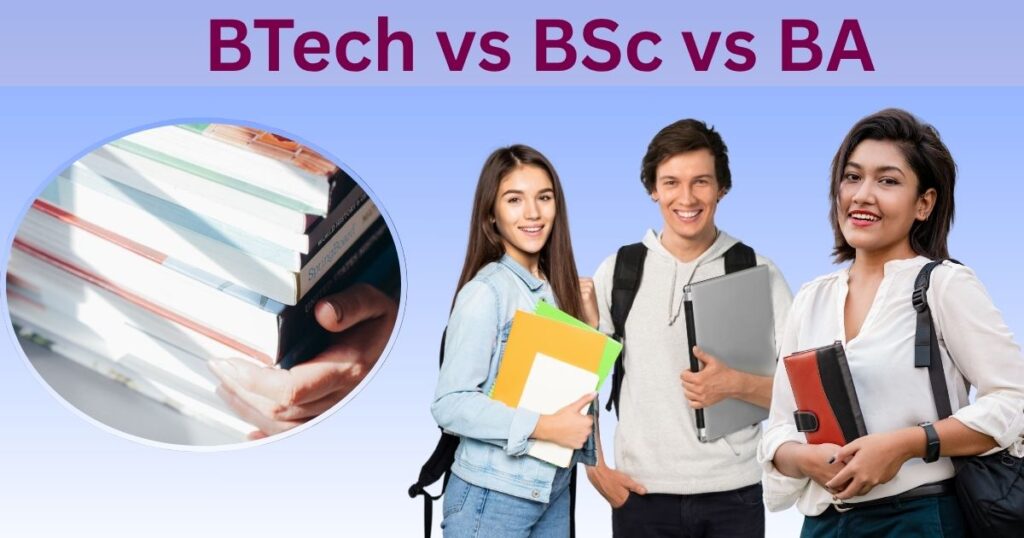
BTech vs BSc vs BA in 2025: Which Degree Offers the Best Future Scope?

BTech vs BSc vs BA in 2025: Which Degree Offers the Best Future Scope?

In today’s world, students must choose their field in which they have interest. Whether you choose BTech vs BSc vs BA in 2025, the future scope is consistently growing, if you follow the right direction. The right direction means if you are interested in teaching then BSc and BA is a good option but if you want to grow in the tech industry then BTech is the right option for you. Focus and the right college is also a matter to build your established career. 

Graduation is the first step in your career so take it wisely. The primary focus of BTech is Engineering & Technology. While BSc opens a path for you in science and research areas. BA is leading you towards further education to get a specialization in any specific subject. Students who are preparing for government exams can also pursue BA after 12th but many posts require other degrees. Before taking any action, you must check eligibility carefully for your future scope. 

Tips To Choose the Field for Graduation

Remember your passion, what you want to become in future? By acknowledging these questions, you can find the answer within yourself and then check the path to reach there. Once you know where to go, you will not get confused about your education. BA and BSc are easy courses, meanwhile BTech is hard, so if you want to become an engineer then you must pursue a BTech degree. 

If you want to become a Teacher, Journalist, Social Worker, HR, or Government Employee then BA is the best option for you. You can pursue other Technical courses and Specializations after BA. If you are interested in Teaching Science, Research, Nursing, or Higher Degrees, you can pursue a BSc. 

Comparison of BTech vs BSc vs BA

BTech (Bachelor of Technology), BSc (Bachelor of Science), and BA (Bachelor of Art) are highly demanding careers which offer a wider range of opportunities to the students. Their comparison is primarily focused on the career scope, course duration, course fees, eligibility and course curriculum.

Course Content of BTech vs BSc vs BA

BTech is a professional degree to deliver hands-on learning for engineering and technology. To advance technology with innovative minds is the motive of the industries. Colleges maintain their curriculum of BTech with application-based skills to get their students industry ready. It covers technical and applied aspects of specific engineering disciplines such as Mechanical, Civil, Computer Science, Chemical, Electrical, and Information Technology.

BSc is a graduation degree with more theoretical education in pure science like Physics, Chemistry, Zoology, Botany, Computer Science, IT, Statistics, Economic, Aeronautics, etc. It offers core concepts on the theories of science & technologies which get you focused on more research methodologies and theoretical understanding.

BA is involved in more Literature, History, Economics, Psychology, Sociology, Political Science, Geography, Journalism, Public Administration, and Social Work. It focuses on more theoretical concepts, creative writing and analytical skills, that is why it is perfect for those who want to become a professor in any of the subjects.

Read More:- SSC JE vs RRB JE: Which Govt Job Offers Better Salary, Growth & Stability in 2025?

Courses Duration 

  • BTech is entirely four years with one year internship. 
  • Standard BSc is a three year course which can be extended in specific programs such as Integrated program or BSc Honors.
  • BA standard degree is a total of three years course but BA honors is extended for four years. 

Eligibility for BTech, BSc, BA Courses

BTech & BSc graduation requires a 10+2 marksheet with science subjects including Physics, Chemistry, Biology & Mathematics. Admission in BSc can be done through an entrance test or direct admission. During BTech admission, you may have to clear JEE Mains/ Advanced which is hard to score well.

Students can take admission in BA after completing their 10+2 in any stream. It is not necessarily important to come from a science or commerce background. Students from arts, commerce, or science are eligible for BA.

Best Future Scope for BTech vs BSc vs BA

BTech Graduates are developing skills in engineering roles in departments of IT, Manufacturing, Chemical, Electrical, Production, Civil, Biomedical. After BTech, students can get a high salary in engineering roles from the top companies like Tata, IBM, Amazon, TCS, Infosys, Cisco, Godrej, and Siemens.

BSc Graduates are offering students a diverse range of opportunities to become job ready but for a higher scope, you should consider a master’s degree after BSc. There are some other specializations in technical courses, data science, and machine learning that can be helpful for getting a job in tech industries. You can also pursue higher education in pure science to become a lecturer or professor.

BA degree is offering many opportunities in further education for research, teaching, nursing, and creative arts & writing. Students can take a BA degree to establish a career in any specific field of subject. It offers many opportunities in the departments like HR, Media & Journalism, Social Work, Event Management, Hotel Management, Content Writer, Digital Marketing, Business Analyst, and Government Sector. Some of these require a diploma or certificate course for applying to the particular role.

How Can You Choose the Best Course?

There is a final answer for that because it all depends on your interest and budget. Let’s start from the lower budget course to the highest budget course:

Choose BA if:

  • You want to become a teacher, professor, analyst, content creator, digital marketing, sales executive, owning a business or preparing for a government job. 
  • You can’t afford the heavy expenses of the course.
  • You are working professionally and want to continue your education.
  • You want to pursue another degree (MA, BEd, LLB) or diploma and don’t want to burden yourself with a ton of syllabus.

Choose BSc if:

  • You are interested in science and want to research into this field.
  • You want to become a professor in a science subject.
  • You cannot afford BTech so you can choose BSc with a technical subject.
  • You are not prepared for the entrance tests, direct admission can happen in BSc.
  • You want further studies after graduation.

Choose BTech if:

  • You want to become an Engineer, interested in Physics, Chemistry, and mathematics.
  • You can afford to study from a recognized college.
  • You want the highest salary package after graduation.
  • You want a structured program to grab industry opportunities. 
  • Higher education like MTech for leadership roles in tech-driven industries. 

How do BTech, BSc, and BA degrees differ in career prospects

A comparison table will be good to observe the differences easily among them:

DegreeKey Career ProspectsTypical RolesSalary and Opportunities
BTechTechnology, engineering, IT, manufacturingSoftware engineer, mechanical engineer, data scientist, IT consultantHigher starting salaries, strong industry demand, direct recruitment in technical roles
BScResearch, academia, pharmaceuticals, environment, governmentResearch scientist, lab technician, data analyst, teacherModest starting salaries, very good with advanced qualifications, flexible career paths
BAHumanities, social sciences, media, civil servicesJournalist, teacher, public relations officer, civil servantGenerally requires higher studies for career growth, diverse but less technical roles

Conclusion

Whether it is a debate of BTech vs BSc vs BA, you can choose your degree according to your interest and need for your career scope. Let’s explore the differences in each degree’s details and career scope which can help you to decide the right degree for you. It’s a turning point of your life after 12th, you can’t decide just in a second. You have to list out your choices, interest, and budget then come back to this article to explore every detail for the BTech, BSc, and BA degree future scope.
Leave a Comment

Your email address will not be published. Required fields are marked *

CCRAS Group A B C Eligibility, Selection Process and Other Details

CCRAS Group A B C

Getting a government job in the healthcare and research sector is a big achievement for any competitive exam aspirant. The Central Council for Research in Ayurvedic Sciences (CCRAS) provides hundreds of vacancies in CCRAS Group A B C posts in different departments. Candidates who are interested in Ayurvedic medicines and treatments can enter this field.

If you are a doctor, nurse or a 10+2 holder aspiring to come to the administration sector, then CCRAS Group A B C is just for you with a heaping number of opportunities. Now, as the Computer-Based Tests (CBT) are over and the 2026 results are officially out, let’s take stock of these posts, know the basic eligibility requirements and give a peek into the selection process to be undergone by successful candidates. 

So, let’s get into the full, simple explanation of the CCRAS Group A B C vacancies. 

What is the CCRAS Recruitment Drive?

CCRAS works under the Ministry of Ayush, The Central Council for Research in Ayurvedic Sciences is a statutory body. It is the foremost national body for promotion of scientific research in Ayurveda and is responsible for evolution, standardisation, propagation of research and also funding. 

For the effective functioning of its large network of institutes and centers of research, Cadre Posts were classified in three hierarchical groups according different organizational functions: 

Group A: These are specialized, premier positions for advanced medical professionals and senior researchers.

Group B includes posts which require an intermediate level of technical knowledge and skills, such as nursing staff, translators and senior laboratory technicians. 

Group C is at working level to perform day-to-day functions which is critical to the daily functioning of the organisation, which includes the office staff, junior assistants, pharmacists and Multi-Tasking Staff (MTS).  

Eligibility CCRAS Group A B C 

Struggling to understand who qualifies is one of the most befuddling parts of any mass government announcement. To make things simple and clear, here is a neat summary of essential eligibility criteria and age limits for the main posts in each group. 

Group A Posts (Specialized & Medical)

For the posts of Research Officer (Ayurveda) and Research Officer (Pathology), the candidates are required to fulfill the Eligibility Conditions i.e. should possess a Postgraduate Degree (MD/MS) in the concerned discipline from a recognized university.  

Further, the candidates must be eligible for registration (or registered) with the State/Central Medical Council. The upper age limit is generally 40 years. 

Group B Posts (Technical & Supervisory)

The Group B posts have their own educational and professional prerequisites. For example:

  • Staff Nurse: B.Sc. Nursing or GNM (Diploma) is mandatory. The candidate should have an experience of minimum two years in teaching or research hospital.  
  • Assistant Research Officer (Pharmacology): The candidate should have M.Pharm or M.Sc in Medicinal Plants specializing in pharmacology with one year of experience after degree.  
  • Translator (Hindi Assistant): The candidate should have a Master‘s degree in the prescribed Hindi / English subject combination and a recognized translation diploma.

The general upper age limit for Group B posts is 30 years. 

Group C Posts (Administrative & Support)

Group C has a different kind of job offer that you can get after your 12th or graduation. These various posts require different qualifications:

Post CCRAS Group A B CEducational QualificationAdditional requirements / Experience
Upper Division Clerk (UDC) & AssistantsGraduate (any stream)Basic knowledge of computers
Lower Division Clerk (LDC)12th passTyping speed: 35 WPM in English or 30 WPM in Hindi
Pharmacist (Grade‑I)– Diploma in Pharmacy / D.Pharm (Ay.) with 2 years experience, or- B.Pharm (Ay.) degreeMust be related to Ayurveda as per CCRAS norms
MTS & Laboratory Attendants12th pass with Science (Physics, Chemistry, Biology)1 year of relevant experience
Age Limit (General)Must be between 25 to 30 yearsRelaxations applicable as per category (SC/ST/OBC/EWS/PwD) as per official notification

Selection Process and Exam Pattern

It is important to understand the testing of candidates for the good preparation in days to come. The entire procedure of the selection was rigidly controlled and transparent by CCRAS. 

1. The Computer-Based Test (CBT)

Exam GroupCBT MarksCorrect Answer (+ Mark)Wrong Answer (- Mark)CitiesExam Period
Group A70+1-0.2538 cities across IndiaNov-Dec 2025
Group B, C, MTS100+1-0.2538 cities across IndiaNov-Dec 2025

2. Skill Tests

Aspiring candidates for the posts of LDC or Stenographer have to undergo stringent typing and shorthand tests to ascertain their practical speed and accuracy. 

3. The Interview Round

For the posts of Group A, the CBT is only a part of examination. The selected candidates also have to go a specialized interview with 30 marks to judge their deep subject matter knowledge and suitability for higher research positions. 

CCRAS Group A B C Cut Off Marks

Official CCRAS Group A B C cut off for the session 2025-26 has not been released in the form of a single cumulative table on the website as yet but as of April 2026 the result and cut off update is activated. 

The cutoff scores are different based on categories like UR, OBC, SC, ST, EWS. Also, the cutoff depends on the post for which you have applied, i.e. Whether you are applying for LDC, UDC, MTS, Lab Attendant or any other post. 

Read More:- UPSSSC Lower PCS Recruitment 2026: Notification, Vacancy, Eligibility & Apply Online

How to check exact cut‑offs

  1. To download the CCRAS Group A B C Cut Off 2026, candidates are advised to visit the official website at https://ccras.nic.in. 
  2. Go to the “Recruitment” or “Results” tab. Search for the link or PDF file named “CCRAS Group A B C Cut Off 2026” or the merit list for the particular post. 
  3. Open the PDF to check the minimum qualifying marks which is divided into UR, OBC, SC, ST & EWS. 

Conclusion

The CCRAS Group A B C will provide many posts which is an excellent chance for the individuals who desire a bright future and want to become a part of India’s AYUSH system of medicines. With a carefully crafted selection procedure – from regular CBTs to special skill assessment – the Council makes certain that they end up with the most passionate students.

The 2025–2026 cycle is already serving as a beacon for those who will come after us, even as we await our final appointment letters. Good luck in the next steps of your career journey, stay tuned and keep your paperwork in order! 

Leave a Comment

Your email address will not be published. Required fields are marked *

Meet the Best History Teacher for Competitive Exams Who Can Boost Your Score

Best History Teachers in India for Competitive Exams UPSC SSC RRB

Aspirants of competitive exams like UPSC, SSC, RRB, State PSC think history is the hardest subject, the truth, it is hard without the right guidance. To understand the facts behind the history instead of rote learning, you need the best history teachers for competitive exams. History is an important subject among all other subjects because it demonstrates the past events across the country, generations and world. 

History is divided into its past in three periods — Ancient, Medieval, and Modern, so if you are preparing for a government exam then consider History is an important role in prelims, mains, and even interviews.

And the right teacher will simplify timelines, connect events and make you remember the logic behind every topic. This will help you remember quickly during the exam or interviews. 

Let’s explore the details of these teachers to understand why they are the best:

Praveen Sir

Praveen Sir is the top ranked teacher for providing best lectures of History online. Many students cleared their exams because his clear explanations and structural approach is quite helpful. Students understand easily because he breaks down complex topics into simple storytelling with factual accuracy. 

Praveen Sir teaching online History lecture for competitive exams.

He makes hard topics like cultural development, Mughal administration, and freedom movement remembered with systematic notes and practical examples. 

Abhishek Suman

Abhishek Suman explaining modern history concepts in classroom.

Abhishek Suman is a popular History teacher and is growing his numbers by providing interesting History Lectures. He makes boring topics become interesting with his explanation of events, he elaborates them with reasoning and connecting them with the present. Students appreciate him for clearing small doubts, especially in modern history. 

Khan Sir 

Khan Sir delivering a humorous yet informative History lecture.

Every aspirant knows Khan Sir from Patna because he is the most famous and growing teacher for the preparation of competitive exams. His teaching style is funny but effective, using real life relatable examples and humour to make every tough topic easier. Students praised his lectures that helped them to understand world history & Modern History. 

Awadh Ojha Sir

Awadh Ojha Sir teaching Modern Indian History to UPSC aspirants.

Awadh Ojha Sir is ideal for UPSC aspirants who struggle to understand modern Indian History. His deep analysis and straightforward teaching style make every student attentive through his lecture. Students admire his passion and dedication for Modern History. His in-depth explanation and motivation pushes students to stay consistent.

Rishabh Sir

Rishabh Sir giving structured history lessons for competitive exams.

Rishabh Sir is also a best history teacher, he focuses on strategically preparing for the government exam. He teaches in a structured way to get students ready for the History Exam. ideal for those students who don’t want to give big time for history but cover up every important topic. He also provides compact notes and highlights on youtube for Ancient, Medieval, and Modern History.

Kumar Gaurav

Kumar Gaurav teaching chronological history events to students.

Kumar Gaurav’s methodological and calm teaching style is connecting events chronologically, it helps students to understand events without getting lost. He is the best for those who are not good with dates and events. 

Dr. Vikas Divyakirti

Dr. Vikas Divyakirti conducting a history lecture integrating culture, society, and polity.

Dr. Vikas Divyakirti is a founder of Drishti IAS, he motivates students to stay consistent. He emphasizes every event in History, connecting them with culture, society, and polity which makes it easier for students to understand easily. His deeper knowledge of history and integration with philosophy and polity make lectures a key success to interview stages. 

Sumit Sir

Sumit Sir providing exam-oriented history revision classes.

Sumit Sir is focusing on exam-oriented teaching, stressing on previous year question practice to ensure students are aligned with the exam pattern. He helped clear the student’s confusion in difficult parts. He also provides exam notes and takes revision classes which is extremely useful before exams.

Why Choosing the Right History Teacher Matters

There is no single answer for the right teacher because it depends on the student’s mind and thinking. Some students get irritated or sleepy during History lessons because they get bored and don’t even understand the topic’s heading. The right teacher comes when you find the lessons more interesting and easy rather than difficult and boring. 

These factors can help you find your right mentor

Teaching Style: Take a demo class of a few teachers and check which teacher’s explanation you understand better. Find the right mentor whose style aligns with your preparation needs.
Exam Orientation: You prefer to study according to the exam pattern.
Resources: Good teachers always provide concise notes, practice questions.
Motivation: beyond just a teacher, they also inspire students to stay consistent.

Read More👉 Meet the Best Hindi Teacher for Competitive Exams Who Can Boost Your Success

Conclusion

History is not just a subject of delusion and theory, it is the journey of society, culture, and politics from years to years. The right teacher can make this interesting rather than boring events which makes it hard to remember. 

Choose the right one in the list of Best History Teachers for Competitive Exams because he can make the burden go away. With the strong preparation in History can help you score high in any competitive exams.

Leave a Comment

Your email address will not be published. Required fields are marked *

WBSSC Result 2025 Declared – Direct Link to Check Your Score & Rank

WBSSC Result 2025

The WBSSC Result 2025 is available on the official site from 16.11.2025 to 14.12.2025. By submitting your Roll Number / Application Number and Blind Box Number on the website, you can check your result. WBSSC SLST has officially opened the link to download the SLST exam result which will fill the 35,726 positions. For your convenience, we also played with a link to download the result. 

The candidates are suggested to verify the cutoff marks and the merit list to know the next stage of selection process. For more information and updates, the candidates are advised to regularly visit the WBSSC website. 

Key Dates to Follow Up

Application Start16/June/2025
Last Date to Apply Online14/July/2025
Exam City AvailableAs Per Schedule
Admit Card Date15/August/2025
Exam Date (Class 09–10)07/September/2025
Exam Date (Class 11–12)14/September/2025
Result Date07/November/2025
Interview Date17/November/2025

Class 09 to 10 Assistant Teacher Salary

Basic Pay₹33,400 per month
Pay LevelPay Level 11
House Rent Allowance₹4,008 (12% on basic)
Medical Allowance₹500
Dearness Allowance (3% on basic)₹1,002
Gross Salary₹38,910
Professional Tax (PTax)₹150
In-Hand Salary₹38,760

Class 11 to 12 WBSSC SLST Salary

Basic Pay₹42,600 per month
Pay LevelPay Level 15
House Rent Allowance₹5,112 (12% on basic)
Medical Allowance₹500
Dearness Allowance (3% on basic)₹1,278
Gross Salary₹49,490
Professional Tax (PTax)₹200
In-Hand Salary₹49,290

Selection Process for WBSSC SLST Teacher Position 

There are various stages in the WBSSC SLST 2025 selection process to test the aspirants in different aspects. Initially, candidates appeared for a written examination to assess their expertise in the domain. Then officials scrutinize school records, to verify the education and value. Those who pass now go on to a panel interview that assesses speaking ability, subject matter expertise, and job fit. Followed by a teaching demo to assess teaching skills and classroom management. Top choices then confirm that the papers are real. A health check is the last to fulfil basic fitness criteria. That’s the step-by-step process to getting the right people for the job.

Read More 👉 IIT Delhi MTech Fees Structure — Complete Details of Tuition, Hostel & Other Charges

Guide to Follow for Downloading the WBSSC SLST Result

  1. Visit the official site to download the WBSSC SLST Result 2025 or simply click on the direct link which will be updated on this page. 
  2. Search for the option to “download the result” link and click on it. When the page opens, provide Your Roll Number or Application Number and Your Date of Birth. 
  3. Hit the Submit button to continue. 
  4. After confirming, a result will be shown on your screen. 
  5. Download/save your scorecard or take a print if required for further reference. 
  6. Verify all the details twice, so that there are no mistakes in the procedure. 
Useful Links
Download ResultClick Here
Official NotificationClick Here
Official WebsiteClick Here

Leave a Comment

Your email address will not be published. Required fields are marked *

CTET Exam Date 2026: Notification, Exam Schedule, Application Dates and Complete Details

CTET Exam Date 2026

The Central Board of Secondary Education (CBSE) has issued the notification for CTET Exam Date 2026. The candidates applying for the position of teachers in India should note the date for this important exam. The CTET 2026 21st edition is going to be held on Sunday, 8 February 2026. If you want to make your career in teaching, then this is a good national level eligibility test to check your abilities.  

Dates To Follow For CTET Exam

EventDate
Application Start Date27/November/2025
Last Date to Apply18/December/2025 
Exam Date08/February/2026 (Sunday)
Result (Tentative)March/2026

Exam Pattern & Schedule

Paper-19:30 AM — 12:00 PM
Paper-22:30 PM — 5:00 PM

Whereas Paper-1 is designed for class first to fifth, Paper-2 is structured from seventh to eighth class teacher. Both papers have 150 MCQs that carry 150 marks and the passing score is 60%. 

Paper 1 Syllabus (Classes 1-5)Paper 2 Syllabus (Classes 6-8)
Child Development & Pedagogy (30 marks) : Concepts of learning, psychology of the child.Language I & II (30 marks each) : ComprehensionMathematics (30 marks) : Numbers, shapes, operations.ENVIRONMENTAL STUDIES (30 marks) Family and Environment, Science Basics. An excellent knowledge of theories and practices in child development and pedagogy etc. is necessary for the implementation of inclusive education.Language I & II (30 marks each): Advanced comprehension.Mathematics and Science (60 marks): Algebra, physics, biology.OR SOCIAL STUDIES (60 MARKS) : HISTORY, CIVICS, GEOGRAPHY. 

Read More :- Top NEET Colleges in Lucknow with High Ranks, Fees, Seats and Details

Salary For CTET Exam Date 2026

The level 1 position offers Rs 9,300 to Rs 34,800 along with the Grade along with the Grade Pay of Rs 4200. While candidates can earn up to Rs. 34,800 with Grade Pay of Rs 4600 at Level 2 position.

Apply HereClick Here
Exam NoticeClick Here
Official WebsiteClick Here

Leave a Comment

Your email address will not be published. Required fields are marked *

RRB NTPC 2025 Exam – Application Dates, Eligibility & Vacancy Details

Railway Recruitment Board announced about the NTPC recruitment drive for the interested candidates who are waiting to apply for Railway jobs. RRB posted on the official website about the recruitment drive for the posts of Station Master, Goods Train Manager, Traffic Assistant, Senior Clerk cum Typist, and more. There are 5810 vacancies out there, and the online application process commences on October 21, 2025 and deadlines for submissions are November 20, 2025. Interested candidates can see the full notice for eligibility rules, fees, age limits, pay info, and how the selection works. Graduates who want jobs in railways should barge at this. 

RRB NTPC Application Dates

Notification Date29/September/2025
Application Start On21/October/2025
Last Date For Application20/November/2025
Admit CardUpdate Soon
ResultUpdate Soon

RRB NTPC Application Fee To Apply

Gen/OBC/EWSRs. 500
SC/ST/EBCRs. 250
Refund amount for Gen/OBC/EWSRs. 400
Refund amount for SC/ST/EBCRs. 250

Read More 👉 Download The Meghalaya Police Result 2025: Get Direct Link Here

Guide to Apply for RRB NTPC Application

Aspiring students can follow the guide to fill the application form for this recruitment process. Be prepared for the exam that will happen soon.

  1. Click on the official website link in this article which redirects you to the official site of RRB.
  2. There is a link “RRB NTPC Graduate Level Recruitment 2025, follow the link and register yourself.
  3. The next step is to fill out every detail carefully in the application and upload documents.
  4. Final submit, then pay application fee to proceed further. 
  5. Remember application is required to appear in the examination but it will eventually return.
  6. Save the form and print it out for any future use.

RRB NTPC Application Job Vacancy

Post VacancySalary
Chief Commercial Cum Ticket Supervisor161₹35,400
Station Master615₹35,400
Good Train Manager3416₹29,200
Traffic Assistant59₹30,000
Junior Account Assistant Cum Typist921₹29,200
Senior Clerk Cum Typist638₹29,200
Total Posts5810
Useful Links
Online ApplicationClick Here
Official NotificationClick Here
Official WebsiteClick Here

Leave a Comment

Your email address will not be published. Required fields are marked *

Scroll to Top