The SSC has announced the SSC Exam Calendar 2025–26 on its official website, so start preparing for the upcoming exams. More than 10 lakh candidates appear out of 50 exams conducted by the SSC every year after 10th, 12th or graduation for jobs in various central government departments and ministries.
This year SSC Calendar (Important Dates) for SSC Exam 2025 (20, 25, 26) contains all info regarding SSC Exams for CGL, CHSL, JE GD Constable, Delhi Police, Steno orga, Stenographer post holders. Candidate can check important events such as notification release date, application dates, exam dates from the schedule to know about the upcoming events which should be useful in your preparation.
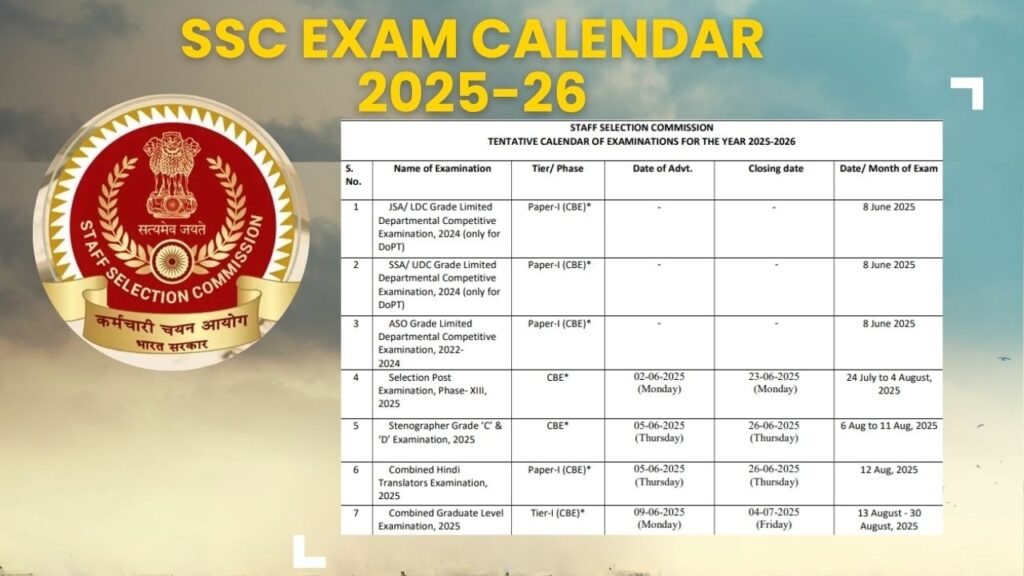
Check Out The SSC Exam Calendar 2025-26
More than five million candidates take the SSC exams for government jobs once in a year after either 10th, 12th or graduation. The revised SSC calendar includes all notification, application, and exam dates for the 2025-26 cycle, providing transparency and a clear path for the candidates.
Exam Name
Schedule Period
SSC Constable (Driver)-Male in Delhi Police Exam
July to December 2025
Head Constable (Ministerial) in Delhi Police
July to December 2025
Head Constable (AWO/TPO)
July to December 2025
Constable (Executive)
July to December 2025
Grade C Stenographer
July to February 2026
Constables and Rifleman in Assam
October to February 2026
JSA/LDC
January to March 2026
SSA/UDC
January to March 2026
ASO
January to March 2026
Key Details for Aspirants
All SSC examinations are held at the designated centers across all over India in Online mode only.
Updates are posted on the official SSC website (https://ssc.gov.in). Aspirants are advised to track the notifications and deadlines for application.
Dates of the examination are liable to change due to unforeseen circumstances, keep watching official notifications for updates if travelling or taking study leaves.
There are more levels/phases to the selection process; CGL, CHSL and JE have additional rounds after Tier 1.
Admit cards, syllabus and other directions for the candidates are issued just before the exam, so keep visiting the official website of SSC regularly.
Follow the Guide to Download the SSC Exam Calendar 2025-26
1. Go To The Official Website of SSC, which is mentioned in this article.
2. Now Search for the SSC exam calendar in the Notification on SSC Exam Schedule 2025-26.
3. Open the link and download the calendar in pdf file OR you can just download it directly from the link section of this article.
4. Download the pdf file in your device.
5. Keep this file save or print for future uses.
The SSC timetable for the 2025-26 session is designed as per the pattern of previous years and it clearly indicates that there are 5 stages in the exam process.Changes or modifications, if any, will be notified on the official website of SSC.
Staff Selection Commision is a governmental organization which recruits candidates for various posts in the government sector. SSC Multi Tasking Staff MTS Recruitment 2025 notification is released, if you are waiting to apply for this position download its notification for all the details. Application Form will start on 26 June 2025. Make sure to fill out an online form before the closing date of registration.
The SSC MTS exam is a process for recruitment for havildar positions and other multi-tasking positions like Daftari, Junior Operator, Peon, Jamadar, Chowkidar, and Mali. If you are interested in working in the government sector, you can apply for these positions after the 10th but prepare well to clear the examination.
SSC Multi Tasking Staff MTS Recruitment 2025 Details
Organization
Staff Selection Commission
Post
Multi Tasking Staff
Overview
SSC MTS is a recruitment process for various roles such as Havaldar, Peon, Chowkidar, etc.
The SSC MTS Syllabus 2025 is updated and it gives you a better understanding of the most important topic ideas. This exam is your gateway to the non-technical role in a government job. Whether you’re a new or repeat aspirant. Here is the breakdown of the SSC MTS Syllabus, and exam pattern to guide you well.
Introduction
This is a national-level recruitment process in India, the candidates who are interested in non-technical roles can appear for this exam. If the aspirants get a good score in the exam they can be selected for the government job. They recruit for non-technical jobs, and Group C positions in different ministries, organizations, and departments. Anyone can take the SSC MTS exam after the 10th pass.
It is important to know that understanding the updates of the syllabus will help you guide the overall important topics which you have to cover first and you must know the exam pattern from the previous year questions. Aspirants who want to crack SSC MTS 2025 must understand the exam pattern before they start preparation.
It has two sessions, in the first session topics are more likely related to the candidates ability for logical thinking and how far they can get to the answer. The topics are Mathematical, Ability, Reasoning Ability, and Problem-Solving, and session 2 has General Awareness, English Language, and Comprehension. Both sessions are mandatory to attempt and this is a computer-based test.
Marking and duration of the SSC MTS 2025
The total of 90 questions in this paper, where the 40 questions from session 1 and 50 questions from session 2. The Total mark of the paper is 270 and the total duration is 90 minutes (extra time for scribe users). Aspirants can take this exam in their regional language. Session I has no negative marking, while Session II penalizes wrong answers by 1 mark each.
Detailed SSC MTS Syllabus 2025
Reasoning Ability & Problem Solving This subject includes a very important topic for testing your logical thinking and problem-solving skills. Alphanumeric series, coding-decoding, analogy, and Odd one out. They are very simple topics but have very impressive and creative methods to improve logical thinking. Non-verbal reasoning (mirror image), Directions and Ranking, Syllogism, Matrix, Mathematical Calculations, and Order of words are the topics in this subject.
Numerical and Mathematical Ability Integers, Whole Numbers, LCM, HCF, Decimals, Fractions, Percentages, Ratios & Proportions, and Averages, are the topics covered in this subject because they are the basic concepts. Then there are more topics that involve the understanding of aspirant mind abilities. Work and time, time and distance, profit and loss, simple interest, discount, area and perimeter, geometry, mensuration, data interpretation, square roots, algebra, and basic trigonometry. This section assesses your numerical aptitude and mathematical understanding.
English Language and Comprehension This subject focuses on vocabulary, sentence structure, synonyms & Antonyms, error spotting, cloze tests, and reading comprehension. These topics help to understand the words and phrases with different meanings or their expression of feelings. These abilities are helpful in many government jobs in various sectors. Having a good command of English will enhance the ability to interpret written and verbal passages.
General Awareness This subject covers topics related to current affairs for both national and international. Recent events, history, geography, art and culture, civics, economics, general science, environmental studies, Indian constitution, sports, and static general knowledge. These are the topics that involve high possibility in the exam.
All four subjects are the overall syllabus to prepare for the SSC MTS examination 2025. Aspirants can get online resources and books on these topics for preparation.
Preparation Tips for SSC MTS 2025
Aspirants check the exam pattern and syllabus before preparing for the examination. Split each subject for the same duration daily so that you can prepare each subject equally and efficiently. Choose the easy topic first and complete then get to the second topic. This strategy will help you cover most of the topic in less time.
Practice mock tests and previous year’s papers to understand the exam pattern and difficulty level. You should also join the coaching classes if you want but you have to do self-study. Don’t waste too much time on a single topic. Stay updated with the current affairs daily.
Conclusion
The SSC MTS Syllabus 2025 can help you crack the exam and open the chance to get a government job in a non-technical role. Aspirants should learn the updated syllabus before preparation even if they are repeat aspirants. It changes every year to make the exam relevant and has value. Make sure to check the pattern of question papers along with a detailed syllabus.
SSC CGL Online Form 2025: SSC Combined Graduate Level CGL Online Form 2025 Released for multiple posts in government sector. Candidates who graduated from any stream can apply to appear in the exam. There are a total of 14582 vacancies, for online form check the link in this article and apply directly to join Combined Graduate Level Exam.
SSC Combined Graduate Level CGL Online Form Details
Application Fee for SSC Combined Graduate Level CGL
General / OBC / EWS
SC / ST / PH
All Category Female
Correction Fee 1st Time
Correction Fee 2nd Time
100/-
0
0
200
500
Application Form Expected Exam Dates
Start Date
9-June-2025
End Date
4-July-2025
Correction Date
9 to 11 – July-2025
Admit Card – Tier 1
August 2025
Exam Date Tier 1
13-30 – August-2025
Exam Date Tier 2
December-2025
Department-Wise Post Detail for SSC Combined Graduate Level CGL Online Form 2025
Post Name
Age-Limit
Eligibility
Auditor in AG or otherMinistries, Accountant in AG or Other, Sr Secretarial Assistant in Electronics, IT, UDC, CSCS, Tax Assistant in CBDT, CBIC, CBN
18-27 Years
Bachelor in Any Stream
Sub Inspector in NIADivisional Accountant in OfficesResearch Assistant, Assistant in Other ministriesInspector in Central Narcotics, DOP, CBIC, in Income Tax (CBDT)
18-30 years
Bachelor in Any Stream
Sub Inspector in CBI
20-30 years
Bachelor in Any Stream
Junior Statistical Officer in MSPI
18-32 Years
Bachelor in Any Stream with Statistics as Statistics
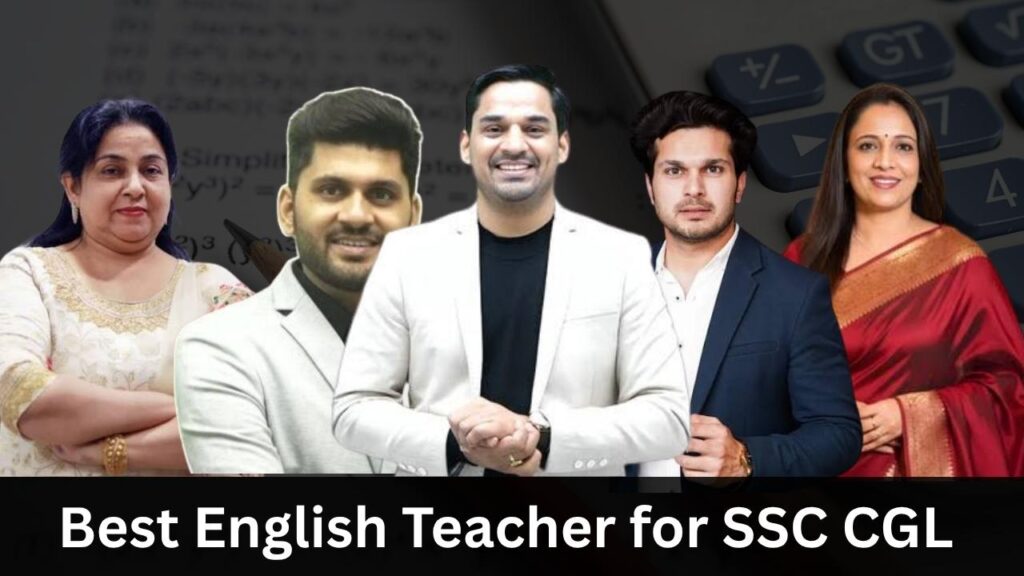
If you are preparing for SSC CGL 2026 then consider preparing English is important, not optional. Whether it’s Tier 1 or Tier 2 cracking the exam won’t be easy until you prepare well. But finding a mentor who really teaches you everything smoothly in English is hard. Here is a list of names of some Best English Teacher for SSC CGL. They will help you with vocabulary, grammar, comprehension, or error spotting.
Why English Matters in SSC CGL
The English Paper will help you to maintain scoring as this is not that hard if you prepare it well. Many students take this subject politely and get low scores. If you want to get high scores then consider this subject important to you and practice well to understand every topic.
Tier 1 English (25 Questions – 50 Marks)
Tier 2 English (45 Questions – 135 Marks)
That’s a total of 185 marks in English and nearly 50% of your selection chances depend on it. Did you know? Many students score well in Quant and Reasoning, but lag behind in English. Now that you know how valuable this paper is, you need expert teachers to boost your vocabulary and train you to read and solve fast.
Best English Teachers for SSC CGL 2026
1. Gopal Verma Sir – The Grammar Wizard
Gopal Verma Sir is famous for his teaching techniques which involve grammar in-depth and clarity of every topic. You can take his classes through online platforms like YouTube and Paramount coaching classes. He launches his book called “Plinth to Paramount” – this book is very impactful for SSC aspirants. Students are considering this book as a grammar Bible.
In the SSC coaching world, Gopal Verma Sir has a reputation for English because of his conceptual and structured way of teaching. If you struggle with tense, voice, narration, articles, or prepositions, his methodical approach will clear your doubts. Ideal for those who have a weak base in grammar.
2. Jaideep Sir – The Concept King
Jaideep Sir is also a wonderful teacher who focuses on concept mapping and practical teaching. He will teach you grammar rules that you can apply in exams. The way he uses simple tricks for complex questions is very useful and trains students for comprehension, para jumbles, and close tests, especially for Tier 2.
Students who want to master English Grammar can learn from Jaideep Sir, you can connect with him through YouTube classes and offline coachings. Many students praise him for his quick responses, highly experienced, and natural tone that helps them to understand quickly.
3. Srikant Sir – Vocabulary & Mock Specialist
He simply prepares you with his storytelling technique by using good vocabulary. It helps you understand more perfectly because English vocabulary is not that easy to learn easily. Srikant Sir’s online sessions will let you remember more with funny and relatable stories. Many students scored full marks in vocab-based questions because of their daily loops of vocabulary practices and mock drills.
Also, his mock paper-solving sessions are very exam-oriented. Ideal for those students who want to polish their vocabulary, not for deep learners.
4. Neetu Ma’am – Fortress of Smart Teaching
Neetu Ma’am is the best option for students who want to learn quickly and in points. She does not complicate the concepts and teaches you with her short tricks and summaries. She is the best teacher for those who want to revise or don’t want to waste their time as they usually learn deep lessons. She is the author of the “English for General Competitions” book. It is good for learning English.
Books: Author of “English for General Competitions”
Her content is especially useful in solving error detection, fill-in-the-blanks, and one-word substitution. Some students recommended her book because it’s well-structured and has point-to-point topics.
5. Sanjay Gupta Sir – The Mentor with Experience
Sanjay Gupta Sir is perfect for those students who want to understand deeply and need good guidance. He offers offline classes and English Lectures online through YouTube. Deep doubt-solving and guidance. He gives a personalized experience mix in his lectures. He also points out your weak areas and helps you improve them. He also uses previous year questions to practice them and prepare you according to the exam pattern.
If you aim to prepare well to crack the SSC exam, Sanjay Sir is a good option. You learn how to think in English, not just mug up rules. Ideal for those who are aiming for AIR ranks.
6. Aman Vashisth Sir – Master of English
Aman Sir is teaching on YouTube and other apps. SSC aspirants can learn English from him because his detailed analysis is enough to help them prepare for the SSC exam. His bilingual explanation (English + Hindi) is best for Hindi-medium students.
His interaction is very polite and gives instant doubt support. He also covers mock test practice and important rules of grammar with perfect examples that help students to remember properly.
7. Rani Ma’am – The Smart Vocabulary Coach
Other than Srikant Sir, Rani Ma’am is also an amazing teacher who helps you with word power, idioms, and expressions. She offers YouTube classes and crash courses.
She uses creative ways of teaching for beginner-level students in English. Vocabulary is hard to remember and use. The proper way of learning vocab by using a fun or engaging way. Ideal for Tier 1 prep where vocab-based questions matter a lot.
Not every teacher suits every student. Here’s how to choose:
Your Need
Best Fit
Weak in grammar
Gopal Verma or Jaideep Sir
Need vocab boost
Srikant Sir or Rani Ma’am
Want exam revision
Neetu Ma’am or Aman Vashisth
Hindi medium comfort
Aman Vashisth
Detailed learning
Sanjay Gupta Sir or Jaideep Sir
Fun + fast learning
Rani Ma’am or Neetu Ma’am
Final Tips for SSC CGL English Preparation
You don’t have to follow every teacher, just simply your needs and sharpen your weak points.
Stay consistent with one or two teachers.
Practice daily mock tests and keep up with them until you learn everything.
Revise rules weekly and keep a vocabulary diary.
Tier 1 is easy but you need to clear it to get a good score.
But Tier 2 needs your real attention as it is hard to crack that’s where real selection depends.
Conclusion
There is not one teacher who can be best for everyone, choosing the right one for you is the hardest thing. Whether it’s the structured teaching of Gopal Verma Sir, the energy of Aman Vashisth, or the revision power of Neetu Ma’am – only you can understand which teacher helps you most in English Grammar.
SSC CGL 2026 is around the corner, so choose wisely and quickly. These Best English Teachers for SSC CGL can help you crack the exam. You can become stronger in English.
If you are someone who always ends up correcting the English grammar of the English movies or newspapers’ headlines/trailers in Hindi and English languages be it at office or traveling or on vacation then this time your hobby can help you earn some good bucks. Enter the Junior Hindi Translator Recruitment.
It’s one of those “hidden gem” professions. It doesn’t always get the loud buzz of the administrative services, but for language lovers, it’s a wonderful route to stability, respect, and an actually compelling day-to-day work life. So, let’s decode all you need to know about Junior Hindi Translator Recruitment without the wordy, government jargon.
What Does a Junior Hindi Translator Recruitment Do?
As a Junior Hindi Translator, you are not just sitting in a room with a dictionary collecting dust. Are you the linguistic bridge for the Government of India.
The Government of India functions in Two-Languages Hindi and English. Each and every official document, press release, circular and policy has to be impeccably worded in both. As a JHT you will be primarily responsible for translating these official documents into Hindi and English.
But this is more than the translation of words. You have to be sure the Rajbhasha(official language) policies are properly executed in all the central government departments, ministries and offices under them. You’re basically the gatekeeper of official communication. It’s a desk job, yes, but it’s one that calls for a quick brain, cultural awareness and a flawless vocabulary.
SSC Junior Hindi Translator Recruitment Exam
Although different agencies also have their own jobs listings, the undisputed king of Junior Hindi Translator Recruitment is the Staff Selection Commission (SSC).
The SSC conducts the Combined Open Competitive Examination for the post of Junior Hindi Translators, Junior Translators and Senior Hindi Translators for the recruitment of Ministry offices, Departments and Organizations of the Government of India on yearly basis. If this career path is something you very seriously want to pursue, then the SSC JHT notification is the one to watch out for.
Dates to Remember
Event
Date
Notification Release
23/April/2026
Application Start Date
23/April/2026
Last Date to Apply
14/May/2026
Last Date for Fee Payment
15/May/2026
Correction Window
19–20/May/2026
Are You Eligible?
This is the point at which crowds start to thin out, which is actually great for you. Not like general exams that are open to all the bachelor degree holders, the Junior Hindi Translator Recruitment has minimum educational qualifications.The criteria for eligibility are usually as follows:
You are required to have a Master’s degree from a recognized university in Hindi with English as a compulsory/optional subject (or as the medium of examination in the degree course).
OR
A Master’s degree in English with Hindi a compulsory/elective subject.
If you are without a Master’s in either of the two mentioned, it is still possible to get in with a Master’s in any subject, given that you took Hindi and English as either your core or elective subjects at the undergraduate level.
Apart from the degrees, the SSC in general also asks for a Recognised Diploma/Certificate course in translation from Hindi to English and vice versa. If you do not have the diploma, you can also qualify with two to three years experience working as a translator from Hindi to English (and vice versa) in a Central or State Government Office.
Exam Pattern SSC JHT exam
The Junior Hindi Translator Recruitment exam is conducted in 2 stages: Paper 1 and Paper 2. Let’s check what really is in store for you.
Paper 1: The Computer-Based Test (Objective)
General Hindi (100 Marks)
General English (100 Marks)
You usually get two hours for this. The syllabus includes everything from grammar, vocabulary, synonyms and antonyms to sentence formation, idioms and phrases. It’s meant to measure your fundamental knowledge of each language.
Paper 2: The Descriptive Test
If you qualify for the cutoff in Paper 1, welcome to the big league. Paper-2 is offline descriptive with a pen and in-answer sheet containing 200 marks in 2 hours.
This paper assesses your real translation skills and writing. You will typically be asked to:
Translate a passage from Hindi into English.
From English to Hindi.
Write an essay in Hindi.
Write an essay in English.
This is the part when genuine language buffs glow. Rote memorization will not help you here – you need natural flow, good handwriting and the ability to express complex thoughts clearly.
Salary and Lifestyle
The post of Junior Hindi Translator is generally in pay level-6 of 7th CPC. It means your basic pay begins at ₹35,400. But that’s just the base. With the addition of Dearness Allowance(DA), House Rent Allowance (HRA) and Transport Allowance(TA), the gross in hand salary you get is around ₹50,000 to ₹70,000 per month which varies depending on the city of your posting (X, Y, or Z category cities).
Apart from the finances, the way of life is very attractive. It’s a white-collar respected desk job with fixed hours dictated by the government. You get all the perks of central government: medical facilities, pension schemes (NPS), job security, and a predictable promotion ladder moving up to Senior Translator, Assistant Director, and beyond.
Junior Hindi Translator recruitment is a testament to the fact that you don’t need to be a maths wizard or a coding genius to land a great job with a stable career. If you have an affinity for words, sentence structures and the lovely nuances of Hindi and English, then this one is right for you.
It’s commitment and constant practice and a real respect for language. Watch the SSC schedule, start translating your favorite articles now, and get ready to transform your love of language into a career for life.
GovUpdatewala is your trusted source for real-time updates on government exams and jobs in India. We provide verified info on SSC, UPSC, Banking, Railways, Defense, and Teaching exams. From syllabus and patterns to important dates and career tips — we support aspirants at every step.