
UPSSSC UP Combined Lower Subordinate Services (Graduate Level) Recruitment Process, Eligibility, And Salary

UPSSSC UP Combined Lower Subordinate Services

Get ready to secure a UPSSSC Lower PCS job to enjoy purposeful life in Uttar Pradesh. UPSSSC UP Combined Lower Subordinate Services (Graduate Level) recruitment is live right now, you can fill the application now. But you must understand each phase of selection, eligibility and preparation to pass the exam.

With 2,285 vacancies up for grabs, this is one of the biggest opportunities of the year for graduates looking to secure a Group ‘C’ administrative foothold in the state.

What is UPSSSC Lower Subordinate Services? (Job Profile)

The Lower Subordinate Services recruitment fills different positions in state government offices. There are most common job roles such as executive, supervisory, and auditing that require candidates who can immediately step into the work to handle public services, implementing government schemes, and making sure rules and policies are followed properly. 

The roles are just simple desk jobs, they offer executive authority to tackle every task. Depending on your qualification and ranking, you could land any of these roles:

  • Executive Officer (Municipal Administration): Manages urban local bodies, public civic amenities, and local revenue collection.
  • Assistant Treasury Accountant / Auditor: Ensures fiscal health, monitors departmental budgets, and conducts financial audits.
  • Mandi Supervisor / Amin: Oversees agricultural market regulations, auction fair play, and revenue reporting for the Mandi Parishad.
  • Assistant Consolidation Officer (Chakbandi): Resolves land disputes, manages agricultural land redistribution, and maintains accurate land maps.

Who Can Apply? (Eligibility Criteria)

Before you hit apply, ensure you tick all the structural requirements set by the UPSSSC:

Educational Qualification

  • Mandatory Foundation: You must hold a Bachelor’s Degree from a recognized Indian university.
  • The PET Gateway: The Main exam needs a valid PET scorecard otherwise they will not let you enter in the exam hall. 
  • Post-Specific Extras:
    • For Auditor/Accountant: You must hold a B.Com degree. 
    • For Mandi Supervisor: Degree in Agriculture, Commerce, or Economics with a minimum of 50% marks.
    • Executive Officer: A computer ‘O’ Level diploma is required for service confirmation.

Age Limit (As of July 1, 2026)

Minimum 21 years
Maximum 40 years.
Age relaxation given to reserved categories ( OBC, SC, ST, )and Ex-Servicemen 

Important Dates & How to Apply

The application window is brief, so do not leave things to the final day when servers traditionally crawl to a halt.

Application Starts29/May/2026
Last Date to Apply18/June/2026
Correction Window Last Date25/June/2026
Admit CardUpdate Later

Step-by-Step Application Process

The Commission relies heavily on your existing PET data to make authentication seamless:

  1. Authentication via PET: Go to the official portal at upsssc.gov.in. Use your PET-2025 Registration Number to login for UPSSSC Lower PCS.
  2. Check Details: Information about your qualification, photograph, caste category are automatically filled from the PET database. Verify everything carefully and fill out any pending post-specific preferences.
  3. Submit Processing Fees: Pay the standard online processing fee of ₹25 for all categories via net banking, UPI, or credit/Debit cards. Note: Shortlisted candidates will pay the structural Main Exam fee later.
  4. Final Printout: Review your final application form, submit it, and download/print the confirmation form for verification rounds.

Vacancy Matrix (2,285 Posts)

The vacancies span several state departments, providing brilliant diversity in career paths. Here is how the open positions look across major segments:

Department / BoardPost NameVacancies
Directorate of Treasury, UPAssistant Treasury Accountant548
Cooperative Societies & PanchayatAccounts Inspector / Auditor419
State Agriculture Mandi ParishadAmin / Auctioneer / Clerk552
Municipal Administration DirectorateExecutive Officer238
Office of Consolidation CommissionerAssistant Consolidation Officer168
Other Allied DepartmentsTechnical Assistants / Supervisors360

Selection Process & Exam Pattern

Getting selected requires navigating a clear, objective framework. There are no interviews for these Group ‘C’ cadres. Your merit relies entirely on written execution.

Step 1: Get UPSSSC PET 2025 Scorecard first

Step 2: Give Main exam and secure good marks

Step 3: Document Verification to check all the information is valid in your application.

The Exam Blueprint

Prepare yourself with understanding the topics that are important in this exam, Lower PCS exam pattern includes:

  1. General Intelligence & Reasoning: to test your logic ability and analytical thinking.
  2. General Knowledge (GK): knowing about your Uttar Pradesh is important to handle any work regarding the state. So increase knowledge in Indian History, Geography, Polity, Economy, and Uttar Pradesh’s History, Administration, and Culture.
  3. General Science & Arithmetic: basic level physics, chemistry, biology, and math.
  4. General Hindi: Focuses on comprehensive reading, letter writing, grammar (Sandhi, Samas, Muhavare), and vocabulary translation.

Strategic Preparation Plan

The competition is high so you have to make a plan that helps you achieve good scores over fractions of marks. Here is a realistic roadmap:

  • Own the UP Specific Section: Knowledge of the state will let you secure 20-25% of GK questions. Research and keep updated with Uttar Pradesh’s budget, schemes, geography, and cultural folklore. Dedicate solid hours to local current affairs.
  • Do Not Avoid Hindi: General Hindi is highly scoring. Mastering basic grammar rules and practicing official letter formats can drastically push your score above average cut-offs.
  • Analyze Mock Tests Weekly: Build your speed and precision. Track where you lose marks to negative scoring and adjust your accuracy levels accordingly.

Read More 👉 Quick Preparation Guide for UP Polytechnic JEECUP 2026

Salary and Career Growth

Let’s talk about the rewards. Apart from massive social prestige, these positions offer financial stability governed by the 7th Pay Commission.

The salary of Uttar Pradesh. Combined Lower Subordinate Services (Graduate Level) are based on their job profile and experience but it ranges between Pay Level 4 to Level 6.

Level 4 (Clerks/Typists)₹25,500 – ₹81,100
Level 5 (Accountants/Amin)₹29,200 – ₹92,300
Level 6 (Executive Officers/ACO)₹35,400 – ₹1,12,400

In-Hand salary will increase because of the multi allowance you will get once you are assigned to your job. So the entry-level gross salaries range from ₹35,000 to ₹55,000 per month depending on city tiers.

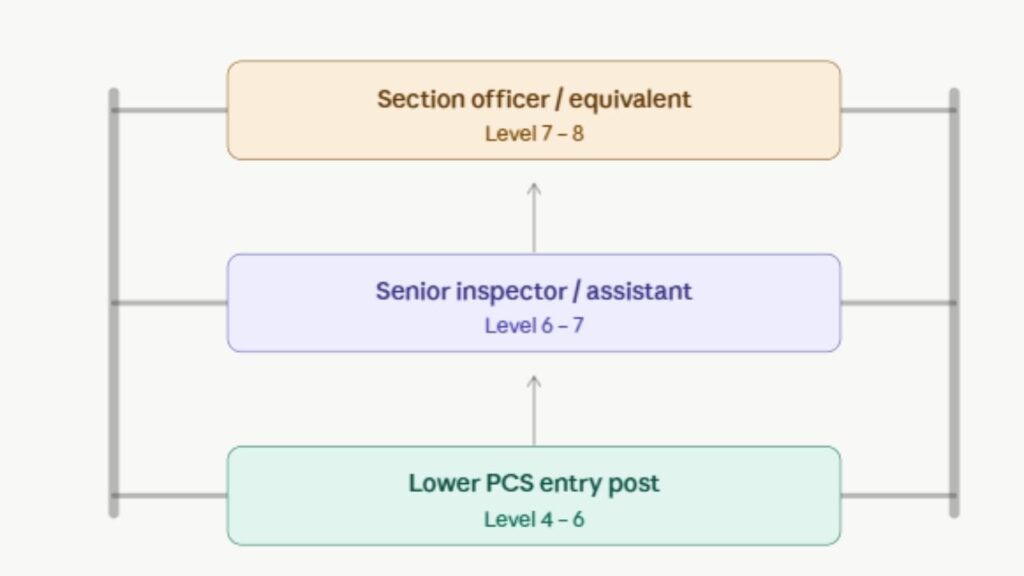
The Promotion Ladder

Your career trajectory doesn’t stall. Junior officers systematically advance through departmental reviews and service experience:
Conclusion

The UPSSSC UP Combined Lower Subordinate Services (Graduate Level) Recruitment is a cycle that ends in a few days and you need to fill the form if you don’t want to miss this opportunity to secure a career in Uttar Pradesh. The competition is very high for the 2,285 seats, so the right strategy to prepare for the exam is mandatory.

Ensure your application goes through successfully before June 18, lock down your study desk, and start structured preparation today. For a comprehensive breakdown of the syllabus, safe score metrics, and targeted departmental tactics, check out this detailed UPSSSC Lower PCS Strategy Guide which covers exactly how to maximize your score in the Mains exam.

Leave a Comment

Your email address will not be published. Required fields are marked *

Difference Between CBSE and ICSE: Which Board is Better for Your Future?

Students studying in classrooms representing CBSE and ICSE boards, highlighting differences in learning styles

Finding out the Difference Between CBSE and ICSE is important because it matters for the future of students. In India, ICSE (Indian Certificate of Secondary Education) affiliated schools are expensive but recognized internationally, and have become popular among students who want to achieve international opportunities. 

And CBSE (Central Board of Secondary Education) has a wide range of affiliated schools which makes it cheaper but effective for national-level exams. Both have different teaching methods, syllabus structure, exam pattern & marks, and career opportunities.

This comparison is not for making it good or bad, showing their strengths and weaknesses will help students to decide better for their future.

Overview of CBSE and ICSE

CBSE – Central Board of Secondary Education

  • CBSE board is run under the Government of India.
  • A wider range of schools are affiliated to CBSE.
  • It is more on the side of theoretical education and focuses on subjects like Science & Maths.
  • Popular among aspirants of NEET, JEE, NDA, and UPSC as it covers all the exams syllabus concisely. 

ICSE – Indian Certificate of Secondary Education

  • Council for the Indian School Certificate Examinations (CISCE) is a private education board which governs ICSE board.
  • As compared to CBSE, schools affiliated to ICSE in India and abroad are less in numbers.
  • It focuses on both theoretical and practical knowledge equally on all subjects including arts, science, and languages.
  • Its balanced education is valued internationally.

Curriculum and Teaching Style

CBSE curriculum is more structured and straightforward, it does not contain any extra details on any topic which makes it less but precise for exams. It prioritizes subjects like Science and Mathematics, designed with theoretical conceptual knowledge which makes it ideal for competitive exams. Other subjects like English and Hindi have fewer chapters and syllabi in comparison to ICSE. It is best for the engineering, medical, or government exams focused students.

ICSE curriculum is designed with lengthy explanations and balanced across subjects. It also focuses on other subjects like Literature, language and practical projects for balanced education. ICSE boards students have to study in-depth of each subject. That feels burdened sometimes but it improves analytical ability. It is best for overall knowledge, communication skills, and global recognition opportunities seeking students.

Read More 👉 Meet the Best History Teacher for Competitive Exams Who Can Boost Your Score

Difficulty Level

CBSE is easier in comparison to ICSE as it has a concise syllabus that covers easily within less time. It encourages more theoretical knowledge than projects. Students can easily clear exams with less academic pressure but it improves basic knowledge. ICSE is more detailed on every topic and stressing on projects, lab world, internal assessments making it heavier for children to cover. But it is best for building overall skills that improves analytical thinking.

Examination Pattern and Grading System

CBSE follows a continuous and comprehensive evaluation system to reduce exam stress and declaring results in CGPA Cumulative Grade Point Average system. Questions in the exam are based on the NCERT books. 

ICSE follows marks-based evaluation and grades are assigned according to the percentage. Questions asked in exams need both depth of knowledge and analytical ability to represent the answer. In the final result, 20-30% makes are dependent on the internal assessments so projects are becoming necessary.

Recognition in India and Abroad

CBSE is recognized in major schools in India, making it best for students who plan to continue study in India. It is popular among the JEE, NEET, NDA and UPSC aspirants. ICSE is recognized globally by foreign universities. Developing language and communication skills with its english-oriented syllabus can help students to continue their studies in foreign universities. 

Language and Communication Skills

If students want to continue their studies abroad, develop communication skills, and aim for jobs where language like English will be needed then ICSE is the best option because CBSE is more focused on Science and Maths. However, CBSE emphasizes English and Hindi but not on the higher level.

Which is More Expensive?

Many government schools are affiliated to CBSE board which make it affordable for the students. Private CBSE schools also have affordable fees in comparison to ICSE affiliated schools. More expensive due to their huge curriculum, projects, and emphasis on quality teaching.

Career and Competitive Exams

Competitive exams aspirants prefer to study in CBSE affiliated schools because it covers a more concise syllabus on important subjects like Economics, Maths and Science. However, ICSE boards schools produce creative minds. They emphasize on English Language & Literature, and analytical skills to help students secure their career in international companies.

Pros and Cons at a Glance

CBSE ProsCons
Easier syllabusLack of strong foundation in English and humanities
Affordable FeesLimited application-based learning
20,000+ schools
Ideal for competitive exams
ICSE ProsCons
Tough syllabusMore-time consuming
International RecognitionExpensive schools
Strong English and analytical skillsLess useful for Indian competitive exams
Encourages overall development

Which Board Should You Choose?

It totally depends on your future goals, aiming to make your career in the medical field, engineering, or government sector then CBSE is a good option because it contains an overall concise syllabus that is needed to study in most of the Indian entrance exams. CBSE board students also can go abroad but they have to study hard even on their english and communication skills. Where ICSE is providing overall development, students can go abroad for higher studies with strong language skills and well-rounded knowledge. 

Both boards have their strengths and weaknesses, for making the right decision, students should choose their board according to their interest, learning style, and career plan. 

FeatureCBSEICSE
Curriculum FocusScience & Math oriented, exam-basedBalanced syllabus, includes languages & arts
Difficulty LevelEasier, conciseDetailed, more challenging
Teaching StyleTheoretical, less projectsPractical, project-based, strong English focus
RecognitionBest for Indian exams (NEET, JEE, UPSC)Internationally valued, good for global studies
EvaluationCGPA/percentage, NCERT-style questionsMarks-based, detailed assessment + projects
LanguageModerate EnglishStrong English & literature
AvailabilityWidely available, govt. & private schools, affordableLimited, mostly private and costlier
ExtracurricularAcademics priority, fewer activitiesEqual focus on academics & extracurriculars
Best ForStudents preparing for Indian competitive examsStudents aiming for holistic or overseas education

Conclusion

Which board is best is a little bit complex, you must know the Difference Between CBSE and ICSE before you select your board. Students and parents both have to understand what are the career goals and which board is good for their children. Some students are not able to handle the tough syllabus of ICSE and some students want to go abroad, so it should be according to your plan not by other people’s recommendation.

Leave a Comment

Your email address will not be published. Required fields are marked *

Top 10 Government Jobs for 12th Pass Candidates in 2025

12th Pass Government Jobs 2025

There are numerous 12th Pass Government Jobs 2025 in India where students can secure their stable career in the specific sector including defense, banking, admin, and public sector undertakings (PSUs). Read the full article to know about job roles, salary, eligibility, and future scope for 12th-pass candidates.

The government is spreading job vacancies for 12th-pass candidates in 2025. You can also secure your career in a specific sector.

Police and Defense

The defense sector has many job roles after 12th pass candidates

  • Police Constable
  • Police Sub-Inspector (some states may require graduation for this job role but some recruit after 12th)
  • National Defence Academy (NDA)
  • Technical Entry Scheme (TES) – Indian Army
  • Agniveer Scheme
  • Military Nursing Service (MNS)

Railway Jobs after 12th pass

Railway job offers a good salary to the candidates, you can apply after 12

  • Junior Clerk Cum Typist
  • Commercial Cum Ticket Clerk
  • Trains Clerk
  • Railway Group D Posts
  • Ticket Collector
  • Ticket Examiner

Banking Jobs after 12th pass

There are Government banks where candidates can apply after 12 but they must pass the exam with a good score. This sector provides long-term career stability.

  • Clerk
  • Data Entry Operator
  • Sales Executive
  • Banking Assistant
  • Cashier
  • Peon

Public Sector Undertakings (PSUs)

  • Junior Assistant/Apprentice
  • Technician
  • Fieldworker
  • Helper

SSC Jobs (Staff Selection Commission)

  • Data entry jobs
  • Lower Clerk
  • Postal
  • Assistant

Similar Eligibility Criteria across these Sectors

There is some eligibility for these roles in Railway, defense, SSC, PSU, and banking are same. Let’s talk about the common criteria for the job roles.

Nationality: Candidates must be the Indian Citizen
Age Limit: The minimum age must be 18 years or older, and the maximum age should be exceeded by the sector and category of the person. You can check these exact eligibility requirements while applying for the specific role.
Educational Qualification: Candidates should pass 10+12 with a 50% score in any stream.

  • Railway:
    For a Technical post in the Railway, the candidate must have an ITI/Diploma.
    Physical Tests are necessary for Group D positions.
  • Defense:
    Only Unmarried candidate apply for NDA post
    Candidate must have good health and pass the medical tests
  • SSC:
    Age Limit vary for some posts
    For Clerical post typing test will be included
  • Banking:
    The Bank Officer post requires graduation, candidates must have a degree in a similar field for this job role
    Computer skills are required in bank jobs
  • PSU:
    GATE score required for the technical posts
    The minimum age required in the range (21-27) may vary according to the various categories.

There are some competitive exams which are conducted by the government for the various job roles in each sector. If you want a government job, you must pass the exam (every job role has different exams)

  • If you want a Job in the Indian Army, navy, or Air Force, You have to attempt the National Defense Academy (NDA) exam and score well to secure a job role.
  • For entry-level jobs in banking, you need to take the IBPS clerk exam.
  • If you want to go in Police jobs you must attempt State Police Constable Exams that are conducted by the state government.
  • For clerks, assistants, and data entry operator job roles candidates must pass the SSC CHSL.
  • Indian Railway offers jobs for the candidates who passed RRB NTPC.

You can apply for 12th Pass Government Jobs 2025 and secure the rewarding career for a lifetime. Every sector has different job roles, just stay focused and clear out the competitive exams. Stay updated with the official notification for latest vacancies in defense, railway, SSC, and PCU to apply early.

Leave a Comment

Your email address will not be published. Required fields are marked *

NEET PG 2025 Admissions Exam Date Out – Check Eligibility, Syllabus & Apply Online Now!

NEET PG 2025 Admissions Exam

NEET PG 2025 Admissions Exam Date Out for the advanced programs in the medical field. If you want to prepare yourself for the National Eligibility cum Entrance Test for Postgraduate (NEET PG) 2025 check the exam pattern and syllabus. Check the admit card before the examination date. Check the official notification and stay updated about the exam details. Before applying candidates must meet eligibility criteria and hold the MBBS certificate. NEET PG 2025 is one the crucial examinations for post-graduation across India. The exam is scheduled for 3 August 2025, and thousands of candidates are preparing to appear in this exam for MS/MD/PG Diploma courses.

Highlights of NEET PG 2025

Exam Conducting BodyNational Board of Examination
Exam NameNEET PG 
PurposeEntrance Exam for MS/MD/PG Diploma
NEET PG 2025 Admissions Exam This is an entrance exam for advanced training programs for those who want growth in their medical field. You can appear in the exam if you have completed your MBBS.
Mode of ApplicationOnline
Mode of Exam Computer-Based Test
Application FeeNA
Apply OnlineClick Here
Official WebsiteClick Here
EventsDates
Notification Release16 April 2025
Application Starts17 April 2025
Application End Date7 May 2025
Admit Card Release31 July 2025
Examination Date3 August 2025
Result Release3rd September 2025
Application Fee
General / OBC3,750
SC / ST / PWD2,750

NEET PG 2025 Exam Eligibility Criteria

Candidates must hold an MBBS degree from the Medical Council of India. Better with the proof of Pass Certificate of MBBS for this exam. It is mandatory to complete a one-year rotating internship program before applying for NEET PG 2025. There is no upper age limit for this exam so anyone can take this exam but candidates who are interested in advanced medical courses must have a valid registration certificate issued by the MCI.

NEET PG 2025 Admissions Exam Details

Exam Pattern for the NEET PG 2025

SectionNo of QuestionsMarks
Clinical Subjects100400
Pre-Clinical Subjects50200
Para-Clinical Subjects50200

The duration is 3 hours & 30 minutes for the NEET PG 2025 paper. The marking of answer in the paper is +4 for the correct answer and -1 for the wrong answer as negative marking. Students should prepare well and efficiently for this examination as it is the entrance exam for the post-medical courses. Students get admission to Medical College/University after clearing this exam.

Perks of This Exam

  • Specialization Opportunities: For students who want to study advanced medical courses and wish for medical training in their specific field, this is the best option for them.
  • Prestigious Institutions: Offers a chance to study in reputed institutions.
  • Career Growth: To enhance the practical ability and concepts for better job roles and salaries. 

Selection Process

Written ExaminationResult DeclarationCounseling Process
The First stage of this exam is a computer-based objective-type question and the level of question is hard, exam covering the MBBS syllabusCheck the NBE portal on the day of result declaration, search your name in the merit list for qualified candidates.Counseling conducted by MCC for the qualified candidates for seat allocation in MS/MD/PG Diploma course 

Syllabus for NEET PG 2025

SectionKey topics
Clinical SubjectsGeneral Surgery, Gynecology and Pediatrics, and General Medicine 
Para-Clinical SubjectsMicrobiology, Pathology, and Pharmacology
Pre-Clinical SubjectsAnatomy, Biochemistry, and Physiology

Some Useful Links

Apply NowClick Here
Download Exam NotificationClick Here
Download Exam City ListClick Here
Telegram ChannelClick Here
Official WebsiteClick Here

Leave a Comment

Your email address will not be published. Required fields are marked *

Top 10 MBA Colleges in Lucknow You Shouldn’t Miss in 2025

Top 10 MBA Colleges in Lucknow You Shouldn’t Miss in 2025

If you are interested in the field of management then pursuing an MBA is a great thought while there are a bunch of options for your career after an MBA. Top 10 MBA Colleges in Lucknow that offer an MBA program, it is a professional degree in management education. You don’t have to relocate for your masters, because Lucknow is emerging as a growing city for higher education. 

MBA offers quality education and strong placements to establish a balanced lifestyle. Whether you’re aiming for India’s top-ranked IIM or looking for a college with good ROI and decent exposure, this article will help you explore the top 10 MBA colleges in Lucknow in 2025.

The list is based on the rankings, fees, and placement percentage from these universities. Investing two precious years of your life in an MBA program should be effective for future growth.

 Indian Institute of Management (IIM-L)

IIM-L has a great reputation around the world since 1984, it’s one of the top IIMs in India. This institute is listed in the top 10 colleges in NIRF and Business Today rankings. Pursuing an MBA from this college could open up many opportunities. IIM Lucknow is best for students who aim for leadership roles in global companies.

Fees₹19–21 lakhs
Average Package₹30 LPA+ (with international offers crossing ₹1 Cr)
AdmissionCAT + Personal Interview
Why Choose IIM-L?Top Level Faculty, Global companies exposure, unmatched placements, IIM prestigehttps://www.iiml.ac.in/

2. Jaipuria Institute of Management (JIM)

 Jaipuria Institute of Management (JIM)

Jaipuria is a private business school for those who don’t want to be pressured by heavy competition in IIM-L. Jaipuria Lucknow is recognized by its advanced education techniques including practical learning, industry level projects, and decent placements. Ideal for those who want to establish their education strong.

Fees₹10–14 lakhs
Average Package₹7.5 LPA
AdmissionCAT/XAT/CMAT/MAT
Why Choose?Good balance of brand, placements, and industry-oriented curriculum

3. University of Lucknow – Institute of Management Sciences

University of Lucknow - Institute of Management Sciences

IMS is a great option for those who can’t afford expensive colleges for MBA programs. It is affordable and offers government-affiliated MBA programs. Lucknow university maintains its management department quite well to provide masters that polishes students’ minds. If you have a potential but don’t have a budget, it has a good value and quality education.

Fees₹1.5–3 lakhs
Average Package₹5–6 LPA
AdmissionLUMET (University-level entrance exam)
Why Choose?High return on investment, stable government-backed education, decent placements

4. Amity University, Lucknow Campus

Amity University, Lucknow Campus

Amity University is private but has a national reputation. Students who are looking for academic quality with a modern campus, it is the best option for them. It offers a glamorous MBA experience with good infrastructure, international tie-ups, and exposure to corporate culture.

Fees₹7–13 lakhs
Average Package₹6 LPA
AdmissionCAT/MAT/XAT/CMAT OR Amity entrance
Why Choose Amity?Its alumni network and advanced educational techniques

5. Shri Ramswaroop Memorial University – SRM University

Shri Ramswaroop Memorial University - SRM University

An emerging private university in Lucknow, SRMU provides the best education in every field. It has been doing great work so it comes to an attention for its updated MBA curriculum and growing industry connect.

Fees₹2.4–3 lakhs
Average Package₹4.8 LPA
AdmissionMAT/CAT/CMAT
Why Choose SRMU?Value for money, modern teaching methods, and focus on industry level education

Read More 👉 Top 10 MCA Colleges in Bangalore – Best Picks for 2025

6. Babu Banarasi Das University – BBD University

Babu Banarasi Das University - BBD University

BBD university offers an MBA program which is well known for its stability and affordability. Students who want a good campus life and an MBA degree, it’s a good option for admission in 2025. 

Fees₹2.1–3 lakhs
Average Package₹4–4.5 LPA
AdmissionDirect or through entrance exams
Why Choose?Well-known brand locally, decent infrastructure, moderate placements

7. Babasaheb Bhimrao Ambedkar University – BBA University

Babasaheb Bhimrao Ambedkar University - BBA University

BBAU offers a wide range of courses, but its MBA program is delivering quality education which empowers student’s careers. This university was founded in 1996, the best university for those who want to pursue an MBA program from a government university and focus on working in the government sector. 

Fees₹1–1.8 lakhs
Average Package₹7.9 LPA (higher than many private colleges!)
AdmissionCUET PG
Why Choose?High ROI, strong academic environment, and growing placement record

8. Integral University, Lucknow

 Integral University, Lucknow

Integral University, Lucknow: A UGC-approved university is a better option for an MBA. This is impactful for careers in management and technical fields. It acquires the position to deliver the best education in their programs. Ideal for those who want a diverse skill set along with an MBA.

Fees₹2–4.5 lakhs
Average Package₹3–3.5 LPA
AdmissionCAT/MAT/IUET/CUET
Why Choose?Offers dual degree options and specializations in niche sectors

9. Ambalika Institute of Management & Technology

Ambalika Institute of Management & Technology

This institute is good for those who want to focus on management education with knowledge of technical concepts. It offers practical concepts rather than just theory. Smaller town students can achieve their goal with its personalized learning.

Fees₹1.7–2 lakhs
Average Package₹3.8 LPA
AdmissionCAT/XAT/MAT
Why Choose?Industry level projects, personalized trained student, batch size is not too large 

10. School of Management Sciences (SMS), Lucknow

School of Management Sciences (SMS), Lucknow

Who want to focus on preparing for industry based management and get job-ready can choose this college. SMS is a name that’s becoming quite known for its industry-aligned teaching and good connections with mid-level companies.

Fees₹1.5–2 lakhs
Average Package₹3.5–4 LPA
AdmissionCAT/MAT/CMAT
Why Choose?Skill-building focused curriculum and consistent placement efforts

There’s not an exact answer here. It depends on your financial status, potential, and preparation. To get admission in a top college like IIM, you must clear the exam but it clears your goal as top consulting or global roles. But not everyone has a ₹20 lakh budget or the CAT score to match. That’s where private colleges step into for an MBA program. These colleges are also top-tier in lucknow, Jaipuria, IMS-LU, and BBAU provide strong value-for-money programs.

Before choosing a college, consider:

Priorities like Budget

Your professional goals

Entrance Preparation

Campus life and culture

To ensure all of the following before selecting these top 10 MBA Colleges in Lucknow, visit the campus and take feedback from the current students of the college.

Leave a Comment

Your email address will not be published. Required fields are marked *

IIT Delhi MBA Fees – Complete Details on Tuition, Hostel And Other Charges

IIT Delhi

The IIT Delhi MBA is considered one among the best return on investment management course in India. Offering a perfect blend of quality education, good industry connect at a manageable fee, it enables students to dream big without the fear of being burdened with debts in private b-school cost. For 2025-27 batch, the total IIT Delhi MBA Fees 2025 is 12.17 lakhs which makes it one of the cost effective option in top management institutes of India. 

IIT Delhi makes quality affordable with a transparent detailed batch-wise payment plan, clearly defined hostel and academic fees, and several options for financial assistance. In addition, the program provides a good return on investment (ROI) as the average placement package is ₹25.82 LPA, which further adds to the enunciation as a top choice for prospective business leaders. 

IIT Delhi MBA Fee Structure 

IIT Delhi MBA fee is ₹ 12.17 lakhs for 2025-27 batch and this makes it one of the least expensive top Indian b-schools. The fee is designed so that the students can derive maximum benefit from it, but still, it should be within the reach of students coming from varied financial backgrounds.  

Complete Breakdown of Detailed Fee Components

The tuition fee for the two-year course is ₹12,00,000, which is payable in four equal installments of ₹3,00,000 per semester. All the education fees, materials for courses and learning resources and even the use of campus facilities are covered by these fees. The total cost of accommodation in the dormitory for two years is Rs. 17,200 or 8,600 per semester.

Complete Breakdown of Detailed Fee Components

Mess fees are to be paid extra and they vary according to consumption, hostel fees are Rs 8,600 per semester. Semester fees are 22,400 for academic and administrative purposes which include the use of internet, sports equipment, library and student-welfare programs. 

Total tuition fees₹12,00,000
Per semester₹3,00,000
Total hostel₹17,200
Per semester hostel₹8,600
Academic charges₹22,400

First Semester Payment Structure

The admission fee structure is categorized based on the candidate’s classification. The fee for the first term for candidates in the General, OBC, and EWS categories is ₹3,31, 000, inclusive of hostel fees and other relevant expenditure like tuition. Those who belong to the SC, ST or PwD categories, however, get a Tuition Fee Waiver. First term fees are drastically reduced for these categories to Rs 31, 000, which is only for the hostel and other miscellaneous expenses. This tiered fee system also reflects a commitment to ensuring equitable access to education, as well as to financial viability for marginalized populations. 

How IIT Delhi MBA Fees Compare with Other Top Colleges

Comparison of MBA Fees Across Top Indian Colleges

How IIT Delhi MBA Fees Compare with Other Top Colleges

IIT Delhi offers great value for money as compared to other top b-schools in India. The fee structure makes it a kind of cross between the premium IIMs and the dirt cheap government ones. 

Old IIMs (Higher Fee Range)
IIM Calcutta₹27.00 lakhs
IIM Bangalore₹26.00 lakhs
IIM Ahmedabad₹26.50 lakhs
Newer IIMs (Moderate Fee Range)
IIM Lucknow₹20.75 lakhs
IIM Kozhikode₹20.50 lakhs
IIM Indore₹21.17 lakhs
Private B-Schools
XLRI (Xavier School of Management) Jamshedpur₹25.00 lakhs
ISB (Indian School of Business) Hyderabad₹40.50 lakhs
MDI (Management Development Institute) Gurgaon₹23.00 lakhs
SPJIMR (Shreyans Prasad Jain Institute of Management & Research ) Mumbai₹21.00 lakhs
Budget-Friendly Government Colleges
FMS (Faculty of Management Studies) Delhi₹2.43 lakhs
JBIMS (Jamnalal Bajaj Institute of Management Studies) Mumbai₹7.00 lakhs
TISS (Tata Institute of Social Sciences) Mumbai₹1.85 lakhs

Although these institutes charge very minimal fees, IIT Delhi gives a middle path with a reasonable fee structure and excellent results. 

IIT Delhi MBA Program Cost Breakdown (Total ₹12.17 Lakhs)

Return on Investment Analysis

The exceptional 2024 Placement Performance demonstrates that IIT Delhi’s MBA Program offers a tremendous return on investment (ROI). Graduates are offered an average salary package of ₹25.82 LPA, the highest package is an impressive ₹41.13 LPA while the median package is ₹24.45 LPA. The program’s remarkable 100 percent placement record is a testament to its strong industry relations and career support. It is the most lucrative choice for an aspiring management professional for a total programme fee of ₹ 12.17 Lakhs. Students have managed their expenses for a few months after they start working. 

Financial Support and Scholarship Options

IIT Delhi provides several support to the students who want to pursue MBA to ensure that everyone gets a chance of education. SC/ST/PwD students are entitled for 100% tuition fee waiver under category based benefits except for hostel and other fees. Furthermore, meritorious students are also eligible for merit scholarships, which are awarded on the basis of their programme-wide academic performance. Also, due to prestige of the institute, education loan for MBA course can be availed from all major banks. And given the school’s elite status, those loans typically carry competitive interest rates. 

Payment Schedule and Methods

In order to ensure transparency and ease of understanding for all students, the fee payment follows a semester-wise structured format. As per the schedule of payment, the fee for the 1st semester is to be paid at the time of admission. Fees are payable at the beginning of each subsequent semester. For your convenience, the fee can also be paid in two installments over two years, making finances a little easier to manage. 

Multiple modes of payments are available for easy transactions. Students can pay online from the time of official portals which ensures the safe and efficient process. Bank loans are disbursed by demand drafts. To suit different taste, there is also bank transfer payment option. This systematic procedure keeps the payment process formal and transparent, at the same time ensuring flexibility and accessibility to the students. 

Why Choose IIT Delhi MBA

Why Choose IIT Delhi MBA

Academic Excellence

The institute, which was ranked 4th in Management by NIRF 2024, is renowned for its outstanding academics and is supported by a strong faculty having rich research and industry experience. The curriculum is broad-based and focuses on experiential learning to ensure that the students are well-prepared to face real-world challenges. 

Industry Connections

It has great industry connections, and excellent placement support with top recruiters due to its vast alumni network in prestige companies, recurring industry interactions and guest lectures. 

Facilities & Location Advantage

The modern facilities on the state of the art campus include a well-equipped library, state of the art computer laboratories, sports and leisure facilities. Opportunity to work in corporate offices and the institution is located strategically in Delhi NCR, the emerging business hub of India making it the best for commerce studies.

Read More:- DSSSB Recruitment 2025 – Latest Vacancy, Eligibility & Application Details

Conclusion

For Indian business schools, the IIT Delhi MBA delivers the best price, quality and outcomes combination you can get. With a total fee of Rs 12.17 lakhs, it holds itself at a higher standard than many of the private IIMs while giving exceptional value for money when compared with the ones that are more prestigious. Given the reputed brand, good placements and affordable fees, it is an excellent value for money for MBA aspirants. 

Transparent breakdowns of fees and category-wise concessions ensure accessibility to students from diverse backgrounds. When viewed from the perspective of ROI, career opportunities and ranking experience, IIT Delhi MBArr its place among the topmost feasible options in India in business school arena. 

Leave a Comment

Your email address will not be published. Required fields are marked *

Scroll to Top