Medical vs Engineering: Which Career Will Make You More Successful in 2025

Medical vs Engineering

If you are an Indian student in Class 10, 11, or 12, chances are you’ve heard a version of this line at least a dozen times. The age-old battle between Medicine and Engineering is a part of our DNA. For generations, these two streams have been seen as the ultimate tickets to a successful, secure, and respectable life.


The world is rapidly changing in 2025 with a lot of new career options for students. But when it comes to choosing between two different careers, everyone gets confused: Which path is better? Medical or Engineering? 

It’s a big decision of your life, both careers need your full potential whether you are preparing for NEET or JEE. It affects your life and your parent’s life too. Choose your path which aligns with your interest and skills.

The First Hurdle: The Challenging Road of Education

Before you can even dream of a stethoscope or a high-tech lab, you have to cross the battlefield of entrance exams. This is the first and most critical difference.

NEET (for Medical): The Marathon of Memory

  • The Exam: This is a single entrance exam for admission in MBBS. In 2024, over 23 lakh students fought for just over 1 lakh MBBS seats. The competition is insane.
  • The Challenge: Tons of topics to cover in Physics, Chemistry, and especially Biology, inside and out. It’s less about complex problem-solving and more about incredible memory, accuracy, and speed.
  • The Journey: The path is long. The time period is 5.5 years for MBBS with an internship certificate. After becoming a doctor at beginner level. You must do a postgraduate degree (MD/MS) to become professional, which is another 3 years after clearing another tough entrance exam, NEET-PG.
  • The Cost: Government medical colleges are very affordable (a few lakhs for the entire course). But getting a seat is like winning a lottery. You must be ready to invest ₹50 lakh to over ₹1 crore for MBBS course and more for postgraduation.

JEE (for Engineering): The Sprint of Logic

  • The Exam: This is a two-step process. JEE Main is the first filter. If you clear it, you can get into NITs and other good colleges. Admission in IITs is tough, you need to clear JEE Advanced.
  • The Challenging Step: If you are interested and have deep understanding in Maths, chemistry and physics, preparing for JEE isn’t that hard for you. But you must prepare with right strategy to beat the competition and get a chance for better college option. Because without a valuable degree, you will not get a high package of jobs. 
  • The Journey: A B.Tech degree is 4 years long. After this, you are an engineer and can start working immediately. A postgraduate degree (M.Tech) is an option, not a necessity, unless you want to get into research or specialised teaching roles.
  • The Cost: The fee for IITs and NITs is around ₹8-12 lakhs for the entire course, which is much more affordable than private medical colleges. Private engineering colleges have a huge range, from a few lakhs to ₹20-25 lakhs.

The stress of Kota coaching factories, the pressure from family, the fear of “wasting a year” – it’s real for both aspirants. A medical journey requires your time and money to become a doctor. You have to make commitments for this career.

Read More 👉 Top Engineering Govt Jobs in India 2025 – High Salary

Career Scope & Opportunities in 2025?

Engineering: it offers a diverse range of opportunities on national and international level.

The word ‘engineer’ is broad. The opportunities in 2025 depend heavily on your branch.

  • Computer Science & IT: This is the king of the jungle right now. With AI, Machine Learning, Data Science, and Cybersecurity booming, a skilled software engineer from a good college can land a job even before their final exams. 
  • Electronics & Communication: This field also requires engineers for running a network, designing for semiconductors, and automation. ECE engineers can get a lot of opportunities with a good salary package.
  • Mechanical & Civil: These are ‘evergreen’ branches. If students have skills and ability to construct, manufacture, and renewable energy then they can pick this career for their career.
  • Abroad: IIT or NIT qualified engineers are well-respected globally. With the right skills you can work on large projects abroad such as the US, Europe, and Australia.

Medical: Job security, secure future, and Respect in society

With an increasing health crisis, everyone needs a doctor who can cure and treat them. After MBBS, Medical training is also mandatory for every student. India has a huge shortage of doctors, with a doctor-patient ratio far below WHO recommendations.

  • In India: A doctor will never be jobless. You can have plenty of options like your own clinic, work in government or private hospitals. After specialization (e.g., cardiologist, dermatologist, oncologist), you will be demanded everywhere. The respect you get from society is unparalleled.
  • Abroad: MBBS degree is a door to open many options abroad but to work in countries like the US or UK, you need to clear their licensing exams (USMLE for the US, PLAB for the UK). Indian doctors can apply for them after a few years of experience in India because it is tough and expensive but the financial rewards and quality of life can be extraordinary.

Salary & Financial Growth

This is where the paths differ significantly.

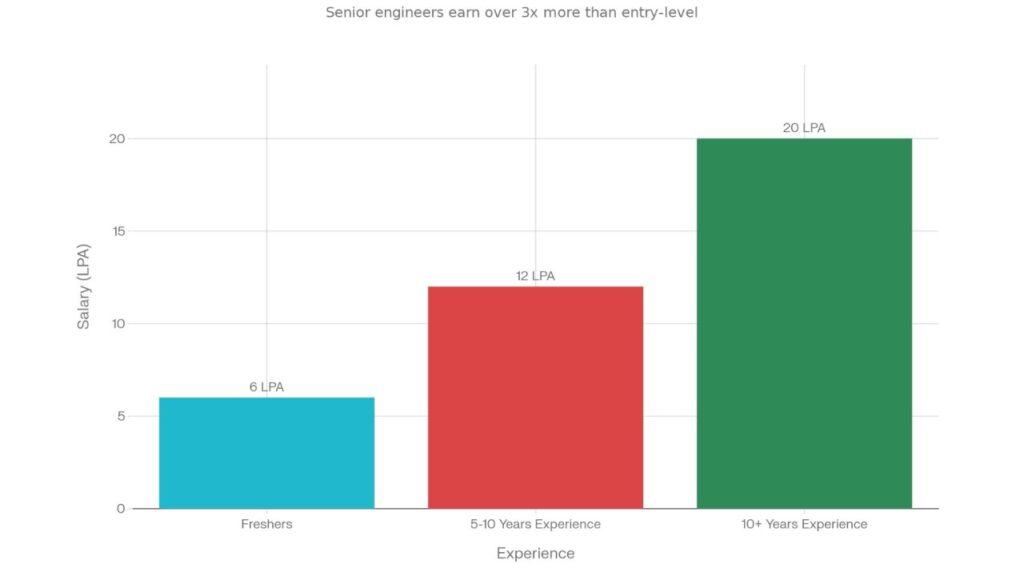
  • Engineering: if you have done engineering in computer science from a reputed college or IIT, you can get a good placement package from top companies. IITs can get a starting package of ₹20-30 LPA. For other branches and colleges, it might be in the ₹6-12 lakh range. Your professional growth depends on how fast you can update your skills.
  • Medical: The financial journey is a slow burn. During your internship and PG residency, you earn a stipend, not a salary (around ₹25,000 to ₹80,000 per month depending on the state and college). The real earning starts after you are nearly 30 years old. But once you are a specialist, your earning potential is immense and stable. A successful specialist in a city can earn lakhs per month, far surpassing most engineers.

The Verdict: Engineering gives you a 6-8 year head start in earning. Medicine promises higher and more stable lifetime earnings, but you have to wait for it.

Read More 👉 Top 10 Central Universities in India 2025 – NIRF Ranking with Full Details

Work-Life Balance & Job Satisfaction

Success isn’t just about your bank balance. It’s about being happy.

A Doctor’s Life:

Heavy responsibility of a patient, being available for emergencies. So, this is not just a regular desk job. You need deal with many new things:

  • The Bad: The hours are brutal. Health crises can happen anytime-anywhere but being a doctor it’s your responsibility to be available for your patients. There are no weekends or festivals when there’s an emergency. Be ready to deal with everyday life and death situations. The small mistake can cost a life, so being focused and emotionally stable is mandatory to handle.
  • The Good: The job satisfaction is on another level. The feeling of saving a life or healing someone is a reward that money can’t buy. The trust and respect you receive from your patients and community are profound.

An Engineer’s Life:

Being an engineer is about creating and solving problems.

  • The Bad: Especially in the IT sector, there’s pressure of deadlines, project delivery, and constantly learning new technologies to stay relevant. Burnout is a real risk. Your job security is often tied to the performance of your company and the economy.
  • The Good: You often have more predictable work hours (though this can vary wildly). You have your weekends off. The work sometimes gives you hard challenges, but a lot of benefits like you can start your own side business after years of experience. You get to build things that millions of people might use, which is a great feeling.

What Should YOU Choose?

Forget about your friend’s suggestions. Forget about what your relatives will say. Ask yourself these questions with an honest heart.

Choose Engineering if:

  • You are fascinated by how things work. You are able to solve complex problems within less time and have a logical and analytical mind.
  • You love to solve quizzes from Maths and Physics.
  • Quickly understands new technologies and skills throughout your life. You don’t have a problem with quick changes in your professional world.
  • You want a faster entry into the professional world and want to start earning relatively early.
  • You are a creator and a builder at heart, whether it’s software, machines, or bridges.

Choose Medical if:

  • You have a deep, genuine desire to help people directly. Your primary motivation is service.
  • You have incredible patience and are prepared for a decade-long educational journey before you are fully settled.
  • You have quickly memorized diagrams and names of the phenomenon. You must adapt a habit to study consistently for very long hours.
  • You love to care about others and have strength to handle the pressure of life and death situations calmly. 
  • You want lifelong respect and a long-term future for your career.

In the end, there is no “better” field. There is only a “better fit” for you. A happy and successful engineer will always do better in life than a frustrated and burnt-out doctor, and vice-versa.

Success in 2025 and beyond will not come from choosing the most popular or the highest-paying stream. It will come from choosing the path where your natural interests and skills lie. It will come from choosing a profession that you won’t just ‘do’ for a living, but one that you will be proud to live every single day. So, talk to your parents, talk to people from both fields, and most importantly, listen to your own heart. The right answer is right there.e-old battle between Medicine and Engineering is a part of our DNA. For generations, these two streams have been seen as the ultimate tickets to a successful, secure, and respectable life.
Leave a Comment

Your email address will not be published. Required fields are marked *

O Level Course 2025: Complete Guide to Fees, Syllabus, Duration & Job Benefits

O Level Course 2025

Students who are interested in the Technical Field can achieve great heights in their career after pursuing NIELIT ‘O’ Level. It opens up the door in both private and government sectors as the requirement of an IT employee is needed everywhere. The world is evolving more into digitalization which has made this field wider and open more vacancies for the candidates. If you also want to make your career stable with a good career path, high-salary, and less hectic job then grab this course now.

Why NIELIT ‘O’ Level Matters in the Digital Age

Chasing after stable and well-paying jobs in India, job-seekers are often driven towards the public sector, where security of jobs and strong perks are widely considered as givens. In today’s increasingly digitised world, being in possession of a recognized and accredited Information technology qualification is not just an advantage – it is a requirement. The NIELIT ‘O’ Level course is at the Midnight of this requirement. 

It is officially considered the same as a Foundation Level CA course. This government approval is really important and gives you the edge that private not accredited courses can never get. The value of this certification is further ratified with its inclusion in the national framework, having been recognized under the National Skills Qualifications Framework (NSQF) at Level 4. 

What Job Roles Can You Get After NIELIT ‘O’ Level

The O Level was structured in such a way as to be responsive to the short-term technical needs of the then contemporary public and private sectors. The stated goal is to prepare students with the skills needed to work in today’s IT-enabled jobs. Among these targeted profiles are User Interface (UI) Designer, Web Designer, Web Publication Assistant, Office Automation Assistant, and IoT Application Integrator.These intentional integration with operational IT rather than simple clerical data entry clearly situates the course as a practical instrument for aspirants to take on current digital workplace requirements. 

Detailed Eligibility Criteria

The basic eligibility criteria require either passing 10+2, or holding a one-year ITI Certificate after Class 10, along with a minimum of one year of experience in the area related to the IT industry. 

The applicants who have passed second year of polytechnic engineering diploma after 10th standard from a government recognized institute are also eligible to apply. 

O’Level Course Duration 

The six-month timeline for graduates enables them to get this commonly required IT credential quickly, thereby reducing the amount of career time lost while waiting for certification. Hence, the ‘O’ Level serves as an important means for enhancing one’s eligibility in a short span of time after the completion of the degree. However, this registration remains valid for five years.

Why Is O’Level Course Value Increasing Day-By-Day?

Mastery in the Revised Syllabus

The importance of NIELIT ‘O’ Level certification in the present high technology world is that O level syllabus is regularly revised and updated which in turn helps to keep the students updated with the latest information and technology available. This syllabus is much beyond the basic knowledge of computing which is now considered old to cater to the demand of the industry for the skills and the industries supported the potential of having high paying jobs. 

Structure and Examination Pattern

The course is staffed with four core theoretical modules, the compulsory practical component, and a project. The four theory modules are:

M1-R5: Information Technology Tools and Network Basics

M2-R5: Web Designing & Publishing

M3-R5: Programming and Problem Solving through Python

M4-R5: Internet of Things and its Applications 

Detailed Module Analysis

All theory subjects will be assessed by a three hours written examination carrying 100 marks. Besides these theory papers candidates are required to pass one full practical examination (PR1-R5) based on the contents of all 4 theory modules, also carrying 100 marks and of three hours duration. Practical work is usually done at the institutionally approved places offering the course. A Project Work (PJ1-R5) is also necessary for certification. 

Read More 👉 Which Entrance Exam Is Best for MBA Abroad in 2025?

Official NIELIT Fees 

The cost a candidate has to bear when applying directly through NIELIT (without availing external tuition) is surprisingly small:

  • Registration Fee is Rs.500 and this registration is valid for 5 years. 
  • A Fee of ₹100.00 is applicable for processing exam applications per examination cycle.
  • The O’ level course fees for each module in the Revision 5 is 1,000 Rs. The total of four modules fee is Rs 4,000.
  • O Level Project Fee (once only for PJ1-R5 submission) The compulsory O Level project fee PJ1-R5 is only ₹100. 

Candidates pursuing O’Level courses from private institutions can get different fees or entire course fees. So, check the total fees amount for this course from the institutions you choose.

Career Pathways in the Private Sector and High-Paying Roles

The NIELIT O Level certification is an address both for private and government jobs. Although the public sector is considered to be the most stable, the private sector has many points of entry and is an important source of early career experience. 

Target Job Profiles 

The level of competence proven through ‘O’ Level is very applicable. There are plenty of O level benefits in government jobs. The roles targeted include vital gating roles such as UI Designer, Web Designer and IoT Application Integrator. Outside these roles, the certification still strongly validates the holder’s knowledge of key IT skills, such as being computer literate, managing data efficiently, using office automation tools, creating simple web applications, and handling databases. These skills are necessary for help desk, IT support, and web maintenance positions in a broad range of private industry. 

Salaries Offered by IT Sector

The average O level course jobs salary in the Private Sector after doing NIELIT ‘O’ Level is around 3 LPA (Lakhs Per Annum). This base figure amounts to roughly ₹ 25,000 per month which is considered as the minimum expectation for blue-collar jobs at the level of data entry operators, junior IT support, or clerical jobs with some know-how of office automation. 

However, In the government sector, For certain technical posts, including Scientific Assistant and some Assistant Programmer positions, that require or consider the O Level equivalency, the Basic Pay can be as high as ₹35,400 even at the entry level. The resulting In-Hand Salary typically settles between ₹45,000 and ₹50,000 per month.  

The Future After O’Level Course 

The NIELIT ‘O’ Level is not a standalone qualification, but it is the essential beginning in a standardized, government-approved system of IT certification that focuses on sustained career advancement. This Systematic faire up Turn is called the DOEACC octuplet. 

From ‘O’ to ‘A’ Level: Advanced Diploma Equivalence

Students may take NIELIT ‘A’ Level after successful completion of ‘O’ Level based on NIOS. This allowed the applicants to expand their skill set to a great extent in specialized areas like Advanced Post Graduate Diploma in Computer Application (APCDCA) or Advanced Diploma (AD) in Computer Hardware Maintenance and Networking. Passing of ‘A’ Level also allows access to mid-level private sector work and makes one more eligible for higher grade government technical posts. 

‘B’ Level and MCA Equivalence

For aspirants to senior management, software developer or research positions the NIELIT route ends with the B Level course. The ‘B’ Level is the high-end among the course level certifications of NIELIT and is professionally recognized by MHRD to be equivalent to Master of Computer Applications (MCA) Degree Course. 

Conclusion

The NIELIT ‘O’ Level is the anchor, pocket friendly and the only entry-level based examination for aspirants who aim at getting a high paying job along with stable income from Indian Public Sector IT for immediate term. It is the basic qualification that enables the accredited path to further study that is comparable to a Master’s degree, so a career begun in government IT isn’t just safe, it has a well-defined and boldly optimistic path for growth. 

Leave a Comment

Your email address will not be published. Required fields are marked *

UPSSSC Pharmacist Eligibility, Selection Process, How To Prepare For Exam 2026

UPSSSC Pharmacist

Understanding UPSSSC Pharmacist Eligibility is essential for students from the science stream who want to secure a government pharmacy job. Pharmacists are important for the hospitals, medical centres, and healthcare facilities for distributing the right dosage to the patients and providing them instructions to take those medicines. 

The demand for educated pharmacists in UP is heavily growing because lack of knowledge can let the patient suffer. So the recruitment board set some rules to the recruitment drive for picking up qualified healthcare professionals.

The result of the PET exam will be released soon on the official site of UPSSSC. Candidates can refresh the page to check the result and only shortlisted candidates can go to the main exam.

If you missed this chance, you can apply for the next recruitment cycle. But before applying, know every detail about the eligibility criteria, exam syllabus for the right preparation strategy.

What Is This Job Actually About UPSSSC Pharmacist? 

Uttar Pradesh Subordinate Services Selection Commission Pharmacist is a Group C government job which offers you to work in the government hospital, health centre, district hospital. You are responsible for the medicine management there.

You have to provide medicines to patients and clear instructions for dosage after getting a job.

In logistics, you have to keep detailed records of maintained stock, counsel for patients on how to take their medication, vaccination camps, and take part in disease control programs.

It’s a responsible and well-compensated job for you, if you want stability and long-term career growth.

UPSSSC Pharmacist Eligibility

Basic requirements for the allopathic pharmacist post:

You must pass your 10th and 12th with Science (PCM or PCB) along with Diploma in Pharmacy (D.Pharma) from a Pharmacy Council of India approved institution. Students who have these educational certificates can apply for this job. Register yourself in the State Pharmacy Council of Uttar Pradesh as it is mandatory. 

Your age doesn’t matter but still students above the age of 18 can apply. You are not welcome if you are above 40 years old.

Can B.Pharm or M.Pharm holders apply without a D.Pharm? 

D.Pharma is compulsory for this job as per the Supreme Court set this rule right under Article 309 of the Constitution. Even Higher degree holders must hold D.Pharma. This clearly makes sense as the Diploma curriculum covers over 500 hours of practical hospital dispensing training. 

B.Pharma and M.Pharma programs focused on research and pharma manufacturing, they don’t train you for the actual hospital dispensing but D Pharma offers that training. So if you have B.Pharma but also hold D.Pharma then you can apply.

There are also cadres for other systems of medicine:

  • Homeopathic Pharmacist: Diploma in Homeopathic Pharmacy is required within the 21 to 40 age group.
  • Ayurvedic Pharmacist: Diploma in Ayurvedic Pharmacy including Bheshaj Kalpana is required within the 18 to 40 age group.
Pharmacy SpecializationMandatory Technical QualificationRegistration Board RequirementAge Range Parameter
Allopathic PharmacistDiploma in Pharmacy (D.Pharm) from a PCI-approved institutionState Pharmacy Council, Uttar Pradesh18 to 40 Years
Homeopathic PharmacistTwo-year Diploma in Homeopathic Pharmacy or three years of state-approved trainingHomeopathic Medicine Board, Uttar Pradesh21 to 40 Years
Ayurvedic PharmacistDiploma in Ayurvedic Pharmacy (including study of Bheshaj Kalpana)State Ayurvedic and Unani Medicine Board, Uttar Pradesh18 to 40 Years

The Mandatory PET Qualification

The recruitment architecture uses a two-tier screening process. UPSSSC doesn’t allow you to appear directly in the main written examination. You have to score in the Preliminary Eligibility Test first.

General, OBC, SC and EWS candidates required a minimum PET score of 10.25 to become eligible. The cutoff for ST was 2.29. As a result, 25,859 candidates were selected and can now take the main test, which is scheduled on June 21, 2026. 

So, appearing in PET is the first thing to do then secure a valid score to enter in the main pharmacist exam.

Here’s the category-wise vacancy split: 

CategoryVacancies
Unreserved (UR)224
OBC151
SC118
EWS56
ST11
Total560

Application Procedure For UPSSSC Pharmacist

Follow the instructions step-by-step to apply for UPSSSC Pharmacist role and application is Rs. 25 for everyone.

  1. Candidates must log in using the same email linked to their PET registration.
  2. There’s no need to fill every detail from scratch because the system retrieves the candidate’s personal details from the PET database. But check the address and everything again.
  3. Enter your educational details or if any detail is missing or mistaken, you can fill out the details.
  4. Recheck and verify then pay the fee.
  5. Submit the application form to get an 11-digit registration number at the end. 

Recruitment Cycle and Detailed Schedule 

Phase MilestoneDate Scheduled
Official Recruitment Notification PublicationFebruary 28, 2026
Commencement of Online Application and Fee Deposit9/March/2026
Concluding Date for Online Application Submission29/March/2026
Last Date for Application Fee Submission5/April/2026
Last Date for Application Details Correction7/April/2026
Release of PET-2025 Shortlisting Results and Cut-offs18/May/2026
Closing Date for downloading qualifying scorecard7/June/2026
Main Written Examination21/June/2026

Evaluation Structure and Examination Pattern

Exam ModeOffline
Question TypeMultiple Choice Question
Total Question100
Duration120 minutes
Negative Marking0.25 marks

There are total three parts in the paper: 

Part 1 — Pharmacy (65 questions)

The D.Pharma curriculum covers Pharmaceutics, Pharmacognosy, Biochemistry and Clinical Pathology, Pharmacology and Toxicology, Human Anatomy and Physiology, Health Education and Community Pharmacy, Pharmaceutical Jurisprudence, Drug Store and Business Management, Hospital and Clinical Pharmacy.

Part 2 — Computer and IT (20 questions)

It covers common knowledge of computer systems which helps your workflow in future. There are four basic topics such as MS Word and Excel basics, Internet, IP addresses, email, Digital payments and e-governance in UP, AI, Machine Learning, IoT, Big Data. 

Part 3 — Uttar Pradesh General Knowledge (15 questions)

Focusing on Uttar Pradesh history and culture which helps you gain 15 marks. So do not neglect the UP GK part because it is easy and marks gaining. Just focus on daily news, history, geography, and culture which covers most of the question. Then cover Industrial hubs, state schemes and river systems of UP.

Salary and Perks 

Pay scale is Level 5 under the 7th Pay Commission. The initial salary starts at ₹29,200 then after some years of experience you can get up to ₹92,300.

So, the basic salary of a fresher after adding allowances can be around ₹48,180. After tax deduction, your in-hand salary would be approximately at ₹43,000–₹44,000 per month

Overall pay level is good for a pharmacist. Just prepare yourself and join but remember one thing that salary range may vary depending on your working region or centres.

Career progression looks like this:

You start as a Pharmacist (Level 5). Then move up to the next higher position with some increment, when you get on Pharmacy Officer position after 10 years which is Level 7 pay grade which means your salary will increase. 

How To Prepare For UPSSSC Pharmacist Exam

For 1–4 weeks: Focus on Pharmaceutics, Pharmacology, and Pharmacognosy as these cover most of the questions in Part 1. Don’t just read, write notes, comparison tables, and understand chapter by chapter. 

Build your foundation on Routes of drug administration and how drugs act on the central nervous system, Classification of drugs of natural origin, Inorganic compounds, acids, bases, buffers, antioxidants, gastrointestinal agents etc.

For 5–6 weeks: Take previous years papers for practice and do MCQs, try 100 Questions at least. Cover Pharmaceutical Jurisprudence, UP GK and Computer IT after practice.

For 7–8 weeks: Take a 120 minute test for yourself to prepare yourself for exams. It’s revision time and you have to spend as much time on review after each mock test. Find errors and mistakes then understand why you made that mistake. The pattern of your mistakes will tell you exactly where to spend your remaining time. 

Read More:- RRB NTPC Graduate New Vacancy Notification 2026 — Check Every Detail

Books worth using:

Subject areaRecommended book/resourcePurpose / Strength
Pharmacy corePharmacist Recruitment Exam Guide — Sunil BakliwalConceptual review; explains core pharmacy topics clearly
Pharmacy MCQ practicePharmacist at Your Fingertips — GDCExtensive multiple-choice practice and exam-style questions
Uttar Pradesh General Knowledge (UP GK)UP Sar Sankalan — Pariksha VaniStandard reference for UP-specific current affairs and static GK
Computer / IT (basic)Lucent’s Computer AwarenessCovers fundamental computer concepts and basics
Computer / IT (advanced, pharmacist-specific)GPT Sir / Wonderslate materialAdvanced topics and targeted practice tailored to pharmacist exams

Conclusion

The vacancy for government pharmacist jobs in UP is rare. 560 posts for a whole state, with above 25,000 eligible candidates appearing for the main exam — the competition is real. But it’s not unbeatable. The syllabus is defined. The pattern is known. It’s a simple game plan for preparing. 

Anyone who starts preparing now can crack the exam and secure the position for a high salary and stable career.

Leave a Comment

Your email address will not be published. Required fields are marked *

SSC Exam Calendar 2026–27: Complete SSC Exam Schedule

SSC Exam

If you’re a hopeful civil servant or job seeker looking for government employment, consider the SSC Exam Calendar 2026–27 as your BFF. It’s your personal schedule that tells you when to study, when to apply, and when to take your exams. The Staff Selection Commission has been released by the Staff Selection Commission 8th January 2026 we’ll decipher every minute detail for you in the simplest way. 

The SSC Calendar acts as your guide-walking tool on your government job journey, It informs you about the dates for release of notifications, when you can submit the online applications, the last date to submit applications, and most importantly, the date on which you have to appear in exams. The government issues over 80,000 vacancies every year at different levels (10th pass, 12th pass, and graduation), so missing even one crucial date could mean the loss of a golden opportunity. 

SSC Exam Calendar 2026: Notifications Come Out?

Different SSC exams have different dates. It began in March 2026 exams like Combined Graduate Level (CGL), Junior Engineer (JE), selection post phase-XIV release their notifications. If you’re applying to these, watch for March 2026. 

In April, there will be notifications for other popular exams such as the Combined Higher Secondary (CHSL), Stenographer, and Junior Hindi Translators (JHT).

Aspirants who are looking for Multi-Tasking (Non-Technical) Staff and Havaldar posts should wait for June 2026. In the meantime, there will be a Notification for Sub-Inspector (SI) Delhi Policy/CF in May 2026. 

Complete SSC Exam Schedule

Exam NameNotification MonthApplication Deadline
JSA/LDC Grade Limited Departmental Exam, 202516/March/20267/April/2026
SSC CGL 2026March/2026April/2026
Junior Engineer—JEMarch/2026April/2026
Selection Post Phase-XIV 2026March/2026April/2026
SSC CHSLApril/2026May/2026
SSC Stenographer Grade C & D April/2026May/2026
SSC Combined Hindi Translators April/2026May/2026
SSC—MTS & Havaldar June/2026July/2026
SSC Central Police OrganisationMay/2026June/2026
SSC GD Constable September/2026October/2026

When Will the SSC Exams 2026 Actually Happen?

The CGL exam, which comes under the most desired post in the SSC, will be held from May to June 2026. For those seeking to begin an engineering career, the Junior Engineer test is also conducted in May to June 2026. Candidates looking at CHSL (Combined Higher Secondary) level may expect it around July – September 2026.

The recruitment for Constables in CAPFs will surely be at the end, Exam dates in January to March 2027, so that will be among the last exams in this series. 

Stenographer and Hindi Translator (For words and typing speed per minute refer point 8 of ADD2) are also scheduled on August to September 2026. The Multi-Tasking Staff and Havaldar posts, which students eagerly flock towards, will hold examinations between September to November 2026. And if you are eyeing the Sub-Inspector post in Delhi Police or CAPF, you should be ready for October to November 2026. 

Read More 👉 Railway RRB Technician Exam Date 2026: CBT Schedule & Latest Updates

Ongoing SSC Exams 2026

There are a few exams în progress or are about to commence. The Delhi Police Head Constable (Ministerial) exam was conducted between 7th to 12th January 2026 and Delhi Police AWO/TPO exam was held from 15th to 22nd January 2026. The eagerly awaited SSC CGL Tier-II exam was held on 18 and 19 January, 2026. Starting from 4th February 2026, the SSC MTS exam is now in progress and recruitment for the post of SSC GD Constable has also begun from 23rd February 2026. 

Delhi Police Head Constable07—12/January/2026
Delhi Police AWO/TPO15—22/January/2026
SSC CGL Tier-II18 and 19/January/2026
SSC MTS04 / February / 2026
SSC GD Constable23 / February / 2026

Application Process Date For SSC Exams 

Usually, there is about a one month period from the release date of the notification to the last date for submitting an application. So when the notification comes out, don’t procrastinate! Register immediately, these deadlines are firm and you won’t get extensions because you forgot. Mark those days on your calendar, set your phone alarms and be sure to send before time runs out. 

Conclusion

The SSC Exam Calendar 2026 – 2027 is not only a timetable, it is your strategic planning guide. As there are many examinations conducted in a year, you can get a number of chances to get a dream government job. Maintain your organization and concentration and keep in mind that Every successful SSC aspirant was a Calendar-junkie. Take it along with you everywhere and success will be waiting for you. The official schedule can be downloaded from the SSC website at ( ssc.gov.in ) for more information. 

Download Official SSC Exam Calendar 2026

Download Calendar Click Here
Official WebsiteClick Here

Leave a Comment

Your email address will not be published. Required fields are marked *

Navodaya Admit Card Release – Check Exam Date & Download Steps

Navodaya Admit Card Release your social media.

NVS Class 6 Admit Card 2025: NVS (Navodaya Vidyalaya Samiti) released the NVS Class 6 Admit Card 2025 for the JNV 6 Selection Test Download. The Class 6 entrance written exam date is October 11, 2025, 654 places are available. Candidates can now also download the exam city intimation slip for the NVS Lateral Entry 5th Class from the official website after entering their further details. These documents can be found at the direct link here or from the official site. 

Official Dates For Navodaya Vidyalaya NVS Class 6

EventDate
Notification Date30 May 2025 
Application Start30 May 2025 
Apply Online Last Date27 August 2025 
Exam City AvailableUpdate Soon
Admit Card17 November 2025 
Exam Date13 December 2025 
Result Date Notify Soon

Total Seats and Age Limit

Seats654
Students Born Between01-05-2014 to 30-07-2016
Past Education Passed 5th from any recognized school

Exam Details For Navodaya Vidyalaya NVS Class 6

Subject QuestionsMarksDuration
Mental Ability Test405060 Minutes
Arithmetic Test202530 Minutes
Language Test202530 Minutes
Total10010002 Hours

Additional Exam Details:

  • Exam Mode: OMR Based
  • Exam Medium: English / Hindi
  • Negative Marking: No

Step-by-Step Guide to Download Admit Card For NVS Class 6

How to Download Navodaya Vidyalaya NVS Class 6 Admit Card 2025 follow these steps:

1. Go to the official site @navodaya.gov.in or the direct link given.

2. Click on “Navodaya Vidyalaya NVS Class 6 Admit Card/ Hall Ticket 2025” Link.

3. Fill in your Application Number and Date of Birth.

4. Click on the Submit button.

5. After this, you will get your admit card on your computer screen. DownloadH, save or print your admit card for further reference.

6. Don’t forget to take printout of your admit card and one valid photo id to the examination centre. 

Useful Links
Download Admit CardClick Here
LoginClick Here
Download ProspectusClick Here
Official WebsiteClick Here

Leave a Comment

Your email address will not be published. Required fields are marked *

MPPSC Food Safety Officer Recruitment 2025 – High-Paying Govt Job! Apply Online Now

MPPSC Food Safety Officer Recruitment 2025

MPPSC is selecting candidates for the FSO position, which offers a high salary. The organization released a notification for MPPSC Food Safety Officer Recruitment 2025 on its official website. The Application will start on 11th July 2025. The candidates should download the notification for the details about the job. If you are interested in inspecting food to ensure your health doesn’t get affected, this role is right for you.

The Food Safety Officer is responsible for ensuring that food products meet the standard range of quality so there can be no harm to the person who eats them. The Food Safety and Standards Authority of India inspects food manufacturing details like location, hygiene, and spoiled material to protect public health.  

MPPSC Food Safety Officer Recruitment 2025 Details

OrganizationMadhya Pradesh Public Service Commission
Post NameFood Safety Officer
OverviewFood Safety Officer recruited by the MPPSC to check food quality to ensure public health safety. The selection goes through with this exam.
Vacancies67
Food Safety Officer Salary RangeRs. 35,000 to Rs. 70,000 per month
Official WebsiteClick Here

Dates to Remember For MPPSC FSO 2025 

Online Application Starts11-July-2025
Last Date for Online Application10-August-2025
Last date for Fee Submission10-August-2025
Last Date for Correction12-August-2025
Admit CardBefore Exam
Exam DateWill Update Soon
Application FeeAge Limit
General/Other State: Rs. 540/-OBC/SC/ST from MP: Rs. 290/-Portal Charges: Rs. 40/-Correction Charges: Rs. 50/-Minimum Age: 21 yearsMaximum Age: 40 years
Age relaxation is provided for the reserved categories for MPPSC FSO.

Read More 👉 UP Lekhpal Vacancy 2025 – 7994 Posts Opening Soon! Eligibility, Exam Dates & How to Apply

Eligibility For The MPPSC FSO Recruitment 2025

If you are interested in acquiring an FSO position then you must have a background in science. The undergraduate degree in Food Technology, Biotechnology, Dairy, Veterinary, Biochemistry, Microbiology, Agricultural, Pharmacy, and Chemistry are required for this job. To pursue any of these degrees you must pass 12th with PCM or PCB.

How to Fill Online Form For MPPSC FSO 2025

  • You have to wait till 11 July 2025 to fill out an application online through the official website. 
  • Login with credentials to apply online.
  • Fill in all the details and attach the necessary documents.
  • Pay the fee amount to proceed with the application.

Important Links for MPPSC Food Safety Officer Recruitment 2025

Download NotificationClick Here
Telegram ChannelClick Here
Official WebsiteClick Here

Leave a Comment

Your email address will not be published. Required fields are marked *

Scroll to Top