Delhi, the capital of the country offers numerous roles across various departments. A large number of organizations are located in Delhi. Explore the Best Government Jobs in Delhi as it is a more convenient location for the freshers for easy settlement in the territory. There are a lot of facilities where anyone can settle down easily. Additionally, locals of Delhi have got a chance to work in their hometown, ideal for those who prefer not to relocate.
A government job, especially in the defence sector is a golden dream for many young Indians. Whether you want to apply for roles such as Technical & Tradesmen and Pioneer etc., apply now at the official site for CRPF Constable Tradesman Recruitment 2026 which issued on April 8, 2026, leading to a large-scale recruitment. With a massive strength of 9,195 vacancies, you can secure your position in the government sector.
Whether it be Heavy Vehicle Driving, Mechanics and any other skilled trades, this guide will take you through everything you need to know about Eligibility, Applications, Exams and Selection.
CRPF Constable Tradesman Recruitment 2026 at a Glance
Knowing the precise distribution of these 9,195 posts can certainly help you in making the right choice of your trade. The openings in the tradesmen and pioneer wings are divided, with a certain percentage allotted to both male and female aspirants.
Category
Details
Male Tradesmen
9,096 posts
Female Tradesmen
79 posts
Pioneer Wing (Male Only)
20 posts (Mason, Electrician)
Key Male Vacancies
Driver: 3,176; Cooks: 1,426; Buglers: 1,263; Motor Mechanic Vehicles: 739
Other Male Trades
Safai Karamchari, Water Carrier, Washerman, Tailor, Barber, Carpenter
Age and Education Criteria
Before hunting down your documents and planning out a study schedule, it is very important to make sure you are eligible. CRPF Constable role prefers following requirements of age, education, and physical strength so you should prepare yourself from the very beginning.
Age Limit
Constable (Driver): 21 and 27 years old
All Other Posts: from 18 to 23 years
5-year relaxation: SC and ST
3-year extension: OBC category
Educational and Technical Qualifications
A 10th pass students are allowed to apply for any of these jobs but some roles require specific specialization courses or additional expertise to hire.
For Driver: Heavy Transport Vehicle (HTV) driving license necessary to drive and deliver tons of packages from one state to another. During the selection, the respective driving test process is mandatory to pass.
For Motor Mechanic Vehicle: 2-year ITI certificate and 1+ year of experience required OR 3-year apprenticeship with experience is applicable to make you eligible.
For Other Trades (Cook, Barber, Tailor, etc.): Having practical experience in the relevant field is needed to get selected.
For Pioneer Wing (Mason/Electrician): students with ITI background are preferred for this position but you can get your place if you have practical experience.
Step-by-Step Selection Process
Wearing a CRPF Constable uniform is a matter of pride and to get it you have to go through a rigorous process that strains your mind and body.
Your knowledge is tested through Computer-Based Test (CBT), you need to prepare yourself to dictate your place on the final merit list.
After passing the CBT test, you have to qualify Physical Standard Test (PST) & Physical Efficiency Test (PET) with your physical abilities and endurance.
Physical measurements are necessary, male height should be above 170 cm, 80 cm chest. Female height should be above 157 cm.
Capabilities also matter, men must run 5 kilometers in 24 minutes and females must run 1.6 kilometers in 8.30 minutes.
There is also a Skill Test in which you are required to complete the task related to your field to check your expertise.
Document verification is important, suppose you are selected for the role and your documents are invalid or you don’t have the original document then you will be rejected for the job.
Your health profile also matters, Detailed Medical Examination (DME) is conducted to check any disease or health issues.
Exam Pattern and Syllabus
To ace the CBT, you need to know how it’s structured. The test comprises 100 multiple-choice questions carrying a maximum of 100 marks. You will get the exact 2 hours to finish the exam.
Be careful with your guesses, as the CRPF follows a rigorous negative marking pattern. You will lose 0.25 marks for every wrong answer.
The syllabus broadly contains General Intelligence and Reasoning, General Knowledge and Awareness, Simple Maths and Basic English or Hindi language comprehension.
How to Apply Online for CRPF Constable Tradesman Recruitment 2026
You can apply online from 20/April/2026 to 19/May/2026. Please be aware that applications are submitted exclusively online, no offline processes are conducted.
Visit the official recruitment portal at CRPF Constable Tradesman Recruitment 2026 Website.
Register yourself with email and password then login to fill the application form with correct details.
Upload clear documents in the correct size and format mentioned there, educational certificates, ID, and other certificates.
Pay the ₹100 application fees if you belong to general, EWS, and OBC students but there is no fee for SC/ST or females.
Review once again and submit the form. Then print it for offline copy with you.
Salary, Perks, and Career Growth
Joining the CRPF Constable Tradesman Recruitment 2026 is not just a job but a long term career with safety. The selected candidates shall be appointed at Pay Level 3 with the basic pay of ₹21,700 in the Pay Matrix.
There is a good benefits package over the base pay. This covers the basic pay along with Dearness Allowance (DA), House Rent Allowance (HRA), risk and hardship allowance (more so when posted in difficult border terrain), full-fledged medical facilities, and pension bond security Strong. Remember, you will need to march, run, hike, climb, etc., ready to be sent anywhere in the length and breadth of the nation as a member of a disciplined force.
The CRPF Constable Tradesman Recruitment 2026 is a good chance for the aspirants who are looking for a satellite government job and want to serve the nation with utmost dedication. 9,195 vacancies, straightforward eligibility, and selection process and the recruitment is open for freshers and experienced across various trades.
So if you really want to get into CRPF, this is the time to kick start your preparation. Concentrate on your CBT basics, stay fit, and keep your documents. plan and pace yourself well as the competition is going to be tough.
Don’t wait for the last date- apply now, study smart, and get one step closer to donning the CRPF Constable Tradesman Recruitment 2026 constable uniform.
If you are among the lakhs of aspirants who are going to appear in the UPSSSC PET Syllabus 2026 exam, you are already aware of the procedure — this exam is the filter. Clear it and a plethora of Group B and Group C government jobs in Uttar Pradesh awaits you. If you fail to clear it, and none of those Mains exams even become an option.
This is why having a proper understanding of the syllabus From day one is more important than just diving in and doing some random practice sets.
So, let’s analyze the UPSSSC PET Syllabus 2026. What is asked in the exam, marks distribution of each section and how you should prepare to crack the exam.
What Exactly Is UPSSSC PET?
UPSSSC PET refers to the Preliminary Eligibility Test, which is organized by the Uttar Pradesh Subordinate Services Selection Commission. Think of it less as a “final” recruitment test and more as a preliminary screen.
It’s compulsory — you cannot even fill out the application form without a valid PET scorecard. If you pass the PET test, your score is good for three years, so you can use it to apply for multiple positions during that period without having to retake the test.
The examination is offline on pen and paper using OMR sheet and it is for basic level aptitude and general awareness and not for anything very technical or domain specific.
Exam Pattern: The Numbers You Need to Know
Before diving into subjects, it helps to understand the shape of the paper:
Feature
Details
Total questions
100
Total marks
100 (1 mark per question)
Duration
2 hours
Negative marking
0.25 marks deducted for every wrong answer
Question type
Objective, multiple-choice with four options
That quarter of a mark negative marking is worth remembering — guessing blindly can damage your score, so accuracy is as important as speed here.
Subject-Wise Breakdown
The UPSSSC PET Syllabus is spread across roughly 15 sections, each with a fixed number of questions and marks. Here’s how it typically looks:
Indian History & Indian National Movement (5 questions, 5 marks each — 10 total) This spans a broad history, including the Indus Valley Civilization, Vedic culture, Jainism/ Buddhism, and leaves off at the Maurya, Gupta, Mughal dynasties and the freedom struggle. Questions on the Swadeshi Movement, Civil Disobedience Movement and the rise of revolutionary nationalism, the Quit India Movement, personalities like Netaji Subhash Chandra Bose and the Azad Hind Fauj.
Geography (5 questions, 5 marks) Topography of India and the world, lakes and rivers and their valleys, underground water, Himalayas, deserts, minerals, political mapping, weather conditions, India Times, and population trends and movements of people.
Indian Economy (5 questions, 5 marks) This is a narrative of India’s economic path from 1947 to 1991 and thereafter — the Five-Year Plans, the mixed economy model, the green revolution, bank nationalization, the 1991 economic reforms, and more recently GST and post-2014 structural/sector reforms.
Indian Constitution & Public Administration (5 questions, 5 marks) The Fundamental Rights and Duties, Directive Principles, parliamentary and federal system, relations between the Union and the States, the judiciary, and local government through Panchayati Raj institutions.
General Science (5 questions, 5 marks) Basic Physics, Chemistry, and Biology — roughly at a Class 12 difficulty level, so nothing too advanced, but you do need conceptual clarity.
Elementary Arithmetic (5 questions, 5 marks) Integers, percentages, basic calculations, square and cube roots, powers, means and such basic and general topics in math.
General Hindi (5 questions, 5 marks) Grammar-related — synonyms, antonyms, one-word substitutions, gender differentiation, homophones, idioms, and proverbs, frequent mistakes, and quizzes on famous writers and their productions.
General English (5 questions, 5 marks) Basic grammar rules along with an unseen passage to test comprehension.
Logical Reasoning (5 questions, 5 marks) A fairly mixed bag — blood relations, coding-decoding, number series, syllogisms, venn diagrams, direction sense, puzzles, statement-conclusion questions, and hysteresis. .
Current Affairs (10 questions, 10 marks) World and national events — that’s where being on top of the recent news really serves you well.
General Awareness (10 questions, 10 marks) A miscellany of neighboring countries, capitals and currencies, Indian states and UTs, national and international day, sports, art and culture, awards, famous books and authors and environment related issues.
Hindi Unseen Passages (10 questions, 10 marks) Two comprehension passages in Hindi to test reading and interpretation skills.
Graph Interpretation (10 questions, 10 marks) Two graphs, testing your ability to read and analyze data quickly.
Table Interpretation (10 questions, 10 marks) Similar to graph analysis, but with tabular data instead.
The following three sections — passages in Hindi, graphs and tables — carry 30 marks in total. That’s almost a third of your total marks, and it’s often the section that candidates underestimate the most.
Considering how dispersed this syllabus is, trying to learn everything at the last minute is just not going to cut it. A better way to think about this is to think of this as a marathon, not a sprint:
Prioritize the data interpretation sections. As graphs, tables and Hindi passages are for 30 marks, regular practice in this section can give you an advantage over other candidates who concentrate only on GK.
Don’t skip static GK for the sake of current affairs. History, geography, economy, and polity constitute 20 marks, and these topics remain static — once you study them thoroughly, they are yours forever.
Revise Hindi grammar rules actively. Many candidates, especially those confident in Hindi, tend to get careless here. Small grammatical nuances trip people up more often than expected.
Practice with a timer. Two hours for 100 questions sounds comfortable, but data interpretation and comprehension sections eat up time fast if you’re not used to them.
Use previous year papers. They’re one of the best ways to understand the actual difficulty level and question framing, rather than relying purely on assumptions about what “might” come.
The UPSSSC PET Syllabus isn’t designed to be intimidating — it’s designed to test whether you have a well-rounded, functional understanding of general knowledge, basic aptitude, and language skills. The trick isn’t studying harder in isolation; it’s studying smart, giving weight to sections based on their actual mark share, and revising consistently rather than in bursts.
If you love to teach other kids then the NTA UGC NET exam is a golden opportunity for you. For thousands of postgraduates in India, this is a chance for a respected, and intellectually fulfilling career. Let’s break down every detail of NTA UGC NET so you understand how to prepare for the examination and what you will face in the future.
Whether your goal is to become an Assistant Professor, pursue a Ph.D. with financial support, It gives you the opportunity to shape young minds and research-based careers. Education is a key for new brains for innovation but guiding them is the task of teachers or professors. You can be the one if your passed this exam.
What Exactly is the NTA UGC NET?
NTA UGC NET is a national-level entrance exam which tests your knowledge of education and aptitude that is required to teach students of higher level. After finishing your graduation, you can take the exam while pursuing a masters degree. There are three categories that you can get into:
Junior Research Fellowship (JRF) & Assistant Professor: if you want to teach university or college level students, a specific subject in which you qualify your graduation. You will get a government stipend to complete your Ph.D.
Assistant Professor & Ph.D. Admission: you are qualified to teach in college but this test will make you eligible for the central universities.
Ph.D. Admission Only: you can secure a seat in Ph.D on the basis of the score, but it doesn’t qualify you for JRF or teaching.
Eligibility Requirements
If you are interested in teaching then shape your studies according to your career. Here is the clear and structured eligibility criteria for you:
Educational Qualification
There are many routes to follow the destination in which the first one is standard: hold Master’s degree / 55% marks for General or EWS mandatory / 50% marks for OBC-NCL, SC, ST, PwD mandatory.
Still in the final year of Master’s: apply and appear in NET exams as you can get your degree within two years, and NET results too.
Recent update for 4-Year Bachelor’s degree students: 75% marks mandatory / JRF and Ph.D. admission allowed.
Age Limits
Only 30 years older can apply for JRF
There is no upper limit for Assistant Professor
How Does the NTA UGC NET Exam Work?
It is totally online, you will sit at a computer center and click through multiple-choice questions. There are two papers and 3-hours given time. No Break!
Paper
Focus
Questions
Marks
Paper 1
General (Teaching & Research Aptitude, Reasoning, Comprehension)
50
100
Paper 2
Subject-Specific (Chosen from a list of 87 subjects)
100
200
And there is no negative marking so try to attempt every question. Every correct answer gives you 2 marks.
Important Dates & Latest Updates
The application date for the 2026 exam cycle was closed on May 24, 2026.
The correction window is only open for now but it will end on May 28, 2026, at 11:50 PM.
Exam City Slips and Admit card are expected on 10–15 June 2026
Exam Dates: June 22 to June 30, 2026.
Salary and Career Breakdown
NTA UGC NET isn’t that easy to break, you need dedication and hard work to crack the exam. After passing it with a good score you are eligible for PhD and assistant professor in any college.
Junior Research Fellowship (JRF): Clear the JRF cut-off, you will receive ₹31,000 to ₹37,000 stipend for Ph.D. After two years, the stipend will increase with the Senior Research Fellowship (SRF).
Assistant Professor: Passing NET makes you eligible for Assistant Professor roles in any college or university across India. Started to receive income between ₹70,000 to ₹85,000+ per month. But starting salaries at private colleges offer between ₹40,000 and ₹60,000.
Corporate and Public Sector Jobs: Your NET scorecard isn’t just for universities. Your value increases after the NET exam as you can teach many in other institutions that give training programs. NET-qualified individuals as subject matter experts and curriculum designers.
NTA UGC NET is not just a competitive exam but a chance for students to make their way in the field of higher education, research and academic excellence. NTA UGC NET exam opens more than one door for you, you can be Assistant Professor, obtain a Junior Research Fellowship (JRF) to pursue funded Ph.D. studies, or just grow in research and studies.
Preparation is tough but high dedication will help you crack the exam. But the rewards are worth the effort: a respected profession, financial stability, and satisfaction to shape the future youth.
If you are preparing for the June 2026 UGC NET cycle then prepare your Paper 1 once you clear the basics, it’s easy to strengthen your subject knowledge for Paper 2. Solve mock tests and previous year questions to make your first attempt will be your last attempt and clear out with good marks.
Engineering dreams cannot scale the sky unless you qualify IIT JEE Advanced. You must fill the IIT JEE Advanced Online Form 2026 to attend this exam for taking an admission into Engineering. It is the only way to get into the renowned Indian Institutes of Technology (IITs) and a gateway to a career. If you have passed JEE Main 2.5 lakh candidates then be ready for the stage.
We know that the next stage is becoming harder but the right strategy and focus can help you beat this examination. Take a step forward to fill IIT JEE Advanced Online Form 2026.
Check out everything before applying to this registration, eligibility, and step-by-step instructions to ensure your form is submitted without any error.
An Overview For IIT JEE Advanced 2026
IIT JEE Advanced is a national-level examination for the students who have passed 10+2 with science subjects as it is the gateway to enter in the engineering field. You can track IIT JEE Advanced Online Form 2026 dates and deadlines to enroll yourself. It is mandatory for admission in IIT and conducted by IIT Roorkee, it happens one time in every year.
Be ready for the Computer‑Based Test (online), held in two compulsory papers on the same day to crack in a first attempt. B.Tech, B.S., dual‑degree, integrated M.Sc., and some integrated M.Tech/B.Arch programs are the courses offered after you clear this exam.
Critical Dates You Cannot Miss
Event
Date / Time (IST)
Registration Opens
23/April/2026
Last Date to Submit Form
02/May/2026
Last Date for Fee Payment
04/May/2026
Admit Card Available
11/May/2026
Exam Date
17/May/2026
Answer Key Release
25/May/2026
Result Declaration
01/June/2026
Check Eligibility for JEE Advanced Before You Apply
Check all the rules and eligibility before going to apply, as it follows rigid and non-negotiable rules. Stop losing your fee with no refund and check it out the rules now.
JEE Main Qualification
The cutoff varies by category but you need to be in the 2,50,000 top rank holders of JEE Main 2026. JEE Main Qualification is non-negotiable for this exam.
Age Limit
Category
Eligible if born on or after
General / OBC (non‑creamy)
01/October/2001
SC / ST / PwD
01/October/1996 (5‑year relaxation)
Class 12 Requirement
Either you passed your 12th in this year or last year for the first time. Only then you are eligible for this examination.
Mandatory Subjects
Physics, Chemistry, and Mathematics are the key subjects and it must be included in your 12th class.
Previous IIT Admission
If you have been selected in IIT through JoSAA previously then you are not eligible for this examination as your seat hasn’t been cancelled through the proper process.
Attempt Limit
You can’t appear in each year, only two times in two consecutive years is the maximum attempt you can get.
Instructions To Fill the JEE Advanced 2026 Online Form
Step 1:Click Here to redirect the official website of JEE Advanced.
Step 2: Open the login page and enter your earlier JEE Main Application number and password and your basic detail will be fetched automatically.
Step 3: You will then have to provide more information, like your preferred test cities. Choose your locations wisely and review all the information once again to avoid any error.
Step 4: Upload valid documents — marksheet of 12th, photo ID, other required certificates and remember to change every document format in PDF format, sized between 50 KB and 300 KB before in your device.
Step 5: Recheck all details and submit the form with a amount of fee required for this examination:
Category
Application Fee (₹)
General / OBC (Male)
3,200
Female candidates (all categories)
1,600
SC / ST / PwD candidates
1,600
Step 6: Download and print the form for keeping it yourself that will be required during the later stages of admission.
It is clear that passing the JEE Advanced 2026 would provide you with the facility to get admissions in 23 IITs of India along with some other participating institutes. The process doesn’t end with the result because after results are announced on June 1, qualifying candidates need to register for JoSAA Counselling, which manages seat allotment through a multi-round exercise of choice filling, locking, and document verification.
Every stage counts, and it is cumulative of the prior one. But at this moment, this is the only step you have in front of you.
Conclusion
JEE Main to JEE Advanced transition is a giant leap. So when I got this, at first it felt like an academic shift from speed and accuracy to deep analytical thinking and mental stamina. Application Process: Submission of the the IIT JEE Advanced Online Form 2026 is the crucial administrative requirement you have to fulfil if you want to go all out in your final revisions and mock tests. .
Since the exam is on 17th May, focus on regular study for these two days. After you’ve signed up, start to prepare for the exam.
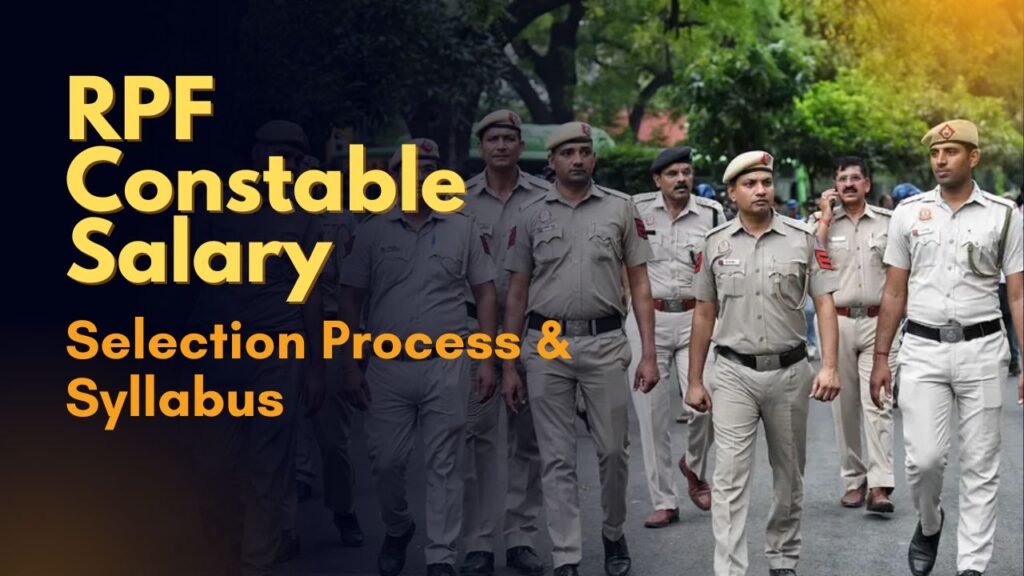
RPF is one of the most popular and important central forces of India, providing a secured career and good remuneration both for male and female aspirants. If you are dreaming of getting a prestigious government job which provides security for your job and financial stability, RPF Constable is your stepping stone for a bright future. So let’s go deep down to the bottom with everything you need to know about this great career.
Understanding RPF Constable Salary
The compensation package is fairly competitive for those who do not have a long track record in government employment. An RPF constable gets a basic pay of Rs. 21,700 per month for an RPF constable which looks low at first, but with various allowances the total amount becomes pretty attractive.
Your salary after allowances addition is usually between Rs.26,000 to Rs.32,000 per month with the variation being based on the city of posting and the type of allowance you are entitled to. The consolidated monthly remuneration (all-inclusive) is between Rs. 37,420 and Rs. 44,460 which is equal to Rs. 3.12 lakhs to Rs. 3.84 lakhs annually.
There are different components of salary in the salary structure that makes your take-home pay higher. You get a Dearness Allowance (DA) of Rs 10,850 which is 50 per cent of your basic pay as a you help me keep pace with inflation. The HRA depends upon your place of posting and it lies between 8 – 30 percent of your basic salary. Transport Allowance and City-wise Others benefits add further to your income.
The RPF salary becomes more alluring because of the regular increments, which are granted at the end of every year of the service. Moreover, you also avail medical facilities, pension schemes as per 7th Pay Commission recommendations and many more benefits which ensure financial stability for life.
The process to become an RPF Constable from a wannabe has a selection process that is fairly straightforward and designed to winnow out the best and fittest. Knowing the steps will give you a strategic edge in your preparation and you can rest assured when you go through the recruitment.
Stage 1: Computer-Based Test (CBT)
The first barrier is the Computer-Based Test, which is the entirety of the selection process. The CBT comprises a 120 marks, 120 multiple-choice questions exam, and you are given 90 minutes to take it. You get one mark for each right answer, but here is the catch: you get one-third of a mark deducted for every wrong one, so choose wisely.
The exam is held in Hindi, English, and in some regional languages so that aspirants from all backgrounds can take it without any difficulty. The level is of 10th standard but don’t take it lightly as questions asked would be based on your overall learning not only from memorizing.
Stage 2: Mandatory Physical Efficiency Test and Physical Measurement Test (PET & PMT) For Candidates
Only the candidates, who qualify the CBT, are called for the Physical Test, This phase has two parts, which are both important in your selection.
The Strength, Endurance and Fitness test tries out your strength, stamina and fitness through real activities. Male candidates are required to run 1600 meters in 5 minutes 45 seconds while female candidates are required to run 800 meters in 3 minutes 40 seconds. You only get one try for the running event—no second chances here, so train hard. And you also have the long jump and high jump tests where you’re given two tries.
Leaping 14 feet in the long jump and 4 feet in the high jump is a requisite for male candidates. Female aspirants have much relaxed parameters: 9 feet for long jump and 3 feet for high jump. Note: ex-servicemen are not required to take the PET but they do have to clear the PMT.
The Physical Measurement Test (PMT) measures your height and chest measurements against certain standards. The male applicants must hold a minimum height of 165 cm (160 cm for SC/ST categories), with an unexpanded chest measurement of 80 cm and an expanded chest measurement of 85 cm. Height requirements for Female Candidates is 157 cm (152 cm for SC/ST Categories). These measurements are to make sure you comply with the physical standards exigent of this job.
Stage 3: Document Verification (DV)
Those who qualify in the PET and PMT are called for document verification, where your eligibility stands verified. You need to submit the originals for age proof, educational qualification, caste certificate (if any) and identity proof.
Stage 4: Medical Examination
The end stage in selection is a medical examination in) depth by RPF medical officers. You should be fit according to medical category ‘B-1’ as per Indian Railway medical manual in order to consider for the post.
RPF Constable Syllabus
First analyze the syllabus then start your preparations accordingly. The RPF Constable CBT syllabus consists of three crucial components considered equal in weightage covering other aspects of your aptitude.
General Awareness (50 questions)
Here, you will be examined on the things happening now, history of India, geography, polity, Indian economy and general science. Topics such as Indian Constitution, fundamental rights and duties, directive principles, economic theories, environment, sports, art and culture and major breakthroughs in science are part of the Topics. So keep yourself updated with the current affair and a little bit knowledge of Indian history, geography and general knowledge for this section.
Arithmetic (35 questions)
Mathematics is not only an instrument of calculation here, nevertheless it is also a matter of thinking and reasoning. The maths section covers number system, percentage, ratio and proportion, simple and compound interest, profit and loss, mensuration, time and work, speed and distance along with elementary algebra. Most of the questions focus on testing your conceptual understanding of math that you can relate to real-life, so it’s always better to have an idea on concepts than mug up formulas.
General Intelligence & Reasoning (35 questions)
Your Mind & Reasoning ability are tested on topics like Analogies, Coding-Decoding, Number Series, Syllogism, Blood Relations, Seating Arrangement, and Non-Verbal Reasoning. Your performance in this region will get a healthy boost from developing logical thinking and practicing pattern recognition.
Preparing Strategically for Success
To crack RPF Constable Exam, do preparation in a systematic way. Firstly, comprehend the syllabus in depth, then solve previous year papers on a large scale. Divide your time according to the level of each question in study time since each topic has equal weight. Information is updated frequently at the official RPF website (rpf.indianrailways.gov.in/RPF), so keep visiting for more notifications.
Don’t wait until the date of the PET slowly approaching for physical preparation. Start your workout regimen now—running, jumping and strength training should be daily activities. Academics are important, but so is physical fitness in this selection.
Your RPF Constable career is tough but highly satisfying. After all, a little planning, hard work and a bit of luck is all you need to make your way through this process and reach a coveted post that will provide you not only with financial security and job stability, but respect in society, as well. Begin preparing now and earn your living in the Railway Protection Force.
Conclusion
Being an RPF Constable is not only a government job but a career to serve in among the most disciplined and respected central forces of India. The financial outlook is good and long-term because you get a good starting salary with allowances, plus regular increments, medical benefits and pension security.
The selection procedure, although tough, transparent is doable with the right mix of brains and brawn. Having a knowledge of syllabus, daily practice for CBT and starting physical training for PET/PMT at an early stage will help you a lot in achieving success.
If you have the right attitude, are disciplined, and able to concentrate hard, then the RPF Constable post can provide you with the pride and social standing besides financial independence and job security. Begin your preparation today, be consistent, and march confidently towards a bright future with RPF.