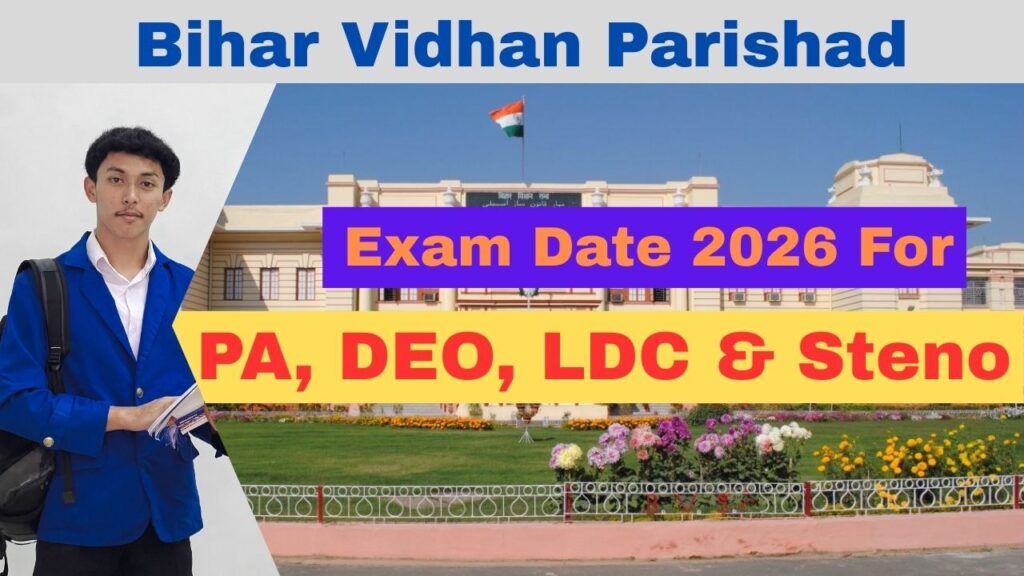
PA, DEO, LDC & Steno Posts Exam Date 2026 is Out Check Bihar Vidhan Parishad Site

Bihar Vidhan Parishad

For Bihar students, a stable, prestigious government job is what defines success in life and as such many are drawn to the Bihar Vidhan Parishad (Legislative Council) for it. It’s been a long preparation but finally, the air is starting to clear. If you have been constantly refreshing the official website and browsing notification bars, you have already filled the application forms.

Now the exam dates for the recruitment for the posts of Personal Assistant (PA), Data Entry Operator ( DEO ), Lower Division Clerk ( LDC ), and Stenographer are now declared. 

Schedule for Exam

The preliminary exam is being held on 05/April/2026 for PA, DEO, and LDC posts which is being filled with the aspirants who score best in this exam.

Starts Apply 28/November/2025
Ends on 05/January/2026
Last Date For Fee07/January/2026
Exam Date05/April/2026

Eligibility For Exam

Applying for Personal Assistant (PA): You must have a degree of a valid university in your hand from any stream and Stenography speed of 100 words per minute (wpm).

For the Stenographer: Stenography speed of 80 wpm with the degree of graduation.

Data Entry Operator (DEO): 8000 words with accuracy per hour speed of typing is required with 12th Certification.

Applying for Lower Division Clerk (LDC): You must have 12th marksheet and 30 wpm of typing speed in both Hindi and English.

Vacancy and Salary Level

This single-day agenda offers some clarity for the 64 vacancies that thousands have applied for. Although the application process ended in January 2026 following a number of extensions, the attention is now firmly on the home straight of revision. 

Post NameTotal VacanciesPay Scale (Level)Key Qualification
Personal Assistant (PA)07Level-07 (₹44,900–1,42,400)Graduate + 100 wpm Steno
Data Entry Operator (DEO)35Level-04 (₹25,500–81,100)12th Pass + 8000 key-depressions/hr
Stenographer12Level-04 (₹25,500–81,100)Graduate + 80 wpm Steno
Lower Division Clerk (LDC)10Level-02 (₹19,900–63,200)12th Pass + 30 wpm Typing

Selection Process

It is not only a written test competition in this recruitment; it is also a competition of knowing the technique of running on the ground. Since these posts are of administrative and technical nature, the Bihar Vidhan Parishad conducts the following stages:

  1. Preliminary/Written Examination: This is the first hurdle. It is basically a general awareness general arithmetic, reasoning and language (Hindi or English).
  2. Skill Tests For PA and Stenographers: You will appear for a shorthand (Stenography) test which is tough as it requires 80–100 wpm.

For DEO, and LDC: Must clear Typing Tests and Computer Tests. Be it key depressions of the hour or the words per minute, accuracy is equally important as speed.

  1. Document Verification & Medical: The end of the road to qualify for meeting all legal and physical condition for the state government. 

Admit Card Download

The admit card is going to be released in March 2026 before the exam so students can download it from the official website. It is a ticket to your exam which is not going to appear on your doorstep. 

Follow these Steps to download: 

  1. Check out to the official site
  2. Login to check your admit card.
  3. Put in your Registration Number and Date Of Birth/Password to login.
  4. Download, have it laminated and get a colour print out.

Note: It will be available five days before the exam so keep checking on the site. It may not show sometimes due to high traffic on the server. 

Read More:- UPPSC APO Admit Card 2026 Out: Check Exam Center and Date

Preparation Strategy

If you have a little time for preparation or you want to revise over three weeks. Here are a few things you can do to beat this examination:

  • Keep A Watch On Current Affairs: Bihar related current affairs and Indian polity are all time favorites in Vidhan Parmanch exams. Revise the recent laws and the state’s schemes.
  • Practice Typing/Steno Daily: The pressure of the exam hall is different from doing practice at home.
  • Practice Papers: Begin untimed with full-length test papers with the clock ticking. This will allow you to make during the General Awareness, Reasoning and Time Sessions.
  • Revise Computer fundamentals: For DEO and LDC posts, questions on MS Office shortcuts, internet protocols, and basic hardware are frequently asked. 

What to Carry to the Exam Center?

  • Admit Card with fully laminated
  • Adhaar or Pan Card copy
  • Passport photo of yours

Conclusion

Bihar Vidhan Parishad Recruitment Exam 2026 is very important for those aspirants who want to make their career in Government Sector. Now that the exam date is out, the entire attention should be on smart revision, regular practice and time management. PA, DEO, LDC, and Stenographer post in UPSC documents, each form is precise and fast at each stage of the application process. Follow the instructions and stay up to date with official notifications, download your admit card on time and have all necessary documents ready. If you eat the right strategy and commitment, this could be your door for a successful career in the Bihar legislative arm. 

Leave a Comment

Your email address will not be published. Required fields are marked *

HTET 2025 Admit Card Out: Download Now from bseh.org.in for 30-31 July Exam

HTET 2025 Admit Card Out

Candidates who are waiting for the HTET 2025 Admit Card can now download from the official website of the Board of School Education, Haryana. You can download the notification for more details about this exam. The official date is 22/July/2025 for declaration of the admit card for examination on 30th to 31st July, 2025. By passing this state-level government exam, candidates are eligible for teaching in haryana government schools. 

Short Details on HTET 2025

ExamHaryana Teachers Eligibility Test
BoardBoard of School Education
Level of ExamState-Level
PurposeHTET is a state-level government exam to assess the knowledge of candidates for teaching.
Exam Duration2 hours 30 minutes
Exam ModeOMR/Offline
Admit CardClick Here
Official WebsiteClick Here

HTET 2025 Admit Card Dates

HTET Admit Card22/July/2025
PGT Level 3 Exam Date30/July/2025
TGT Level 2 Exam Date31/July/2025
PRT Level 1 Exam Date31/July/2025

Read More 👉 UPPSC Assistant Teacher Online Form 2025 Released for 7466 Posts

Eligibility For HTET Admit Card

This is a state-level government exam which makes you eligible for teaching positions in Haryana government schools and colleges. But there are some educational qualifications which are required for this examination.

There are three different levels of teachers – level 1 (primary teacher), level 2 (TGT Teacher), and level 3 (PGT Lecturer). With 10+12 marksheets, you need some higher education for this position. Here is the detail:

Primary TeacherMarksheet of 12th & Pass Certificate of D.Ed/B.El.Ed
TGT TeacherGraduation Degree & B.Ed/ Integrated Bachelor’s with B.Ed
PGT LecturerMaster Degree & B.Ed/ Integrated program

Steps To Download HTET Admit Card

Step 1Click on the link to the official website. The link will redirect you to the official website of Board of School Education, Haryana.
Step 2 Scroll down & Click on the “Haryana TET Admit Card” link.
Step 3Click on Login, the new page will open.
Step 4Enter Registration or Phone Number & Password to log in.
Step 5Admit Card will be shown, now you can download it.
Step 6Save your Admit card in your mobile or laptop for printout.
Important Links
Admit CardClick Here
Download NotificationClick Here
Official WebsiteClick Here

Leave a Comment

Your email address will not be published. Required fields are marked *

BSc Physiotherapy (BPT): Course Details, Eligibility, Fees & Career Scope

BSc Physiotherapy

BSc physiotherapy is a 4-year undergraduate professional course, that can be opted by those students who wish to pursue a career in healthcare services or wish to provide care to patients through physical rehabilitation and therapeutic care. The course gives you a thorough knowledge of human body anatomy, movement science and modern physiotherapy techniques as medical science and clinical practice. Due to increasing emphasis on physical well-being, rehabilitation, and sports medicine, physiotherapy has become a well-established and sought after profession and BSc Physiotherapy is a particularly good academic option for students who take interest in patient care, science of recovery and holistic health. 

Overview of BSc Physiotherapy

The bachelor’s degree in physiotherapy is an application of clinical and science based physiotherapy. This course is conducted for four years both for theoretical sessions and practical training where the course participants learn basics of anatomy and physiology as well as methodology of physical therapy. 

Students also complete clinical placements or internships where they have the opportunity to work with patients who have a range of bodily ailments. This practical experience is key to acquiring the skills you need to become a physiotherapist. 

Course Curriculum for BSc Physiotherapy

The BSc Physiotherapy course combines theory and practice in equal measure to develop sound clinical and professional competence. It begins with core modules in anatomy, physiology, biochemistry, pharmacology, assessment techniques, research methodologies, and communication skills in order to build a robust base.

Students also take higher-level courses in rehabilitation techniques, therapeutic interventions, sports physiotherapy, kinesiology, and biomechanics in the second year. It also involves clinical training with practical placements, enabling students to put their knowledge into practice in real-life healthcare environments. Assessment of learning in physiotherapy is by written papers and practical examinations and project work, all of which are designed to ensure students’ all-round competence in the practice of physiotherapy. 

Eligibility for BSc Physiotherapy

The requirements for admission to a Bachelor of Science (BSc) in Physiotherapy would vary from one institute to another and is subject to the individual decisions of the institute. 

Basic academic requirement: candidates generally should have completed their 12th-grade higher secondary education with not less than 50% aggregate in science stream. 

Eligibility for BSc Physiotherapy

Requirements for Subjects: Apart from the total percentage, he/she has to compulsorily pursue some core subjects in class 12. The essential subjects to be studied usually are:

  • Physics
  • Chemistry
  • Biology

These are important subjects because they help you learn basics which are required to know the human body, its functions and scientific rules which are applied in physiotherapy. 

Further Information: Vocational qualifications such as BTECs may be accepted by some institutions in addition to or in place of equivalent qualifications, subject to their individual application requirements. 

The best universities might also have additional requirements such as entrance examinations (NEET, CUET, or state-level exams) or interviews to assess candidates. 

Admission Process in Best Universities of India

Admission for the BSc Physiotherapy course is based on entrance exam conducted either by individual colleges or through centralized examination system. 

These are the most common entrance exams: 

  • NEET 
  • CUET 
  • KCET 
  • IPU CET 
  • LPU NEST 

Application Process

  1. Get/Download the Application Form: Students can either download the application form for the respective college or university from the official website or they can get the application form from the college or university itself by visiting the institute. 
  2. Submission of Documents: Documents to be submitted are usually the Class 10 and Class 12 mark sheets, photographs, identity proof, etc. as per the norms of the institution.
  3. Entrance Exam: Aspirants need to take the designated entrance test by the specified deadlines of the college/university.
  4. Cut-off list/Interview: When the entrance examinations are over, the college may announce a cut-off list/interview for finalizing the admission on the basis subject and other criteria.
  5. Confirm Admission: After this, the qualified candidates have to confirm their admission by submitting the requisite fee and the formalities for the same are provided by the concerned institution. 

Fees Range in India’s Best Colleges

In India, the BSc Physiotherapy course fees in the top institutes are generally in a range of INR 50,000 – 3,00,000 per year depending on whether it is a government or private institution. 

Some of the top ranks such as All India Institute of Medical Sciences (AIIMS) and Christian Medical College (CMC) can command fees on the higher end of this, while others have much lower overall costs of training due to government subsidies.

All in all, the expenditure of Bsc Physiotherapy Education varies in different countries and institutions and it is recommended to explore each college for further information about tuition fee and living expenditure. 

Future Opportunities

Career Focus with BSc Physiotherapy in India

BSc Physiotherapy is a good career option and has a very bright future in India as the demand of qualified physiotherapists is increasing all over the world. Graduates have several options to choose from, including options that are designed to work with patients that have different needs and in different healthcare environments. 

Clinical Physiotherapy

One of the primary career opportunities is that of a Clinical Physiotherapist, which allows the graduates to work in hospitals, clinics and rehabilitation centers. Physiotherapists assess and treat patients in institutions, but may also be employed as independent consultants. Students can assess as orthopedics, neurology, pediatrics, geriatrics, and cardiopulmonary physiotherapy. 

Sports Physiotherapy

Another important area is Sports Physiotherapy which relates the treatment and prevention of sports injuries. Sports physiotherapists work with athletes to improve performance and prevent injuries and they may be found working with sports teams and gymnasiums. 

Rehabilitation Therapy

Rehabilitative is a key discipline the physiotherapists are concerned with rehabilitation and restoration of motion and function to people. Physiotherapy is important for post operative rehabilitation after surgery. It helps to regain function, manage pain and discourage complications, which are essential elements in the promotion of the best recovery. 

Academic and Research Opportunities

The graduates can also go for academics, and teach the candidates in Physiotherapy in colleges and universities. Opportunities for higher education like MPT (Master of Physiotherapy) or even PhD will also add on to career options. 

Government and Private Sector

BSc Physiotherapy graduates can apply for jobs in both the government and private sector. Qualified physiotherapists are in demand in government hospitals, health campaigns, non-governmental organizations (NGO), but they also have important positions in private clinics, companies, health care programs and sports clubs. 

Career Focus with BSc Physiotherapy Abroad

Working abroad can increase chances of finding a job for physiotherapy graduates. Countries like Australia, Canada, Germany and Switzerland are very friendly to international physiotherapists and in many cases allow for foreign trained professionals to obtain licensure.

Professional Growth

Professional development is necessary in the field of physiotherapy. Additional to the physiotherapy degree, many physiotherapists also get specialised qualification/education in the field of paediatric physiotherapy, geriatrics or rehabilitation to name a few.

Work within international physiotherapy organizations and/or attend workshops or conferences in a foreign country to further your career development and to acquire a competitive advantage make you more marketable as a graduate when you’re seeking employment. 

Salary Expectations

In India, a physiotherapist’s average annual salary is INR 1,018,527 (USD 12,300). Fresher physiotherapists are paid around INR 15,000 to 25,000 per month (varies as per employer and city conditions) or can get a stipend from the higher education institute from where they had studied. 

With more experience, salaries are estimated at INR 50,000 – 80,000 per month. 

Canadian physiotherapists can count on earning from $70,000 to 85,000 USD, which is quite a high salary when compared to that of other countries. Newly graduated physiotherapists in Australia generally earn a salary of around AUD 65,000 which grows significantly for more finding its way to up to around AUD 140,000 in senior positions or clinical educators.

Physiotherapists in Gulf countries like Saudi Arabia, UAE, Qatar, also enjoy good pay scales. Staff physical therapists in these areas typically make between USD 3,500 and 5,000, while senior therapists could be paid up to 6,000 USD or more per month.

The salary forecasts for physiotherapists indicate a wide range depending on region of work, sector specialisation and level of experience. 

BSc Physiotherapy Comparison with BPT

The BSc physiotherapy is more a scientifically based approach covering a wide range, but the Bachelor of Physiotherapy (BPT) is also mixed with a considerable amount of practical training, which focuses on the therapeutic procedures and assessment methods required in the industry. BPT courses may also focus on the use of physiotherapy in different clinical areas so graduates can find employment there too. 

BSc Physiotherapy Comparison with BPT

The BPT course is innovatively crafted which equips students not only with theoretical knowledge but also with practical expertise required to evaluate, diagnose and treat various physical disorders, thus it is a good option for students who want to pursue a career in which they help patients regain mobility and quality of life vision enabled by physical rehabilitation. 

Overall, BSc and the BPT in physiotherapy provide different routes to a career in physiotherapy BSc offers a wider scientific base and BPT concentrates more on clinical aspects and therapeutic procedures. Both courses could lead to rewarding careers in the ever changing area of physiotherapy, specific to the interests and talents of the graduates. 

Conclusion

BSc Physiotherapy is a great opportunity to explore what a rewarding healthcare career could be like, with well-rounded knowledge in sciences, clinical practice and career types. Physiotherapy today is a dynamic and expanding profession all over the world including our country with multifaceted activities starting from hospital, sports rehabilitation to research, academic and international exposure.

Whether students are going into clinical practice, further education, or opportunities abroad, they will graduate from this program with the knowledge, skills and confidence to guide their growth. In essence, BSc Physiotherapy it not just a degree—it is a journey to a rewarding career dedicated to improving mobility, health and quality of life. 

Leave a Comment

Your email address will not be published. Required fields are marked *

PCS Exam (Provincial Civil Services): Roles, Structure and Selection Process

PCS Exam (Provincial Civil Services)

PCS Exam (Provincial Civil Services) is an important pillar for the state administration in Indian states. And this is what closely shapes the state through its good governance, which is ultimately determined by the effective application of the policies and programmes. This blog will be a brief account of what PCS is about, the exam pattern for PCS, the recruitment procedure, the responsibilities, duties to be performed by PCS officers and importance of civil services in the Indian scenario. 

What is PCS?

The Provincial Civil Services (or PCS Exam) is an administrative services of state, which works under state government. Whereas every state in India has its own civil services responsible for law and order of the state, execution of the policies of the government and delivery of services to the citizens. The PCS officers are state government officers and are posted at various levels to district administration, revenue and welfare of public. 

Importance of PCS

Administrative Backbone: The PCS Exam is considered to be the backbone of the state administration, as it is the vehicle for enforcement of the government at the village level.

Service to Public: Public servants under the PCS Exam have the duty of dispensing important public services — health, education, infrastructure.

Implementation of Policies: They are also instrumental in the execution of several government plans and programmes for the citizens.

Local Governance: In many cases, PCS officers serve in local governments, which brings them closer to the population they administer. 

Structure of PCS

State Administrative Service (SAS)

  • The State Administrative Service (SAS), a key component of PCS Exam, is equivalent to IAS at the state level that deals with core district administration. 
  • Officers begin their careers as Deputy Collectors or Sub-Divisional Magistrates (SDMs) and are District revenue officers in charge of implementing Schemes such as MNREGA and PMAY, Revenue matters, Public grievances and Disaster management. 
  • After 8-10 years they get promoted to DM at Pay Level 10 (₹56,100–₹1,77,500) along with benefits like official residence, vehicles, and allowances. 
  • It is conducted through PCS Exam Prelims, Mains and Interview, is having a bachelor’s degree and aged between 21-40. For instance, in UPPCS, one can expect SAS posts to start as Naib Tehsildars in tehsils. 

State Police Service (SPS)

  • The State also has its own police force namely the State Police, which is the principal law enforcement agency.
  • DSPs are recruited through PCS Exam with physical tests as mandatory duties include investigation of crimes, dealing with cybercrime, providing security to VIPs, managing traffic and community policing and from there you can be promoted to the ranks of Superintendent of Police or DIG.  
  • Pay levels vary from 10-12 (₹56,100–₹2,08,300) with uniform and arms allowances. 
  • Relevant for graduates between the ages of 21-40, is popular in urban-heavy states like Uttar Pradesh, where DSPs combat Noida crime surges. 

State Revenue Service (SRS)

  • Land Revenue and Taxation and Records is a branch of the State Revenue Service (SRS) that acts as the keeper of land revenue and taxation and related records, it is directly linked with the highest levels of the member starting from entry level as Naib Tehsildars through PCS exams. 
  • The Officers are responsible for issuing caste/income certificates, they settle land disputes under various acts like UP Zamindari Abolition, they also collect stamp duty and also supervise mutation, they also get promoted as Tehsildars or Additional Collectors. 
  • Level 10 Pay is inclusive of rural-related allowances. 
  • Awareness of land laws is indispensable for this cadre and for an agrarian state like Rajasthan where water and wastelands are such a big issue. 

Other Services

PCS has a number posts such as State Forest Service (SFS) for wildlife conservation and anti poaching (like Uttarakhand PCS). It also contains the State Engineering Service (SES) in public works and irrigation (MPCPS). 

Other posts include BDOs, Commercial Tax Officers, and many state specific posts like Bagasse Officers in Bihar. 

Percentage varies 40-50% SAS, 20-30% Police, Technical background preferred for technical posts. It used to have its own state level administration which was only after 8+ years that were IAS/IPS. 

Read More:-India Post GDS 2026 Recruitment Notification & Apply Guide

Recruitment Process of PCS in Detail

Who Can Apply

The candidates should meet the following criteria to apply for the PCS officer:

Qualification: The minimum requirement for this is a bachelor’s degree from an accredited institution. 

Age Limit: The age limit is generally 21-32 years, with relaxation in upper age limit for reserved categories.

Nationality: The applicant should be an Indian citizen or a non-resident Indian and he should fulfill certain criteria laid down by the state government. 

Examination Process

Generally, the recruitment procedure for PCS Exam is as follows:

  • Preliminary Examination: This is an objectivity-type exam which measures the general knowledge and awareness level of aspirants. It acts as a test in eliminating the candidates for the main exam.
  • Main Examination: The eligible candidates who have successfully qualified in the preliminary exam can apply for the main exam. These are descriptive type papers based on different subjects like general studies, language and optional subjects.
  • Interview: In this round candidates are assessed on their personality, communication ability and whether they have the makings to be part of the civil services. 
  • Final Selection: Final merit list will be prepared on the basis of result of main exam and Interview. 

Roles and Responsibilities of PCS Officers

PCS officers are given a multitude of duties, depending on where they are posted. Some of the most important ones are:

What is a District Collector? 

The District collector is the head of the district administration and is responsible for the collection of revenue, maintenance of law and order, and implementation of various development schemes. 

Sub-Divisional Officer (SDO): 

SDO is the chief officer of a sub-division and the officer-in-charge of administration at the sub-divisional level, monitors developmental works in the sub-division along with maintenance of law and order. 

Tehsildar

This officer is responsible for revenue collection, maintenance of land records, settlement of land disputes, and execution of government schemes at the grass root level at tehsil level. 

Block Development Officer (BDO)

At the block, BDOs have to implement, run and monitor the rural development programmes, coordinate with the local bodies, and attend to public grievances and be the communication between the Government and the rural people. 

Challenges Faced by PCS Officers

Having the title of a PCS officer is a prestigious and fulfilling job, but it has its share of challenges:

  • Work Pressure: Officers are regularly under tremendous pressure to meet deadlines and provide output on a timely basis.
  • Political Interference: The political environment is not always easy for the officers to perform its duties in the political interference of nature.
  • Public Expectations: Expectations from the street can be very high, and officers have to try to live up to them with limited resources.
  • Corruption: Nowhere is the battle more difficult to win, or the temptation to strangle it with myriad legs more prevalent than in the PCS system. 

The Significance of PCS in Society

The importance of PCS Exam in society is invaluable. These officers play a crucial role in determining the future of the state and in translating government policies into action. They serve as the government’s interface with citizens to redress grievances and promote development.

Furthermore, the PCS allows people to positively give back to society. It draws passionate and driven people looking to have an impact in their communities. The feeling of doing service to the public and being part of the process of governance is only one among many reasons which make the PCS a dream for many. 

Conclusion

The PCS Exam (Provincial Civil Services) is the catalyst of the state administration in India. It provides an exciting and challenging career for those who love public service and governance. With its organised selection procedure, varied assignments, and the chance to bring about positive changes in society, PCS continues to lure men and women of talent dedicated to the nation. As we march forward for building a New and Modi-led India, the role of PCS officers will be no less important in spearheading this change and in ensuring the effective governance of the state.

So, for the candidates who are willing to apply for the exam, knowing about the PCS exam and preparing well can give them a good career in civil services, through which they can contribute to their state and the country. 

Leave a Comment

Your email address will not be published. Required fields are marked *

Indian Revenue Service: India’s Most Underrated Career Path

Indian Revenue Service

When you are dreaming about passing the Indian Revenue Service exam, many of them aspire to three letters: IAS. But among the tens of thousands of them, there is a quieter, sharper posse that it looks like the mainstream hasn’t quite tuned into yet – the Indian Revenue Service could well be the best career choice in the entire civil services ecosystem. 

What is the Indian Revenue Service?

When most people hear Indian Revenue Service they think of someone sitting with a bunch of papers behind a dusty desk, stamping tax returns. That couldn’t be further from the truth.

The Indian Revenue Service is, at bottom, a law enforcement and policy-making juggernaut. It is also the financial backbone of India — the body that raises the funds that pay for hospitals, highways, schools, and defence. The service was formed in its current style in 1953 and is divided into two significant arms, the IRS (Income Tax) and the IRS (Customs and Indirect Taxes). 

Nearly 9,775 officers, the two branches of the chargeable revenue service are testament to a cadre that pervades nearly every facet of the Indian economy. 

Eligibility

  1. Applicants must be Indian citizens or belong to certain categories of Persons of Indian Origin (PIO) to apply for the IRS. 
  2. The basic educational qualification is a Bachelor’s degree in any stream from any recognized university by the Government. 
  3. UPSC is quite flexible in this regard as it permits the students pursuing the final year of University to appear in the Preliminary examination for the CSE examination on a provisional basis, however, they are required to submit the passing certificates before joining the Mains exam. 
  4. The age limit is 21 — 30 years, you can check further below. 
Applicant CategoryMinimum AgeMaximum Age LimitPermitted Examination Attempts
General21 Years32 Years6 Attempts
Economically Weaker Section (EWS)21 Years32 Years6 Attempts
Other Backward Classes (OBC)21 Years35 Years9 Attempts
Scheduled Castes / Scheduled Tribes (SC/ST)21 Years37 YearsUnlimited (up to maximum age limit)
Persons with Benchmark Disability (PwBD – General/EWS)21 Years42 Years9 Attempts
Disabled Defence Services Personnel / Ex-Servicemen21 Years35 to 37 Years9 Attempts

Work Responsibility

These are the people who appear and plunder the offices of billionaires at the break of dawn. They follow cryptocurrency tracks across borders. They capture drugs off the shore. They bust shell companies that hide thousands of crores in black money. And yes, they also sit in hearings, argue byzantine tax law before tribunals and help shape the very policies that dictate how India earns its revenue.

This is not a desk job. This is one of the most intellectually challenging, operationally thrilling and financially rewarding career in Indian public service. 

Participate & Crack IRS

Hacking the Indian Revenue Service is tough but then, nothing good ever is. The only avenue of entry is through the UPSC Civil Services Examination, which is attempted by about 1.1 million aspirants every year. The exam takes place in three stages, all tough. 

  • The first is the Preliminary exams – a two-paper objective test to weed out the unprepared. 
  • Then there is Mains, nine descriptive papers penned down over a period of a few days, examining one on history and geography, ethics and economics, and so on. 
  • A final interview by a panel of seasoned bureaucrats and scholars. 
Mains Examination PaperSubject Focus and Syllabus ParametersMaximum Marks
Paper I (Essay)Multiple topics requiring analytical and philosophical discourse.250
Paper II (GS I)Indian History, national Geography and geo of the World and culture.250
Paper III (GS II)Law & Constitution, Social Science, and International Affairs.250
Paper IV (GS III)Tech, hacking, Economic Development, Bio-diversity, and crisis management.250
Paper V (GS IV)Ethics, Integrity, and Aptitude (Case studies on administrative morality).250
Paper VI (Optional I)Subject chosen by the candidate from a predefined list of 48 disciplines.250
Paper VII (Optional II)Second paper of the chosen Optional Subject.250

Top Recommendations for Exam Preparation

The whole process, beginning to end, can take years of preparation. Most of the toppers are second-time IAS aspirants and they spend 2-4 years mugging up the NCERT textbooks, M Laxmikanth Indian Polity, Ramesh Singh Indian Economy and reading daily newspapers like The Hindu. They write answers daily in practice. Join offline coachings or attend world-class online platforms such as Vision IAS or Vajiram & Ravi from wherever they live. 

Cutoff Marks Needed for Selection

A candidate from general category is usually required to rank between 239-379 to get IRS (Income Tax). For IRS (Customs and Indirect Taxes), the range is a little wider — something like 265 to 497. They are excellent ranks, well within the top 0.5% of all candidates. But unlike the IAS cut-off which is near impossible, the IRS is a realistic and achievable target for those who seriously prepare. 

ServiceGeneral Category (Last Rank)OBC Category (Last Rank)SC Category (Last Rank)ST Category (Last Rank)
IAS (2024 Trends)78 —- 96435 —- 457567—- 629528 —- 625
IPS (2024 Trends)225 — 252480 —-656638 — 865645 — 867
IRS (Income Tax)239 — 379485 — 706602 — 969674 — 1032
IRS (Customs & IT)265 —- 497515 — 823649 — 970680 —- 1053

The “big three” services—consisting of the Indian Administrative Service (IAS), the Indian Foreign Service (IFS) and the Indian Police Service (IPS)—are in the topmost Tier 1 class. These services traditionally take the bulk of the top 150 candidates. The IAS is the undisputed king of the civil services, with unparalleled executive powers, while the IFS has the glamour of global diplomatic representation, and the IPS has the unmatched power of the uniform.

The Indian Revenue Service holds the very prestigious Tier 2 bracket and is known for its unbeatable power in financial affairs along with a good urban living. With a bigger cadre size and distinct preference pattern giving priority to metro stability rather than rural administration, the IRS (IT) and IRS (C&IT) take a large chunk of the successful candidates which are ranked between 240 and 650 in the general category. 

What Happens After the IRS Exam?

IRS (Income Tax) officers are on their way to Nagpur’s National Academy of Direct Taxes (NADT) — a sprawling green-fitted campus, where a 16-month professional course converts the generalist officers into financial experts. The content is demanding: income tax law, corporate accounting, forensic investigation, international taxation, transfer pricing. It’s not just classroom theory, either. Officers labor months in the trenches, conducting real assessments and audits with seasoned veterans.

IRS (Customs and Indirect Taxes) officers are trained at the brand new NACIN campus in Palasamudram, Andhra Pradesh — a breathtaking 500-acre establishment which also serves as a World Customs Organization regional training centre for the Asia-Pacific region. The syllabus here includes GST, customs law, border management, narcotics control and contemporary areas such as data analytics and artificial intelligence.

Holistic development is taken seriously in both academies. Morning physical training, evening cultural programmes and personal hobbies. The objective is to produce officers who are not just technically competent but mentally tough, well rounded human beings who can manage in high-pressure environments without losing their cool. 

Read More:- Railway RRC WR Apprentice Recruitment 2026 – Apply Online

Pay Scale and Future Opportunities

The pay of IRS officers is very good and is governed by the 7th central pay commission (CPC). Financial estimates for the 8th CPC, as the pay commission is next in line, indicate a possible 2.25 multiplier to the basic pay, which would again make being in the service financially attractive. Officers join the service at Pay Level 10 ( Junior Time Scale ) and can rise in 30 years of service through the ranks to the Apex Scale at Pay Level 17. 

The following outlines the elaborate and comprehensive financial and hierarchical system: 

IRS DesignationPay LevelBasic Pay (7th CPC)Estimated Gross Monthly SalaryCareer Timeline (Approx.)
Assistant CommissionerLevel 10Rs 56100Rs 85000 0 – 4 Years
Deputy CommissionerLevel 11Rs 67700Rs 100,000 5 – 8 Years
Joint CommissionerLevel 12Rs 78800Rs  1,25,0009 – 12 Years
Additional CommissionerLevel 13Rs 118500Rs 1,60,000 13 – 16 Years
CommissionerLevel 14Rs 1,44,200Rs 2,00,00017 – 20 Years
Principal CommissionerLevel 15Rs 1,82,200Rs 2,40,00020+ Years
Chief CommissionerLevel 16Rs 2,05,400Rs 2,80,000 25+ Years
Principal Chief CommissionerLevel 17 (Apex)Rs 2,25,000Rs 3,20,000Apex Career Stage

In cases where government accommodation is either not available or refused within the government-officer circle, the officers are paid a handsome House Rent Allowance (HRA) of 8% to 24% of their basic pay based on the tier categorization of the city in which they are posted. 

Conclusion

Indian Revenue Service is not just a career option but a vocation for those who want to make a real difference and are willing to work in the shadows and not in the spotlight. It is a combination of power and responsibility, brain and brawn, permanence and challenge. IRS officers at the national and state level are, quite literally, the core of India’s power but theirs is an unobtrusive, unshowy, and often unacknowledged influence.

In a culture where the IAS, IPS and IFS reign supreme in public imagination, the IRS gets overlooked not because it does not hold enough power or prestige or purpose but because it doesn’t shout about it. And yet, for those with the time to can see its nuances, it provides one of the most rounded existences in Indian public service — professional esteem, financial security, urban postings, intellectual stimulation, and tangible national outcomes. 

GovUpdatewala is your trusted source for real-time updates on government exams and jobs in India. We provide verified info on SSCUPSCBankingRailwaysDefense, and Teaching exams. From syllabus and patterns to important dates and career tips — we support aspirants at every step.

Leave a Comment

Your email address will not be published. Required fields are marked *

BSc Dialysis Technology: Course Details, Eligibility, Salary & Career Scope

BSc Dialysis Technology

BSc Dialysis Technology course is recognized a professional course under the regimen of which the students are prepared and polished to serve in the field of renal care and dialysis. The course duration is 3 to 4 years and is a mix of theoretical concepts as well as practical training. Subjects studied include anatomy, physiology, renal pathology, dialysis techniques, biochemistry and pharmacology. Also, patient care management is stressed so that graduates will be able to function at a high level in clinical environments, such as hospitals and dialysis centers. 

Eligibility and Admission

Requirements for the Admission in BSc Dialysis Technology courses are the possession of higher secondary education with a science background. Some colleges may also demand entrance tests and/or interviews as a part of the application process. Here is the full breakdown of Eligibility for Bsc Dialysis Technology:

Educational Background:

Candidates are generally expected to have passed their 10+2 or an equivalent higher secondary education examination with science stream (with the subjects of Physics, Chemistry, and Biology (PCB)) from a recognized board.45% to 60% in aggregate in these subjects is required by most institutions coming with variations as per applicant category i.e. general,sc/st or obc. 

Entrance Exams:

BSc Dialysis Technology programs entrance examination may differ from one college to another, however, many colleges conduct B.Sc in dialysis technician examination for admission, to check the candidate’s knowledge and comprehension of basic scientific concepts related to the field of dialysis-tech. So, they accept admissions through their merit scores. 

The mentioned premier institutions including JIPMER, SGPGI and Jamia Hamdard have started admitting students on the basis of entrance exams like NEET, CUET, KCET (Karnataka Common Entrance Test), KEAM (Kerala Engineering Architecture Medical)

But most of the colleges accept students on their 10+2 scores with subjects including physics, chemistry and biology or mathematics.

Admission Process

Check the colleges that offer BSc Dialysis Technology courses then visit their official website to enroll yourself. 

  • The admission portal opens for a short period of time, mostly in April and March. Students need to apply with supportive documents which includes marksheets and certificates of qualifications. Please fill the application carefully while applying for admission.
  • If there is any entrance exam required during the admission then the notification will be released for the examination, you must check carefully.
  • Some programs may also require an interview after the entrance exam to determine if the candidate is truly interested and if he or she would be a good fit for the field of dialysis technology. 
  • Institutions generally prepare a merit list considering aggregate performance in the written-test, interview (if applicable) and the qualifying examination which is used for offering the admission to the applicants. 

BSc Dialysis Technology Syllabus Details

The educational content of the BSc Dialysis Technology syllabus is designed to be comprehensive for developing required skills in students to carry out dialysis procedures and patient care. The course duration is 3 years which may extend to 4 years including internships and practice-based activities. Important topics are:

  1. You’re going to learn the human body’s systems, mainly the renal system, so you know how dialysis works on your body.
  2. Renal Pathology: How the kidneys work, what goes wrong in the different kinds of kidney illnesses.
  3. Understanding Different Dialysis Modalities: Obtain specialized knowledge about various dialysis modalities, including hemodialysis and peritoneal dialysis, such as machine operation, procedures, and patient care during treatment.
  4. Biochemistry Metabolic alterations in patients with kidney diseases and the contribution of dialysis to these biochemical alterations.
  5. Pharmacology Medications used in renal care: Drug interactions and patient safety during dialysis.

The objective of the syllabus is to make the student well versed with the theoretical and practical aspects of the dialysis technology profession. 

Practical Training

Besides the core subjects the curriculum also includes practical modules, which enable the students to become familiar with the real work situation. This training is frequently conducted in the following settings:

  • Clinical Rotations: Students complete clinical rotations in hospitals or in specialized dialysis centers, offering hands-on experience with the dialysis processes and patient care procedures.
  • Simulation Labs: Numerous programs include simulation training to train students in a simulated environment prior to working with real patients. 

Elective Modules

In some universities, optional courses are available where students can develop their knowledge in particular fields, as:  

  • Nutritional Support in Renal Disease: This study unit focuses on the dietary management of renal patients, including those receiving dialysis.
  • Advanced Renal Nursing (Beginners) Suitable for residents who wish to further their nursing knowledge in renal care.
  • Investigations in Dialysis Technology: This section considers new developments and breakthroughs in the renal procedure. 

Assessment Methods

The syllabus often involves different methods of assessment including the following:

Written examinations: To test knowledge of theoretical subject areas.

Practical tests: At clinical rotations or labs, you will undergo testing.

Projects: To promote research and investigation on particular subjects in the field of dialysis technology. 

Skills Acquired in BSc Dialysis Technology

Dialysis Technicians are an important part of the healthcare team, especially in caring for patients with kidney disease that must undergo dialysis. What they need to learn are technical skills as well as interpersonal skills. 

Dialysis technicians require a suitable combination of technical skills and people skills. Technically, they have to operate dialysis machines, watch patient vital signs, handle vascular access and interpret lab results to deliver safe and efficient care. 

They must also be empathetic and possess the ability and skills to communicate with patients, attend to emergencies and work with medical teams. They serve an educational role, as well, teaching patients about treatment, lifestyle and managing illness, so patients can become active participants in their care. 

Career Opportunities & Future Scope

Dialysis technicians are a subset of technologists, who work with the machines located at a dialysis center, the dialysis machine. Indraprastha Apollo Hospitals (New Delhi), Fortis Memorial Research Institute (Gurgaon) and Max Hospital (Several locations) are among the best employers, offering vacancies for patient care technicians and clinical managers.

Hospitals: Dialysis Technicians may work in a hospital setting, providing care to patients who require dialysis. These specialized technicians are essential to deliver safe and effective treatment. 

Travel Placement: Something a few travel dialysis tech are able to do, is to work on a travel basis at various locations. Companies like Nephro Plus help these travel positions, typically with great pay and benefits.

Home Dialysis: Or in some cases, technicians work in the home care arena. Companies like DCDC Kidney Care aiding patients that dialyze in their own homes. They assist with instructions and follow-up care, monitoring that patients operate their equipment safely. 

Some of the top global Dialysis Hospitals and Companies that offer first class patient care, not only this but they hire in a massive figure from India too. So, students can also apply outside of India. There are few top Dialysis centers including AMN Healthcare, Aya Healthcare, Cross Country Healthcare etc.

Career Advancement

Specialization: Dialysis technicians may further specialize, and become a certified dialysis technician (CDT). This certification could improve employment opportunities and generally results in higher salaries and more advanced positions.

Additional Education: Further education, such as an associate’s degree in nursing or supplemental certifications in nephrology, may qualify you for more advanced positions as registered nurse roles.

Management Opportunities: Senior technicians or lead in-centre technicians frequently go on to management, they may manage teams, manage patient care provision, and day-to-day logistics of dialysis clinics – center operations management. 

Read More 👉 RRB ALP Admit Card 2026 Released: Download CBT-1 Hall Ticket Now

Dialysis Technician Salary Expectations

Dialysis technician salaries may be different according to various factors like the location, the experience, and the nature of the organization they work in.

Dialysis Technicians in India make about ₹2,00,000 to ₹4,00,000 a year. Our the ceiling is 5,00,000 which is not unrealistic for a technician with 8+ years of experience.

It is normal for people living in or around the cities of Delhi, Chennai etc to have a higher demand for health care. A skilled technician can make between ₹4,00,000 and ₹6,00,000 annually in these regions.

Also, earning specialized training – such as hemodialysis or peritoneal dialysis certification, salaries can also go up. They may earn the opportunity to further increase their income. 

In the US, the average dialysis technician salary is $25 per hour which is about $51,316 per year. For example, in California, the wage per hour for a dialysis technician is about $26.47

Conclusion

BSc Dialysis Technology is tailor made for Students who are aspiring to be a Backbone of Renal Healthcare Sector. This combination of theoretical and practical knowledge enables the graduate to confidently perform advanced procedures such as dialysis, patient care and clinical work. 

Due to the increasing number of patients suffering from kidney disorders in India as well as all over the world, the opportunity for trained Dialysis Technicians is also increasing. From hospitals and dialysis units to home-care agencies and world health services, job prospects are varied—and growing. 

For students seeking a secure, respected and impactful healthcare career with immense potential for growth, BSc Dialysis Technology is a winning choice that will not just help them reach their professional goals, but also provide them the satisfaction of being able to make a real difference to the lives of patients. 

Leave a Comment

Your email address will not be published. Required fields are marked *

Scroll to Top