Best Apps to Prepare CBSE Board Exam 2027 (Class 10 and 12)

CBSE Board

Most students get a lot of study materials but preparing in six months for your board doesn’t mean you have to learn line by line from a textbook. You have to understand the topics which one needs more time or which needs few bullet points to understand. The Best apps will help you prepare CBSE Board Exam 2027 without giving any burden. 

The interface of these apps are so easy and topics are divided accordingly for students to catch up easily. You don’t have to rely on one app because each app offers a distinctive purpose, so install according to your needs, not just because it shows “Best” on Google.

CBSE Board Exam 2027 Class 10 & 12 Dates

CBSE Board Exam date sheet decides how much you have left for your preparations. So choose your app accordingly. CBSE Class 10 date sheet is expected to be released soon but you can prepare according to the exam pattern which will be the same for 2027. 

  • Theory exams: Expect February and March.
  • Practicals: Winter-bound schools hold them in November and December, and other schools start from January 1.
  • Sample papers: CBSE has already published them for both classes.
  • Passing marks: You need at least 33% in each subject.

Class 10 students also have a safety net. 2026 was the first year of the two-exam system, and the pattern is likely to repeat. Phase 1 ran from February 17 to March 11, 2026, with results on April 15. The optional second exam ran May 15 to 21, let students retake up to three subjects, and kept the better score. 

Administrative deadlines are also close. Schools had to submit candidate lists by October 21, with a late-fee window to October 30, and private candidates were asked to apply by October 23. Ask your school this week whether your name is on the list.

How to Choose a CBSE Board Exam App Without Wasting a Month

The mistake is downloading three apps and finishing none. Board prep needs three things, and no single app does all three well.

  1. NCERT-aligned concept clarity. CBSE papers lean heavily on NCERT.
  2. Timed practice. Reading a chapter and writing an answer in 3 hours are different skills.
  3. Fast doubt resolution. A doubt left unresolved for three days quietly eats a revision week.

Pick one app per need, not one per subject. That is the logic behind the picks below.

The Best Apps to Prepare for the CBSE Board Exam 2027

1. DIKSHA: Best for Free, Official NCERT Support

Best for: Government-backed app for CBSE students to get syllabus-accurate material. Cost: Free.

DIKSHA is the government’s own platform, led by NCERT. There is a QR code printed in the back side of the NCERT book which you can scan from your phone and it opens a video, notes or a full explanation of that chapter. If you are stuck at any topic, just scan the code that helps you land on material mapped to that exact chapter.

It also works for students with patchy connections. Content can be downloaded in advance, and a desktop version offers downloaded textbooks and question banks offline. The app has crossed 5 crore downloads with a 4.1 rating.

DIKSHA is helpful for students who want to understand concepts quickly in more detail. It will not guide you, schedule you, or rank you against lakhs of students so use it as your concept backbone with other powerful CBSE board exam learning apps. 

2. Khan Academy: Best for Free Maths and Science Concept Clarity

Best for: Students with weaker basics in Maths and Science, it is helpful to learn from basic to advance with patience. Cost: Free.

Khan Academy designed maths and science content to the NCERT/CBSE curriculum so students get them easily along with quizzes and full chapter tests in maths for classes 6 to 12. And that’s unique about this app, it prepares them who often fail a trigonometry or calculus question because a Class 8 or 9 idea never stuck and that matters for the CBSE board exam.

Language is a plus point. The platform is available in Hindi, Hinglish, Tamil, Marathi, Kannada, Gujarati, Assamese and Punjabi.

The limit is scope. The alignment covers maths and science, so English, Social Science and commerce subjects need another source. It teaches concepts and does not simulate a board paper, so pair it with sample papers.

3. Physics Wallah (PW): Best for Affordable Live and Recorded Classes

Best for: Students who want structured teaching with a lower price than most private coaching. Cost: Free notes batch available; paid CBSE batch prices. Physics Wallah’s current online batch price starts at about ₹2,200 for Class 10 Udaan 2.0 2027 and ₹1,500–₹1,700 for Class recorded class. 

PW is the practical middle ground. It has a no-cost entry point: the Udaan Free Series is a notes-only batch for Class 10 CBSE students, completely free, covering Physics, Chemistry, Biology, Maths and SST. Treat it as a try-before-you-buy option, because notes alone will not teach you a topic.

PW also sells full batch-wise courses where you can get live tutor but my suggestion is you should join in April when the session starts because it is totally based on school syllabus. In this class, you can also get PDF notes and board-format assignments. Joining it when you have only 3 months left for the CBSE board exam is not worth it.

The catch is that PW sells many overlapping batches. Check the batch’s board, class and validity date before paying, because several 2026 batches expire in 2026.

4. myCBSEguide: Best for Sample Papers and Previous Questions

Best for: students who want to practice and solve question papers when 60 days are left before the exam. Cost: Free to browse, few materials are premium: ₹199 for 3 months is a starting package which is affordable for most students.

This is not an app for courses or explained guides, it is a paper-practice app so you can analyze your mistakes and correct them before the exam. The more you find to fix it, the more prepared you become. The myCBSEguide is the wise option for CBSE board exam because it offers NCERT solutions, sample papers, and a 10-year question bank with solutions. 

The papers have the 2026–27 syllabus before you rely on them. The safest habit is to cross-check against the official sample papers on cbseacademic.nic.in.

5. Doubtnut: Best for Instant Doubt Solving on Maths and Science

Best for: It’s too easy and helpful when you have no time. Cost: Free to download. You can use it for free but there’s ₹846 + taxes for a Class 10 CBSE crash course.

Just upload a photo of the question from science or maths and the app returns a step-by-step video solution. It covers NCERT, RD Sharma and CBSE board-book solutions for classes 9 to 12, and is now part of the Allen group. It also works across languages. The app supports multiple regional languages.

The risk is habit. You eventually get lazy to solve every problem on your own and start putting photos to solve quickly which is a bad point. So use it if you can control yourself. It is best to try each question for ten minutes first, then scan it. Doubtnut covers maths and science, not the full syllabus.

👉 Gemini 4 Argon : How the New AI Model Can help Students & Teachers

6. Edzy: Best for AI-Guided Doubt Help and Revision Planning

Best for: Students who feel overwhelmed and want a nudge about what to revise next. Cost: Edzy’s current Pro plan costs ₹499 per month for CBSE students.

Edzy is the newest AI-guided app that acts as a personal AI tutor for CBSE Classes 6 to 12. The app offers step-by-step guidance on every topic with adaptive revision and instant doubt help. These features make the learning app more convenient for CBSE students. 

Adaptive tools suit one specific problem: knowing what to do on a Tuesday evening. If you waste time deciding between Chemistry and Maths, a planner removes that friction. Use it for doubts and planning, and never as the only source for numerical or derivation answers. Check those against your NCERT book.

7. ExamPredict AI: Best as a Revision Prioritiser, Not a Prediction Machine

Best for: Students in the last few weeks who have finished the syllabus and want to rank chapters by past-paper frequency. Cost: One-time purchase of ₹749 for one all-subject pack for either Class 10 or Class 12. 

The tool markets itself on analysing past papers and exam trends to pinpoint high-probability topics. Treat that as a sorting aid. Past frequency tells you where marks have come from, not what will be asked in February 2027. I couldn’t verify that it is built for CBSE, so check that it uses CBSE papers before trusting its rankings. Never skip a chapter because a tool called it unlikely. A skipped chapter is a guaranteed zero if it appears.

Which App Should You Install?

DIKSHA versus PW is a choice between free and guided. DIKSHA costs nothing but expects you to drive. PW gives you a teacher and a schedule. If you can read an NCERT chapter and understand it alone, DIKSHA plus a practice app is enough. If you need someone explaining Chemistry or Maths, PW or Khan Academy earns its fee.

“Self-disciplined and weak in Maths or Science? Pair DIKSHA with Khan Academy for concepts and use Doubtnut only after you’ve tried the problem yourself.” 

Do not run more than two paid apps in parallel. Two full subscriptions double your content and halve your revision time.

👉 Voice to Notes Tools for Students : Study Faster Without Typing

Conclusion

Whichever app you choose to prepare for the CBSE board exam, just remember: no new chapters after the date sheet drops. This rule will help you stay on the right track to fully prepare you. 

Once CBSE publishes the CBSE exam date sheet, check how much gap between each paper you get, assign one full-length timed sample paper to each subject, and revise from your mistakes instead of rewatching lectures. Apps give you content. The marks come from the papers you attempt and the errors you fix.

Class 10 students should also remember that the May Phase 2 is a backup, not a plan. Treating February as the real exam leaves May as insurance. Check CBSE official site for the date sheet. When it lands, build your calendar around it and pick your two apps.

Leave a Comment

Your email address will not be published. Required fields are marked *

Paramedical Courses Career Roadmap After 12th: Jobs, Salary & Scope

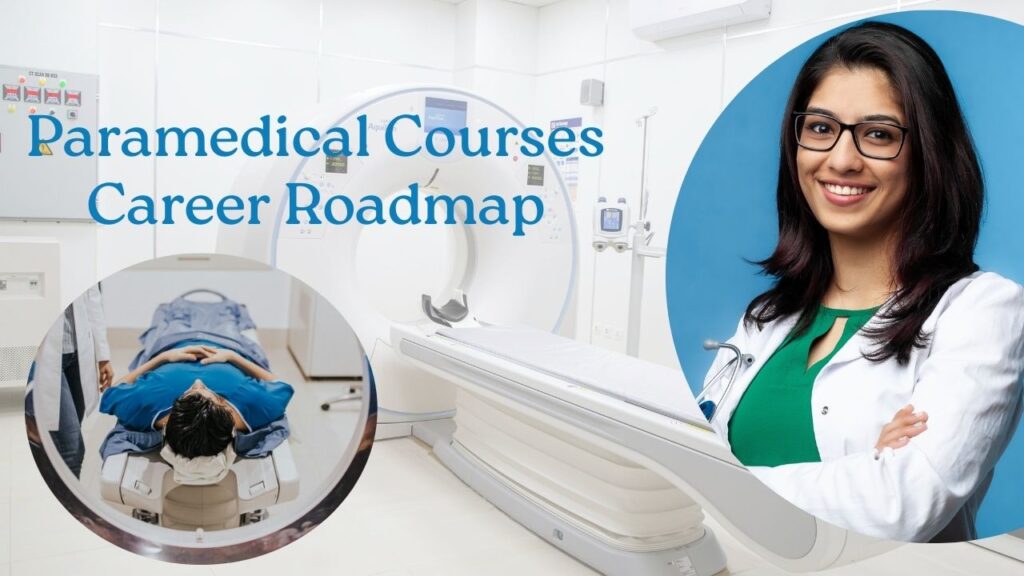
Paramedical Courses

The domain of paramedical sciences is an exciting path for students who have completed high school to explore the diverse aspects of the healthcare sector. In line with increasing need for trained personnel, Paramedical Courses Career Roadmap consist of specific training on diagnostics, emergency care, treatment and rehabilitation. 

These Paramedical Courses aim not only to provide technical knowledge but also to train students to overcome professional challenges in an ever-changing healthcare environment, which is the reason why this is such a popular career path for young aspirants.

Here, we provide a full-fledge career guide for all the high school graduates who aspire to establish a career in paramedical services in the near future. Here, we will discuss your eligibility, the course, different specializations, the procedure to move into the sector and a variety of attractive career options after you complete it. 

Why Choose a Paramedical Courses?

Types of paramedical jobs have also been included in the lists of healthcare occupations. What questions do you have about paramedics? They also play a vital role in critical diagnosis, emergency and outpatient treatment as well as in patient rehabilitation.Reasons to choose a job in paramedical science include: 

  • In high demand: Health care is growing. The reports state that the need for paramedical technicians will increase by 20-25% over the next few years, especially in the developing countries.
  • Endless Career Paths: There are endless career paths in paramedic including Emergency Medical Technician (EMT), Medical Laboratory Technologist, or taking a leap into new-age disciplines like telemedicine and health informatics.
  • Personal and Social Satisfaction: In direct patient care and its positive impact on society, the paramedical professionals have the greatest chance for both professional fulfillment and job security permanently. 

This has opened up a window of opportunity for high school graduates to make a career in the healthcare sector through paramedical courses. 

Eligibility and Requirements for High School Graduates

The path to a good paramedical career begins with the right academic background. For class 12 board takers, the online eligibility criteria for admission are as follows:

  • Educational qualifications: A high school diploma with science subjects like biology, chemistry and physics is mandatory. Many paramedical centers have the expectation that students will excel in those subjects because they are the basis of the more difficult material taught in further courses.
  • Basic Certifications:You can get some extra certifications like basic life support (BLS) or CPR Training which can help you stand out. These credentials not only prepare candidates for the hands-on practical aspects of healthcare, but also attest to their dedication to the field.
  • Entry Exams and Selection Process: A few courses may have an entrance exam or an aptitude test, and have an admission process that involves showing your enthusiasm for the science and health care.

These essential qualifications allow high school graduates to pursue a variety of Paramedical Courses, and so the door is opened to a multifaceted education. 

Read More:- RRB Group D Recruitment 2026 — Check Vacancy and Link

Courses and Specializations in the Paramedical Field

There are various types of Paramedical Courses that you can opt for—certificate and diploma courses to full degree courses. Theoretical as well as practical knowledge is imparted, so students gain a good understanding of what is required at workplaces in hospitals and other healthcare facilities. 

Below is a table with a brief summary of some of the specializations with the work they do and place of work: 

SpecializationRoleWork Settings
Medical Laboratory TechnologistBlood, Blood Fluids, Tissues Testing Diagnostic center, Hospitals, Research Facility
Radiology TechnicianX-rays, MRIs, CT scans using machinesRadiology Center
Emergency Medical Technician (EMT)Provide First-Aid in EmergencyER, Ambulance
PhysiotherapistEngage with Patients for Rehab and guide themRehabilitation Clinics and Hospitals
Anesthesia TechnologistAssisting with AnesthesiaOperation room
Other Roles (Optometrist, Dental Hygienist, Speech Therapist, Occupational Therapist)Patient Special CareMostly private clinics

This table is a sample of the multiple occupations which are available for the paramedical candidates but, all of them may vary in their complexity and challenges. The courses in these disciplines usually consist of lectures and laboratories and/or clinical rotations and or paid or unpaid work placements that provide students with hands-on experience required to work in their chosen field. 

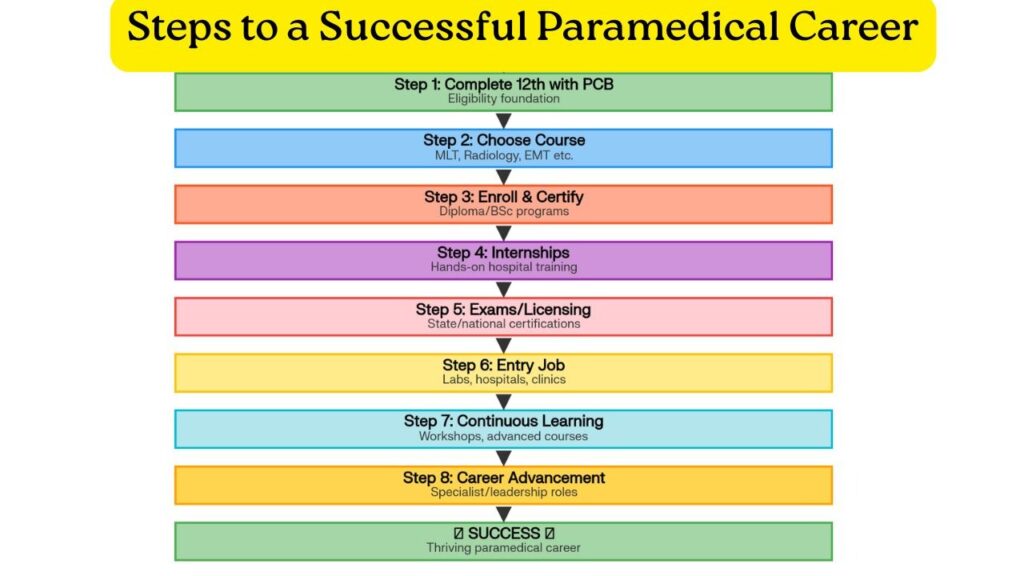
Steps to a Successful Paramedical Career

A step-by-step advance is necessary for a career in paramedical work. The given flowchart depicts the straightforward career opportunity for the regular high school pass outs: 

The flowchart of Paramedical Courses shows the process step by step: Begin with a solid academic foundation, apply practical experience, get certified, and then specialize or move into management. Each phase relies on the previous one to build depth and breadth of skills in the professionals. 

Career Opportunities in the Paramedical Courses

Paramedical professions have a wealth of options and opportunities that go well beyond the usual roles. After completing their education, students can work in multiple fields such as: 

  • Hospital Environments: A large portion of paramedical professionals employed in hospitals include them in the diagnosis, patient care, and testing.
  • Diagnostic and Imaging Centers: Medical Laboratory Technologist, Radiology Technician and other allied health professionals play an essential role in identifying and diagnosing countless diseases.
  • EMS: EMTs and Paramedics are needed now as much as ever in ambulance services and emergency departments, where making split-second decisions in a pump-driven environment is part of the job.
  • Trend Trailers: As telemedicine and health informatics matures, more jobs are likely to emerge for people focused on the convergence of healthcare and technology.
  • Own Business: Many practitioners have transitioned from practicing to owning their own clinic, laboratory, or home healthcare service, and some contribute to the field by working in their own business while enjoying the personal freedom associated with being your own boss. 

The positive growth in the healthcare industry along with technology enhancements is expected to create additional jobs, which makes it a promising field for people looking to build a career in this industry. 

Benefits of a Paramedical Career

Benefits of a career in paramedics are numerous and high school graduates can look forward to a great future (Check out some of the pros and cons about joining this career below):

  • Employment Security: Increasing Paramedic jobs healthcare needs worldwide ensure a stable and promising future for paramedical practitioners.
  • High Salary: The salaries for a number of these positions are competitive, commensurate with their unique skill set and important responsibilities.
  • Variety of Opportunities: You can find job opportunities to suit your interest, whether that be hands-on with patient care, supporting diagnostics or working with new technology.
  • Personal Satisfaction: A career in paramedicine not only is financially rewarding, but it can positively affect the lives of thousands of patients and the community at large.
  • Career Advancement: Many health services have in place a career progression (e.g. the Paramedic Practice Advancement Ladder) to include rewarding experience and ongoing professional development. 

Institutional Support for Aspiring Paramedical Professionals

There are many reputed colleges which offer good facilities and infrastructure for students who want to make a career in paramedical. For example:

  • Belarani Institute of Paramedical & Allied Sciences: The Training provided is more practical oriented by the experts with well experienced trainers and Placement Support to the students on completion of their Training.
  • LifeLine EMS: Nowhere is this more true than in Southern California where LifeLine EMS provides seamless EMT to Paramedic pathways, comprehensive training, mentorship programs and well-defined internal career promotion tracks.
  • Colleges like Foothill College and The George Washington University: The programs which run the gamut from short-term, intensive 11.5-month programs to long-term degree programs include classroom instruction, skills labs, clinical rotations and field internships designed to fully prepare students to meet the challenges of the profession.

These schools do more than train students in the latest tools and technology, they create cultures where a commitment to lifelong learning and professional success is ingrained. 

Conclusion

Paramedical Courses Career Roadmap: High school graduates opting for a profession in paramedical sciences not only ensure a bright and stable career but also play an important role in the advancement of global healthcare. With the right skills and commitment, as the industry continues to grow, there will be countless opportunities for those dedicated to pursuing a career path with endless potential.

So whether you’re interested in the accuracy of laboratory diagnostics, the life-saving measures of emergency services, or the professional practice of physiotherapy and more, there’s no doubt that your career in the paramedical sector will be fulfilling and rich with opportunity. Begin your journey today and discover the opportunity to have a real impact on the lives of many. 

Leave a Comment

Your email address will not be published. Required fields are marked *

CTET Exam 2026: Check Exam City, Notice, Exam Dates, Syllabus and Eligibility Information

CTET Exam 2026

The golden opportunity is announced for all the Teachers in India through CTET exam 2026. Organized by CBSE, this country level examination is for teaching jobs in government and private schools for Class 1 to 8. Candidates who apply in December 2025 for this examination should get ready for the exams.

Notification Details

Exam notice is released for CTET exam 2026, you can also get official notification on the official website for all the details about the exam. Candidates who filled the forms in November — 18 December 2025 can prepare themselves for the examinations in prior time to avoid panic at the end.

CTET February 2026 Exam Dates and Format 

FeatureDetails
Exam Date7 & 8 /February /2026 (Saturday & Sunday)
Mode of ExamOffline (Pen & Paper / OMR Sheet)
Number of Cities132 to 140 Cities Nationwide
Total PapersFor 1-5 Standard: Paper I;  For 6-8 standard: Paper II
Question Type150 Multiple Choice Questions 
Total Marks150 Marks per paper
Duration150 Minutes (2.5 Hours)
Negative MarkingNone
Language OptionsBilingual (Hindi/English) + 20 Regional Languages

Syllabus Overview

Paper 1 consists of questions from Child Development & Pedagogy, Language I & II, Science (for Science group), Social Studies (for Social studies group), Mathematics, and Environmental Studies, the emphasis is primarily on assessing the capability to teach at mali-ly school children. 

Paper 2 deals with Child Development, Language I and II and options such as Maths/Science or Social Studies for senior levels. 

Subjects stress pedagogy, theories of learning, and content of subjects based on guidelines of NCTE. 

Pass requirement is 60% for general (55% for reserved). 

Education and Age Limit Rule

  • There is no age limit here—everyone is welcome to apply, if you are Indian or you have Indian roots. 
  • For Paper 1, you should have a minimum of 50% in 10+2 with a 2-year Diploma in Elementary Education (D.El.Ed) or graduation with B.Ed. 
  • Paper 2: Graduation with minimum 50% marks and B.Ed or its equivalent like B.Ed (Special Education) is essential. . 
  • Reserved Category (SC/ST/OBC/PwD) Candidates can get Relaxations of 5% less in qualifying marks. 
  • Candidates who are appearing in the last year of their course are also eligible. 

CTET exam 2026 Admit Card Download Step-by-Step Instructions

  1. Go to the Important links section below and click on the Admit Card option.
  2. Enter your login details correctly to avoid interruptions and download your admit card
  3. Admit Card will appear 3-4 days before the exam, kindly wait for it.
  4. After the CTET admit card has been issued, get print out from here to carry a copy with you to the exam centre. 
Important Links
Exam NoticeClick Here
Date & City of examClick Here
Admit CardClick Here
Official WebsiteClick Here

Leave a Comment

Your email address will not be published. Required fields are marked *

HR Professional Courses: Get Complete Guide on Career Path, Salary & Growth

HR Professional Courses

If you’re curious about what it takes to be a Human Resources (HR) professional, you’re in the right place. Over the past 10 years, the HR Professional Courses has undergone significant transformation, shifting away from an administrative role to gaining importance and recognition as a strategic business partner in organizational culture, employee satisfaction and business performance. This all-in-one resource will take you through the Need to Knows of building a fulfilling HR career in India, whether you are a fresher exploring career options or a career changer seeking a meaningful direction. 

What Does an HR Professional Actually Do?

Before we get into courses and salaries, let’s demystify the day-to-day life of a HR professional. Despite the stereotype that human resources is just paperwork and policies, HR employees today wear many hats. You will participate in strategic talent acquisition to seek and recruit candidates aligned with company values and who will drive growth. You’ll design and deliver programs to upskill the employees, mentor junior staff, and help them grow their career within the company. 

On the compliance and policy side, you will be monitoring the company’s compliance with labour laws, conducting employee relations with tact, mediating disputes equitably and managing the full spectrum of employee life from hiring to offboarding. Compensation and benefits policies are your domain too: You develop the strategies, coordinate the performance reviews, and you can even assist with organizational development by working with your leaders on future staffing and succession planning. In today’s world of data and analytics, many HR professionals are also utilizing analytics to monitor indicators such as employee engagement, retention rates and hiring effectiveness to drive additional business improvements. 

The joy of human resources is that each day is different, with issues ranging from handling a difficult employee complaint to developing a creative new-hire program or spearheading an organization-wide change effort. 

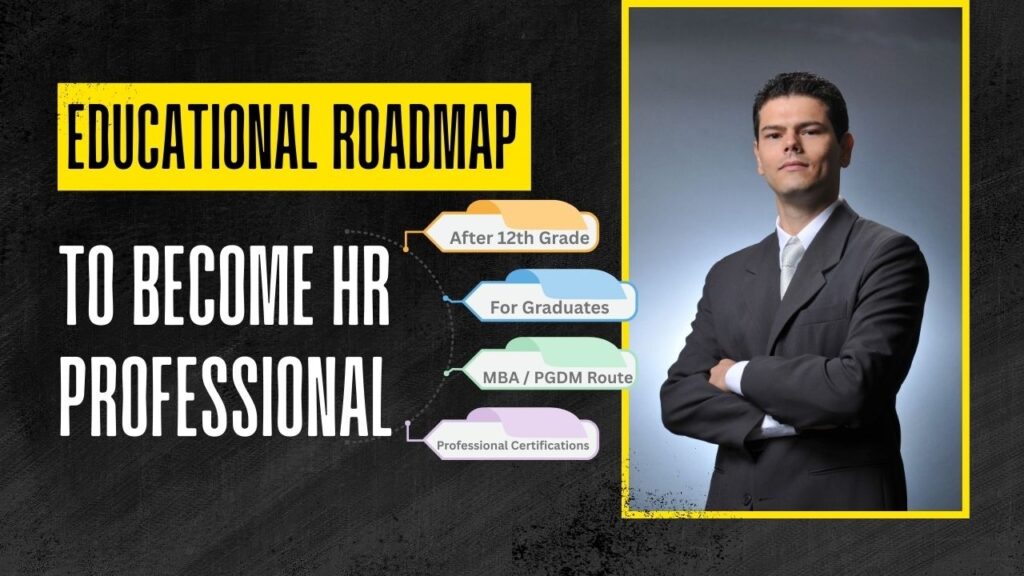
Educational Roadmap To Become HR Professional

HR career paths

The great thing about HR career paths is that there is no single “correct” path. To your education and current level of career aspirations, you can add several points of entry: 

After 12th Grade

If you have completed the high school you can go for the Diploma in Human Resource Management. These 1-3 year courses are available at a cost of Rs 50,000 to Rs 2,00,000 according to the classification of institution as a government or a private one. Alternatively, you can do 3 years of Bachelor’s degree (BBA, BA, BS) in HR or something related. Government College fee is goes from ₹1-8.5 lakhs and for private college fee is from ₹3-16.25 lakhs.The eligibility criterion is generally 50-60% in 12th class. 

For Graduates

If you already hold a bachelor’s degree (in any stream as per your undergraduate major), you can go forward for professional certificates or a post graduate diploma. A professional certificate of 6-12 months costs between ₹20,000 and ₹1,00,000, while a post graduate diploma for 1-2 years is valued at ₹50,000-₹1,20,000. These courses are great if you want to make a move into HR for then a full 2 year MBA. 

MBA / PGDM Route

If you are looking for an overall business education with focus on HR, a 2 year MBA or PGDM in Human Resources fees vary from ₹ 2-27 lakhs based on the tier of the college and the location. These programs on the repel need entrance exams as CAT, SNAP, MAT, or XAT. Top tier institutions such as IIM, XLRI have higher fee yet provide excellent placement package and networking. 

Professional Certifications

Professional certification is also valuable in addition to formal education. The popular certification include CHRG (Certified Human Resource Generalist) which has fees of ₹50,000-₹2, 00,000.

The CHRM (Certificate in Human Resource Management) is priced at ₹90,000-₹8,00,000 and the CHRP (Certified Human Resource Professional) costs ₹80,000-₹4, 00,000.Two globally-oriented credentials that also have value on an international basis are the SHRM-CP (Society for Human Resource Management Certified Professional) and the aPHR (Associate Professional in Human Resources) both of which are recognized by employers in many countries around the world.   

Eligibility Requirements You Need to Know

  • For Diploma Courses: You need to pass 12th grade exam with minimum 45% in aggregate.
  • ​For Bachelor’s Degrees: Obtain 50-60% in 12 grade; some colleges require entrance exams.
  • ​For M.B.A. Directly after 10+2: Achieved a minimum of 60% in your 12th grade exams; passed entrance exams such as CAT, MAT, SNAP, or XAT.
  • ​HR-Related Certifications: Many certifications such as SHRM-CP have prerequisites of at least 3 years of HR work experience in an HR function, whereas entry-level aPHR caters to HR novices or individuals beginning their journey in HR. 

Starting Salary For HR

Entry level HR professionals in India get a good pay as per market standard. An HR fresher gets a salary in the range of ₹15,000-₹30,000 per month, which comes around ₹3-5 LPA per annum. However, this might differ drastically depending on a few things such as: 

  • By Role: HR recruiters and coordinators normally begin with salaries of ₹18,000–₹26,000 per month and HR analysts with good technical skills can make ₹25,000–₹35,000 per month from the very start.
  • By Education: Tier-1 MBA (HR) pass-outs have high salary prospects of ₹30,000–₹40,000 per month and BBA or BA grad can make ₹18,000–₹25,000 per month.
  • By Industry: It is not always that an HR company gives you a chance but you can get IT, finance and e-commerce industries offer for an HR with starting pay of ₹28, 000 to ₹35, 000. 
  • By Location: Metrocities like Bengaluru and Delhi offer great pay to HR Professionals.  

Career Growth

Indian HR salaries have increased 24% from 2019, this is higher compared to IT sector’s 6.5% CAGR. This signals the rising level of strategic importance that HR has in organizations. 

Indian HR salaries

Career Progression Timeline

Start as an HR Assistant or Coordinator (0-2 years), then advance to HR Generalist or Specialist (2-10 years) in areas such as L&D Manager or Recruiter, then go to HR Manager or HR Business Partner (5-10 years) and subsequently to executive positions which include Director, Head of HR, or CHRO (10+ years).   

Salary Growth by Experience

A fresher can typically expect a starting salary of ₹3–5 LPA. As you gain more experience, this can be anywhere from ₹11-15 LPA at HR Manager level, ₹20-25 LPA in senior specialist roles and anywhere between ₹40-150+ LPA for CHRO of a large company. The steepest rise in salary is generally seen between 10 to 13 years of experience- whereby the median CTC varies around ₹38 LPA.   

Emerging High-Growth Specializations

For maximum growth, strategic HR roles are the way to go. HR Analytics Managers earn ₹40-60 LPA, Salary & Benefits Managers earn ₹28-42 LPA, and Diversity & Inclusion Managers earn close to ₹20 LPA. These positions are growing at 15-22% per year because they have a direct effect on business results. 

Conclusion

The Job growth of approximately 7% over the next ten years will add about 17,400 new jobs and is expected for the HR occupation. Instead of being automated out of existence like some admin jobs, strategic HR roles are increasingly precious. You get to work with people, solve truly complex organizational issues, shape company culture, and have a tangible impact on whether employees are happy at work.

​”The investment, be it ₹50,000 for a diploma or ₹20 lakhs for an MBA, gets returned fast in the form of a competitive pay package and strong career growth. More than who you’re working for, it is the work, financial and personal fulfilment you are creating.

First, decide on the HR professional Courses that best matches your current qualifications and your career timeline, learn core HR skills to get started, and don’t overlook the impact certifications can have in helping you stand out. 

Leave a Comment

Your email address will not be published. Required fields are marked *

Time Management Tips for Students and Government Job Aspirants

Time Management Tips

The reality is that most people don’t have a problem with time. They have a problem with managing time. The Time Management Tips for students and government job aspirants is important. For instance, two students may have identical 24 hours, the same syllabus, and the same exam date — yet end up in completely different places on result day. It’s because almost always how they spend their hours. 

This guide analyses the time management principle that really applies for us Indians — students in school & college, competitive exam aspirants for SSC, RRB, UPSC, banking and state-level, entrance exam students aiming for IIT, NEET, or law entrances, and working professionals attempting to study after holding a full day at the office. The circumstances may vary, but the fundamental discipline is one and the same. 

Why Time Management Tips Actually Matters 

It’s not that they don’t know “time management is important,” it’s just that no one actually has time to do it, not that they need it any more than the rest of us do. For exam candidates in particular, bad time management means not only less revision. It has three very real and very specific costs. 

First, it makes your syllabus look bloated. A topic that should take roughly three weeks gets stretched out over two months, not because it’s difficult, but because you’re learning in fragmented, distracted sessions rather than in concentrated blocks. 

Second, it kills your mock test performance. Candidates who are poor at managing their prep time tend to be procrastinators and pick up the easy topics first and push the difficult topics towards the end, so that by the time mocks begin, half the syllabus feels like a stranger under exam pressure. 

Third, and this is the one no one talks about nearly enough, it destroys your confidence. When you’re always feeling “behind,” you begin to question your own competence, even though the real problem was never intelligence — it was planning. 

Effective time management is not a matter of finding more hours in the day. It’s realizing that you actually already have the time, you just need to make it work. 

Time Management Tips for Students

Students who are balancing regular academics, tuition and assignments along with personal life also need a system which is practical and not a strict timetable copied from a top scorer’s Instagram post. 

Start with a weekly map, not a daily one. Daily to-do lists come crashing down as soon as one thing goes wrong — a pop quiz, a family gathering, feeling too tired. A weekly perspective allows you to reschedule your responsibilities without thinking you are having a bad day. Block out any non-negotiable obligations (class time, work, sleeping) and then plan your study periods around those. 

Use the “two-subject rule” for evenings. Attempting to cover every topic every day tends to result in none of them being covered very well. Choose two topics each night and dive in, cycling through the week. Depth outperforms breadth in terms of real retention. 

Protect your first hour after school. Most students spend the golden hour after school on their phones scrolling “just for ten minutes” which ends up being ninety. That first hour, when the day’s lessons were still fresh, was the best time for revision — not for new topics. 

Treat sleep as part of your study plan, not separate from it. Sleep deprivation to “make more time” is the most common error students make, and it backfires almost every time. Retention falls off a cliff with poor sleep, so those extra two hours often result in less learning than one focused hour on a well-rested brain. 

Time Management Tips for Government Job and Recruitment Exam Preparation

Preparation for government exams — SSC CGL, SSC JE, RRB NTPC, RRB ALP, Agniveer, UPSSSC, banking exams, state PCS has its own trap: it has a huge, fixed syllabus that remains more or less unchanged every year, making it very easy to remain stuck in a “preparation phase” without feeling ever ready. 

Reverse-engineer your timeline from the exam date, not from the syllabus. Most aspirants begin by telling themselves “I’ll finish RC, quant, then GK” without even assessing if that speed is even sustainable till the exam. Count backwards instead: How many weeks are there until the exam, how many subjects do you have to learn, and how many practice tests do you want to do before the D-day. This one change detects date problems three months in advance rather than three weeks before the test. 

Separate “learning time” from “practice time” clearly. Many candidates confuse these two processes — theory reading and question practice in one session and slow themselves down in both. Assign some fixed duration blocks solely for concept learning, and some solely for solving past year papers & mocks in a timed environment. They develop different abilities.

Make a weekly slot for current affairs you gear towards a level, don’t squash it in as a bit of leftover time. For exams like ssc, rrb,state level recruitment exam current affairs/general awareness is often pushed to “whenever i find time to study”,which is usually never. Settle for one or two brief daily sessions instead of waiting for free moments that never come. 

Mock tests deserve a full time slot, not a rushed one. Scheduling simulation the real exam length is as important as doing the questions. Your practice test should honor that 90 minutes of pressure since it should help simulate the real exam (and the review afterward) — not just the solving. 

Time Management Tips for Entrance Exam Aspirants

Entrance exams such as JEE, NEET, CLAT, and CUET operate on a different time scale as compared to the recruitment exams – they meld board exam stress with competitive exam intensity, and that too, in the same academic year. 

Sync your school syllabus and entrance syllabus instead of running two separate tracks. An enormous portion of time is wasted due to students studying the same subject chapter twice — once for boards, and once for the entrance exam in entirely separate sittings. Studying the two simultaneously, at entrance-level depth from day one, is months ahead of the full prep cycle. 

Rotate subjects daily instead of exam-cramming one at a time. These exams cover more than one subject at a time, so you have to keep your mind warmed up in all of them and not just be sharp on one subject and rusty on the others. A steady rotation — even if uneven in the number of hours per subject, keeps all the subjects “alive” in your mind. 

Track mistakes, not just completed chapters. Sorting out what you have achieved in the syllabus feels productive, but it doesn’t tell you information about what is actually going wrong. Keep a list of mistakes you make again and again when doing practice questions — that list is your revision material that will be the most efficient in the last month. 

Read More 👉 Data Science vs AI: Which Career Is Better?  

Time Management Tips for Working Professionals Preparing Alongside a Job

This may be the most difficult version of the problem since the constraint is not motivation — it’s literally hours in the day. Working professional-level test such as a government exam or a career-switch entrance exam does not have the luxury of a 8-hour study day. 

Accept the 90-minute reality and plan around it. The majority of working people truly have only about 60 to 120 minutes of concentrated work time in a day, divided between early morning and late evening. Struggling against this reality by aiming for 5 hours a day is just setting yourself up for failure and guilt. Schedule for the attainable during a weekday, and save the heavy-duty work for weekends — full-length mocks, madly difficult topics, revision marathons. 

Use commute and break time for low-effort, high-repetition tasks. Formulas, vocabulary, current affairs and short revision notes can easily be crammed into a commute or a lunch break. Save your truly fresh, high-powered hours — typically in the morning for the subjects that actually demand thinking of the deep kind. 

Don’t try to “catch up” by sacrificing entire weekends repeatedly. Burnout for working professionals generally results from this very pattern: lean weekdays, and then trying to fit a week’s worth of goals into Saturday and Sunday. It lasts for a couple of weeks, then crumbles. A sustainable pace beats a heroic one that quits come month three.  

Tell your workplace and family what you’re doing, even loosely. Candidates who do not share details of their preparation for the exam generally end up with more distractions during their study sessions as no one with whom they dwell or live is aware that those hours are sacrosanct. A modest notice - “I study from 6 to 7:30 every day” – cuts interruptions more effectively than any planner or app could. 

The One Habit That Ties All of This Together

Across students, government exam aspirants, entrance candidates, and working professionals, the single most useful habit is the same: reviewing the week, not just planning it. Most people plan on Sunday and then never look back until the next Sunday. Spending fifteen minutes reviewing what actually got done versus what was planned and being honest about why the gap happened is what turns a time management system from a wishlist into something that actually works over months of preparation.

Time management Tips for exams was never really about finding more hours. Every aspirant, regardless of which exam they’re preparing for, is working for the same 24 hours as everyone else. What separates a good result from a missed one is usually not effort — it’s whether those hours were spent on the right things, at the right time, consistently enough to matter.

Conclusion

Time management tips for students and government job aspirants is important for sustaining consistency in preparation for SSC, UPSC, RRB, banking, work, or JEE, NEET exams. Begin with attainable goals in mind, focus on the most important things, check in on your progress each week, and then rest appropriately. Little bit of betterment you make up every day adds together over months of training. 

Leave a Comment

Your email address will not be published. Required fields are marked *

HPSC Recruitment For PGT Post Graduate Teacher (PGT) Computer Science 2026

HPSC Recruitment

The HPSC Recruitment for 2026 Post Graduate teacher (PGT) Computer science Vacancy is out. There are a total of 1,672 posts and the process of application is going on. Those interested in this job can apply on-line from 16/February/2026 to 09/March/2026. Here is a golden opportunity  for all the aspirants who want to become a teacher in Haryana. 

Candidates should meet the eligibility criteria as per the HPSC to apply for the Teaching Posts. There is full information regarding eligibility, application fees, exam pattern and selection procedure in the notification. Applicants are advised to go through this notification carefully of HPSC Recruitment to ensure that they meet the eligibility criteria. 

Application Fees of HPSC Recruitment

CategoryFee
General/EWS/OBC₹1,000
SC/BC/PwD/Ex-Serviceman₹250
Females₹250
PH (Divyang)No fee

Schedule For Haryana HPSC PGT Teacher

EventDate
Notification Release5/February/2026
Online Application Start16/February/2026
Application Deadline9/March/2026 
Fee payment deadline9/March/2026

Education Requirement

QualificationDetails
M.Sc. Computer Science2-year regular course 
MCA3-year regular course
BE/B.Tech in Computer Science/ITFrom recognized university, minimum 55% aggregate 

Age Limit

CategoryAge Range
Minimum18 years
Maximum42 years (relaxations apply) 

Application Process

  1. View the Official Notification Or Apply Online: Interested candidates can apply online through the HPSC website.
  2. Now, go to the “Recruitment” section, check and click on the advertisement for PGT Computer Science.
  3. Select the option for Online Registration. Make sure you provide the correct number and DOB for registration in this step.
  4. Then, after registering for an account, you can complete your application form with the necessary details. It includes the details of educational qualification, ID, etc.
  5. Now, make the payment of the application fee as specified in the notification. You need to ensure that you do this step otherwise your application will not proceed further.
  6. After filling the form and making the payment of the fee, you may attach the required documents and submit the application. 

NOTE: Do keep a printout of your application form and payment slip for your reference. 

Read More:- BSc Dialysis Technology: Course Details, Eligibility, Salary & Career Scope

Selection Process and Exam Pattern 

The PGT selection procedure of HPSC Recruitment is meant to be a just and fair assessment through a simple two-tier exam system where your basic knowledge as well as expertise in the subject is tested.

1. Screening Test:

This is the initial level of screening. It combines your general knowledge with rudimentary knowledge of your subject to get rid of the non-serious and non-able candidates.

2. Subject Knowledge Test:

This is the main exam phase. It examines more deeply into your subject and examines what extent your conceptual clarity, understanding and hold of the subject is.

The selected candidates may be called for interview which will be concentrated for personality, communication/interactive skill and teaching aptitude after these written tests. 

Total Questions100 
Total Marks100 
Marking Scheme+1 mark per correct answer (0.25 negative marking in screening test) 

Syllabus for the HPSC PGT Exam

The HPSC PGT syllabus is very well crafted, as it is designed to impart teaching basics along with in-depth subject knowledge, guiding candidates to prepare in a comprehensive and methodical manner. It’s not just a test of what you know—it’s also a test of how well you know teaching.

General Topics (Applicable to all Subject)

These components are designed to focus on developing effective teaching practices:

Educational Psychology: Provides knowledge of how students learn, think, and grow, as well as some significant theories of learning and development.

Pedagogy: Practical teaching techniques, teaching in the classroom as well as learning to learn.

TLM (Teaching-Learning Materials): Related to production, use and management of TLM for efficient and effective classroom learning. 

Subject Specific Knowledge 

Each PGT subject has its own defined detailed syllabus by HPSC which is depth orientated and specialised.

For instance: For example, in Computer Science — Data structures, searching and sorting, algorithm analysis, graph theory getting solid computational and logical foundations.

English: A focus on reading comprehension, critical thinking and analysis of texts is effectively promoted by the syllabus. 

Conclusion

The application for HPSC Recruitment for PGT Computer Science 2026 is expected to be filled with aspiring candidates who wish to establish their career in the teaching field through this Haryana Public Service Commission Teaching jobs. With 1,672 vacancies dealing with a transparent selection process & a well-structured exam pattern, this recruitment serves as the best platform to enter into Haryana education. 

If you qualify for the eligibility and have the enthusiasm to teach, now is your time to take the plunge. Smart Preparation, Strategic Syllabus, brief Application Procedure & Get all Official Notifications. HPSC Recruitment 2026 can be the stepping stone for a bright and safe career in the Haryana’s Education System with hard work and integrity. 

GovUpdatewala is your trusted source for real-time updates on government exams and jobs in India. We provide verified info on SSC, UPSC, Banking, Railways, Defense, and Teaching exams. From syllabus and patterns to important dates and career tips — we support aspirants at every step.

Leave a Comment

Your email address will not be published. Required fields are marked *

Scroll to Top