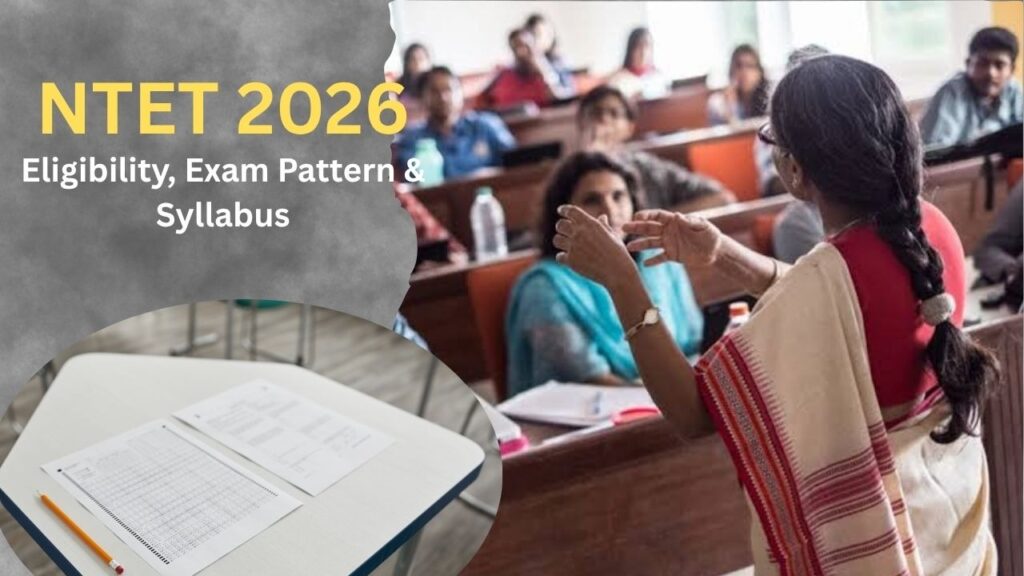
NTET 2026: Complete Information on Eligibility, Exam Pattern & Syllabus

NTET 2026

Do you want to develop the future of healthcare education in India? If you intend to apply for the post of Assistant Professor, Associate Professor or Professor in ISM or Homoeopathy, then the first step is to qualify the NTET 2026.

National Teachers Eligibility Test (NTET) for teaching in AYUSH Institutions (PCM/PCB) NCISM NCH has notified the conduct of National Teachers Eligibility Test (NTET) for educators in AYUSH colleges. From Minimum Eligibility Criteria, Exam Pattern, Syllabus, to preparation tips, this complete, evergreen guide dresses up all the essential aspects for NTET. 

Let us check out the details to start your academic career. 

What is the NTET 2026 Exam?

The National Teachers Eligibility Test (NTET) is a country level AYUSH teachers suitability test that aims at testing potential teaching capabilities, communication skills and knowledge of educational psychology of prospective AYUSH teachers. Be it Ayurveda, Unani, Siddha or Homoeopathy, the NTET 2026 is a mandatory requirement for teachers to keep abreast with contemporary teaching methods to train future doctors. It tests your teaching potential, not your medical know-how, which you have already been through a sufficient number of times in your postgraduate medical degree. 

NTET 2026 Eligibility Criteria

Cooperating with the rules of UPSC before applying to NTET is the right choice because you can waste your time if you’re not eligible for the examination. Whether it’s a document or age criteria, make sure you lie on the guidelines. NTET is solely for post graduates and final year students of certain medical and para-medical disciplines.

Here is the list for the minimum eligibility criteria:

Basic educational qualification: Must complete your masters in whatever field you have chosen. Graduated students can pursue any of these postgraduate degrees in Ayurveda, Unani, Siddha, Homoeopathy or allied areas to be eligible. 

Related fields: The candidates should have valid bachelor’s degree in AYUSH (BAMS, BUMS, BSMS, BHMS) withMaster of Public Health (MPH) or M.Sc in Anatomy, Physiology, Biochemistry orMicrobiology. 

Students in their final year of education can take the exam if you are progressing and have completed at least 30 months of your masters program. 

Career Stage: Only first time aspirants to the teaching profession (Assistant Professor) at the entry level are required to qualify in this exam. It is also necessary for higher teaching positions if the candidate is coming to teaching from clinical practice or research for a number of years and not for the first time. 

NTET Exam Pattern

FeatureDetails
Mode of ExaminationComputer-Based Test (CBT)
Total Duration120 Minutes (2 Hours)
Total Questions100
Question TypeMultiple Choice Questions (MCQs) with 4 options
Maximum Marks100 Marks
Marking Scheme+1 mark for every correct answer
Negative MarkingNo Negative Marking
Medium of PaperEnglish and Hindi
Difficulty Distribution40 Easy, 40 Medium, 20 Difficult questions

Detailed NTET 2026 Syllabus

The NTET 2026 syllabus is concerned only with teaching techniques, management of the class and human mind. It has been segmented into 8 modules. Here you go, this is What to Study:

Teaching & Training

  • Definition, aims, and levels of teaching (to teach at Memory Level, to teach at Understanding Level, to teach at Reflective Level).
  • Features of adult and youth learners (Educational, Social, Emotional, and Intellectual).
  • Contemporary methods of teaching, clinical teaching and teaching at the bedside.
  • VARK learning style (Visual, Aural, Reading/Writing in Learning, Kinesthetic). 

Communication

  • Definition, nature, types and barriers of communication.
  • Verbal vs non-verbal and intercultural communication.
  • Teacher-Learner and Doctor-Patient communication models.
  • Place of mass media in society and contemporary education.

Classroom Management

  • Maintaining studious engagement, and motivated learning in heterogeneous classrooms.
  • disciplinary management and discipline and positive, inclusive learning environments.
  • Work with real teaching environments such as OPDs, clinical labs, skill labs, and community outreach programs. 

Methods of Evaluation

  • The formative and summative assessment processes in learning.
  • Evaluation mechanisms under the CEC procedures.
  • Evaluation of clinical competence by OSCE (Objective Structured Clinical Exam), long case and short case.
  • Importance of organised feedback in learning.

Educational Technologies

  • The emergent and shifting terrain In medical education: ICT and its management.
  • The utilization of the Internet, e-mail and video conferencing in the contemporary teaching environment.
  • Knowledge of online teaching environments and MOOCs (e.g. SWAYAM and SWAYAMPRABHA). 

Educational Psychology

  • The cognitive development from childhood to adult with storing knowledge and learning through life experience by the human mind.
  • Psychological theories of relevance to teaching: Piaget’s cognitive development, Vygotsky’s sociocultural perspective, Bronfenbrenner’s social context.

Educational Andragogy 

  • Get to know Andragogy (the designated way and technique of teaching adult learners).
  • The principles, needs and characteristics of adult learning.
  • Building Skills for Self-Directed and Lifelong Learning.

Learning and Pedagogy

  • Fundamental notions and sequential procedures of pedagogical analysis.
  • Critical pedagogy and the development of particular learning outcomes.
  • A few guidelines to facilitate doing student-centred teaching-learning workflow effectively.
  • Eligibility Conditions and Validity of the Certificate

Examination Result: 

The candidates are required to obtain the minimum of 50% marks (without any rounding off) in the examination to be considered as “NTET Qualified”.

Certificate Validity: 

On clearing the NCTET, your NTET Eligibility certificate is valid for 10 years from the date of passing. If they fail to join teaching within the 10 years or take a career break of above 10 years, they would need to take up and clear the test once again to continue in teaching. 

Read More:- DECE-LE Admission Form 2026: Apply Online, Eligibility, Exam Date & Full Details

Tips to Crack the NTET 2026

Since teaching is what the NTET 2026 tests and not medical science, your prep plan needs to adjust slightly.

  • Learn the Pedagogy Fundamentals: To learn some of the main educational psychology concepts, read some of the key texts by Piaget, Vygotsky and from contemporary educational models.
  • Concentrate on Clinical Teaching: The usual pedagogy holds only tenuously when considering the OPD and in AYUSH teaching. Attending clinical, bed side and OPD teaching methods, they are very practical.
  • Manage Your Time: There are 100 questions in 120 minutes. Time is more than sufficient, but reading the lengthy scenario-based teaching method questions can be consuming. You will be building your reading speed with regular mock tests.
  • Take Advantage of the ‘No Negative Marking’ Rule: Have a guessing game plan for hard questions. Do not leave a question unanswered on your CBT screen.
  • Keep Abreast with Ed-Tech: Keep track of the latest digital education tools and steps taken by the Indian government in the education sector. 

Conclusion

The NRIMT or NTET 2026 is one of the excellent, forward-looking measures by NCISM & NCH to bring about a unified quality in the AYUSH education throughout the country. This idea of focusing on “how to teach” rather than “what to teach” makes future doctors be taught by qualified, caring and extremely capable teachers.

So with this article, get yourself prepared to land on the hot seat of the National Teachers Eligibility Test. Go in depth with your syllabus and learn to think like the psychology of adult learners and you are on your way to a very successful and satisfying career as a medical teacher.
Leave a Comment

Your email address will not be published. Required fields are marked *

BSc Radiology and Imaging Technology: Course, Eligibility, Fees & Career

BSc Radiology and Imaging Technology

BSc Radiology and Imaging Technology is a three-year program (with one-year internship that is mandatory in most of the institutions) that equips the students with the knowledge of medical imaging. The core science portion of the curriculum (focusing on physics, chemistry, and biology) is integrated with clinical imaging courses including: anatomy and pathology, radiographic procedures, sonography techniques, ultrasound physics, computed tomography (CT), magnetic resonance imaging (MRI), and radiation protection. 

The Bachelor of Science in Medical Radiology and Imaging Technology is becoming the backbone of diagnostic medicine today. This transformation is being driven by three coalescing factors: the full enforcement of National Commission for Allied and Healthcare Professions (NCAHP) Act 2021, the adoption of advanced artificial intelligence (AI) in diagnostic workflow, and the growing world-wide need for expert imaging technologists. 

The course is intended to prepare competent technologists (“radiographers”) who will be well versed in the operation of contemporary imaging equipment and have a solid foundation in the science of diagnostic radiology. 

Who is a Radiology Technologist?

The Radiology Technologist/Radiographer is a clinical scientist who holds at least a B.Sc. or M.Sc. degree in Radiography. They don’t just know how to run the machines, they understand the physics behind the formation of images, the physiological basis of pathology and the important issues surrounding patient safety and radiation protection. 

Why Has This Course Become Important in Diagnostics?

Imaging is at the heart of diagnostics, which are critical to contemporary medicine; more than 80% of hospital care relies on them. B.Sc. In addition to machinery handling the Technician holder needs to perform a large part in the day to day imaging workflow by the year 2026 MRIT graduates holders can expect to be involved with state of the Art technology like PET-MRI, SPECT-CT, Protocol Optimization, Post Processing, QC. 

Also this line job is work during recession. There is a long-term demand for skilled radiographers, particularly those trained in PACS and RIS, as the population of India grows older, lifestyle ailments become more common, and digital healthcare is enhanced under the ‘Ayushman Bharat Digital Mission’. 

Entrance Exams & Eligibility Details For Admission 

NEET UG 2026

National Eligibility cum Entrance Test (NEET UG) shall be the single entrance examination for admission to all the undergraduate allied and healthcare courses like BSc Radiology and Imaging Technology from the academic year 2026-27, according to NCAHP. 

AIIMS — 2026 Paramedical Entrance Test

Along with NEET, there is the AIIMS entrance Test which is held by AIIMS for paramedical courses leading to B.Sc. and M.Sc. The date of AIIMS B.Sc. Paramedical 2026 exam is tentatively on 30 May 2026. 

Note:- Candidates are requested to cross-check this with official notification as some calendars mention July for Examination, however May is the only projected window as per academic calendar.

How to apply:

  • Basic Registration: The schedules released in 2026 March/April. You can create a Registration ID.
  • Final Registration: Involves the generation of a Unique Code (RUC), payment of application fee, usually in May 2026.

Test Format: This computer-based test will consist of 90 multiple-choice questions (MCQs) on biology/mathematics, chemistry, and physics and will last for 90 minutes. Any wrong answer can take away ⅓ marks.

Admissions at JIPMER & PGIMER

JIPMER (Puducherry): B.Sc admissions The admissions to the B.Sc shall be The Allied Health Science at JIPMER (Puducherry) for the year 2026 will be on the basis of the NEET UG scores. JIPMER normally holds its own counseling for these seat(s). 

PGIMER (Chandigarh): The institution holds a separate CBE, these are usually conducted in the months of August/September. The process of application normally commences in June. 

State and Private University Tests

CUET (Common University Entrance Test): Central universities, such as Banaras Hindu University (BHU), utilise the CUET. The essential subject combination for Radiology is Physics, Chemistry, and Biology / Mathematics.

Manipal: in MAHE, Phase 1 is scheduled for April 2026 for admission test, and the next Phase 2 for May 2026. 

CMC Vellore: It is a tough Institute level CBT (Computer Based Test) followed by a Step-2 evaluation (Practical tests and interviews.) 

Eligibility Criteria 2026

Educational qualification: Should be passed class 12th board with physics, chemistry and biology (pcb) and English. Some of the institutes like AIIMS allow mathematics (pcm) for Radiology courses.

Minimum Marks: For the general/EWS/OBC category, it is 50% aggregate and for the SC/ST category, it is 45%.

Read More:- Supreme Court Law Clerk Recruitment 2026 Notification Details

List of Colleges For BSc Radiology and Imaging Technology

There are 140+ colleges around India that offer BSc Radiology and Imaging Technology without taking too much fees, especially in government colleges. If you have interest in lab technologies or figuring out body structures and making reports then take admission for securing your career in this field.

CollegeLocationApprox. FeesNotes 
AIIMS—New DelhiDelhi₹4,500Elite training facility as it is Top-ranked college
PGIMERChandigarh₹10,500Members are mindful and placements opportunities
JIPMERPuducherry₹94,000Excellent internships
AIIMS—RishikeshUttarakhand₹46,000High packages up to ₹24L
GMCHChandigarh₹39,000Affordable govt option
Integral UniversityLucknow, UP₹3.15LGood infra, local pick
Parul UniversityVadodara₹4.6LPrivate, placements ₹6L avg
SGT UniversityGurgaonVariesModern facilities

Academic Curriculum for the Course 

Theory and laboratory practice are included in the curriculum of BSc Radiology and Imaging Technology. The following topics were covered: Human anatomy/physiology, Imaging Physics, General Radiography, Ultrasound Imaging, CT Scanning, MRI Basics, Radiobiology and Radiation Protection, Digital Image Processing, and General Patient Care. 

BSc Radiology and Imaging Technology is a four year degree course. The first three years were spent attending didactic lectures, practical laboratory courses, and clinical observations. The fourth year is a required, full-time clinical internship during which the student serves as a student technologist at a hospital. 

PhaseDurationFocus Areas
Year 1Semesters 1-2Basic Medical Sciences, Communication Skills, Computer Basics
Year 2Semesters 3-4Core Radiography, Radiation Physics, Conventional Imaging
Year 3Semesters 5-6CT, MRI, USG, etc Interventional Radiology
Year 4Semesters 7-8Clinical Internship, Logbook, Project Work

The 2026 Curriculum is intended to establish progressively developing competencies. 

Year 1: The Foundation

The goal is to give the student a foundation in the human body and the hospital setting.

  • Human Anatomy & Physiology: This Is Not a “Fly By” Tour Students are required to study detailed osteology (bones) to learn how to position for radiographic.
  • They are taught body systems physiology to understand how to administer contrast media.
  • General Physics: The basic laws of physics applicable to the production of radiation.
  • Clinical Pathology & Biochemistry: Basics of blood tests (creatinine, urea) which are important prior to contrast administration.
  • English & Communication: Necessary to describe techniques to patients and to calm them. 

Year 2: The Core

Students access the realm of diagnostic imaging in BSc Radiology and Imaging Technology.

  • Radiation physics: The production of X-rays, their interaction with matter, and the design of X-ray tubes.
  • Radiographic Positioning, the science and art of positioning the patient to radiograph the body part (i.e. Towne’s view for skull, Skyline view for patella).
  • Darkroom to Digital: Darkrooms may be a thing of the past, but knowing the history is key. Emphasis is placed upon Computer Radiography (CR) and Direct Digital Radiography (DR) modalities.
  • Radiation Protection: Students learn the ALARA (As Low As Reasonably Achievable) concept along with shielding and dose limit for worker and patient. 

Year 3: The Advanced Frontier

This is the year when the high-end modalities that shape contemporary radiology are covered.

  • Computed Tomography (CT): CT Physics, generations of scanners, helical vs. axial scanning, and protocols for different body regions.
  • Magnetic Resonance Imaging (MRI): Principles of the complicated physics of nuclear magnetic resonance, safety issues related to ferromagnetic materials, and pulse sequences.
  • Ultrasonography (USG): Essentials of acoustics, transducer design, and the technologist’s function in the operation of the sonographer.
  • Interventional Radiology (IR): Orientation to the Cath Lab Sterility and Equipment utilized in Angiography.   
  • Radiation and Radioactivity in Nuclear Medicine Basics of PET-CT Handling of Radioisotopes including Technetium-99m. 

Year 4: The Internship

The purpose of the internship is to transition a student to a worker. Interns rotate through different departments, including X-ray, CT, MRI, Emergency and ICU. They need to keep a logbook of cases they have done, and are evaluated on their technical skills and dealing with patients. 

BSc Radiology and Imaging Technology Career Scope & Salary

Skilled radiographic professionals are sought after in India’s growing healthcare sector. Radiology technicians also work in public and private hospitals, diagnostic laboratories (pathology and imaging centres), government health schemes, private practitioners and emerging digital health platforms including teleradiology and artificial intelligence (AI) imaging start-ups. 

BSc Radiology and Imaging Technology

Clinical Roles

  • Radiologic Technologist: The typical baseline position. Duties are to perform x-rays, triage patients and maintain radiation safety .
  • CT Technologist: So, what’s the place in the hierarchy. Knowledge of cross-sectional anatomy and contrast administration is required.
  • MRI Technologist: A step up. MRI scanners are complicated, and patient safety (screening for metal) is critical. The technologists here typically make 20-30% more than a general radiographer.
  • IR Technologist: The Cath Lab Experience. In a stressful environment, high volume dealing with cardiac and vascular interventions. You’ve got to wear thick lead aprons for long hours – but when you’re done, you’re king and you’ve got money in your pocket.
  • Mammographer: Expert in breast imaging. Because of the sensitive nature of the exam, female technologists are preferred for this position. 

Sector & Role Wise Salary (2026)

RoleExperienceSectorApprox. Monthly Salary (INR)
Jr Technologist0-2 YearsPrivate sector Hospital Rs 18–25k
Jr Technologist0-2 YearsAIIMS/Govt (Contract)Rs 25–35k
Sr Technologist5+ YearsCorporate HospitalRs 45–60k
MRI Specialist3-5 YearsDiagnostic ChainRs 35–50k
Application Specialist2-5 YearsMedical Device Co.Rs 50–80k + other allowance
Govt. PermanentEntry LevelGovernmentRs 45–55k (Initial + Allowance)

Who is Ideal For this Course?

BSc Radiology and Imaging Technology course is for students who like science and technology and want to work in the health sector. The ideal candidate: is detail oriented, is able to follow protocols which are critical for safety, is comfortable using computers and complex machinery, and can interact with patients (explain procedures, position patients). A BSc radiology student should be well versed with biology and physics and should also be calm and responsible because any mistake in imaging can impact the diagnosis. 

Future Value of BSc Radiology and Imaging in Healthcare

In India’s upcoming healthcare scenario, BSc Radiology and Imaging Technology are a must-have. With the proliferation of private hospitals and diagnostic chains in Tier II/III cities, the need for imaging services is on the rise.

Technologies, such as AI-based image analysis, hybrid imaging (e.g. PET/CT), etc, indicate that the profession will continue to be hitech. So BSc (Hons) in Radiography graduates will play a vital role in connecting technology and patient care. The course produces practical professionals who can contribute immediately to hospitals’ diagnostic teams, which is critical in a country like India, where there is a shortage of doctors. 

Conclusion

In a day and age when technology and medicine are coming together closer than ever, the Radiology Technologist is at the controls of the medical world’s most powerful machines. For individuals who are detail-oriented, have a caring nature, and technical mind, BSc Radiology and Imaging Technology offers a fulfilling, stable and ever-changing career. 

Leave a Comment

Your email address will not be published. Required fields are marked *

CTET Exam 2026: Check Exam City, Notice, Exam Dates, Syllabus and Eligibility Information

CTET Exam 2026

The golden opportunity is announced for all the Teachers in India through CTET exam 2026. Organized by CBSE, this country level examination is for teaching jobs in government and private schools for Class 1 to 8. Candidates who apply in December 2025 for this examination should get ready for the exams.

Notification Details

Exam notice is released for CTET exam 2026, you can also get official notification on the official website for all the details about the exam. Candidates who filled the forms in November — 18 December 2025 can prepare themselves for the examinations in prior time to avoid panic at the end.

CTET February 2026 Exam Dates and Format 

FeatureDetails
Exam Date7 & 8 /February /2026 (Saturday & Sunday)
Mode of ExamOffline (Pen & Paper / OMR Sheet)
Number of Cities132 to 140 Cities Nationwide
Total PapersFor 1-5 Standard: Paper I;  For 6-8 standard: Paper II
Question Type150 Multiple Choice Questions 
Total Marks150 Marks per paper
Duration150 Minutes (2.5 Hours)
Negative MarkingNone
Language OptionsBilingual (Hindi/English) + 20 Regional Languages

Syllabus Overview

Paper 1 consists of questions from Child Development & Pedagogy, Language I & II, Science (for Science group), Social Studies (for Social studies group), Mathematics, and Environmental Studies, the emphasis is primarily on assessing the capability to teach at mali-ly school children. 

Paper 2 deals with Child Development, Language I and II and options such as Maths/Science or Social Studies for senior levels. 

Subjects stress pedagogy, theories of learning, and content of subjects based on guidelines of NCTE. 

Pass requirement is 60% for general (55% for reserved). 

Education and Age Limit Rule

  • There is no age limit here—everyone is welcome to apply, if you are Indian or you have Indian roots. 
  • For Paper 1, you should have a minimum of 50% in 10+2 with a 2-year Diploma in Elementary Education (D.El.Ed) or graduation with B.Ed. 
  • Paper 2: Graduation with minimum 50% marks and B.Ed or its equivalent like B.Ed (Special Education) is essential. . 
  • Reserved Category (SC/ST/OBC/PwD) Candidates can get Relaxations of 5% less in qualifying marks. 
  • Candidates who are appearing in the last year of their course are also eligible. 

CTET exam 2026 Admit Card Download Step-by-Step Instructions

  1. Go to the Important links section below and click on the Admit Card option.
  2. Enter your login details correctly to avoid interruptions and download your admit card
  3. Admit Card will appear 3-4 days before the exam, kindly wait for it.
  4. After the CTET admit card has been issued, get print out from here to carry a copy with you to the exam centre. 
Important Links
Exam NoticeClick Here
Date & City of examClick Here
Admit CardClick Here
Official WebsiteClick Here

Leave a Comment

Your email address will not be published. Required fields are marked *

BSc Emergency and Trauma Care: Get Trained to Serve in Emergencies

BSc Emergency and Trauma Care

In the intense hospital setting, there is a place where seconds count and the word “routine” hasn’t been uttered in years. It’s the Emergency Room (ER) after BSc Emergency and Trauma Care. Although the faces with which we most commonly associate life saving are those of the doctors and nurses, there is an equally specialised group of para-professionals working with them: Emergency and Trauma Care Technologists.

Requirement for BSc Emergency and Trauma Care

A candidate must possess 10+2 in Science (PCMB/PCMC) & it’s important to know that some colleges asked for a 45%- 55% minimum score. This course prepares students to pursue a career on an emergency basis like when an urgent requirement of a doctor arise in an emergency room, on an operating table etc.

English is normally compulsory subject in class 12th and you should be minimum of 17 years of age at the time of the admission, medical fitness certificate is also required at times. 

Duration and Course Subjects

The 3-­4-year BSc Emergency and Trauma Care course enables students with the necessary skills and knowledge to deliver care to the traumatized and the emergency patient. The content sequentially increases in complexity starting with the basic sciences and advancing to clinical interventions.

The following topics are repeatedly addressed:

Basic Sciences

  • Human Anatomy 
  • Physiology 
  • Biochemistry 
  • Pathology 
  • Microbiology

Emergency Care 

  • Emergency Medical Services 
  • Pre-hospital Trauma Life Support 
  • CPR & Airway Management 
  • Hemorrhage Control

Clinical Emergencies 

  • Medical Emergencies 
  • Trauma & Surgical Emergencies 
  • Pediatric and Special Population Emergencies 
  • Critical Care Technology

The program is focused on theoretical and clinical training, designed to equip students to manage high-stakes trauma environments with both assurance and thoroughness. 

Semester Breakdown

SemesterCore Subjects
1st/2ndAnatomy, Physiology, Biochemistry, Intro to EMS, Pharmacology
3rd/4thMedical Emergencies, Trauma Emergencies, Pathology, Biostatistics
5th/6thDisaster Management, Patient Monitoring, Advanced Life Support

Mail Skill You Must Have

While the “BSc” part of the title sounds academic, the job is deeply emotional. You will become a patient’s life-saver on the worst day of their life.

Empathy in the moment is a talent they don’t always rate you on, but it’s the most important one you’ll have. You’re not just treating a body but also confronting the panic and worry and sorrow of the people surrounding it. Those relatives, too, are often in over their heads, and those patients are frightened. You’ve got to be a genuinely kindhearted person to remain calm, tell them everything will be all right and comfort them while you are doing something like firing up a ventilator.  

Career Goal 

The demand for graduates from the BSc Emergency and Trauma Care course continues to grow within the health care industry, with opportunities for employment with both public and private providers, transport­ focused roles in emergency situations, and roles such as the immediate stabilization of patients. It is one of the best courses which open your professional way with good packages because experience in this field has many different responsibilities. 

Roles & Responsibility 

RoleResponsibility
Trauma TechnicianTake part in Trauma Cases with surgeons and ER doctors to stand as a pillar on saving lives.
Emergency Medical Technician (EMT)Quick Response to save life’s on the spot emergencies techniques. 
Flight ParamedicWorking on air ambulances or rescue helicopters for remote locations.
Critical Care AssistantManaging patients in the ICU who require constant monitoring.
Disaster Management OfficerWorking with Social Work Organisations like NGOs or governments to plan responses to natural disasters.

Top Employers

SectorExamples
HospitalsApollo, Fortis, Max Healthcare, Medanta
Ambulance ServicesGVK EMRI, Air Ambulance
Government/OtherIndian Red Cross, Fire Department Emergencies, Disaster Organizations

Jobs Salary After BSc Emergency & Trauma Care

The BSc Emergency and Trauma Care salary in India varies as per the job position, skills, experience, work location (metros like Delhi, Bangalore provide higher salary) and type of the company. For 3 to 5 years of experience, the salary can be 5 — 8 lakhs per year along with allowances for shifts or overtime. 

Salary by Role

RoleFresher Salary (₹/month)Experienced salary in LPA
Emergency Medical Technician20,000-40,0003-7
Trauma Care Technician25,000-50,0005-8
ER Coordinator30,000-55,0005-9
Disaster Specialist40,000-70,0006-10

How to Get Government Jobs After This Degree

For government job after BSc Emergency and Trauma Care, concentrate on the paramedical recruitment in state health departments, NHM, and hospitals as these are the very places that consider this as a preferred degree for EMT and trauma-related Jobs.

Preparation includes watching portals, acquiring certifications such as BLS/ACLS, and passing written tests or interviews. 

Steps to make a career in government healthcare or allied services: 

  1. Get updated: Get into the habit of visiting the official websites regularly i.e. NHM, State Health Society, ESIC, AIIMS, and 108 Ambulance Services. These sites raise alerts for complainants for job notification, recruitment-related news and other information which might help you get one step closer to your dream job.
  2. Boost your profile: Having professional certification can do wonders in polishing up your resume. Courses like BLS (Basic Life Support), ACLS (Advanced Cardiovascular Life Support) and ITLS (International Trauma Life Support) bring weightage to your profile. Along with these certifications, relevant field experience 1-2 years will make a great difference in your selection. 
  3. Apply and Prepare: Apply online for exams that generally comprise multiple choice questions (MCQs) on anatomy, emergency care, and general information. 
RecruiterRoles7th CPC Salary
NHM/State Health Societies EMT/ParamedicRs 25500—81100 at Level-4 Rs 35400—1,12,400 at Level-6 
AIIMS/Government Hospitals and ESICTrauma Technician, ER AssistantRs 25000—50,000 entry role
Armed Forces/Disaster BodiesAmbulance TechnicianVaries by level

The Future of Emergency Care

As medicine becomes more specialized, the need for full-time trauma providers is growing exponentially. We are going from “general” care to “specialized,” rapid response. With the advent of smart ambulances and telemedicine, an BSc Emergency and Trauma Care alumnus is no longer a mere “aide”, they are a high-tech clinician leading the cutting-edge of medicine.

 Read more: MPESB Group 5 Paramedical Recruitment 2026

Conclusion

A BSc Emergency and Trauma Care is not just an academic qualification; it is a key which opens the door to the human condition. It is a profession for the strong, the fast-thinking and the kind. If you’re looking for a career in which you’ll keep on learning, and where you can tell people, “You really needed me today,” this is the road for you. 

Leave a Comment

Your email address will not be published. Required fields are marked *

HPSC Recruitment For PGT Post Graduate Teacher (PGT) Computer Science 2026

HPSC Recruitment

The HPSC Recruitment for 2026 Post Graduate teacher (PGT) Computer science Vacancy is out. There are a total of 1,672 posts and the process of application is going on. Those interested in this job can apply on-line from 16/February/2026 to 09/March/2026. Here is a golden opportunity  for all the aspirants who want to become a teacher in Haryana. 

Candidates should meet the eligibility criteria as per the HPSC to apply for the Teaching Posts. There is full information regarding eligibility, application fees, exam pattern and selection procedure in the notification. Applicants are advised to go through this notification carefully of HPSC Recruitment to ensure that they meet the eligibility criteria. 

Application Fees of HPSC Recruitment

CategoryFee
General/EWS/OBC₹1,000
SC/BC/PwD/Ex-Serviceman₹250
Females₹250
PH (Divyang)No fee

Schedule For Haryana HPSC PGT Teacher

EventDate
Notification Release5/February/2026
Online Application Start16/February/2026
Application Deadline9/March/2026 
Fee payment deadline9/March/2026

Education Requirement

QualificationDetails
M.Sc. Computer Science2-year regular course 
MCA3-year regular course
BE/B.Tech in Computer Science/ITFrom recognized university, minimum 55% aggregate 

Age Limit

CategoryAge Range
Minimum18 years
Maximum42 years (relaxations apply) 

Application Process

  1. View the Official Notification Or Apply Online: Interested candidates can apply online through the HPSC website.
  2. Now, go to the “Recruitment” section, check and click on the advertisement for PGT Computer Science.
  3. Select the option for Online Registration. Make sure you provide the correct number and DOB for registration in this step.
  4. Then, after registering for an account, you can complete your application form with the necessary details. It includes the details of educational qualification, ID, etc.
  5. Now, make the payment of the application fee as specified in the notification. You need to ensure that you do this step otherwise your application will not proceed further.
  6. After filling the form and making the payment of the fee, you may attach the required documents and submit the application. 

NOTE: Do keep a printout of your application form and payment slip for your reference. 

Read More:- BSc Dialysis Technology: Course Details, Eligibility, Salary & Career Scope

Selection Process and Exam Pattern 

The PGT selection procedure of HPSC Recruitment is meant to be a just and fair assessment through a simple two-tier exam system where your basic knowledge as well as expertise in the subject is tested.

1. Screening Test:

This is the initial level of screening. It combines your general knowledge with rudimentary knowledge of your subject to get rid of the non-serious and non-able candidates.

2. Subject Knowledge Test:

This is the main exam phase. It examines more deeply into your subject and examines what extent your conceptual clarity, understanding and hold of the subject is.

The selected candidates may be called for interview which will be concentrated for personality, communication/interactive skill and teaching aptitude after these written tests. 

Total Questions100 
Total Marks100 
Marking Scheme+1 mark per correct answer (0.25 negative marking in screening test) 

Syllabus for the HPSC PGT Exam

The HPSC PGT syllabus is very well crafted, as it is designed to impart teaching basics along with in-depth subject knowledge, guiding candidates to prepare in a comprehensive and methodical manner. It’s not just a test of what you know—it’s also a test of how well you know teaching.

General Topics (Applicable to all Subject)

These components are designed to focus on developing effective teaching practices:

Educational Psychology: Provides knowledge of how students learn, think, and grow, as well as some significant theories of learning and development.

Pedagogy: Practical teaching techniques, teaching in the classroom as well as learning to learn.

TLM (Teaching-Learning Materials): Related to production, use and management of TLM for efficient and effective classroom learning. 

Subject Specific Knowledge 

Each PGT subject has its own defined detailed syllabus by HPSC which is depth orientated and specialised.

For instance: For example, in Computer Science — Data structures, searching and sorting, algorithm analysis, graph theory getting solid computational and logical foundations.

English: A focus on reading comprehension, critical thinking and analysis of texts is effectively promoted by the syllabus. 

Conclusion

The application for HPSC Recruitment for PGT Computer Science 2026 is expected to be filled with aspiring candidates who wish to establish their career in the teaching field through this Haryana Public Service Commission Teaching jobs. With 1,672 vacancies dealing with a transparent selection process & a well-structured exam pattern, this recruitment serves as the best platform to enter into Haryana education. 

If you qualify for the eligibility and have the enthusiasm to teach, now is your time to take the plunge. Smart Preparation, Strategic Syllabus, brief Application Procedure & Get all Official Notifications. HPSC Recruitment 2026 can be the stepping stone for a bright and safe career in the Haryana’s Education System with hard work and integrity. 

GovUpdatewala is your trusted source for real-time updates on government exams and jobs in India. We provide verified info on SSC, UPSC, Banking, Railways, Defense, and Teaching exams. From syllabus and patterns to important dates and career tips — we support aspirants at every step.

Leave a Comment

Your email address will not be published. Required fields are marked *

Supreme Court Law Clerk Recruitment 2026 Notification Details

Supreme Court Law Clerk Recruitment 2026

Supreme Court Law Clerk Recruitment 2026 of India announced notification released on 20 January 2026 and opened the portal to receive applications for Law Clerk-cum-Research Associate (LCRA) for the year 2026, marking a fantastic opportunity for budding legal minds. Supreme Court Law Clerk Recruitment is a paid position with 200 seats available and the stipend amounting to ₹80,000 per month, making it a prestigious and fulfilling experience.

The applications started on February 7, 2026 and should be sent through the official website of the Supreme Court of India (sci.gov.in). Interested candidates are advised to send their application before the last date 10th March 2026. This is an extraordinary opportunity to acquire priceless experience in the legal industry. 

Date Schedule for Supreme Court Law Clerk Recruitment

PhaseDate/Details
Notification20/January/2026
Application Window20/January —- 7/Feb 
Exam10/March/2026 
InterviewsJune/2026
JoiningAugust/2026

Quick Eligibility Check

  • You can apply if you are a fresh LLB graduate from the 3-year or 5-year program with a cumulative score of 55% across all years and have a degree from a University/Institute recognized by NLU or from the top-10 NIRF ranked law schools (2020-2024).
  • In the academic department, the standard is well defined and just: you require 55% marks in graduation minimum, with relaxation to 50% for SC/ST candidates. 
  • Age: As on 01/08/2026 Candidate should be under 32 years and above 20 years.
  • There’s no experience required but you have to go full-time no side hustles.

Its merit-based magic: shortlisting will be on the basis of a written exam (objective + subjective on law/constitution) followed by an interview for the toppers. Question on constitutional, IPC, current affairs. 

Read More👉 Allied Medical Courses Roadmap 2026: Eligibility, NEET, Courses & Career Scope

Selection Process

Candidates have to fill out the application form to access the admit card for the examination. Follow the three phase selection process for Law Clerk Recruitment 2026, online MCQ test, Written test then prepare yourself for interview. 

How to Fill Application and Fees

  1. You need to register yourself on the official website of SCI.
  2. Login with your credential to fill the entire details required to complete the form and check again.
  3. Submit Rs. 750 via online payment to complete the process 
  4. Print out your form for offline reference.
Useful Links
Download NotificationClick Here
Apply NowClick Here
Official WebsiteClick Here

Leave a Comment

Your email address will not be published. Required fields are marked *

Scroll to Top