Bihar Panchayati Raj Technical Assistant Recruitment starts from 26 May 2025 in Bihar. Candidates who are willing to join a government job on a Technical Assistant post, this is the best time to take a chance for your career. There are a large number of candidates who wish to apply for this position as this is a golden opportunity for them. The department has announced the recruitment process for 2025 to fill the vacancies in the Technical Assistant Post.
Highlights of the Bihar Panchayati Raj Technical Assistant Recruitment
Exam Conducting Body
Bihar Panchayati Raj Department
Post Name
Technical Assistant
Job Location
Bihar
Bihar Panchayati Raj Technical Assistant
It is conducted to recruit for the Technical Assistant Post, especially in Bihar. Interested candidates can apply online to ensure their stable career.
The total number of vacancies is 942 for the Technical Assistant post. This post requires a diploma in Civil Engineering from any recognized university. Apply for this post if you wish to build a stable career and secure your future that will give you lifetime joy. Bihar Panchayati Raj Technical Assistant Recruitment starts on 26 May 2025 and ends on 25 June 2025. Apply online to grab the opportunity in this government job as soon as possible. Kindly check the all details on the official website mentioned in this article for documents required and Form filing or you can directly apply from the link provided in the article.
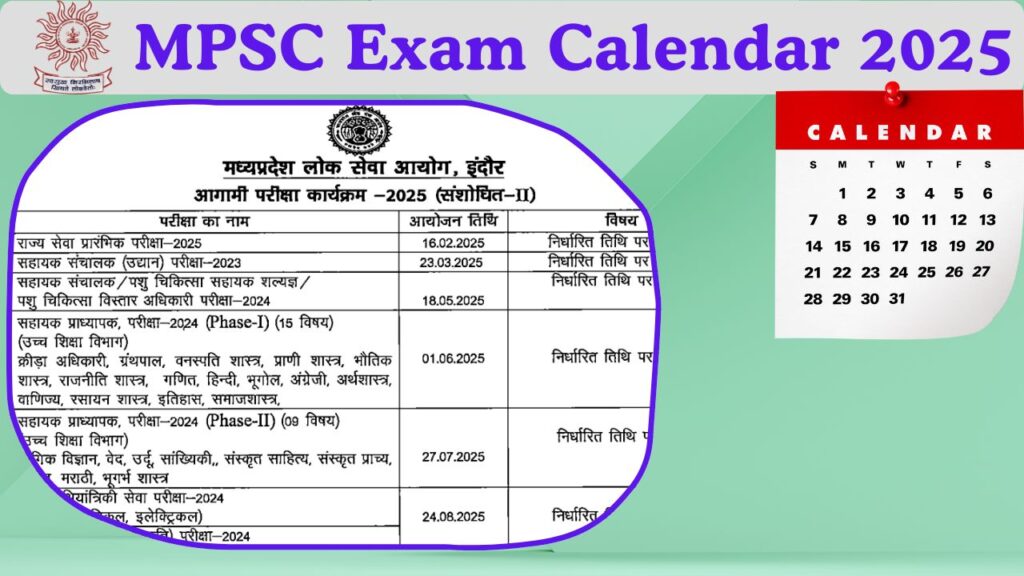
Maharashtra Public Service Commission is an organization to proceed recruitment for various posts through competitive exams. News The MHRD has released details regarding the examination dates, pattern, eligibility, fees and selection process. The schedule incorporates also approved modifications and updates to the latest developments. This is the most important tool for aspirants who are going for MPSC exams to prepare and aware about updates.
Major MPSC Exams Calendar For Early Preparations
MPSC Rajyaseva Exam
Notification Release
18th/March/2025
Application
28/March—17/April/2025
Prelims Exam Date
9th/November/2025
Vacancies
385
Posts
State Civil Services, Forest Services, Civil Engineering Services
Mains Exam
29th/March—26th/April/2026
Result
July/2026
MPSC Group B Combined Services Exam
Notification Release
29/July/2025
Application
1—21/August/2025
Prelims Exam Date
21st/December/2025
Vacancies
282
Mains Exam
17th/May/2026
MPSC Group C Combined Services Exam
Notification Release
Last of the 2024
Prelims Exam Date
1/June/2025
Result
October/2025
Mains Exam
29/June/2025
Other Major MPSC Exams
Forest Service Main
5—9/May/2026
Civil & Agricultural Main Exam 2025
16th/May/2026
Group C Combined Prelims
4th/January/2026
Group C Combined Main
7/June/2026
Eligibility For MPSC Exams
The educational standard is usually graduation for most of the examinations.
The age limit is 18 to 38 years as general, but may change for post to post and reserved category. For more details on age relaxation, criteria, please refer to the official notification.
The process of MPSC exams is 3 tiered for all major exams.
Prelims: Objective/MCQs papers, on qualifying basis Rajyaseva, 2 papers (GS & Aptitude/Language), Group B & C as per notification.
Mains: Several papers of different subjects, including a language paper, a general studies paper and papers on the candidate’s discipline. Marks obtained here are useful for final merit.
Interview and Document Verification: After qualifying in Mains, candidates are called for Interview and Document Verification.
Guide to Download Calendar MPSC Exam Calendar 2025
If you’re a hopeful civil servant or job seeker looking for government employment, consider the SSC Exam Calendar 2026–27 as your BFF. It’s your personal schedule that tells you when to study, when to apply, and when to take your exams. The Staff Selection Commission has been released by the Staff Selection Commission 8th January 2026 we’ll decipher every minute detail for you in the simplest way.
The SSC Calendar acts as your guide-walking tool on your government job journey, It informs you about the dates for release of notifications, when you can submit the online applications, the last date to submit applications, and most importantly, the date on which you have to appear in exams. The government issues over 80,000 vacancies every year at different levels (10th pass, 12th pass, and graduation), so missing even one crucial date could mean the loss of a golden opportunity.
SSC Exam Calendar 2026: Notifications Come Out?
Different SSC exams have different dates. It began in March 2026 exams like Combined Graduate Level (CGL), Junior Engineer (JE), selection post phase-XIV release their notifications. If you’re applying to these, watch for March 2026.
In April, there will be notifications for other popular exams such as the Combined Higher Secondary (CHSL), Stenographer, and Junior Hindi Translators (JHT).
Aspirants who are looking for Multi-Tasking (Non-Technical) Staff and Havaldar posts should wait for June 2026. In the meantime, there will be a Notification for Sub-Inspector (SI) Delhi Policy/CF in May 2026.
Complete SSC Exam Schedule
Exam Name
Notification Month
Application Deadline
JSA/LDC Grade Limited Departmental Exam, 2025
16/March/2026
7/April/2026
SSC CGL 2026
March/2026
April/2026
Junior Engineer—JE
March/2026
April/2026
Selection Post Phase-XIV 2026
March/2026
April/2026
SSC CHSL
April/2026
May/2026
SSC Stenographer Grade C & D
April/2026
May/2026
SSC Combined Hindi Translators
April/2026
May/2026
SSC—MTS & Havaldar
June/2026
July/2026
SSC Central Police Organisation
May/2026
June/2026
SSC GD Constable
September/2026
October/2026
When Will the SSC Exams 2026 Actually Happen?
The CGL exam, which comes under the most desired post in the SSC, will be held from May to June 2026. For those seeking to begin an engineering career, the Junior Engineer test is also conducted in May to June 2026. Candidates looking at CHSL (Combined Higher Secondary) level may expect it around July – September 2026.
The recruitment for Constables in CAPFs will surely be at the end, Exam dates in January to March 2027, so that will be among the last exams in this series.
Stenographer and Hindi Translator (For words and typing speed per minute refer point 8 of ADD2) are also scheduled on August to September 2026. The Multi-Tasking Staff and Havaldar posts, which students eagerly flock towards, will hold examinations between September to November 2026. And if you are eyeing the Sub-Inspector post in Delhi Police or CAPF, you should be ready for October to November 2026.
There are a few exams în progress or are about to commence. The Delhi Police Head Constable (Ministerial) exam was conducted between 7th to 12th January 2026 and Delhi Police AWO/TPO exam was held from 15th to 22nd January 2026. The eagerly awaited SSC CGL Tier-II exam was held on 18 and 19 January, 2026. Starting from 4th February 2026, the SSC MTS exam is now in progress and recruitment for the post of SSC GD Constable has also begun from 23rd February 2026.
Delhi Police Head Constable
07—12/January/2026
Delhi Police AWO/TPO
15—22/January/2026
SSC CGL Tier-II
18 and 19/January/2026
SSC MTS
04 / February / 2026
SSC GD Constable
23 / February / 2026
Application Process Date For SSC Exams
Usually, there is about a one month period from the release date of the notification to the last date for submitting an application. So when the notification comes out, don’t procrastinate! Register immediately, these deadlines are firm and you won’t get extensions because you forgot. Mark those days on your calendar, set your phone alarms and be sure to send before time runs out.
Conclusion
The SSC Exam Calendar 2026 – 2027 is not only a timetable, it is your strategic planning guide. As there are many examinations conducted in a year, you can get a number of chances to get a dream government job. Maintain your organization and concentration and keep in mind that Every successful SSC aspirant was a Calendar-junkie. Take it along with you everywhere and success will be waiting for you. The official schedule can be downloaded from the SSC website at ( ssc.gov.in ) for more information.
Candidates can check the DFCCIL Answer Key 2025 on the official website of the Dedicated Freight Corridor Corporation of India Limited and raise an objection before the result. The DFCCIL Answer Key uploaded on the official website on 18 July 2025. The portal will open till 22 July 2025, download the Answer Key for MTS, Junior Manager, and Executive recruitment exam.
Candidates can download the answer key 2025 by login on the official website. You can find the direct login link in the Links Section of the article.
Post Name
Multi-Tasking Staff, Executive, Junior Manager
Exam Conducting Body
Dedicated Freight Corridor Corporation of India Limited
Click on the official website link to redirect on DFCCIL official website.
Click on Log in, the page will appear, enter your ID and Password.
Submit to log in with your account, the Answer Keywill appear on the screen.
Download the answer keyand match your responses.
Raise Objection for DFCCIL Answer Key
If you find any error, you can raise an objection only if you can prove the right answer with reliable sources or proof. You can raise an objection till the last date after that the final answer will be declared and no objection will be raised after that. The result will be declared after the objection has been reviewed.
TheBoard of Technical Education Uttar Pradesh has released the 2025 result for the even-semester examination which was held between May–June 2025. Candidates who are present in this exam can check the BTEUP Result 2025. Go to the official website to download your scorecard or go through the direct link for the main exam result 2025 mentioned in the article.
Students must know their registration number and date of birth to enter on the login page. After logging, your result will be shown. Candidates can also visit the login page with a direct result link.
Go to the official website of BTEUP.
BETUP Result 2025 will be displayed on the homepage of the website.
Click on it and enter your necessary details.
Submit the details to log in to your account.
The result will be shown on the screen, and you can download and save it on your device.
Candidate’s Name, Roll Number, Exam Name & Centre, Marks Total & Obtained, Percentage, Result Status. Candidates must have entered the correct details to get their results.
If you began your preparation for the IBPS PO with the mock tests of the last year, then your syllabus is already out of date with yesterday’s blueprint. The IBPS PO MT XVI cycle for 2026 has evolved quite a bit in terms of number of vacancies, in the Mains exam, and even in the rounds after the interview, so aspirants who do not revise their strategy might find themselves sitting in the exam hall solving a paper that is no more.
Here are the real differences this time around and what that means for how you prepare.
What Changed in IBPS PO MT XVI 2026
The IBPS PO MT XVI detailed notification was published on 30 June and 01 July 2026 on ibps.in, inviting applications for the posts of Probationary Officer and Management Trainee in 11 participating public sector banks for the recruitment year 2027–28.
The total number of vacancies mentioned in the first notification was 6,715. That figure has since shifted — as per the 20 July 2026 update from IBPS, the number stands at 7,365, which is approximately 29% more than last year’s intake.
Two banks, UCO Bank and Union Bank of India, had not yet submitted their vacancy numbers as of this update, so the final count may change once more before the end of the process. Bank of Baroda, Canara Bank, and Bank of Maharashtra currently have the largest number of vacancies.
The date for application also got extended. It was initially scheduled to end on 21 July 2026 but IBPS extended the last date to 26 July 2026. This year also brings something new with effect: a two-day correction window post registration closure, so candidates who find an error in their form after submission are not doomed by it.
Important Dates for IBPS PO MT XVI Recruitment 2026
Milestone
Date
Detailed notification released
30 June – 1 July 2026
Online application window
1 – 26 July 2026 (extended from 21 July)
Preliminary exam
22 & 23 August 2026
Main exam
4 October 2026
Personality Test / Interview
To be announced
Treat the interview and personality test dates as provisional until IBPS confirms them closer to the Mains result — that stage of IBPS PO MT XVI typically gets scheduled bank-wise, so your call letter will carry the exact date and centre.
Eligibility Criteria
To apply for IBPS PO MT XVI Recruitment, you need a graduation degree in any discipline from a recognised university, with your mark sheet or provisional degree certificate in hand at the time of registration — IBPS doesn’t accept “result awaited” candidates.
The age bracket is 20 to 30 years as on 1 July 2026; the usual government relaxations for reserved categories apply, but confirm the exact slab-wise relaxation against the official notification PDF rather than assuming it mirrors last year’s, since IBPS has been known to revise fine print between cycles.
The application fee is ₹175 for SC/ST/PwBD candidates and ₹850for everyone else, payable online through the IBPS portal.
Salary and Pay Scale
An IBPS PO MT XVI Recruitment selected candidate shall begin at the basic pay of ₹48,480. When DA, HRA and other allowances are included, the salary comes to around ₹74,000-76,000 per month in-hand, although it may vary based on place of posting and allowances structure of individual banks.
The Exam Pattern For IBPS PO MT XVI Really Diverges From Last Year
Prelims remains the same. It’s still 100 questions for 100 marks on English Language, Quantitative Aptitude and Reasoning Ability, with 60 minutes for the duration which is divided into three separate timers of 20 minutes each. A ¼ mark will be deducted for each wrong answer and your Prelims score is only a qualifying hurdle — it is not taken into account for the final merit list.
Mains is what makes IBPS PO MT XVI Recruitment seem an altogether different exam. The objective paper has increased from 145 questions to 170 questions, while the total marks remain 200 in a duration of 160 minutes. The English Language now asks more questions but awards fewer marks – 20, down from 40, so that each English question is worth less than it ever was.
General/Economy/Banking/Digital/Financial Awareness has been increased to around 50 questions for 60 marks and is one of the heaviest sections in the exam and also Data Analysis & Interpretation has been given more marks.
The subjective paper remains 25 marks for 30 minutes, although sources vary on whether it’s essay writing and comprehension or if it includes letter writing — do confirm this with your admit card and the official notice when released, don’t take either version for your final source of information.
Selection Process: Four Stages, Not Three
Where IBPS PO MT XVI Recruitment used to run Prelims, Mains, and Interview, this cycle adds a fourth step: a Personality Test, conducted after Mains and before the interview. It’s mandatory for anyone shortlisted, but non-qualifying — its purpose is to hand the interview panel a personality profile rather than to filter candidates out on its own.
The interview itself is still conducted by the individual participating banks, and you’ll need at least 40% to qualify (35% for SC/ST/OBC/PwD candidates).
Final merit combines Mains and Interview scores in an 80:20 ratio — Prelims marks play no role beyond getting you through the door.
One Preparation Tip You Shouldn’t Skip
Don’t wait until after Prelims to deal with the Mains shift. Because Banking Awareness and Data Analysis & Interpretation now carry noticeably more weight in IBPS PO MT XVI’s Mains paper, block out a fixed weekly slot — even 30 minutes, three times a week for RBI circulars, recent monetary policy changes, and current banking-sector news, starting today rather than after Prelims is done.
Candidates who leave Banking Awareness for a last-minute cram before Mains are the ones most exposed by this year’s restructured weightage.
The vacancy count for IBPS PO MT XVI Recruitment isn’t fully locked yet, with two banks’ numbers still pending, and the interview-stage calendar hasn’t been released. Keep checking ibps.in directly rather than relying on secondhand vacancy figures as you get closer to results — in a cycle with this many moving parts, the official notification is the only version worth trusting completely.
Conclusion
The IBPS PO MT XVI Recruitment 2026 notification came with more vacancies and a new selection process, so it is a good chance to grab for banking aspirants. Check your eligibility, apply online, and start preparing for Prelims and the revised Mains exam today.
There might be updates for vacancies and schedules from IBPS’s side, so keep visiting the official site for the latest notifications and do not trust other websites.