IIT BHU Fees for BTech: Tuition, Hostel & Other Charges Explained

IIT BHU fees for 4 years btech

Students must be aware of the entire IIT BHU fee structure if they are planning to pursue the B.Tech degree for 4 years, as the Institute operates on an income- and category-based system. IIT BHU is considered one of the best value for money engineering colleges in India with good placements and govt backed fee waivers and the fee is moderate as compared to many other IITs. 

The overall academic fee for four years for General/OBC/EWS students having an annual family income of more than ₹5 lakh is almost ₹10.4 lakh, while due to hefty tuition fee waivers, the students coming from lower income groups or reserved categories are charged a lot less. Students should also keep in mind that in addition to tuition realistic these fees are as well as hostel and mess charges while calculating up the actual four-year budget.  

IIT BHU B.Tech Fees Overview

IIT BHU (Varanasi) has a caste cum income-based fee structure and hence what you have to pay depends both on your caste category as well as your annual income. Academic fees include the fees for tuition, examination, registration, hostel seat rent and other institutional charges, but mess fees must be paid separately every semester.​

For a General/OBC/EWS student with income above ₹5 lakh per annum, the total academic cost for 4 years of B.Tech (not including mess and personal expenses) comes to around ₹10.41 lakh. The addition of hostel and mess makes the true 4 year cost regularly cross ₹11.5-12 lakh, based on yearly revisions and your lifestyle. 

IIT BHU B.Tech Fees Fee Structure Table

The following is the approximate fee structure of B.Tech course of IIT BHU for 4 years for various categories and income slabs (Mess charges are not included). These figures are for indicative purpose for 2025-entry students and are subject to minor changes in future circulars. 

CategoryAdmission CostSemester FeeFirst-Year Total4-Year Total 
GEN/OBC/EWS with Income less than ₹5L₹15,750​₹1,06,350₹1,21,600​₹10,00,000
GEN/OBC/EWS with Income less than ₹1-5L₹15,750₹39,683₹54,933~₹3,20,000
GEN/OBC/EWS with Income less than ₹1L₹15,750₹6,350₹21,600~₹50,000
SC/ST/PwD with no income limitations₹15,750₹6,050₹21,300~₹48,000

Fee Structure in More Detailed Way

One-Time Charges at Admission₹5,750
Refundable Deposits at Admission₹9,000
Tuition Fee₹1,00,000
Additional Charges₹16,500 per semester

Realistic Budget: Academic + Hostel + Mess

While academic fees only are quoted in brochures, parents should calculate fees with hostel and mess included so as to not suffer a financial shock later. IIT BHU Hostel fee (seat rent plus utilities) is very nominal compared to fees, but mess bills are a hefty recurring cost.​

  • Seat rent for the hostel and utilities: a few thousand rupees per semester (added to the normal semester fee).
  • Mess advance: usually ₹15,000–17,000 a semester – rates depend on the mess committee.
  • Estimated four-year mess cost: ₹1.2–1.4 lakh (based on eight regular semesters and modest inflation has been taken into account).
  • General/OBC/EWS Candidates who have their house income less than 5 lakh have a good all inclusive practical 4 year budget (academics+hostel+mess) would be around 12 lakh. 

This is the lower fee budget particularly for those who receive full or partial tuition waivers, students with lower-income can have a shot at IIT BHU. 

Read More 👉 UP Board Exam Date 2026 – Latest Time Table, Schedule & Updates

Comparison With Other Top Universities

In order to get a sense of how affordable IIT BHU is, it makes sense to compare its 4-year B.Tech fee with that at other reputed institutes like IIT Delhi and BITS Pilani. The following amounts (approximates) are for General/OBC/EWS students with income above ₹5 lakh per year and do not include hostel/mess. 

InstituteApprox. 4-Year Academic Fees Verdict
IIT BHU₹ 10.4 lakhAmong the lowest 4-year IIT fees. 
IIT Delhi₹ 8.6–8.7 lakhSlightly lower than most IITs; very strong ROI. 
BITS Pilani (any campus)₹ 19–22 lakhNearly 2x IIT BHU; private, higher annual tuition.

Both IIT BHU and IIT Delhi receive government subsidies that make the cost of tuition approximately ₹8–10 lakh for 4 years.​

Since BITS Pilani is a private deemed institution the fees are much higher, the total cost for 4 years (including hostel and mess) can easily cross ₹22-24 lakh. 

Fee Comparison With IIT Delhi And BITS Pilani
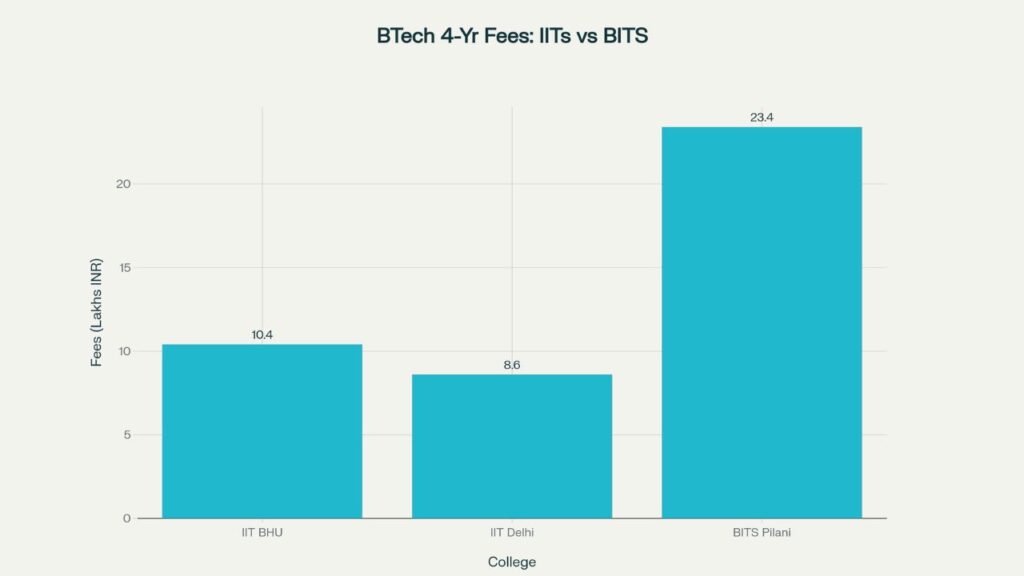
4-year BTech Academic Fee Comparison (2025)

IIT BHU and IIT Delhi 4-year fees are about ₹10.4 lakh and ₹8.6 lakh respectively for the same duration. Meanwhile, tuition fees at BITS Pilani vary from ₹19 lakh to ₹22 lakh for 4 years, not inclusive of inflation and full residential expenses. 

For students who are granted income-based fee waiver or belong to SC/ST/PwD categories, IIT BHU becomes significantly better option over private colleges, as their burden of tuition fees is substantially reduced or waived off. This balance of modest fees, good placements and central government support is what makes IIT BHU one of the best ROI engineering options now available in India. 

Conclusion

The B.Tech fee at IIT BHU is kept as per the income slabs of students, Hindi Medium assistance patches are provided. With substantial waivers for economically backward sections and SC/ST/PwD students, and government subsidies making the aggregate academic fee lesser than most of the premier institutes, IIT BHU promises one of the best ROI among the top engineering colleges. 

The bottomline is that the 4-years cost of attendance remains affordable when compared to private institutes like BITS Pilani, whose fees can run to almost twice this amount, even after adding hostel and mess charges. If you are a student who wants a good mix of fees, quality education with good placements, IIT BHU is a very cost-effective and future proof bet. 

Leave a Comment

Your email address will not be published. Required fields are marked *

BPSC Motor Vehicle Inspector Recruitment 2025: Apply Before Deadline!

BPSC Motor Vehicle Inspector Recruitment 2025

Those Candidates who are interested in MVI can apply for BPSC Motor Vehicle Inspector Recruitment 2025. The Motor Vehicle Inspector is a technical post for inspecting vehicles for public safety on roads, and emission standards. BPSC conducts this recruitment to fill MVI positions in Bihar Transport Department. Candidates can apply online for this government post 10/06/2025 to 03/07/2025. Check out the important dates, structure, and syllabus to prepare before applying.

Summary of BPSC Motor Vehicle Inspector Recruitment 2025

Exam ConductedBihar Public Service Commission (BPSC)
Post NameMotor Vehicle Inspector (MVI)
Vacancy28
BPSC Motor Vehicle Inspector Recruitment 2025To fill the Motor Vehicle Inspector Bihar Government conduct this process. Candidates who passed 10th or diploma are eligible for this exam
Registration date10th June – 3rd July 2025
Online FormClick Here
Official WebsiteClick Here
Events Dates
Notification Release10 June 2025
Online Application Start10 June 2025
Last Date to Apply3 July 2025
Admit Card ReleaseSeptember 2025
Exam DateOctober 2025
Application Fee
General/OBC750/-
SC/ST/Female/PWD200/-

Selection Process

StageDescription
Written ExaminationObjective type Questions from all the 3 subjects: Mechanical Engineering, General Studies, Motor Vehicle Laws
InterviewFor candidates qualified in written exam only appear in Interview
Document VerificationFinal stage with certificate checking

Educational Qualification

Candidates who pass 10th from any recognised board are eligible for this exam. A diploma is required to this role from any recognized institute or board in Engineering. Valid driving license is mandatory. Check the eligibility criteria on the official website of the Bihar Government.

Documents Required

  • Class 10 Marksheet to prove that you have passed the 10th
  • Diploma Certificate for ensuring the knowledge you gain in engineering
  • Valid Driving License
  • Caste Certificate (if applicable)
  • Recent Passport-size Photograph
  • Signature

Eligibility Criteria (Age Limit As on 01.08.2025)

CategoryMinimum AgeMaximum Age
General18 Years37 Years
OBC / EBC / Female18 Years40 Years
SC / ST18 Years42 Years

Salary Structure 

ComponentAmount (nearly around)
Basic Pay₹35,400 – ₹1,12,400
Grade Pay / LevelLevel 6 (7th Pay CPC)
Gross Monthly Salary₹50,000 – ₹60,000
AllowancesDA, HRA, Medical, Travel

Some Useful Links

Apply OnlineGo To
LoginGo To
Download NotificationGo To
Official WebsiteGo To

Leave a Comment

Your email address will not be published. Required fields are marked *

UPPSC Assistant Teacher Online Form 2025 Released for 7466 Posts – Apply Now Before It’s Too Late!

UPPSC Assistant Teacher Online

UPPSC Assistant Teacher Online Form application portal opens for 10 days on the official website of UPPSC. Candidates are advised to fill before 28 August 2025, correction in the application form will be made until 4 September 2025. Uttar Pradesh Public Service Commission put every detail regarding the Assistant Teacher exam in the official notification. 

Post NameAssistant Teacher
Exam Conducting BodyUttar Pradesh Public Service Commission
Vacancies7466
Initial Salary Range60,000 – 70,000 per month
Selection ProcessWritten Exam, Document Verification, & Medical Examination

UPPSC Assistant Teacher Online Form Dates

Application Starts On28/July/2025
Last Date for Registration28/August/2025
Correction Last Date4/September/2025
Fee payment last date28/August/2025
Exam dateUpdate Soon
Application Fee
General/OBC/EWSRs. 125
SC/STRs. 65
PHRs. 25

Eligibility Criteria For UPPSC Assistant Teacher 

  • Completed graduation in any subject. 
  • B.Ed & UPTET qualified candidates can apply for this post.
  • The age limit varies between 21 years to 40 years.
  • Age relaxation is given to the reserved categories, read the notification for full details. 

Read More 👉 UGC NET June 2025 Result Date Revealed – Check When & How to Download Your Scorecard!

Guide to Fill the UPPSC Assistant Teacher Online Form

  1. You need to visit the official website of the UPPSC.
  2. Apply for the UPPSC Assistant Teacher by clicking on the link.
  3. Register yourself by filling out the details on the application form.
  4. Attach your documents which are required with the application.
  5. After checking all the information in the application once, pay the amount of processing fee.
  6. Submit the application and download it for future preference. 
UPPSC Assistant Teacher Online
Important Links
Apply NowLink Activate soon
Full NotificationUpdate Soon
Official WebsiteClick Here

Leave a Comment

Your email address will not be published. Required fields are marked *

UP Board Exam Date 2026 – Latest Time Table, Schedule & Updates

UP Board Exam Date 2026

UP Board Exam Date 2026 has been announced — and it will be the moment for students across Uttar Pradesh to stop waiting and start preparing. The Uttar Pradesh Board (UPMSP) has released the modified schedule for Class 10 and Class 12 on the official website upmsp.edu.in, Students can now check the revised time table for UP Board 2023 on the official site. As exams are from 18 February to 12 March 2026, students can now prepare study plan accordingly and stay free from last moment pressure. 

Whether you are finalizing your notes, giving last minute practice tests, or cramming difficult calculations, holding the official schedule brings a ne find structure to your day. To cater to the large number of candidates the board has also declared two shifts for the exam that will be conducted in well-organized manner at the centers across the state. 

So, the final schedule is here now, students can get ready for the first step in their life for their career journey. 

Revised Exam Dates For UP Board 2026

The board examinations for class 10 and 12 of this session (2026) will be conducted from 18 February to 12 March 2026. Now everyone can get relief about the exam dates because it’s time to prepare yourself for the final exam. The official time table was published in early November 2025 and it makes everyone’s life easier who is preparing for one of India’s biggest state board exams.​

So, whether you are cracking your last mock tests or memorizing those hard formulas, keep remember that this marksheet will be a valuable asset for the lifetime and make sure to mark these dates on your calendar. 

Two Shifts for the Board Exams

The board has mentioned that the exams will be conducted in the morning and afternoon to manage the large number of students:  

Morning Shift8:30 am to 11:45 am
Afternoon Shift2:00 pm to 5:15 pm

This system is better to handle the huge crowds, and it would allow everyone ample time to get to the exam site and take the paper with no rush whatsoever.​

Pro tip: It is wise to arrive at your exam center at least an hour before your shift begins. This will help you avoid facing last minute hassles or getting delayed and start your exam with a peaceful mind. 

Dates & Subjects For Board 2026

Some important dates and topics are as follows for the UP Board exams. This is a sample of how the major subjects for classes 10 and 12 are spread roughly across the dates, though the exact subject wise date sheet may vary:   

UP Board High School (Class 10)

DateShiftSubject
18/February/20268:30 am – 11:45 amHindi
18/February/20262:00 pm – 5:15 pmElementary Hindi
19/February/20268:30 am – 11:45 amComputer
20/February/20268:30 am – 11:45 amSocial Science
23/February/20268:30 am – 11:45 amEnglish
25/February/20268:30 am – 11:45 amScience
27/February/20268:30 am – 11:45 amMathematics
28/February/20268:30 am – 11:45 amSanskrit
9/March/20268:30 am – 11:45 amUrdu
12/March/20268:30 am – 11:45 amAgriculture

Note: For Class 12th, the afternoon shift will be given mostly but please check on the official website for accurate timing details of each paper.

To view or download a detailed subject-wise routine, you can visit the official website of UPMSP (upmsp.edu.in) and get the latest PDF timetable. 

What Changed in the Revised Time Table?

The most important modification of the schedule for 2026 is that the schedule adjustment applies to certain big papers such as Hindi. Earlier, Hindi (Both Class 10 & 12) was conducted in the same shift but due to the large number of students, the UP Board has now divided them. For instance, Class 10 Hindi will be held in the morning shift, and Class 12 Hindi will be held in the evening shift on the day. ​

The segregation is expected to check the latest rush at exam centers and the smooth and fair conduct of exams. In the same vein, the board also changed the shift for the Class 12 Sanskrit exam to lessen congestion. 

Exam Center Allocation

The UP Board is also adopting a digital, computer-based center allotment process for 2026. Within a radius of 7 – 15 km from your school or residence, you will be assigned an exam centre. This digital policy is aimed at ensuring that students do not have to travel too far and the centres are determined based on availability of infrastructure, safety etc.​

The process of center determination has already been initiated and it will be finalized by December 2025 so students can expect to know their exact centers for various courses. 

How to Download the Official Date Sheet

  1. Getting your official exam dates is super simple:
  2. Visit the Official UP Board Website: upmsp.edu.in 
  3. Check for the link “UP Board Time Table 2026” or “Date Sheet 2026” on the main page.
  4. Press the link of Class 10 or Class 12 as your requirement.
  5. Save the PDF and take a printout for future reference.
  6. Always trust on the official UPMSP website for the latest updates and don’t believe in rumours from non-official sources. 

Related Exam Updates 

  1. September 1, 2025 was the last date of submission of fee for board examination. School has confirmed all your details are correct or not on 6th of September 2025. Ensure that your details are correct before submission as corrections could be problematic afterwards. ​
  2. Correction Period: For any error in the registration form, a correction window was open from September 12 – 20, 2025.
  3. Admit Card: You’ll get your admit card through your school, or you can download them from the official site.​
  4. Lab Tests: These shall be held separately prior to the theory test, tentatively in January – February 2026. To be informed on dates by your school.

Useful Tips to Prepare for UP Board Exams

  • Make a revision schedule: The exam dates are now out, so decide on your revision topics and give yourself days to focus on tricky subjects.
  • Solve previous years’ papers: It makes you familiar with the pattern and important questions.
  • Schedule rest stops and downtime: You’re not getting any points for working yourself to the bone – you need to rest and relax to be able to focus.
  • Keep in touch with your teachers: Ask for help if you need it – don’t be afraid. 
  • The official updates, reschedules, or other notices would be announced on the UPMSP website only. 
  • Check regularly, as your admit card and practical exam dates are approaching.Don’t believe in rumours— rely on only official announcements for information about your board exams. 

Conclusion

The UP Board exam 2026 syllabus is now well-organized and clear, and some steps have been taken to make the experience fair and smooth for the students. The 2026 Olympics will take place from February 18 to March 12, 2026, and with all the major updates already out of the way, it’s time to set your mind to preparation with a calm and clear plan.

Keep in mind that you don’t need to work hard for a board exam to do well but work smart and timely. Good luck to all the candidates! may you get the results you want for all your efforts. 

Leave a Comment

Your email address will not be published. Required fields are marked *

Indian Revenue Service: India’s Most Underrated Career Path

Indian Revenue Service

When you are dreaming about passing the Indian Revenue Service exam, many of them aspire to three letters: IAS. But among the tens of thousands of them, there is a quieter, sharper posse that it looks like the mainstream hasn’t quite tuned into yet – the Indian Revenue Service could well be the best career choice in the entire civil services ecosystem. 

What is the Indian Revenue Service?

When most people hear Indian Revenue Service they think of someone sitting with a bunch of papers behind a dusty desk, stamping tax returns. That couldn’t be further from the truth.

The Indian Revenue Service is, at bottom, a law enforcement and policy-making juggernaut. It is also the financial backbone of India — the body that raises the funds that pay for hospitals, highways, schools, and defence. The service was formed in its current style in 1953 and is divided into two significant arms, the IRS (Income Tax) and the IRS (Customs and Indirect Taxes). 

Nearly 9,775 officers, the two branches of the chargeable revenue service are testament to a cadre that pervades nearly every facet of the Indian economy. 

Eligibility

  1. Applicants must be Indian citizens or belong to certain categories of Persons of Indian Origin (PIO) to apply for the IRS. 
  2. The basic educational qualification is a Bachelor’s degree in any stream from any recognized university by the Government. 
  3. UPSC is quite flexible in this regard as it permits the students pursuing the final year of University to appear in the Preliminary examination for the CSE examination on a provisional basis, however, they are required to submit the passing certificates before joining the Mains exam. 
  4. The age limit is 21 — 30 years, you can check further below. 
Applicant CategoryMinimum AgeMaximum Age LimitPermitted Examination Attempts
General21 Years32 Years6 Attempts
Economically Weaker Section (EWS)21 Years32 Years6 Attempts
Other Backward Classes (OBC)21 Years35 Years9 Attempts
Scheduled Castes / Scheduled Tribes (SC/ST)21 Years37 YearsUnlimited (up to maximum age limit)
Persons with Benchmark Disability (PwBD – General/EWS)21 Years42 Years9 Attempts
Disabled Defence Services Personnel / Ex-Servicemen21 Years35 to 37 Years9 Attempts

Work Responsibility

These are the people who appear and plunder the offices of billionaires at the break of dawn. They follow cryptocurrency tracks across borders. They capture drugs off the shore. They bust shell companies that hide thousands of crores in black money. And yes, they also sit in hearings, argue byzantine tax law before tribunals and help shape the very policies that dictate how India earns its revenue.

This is not a desk job. This is one of the most intellectually challenging, operationally thrilling and financially rewarding career in Indian public service. 

Participate & Crack IRS

Hacking the Indian Revenue Service is tough but then, nothing good ever is. The only avenue of entry is through the UPSC Civil Services Examination, which is attempted by about 1.1 million aspirants every year. The exam takes place in three stages, all tough. 

  • The first is the Preliminary exams – a two-paper objective test to weed out the unprepared. 
  • Then there is Mains, nine descriptive papers penned down over a period of a few days, examining one on history and geography, ethics and economics, and so on. 
  • A final interview by a panel of seasoned bureaucrats and scholars. 
Mains Examination PaperSubject Focus and Syllabus ParametersMaximum Marks
Paper I (Essay)Multiple topics requiring analytical and philosophical discourse.250
Paper II (GS I)Indian History, national Geography and geo of the World and culture.250
Paper III (GS II)Law & Constitution, Social Science, and International Affairs.250
Paper IV (GS III)Tech, hacking, Economic Development, Bio-diversity, and crisis management.250
Paper V (GS IV)Ethics, Integrity, and Aptitude (Case studies on administrative morality).250
Paper VI (Optional I)Subject chosen by the candidate from a predefined list of 48 disciplines.250
Paper VII (Optional II)Second paper of the chosen Optional Subject.250

Top Recommendations for Exam Preparation

The whole process, beginning to end, can take years of preparation. Most of the toppers are second-time IAS aspirants and they spend 2-4 years mugging up the NCERT textbooks, M Laxmikanth Indian Polity, Ramesh Singh Indian Economy and reading daily newspapers like The Hindu. They write answers daily in practice. Join offline coachings or attend world-class online platforms such as Vision IAS or Vajiram & Ravi from wherever they live. 

Cutoff Marks Needed for Selection

A candidate from general category is usually required to rank between 239-379 to get IRS (Income Tax). For IRS (Customs and Indirect Taxes), the range is a little wider — something like 265 to 497. They are excellent ranks, well within the top 0.5% of all candidates. But unlike the IAS cut-off which is near impossible, the IRS is a realistic and achievable target for those who seriously prepare. 

ServiceGeneral Category (Last Rank)OBC Category (Last Rank)SC Category (Last Rank)ST Category (Last Rank)
IAS (2024 Trends)78 —- 96435 —- 457567—- 629528 —- 625
IPS (2024 Trends)225 — 252480 —-656638 — 865645 — 867
IRS (Income Tax)239 — 379485 — 706602 — 969674 — 1032
IRS (Customs & IT)265 —- 497515 — 823649 — 970680 —- 1053

The “big three” services—consisting of the Indian Administrative Service (IAS), the Indian Foreign Service (IFS) and the Indian Police Service (IPS)—are in the topmost Tier 1 class. These services traditionally take the bulk of the top 150 candidates. The IAS is the undisputed king of the civil services, with unparalleled executive powers, while the IFS has the glamour of global diplomatic representation, and the IPS has the unmatched power of the uniform.

The Indian Revenue Service holds the very prestigious Tier 2 bracket and is known for its unbeatable power in financial affairs along with a good urban living. With a bigger cadre size and distinct preference pattern giving priority to metro stability rather than rural administration, the IRS (IT) and IRS (C&IT) take a large chunk of the successful candidates which are ranked between 240 and 650 in the general category. 

What Happens After the IRS Exam?

IRS (Income Tax) officers are on their way to Nagpur’s National Academy of Direct Taxes (NADT) — a sprawling green-fitted campus, where a 16-month professional course converts the generalist officers into financial experts. The content is demanding: income tax law, corporate accounting, forensic investigation, international taxation, transfer pricing. It’s not just classroom theory, either. Officers labor months in the trenches, conducting real assessments and audits with seasoned veterans.

IRS (Customs and Indirect Taxes) officers are trained at the brand new NACIN campus in Palasamudram, Andhra Pradesh — a breathtaking 500-acre establishment which also serves as a World Customs Organization regional training centre for the Asia-Pacific region. The syllabus here includes GST, customs law, border management, narcotics control and contemporary areas such as data analytics and artificial intelligence.

Holistic development is taken seriously in both academies. Morning physical training, evening cultural programmes and personal hobbies. The objective is to produce officers who are not just technically competent but mentally tough, well rounded human beings who can manage in high-pressure environments without losing their cool. 

Read More:- Railway RRC WR Apprentice Recruitment 2026 – Apply Online

Pay Scale and Future Opportunities

The pay of IRS officers is very good and is governed by the 7th central pay commission (CPC). Financial estimates for the 8th CPC, as the pay commission is next in line, indicate a possible 2.25 multiplier to the basic pay, which would again make being in the service financially attractive. Officers join the service at Pay Level 10 ( Junior Time Scale ) and can rise in 30 years of service through the ranks to the Apex Scale at Pay Level 17. 

The following outlines the elaborate and comprehensive financial and hierarchical system: 

IRS DesignationPay LevelBasic Pay (7th CPC)Estimated Gross Monthly SalaryCareer Timeline (Approx.)
Assistant CommissionerLevel 10Rs 56100Rs 85000 0 – 4 Years
Deputy CommissionerLevel 11Rs 67700Rs 100,000 5 – 8 Years
Joint CommissionerLevel 12Rs 78800Rs  1,25,0009 – 12 Years
Additional CommissionerLevel 13Rs 118500Rs 1,60,000 13 – 16 Years
CommissionerLevel 14Rs 1,44,200Rs 2,00,00017 – 20 Years
Principal CommissionerLevel 15Rs 1,82,200Rs 2,40,00020+ Years
Chief CommissionerLevel 16Rs 2,05,400Rs 2,80,000 25+ Years
Principal Chief CommissionerLevel 17 (Apex)Rs 2,25,000Rs 3,20,000Apex Career Stage

In cases where government accommodation is either not available or refused within the government-officer circle, the officers are paid a handsome House Rent Allowance (HRA) of 8% to 24% of their basic pay based on the tier categorization of the city in which they are posted. 

Conclusion

Indian Revenue Service is not just a career option but a vocation for those who want to make a real difference and are willing to work in the shadows and not in the spotlight. It is a combination of power and responsibility, brain and brawn, permanence and challenge. IRS officers at the national and state level are, quite literally, the core of India’s power but theirs is an unobtrusive, unshowy, and often unacknowledged influence.

In a culture where the IAS, IPS and IFS reign supreme in public imagination, the IRS gets overlooked not because it does not hold enough power or prestige or purpose but because it doesn’t shout about it. And yet, for those with the time to can see its nuances, it provides one of the most rounded existences in Indian public service — professional esteem, financial security, urban postings, intellectual stimulation, and tangible national outcomes. 

GovUpdatewala is your trusted source for real-time updates on government exams and jobs in India. We provide verified info on SSC, UPSC, Banking, Railways, Defense, and Teaching exams. From syllabus and patterns to important dates and career tips — we support aspirants at every step.

Leave a Comment

Your email address will not be published. Required fields are marked *

BBAU PG Admission 2025: Dates, Fees, Eligibility & Offered Courses Revealed!

BBAU PG Admission 2025: Dates, Courses, Fees, Eligibility

BBAU counselling dates have been released for the PG programme 2025-26.  Candidates are shortlisted in the merit list who have scored well in the entrance exams. Now they have to prepare for the next round of the counselling which is document verification and fee submission. Total of three phases of the admission process, those who cannot find their name in the first phase can wait for the second phase merit list. Candidates are advised to follow up on the important dates through notification. You can download it from the link mentioned below in the article.

BBAU PG Admission Procedure

The candidates should give the CUET PG exam, which is an entrance exam for admission to postgraduate programs. Students can get admission in BBAU according to their CUET PG score. Next step, candidates should register themselves on the admission portal and select their choices in the course. The merit list will be declared on the official website, and shortlisted candidates can verify their documents. Candidates who are selected according to their CUET score can submit their fees through the online SAMARTH portal.

Important Dates
Last Date for Registration30/June/2025
Phase-107/July/2025
Phase-214/July/2025
Phase-321/July/2025
Last Date for Fee Submission 16/August/2025
Document verification31/July/2025
Spot Counselling-I Date30–31/July/2025
Spot Counselling-2 Date14/August/2025
Official WebsiteClick Here
Application Fee
GeneralRs. 700/-
EWS/OBC/URRs. 500/-
SC/ST/PWDRs. 300/-
Late Fee (all Categories)Rs. 1000/-

Documents Required for PG Admission in BBAU

  • Marksheet/Degree or Bachelors
  • Aadhaar Card
  • Nationality Proof
  • Caste Certificate
  • Migration Certificate
  • Income Certificate

Read More 👉 How to Take Admission in Delhi University in 2025 – Full Process Explained!

Eligibility & Fees For The PG Admission in BBAU

Degree EligibilityFee
M.AGraduation degree with 50% marks in the relevant subject 15000
M.ScGraduation degree (B.Sc/equivalent) with a 50% score25000
Master of LibraryB. Lib. Sc/ B. Lib with 50% score15000
MCABachelor’s degree in computer science OR IT, B.Sc/BCA with 50% marks, OR B.Com/BA with maths25000
M.Tech.B.Tech/BE/MCA in computer science OR IT, M.Sc with IT/CS (50% score)35000
MBABachelor’s degree with a 50% score45000
M. PharmB.Pharma with 60% score10000
LL.M.Bachelor’s in Law45000
B.EdBachelor’s OR Master’s in any discipline with a 50% score.10000
Useful Links
Download NotificationClick Here
Download Admission PolicyClick Here
Official WebsiteClick Here

Leave a Comment

Your email address will not be published. Required fields are marked *

Scroll to Top