If you have completed 12th with a science subject and are interested to join the Uttar Pradesh Police Force then this is the chance to transform your life! The application process has begun for the Uttar Pradesh Police Recruitment & Promotion Board (UPPRPB) Computer Operator Grade-A vacancies – the total number of vacancies is 1,352. So, let’s get into all that we need to know about this golden opportunity.
A career with UP Police is an excellent opportunity for youth having technology savvy to establish their bright future in law-enforcement. With 1,352 vacancies available and a good pay scale of Level-4 (₹25,500 – ₹81,100), this job is not only offering colorful career but also financial security. The registration is valid for both men and women across the UP, so the whole terrain of the state could participate in it.
Mark Your Calendar With These Dates
Event
Date
Online Application Start
December/16/2025
Registration Deadline
January/15/2026
Fee Payment Last Date
January/15/2026
Fee Correction Window
January/16-18/2026
Exam Date
To be notified
Admit Card Release
Notify Later
Do You Qualify For This Post?
Requirement
Details
Age Limit
18-28 years
Educational Qualification
10+2 with Physics & Mathematics
Computer Certification
DOEACC ‘O’ Level OR Diploma in IT/Computer/Electronics Engineering
The procedure of application for Uttar Pradesh Police Recruitment and Promotion Board (UPPBPB) is easy and in online mode only. Step by step instructions are provided below:
1. Visit the official page of UPPBPB at the official website which is also mentioned in the article.
2. Sign up with a valid mobile number and email id.
3. Follow the guidelines to complete the One-Time Registration (OTR).
4. Fill in the details in the application form correctly related to your Personal and Educational Qualification etc.
5. Attach all relevant documents, i.e. mark sheets, certificates, a recent photograph and the signature.
6. Submit the application fee as applicable through the online mode.
7. Complete this and then apply with your full application and print the confirmation page for your document.
Make sure that all the information they are providing is true and correct, and that the files they upload are according to the size, format, etc. specified above so that they don’t have to face any trouble.
Application Fee
General/OBC/EWS
₹500
SC/ST
₹400
Selection Process
Stage
Description
Written Examination
200 MCQ questions (400 marks)
Typing Test
Hindi & English typing skill test
Document Verification
Authenticate original certificates
Final Merit List
Based on written exam performance
Exam Pattern
The question paper has a General Hindi, General Knowledge, Mental Aptitude/Reasoning and Computer Science section. All the three sections contain 50 questions and every question carries two marks thereby the maximum score for the paper is 100 marks.
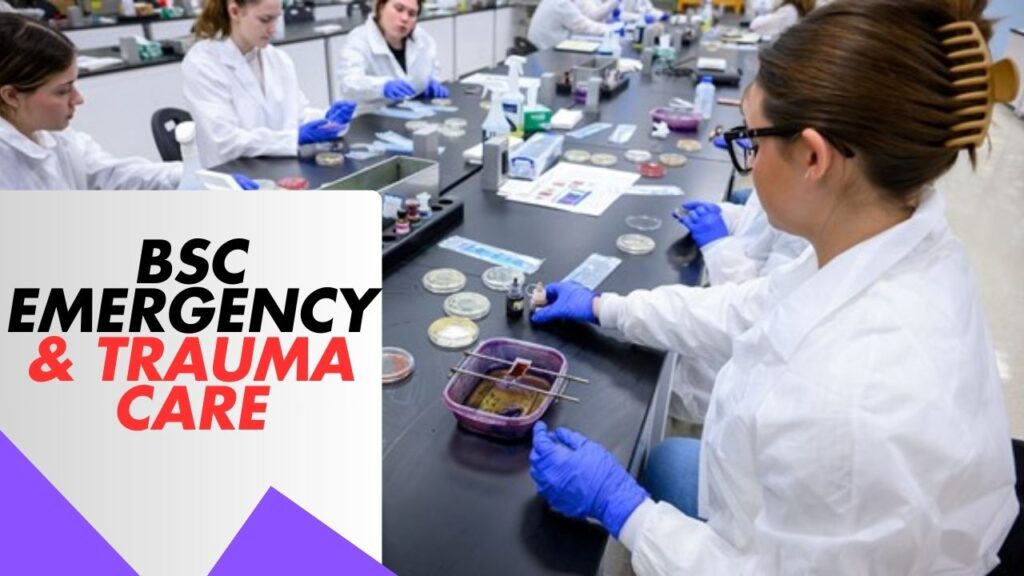
In the intense hospital setting, there is a place where seconds count and the word “routine” hasn’t been uttered in years. It’s the Emergency Room (ER) after BSc Emergency and Trauma Care. Although the faces with which we most commonly associate life saving are those of the doctors and nurses, there is an equally specialised group of para-professionals working with them: Emergency and Trauma Care Technologists.
Requirement for BSc Emergency and Trauma Care
A candidate must possess 10+2 in Science (PCMB/PCMC) & it’s important to know that some colleges asked for a 45%- 55% minimum score. This course prepares students to pursue a career on an emergency basis like when an urgent requirement of a doctor arise in an emergency room, on an operating table etc.
English is normally compulsory subject in class 12th and you should be minimum of 17 years of age at the time of the admission, medical fitness certificate is also required at times.
Duration and Course Subjects
The 3-4-year BSc Emergency and Trauma Care course enables students with the necessary skills and knowledge to deliver care to the traumatized and the emergency patient. The content sequentially increases in complexity starting with the basic sciences and advancing to clinical interventions.
The following topics are repeatedly addressed:
Basic Sciences
Human Anatomy
Physiology
Biochemistry
Pathology
Microbiology
Emergency Care
Emergency Medical Services
Pre-hospital Trauma Life Support
CPR & Airway Management
Hemorrhage Control
Clinical Emergencies
Medical Emergencies
Trauma & Surgical Emergencies
Pediatric and Special Population Emergencies
Critical Care Technology
The program is focused on theoretical and clinical training, designed to equip students to manage high-stakes trauma environments with both assurance and thoroughness.
Semester Breakdown
Semester
Core Subjects
1st/2nd
Anatomy, Physiology, Biochemistry, Intro to EMS, Pharmacology
3rd/4th
Medical Emergencies, Trauma Emergencies, Pathology, Biostatistics
5th/6th
Disaster Management, Patient Monitoring, Advanced Life Support
Mail Skill You Must Have
While the “BSc” part of the title sounds academic, the job is deeply emotional. You will become a patient’s life-saver on the worst day of their life.
Empathy in the moment is a talent they don’t always rate you on, but it’s the most important one you’ll have. You’re not just treating a body but also confronting the panic and worry and sorrow of the people surrounding it. Those relatives, too, are often in over their heads, and those patients are frightened. You’ve got to be a genuinely kindhearted person to remain calm, tell them everything will be all right and comfort them while you are doing something like firing up a ventilator.
Career Goal
The demand for graduates from the BSc Emergency and Trauma Care course continues to grow within the health care industry, with opportunities for employment with both public and private providers, transport focused roles in emergency situations, and roles such as the immediate stabilization of patients. It is one of the best courses which open your professional way with good packages because experience in this field has many different responsibilities.
Roles & Responsibility
Role
Responsibility
Trauma Technician
Take part in Trauma Cases with surgeons and ER doctors to stand as a pillar on saving lives.
Emergency Medical Technician (EMT)
Quick Response to save life’s on the spot emergencies techniques.
Flight Paramedic
Working on air ambulances or rescue helicopters for remote locations.
Critical Care Assistant
Managing patients in the ICU who require constant monitoring.
Disaster Management Officer
Working with Social Work Organisations like NGOs or governments to plan responses to natural disasters.
Top Employers
Sector
Examples
Hospitals
Apollo, Fortis, Max Healthcare, Medanta
Ambulance Services
GVK EMRI, Air Ambulance
Government/Other
Indian Red Cross, Fire Department Emergencies, Disaster Organizations
Jobs Salary After BSc Emergency & Trauma Care
The BSc Emergency and Trauma Care salary in India varies as per the job position, skills, experience, work location (metros like Delhi, Bangalore provide higher salary) and type of the company. For 3 to 5 years of experience, the salary can be 5 — 8 lakhs per year along with allowances for shifts or overtime.
Salary by Role
Role
Fresher Salary (₹/month)
Experienced salary in LPA
Emergency Medical Technician
20,000-40,000
3-7
Trauma Care Technician
25,000-50,000
5-8
ER Coordinator
30,000-55,000
5-9
Disaster Specialist
40,000-70,000
6-10
How to Get Government Jobs After This Degree
For government job after BSc Emergency and Trauma Care, concentrate on the paramedical recruitment in state health departments, NHM, and hospitals as these are the very places that consider this as a preferred degree for EMT and trauma-related Jobs.
Preparation includes watching portals, acquiring certifications such as BLS/ACLS, and passing written tests or interviews.
Steps to make a career in government healthcare or allied services:
Get updated: Get into the habit of visiting the official websites regularly i.e. NHM, State Health Society, ESIC, AIIMS, and 108 Ambulance Services. These sites raise alerts for complainants for job notification, recruitment-related news and other information which might help you get one step closer to your dream job.
Boost your profile: Having professional certification can do wonders in polishing up your resume. Courses like BLS (Basic Life Support), ACLS (Advanced Cardiovascular Life Support) and ITLS (International Trauma Life Support) bring weightage to your profile. Along with these certifications, relevant field experience 1-2 years will make a great difference in your selection.
Apply and Prepare: Apply online for exams that generally comprise multiple choice questions (MCQs) on anatomy, emergency care, and general information.
Recruiter
Roles
7th CPC Salary
NHM/State Health Societies
EMT/Paramedic
Rs 25500—81100 at Level-4 Rs 35400—1,12,400 at Level-6
AIIMS/Government Hospitals and ESIC
Trauma Technician, ER Assistant
Rs 25000—50,000 entry role
Armed Forces/Disaster Bodies
Ambulance Technician
Varies by level
The Future of Emergency Care
As medicine becomes more specialized, the need for full-time trauma providers is growing exponentially. We are going from “general” care to “specialized,” rapid response. With the advent of smart ambulances and telemedicine, an BSc Emergency and Trauma Care alumnus is no longer a mere “aide”, they are a high-tech clinician leading the cutting-edge of medicine.
A BSc Emergency and Trauma Care is not just an academic qualification; it is a key which opens the door to the human condition. It is a profession for the strong, the fast-thinking and the kind. If you’re looking for a career in which you’ll keep on learning, and where you can tell people, “You really needed me today,” this is the road for you.
UPESSC UP Primary Teacher Recruitment 2026 form will close today (15/October/2026) and candidates who haven’t paid the fee should do it right now before your application is revoked. This is the selection examinations and recruitment for teaching and education-service posts in Uttar Pradesh.
Primary teachers are eligible to teach Classes 1 to 5 in Uttar Pradesh government/basic education schools. This is the doorway to pass through with a good score to get this opportunity. UPESSC announced 12,405 posts under the Primary Teacher Recruitment 2026.
UPESSC UP Primary Teacher Recruitment 2026 Timeline
Event
Date
Notification release
15 September 2026
Online application start
16 September 2026
Last date to apply and pay fee
15 October 2026
Application correction window
19 October 2026
Written examination
3–4 December 2026
Admit card / exam city details
To be announced by UPESSC
Who Are Eligible For Primary Teacher Recruitment 2026
Education: You must carry a degree in any discipline with a teacher training certificate. There are approved elementary-education qualifications such as D.El.Ed. OR B.El.Ed OR BTC. If you have both then clarify the TET exam and if you have passed Teacher Eligibility Test (Primary-Lv), you are eligible for this post.
Age: You must be 21 to 40 years old as on July 1, 2026. Your age on the day you apply doesn’t matter. Only your age on that date does.
Age relaxation: The upper limit is higher for some candidates. Age relaxation means teachers get more years in service, 5 years is given for SC/ST/OBC and 15 years to PwBD. If you are someone whose father or mother is also a government school teacher then you get 3 more years. Shiksha Mitras can apply up to age 60
How to Fill The Form
Click on the link to get on the official website of UPESSC.
If you haven’t done One-Time Registration yet, do it now with your own mobile number and email ID.
After that you will receive credentials to login and click on the Primary Teacher Recruitment 2026 notification.
Fill all the details including your DOB, category, qualifications, and other specific information asked in the form.
Review what you fill because any spelling mistake can cost you later.
Enter your preferences, choose wisely according to your lifestyle.
Upload your documents such as photo, sign, certificates.
Pay the amount and submit the form. Download the copy to keep it safe.
Application Fee
Category
Fee
General / UR / OBC / EWS
₹1,000
SC / ST
₹500
PwBD / Divyangjan
₹300
UPESSC UP Primary Teacher (Assistant Teacher) Recruitment 2026 Exam Pattern
Particular
Details
Exam mode
Offline, OMR-based pen-and-paper test preprod.
Question type
Multiple-choice questions (MCQs)
Total questions
120
Total marks
120
Duration
2 hours
Marking
+3 for each correct answer
Negative marking
-1 for each incorrect answer
If you are going to prepare according to the section-wise then here is the order from maximum marks and question to the lowest.
30 marks/question: Hindi, Sanskrit and English
25 marks/question: General Knowledge, Current Affairs and Reasoning, IT, Life Skills and related sections
16 marks/question: Mathematics
8 marks/question: Science, Environment and Social Studies, Teaching Skills / Pedagogy
The UP Primary Teacher recruitment will test your knowledge and how well you can teach kids. The language section covers comprehension, vocabulary and error spots. Math covers basic calculations and easy problems and physics, chemistry, and biology’s basic definitions and units are covered in the science section.
Social studies covers basic knowledge of Uttar Pradesh infrastructures and common topics of environment while current events and general knowledge covers Uttar Pradesh-specific topics, culture and polity along with International events. Basic knowledge of Tech is also asked from you and reasoning like puzzles, coding-decoding, Venn diagrams also come.
The teaching section covers your ability to handle children which is needed to teach them at their level of understanding. It accesses your teaching methods, professional ethics and classroom management.
Overall, the paper expects you to handle a Class 5 textbook confidently and to understand how a child learns from it.
Dearness Allowance, HRA, travel allowance and other admissible benefits as per UP government rules
Conclusion
UPESSC UP Primary Teacher Recruitment 2026 is an opportunity for teachers to get eligible for teacher 1–5 classes in government school. It is a high-paying path for the talented teachers who can make the children’s future brighter.
If you have passed the TET exam and have a certificate of teaching then you are eligible to apply for this application. The window closes soon so those who have already filled the application must start revising the syllabus and take mock tests to beat the competition.
In the constantly changing healthcare environment, the focus is changing. Doctors and nurses may be the public face of medicine, but there is a whole engine room of professionals holding the system together: the Allied Health Professionals. To become one, you need to break down the Allied Medical Courses Roadmap.
If you have ever asked yourself questions like “who runs that fancy MRI machine?”, “who handles the complex chemistry of a pathology lab?”, or “who assists a runner to walk again after a devastating injury?”, you have now become the proud owner of a glimpse into the world of Allied Health.
As the 2026 Union Budget announced the addition of ten new allied health disciplines and targets to train one lakh professionals in five years, there is no better time to chart your path in this domain.
What are Allied Medical Courses?
Allied Health Sciences (AHS) are career options in the healthcare sector where professionals work in tandem with doctors and provide diagnostic, technical, therapeutic and other support services. These courses are specialized rather than comprehensive like an MBBS. They’re the hands-on, practical side of medicine—taking the technology and therapy and making them work to save lives.
Who Can Choose Allied Medical Courses?
These are the courses that are available for science stream students after 12th, and they consist of theory, practicals and also internships. Unlike MBBS, they are open (3-4 years), cheap (₹50k-₹5 lakhs total), and now NEET-compulsory under NCAHP for uniformity. Perfect for students looking at colleges like King George’ Medical University or the privates.
Allied Medical Courses Roadmap
Charting a course for this vocation from high school to the hospital is going to be a bit of a balancing act, particularly with new rules set to be implemented in 2026.
1. The Foundation (Class 12)
Allied health programs require a science core including physics, chemistry, and biology (PCB). Although certain diploma courses earlier admitted students from other streams, the drift in 2026 is towards making science a single stream for clinical jobs.
2. The Entrance Era (NEET 2026 onwards)
As per the notification of National Commission for Allied and Healthcare Professions, NCAHP dated 31st May 2023 NEET UG is going to be made compulsory for admissions in various undergraduate allied courses from 2026-27. It implies that the “non-NEET” option to some of the best institutes is being gradually closed, which will help enhance the quality and professional recognition of the graduates.
3. Choosing Your Path: Degree vs. Diploma
Bachelor’s Degree (B.Sc./BPT): Normally 3 to 4.5 years. They offer more theoretical knowledge and are oftentimes necessary for obtaining work permits in other countries.
Diploma (DMLT/DRT): 2 years in general. These “accelerated” tracks offer a practical focus on talent for students interested in moving quickly into the workforce.
Studying samples like blood, tissue, and other body fluids.
Lab Technologist
Bachelor of Physiotherapy — BSc (BPT)
Helping in regaining strength through Physical rehabilitation
Physiotherapist
BSc with Radiology & Imaging
Scanning through X-rays, CT scans, and MRIs to detect injuries
Radiology Technologist
B.Sc. Anaesthesia & OT Tech
Supporting surgeons and managing ICUs.
OT Technician
B.Sc. Cardiac Care Technology
Monitoring heart health and ECGs.
Cardiac Technician
Why Choosing an Allied Medical Courses Roadmap is Right?
Entry to workforce more quickly
While an MBBS requires 5.5 years (plus specializations), most allied health programmes make you career-ready within 3 to 4 years. This is your lane if you just want to start making a difference and earning sooner.
High Demand
There is a massive demand for healthcare technicians worldwide and skilled professionals capable of meeting that demand are difficult to find, making it a path to high opportunity around the globe. Expansion of the Regional Medical Hubs (introduced in 2026 Budget) is expected to generate thousands of jobs in diagnostics and rehabilitation in India alone.
Technological Integration
If you’re a gadget geek or tech enthusiast, then Allied Health is the way to go. You don’t just read charts, you’re running some of the most sophisticated AI-enabled machines on the earth.
Future Scope and Salary
The era when Allied Health was considered a “plan B” is behind us. By 2026, the starting salaries of freshers can vary from ₹2.5L per annum to ₹5L per annum based on the specialization. Specialized positions such as Perfusionists or Cardiac Technicians also attract even higher premiums.
Additionally these degrees have great international mobility. Countries such as the UK, the UAE and Canada have specific visa tracks for Allied Health workers, so this is really your ticket to a global career.
Conclusion
The Allied Medical Courses Roadmap isn’t a secret trail anymore — it’s a fast moving highway. With a government emphasis on skilling and the standardization of entrance exams, these professions are enjoying a newfound prestige.
If you love science but don’t want to go to medical school for ten years, the Allied Health track is a balanced, tech-forward, and profoundly satisfying way to go.
It is confusing to choose the right path for your career being a commerce student, here is the list of government jobs for commerce students. If you want to establish a stable career for your future growth and high salary consider this is an opportunity to apply to any of these government jobs. Let’s take a look into eligibility, salary, and perks of having a government job in any sector.
List of government jobs in India for commerce student
Income Tax Officer
If you are interested in financial or economic content you can apply for the income tax officer role as it is a high level job and offer big perks of the role. Being an income tax officer, your responsibility is heavy because it becomes nasty sometimes and needs a strict rule followed under the law. The respect and power are worth for this hectic job.
Department
Income Tax Department
Eligibility
B.Com
How to apply
Through SSC CGL Exam
Approx Salary
₹44,900/month + allowance
Assistant Audit Officer
One of the most paying jobs in India and recruitment for this job role is through the SSC exam. Those who are interested in Auditing and checking government expenditure can apply for this. The work is not hectic and anyone can do the job if they pass the exam.
This job was that hectic but nowadays it becomes a more critical and pressurized job because it has sales targets, but it is some relief in the government sector. Government sector offers good work and high salary, also great professional growth.
Banks
RBI, CBI, Canara, and Punjab Bank
Eligibility
B.Com
How to apply
Through IBPS PO / SBI PO exam
Approx Salary
₹41,960/month + allowance
Chartered Account in Government sector
Other than corporate, CA is required to handle the work in public sectors and ministries. If you are CA qualified and looking for a stable career, consider this a golden opportunity for you. Organizations like GAIL and ONGC are recruiting candidates to fill the vacancies in the department.
Department
Public Sector Undertakings
Eligibility
CA from ICAI
Recruitment
By BHEL, ONGC, GAIL, Indian Railways
Approx Salary
₹50,000 to ₹1,20,000/month
Finance Officer
This job role is very valuable for your future if you have a bachelor’s or Masters in Finance. The work is related to the management of budgets, accounts and government expenditure. This work is office related so it is peaceful for women too as it require skilled mind who can be able to use numbers perfectly and good in accounting
Department
Railways, DRDO, ISRO
Eligibility
B.Com, MBA in Finance, M.Com
How to apply
Through UPSC, State PSC
Approx Salary
₹45,000 – ₹75,000/month
UPSC Civil Services
There is a future for you to become IAS, IRS, and IES. YES, you can apply for this position if you are interested in serving the nation but recruitment for this position is through UPSC Exam and it is the most toughest exam across the globe.
Department
Union Public Service Commission
Eligibility
B.Com
How to apply
Through UPSC Exam
Approx Salary
₹56,100 – ₹2,50,000/month
RBI Grade B Officer
Individuals who have interest in finance and are passionate about working in RBI should consider to lay a hand on this job role. This is not just a bank but a monetary policy that works for the country. This is beneficial for a long-term career so is a highly respectable position in India. You can get a job in banks if you have a better understanding of accounting.
Department
Reserve Bank of India
Eligibility
B.Com with 60% marks
How to apply
Exam for recruitment
Approx Salary
₹83,254/month
PSU Jobs in Account and Finance
Your career is set if you are thinking about getting a job in PSUs but it is highly competitive so you have to prepare well to be selected in this job role. The recruitment happens through exams like GATE or UGC NET so, you have to prepare well in this exam and score high. After clearing these exams, you become qualified for this job opportunity and check the vacancies on the official website of the organizations.
The Tax Assistant and Clerk job posts are the simple jobs, more like less stressful and have a great work balance for the future. These roles have one flaw for those candidates who want fast promotions. However, it is a great opportunity for those who want to settle in their hometown.
Department
State PSCs
Eligibility
B.Com
How to apply
Recruited by UPPSC, MPPSC
Approx Salary
₹25,000 – ₹60,000 per month
SSC Auditor
This job offers a great pay in regular hours of working. If you want a peaceful job and fixed hours consider this job is for you. The recruitment is processed by SSC. Various departments need good auditors so if you have done your B.com you can apply for this job.
Department
Railways, Ministries
Eligibility
B.Com
How to apply
Through SSC CGL Exam
Approx Salary
₹29,200 – ₹92,300/month
Preparation Tips
Choose the department or job post wisely before you start preparing for the recruitment exam.
Use online resources and previous year questions for the exam pattern understanding.
Solve test series and schedule your time for your studies.
Go on slowly but consistently and stay focused.
Keep updated on vacancies so you do not miss any application process before the exam.
Start revising yourself before the exam.
Exams for Commerce students
SSC CGL
This exam has a static syllabus but is lengthy. So you can take this exam if you have clear concepts in basics because it is a safe option. It is not as hard as the banking or UPSC exam but opens up many opportunities in the government sector for commerce students. You must start preparing along with your graduation so you can pass the exam.
Banking Exam
This is highly competitive and you have to prepare for it with full focus and sharp mind. It contains topics related to finance, and policies. You prepare yourself well atleast give 1 to 2 years for preparation. It has arithmetic, general awareness, and reasoning questions but you can get high scores when your answer will be correct, the negative marking in these questions will deduct your score.
UPSC
It is the hardest exam so you must give 2 or 3 years to prepare yourself for this exam. It is time taking but worth it. If you want to grab a high reward of your full potential then you can take this exam. Focus on easy topics first because negative marking in the exam will deduct your score and you will not be able to crack this exam.
Conclusion
As a commerce student you have a vast amount of opportunities in the government sector. You have to prepare your skills in Finance, Accounting, Taxation, and Policy Execution for securing a government job after graduation or Master’s. Here the list of government jobs for commerce students but choose the right path for yourself. The career in which you are passionate and skilled.
The RRB RPF Sub-Inspector exam is considered as one of the toughest national level exam in India and it is conducted by Railway Recruitment Board under the Ministry of Railways. The exam is held to select eligible and committed candidates for the post of Sub Inspector in Railway Protection Force, a specialized security force which ensures the safety of railway passengers, railway premises, and vital rail components in every zone of Indian Railways.
RPF SI Recruitment is prestigious post and government job and it has good salary package, so, that is way it is most demanded exam in our country. The exam is conducted as computer based test (CBT) in 15 languages apart from English such as Hindi, Urdu, Tamil, Telugu, Kannada, Odia, Malayalam, Marathi, Gujarati, Bengali, Assamese, Punjabi, Manipuri and Konkani, for the convenience of candidates from all corners of the country.
Eligibility Rules for RPF Sub-Inspector
Will you be entitled for the RPF Exam or not? Those who fulfill the Railway Protection Force eligibility criteria can apply for this prestigious job.
Age Limit: The upper age is 28 years on 1st July of the year of recruitment and the lower is 20 years. However, various relaxations applicable for different categories is stated as below:
SC/ST
5 years
OBC
3 years
domiciled Candidates from J&K and LadakhOR Central Government employees
UR/EWS – 5 yearsOBC – 8 yearsSC/ST – 10 years
Widows
UR/EWS – 2 yearsOBC – 5 yearsSC/ST – 7 years
Educational Qualification: The candidate should possess a Bachelor’s Degree in any stream from a recognized university for RPF Sub-Inspector exam. The requirement of Graduation is in place to get a basic intellectual knowledge which is required to hold duties of administration and leadership in security services.
Nationality: You must be an Indian citizen for this recruitment.
Physical Fitness Standards: Basic eligibility does not specifically state this, nonetheless candidates have to be physically fit to meet with the standards laid down in the efficiency test and physical measurement which are critical to the selection procedure.
Posting choices are due to the candidates holding down their preferred location during the filling of the preference form as the posts are spread across multiple railway zones in India which include Eastern Railway, Southern Railway, RPSF (Railway Protection Special Force) and many other zones. Since candidates can opt for postings near their home state/region, this zonal arrangement makes the exam less inaccessible.
Exam Pattern and Question Distribution
The knowledge of exam pattern is needed for the strategic preparation. The RPF SI exam is a single level exam which is conducted in the form of an online computer-based test, having multiple choice questions, which is of 2 hours duration.
There are three sections in the RPF SI Exam:
General Awareness (50 Questions, 50 Marks): This section is an evaluation of your knowledge about Indian history, the Indian constitution, polity, geography, Indian economy, the general science, sports, current national and international events and also a few questions on current governments recently introduced. The questions test both your static and dynamic awareness or knowledge of current affairs.
Arithmetic (35 Questions, 35 Marks): The arithmetic section includes questions on number systems expansion, simplification by BODMAS rule, ratio and proportion, percentage, profitable loss, interest calculation on SI and CI, time and work question average time related queries and simple topic of algebra.
General Intelligence and Reasoning (35 Questions, 35 Marks): Assess your ability to think logistically and solve problems through verbal and non-verbal reasoning and General Intelligence via questions on Analogies, Classifications, Coding Decoding, Series Completion, Blood Relations, Directions, Logical Reasoning and Pattern Recognition.
To promote accuracy rather than the recklessness of wild guesses, each correct answer is awarded one mark, while for each wrong answer one-third of a mark is deducted. The exam is available in fifteen different Indian languages but most of the candidates opt either Hindi or English.
Topic-Wise Syllabus Breakdown
General Awareness Topics
Domestic and International news, political scenes, social conditions, notable events and progress, awards and accolades.
Indian history is divided into independence movements, ancient India, medieval India, modern India and significant historical personalities.
Indian Constitution: Sections and their significance, process of making amendments, rights to the individuals and guiding principles of state policy
Physical and Global geography, environmental concerns, and Indian geography basics.
General Science: All Physics, Chemistry and Biology topics for Class 10–12
Athletics, such as football, great players, artistic genres, music, dance, literary, performing arts performances sport and culture.
Arithmetic Topics
Number system: prime and composite numbers, divisibility, whole numbers, and HCF, and LCM
Simplification: BODMAS rule application, square roots, decimals, and fractions
Ratio and Proportion: Sharing issues, partnerships, direct and indirect proportion, and mixtures
Percentage: Simple percentage calculations, percentage increase or decrease
Cost price, selling price, profit and loss, discount and percentage of profit and loss
Simple and compound interest: applications of principal, rate and time, and formulae
Time and Work: Pipe and cistern problems, work and work efficiency, work with wages
Average: Weighted averages, age-related averages, and averages formulas
Algebra: Basics of algebraic expressions and linear equations
General Intelligence and Reasoning Topics
Analogies: Finding relationships between word pairs
Classification: Categorizing similar items and identifying the odd one out
Coding- Decoding: Decoding the pattern of coded messages
Finding pattern in numerical or alphabetic series is called Completion of series.Blood Relations: Understanding family relationships
Directions: Solving puzzles on directions
Logical Reasoning: Understanding the statement and making the argument
Finding unseen patterns in logical or visual series
Selection Process For RPF Sub-Inspector
RPF SI Selection Process is the multi-level RPF SI selection process that aims to assess the candidates on various parameters. Understanding all stages enable you to be prepared in every possible way.
Computer-Based Test (CBT) at Stage 1: The initial challenge is a 90-minute pen and paper test consisting of 120 questions. A high score is required to advance to the second stage, as this round finishes off a large number of applicants.
Stage 2: The candidates who clear the CBT are called for the Physical Efficiency Test (PET) and Physical Measurement Test (PMT). The PMT is a measurement of height and chest for male applicants, and height for female applicants. The Physical Efficiency Test examines physical stamina by way of demanding routines.
Stage 3Document Verification (DV): The PET/PMT qualified candidates are called for the document verification. At this stage, the information provided by the candidates is matched with the original educational certificates, caste certificate and identity proofs.
Stage 4 involves a complete Medical Examination by CAPF/Govt. Your medical examination confirms that you have the physical ability to do your demanding job.
Salary and Job Benefits
The RPF Sub-Inspector post is attractive for various reasons like good income, stable government job and good facility.
Salary Structure
The 7th CPC has fixed the minimum pay for RPF SI as Rs 35,400 per month with a grade pay of Rs 4,200. Yet the net pay, after subsidy and deductions, is Rs. 43,000 and Rs. 54,162 per month.
Additional Allowances and Benefits
Medical Facilities: Comprehensive coverage for the healthcare of you and your family
Travel and Transfer Allowance: Assistance with relocating and traveling for work
Pass and Privilege Ticket Orders: Discount train travel for you and your family
Education Support: Support for your children’s education
Provident Fund (PF): A provident fund is a savings cum retirement benefit scheme available to all salaried classes of individuals
Gratuity: Lumpsum on exit
Application Fee and Where To Apply
The fee structure is designed keeping in mind everyone and also in compliance with the government norms. Rs 500 as the fee for General, OBC, and EWS candidates. SC, ST, PH ( hearing impaired) candidates and all women candidates are required to pay only Rs.250.
You do the entire application online at the RRB site (rpf.indianrailways.gov.in). This allows you to apply from anywhere in India.
Preparation Tips and Strategy
Success in RPF SI exam requires a solid study plan along with theoretical knowledge and that of practicing. Candidates must focus on the General Awareness section by keeping them updated with current affairs on a monthly basis, practice regular mock test for improving accuracy, and to be able to perform in a limited time. The sensible marking scheme and relatively small extent of syllabus make this test attainable with concentrated 4-6 months of preparation.
Conclusion
The RPF SI exam provides a golden opportunity to all the educated candidates to get a respectable government job. It means steady work, good pay and a major part in keeping the nation safe. Determination, good Study material and regular Practice can make your Dream of becoming RPF Sub-Inspector into Reality.