If you are a resident of Rajasthan and are interested in a government job, you can apply for the various posts mentioned in the article. The Best Government Jobs in Rajasthan not only provide competitive salaries but also ensure a stable & rewarding career. Candidates from any stream can apply for government jobs, but the exam for these job roles is hard.
NEET PG 2025 Admissions Exam Date Out for the advanced programs in the medical field. If you want to prepare yourself for the National Eligibility cum Entrance Test for Postgraduate (NEET PG) 2025 check the exam pattern and syllabus. Check the admit card before the examination date. Check the official notification and stay updated about the exam details. Before applying candidates must meet eligibility criteria and hold the MBBS certificate. NEET PG 2025 is one the crucial examinations for post-graduation across India. The exam is scheduled for 3 August 2025, and thousands of candidates are preparing to appear in this exam for MS/MD/PG Diploma courses.
Highlights of NEET PG 2025
Exam Conducting Body
National Board of Examination
Exam Name
NEET PG
Purpose
Entrance Exam for MS/MD/PG Diploma
NEET PG 2025 Admissions Exam
This is an entrance exam for advanced training programs for those who want growth in their medical field. You can appear in the exam if you have completed your MBBS.
Candidates must hold an MBBS degree from the Medical Council of India. Better with the proof of Pass Certificate of MBBS for this exam. It is mandatory to complete a one-year rotating internship program before applying for NEET PG 2025. There is no upper age limit for this exam so anyone can take this exam but candidates who are interested in advanced medical courses must have a valid registration certificate issued by the MCI.
NEET PG 2025 Admissions Exam Details
Exam Pattern for the NEET PG 2025
Section
No of Questions
Marks
Clinical Subjects
100
400
Pre-Clinical Subjects
50
200
Para-Clinical Subjects
50
200
The duration is 3 hours & 30 minutes for the NEET PG 2025 paper. The marking of answer in the paper is +4 for the correct answer and -1 for the wrong answer as negative marking. Students should prepare well and efficiently for this examination as it is the entrance exam for the post-medical courses. Students get admission to Medical College/University after clearing this exam.
Perks of This Exam
Specialization Opportunities: For students who want to study advanced medical courses and wish for medical training in their specific field, this is the best option for them.
Prestigious Institutions: Offers a chance to study in reputed institutions.
Career Growth: To enhance the practical ability and concepts for better job roles and salaries.
Selection Process
Written Examination
Result Declaration
Counseling Process
The First stage of this exam is a computer-based objective-type question and the level of question is hard, exam covering the MBBS syllabus
Check the NBE portal on the day of result declaration, search your name in the merit list for qualified candidates.
Counseling conducted by MCC for the qualified candidates for seat allocation in MS/MD/PG Diploma course
Syllabus for NEET PG 2025
Section
Key topics
Clinical Subjects
General Surgery, Gynecology and Pediatrics, and General Medicine
The RRB RPF Sub-Inspector exam is considered as one of the toughest national level exam in India and it is conducted by Railway Recruitment Board under the Ministry of Railways. The exam is held to select eligible and committed candidates for the post of Sub Inspector in Railway Protection Force, a specialized security force which ensures the safety of railway passengers, railway premises, and vital rail components in every zone of Indian Railways.
RPF SI Recruitment is prestigious post and government job and it has good salary package, so, that is way it is most demanded exam in our country. The exam is conducted as computer based test (CBT) in 15 languages apart from English such as Hindi, Urdu, Tamil, Telugu, Kannada, Odia, Malayalam, Marathi, Gujarati, Bengali, Assamese, Punjabi, Manipuri and Konkani, for the convenience of candidates from all corners of the country.
Eligibility Rules for RPF Sub-Inspector
Will you be entitled for the RPF Exam or not? Those who fulfill the Railway Protection Force eligibility criteria can apply for this prestigious job.
Age Limit: The upper age is 28 years on 1st July of the year of recruitment and the lower is 20 years. However, various relaxations applicable for different categories is stated as below:
SC/ST
5 years
OBC
3 years
domiciled Candidates from J&K and LadakhOR Central Government employees
UR/EWS – 5 yearsOBC – 8 yearsSC/ST – 10 years
Widows
UR/EWS – 2 yearsOBC – 5 yearsSC/ST – 7 years
Educational Qualification: The candidate should possess a Bachelor’s Degree in any stream from a recognized university for RPF Sub-Inspector exam. The requirement of Graduation is in place to get a basic intellectual knowledge which is required to hold duties of administration and leadership in security services.
Nationality: You must be an Indian citizen for this recruitment.
Physical Fitness Standards: Basic eligibility does not specifically state this, nonetheless candidates have to be physically fit to meet with the standards laid down in the efficiency test and physical measurement which are critical to the selection procedure.
Posting choices are due to the candidates holding down their preferred location during the filling of the preference form as the posts are spread across multiple railway zones in India which include Eastern Railway, Southern Railway, RPSF (Railway Protection Special Force) and many other zones. Since candidates can opt for postings near their home state/region, this zonal arrangement makes the exam less inaccessible.
Exam Pattern and Question Distribution
The knowledge of exam pattern is needed for the strategic preparation. The RPF SI exam is a single level exam which is conducted in the form of an online computer-based test, having multiple choice questions, which is of 2 hours duration.
There are three sections in the RPF SI Exam:
General Awareness (50 Questions, 50 Marks): This section is an evaluation of your knowledge about Indian history, the Indian constitution, polity, geography, Indian economy, the general science, sports, current national and international events and also a few questions on current governments recently introduced. The questions test both your static and dynamic awareness or knowledge of current affairs.
Arithmetic (35 Questions, 35 Marks): The arithmetic section includes questions on number systems expansion, simplification by BODMAS rule, ratio and proportion, percentage, profitable loss, interest calculation on SI and CI, time and work question average time related queries and simple topic of algebra.
General Intelligence and Reasoning (35 Questions, 35 Marks): Assess your ability to think logistically and solve problems through verbal and non-verbal reasoning and General Intelligence via questions on Analogies, Classifications, Coding Decoding, Series Completion, Blood Relations, Directions, Logical Reasoning and Pattern Recognition.
To promote accuracy rather than the recklessness of wild guesses, each correct answer is awarded one mark, while for each wrong answer one-third of a mark is deducted. The exam is available in fifteen different Indian languages but most of the candidates opt either Hindi or English.
Topic-Wise Syllabus Breakdown
General Awareness Topics
Domestic and International news, political scenes, social conditions, notable events and progress, awards and accolades.
Indian history is divided into independence movements, ancient India, medieval India, modern India and significant historical personalities.
Indian Constitution: Sections and their significance, process of making amendments, rights to the individuals and guiding principles of state policy
Physical and Global geography, environmental concerns, and Indian geography basics.
General Science: All Physics, Chemistry and Biology topics for Class 10–12
Athletics, such as football, great players, artistic genres, music, dance, literary, performing arts performances sport and culture.
Arithmetic Topics
Number system: prime and composite numbers, divisibility, whole numbers, and HCF, and LCM
Simplification: BODMAS rule application, square roots, decimals, and fractions
Ratio and Proportion: Sharing issues, partnerships, direct and indirect proportion, and mixtures
Percentage: Simple percentage calculations, percentage increase or decrease
Cost price, selling price, profit and loss, discount and percentage of profit and loss
Simple and compound interest: applications of principal, rate and time, and formulae
Time and Work: Pipe and cistern problems, work and work efficiency, work with wages
Average: Weighted averages, age-related averages, and averages formulas
Algebra: Basics of algebraic expressions and linear equations
General Intelligence and Reasoning Topics
Analogies: Finding relationships between word pairs
Classification: Categorizing similar items and identifying the odd one out
Coding- Decoding: Decoding the pattern of coded messages
Finding pattern in numerical or alphabetic series is called Completion of series.Blood Relations: Understanding family relationships
Directions: Solving puzzles on directions
Logical Reasoning: Understanding the statement and making the argument
Finding unseen patterns in logical or visual series
Selection Process For RPF Sub-Inspector
RPF SI Selection Process is the multi-level RPF SI selection process that aims to assess the candidates on various parameters. Understanding all stages enable you to be prepared in every possible way.
Computer-Based Test (CBT) at Stage 1: The initial challenge is a 90-minute pen and paper test consisting of 120 questions. A high score is required to advance to the second stage, as this round finishes off a large number of applicants.
Stage 2: The candidates who clear the CBT are called for the Physical Efficiency Test (PET) and Physical Measurement Test (PMT). The PMT is a measurement of height and chest for male applicants, and height for female applicants. The Physical Efficiency Test examines physical stamina by way of demanding routines.
Stage 3Document Verification (DV): The PET/PMT qualified candidates are called for the document verification. At this stage, the information provided by the candidates is matched with the original educational certificates, caste certificate and identity proofs.
Stage 4 involves a complete Medical Examination by CAPF/Govt. Your medical examination confirms that you have the physical ability to do your demanding job.
Salary and Job Benefits
The RPF Sub-Inspector post is attractive for various reasons like good income, stable government job and good facility.
Salary Structure
The 7th CPC has fixed the minimum pay for RPF SI as Rs 35,400 per month with a grade pay of Rs 4,200. Yet the net pay, after subsidy and deductions, is Rs. 43,000 and Rs. 54,162 per month.
Additional Allowances and Benefits
Medical Facilities: Comprehensive coverage for the healthcare of you and your family
Travel and Transfer Allowance: Assistance with relocating and traveling for work
Pass and Privilege Ticket Orders: Discount train travel for you and your family
Education Support: Support for your children’s education
Provident Fund (PF): A provident fund is a savings cum retirement benefit scheme available to all salaried classes of individuals
Gratuity: Lumpsum on exit
Application Fee and Where To Apply
The fee structure is designed keeping in mind everyone and also in compliance with the government norms. Rs 500 as the fee for General, OBC, and EWS candidates. SC, ST, PH ( hearing impaired) candidates and all women candidates are required to pay only Rs.250.
You do the entire application online at the RRB site (rpf.indianrailways.gov.in). This allows you to apply from anywhere in India.
Preparation Tips and Strategy
Success in RPF SI exam requires a solid study plan along with theoretical knowledge and that of practicing. Candidates must focus on the General Awareness section by keeping them updated with current affairs on a monthly basis, practice regular mock test for improving accuracy, and to be able to perform in a limited time. The sensible marking scheme and relatively small extent of syllabus make this test attainable with concentrated 4-6 months of preparation.
Conclusion
The RPF SI exam provides a golden opportunity to all the educated candidates to get a respectable government job. It means steady work, good pay and a major part in keeping the nation safe. Determination, good Study material and regular Practice can make your Dream of becoming RPF Sub-Inspector into Reality.
The preparation of banking exams starts with the best books banking exam because it is a hard task and at the same time interesting for the aspirants who want to establish their career in the finance domain. Every year 1 lakhs plus aspirants appear for these competitive exams like IBPS, SBI, RBI and other banking exams at state level. What can you do to give yourself the best chance to succeed among such fierce competition?
What Started Out as a 100% Prep for the 2025 Exam Has Now Evolved Into a Prep with Traditional Materials and a Little Bit of Technology of the Digital Age.. If you are seeking professional-endorsed textbooks or want to enjoy online courses, apps for mobile or interactive, view these product selections loaded with high quality.
The banking exams are considered to be the toughest competitive exam in India. The way to success is to choose the right study books and make use of the good online study materials. Here is a complete list of the best books and online resources that you can use to enhance your chances of success in banking exams 2025.
Essential Books for Banking Exam Preparation
Quantitative Aptitude & Data Interpretation
R.S. Aggarwal’s “Quantitative Aptitude for Competitive Examinations” is the only quantitative exam preparation guidebook for competitive exam preparation. This all-inclusive book comprises all the basic topics from arithmetic, algebra, geometry and data interpretation along with a plethora of practice problems with their solutions and explanations. The updated 2025 edition features more than 10,000 practice questions and 40 video lessons.
Rajesh Verma’s “Fast Track Objective Arithmetic” is a very good book for shortcuts and tricks which are very important for time limited banking exams. The strength of the book is based on tricks and shortcuts which have vital importance in success in competitive exam.
Arihant’s “Data Interpretation & Data Sufficiency” also ensures depth preparation for the techniques to solve DIs based on Pie charts, Bar charts, Line charts, Caselets. This approach is more result-oriented and can help candidates to perform better in or break this one of the highest scoring sections of banking exams.
English Language
S.P. Bakshi “Objective General English” is a step by step guide to grammar and comprehension which help the students to understand the way of writing and based on that How to use. This is the most appreciated and recommended book for the topic Sentence Correction and Reading Comprehension.
“Word Power Made Easy” – Norman Lewis is Still the Best Vocab Builder. A Quick Review of. Its drill-and-kill approach to vocabulary building will help anyone crushing banking exams.
High School English Grammar and comprehension. Wren and Martin This book contains basic grammar which is needed for the banking exam. This classic text strengthens and solidifies essential grammatical principles, both simple and complex, that serve as the foundation of English language mastery.
Reasoning Ability
R.S. Aggarwal’s A Modern Approach To Verbal & Non-Verbal Reasoning is a very good book which covers the whole verbal and non verbal reasoning topics in depth with good number of questions. This complete coverage of the book allows you to attempt all kinds of reasoning question in the banking exams.
M.K. Pandey’s “Analytical Reasoning” is all about analytical reasoning with detailed solutions and higher order problems. This book is great for most challenging puzzles and most difficult seating arrangements.
Kiran Prakashann Reasoning Books comprises of topic wise syllabus specifically for banking exams with solutions which are easy to understand and tricks to save the time in solving.
Banking Awareness & General Knowledge
“Banking Awareness” published by Arihant is the best book to study from for the section of banking awareness, it covers all the topics related to banking, financial awareness and general current affairs. The revised edition 2025 includes Union Budget 2025-26 and Economic Survey 2024-25 and is very useful for today’s exam patterns.
Now “Banking Awareness” by Disha Experts is all new revised content with solutions of previous years’ questions. This book is written specifically for the banking exams with live examples of the banking sector.
The latest national and international affairs are like annotated with his General Knowledge Books Manohar Pandey. These books will enable the aspirants to keep pace with the fast-moving current affairs.
Testbook provides a complete mock test series including thousands of tests for different types of banking examinations. Their platform consists of a wealth of information with analysis of performance, tests for each section and simulations with unlimited tries possible along with guidance of professionals.
Oliveboard powers analytics using AI and enables adaptive learning on their mock test platform. The exam style tests are meticulously prepared for the candidates to practice with simulated environment to enhance their speed, accuracy and confidence.
PracticeMock provides candidates with the opportunity to practice with a series of full-length and section-wise tests, each simulating the actual test with explanations and other features to assist you in your preparation for the exam.
Video Learning Platforms
Adda247 is the most sought after Indian government exam preparation platform with more than 9 million subscribers on Youtube. They provide well-structured courses, live classes, class recordings and all subject study materials for banking exams.
Unacademy lets you study from the best teachers in India and courses for various languages. Their platform features live and recorded classes and provides very good explanations and a detailed coverage of banking exam syllabus.
Physics Wallah (PW) has dedicated courses for banking – IBPS, SBI, RBI, and NABARD with live classes, video lectures, mock tests, and study materials.Their Bank Mahapack caters to 20+ exams comprising of 100+ batches and 2000+ live classes.
Free Online Resources
Youtube has offered a wider range of tutorials on Banking Exam Preparations. Students can start preparing for free with a good internet connection and dedication. Some of the most popular tutorials are — Saurav Sir from Adda247, Ashish Arora from Studified, BE BANKER, Bankers Point and BANKERS BUDDY cover everything about banking exam preparation through free video content. These channels give you live session regularly concept explanation and current affairs.
Free Mock Tests and PDFs
Download PDFs and take daily mock tests for free from Smartkeeda & Cracku. IIKD Online is offering free coaching classes for the students through more than 200 video lectures, 20+ mock tests and 5,000+ practice questions.
Conclusions
Succeeding in a banking exam is not a cup of tea, it requires a lot of hard work but not just hard work as strategizing is also very important. The best books banking exam and online resources featured in this article will provide a comprehensive base material for your study process starting from conceptual clarity to timed practice.
Select your study material carefully according to the exam you want to take – IBPS, SBI, RBI and so on, and what learning mode works best for you. Take the best of traditional reading and the best of technology and you can’t go far wrong.
Remember: Consistency + Quality = Success
With a seemingly right mindset and study plan, your dream for banking exam in 2025 is definitely achievable.
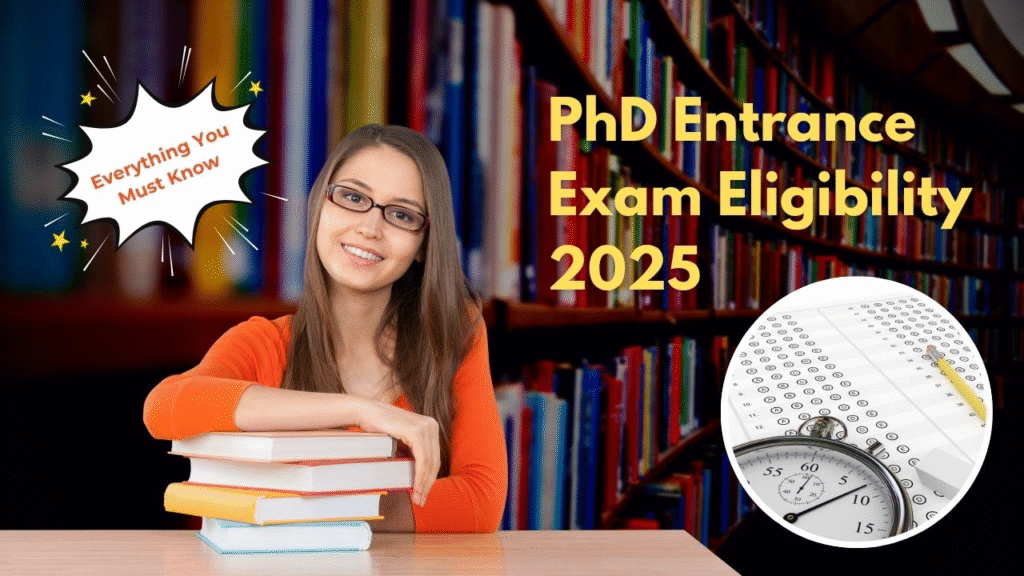
Are you ready to dive headfirst into the world of research and academia? If you are planning for a PhD in 2025, then be ready to know about the PhD Entrance Exam Eligibility 2025! This guide will offer you all the information regarding Phd entrance exam eligibility. From fundamental academic qualifications to the newest information on entrance exams, so you should prepare according to the eligibility criteria and entrance exams. Whether you’ve just graduated and wanted to get into the research field and make your future brighter, or you’re a working professional thinking about a part-time PhD, we’ve got your back. Let us decode the eligibility criteria for you and help you pave your path for a doctorate!
Core Academic Qualification
The applicant should have one of the following qualifications from a recognized board/institution:
2-year/ 4-semester Master’s degree post a 3-year Bachelor’s degree or a 1-year/ 2-semester Master’s degree post a 4-year Bachelor’s degree.
Comparable foreign qualifications if recognized by the relevant bodies.
The M.Phil. is also being at least partly phased out in select instances M.Phil. degree holders may apply directly for PhD programmes, albeit.
Minimum Marks Required
55% marks in aggregate (or its equivalent grade in the relevant subject(s) of study).
Reserved category relaxation 5% relaxation in the marks (i.e. minimum 50%) is applicable to SC/ST/OBC (non-creamy layer)/PWD/EWS and other similar categories as per UGC policy.
New Direct Admission Pathways
If you are a 4-year bachelor’s degree holder and sold a minimum of 75%, you are lucky! You can go directly for the PhD without Doing a master’s degree. The catch? You just have to crack the entrance exam to get the seat. So if you’re eager to go right into researching after your undergrad, this might be a good way to skip ahead in your academic career. Just make sure you’re prepared and your grades are good!
Entrance Exam Requirement For PhD
Major National-Level Entrance Exams for PhD Admission — From 2025 on, the majority of universities and institutes in India will adopt UGC NET scores for PhD admissions, instead of institutional entrance exams. Science, Engineering and Medical PhD- Exam like CSIR NET, GATE, ICMR JRF, DBT JRF, JEST is still flagged.
Also, some institutions may consider GRE/GMAT scores for management-related disciplines. This change will also help in unifying the process of admission throughout the country.
Exemption Provision — Those candidates who have qualified national fellowship like NET-JRF, CSIR-JRF, GATE, etc. are usually not required to write the entrance exam but they need to take the interview.
Interview and Proposal
Admission to PhD programs is usually followed by a personal interview where the research potential and preparedness of the student is assessed, and where the student is questioned about his/her Statement of Purpose (SOP) or a draft research proposal.
Age Limit
No upper age limit: Adopting a relaxation for the age bar for pursuing a PhD, all those having the requisite academic qualifications will be able to apply for a PhD in India in 2025, there is no age bar for UGC NET or institution-based examinations.
Certain courses or universities (for instance, a few IIMs) may have an upper age limit (typically 40 years).
Part-Time and Full-Time PhD
Part-time PhD programs are indeed recognized, especially for working professionals, as long as they can provide a No Objection Certificate (NOC) from their employer.
However, full-time PhD programs demand regular attendance on campus so students must attend regular classes, the minimum 75% attendance is mandatory. Most universities offer hostel accommodations to support students during their studies.
Minimum length of stay: 3 years (coursework included).
Maximum Duration: 6 years (up to one year extension in exceptional circumstances for full-time students).
Compulsory propaedeutic course work on research methodology and core courses in the first terms.
Recent UGC Updates for 2025
NET score is compulsory for the admission from the session 2025, replacing the majority of university-level entrance examinations.
Professional/part-time mode with NOC with distance education allowed.
Direct PhDs from four-year undergraduate studies for deserving students.
Important Takeaways for 2025 Applicants
Most phd admissions are focused on NET scores.
It is mandatory to have a Master’s degree with an aggregate of 55% marks or equivalent, else the maximum marks will be relaxed by 5% for reserved categories.
There is no age limit for applying for most of the courses.
The provisions for Part-Time and Interdisciplinary Research are being promoted under NEP-2020.
Interviews and research proposals are required following preliminary screening.
Please refer to the individual university portals for detailed and discipline oriented parameters.
Regulations are evolving; always check university details before applying.
Conclusion
Remembering this as you gear up for your PhD journey: the ground is always shifting. Two new direct admission options, and a common entrance test for all, make 2025 the year to watch out for all research aspirants. Keep up with developments, watch out for your marks and check out to universities for fresher information. The dream of having a PhD is a bit nearer for you, and with a little guidance about PhD Entrance Exam Eligibility 2025, you will be able to take a first step towards making your mark in the world of academics. So, get excited, stay motivated and you know what it’s time to make that PhD dream a reality!
The SSC MTS Syllabus 2025 is updated and it gives you a better understanding of the most important topic ideas. This exam is your gateway to the non-technical role in a government job. Whether you’re a new or repeat aspirant. Here is the breakdown of the SSC MTS Syllabus, and exam pattern to guide you well.
Introduction
This is a national-level recruitment process in India, the candidates who are interested in non-technical roles can appear for this exam. If the aspirants get a good score in the exam they can be selected for the government job. They recruit for non-technical jobs, and Group C positions in different ministries, organizations, and departments. Anyone can take the SSC MTS exam after the 10th pass.
It is important to know that understanding the updates of the syllabus will help you guide the overall important topics which you have to cover first and you must know the exam pattern from the previous year questions. Aspirants who want to crack SSC MTS 2025 must understand the exam pattern before they start preparation.
It has two sessions, in the first session topics are more likely related to the candidates ability for logical thinking and how far they can get to the answer. The topics are Mathematical, Ability, Reasoning Ability, and Problem-Solving, and session 2 has General Awareness, English Language, and Comprehension. Both sessions are mandatory to attempt and this is a computer-based test.
Marking and duration of the SSC MTS 2025
The total of 90 questions in this paper, where the 40 questions from session 1 and 50 questions from session 2. The Total mark of the paper is 270 and the total duration is 90 minutes (extra time for scribe users). Aspirants can take this exam in their regional language. Session I has no negative marking, while Session II penalizes wrong answers by 1 mark each.
Detailed SSC MTS Syllabus 2025
Reasoning Ability & Problem Solving This subject includes a very important topic for testing your logical thinking and problem-solving skills. Alphanumeric series, coding-decoding, analogy, and Odd one out. They are very simple topics but have very impressive and creative methods to improve logical thinking. Non-verbal reasoning (mirror image), Directions and Ranking, Syllogism, Matrix, Mathematical Calculations, and Order of words are the topics in this subject.
Numerical and Mathematical Ability Integers, Whole Numbers, LCM, HCF, Decimals, Fractions, Percentages, Ratios & Proportions, and Averages, are the topics covered in this subject because they are the basic concepts. Then there are more topics that involve the understanding of aspirant mind abilities. Work and time, time and distance, profit and loss, simple interest, discount, area and perimeter, geometry, mensuration, data interpretation, square roots, algebra, and basic trigonometry. This section assesses your numerical aptitude and mathematical understanding.
English Language and Comprehension This subject focuses on vocabulary, sentence structure, synonyms & Antonyms, error spotting, cloze tests, and reading comprehension. These topics help to understand the words and phrases with different meanings or their expression of feelings. These abilities are helpful in many government jobs in various sectors. Having a good command of English will enhance the ability to interpret written and verbal passages.
General Awareness This subject covers topics related to current affairs for both national and international. Recent events, history, geography, art and culture, civics, economics, general science, environmental studies, Indian constitution, sports, and static general knowledge. These are the topics that involve high possibility in the exam.
All four subjects are the overall syllabus to prepare for the SSC MTS examination 2025. Aspirants can get online resources and books on these topics for preparation.
Preparation Tips for SSC MTS 2025
Aspirants check the exam pattern and syllabus before preparing for the examination. Split each subject for the same duration daily so that you can prepare each subject equally and efficiently. Choose the easy topic first and complete then get to the second topic. This strategy will help you cover most of the topic in less time.
Practice mock tests and previous year’s papers to understand the exam pattern and difficulty level. You should also join the coaching classes if you want but you have to do self-study. Don’t waste too much time on a single topic. Stay updated with the current affairs daily.
Conclusion
The SSC MTS Syllabus 2025 can help you crack the exam and open the chance to get a government job in a non-technical role. Aspirants should learn the updated syllabus before preparation even if they are repeat aspirants. It changes every year to make the exam relevant and has value. Make sure to check the pattern of question papers along with a detailed syllabus.