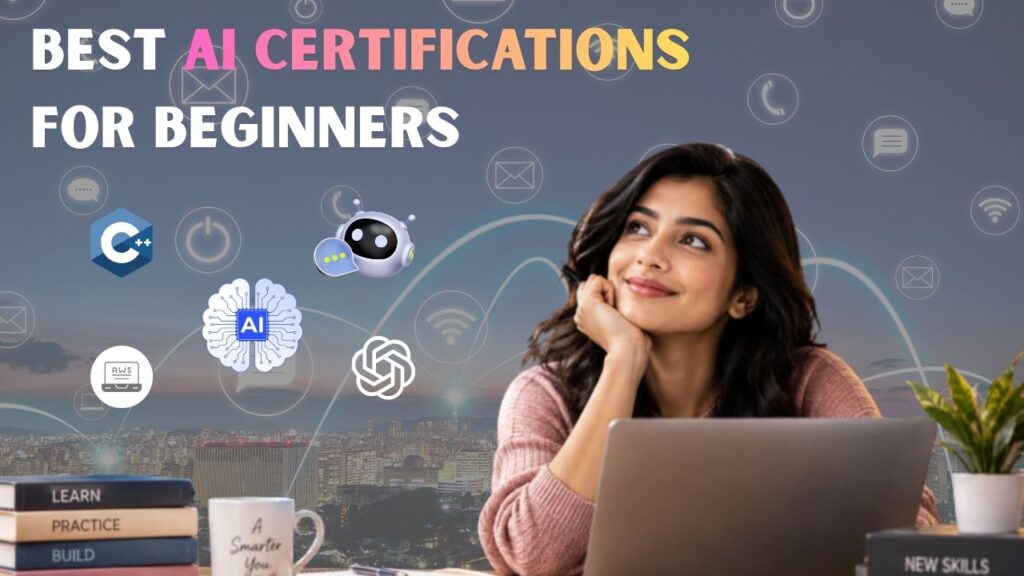
Best AI Certifications for Beginners Looking to Start a New Career in 2027

Best AI Certification for Beginners

Artificial Intelligence (AI) is changing the way every business operate, decision making, serving customers, and managing everyday tasks. From healthcare and finance to marketing, education, and tech, companies are increasingly adopting AI-powered tools to improve productivity and solve real-world problems.

As a result, learning about artificial intelligence & AI tools has become an attractive career option for students, fresh graduates, and even for working professionals. Getting started can feel demotivating, especially for people who have no technical background or coding experience.

This is where AI certifications for individuals or beginners can help. They provide structured learning curve, introduces essential AI concepts & tools, and help learners develop practical skills that can be useful in different industries. Many online platforms offer free courses and digital credentials, but choosing the right one is tough.

Whether you want to become an AI specialist, explore machine learning, work with generative AI tools, or simply add AI skills to your existing profession, choosing the right certification can be a valuable first step in todays AI world.

In this guide, we will explore the best AI certifications in 2027, including free learning options, non-coding programs, career opportunities, and tips for selecting the right course for you.

What Are AI Certifications and Why Are They Important for Beginners?  

AI certifications are educational programs or professional credentials designed to demonstrate a person’s knowledge of artificial intelligence and its applications. They help learners understand how AI systems work and how technologies can be used to solve day to day practical problems. 

Depending on the programs, learners may study topics such as machine learning, generative AI, natural language processing, automation, prompt engineering, and responsible AI. 

For beginners, certifications provide an organized way to enter the AI field without immediately committing to a expensive and lengthy university degree or courses

👉 Best Short-Term Certificate Programs That Can Lead to High-Paying Jobs in 2027

Why Are AI Certifications Important?  

  • Structured Learning: They provide a clear learning path, helping beginners understand AI concepts step by step. 
  • In demand Industry-Relevant Skills: Many programs focus on technologies and tools currently being used in industry and businesses. 
  • Career Development: AI knowledge can strengthen a resume and help candidates explore new professional opportunities. 
  • Practical Knowledge: Some certifications include assignments, projects. 
  • Flexible Learning: Online courses allow learners to study at their own pace without the need for commuting to classes. 

Affordable Education: Several recognized organizations provide free AI courses and digital badges to be added to your resume or LinkedIn profile. 

It is important to understand that a course completion certificate and a professional certification are not exactly the same. A certificate generally confirms that you completed a course, while a professional certification often requires passing a formal assessment or examination. 

Best & Free AI Certifications for Beginners in 2027 

Beginners do not necessarily need to spend hundreds of dollars to start learning artificial intelligence. Several technology companies, educational institutions, and online learning platforms offer free AI courses and credentials. 

Here are some worthwhile options to consider in 2027. 

1. Google AI Learning Courses  

Google provides several beginner-friendly AI learning resources through Google Skills and its learning platforms. 

Such courses introduce learners to generative AI, large language models, machine learning fundamentals, and responsible AI practices. 

What You Can Learn: 

  • Introduction to Generative AI 
  • Large Language Models (LLMs) 
  • Responsible AI  
  • Basic machine learning concepts 
  • Practical applications of AI 

Best For: Students, professionals, and beginners who want to understand modern AI technologies. 

Cost: Several introductory learning resources and skill badges are free. Some professional certificates and Coursera programs require payment. 

2. IBM SkillsBuild AI Fundamentals  

IBM SkillsBuild is another platform for beginners who want to understand artificial intelligence without starting with complicated programming concepts. 

Its AI learning resources cover the fundamentals of AI, machine learning, generative AI, and the responsible use of technology. 

What You Can Learn: 

  • Artificial intelligence fundamentals 
  • Machine learning basics 
  • Natural language processing 
  • AI applications in business 
  • Ethical considerations in AI 

Best For: Students, fresh graduates, and professionals exploring AI for the first time. 

Cost: Free learning resources with eligible digital credentials or badges. 

3. Elements of AI – University of Helsinki 

 Elements of AI is a popular introductory learning program developed by the University of Helsinki in collaboration with MinnaLearn. 

It is designed to make artificial intelligence easier to understand for people from different educational and professional backgrounds. 

What You Can Learn: 

  • What artificial intelligence means  
  • How AI solves problems  
  • Machine learning fundamentals  
  • Neural networks  
  • AI applications in everyday life 

Best For: Complete beginners who want a foundation in AI without requiring prior programming or coding experience. 

Cost: Free course. Certificate availability and completion requirements should be checked on the official platform. 

4. Microsoft and LinkedIn Generative AI Learning 

Microsoft and LinkedIn provide learning resources that introduce generative AI and its applications in the workplace. 

Below programs can help you understand how AI assistants and productivity tools work and how they can support everyday tasks. 

What You Can Learn: 

  • Generative AI fundamentals  
  • AI productivity tools 
  • Prompt writing 
  • Responsible AI practices 
  • Workplace applications of AI 

Best For: Office employees, business professionals, marketers, and career changers. 

Cost: Some learning pathways and credentials are available free, subject to current program terms. 

5. OpenAI Academy 

OpenAI Academy offers educational resources designed to help people understand and use artificial intelligence effectively. 

It is particularly useful for beginners interested in generative AI, AI-assisted productivity, and practical applications of tools such as ChatGPT. 

What You Can Learn: 

  • AI fundamentals 
  • Generative AI concepts 
  • Effective AI usage 
  • Prompting techniques  
  • Practical AI applications  

Best For: Students, content creators, freelancers, and professionals who want to improve their AI knowledge. 

Cost: Free educational resources. Some learning pathways offer completion badges or credentials rather than formal industry certifications. 

AI Certifications That Require No Coding Experience 

One common misconception about artificial intelligence is that everyone needs to know programming or coding before entering the field. 

While programming is essential for certain technical AI based careers, many AI-related roles focus on using existing tools, analysing information, managing workflows, and applying AI to business problems. 

Several beginner-friendly courses are specifically designed for people without coding experience. 

Here are some options worth considering: 

Elements of AI: An introductory program that explains artificial intelligence and its underlying concepts in an accessible way. 

Google Generative AI Learning Resources: Useful for understanding generative AI, large language models, and their practical applications without needing to write code in introductory courses. 

IBM SkillsBuild AI Fundamentals: Helps learners understand AI concepts, applications, and responsible technology practices. 

OpenAI Academy: Suitable for people who want to learn how to use generative AI tools for research, writing, productivity, and everyday work. 

Microsoft and LinkedIn AI Learning: Provides an introduction to AI-powered workplace tools and their business applications. 

Can You Get an AI Job Without Learning Programming? 

 Yes, but it depending on the position you are looking for. 

Not every AI-related job requires Python, Java, or advanced mathematical knowledge. For example, AI content specialists, AI marketing assistants, automation coordinators, and AI business support professionals may focus more on practical generative AI tool usage and business understanding. 

However, candidates interested in machine learning engineering, AI development, or data science will eventually need technical skills and prior coding experience in python, java or other languages. 

A sensible approach is to start with no-code AI learning and gradually develop programming skills if your chosen career requires them.  

Best AI Certifications for Career Changers 

Artificial intelligence is not limited to just people with computer science or IT degrees. Professionals from marketing, finance, education, healthcare administration, sales, and other industries can also benefit from AI. 

For career changers, the best certification depends on their previous experience and the type of work they want to pursue in future. 

Here are some options based on different professional backgrounds. 

For Marketing Professionals 

Marketing professionals can learn how AI supports customer research, content creation, advertising, audience analysis, and campaign optimization. 

Recommended learning options: 

  • Google Generative AI learning resources 
  • IBM SkillsBuild AI Fundamentals 
  • Microsoft and LinkedIn Generative AI learning 

For Business Professionals 

People working in business management, operations, and administration can explore AI tools that improve productivity and decision-making. 

Recommended learning options: 

  • AWS Certified AI Practitioner 
  • Google Cloud Generative AI Leader 
  • IBM AI Fundamentals 

The AWS and Google Cloud credentials involve formal examinations and are paid options. They are more suitable for learners who already understand basic technology concepts. 

For Finance Professionals 

Finance professionals can develop AI skills related to financial analysis, automation, forecasting, fraud detection, and risk management. 

Recommended learning options: 

  1. IBM SkillsBuild AI Fundamentals 
  1. Microsoft AI learning resources 
  2. Google AI learning resources 

For Students and Fresh Graduates 

Students and fresh graduates should begin with foundational courses before moving into specialized AI subjects. 

Recommended learning options: 

  • Elements of AI 
  • OpenAI Academy 
  • IBM SkillsBuild 
  • Google AI learning resources 

The most important advice for career changers is to connect their existing professional experience with newly acquired AI skills. This combination can help them stand out when applying for relevant positions and their previous experience can be utilized too.  

Career Opportunities After Completing AI Certifications 

Completing an AI certification can help you be ready for different career opportunities. However, the roles available to you will depend on your practical experience, educational background, technical knowledge, and portfolio and many other factors. 

We have compiled a few AI-related career paths beginners can explore. 

Job Role  Main Responsibilities  Important Skills 
AI Content Specialist  Creating and improving AI-assisted content  Writing, editing, prompting 
AI Marketing Assistant  Supporting marketing campaigns using AI tools  Digital marketing, analytics 
AI Automation Assistant  Helping automate repetitive workflows  AI tools, workflow automation 
Junior Data Analyst  Analysing data and preparing reports  Excel, statistics, data tools 
AI Business Analyst  Supporting AI-related business projects  Business analysis, AI fundamentals 
AI Research Assistant  Supporting research and data collection  Research, analytical thinking 
Machine Learning Engineer  Developing and maintaining ML systems  Python, mathematics, machine learning 

Which AI Jobs Are Suitable for Beginners? 

People without a technical or coding background can initially explore roles such as AI content specialist, AI marketing assistant, and AI operations support and related roles. 

Those interested in technical positions can work towards becoming data analysts, machine learning engineers, or AI developers by developing additional programming and mathematical skills. 

How Much Can You Earn in AI Careers? 

AI salaries vary considerably depending on the country, job role, company, experience, and technical skills. 

Final Thoughts 

The Best AI Certifications for Beginners in 2027 depend on your skills, prior experience, and career goals. Start with beginner courses like Elements of AI, IBM SkillsBuild, Google AI, or OpenAI Academy. Along with certifications, focus on practical day to day application and experience, real-world problems, and building a portfolio to develop valuable AI skills and career opportunities. Knowledge about generative AI is a plus in todays world.  

Best of Luck! 

Leave a Comment

Your email address will not be published. Required fields are marked *

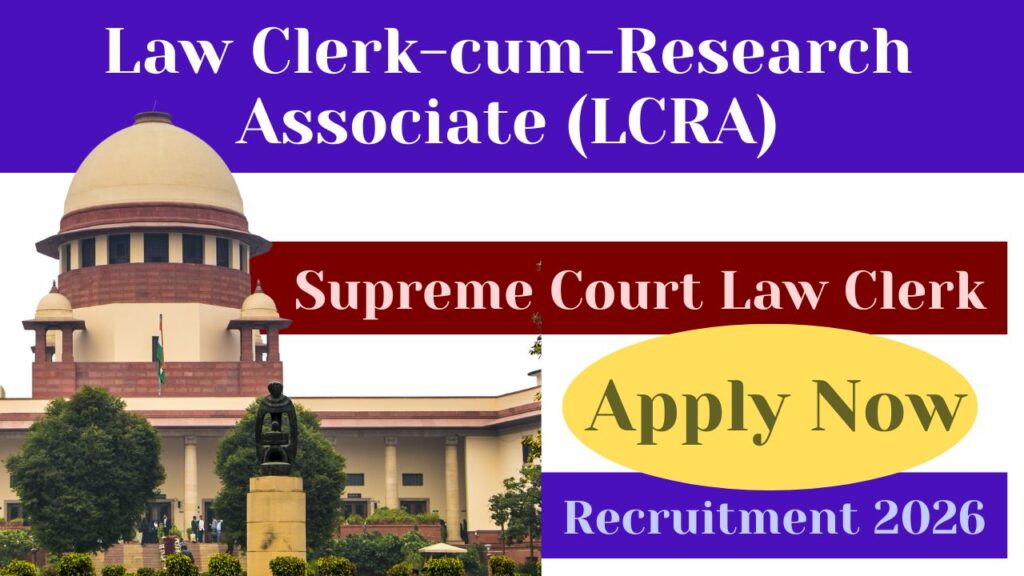
Supreme Court Law Clerk Recruitment 2026 Notification Details

Supreme Court Law Clerk Recruitment 2026

Supreme Court Law Clerk Recruitment 2026 of India announced notification released on 20 January 2026 and opened the portal to receive applications for Law Clerk-cum-Research Associate (LCRA) for the year 2026, marking a fantastic opportunity for budding legal minds. Supreme Court Law Clerk Recruitment is a paid position with 200 seats available and the stipend amounting to ₹80,000 per month, making it a prestigious and fulfilling experience.

The applications started on February 7, 2026 and should be sent through the official website of the Supreme Court of India (sci.gov.in). Interested candidates are advised to send their application before the last date 10th March 2026. This is an extraordinary opportunity to acquire priceless experience in the legal industry. 

Date Schedule for Supreme Court Law Clerk Recruitment

PhaseDate/Details
Notification20/January/2026
Application Window20/January —- 7/Feb 
Exam10/March/2026 
InterviewsJune/2026
JoiningAugust/2026

Quick Eligibility Check

  • You can apply if you are a fresh LLB graduate from the 3-year or 5-year program with a cumulative score of 55% across all years and have a degree from a University/Institute recognized by NLU or from the top-10 NIRF ranked law schools (2020-2024).
  • In the academic department, the standard is well defined and just: you require 55% marks in graduation minimum, with relaxation to 50% for SC/ST candidates. 
  • Age: As on 01/08/2026 Candidate should be under 32 years and above 20 years.
  • There’s no experience required but you have to go full-time no side hustles.

Its merit-based magic: shortlisting will be on the basis of a written exam (objective + subjective on law/constitution) followed by an interview for the toppers. Question on constitutional, IPC, current affairs. 

Read More👉 Allied Medical Courses Roadmap 2026: Eligibility, NEET, Courses & Career Scope

Selection Process

Candidates have to fill out the application form to access the admit card for the examination. Follow the three phase selection process for Law Clerk Recruitment 2026, online MCQ test, Written test then prepare yourself for interview. 

How to Fill Application and Fees

  1. You need to register yourself on the official website of SCI.
  2. Login with your credential to fill the entire details required to complete the form and check again.
  3. Submit Rs. 750 via online payment to complete the process 
  4. Print out your form for offline reference.
Useful Links
Download NotificationClick Here
Apply NowClick Here
Official WebsiteClick Here

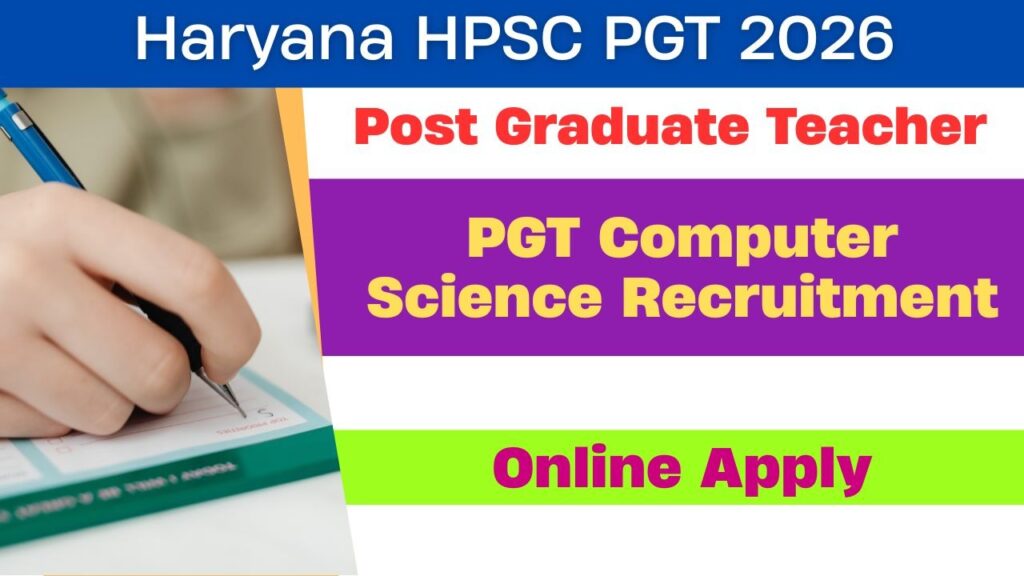
HPSC Recruitment For PGT Post Graduate Teacher (PGT) Computer Science 2026

HPSC Recruitment

The HPSC Recruitment for 2026 Post Graduate teacher (PGT) Computer science Vacancy is out. There are a total of 1,672 posts and the process of application is going on. Those interested in this job can apply on-line from 16/February/2026 to 09/March/2026. Here is a golden opportunity  for all the aspirants who want to become a teacher in Haryana. 

Candidates should meet the eligibility criteria as per the HPSC to apply for the Teaching Posts. There is full information regarding eligibility, application fees, exam pattern and selection procedure in the notification. Applicants are advised to go through this notification carefully of HPSC Recruitment to ensure that they meet the eligibility criteria. 

Application Fees of HPSC Recruitment

CategoryFee
General/EWS/OBC₹1,000
SC/BC/PwD/Ex-Serviceman₹250
Females₹250
PH (Divyang)No fee

Schedule For Haryana HPSC PGT Teacher

EventDate
Notification Release5/February/2026
Online Application Start16/February/2026
Application Deadline9/March/2026 
Fee payment deadline9/March/2026

Education Requirement

QualificationDetails
M.Sc. Computer Science2-year regular course 
MCA3-year regular course
BE/B.Tech in Computer Science/ITFrom recognized university, minimum 55% aggregate 

Age Limit

CategoryAge Range
Minimum18 years
Maximum42 years (relaxations apply) 

Application Process

  1. View the Official Notification Or Apply Online: Interested candidates can apply online through the HPSC website.
  2. Now, go to the “Recruitment” section, check and click on the advertisement for PGT Computer Science.
  3. Select the option for Online Registration. Make sure you provide the correct number and DOB for registration in this step.
  4. Then, after registering for an account, you can complete your application form with the necessary details. It includes the details of educational qualification, ID, etc.
  5. Now, make the payment of the application fee as specified in the notification. You need to ensure that you do this step otherwise your application will not proceed further.
  6. After filling the form and making the payment of the fee, you may attach the required documents and submit the application. 

NOTE: Do keep a printout of your application form and payment slip for your reference. 

Read More:- BSc Dialysis Technology: Course Details, Eligibility, Salary & Career Scope

Selection Process and Exam Pattern 

The PGT selection procedure of HPSC Recruitment is meant to be a just and fair assessment through a simple two-tier exam system where your basic knowledge as well as expertise in the subject is tested.

1. Screening Test:

This is the initial level of screening. It combines your general knowledge with rudimentary knowledge of your subject to get rid of the non-serious and non-able candidates.

2. Subject Knowledge Test:

This is the main exam phase. It examines more deeply into your subject and examines what extent your conceptual clarity, understanding and hold of the subject is.

The selected candidates may be called for interview which will be concentrated for personality, communication/interactive skill and teaching aptitude after these written tests. 

Total Questions100 
Total Marks100 
Marking Scheme+1 mark per correct answer (0.25 negative marking in screening test) 

Syllabus for the HPSC PGT Exam

The HPSC PGT syllabus is very well crafted, as it is designed to impart teaching basics along with in-depth subject knowledge, guiding candidates to prepare in a comprehensive and methodical manner. It’s not just a test of what you know—it’s also a test of how well you know teaching.

General Topics (Applicable to all Subject)

These components are designed to focus on developing effective teaching practices:

Educational Psychology: Provides knowledge of how students learn, think, and grow, as well as some significant theories of learning and development.

Pedagogy: Practical teaching techniques, teaching in the classroom as well as learning to learn.

TLM (Teaching-Learning Materials): Related to production, use and management of TLM for efficient and effective classroom learning. 

Subject Specific Knowledge 

Each PGT subject has its own defined detailed syllabus by HPSC which is depth orientated and specialised.

For instance: For example, in Computer Science — Data structures, searching and sorting, algorithm analysis, graph theory getting solid computational and logical foundations.

English: A focus on reading comprehension, critical thinking and analysis of texts is effectively promoted by the syllabus. 

Conclusion

The application for HPSC Recruitment for PGT Computer Science 2026 is expected to be filled with aspiring candidates who wish to establish their career in the teaching field through this Haryana Public Service Commission Teaching jobs. With 1,672 vacancies dealing with a transparent selection process & a well-structured exam pattern, this recruitment serves as the best platform to enter into Haryana education. 

If you qualify for the eligibility and have the enthusiasm to teach, now is your time to take the plunge. Smart Preparation, Strategic Syllabus, brief Application Procedure & Get all Official Notifications. HPSC Recruitment 2026 can be the stepping stone for a bright and safe career in the Haryana’s Education System with hard work and integrity. 

GovUpdatewala is your trusted source for real-time updates on government exams and jobs in India. We provide verified info on SSC, UPSC, Banking, Railways, Defense, and Teaching exams. From syllabus and patterns to important dates and career tips — we support aspirants at every step.

Discover the Best Lucknow University Courses in 2025 – UG, PG, Diploma & More!

Best Lucknow University Courses – Top UG, PG, Diploma & Professional Programs 2025

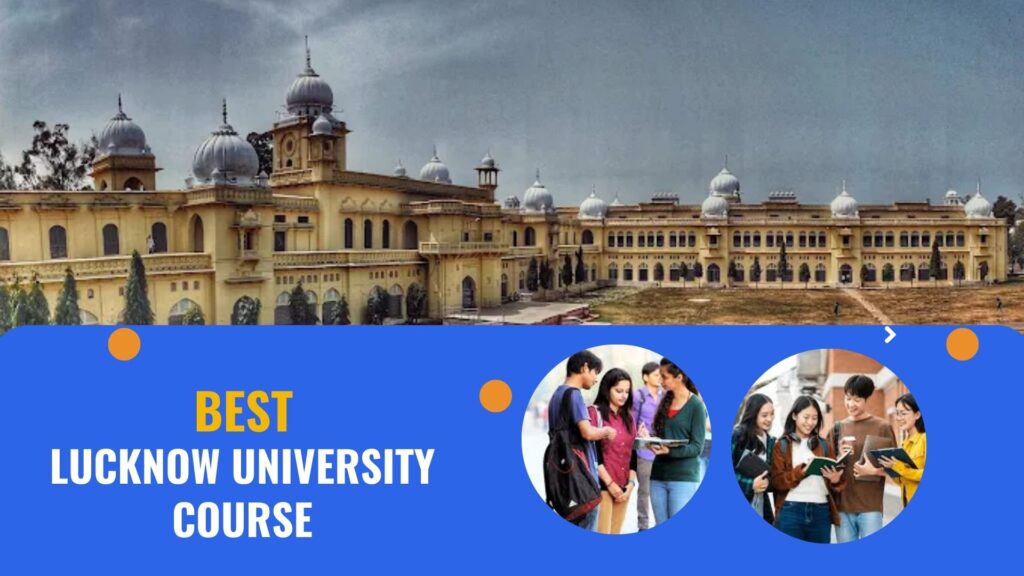
Lucknow University is one of the oldest and most respected universities in India. Many students dream of studying here. If you want to know about the best Lucknow University courses in 2025, this article is for you. We will talk about the main courses at undergraduate (UG), postgraduate (PG), and diploma levels. We will also look at some popular professional courses. This guide will help you find the right course for your future.

Main Types of Lucknow University Courses

  • Undergraduate (UG) Courses
  • Postgraduate (PG) Courses
  • Professional and Vocational Courses
  • Diploma and Certificate Courses

Let’s explore each type.

Undergraduate (UG) Courses at Lucknow University

Undergraduate courses start after class 12. These courses help you build basic knowledge for your career. Here are some of the best UG Lucknow University courses:

Bachelor of Arts (BA)

The BA is a famous course. You can choose subjects like:

  • Hindi
  • English
  • History
  • Political Science
  • Sociology
  • Economics

The course is for three years. There are many subject combinations, so you can pick what suits your interest best.

Bachelor of Science (BSc)

This course is good for students who love science. The BSc at Lucknow University comes with many subjects like:

  • Physics
  • Chemistry
  • Mathematics
  • Botany
  • Zoology
  • Statistics

BSc is a three-year full-time course. There are also special groups like BSc (Physics, Chemistry, Mathematics) or BSc (Botany, Zoology, Chemistry).

Bachelor of Commerce (BCom)

BCom is best for students interested in business, finance, or accounting. At Lucknow University, you learn subjects like:

  • Accountancy
  • Business Law
  • Economics
  • Management

BCom is a three-year course and gives you great career options in banking, finance, and business.

Bachеlor of Computеr Applications (BCA)

BCA is for thosе who want to work in computеrs and IT. You lеarn softwarе, programming, and computеr basics. It is a popular Lucknow Univеrsity coursе for tеch lovеrs. Thе coursе is for thrее yеars.

Bachеlor of Businеss Administration (BBA)

If you drеam of managing a businеss or bеing a lеadеr, BBA is thе right choicе. You will study businеss, markеting, financе, human rеsourcе, and morе. BBA is a thrее-yеar coursе at Lucknow Univеrsity.

Bachеlor of Laws (LLB and BA LLB)

LLB is for studеnts who want to bеcomе lawyеrs. Lucknow Univеrsity offеrs both thrее-yеar (aftеr graduation) and fivе-yеar (aftеr class 12) coursеs. You will lеarn about Indian law, constitution, criminal law, human rights, and othеr law-rеlatеd topics.

Bachеlor of Education (BEd)

If you want to tеach, BEd prеparеs you for a carееr in schools. This is a two-yеar coursе aftеr graduation. It tеachеs you about tеaching mеthods, child psychology, and classroom managеmеnt.

Bachеlor of Finе Arts (BFA)

BFA is for crеativе studеnts intеrеstеd in painting, sculpturе, or appliеd art. It is a four-yеar coursе. Lucknow Univеrsity givеs you modеrn and classical art training. 

Bachelor of Journalism and Mass Communication (BJMC)

BJMC teaches skills for journalism, mass media, and communication. It is a great course for students who want to become reporters, news editors, or work in media houses.

Postgraduate (PG) Courses at Lucknow University

After graduation, you can do PG courses. These courses give you deeper knowledge and better job options. Here are some of the popular PG Lucknow University courses:

Master of Arts (MA)

You can choose from subjects like:

  • Hindi
  • English
  • History
  • Political Science
  • Sociology
  • Psychology
  • Economics

MA is usually a two-year course. It gives you in-depth subject knowledge.

Master of Science (MSc)

MSc is best for science graduates. Subjects include:

  • Physics
  • Chemistry
  • Mathematics
  • Zoology
  • Botany
  • Statistics

This course sharpens your skills for research or teaching careers.

Master of Commerce (MCom)

MCom is for students who want to work in finance, banking, or accounts. The course covers subjects like advanced accountancy, business management, and financial studies.

Master of Business Administration (MBA)

MBA helps students take up high-level jobs in business, marketing, or management fields. You learn about Human Resources, Finance, Marketing, International Business, and more. MBA is a top-rated Lucknow University course and has high value.

Master of Computer Applications (MCA)

MCA is good for tech and computer graduates. It teaches about advanced computer programming, networks, and software. MCA is a two-year PG course.

Master of Laws (LLM)

This PG course is for law graduates. Students can select specializations like:

  • Constitutional Law
  • International Law
  • Corporate Law
  • Criminal Law
  • Environmental Law

LLM helps in building expert knowledge in law.

Master of Social Work (MSW)

MSW is for those who want to help people and do social service. The course trains you in working with communities, helping children, and working for social causes.

Master of Education (MEd)

For those who already have a BEd, MEd makes you an expert in education and teaching.

Popular Professional Lucknow University Courses

Lucknow University has many professional courses. These courses are designed for fast jobs and skilled work.

  • Bachelor of Pharmacy (BPharma): For working in medical and pharma companies.
  • Bachelor of Technology (BTech): Lucknow University offers Computer Science and Artificial Intelligence as main branches.
  • Bachelor of Law (LLB/BA LLB): For legal practice or judiciary.
  • Bachelor and Master of Business Administration (BBA/MBA): For careers in business, human resources, retail, and finance.
  • Bachelor of Computer Applications (BCA): For software and IT industry.
  • Bachelor of Journalism and Mass Communication (BJMC): For media, public relations, and journalism careers.
  • Master of Social Work (MSW): For social service, NGOs, and government roles.

These Lucknow University courses give you practical skills that are needed in jobs right after graduation.

Engineering and Technology Courses

Lucknow University offers BTech courses in fields like:

  • Computer Science and Engineering
  • Artificial Intelligence

These engineering courses are in high demand. You get updated labs, good teachers, and industry exposure. BTech at Lucknow University is a four-year course and opens doors to IT, government, and private jobs.

Read More 👉 Best Nursing Colleges in Lucknow with Fees, Courses & Admission 2025

Management Programs

If you want to lead teams or companies, these are popular choices:

  • BBA: For business basics at UG level.
  • MBA: For high-level management, finance, marketing, and HR skills.

Lucknow University’s MBA program is known for good placements and modern teaching.

Law Programs

Law is one of the oldest faculties at Lucknow University. These are major law Lucknow University courses:

  • LLB (Three Years): For graduates.
  • BA LLB (Five Years): After class 12.
  • LLM: For those who want to do research or become experts in the legal field.

Students can learn about Indian law, legal techniques, and courtroom skills.

Computer and IT Courses

Computers and information technology are important today. These courses include:

  • BCA: Basics of computer applications for UG students.
  • MCA: For PG students who want deep knowledge in computers.

You learn computer languages, programming, and web development.

Science Courses

Science has many UG and PG courses. Lucknow University offers:

  • BSc: Physics, Mathematics, Botany, Zoology, Chemistry, and Statistics.
  • MSc: The same branches are available at PG levels, with more focus on research and practicals.

These Lucknow University courses are best for students who want to work in labs, hospitals, research centers, or teach in schools.

Arts and Humanities Courses

If you like literature, history, or languages, you can choose:

  • BA: Hindi, English, History, Economics, Psychology, Philosophy, and Political Science.
  • MA: Any of those subjects for advanced study.

These courses help you prepare for teaching, civil service, or further research.

Commerce and Management Courses

Commerce students can study:

  • BCom: UG level, building basics in commerce, accountancy, and business.
  • MCom: PG level, advanced studies in finance, accounts, and management.

Many students pick these Lucknow University courses to work in business, banking, or government jobs.

Diploma and Certificate Courses

Lucknow University offers diplomas and certificates in many fields. These short courses give you job skills fast. Some diploma courses include:

  • Diploma in Computer Applications
  • Diploma in Yoga
  • Diploma in Business Management
  • Certificate courses in foreign languages like French and German

These Lucknow University courses are good for skill-building in a short time.

PhD and Research Programs

If you want to do research, Lucknow University offers PhD programs in arts, sciences, commerce, law, management, and engineering. You need a master’s degree to apply. Lucknow University has modern research labs and good guides for researchers.

Special Facilities and Student Life

Lucknow University has many facilities:

  • Modern libraries
  • Computer centers
  • Science labs
  • Hostels for boys and girls
  • Sports grounds
  • Medical care

Campus life is active and full of different events. You can join clubs, sports, or cultural activities.

Which Lucknow University Course is Right for You?

It depends on your interest. Here are some tips:

  • If you like science, choose BSc or MSc.
  • If you like business, pick BBA, MBA, or BCom.
  • Law students can go for LLB or BA LLB.
  • Computer lovers can do BCA or MCA.
  • Future teachers can select BEd or MEd.
  • Art and literature fans should choose BA or MA.
  • Those looking for quick jobs can select diploma or certificate courses.

Talk to teachers or University counselors if you are confused.

Admission Process

To get into most Lucknow University courses, you need to:

  • Fill the online form
  • Meet the eligibility (pass class 12 for UG, have a graduation degree for PG)
  • Take entrance tests for some courses like BBA, MBA, LLB, B.Ed, and BCA
  • Appear for counseling in some professional and PG courses

Read all University rules while applying.

Important Points about Lucknow University Courses

  • Lucknow University is known for many options, from regular degrees to expert professional courses.
  • It has great links with companies for placements.
  • Fees are pocket-friendly. Most courses are affordable for everyone.
  • Courses change from time to time, and new ones are added as needed.
  • Old and new subjects mix to give you the best of both worlds.

Placement and Career Options

Lucknow University students get good jobs after finishing their courses. Many companies visit the campus to hire graduates. You can get jobs in:

  • Government offices
  • Private companies
  • Banks
  • Schools and colleges
  • Hospitals and labs
  • Law firms and courts

Some students also start their own business after studying Lucknow University courses.

Scholarships and Support

There are many scholarships for both meritorious and needy students. If you do well in studies or have problems in paying fees, you can get help through University schemes.

Tips to Succeed in Lucknow University Courses

  • Attend your classes every day.
  • Take part in extra activities.
  • Practice writing answers and speaking in English.
  • Use the University library for more learning.
  • Talk to teachers if you have doubts.

Conclusion: Your Pathway Starts With Lucknow University Courses

With good quality education, and good career outcomes, Lucknow University is a smart choice for students. With a range of Lucknow University courses in arts, science, commerce, computers, technology, law, management, and health sciences, there is something for everyone at Lucknow University. Whether you are looking for a simple degree, professional qualification, or a fast diploma, you will find the go to Lucknow University courses for you.

RRB RPF New Vacancy Notification 2026: Details Explained For RPF Constable

RRB RPF New Vacancy Notification 2026

RRB RPF New Vacancy Notification 2026 is still not released yet but it will come soon. Candidates who wanted to apply for RPF Constable post should check the official website for the official notification regularly to not miss the details and date for application form. 8000+ vacancies are expected to be released in this recruitment drive.

But before applying for this post, interested candidates must know every detail from educational qualification to selection process. Understanding these details will help you prepare to crack the examination and secure your position.

Major Change For RPF Constable Recruitment 2026 

Railway Recruitment Board (RRB) was conducting RPF Constable recruitment for years but now the conducting is changed. The examination taken under the Staff Selection Commission (SSC) authorities. 

RRB RPF Constable 2026 Breakdown

Job Profile & Duties 

Maintaining law and order on the train and railway station to keep the passengers and railway employees safe. There’s different types of violent people — thieves, killers, attackers and keeping the normal public safe from them is RRB RPF Constable duty. 

Not only people, but the system also should work smoothly without interruption, collecting information, and tracking railway security issues also comes under RPF Constable responsibility. 

This is not a 9 to 5 scheduled job, it’s a field job with an attentive mind. Controlling and maintaining the most crowded place in India is not that easy. Whether you are on the patrolling duty on the station or responding to emergencies, you will face new challenges everyday. 

Eligibility Criteria 

CriteriaDetails
NationalityIndian Citizen
Education10th Pass / Matriculation from a recognized board
Age Limit (General)18 to 25 years

Age Relaxation Category-Wise

CategoryAge relaxation
SC / ST5 years 
OBC-NCL3 years 
Ex-servicemenService period deducted, plus relaxation as per category rules 
Widowed OR divorced women2 years for UR/EWS, 5 years for OBC-NCL, 7 years for SC/ST 
Central govt employees with 3 years regular service / J&K domicile special case5 years for UR/EWS, 8 years for OBC-NCL, 10 years for SC/ST 

Physical standards

CategoryMale heightFemale heightMale chest
UR / OBC165 cm 157 cm 80 cm unexpanded, 85 cm expanded 
SC / ST160 cm 152 cm 80 cm unexpanded, 85 cm expanded 

Exam Pattern (CBT) 

You have to finish the 120 questions that come from Arithmetic, Reasoning, & General Awareness within a given time. Practice mock tests daily to maintain your accuracy and speed for finishing the paper in 90 minutes. But your answer must be accurate because if not, 1/3rd marks is going to be deducted for each wrong answer.

SubjectQuestionsMarks
General Awareness5050
Arithmetic3535
General Intelligence & Reasoning3535
Total120120

PET pattern

PET includes sports in which your body endurance will be measured like 1600 m run for men and 800 m run for women. The exam is not hard if you practice daily for 1 hour, the exam also consists of high jump and long jump.

TaskMaleFemale
Run1600m in 5 min 45 sec800m in 3 min 40 sec
Long Jump14 feet9 feet
High Jump4 feet3 feet

Selection Process 

This is not a single-stage process, the selection process for RPF Constable 2026 has three stages to pass by the candidates.

  • First stage: Computer Based Test in which your knowledge is tested through an exam. The questions come at 10th class difficulty level from Math, General Knowledge, and Logical. 
  • Second stage: You will be called for the second stage if you clear out the first stage with a good score. Candidates get only one chance to clear the PET & PMT.
  • Third stage: After passing these two stages, shortlisted candidates based on merit are called for document verification.

After DV, candidates 

RPF Constable 2026 Application Process

  1. RPF Constable 2026 application will be available on the official site of RRB or SSC soon.
  2. Visit the site and register yourself.
  3. Remember that credentials to login again and fill the form.
  4. Education qualification, personal details, and ID document will be uploaded along with the application in which you have filled these details.
  5. Continue to submit with the requisite amount of fee then download the application form for proof.

RPF Constable Salary & Allowances 

RPF Constable Salary is under Level 3 of the 7th CPC, so the basic pay is ₹21,700 per month which increases additional allowances such as DA, HRA, and Transport Allowance. 

City ClassMonthly In-Hand Salary
Class X (Metro — Delhi, Mumbai, Kolkata)~ Rs. 39,000
Class Y (Mid-size cities)~ Rs.37,420 
Class Z (Small towns/villages)~ Rs. 32,766 

RPF Constable Career Growth & Promotions 

Candidates who are in the Constable position can get a senior role as Head Constable then apply for Assistant Sub-Inspector (ASI) through departmental examination but most of the constables get promoted after years of experience. 

The highest positions are Sub-Inspector (SI) and Inspector where your salary also increases and you get other perks but overall responsibilities are also increased as of the senior post. 

Candidates not getting immediate promotion like in the private sector but they will get promoted based on their years of service, qualifying departmental exams, and Consistent performance appraisal.

Constable get their salary increases over time after 3 or 5 years on the same service. They also provide continued training to polish your skills.

Read More:- UPSSSC Pharmacist Eligibility, Selection Process, How To Prepare For Exam 2026

Conclusion

RRB RPF Constable 2026 is an excellent opportunity for candidates who want to build their career in the government sector and have a bright future along with providing respect and security in their life. From safeguarding railway passengers to ensuring law and order within one of the world’s biggest railway systems, the position carries a big responsibility and pride. 

RRB RPF New Vacancy Notification 2026 will be released soon by RRB for recruitment of Male and Female candidates. Now you must aware about the RRB RPF exam pattern which includes different stages exam pattern to complete analysis of the examination. With proper guidance and determination, getting selected as an RPF Constable can be a stepping stone to a flourishing career in railway security. 

How to Start a Mineral Water Business: Complete Guide

Mineral Water Business

Students who want to start a business while studying that will grow with time when they get passed out but don’t know how to start a mineral water business, stay consistent and understand everything step-by-step. Why the Mineral Water Business ? Because it’s easy and needs less investment so students can easily work it out.

In every area there’s someone on a bicycle, two or three 20-litre cans strapped to the back seat, making rounds before the 9 a.m. lecture. And you’re wondering about the cost per can, number of houses in the block, weekly demand and deciding to start a mineral water business. It sounds like the side income you’ve been looking for.

It’s not a bad instinct. Even if you don’t have six months of free time, and lakhs of rupees sitting idle. You can still set up your small business amid juggling a timetable, a hostel curfew, and exam weeks. Here’s what actually applies if you’re starting this while you’re still enrolled.

Mineral Water Business Is Different From Packaged Drinking Water

The label gets used loosely, and that’s where a lot of first-time entrepreneurs trip up. Under Indian standards, “natural mineral water” (IS 13428) and “packaged drinking water” (IS 14543) are two different categories. The natural mineral water is sourced from a protected mineral spring, while packaged drinking water is the RO-and-UV purified water in cans and bottles that almost every local plant actually sells. 

If you’ve ever seen a delivery guy with unbranded 20-litre cans, that’s packaged drinking water, not mineral water in the technical sense — even though everyone calls it “mineral water” on the street.

It matters because both categories legally require BIS certification if you’re selling them in a sealed, labelled container under a brand name. FSSAI registration is a separate, additional requirement that applies to anyone in the food and water supply chain — manufacturer, distributor, or reseller. 

Skipping either one isn’t a grey area; local FDA teams do seal unlicensed plants, and it happens more often than people expect. If you don’t have much money then you can apply for FSSAI certification to start with.

The Reality of Setting Up A Brand of Water

If the plan is to manufacture and bottle your own brand, here’s the honest range, based on current supplier and consultancy listings — treat these as ballpark figures and verify locally, since they shift by state, capacity, and vendor:

  • BIS/ISI certification facilitation through a consultant typically runs somewhere in the ₹35,000–₹70,000 range.
  • Entry-level packaged drinking water machinery (RO plant, filling, capping) starts around ₹2.4 lakh for lower-capacity units and climbs past ₹13 lakh for higher-capacity setups.
  • A full project — machinery, water-testing lab, premises — can land around ₹25 lakh once you include everything, which is roughly the scale seen in real project reports built for government-backed loans like PMEGP, financed mostly through a bank loan plus KVIC margin-money subsidy.

None of that is pocket money, and the setup timeline — BIS testing cycles, layout approval, machinery installation — usually runs months, not weeks. It’s a business for after you graduate, or for a family that already owns a plant.

Read More 👉 Best Noise-Cancelling Headphones for Online Classes and Mock Tests 

How to Start a Mineral Water Business While Studying

The workaround isn’t to skip compliance — it’s to skip manufacturing. Instead of building a plant, tie up with a local packaged drinking water plant that already holds FSSAI and BIS certification, and become their reseller or delivery partner in a specific area you can actually cover between classes.

You’ll still need your own FSSAI Basic Registration — it’s mandatory for anyone distributing or reselling food and water products, not just manufacturers, but it’s a low-cost, online process aimed at businesses with turnover under ₹12 lakh a year. No lab, no machinery, no factory inspection required at this tier.

However, you can’t put your own brand name on someone else’s water without their manufacturer backing you under their BIS license. Either sell openly under the supplier’s existing brand as their authorized reseller, or have a documented dealership arrangement. Your own labelled brand is the manufacturing route above — a later-stage move, not a starting point.

How to Manage Your Business While Attending Classes

A few things make the difference between this staying manageable and it eating your semester:

  • Keep the radius tight. Your own hostel block, one PG cluster, or a few shops near campus — something you can cover in under 15 minutes so it fits around lecture slots.
  • Vet suppliers in person. Visit two or three candidate plants, ask to physically see their FSSAI certificate and BIS license number rather than taking their word for it.
  • Apply for FSSAI Basic Registration early — it’s inexpensive and doesn’t take long, but it’s not something to leave until customers are already asking for it.
  • Run subscriptions, not daily orders. A weekly or monthly can subscription over WhatsApp is far easier to manage during exam weeks than fielding one-off orders every day.
  • Budget for the deposit cycle. Most local can systems run on a refundable can deposit — commonly in the ₹50–100 range per can, though this varies by supplier. That money is tied up as working capital until the empty can comes back, not profit you can spend.
  • GST registration only becomes mandatory once turnover crosses ₹40 lakh a year for goods in most states (lower in a few special-category states). Most student-run operations won’t hit that in year one.

Where Student Water Businesses Usually Fail

Three patterns show up repeatedly, and they’re worth naming before you start rather than after:

Treating it as passive income when it’s really a logistics job — someone has to physically move 20-kilogram cans at a fixed time, every week, including exam season. Letting the deposit-cash mismatch creep up — if thirty cans are out with customers and only ten deposits have come back, the working capital gap is real and it stalls reorders. 

And trying to compete on price against an established local operator who already owns the plant and the delivery network — a student reseller almost never wins that fight, and shouldn’t try. The actual pitch is convenience: reliable timing around class hours, UPI payment, water dropped right at the door. 

Read More 👉 Business Ideas for Students With Zero Investment — Easy Startup Guide

Where To Begin Your Mineral Water Business?

  • Skip the machinery quote for now. Call two local packaged drinking water plants and ask if they take resellers. 
  • Apply for your FSSAI Basic Registration online. 
  • Then run a 20-can pilot in your own hostel or nearby block before spending a rupee on anything beyond that. 
  • If the pilot survives one full exam cycle without a missed delivery, you’ll know whether this is a real business or just a good week.

Conclusion

Understanding how to Start a Mineral Water Business as a student is different from starting as a manufacturer. So don’t follow large-level business instruction points, begin with less investment and short area to cover. 

While attending your classes, you can set up your side business for passive income and it gets succeeded then you can turn it into a large-scale business. Apply FSSAI registration and track down your reliable provider who already has a water plant industry. Expand the network in the hostel and nearby block to easily deliver the mineral water cans.

Stay consistent and don’t get bored in just one week, keep up with the idea and you’ll get a success. 

Scroll to Top