The basis of the present banking recruitment in India is the Institute of Banking Personnel Selection (IBPS). New mode of recruitment – Common Recruitment Process (CRP), is added transparency, uniformity and merit in recruitment in PSBs, RRBs and financial institutions. From probationary officers and clerks to technical officers at various levels of specialization, Institute of Banking Personnel Selection is the only gateway for obtaining safe, well-respected and rapidly growing jobs in the Indian banking sector.
To the hundreds of thousands of hopefuls they serve annually, Institute of Banking Personnel Selection is more than just an exam body — it’s a vehicle to financial stability, social standing, and long-term career growth in the country’s most trusted sector.
- Public Sector Banks—PSBs
- Regional Rural Banks—RRBs
Public Sector Banks—PSBs
Mentioned PSBs are the backbone of Indian banking with pan-India transferability and variety of career options. They offer PO, Clerk and Specialist Officers.
| Participating Bank | Headquarters |
| Bank of Baroda | Vadodara |
| Bank of India–BOI | Mumbai |
| Bank of Maharashtra—BOM | Pune |
| Canara Bank | Bengaluru |
| Central Bank of India—-CBI | Mumbai |
| Indian Bank | Chennai |
| Indian Overseas Bank—IOB | Chennai |
| Punjab National Bank—PNB | New Delhi |
| UCO Bank | Kolkata |
| Union Bank of India—UBI | Mumbai |
Those who desire to apply should note that the State Bank of India (SBI) holds its own recruitment, but the pattern is more or less similar to IBPS.
Regional Rural Banks (RRBs)
RRBs have a distinct type of recruitment as it gives the option to the candidate to attempt the language section in either Hindi or English, which is a crucial factor in terms of inclusivity.

Who are Eligible For Banking Jobs
Educational Qualifications
- Eligibility for PO and Clerk – A Bachelor’s degree in any discipline from a recognized university.
- Computer Literacy: Nowadays, operating knowledge of computer systems is a must for clerical posts. Candidates must possess a Certificate/Diploma/Degree in computer operation or must study Computer/IT as a subject in High School/College.
- Percentage Calculation: IBPS is too accurate in terms of marks. The marks in percentage obtained in graduation shall be calculated by dividing the total marks obtained by the maximum marks of aggregate of all subjects/semesters. The fraction of percentage obtained will be ignored (e.g. 59.99% will be considered as less than 60%).
Age Limits and Relaxations
| Post Category | Minimum Age | Maximum Age |
| Clerk (CSA) | 20 Years | 28 Years |
| Probationary Officer (PO) | 20 Years | 30 Years |
| Specialist Officer (SO) | 20 Years | 30 Years |
| RRB Office Assistant | 18 Years | 28 Years |
| RRB Officer Scale I | 18 Years | 30 Years |
| RRB Officer Scale II | 21 Years | 32 Years |
| RRB Officer Scale III | 21 Years | 40 Years |
Relaxations for categories:
- SC/ST: 5 years.
- OBC: 3 years.
- PwBD: 10 years.
- Ex-Servicemen: + 3 years.
Examination Patterns For Institute of Banking Personnel Selection Exams
The selection stage is a multi round game that evaluates how fast you can work, how accurate you are, how deep your concepts go, and your personality.
1.The Preliminary Examination
| Section | Questions | Marks | Duration |
| English Language | 30 | 30 | 20 Minutes |
| Quantitative Aptitude | 35 | 35 | 20 Minutes |
| Reasoning Ability | 35 | 35 | 20 Minutes |
| Total | 100 | 100 | 60 Minutes |
Now candidates will have to concentrate on only Quantitative Aptitude & Reasoning to secure 40-40 marks for correct answers in the allotted time of 45 minutes.
The Main Examination
The Mains Exam is a battle of stamina and depth. The level of difficulty leaps up dramatically from Prelims.
IBPS PO Mains
| Section | Questions | Marks | Duration |
| Reasoning & Computer Aptitude | 45 | 60 | 60 Minutes |
| General/Economy/Banking Awareness | 40 | 40 | 35 Minutes |
| English Language | 35 | 40 | 40 Minutes |
| Data Analysis & Interpretation | 35 | 60 | 45 Minutes |
| Objective Total | 155 | 200 | 180 Minutes |
| Descriptive Test (Letter & Essay) | – | 25 | 30 Minutes |
| Grand Total | – | 225 | 210 Minutes |
IBPS Clerk Mains
Related topics but none of those included the Descriptive Test and Interview.
Total: 200 Marks examination should be completed in just 160 Minutes.
Interview
After qualifying for the Mains exam, you need to clear the interview round for the final selection for the PO (Probationary Officer) post. 80% weightage is given to the score in Mains exam while 20% weightage is given to the interview score to prepare the overall merit list. The interview is for the purpose of evaluating SB candidates to see their suitability with the organisation in terms of their personality, communication skills and knowledge of banking.
Read More:- BSc Physiotherapy (BPT): Course Details, Eligibility, Fees & Career Scope
Syllabus Strategy: A Topic-Wise Breakdown
Quantitative Aptitude & Data Interpretation
- To do well in the Data Interpretation (DI) in Mains, percentages, ratios and averages should be given the utmost importance as they are the base to solve the tricky and complex problems. Implicit Caselets, Radar Graphs and Missing DI Tables also find place in this section but rather drag simple calculation and hence analytical prowess is a necessity. Also mental calculation is necessary to increase calculation speed.
- The newer pattern seems to favour “Quantity Comparison” (two given quantities to be compared) and “Data Sufficiency” items, which test conceptual clarity rather than just speed. With regular practice and tactics in place for these sections, one can surely boost performance.

Reasoning Ability
- Puzzles and Seating Arrangement: These constitute an essential 50-60% of the section. Types include Circular, Linear (North-South facing), Box, Floor, and the terrifying “Uncertain number of persons” arrangement.
Strategy: Play four to five puzzles each day, every day. The trick is to know how to write down ”conditions” efficiently before making the arrangement.
- Logical Reasoning: Syllogisms (now with “Only a few” cases), Inequalities, and Coding-Decoding inject a speed-boost.
English Language
- For Institute of Banking Personnel Selection Mains, for Reading Comprehension preparation concentrate on practising long passages from reliable sources like the Economist, or financial dailies as they are frequently centred around similar topics like inflation, cryptocurrency, and geopolitics. Improve your grammar especially in Error Spotting & Phrase Replacement by learning Parts of Speech and Subject-Verb Agreement.
- The reader’s “Editorial Routine” is well worth doing. Reserve a portion of your day to reading the editorial pages of leading newspapers like The Hindu. This is good for not only increasing the reading speed and building vocabulary but also of getting new ideas and useful material for Descriptive Essay as well as Interview.
General & Banking Awareness
To prepare well, concentrate on the following:
- Current Affairs: Go through the previous 4-6 months of affairs, This includes biggest appointments, awards, summits, government schemes, sports etc.
- Banking Awareness: Be aware of important terms like Repo Rate, Statutory Liquidity Ratio (SLR), Cash Reserve Ratio (CRR), Basel Norms, NPA (Non-Performing Assets), Priority Sector Lending.
- Static GK: Learn about currencies, capitals, national parks and the headquarter of international bodies.
Probationary Officer (PO) / Management Trainee
The Probationary Officer is the first rung on the ladder of bank officers which is also the most sought after post in banking.
Role Description
A Institute of Banking Personnel Selection PO is then the all-purpose manager. In a two year working trial (probation) the officer is sent to all the areas of the branch-loans, forex, clearing, pensions and general banking. They receive training to monitor clerical employees, approve transactions, and oversee client relations. It is a highly responsible and decisive post.
Salary (2026 Estimates)
After the 12th Bipartite Settlement, the financial attractiveness for the post of PO has gone up further.
- Basic pay: ₹48,480 – 85,920 varies according
- The monthly pay is between Rs. 85000 and Rs. 90000 gross, with dearness allowance (DA), house rent allowance (HRA), and city compensatory allowance (CCA) and other small things.
- Perks: Leased housing (rent is often reimbursed upwards of ₹20,000-₹30,000 depending on city), medical assistance, newspaper allowance, and leave fare concession.
Future Growth
Customer Service Associate (Clerk)
Once just titled Institute of Banking Personnel Selection “Clerk” this position has had a name change in a lot of banks to be more reflective of the work since this is a customer facing role as Customer Service Associate (CSA).
Role Description
The Institute of Banking Personnel Selection Clerk is the initial contact for any branch visit from a customer. Responsibilities are handling cash (depositor/teller), updating passbooks, validating KYC documents and running the single-window counter. Clerks are subject to fixed working hours (usually 10 AM to 5 PM) and they don’t have to worry so much about targets or administrative decisions as opposed to POs.
Salary
| Component | Amount (₹) |
| Basic Pay | 24,050 |
| Gross Monthly Salary | 37,000 – 41,000 |
| In-Hand Salary | 34,000 – 35,000 |
Future Opportunities
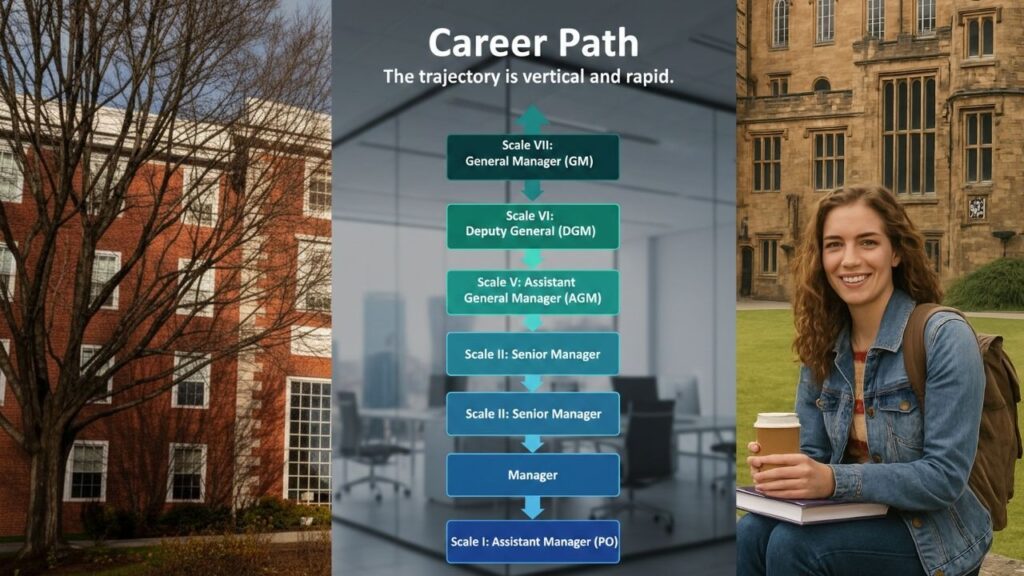
Although the entry level is low, internal promotion exams enable Clerks to rise to the Officer ranks in around 3-4 years. Several of the top PSB executives began their careers as clerks.
Specialist Officer (SO)
The Institute of Banking Personnel Selection SO position is designed for professionals with domain specific technical expertise.
- IT Officer: Responsible for the bank’s Core Banking Solution (CBS), cybersecurity, and digital channels.
- Agricultural Field Officer (AFO): The AFO is vital in India and the priority sector lending is entrusted with it. They visit villages, they visit crop patterns, they sanction agricultural loans, and then they ensure recovery. This position is the bank’s link with the rural economy.
- Rajbhasha Adhikari: For activity under the Official Languages Act and for getting circulars and other documents translated in Hindi.
- Officers in charge of Law, HR and Marketing: They manage the day to day running of their respective functions on litigation, manpower administration and product publicity respectively.
Specialist Officer (SO) Streams
Agricultural Field Officer (AFO)
As the Indian economy is agriculture based, banks are required to provide 18 per cent of their Adjusted Net Bank Credit to agriculture.
Syllabus: Soil Science, Agronomy, Horticulture, Animal husbandry, Agricultural Economics and recent Government Schemes (like PM-KISAN).
Preparation: Aspirants will need to concentrate on both the rabi and kharif crop seasons, diseases, and breeds of cattle /poultry, as the queries are very technical.
IT Officer
As banks go digital the IT Officer protects the infrastructure.
Course Outline: Installing and managing Database Management Systems (DBMS), Networking (OSI Model, TCP/IP), Network Security, Operating Systems and emerging new technologies such as Cloud Computing and AI in Banking.
Preparation: Refer to standard B.Tech/MCA books. Programming problems are uncommon; emphasis is placed on concepts and architecture.
Law Officer
In order to study well, you need to have the basics of the major provisions and its applications under the Banking Regulation Act, RBI Act, SARFAESI Act, Negotiable Instrument Act, Contract Act, and DRT rules and regulations. Be aware of the recent changes in the Insolvency and Bankruptcy Code (IBC) and the impact it has on Banking & Financial Institutions. A detailed understanding of these acts will be important for an in-depth knowledge of the subject.
Applying for IBPS exams like PO or Clerk
- Visit www.ibps.in and click on the “CRP PO/Clerk Recruitment” link for the latest job.
- Select “New Registration,” and then provide a valid email ID and mobile number. Your provisional registration number and password will be sent to your mobile phone and e-mail.
- Use this information to log in. Upload your photo, signature etc and then fill personal details like DOB, category, education, bank details etc.
- Pay now as General/OBC/EWS: ₹850. SC/ST/PwBD: ₹175.
- Press final submit, and download your e-receipt. Save a copy of the printout for your files.
Conclusion
The Institute of Banking Personnel Selection is not a mere examination body; it is a decider of the fate of the Indian middle class. It provides a clear, quantified and fair route to a career that is respectful and has stability. The process for learning from the first day learning percentages to the day helm Officer walking into a branch is transformative.
So for the student on the threshold, the message is simple: The competition is keen, but the procedure of Institute of Banking Personnel Selection is predictable. Through razor-sharp focus on the syllabus, smart test craft and knowing how to ride out temporary bad luck, the gates to India’s financial services sector are waiting for you.