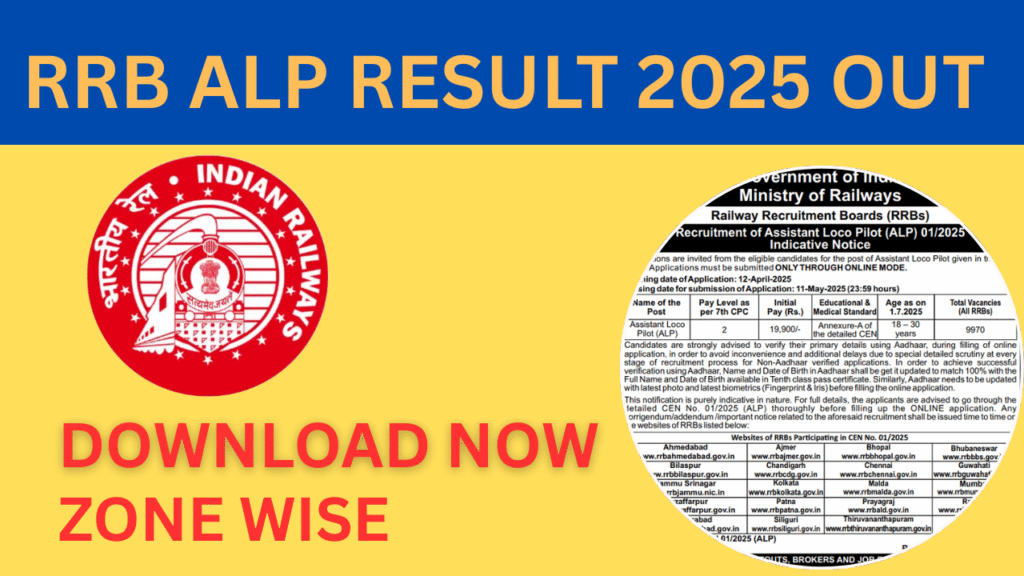
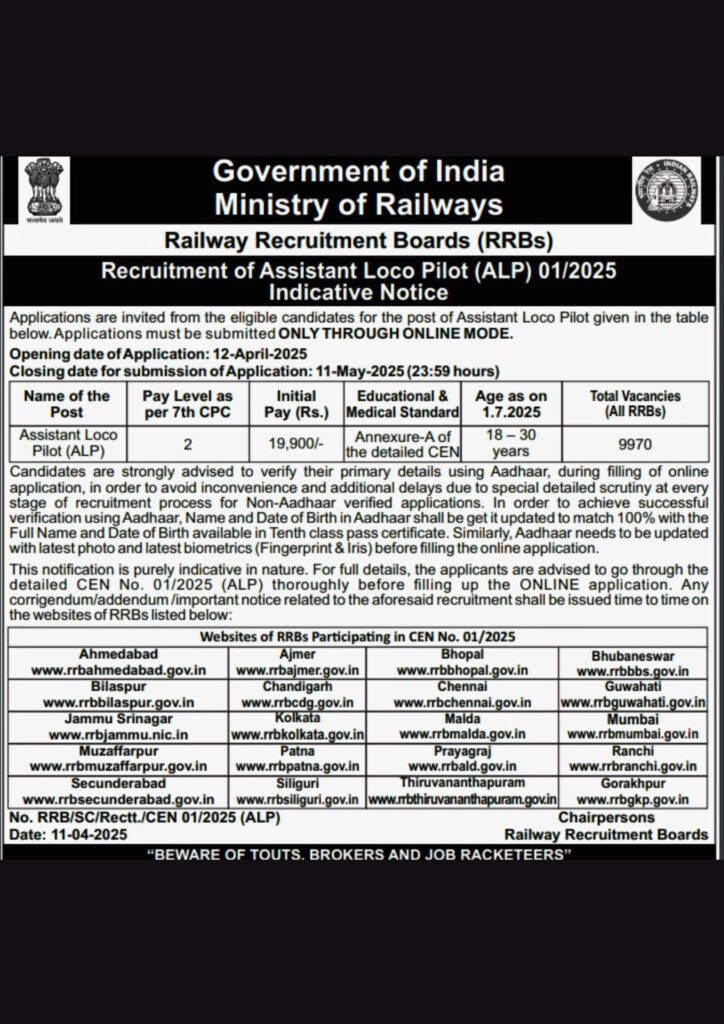
Railway Recruitment Board updates the RRB ALP Tier 2 Result 2025 Out result for assistant loco pilot exam held from 2 to 6 May, 2025, on their official website. Students who are waiting for the result can see now. You can download the RRB ALP notice to know more details.
The selection process for Assistant Loco Pilot post is divided into CBT 1, CBT 2, CBAT, Document verification and Medical Examination. Candidates must have cleared out all the rounds to get selected.
TheRRB NTPC is a competitive exam for candidates recruitment in various roles. The goal of this examination is to fill 11,558 vacancies in non-technical sectors. The massive recruitment of over 12 million applicants includes both graduate and undergraduate candidates. The selection process is multi-staged, having two computer-based tests following up the typing or aptitude skill test, document verification, and medical examination (for certain posts like railway). This rigorous process ensures that only the most capable and well-prepared candidates secure a position in the Indian Railways.
To crack this exam candidates must prepare by understanding the latest syllabus and exam pattern of the examination. The exam pattern is designed to assess the ability of the candidate for such roles as Station Master, Goods Train Manager, Senior Clerk cum Typist, Junior Clerk cum Typist, and many more. Candidates must be proficient in General Awareness, Mathematics, and General Intelligence & Reasoning, with each stage testing different aspects of knowledge and aptitude.
Stages of selection
To recruit the most qualified candidates they structured the process in multiple stages for various non-technical posts. The First stage includes a Computer Based Test, a common screening round for all applicants. This stage covers the topics of General Awareness, Mathematics, and General Intelligence & Reasoning. Candidates must clear the CBT-1 to get their name in the shortlist for the next round.
Second Stage following up the more advanced topics in the subjects to ensure the ability of the candidate. Candidates must clear this second stage with a higher level of difficulty of the questions and more questions. Those who clear this stage are eligible for subsequent skill-based assessments.
The Next stage requires the skill test of the candidates for which they were applied. Some Job posts are required to pass the typing skill test to clear the stage they must score better in this stage. The Typing Skill Test is mandatory for clerical posts, evaluating candidates’ typing proficiency. Posts like Station Master and Traffic Assistant have to take aptitude tests for operational roles.
The Last stage is for the shortlisted candidates who passed the above stage and now time to proceed with the document Verification and then the Medical examination to ensure the candidates are perfectly fine to join the organization or department. Only those who qualify in all these stages are considered for final appointment.
RRB NTPC Exam Pattern 2025 (Subjects, Marks, Duration, and no of questions)
Exam Stage
Subjects
Number of Questions
Total Marks
Duration
CBT 1
General Awareness,Mathematics,General Intelligence & Reasoning
100
100
90 minutes
CBT 2
General Awareness,Mathematics,General Intelligence & Reasoning
120
120
90 minutes
Negative marking: The candidate should be aware of negative markings for the question. 1/3 mark is deducted for every wrong answer. While the correct answer gets you 1 mark. Negative marking applies to both CBTs.
Language: This exam is available in multiple languages. Candidates can choose a regional language from different regions can also attempt this exam. The primary languages include English and Hindi. For the Computer-Based Aptitude Test (CBAT), the question paper is provided only in English and Hindi.
Subject-Wise Number of Questions and marks for RRB NTPC
Subject
CBT 1: No. of Questions
CBT 1: Marks
CBT 2: No. of Questions
CBT 2: Marks
General Awareness
40
40
50
50
Mathematics
30
30
35
35
General Intelligence & Reasoning
30
30
35
35
Total
100
100
120
120
Detailed Syllabus for RRB NTPC 2025
It is structured in a way that helps evaluate the candidate’s proficiency in Mathematics, General Intelligence & Reasoning, and General Awareness. Both CBT-1 and CBT-2 contained the same syllabus, the key difference is there are more questions in CBT-2 and harder-level questions. Let’s break down the topics of each subject that will help you to maintain the learning pattern.
Mathematics
This sections includes basic quantitative skills enhancing topics like Number System, Decimals & Fractions, LCM & HCF, Ratio and Proportion, Percentage, Mensuration, Time and Work, Time and Distance, Simple & Compound Interest, Profit and Loss, Algebra, Geometry & Trigonometry, Elementary Statistics, and Data Interpretation.
General Intelligence & Reasoning
This section has reasoning topics to check the candidates’ logical thinking and the ability to assess their skill in problem-solving. The important topics are Analogies, Number & Alphabet Series, Coding-Decoding, Mathematical Operations, Similarities & Differences, Blood Relations, Analytical Reasoning, Syllogism, Jumbling, Venn Diagrams, Puzzles, Data Sufficiency, Statement-Conclusion, Decision Making, Maps & Graph Interpretation. To prepare for this subject you must practice logic-related questions daily to crack the exam.
General Awareness
General Awareness means how much you observe the changes and updates around yourself. It must be national or international but have high value for government jobs. You must prepare well in this subject for higher scores. Current Affairs (National & International), Indian History & Freedom Struggle, Geography (India & World), Indian Polity & Governance, Indian Economy, General Science (Physics, Chemistry, Biology), Art & Culture of India, Sports, Computer Basics & Applications, Important Organizations (UN, WHO, etc.), Government Schemes, and Static GK.
Conclusion
Here is the updated syllabus for the candidates who want to crack the RRB NTPC examination. This exam is conducted to recruit candidates for non-technical posts in the government sector. This structured RRB NTPC Syllabus 2025 will help you crack the exam.
Railway RRB Technician Exam Date 2026: If you are waiting for the RRB Technician Grade 1 and Grade 3 post exam then be ready, as the Railway Recruitment Board has revealed the CBT dates — held from 05 to 09 March 2026. People who submitted their applications for these posts can start their preparations from now on and for more information about the examination refer to the official notification.
The exam dates have been announced officially, there is no more space for procrastination. If you are aiming for Technician Grade 1 or Grade 3, begin to formulate your preparation strategy now. General Intelligence & Reasoning, General Science and General Awareness are the subjects to be focused for Grade 3 and you should make a habit of solving previous year question papers and mock tests regularly.
Mark Your Calendars
The First Stage Exam RRB Technician (CEN 02/2025) Computer-Based Test(e-CBT) will be conducted from 5th to 9th March, 2026. Yes, you read it right the examination will be conducted for five days, and your exam city and category date and time slot will be considered as the assign of the date and slot.
This huge recruitment is to fill a staggering 6,238 vacancies which includes 183 posts for Technician Grade 1 Signal and 6,055 for Technician Grade 3 in multiple railway zones.
Important Dates You Can’t Afford to Miss
Application Dates
28th June — 9th August 2025
City Intimation
10 days before exam date (expected 23/February/2026)
Admit Card
4 days before exam date (Expected 1/March /2026)
Exam Date 2026
5th to 9th March 2026
Application Fee
SC / ST / Ex-Serviceman / PWDs
Rs. 250/-
Gen / OBC / EWS
Rs. 500/-
Exam Pattern For RRB Technician
The exam is simple in format featuring 100 multiple choice questions accounting for 100 marks. You will be given 90 minutes to write it. One-third of a mark will be deducted for every incorrect answer – so be accurate!
Good news for job seekers in India! The Railway Recruitment Board (RRB) has released RRB Group D Recruitment 2026 notification with approximately 22000 Level-1 posts. This drive, for CEN 09/2025 will fill posts of Track Maintainer, Assistant (Workshop), Pointsman and the like and is suited for 10th-pass youngsters aspiring for handsome coach packets jobs in railways.
Key Dates at a Glance
Short Notification
19/Jan/2026
Online Registration Start
31/Jan/2026
Application Deadline
02/March/2026
Detailed Notification
Update Soon
Application Fee For RRB Group D Recruitment
General/OBC/EWS : Rs. 500 per person
Female/SC/ST/PWD : Rs. 250/-
Eligibility Essentials For RRB Group D Recruitment 2026
Candidates who have 10th pass (or ITI from NCVT/SCVT for certain posts) are qualified to apply for this job. Age must be above 18 and below 33 years (relaxation for SC/ST/OBC). No degree required, so it’s open to millions. Physical health and rudimentary abilities are important also.
Criterion
Requirement
Education
10th Pass / ITI
Age Limit
18-33 years
Nationality
Indian Citizen
Age relaxation is provided for reserved category
Selection Process Breakdown
The procedure of selection is conducted in phases: at the beginning, a Computer-Based Test (CBT) includes the subjects Mathematics, General Awareness, Science, and Reasoning (100 questions within 90 minutes).
Then, there is a Physical Efficiency Test (PET), consisting of running and lifting, among other things. This is followed up by Document Verification and Medical Examination.
Aspirants are shortlisted in accordance with merit, so begin your preparations for the PET right away.
Salary and Perks
Get the job and enjoy Level-1 pay: Basic 18,000 + DA, HRA, TA – take-home 22,000-25,000 a month. Throw in job security, pensions, free travel and prospects for advancement.
Follow These Steps To Apply
Go to Official Website via direct Link given in the below section
Under the ‘Notices’, click on the Railway Recruitment 2026 and find registration form
Once the link will be active to the application portal, you can fill up your details and submit.
While submitting it requires you to pay the amount and print out the offline copy of the application.
RRB JE is a recruitment exam for Junior Engineer Jobs in the Railway sector. This is a competitive exam for those who wish to establish a stable career as an engineer in the Railways. It is conducted by the Railway Recruitment Board (RRB).
The RRB recruits junior engineers for the technical roles in Railways through this exam. Candidates who want to have a strong and stable career in the railway sector are preparing so well to get the highest score. Lakhs of students apply for this exam to get a job.
The RRB JE 2025 exam is designed to fill vacancies for Junior Engineers (JE), Junior Engineer (IT), Depot Material Superintendent (DMS), etc. For cracking the RRB JE 2025 you must consistently check the updated syllabus and exam pattern. Candidates must have the technical skills and knowledge before applying for this job role. The selection process is difficult as this reflects the critical responsibilities. Junior Engineers have a role in maintaining and developing systems across the Railway.
RRB JE Exam Pattern 2025
Exam Pattern for RRB JE CBT-1
In this exam, each question carries 1 mark, and the total number of questions is 100. The duration of the exam is 90 minutes. All the questions are objective-type multiple-choice. If there is an incorrect answer then the 1/3rd mark is deducted as a negative marking.
Sections and Distribution of Questions
Section
Number of Questions
Marks
Mathematics
30
30
General Intelligence & Reasoning
25
25
General Awareness
15
15
General Science
30
30
Total
100
100
Minimum Qualifying Marks
It depends on the category or financial status of the candidate. Economically weaker and unreserved candidates get 40% minimum qualifying marks. Scheduled Caste and Backward get 30% minimum qualifying marks. Scheduled Tribe gets 25% minimum qualifying marks.
RRB JE CBT 2 Exam Pattern 2025
Each question in CBT-2 carries 1 mark and makes a total of 150 marks. Candidates must complete the exam in 2 hours. For each Wrong answer, 1/3rd mark is deducted as a negative marking.
Sections and Distribution of Questions
Section
Number of Questions
Marks
General Awareness
15
15
Physics & Chemistry
15
15
Basics of Computers and Applications
10
10
Basics of Environment and Pollution Control
10
10
Technical Abilities (as per discipline)
100
100
Total
150
150
Minimum Qualifying Marks
For unreserved candidates minimum qualifying marks are 40%. Other backward classes and Scheduled caste got 30%, Scheduled Tribe got 25%.
TThis exam pattern is dependent on assessing the candidates’ ability across four sections, i.e. Mathematics, General Intelligence & Reasoning, General Awareness, and General Science. To maximize your score you must prepare all the sections and every section has crucial topics.
Mathematics
The mathematics section contains topics such as Number Systems, BODMAS, Decimals and Fractions, LCM & HCF, Ratio and Proportion, Simple and Compound Interest, and Profit and Loss, these topics are easy but important to practice for preparation. Percentages, Mensuration, Time, Work and Distance, Algebra, Geometry, Trigonometry, Elementary Statistics. Mastering these topics will get you ready for the quantitative section with confidence.
General Intelligence and Reasoning
This section assesses the candidate in their abilities through Analogies, Alphabetical and Number Series, Coding and Decoding, Mathematical Operations, Relationships, Syllogism, Venn Diagram, Data Interpretation and Sufficiency, Conclusions and Decision Making, Similarities and Differences, Analytical Reasoning, Statement (Arguments and Assumptions). By preparing this topic proof your logic and reasonable thoughts also enhance your speed in recognizing patterns. Candidate must practice for these topics consistently.
General Awareness
General Awareness contains topics such as Current Affairs, Indian Geography, Culture and History of India (including the freedom struggle), Indian Polity and Constitution, Indian Economy, Environmental Issues (India and the World), Sports, and General Scientific and Technological Developments. These topics have to enhance the powerful skill for staying updated or be the first to know everything that could effective and influential on the nation or internationally. Staying updated with daily news and revising static GK will be beneficial for this section.
General Science
Physics, Chemistry, and Life Sciences have a strong grasp of fundamental scientific principles. This section is easy because it contains the 10th class syllabus of basic science. However, it is easy as well as mandatory to rank high score in this section.
RRB JE CBT 2 Syllabus
General Awareness
The General Awareness section in CBT 2 covers all topics from CBT 1—such as current affairs, Indian geography, history and culture, Indian polity, economy, environmental issues, sports, and scientific developments but with deeper topics and complexity. So, be prepared well for the CBT-2 because it is hard as compared to the CBT-1. As you have cleared out CBT-1, you could prepare a general awareness section easily it covers the day-to-day updates and old important events or locations. Focus more on national and international events, and government schemes.
Physics & Chemistry
CBT-2 focuses on deeper concepts of physics and chemistry that are relevant to engineering. Candidates are expected to have a solid grasp of core concepts from both subjects, the basic principles and laws, 10th class NCERT can also have such concepts which can help to crack this exam.
Basics of Computers and Applications
This section focuses on computer fundamentals, networking, MS Office, and operating systems. Candidate must have basic knowledge of these basic computers. As for the engineering job posts technical skills are required and computer application is one of the concepts every candidate must learn.
Basics of Environment and Pollution Control
This section includes environmental concepts of pollution (air, water, noise) and also its effect on the land, global warming (one of the rising topics of these days), ozone depletion is the layer around the earth which is decreasing day-by-day, waste management, and sustainable development. Sustainable development is rising in every sector because of the necessity and people’s support for a sustainable future. Mastering these topics will help you to maximize your score in these sections.
Technical Abilities (as per discipline)
The Technical Abilities section covers the topic of engineering and varies to the candidates’ branch such as Civil, Mechanical, Electrical, or Electronics. This section tests the knowledge of the candidate in their respective field of engineering. Ensuring a thorough assessment of core concepts and practical knowledge required for junior engineering roles in Indian Railways.
Branch
Key Topics
Civil Engineering
Building material includes the construction needs to build the infrastructure.- Surveying: Measurement techniques, leveling, mapping, and surveying instruments. Without the help of the instrument, it is impossible to build something accurate.- Hydraulics: resources of water, Fluid properties, etc- Structural Engineering: Analysis and design of beams, and columns.- Transportation Engineering: all four means of transportations engineering.- Estimation and Costing: Preparation of budgets, cost analysis, valuation in construction.- Soil Mechanics: soil fertilization, classification, properties- Environmental Engineering: pollution and global warming effects, sustainability
Electrical Engineering
– Basics of Electrical Circuits: Circuit laws, network theorems, analysis.- Electrical Machines: Transformers, motors, generators- Measurement techniques, instrument types, calibration.- Control Systems: Feedback mechanisms, stability, automation.- Utilization of Electrical Energy: Lighting, heating, traction, industrial applications.- Power Systems: Generation, transmission, distribution, protection systems.- Basic Electronics: Semiconductors, digital electronics, diodes
– Basic Electronics: Semiconductors, transistors- Digital Electronics: AND AND NOR- Logic gates- Communication Systems: Analog OR digital communication, modulation, transmission, frequency.- Control Systems: Feedback, stability, process control.- Network Theory: Circuit analysis, filters, network theorems.- Instrumentation: Measurement systems, transducers, signal conditioning.
Computer Science & IT
– PC Software: MS Windows, Word, Excel, PowerPoint.- Computer Fundamentals: Hardware, Software, Internet basics.- Programming Languages: OOP concepts, Java, C++- Data Structures: Arrays, stacks, searching, sorting.- DBMS: Relational models, SQL, triggers, database design.- Operating Systems: Linux, commands, system administration.- Web Technologies: HTML, web servers, internet protocols, security.- Networking: OSI model, TCP/IP, topologies, transmission media, error detection/correction.
RPF constable results have been officially declared now, candidates can login and check their score on the official website. The exam was held between 2nd to 18 march 2025 for railway protection force constable recruitment. This is a competitive exam and lakhs of aspirants participated in the exam and now it is time to watch their score. You can download the scorecard and print it out for offline copy.
Recruitment Body
RRB
Post
RPF Constable
Railway RPF Constable
Central government Job post under the Ministry of Railway, which mainly refers to constables on the Railway Protection Force.