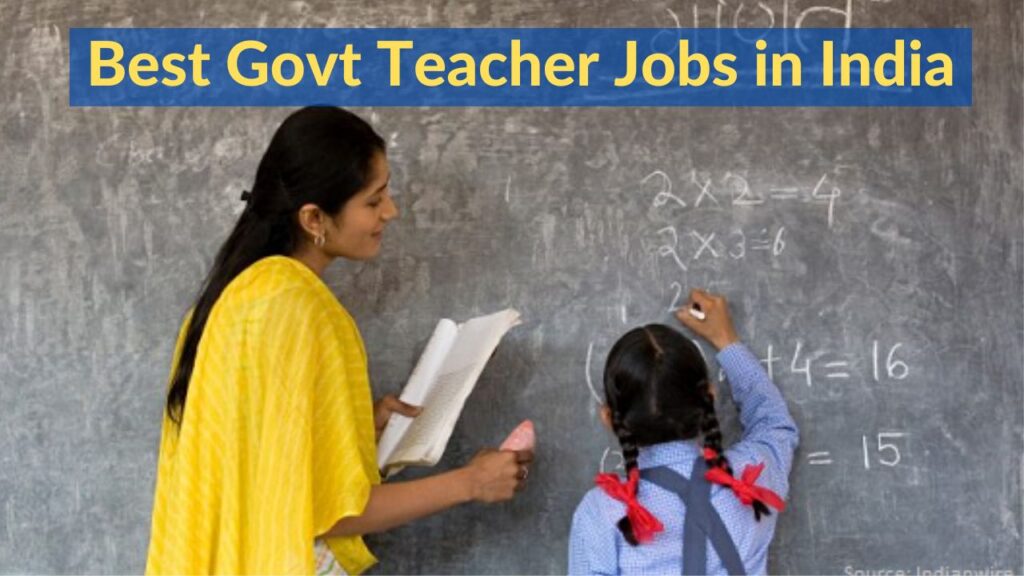
Best Govt Teacher Jobs in India You Shouldn’t Miss in 2025

Best Govt Teacher Jobs in India

If you are considering teaching as a career option, here are some of the best govt teacher jobs you can look into. Government teachers are very respectable and offer high salaries with career stability. You can choose this profession if you are interested in teaching, there are several opportunities for aspiring teachers you can explore in this article. First of all, government jobs provide high perks such as a large pay scale, job security, promotions, and pensions. Second, it is not a very hectic profession. You can easily educate youngsters on specific subjects.

Top Government Teacher Jobs in India

1. Primary School Teachers (PRT)

EligibilityB.Ed is compulsory or D.Ed
CTET-qualified or STET-qualified
SalaryStarting pay from ₹30,000 to ₹40,000 per month.
Allowance benefit

Recruitment Process for Primary School Teachers

If you are eligible to be a primary school teacher, you can apply for this position after passing the eligibility test conducted by the government. This is a written exam that includes the basics of the subjects. After passing the exam the next stage is document verification and interview. The interview is taken by the school or college directly after the document verification. 

2. Trained Graduate Teachers

EligibilityGraduate with any relevant subject
B.Ed degree and CTET certification. Both are required 
SalaryStarting pay from ₹40,000 – ₹55,000 per month.
Dearness Allowance and House Rent Allowance

Requirement Process

The organizations like DSSSB, KVS, and state education are taking the exam for this role. Only the qualified teachers are eligible to teach in the Schools. If you are planning to establish a career as a government teacher then start preparing for the exam and beat the competition for securing a job role. 

3. Post Graduate Teachers 

EligibilityPost-graduate degree in a specific subject
B.Ed qualification 
CTET preferred in some states
SalaryStarting pay from ₹60,000 – ₹80,000 per month.

Recruitment Process

By clearing the National-Level exams like KVS, NVS, or any other state-specific, you can get a position as the post-graduate teacher in a school. It depends on your subject choice which teacher you can become and how much teaching experience you have. 

Specialized Teaching Roles

Assistant Professors in Colleges

Assistant Professor is the first stage position as a teacher in any college or university. The candidate has to gain experience through this position for teaching as an associate professor. The requirement of experience is required in some colleges but a master’s degree is compulsory for this position. The qualification of PhD is mandatory, if you clear the NET are eligible for this role without the PhD. The NET/SLET qualified candidates are eligible for this position. 

EligibilityMaster’s degree with at least 55% marks
NET or PhD qualification 
SalaryStarting pay from ₹70,000 – ₹1,20,000 per month.
Research opportunity

Recruitment Process

The selection process for Assistant Professors in Colleges happened after clearing the UGC-NET exam or state-level exam. You will be selected for the next stage for an interview directly from college. Both stages are mandatory for assistant professor positions in any college.

Special Education Teachers

The special teachers are delivering education to those students who do not understand easily as they have a lack of development, intelligence, and emotional disabilities. The aim is to support these children in learning and help the students achieve their full potential in academic and social settings. 

EligibilityBachelor’s/Master’s degree with at least 55% marks in Special education 
RCI registration (Rehabilitation Council of India)
SalaryStarting pay from ₹45,000 – ₹60,000 per month.

Recruitment Process

The recruitment for the special education teacher is conducted by the state board or CBSE. NGOs are involved in this process too. This role requires teaching certification of specific special education, maybe it is not required by some states. Training is preferred for assessing knowledge of various disabilities like autism, dyslexia, or ADHD because it helps teachers to understand the child problem.

Centralized Teaching Jobs

Kendriya Vidyalaya Sangathan Teacher

The Kendriya Vidyalaya Sangathan is the organization under the government of India. The KVS teachers are responsible for this education system of all the schools under the central government, sometimes we call KVS teachers the heart of this system.

EligibilityPRT: Graduation in a relevant subject (B.Ed/D.Ed, CTET)
TGT: Graduation with a B.Ed/D.Ed, CTET
PGT: Post-Graduation in a relevant subject + B.Ed
Age: 18-40 years
SalarySalaries are as per the 7th pay commission, ranges between 40,000 to 90,000
Other benefits such as allowance and medical coverage is given to the teachers

Recruitment Process

The candidates have to take the written examination test for this position. The PRT, TGT, and PGT positions are require some specific examination clearance. You must clear the written exam then you go to the interview stage if you are selected in these two stages only then come on to the next stage which is the Skill Test. The Skill test is based on the specific post you are applying for like music, dance teacher, or any other category.

Navodaya Vidyalaya Samiti Teachers

The Navodaya Vidyalaya Samiti is also under the Ministry of education, which is the central government organization specializing in providing quality education to children from rural areas. This is a free education providing talented children. The motive of the teacher is to develop academic excellence in every area of the country.

EligibilityTGT: Graduation with B.Ed/D.Ed, CTET
PGT: Post-Graduation in any relevant subject + B.Ed
Age: 18-50 years
SalarySalary range between 40,000 to 85,000
Other benefits like allowance, and professional development

Recruitment process

You have to take the written examination that evaluates subjects of knowledge in aptitude, reasoning, and general awareness. The next step is an interview, if you are selected in the first step you are eligible for the interview. The last and final stage is a skill test which is taken for specific posts like music, art, or physical education. The recruitment for this position is published on the NVS official website.

State Government Teaching Jobs

State Education Board Teachers

The various state governments in India are recruiting teachers for the state education board education. The State Education Board Teacher has a responsibility to teach students according to the syllabus and exam pattern. The students came from urban and rural areas on this board. Teachers must maintain lesson plans and assist in implementing state-level education initiatives. 

Types of State Education Board Teachers

Primary School Teachers Teach students from 1 to 5
Upper Primary School TeachersTeach students from 6 to 8
Secondary and Higher Secondary TeachersTeach grades 9 to 12 specialized subjects such as Mathematics History, English, etc
Prepare them for the state exam

Recruitment Exams for Teacher Jobs

Central Teacher Eligibility Test (CTET)This test is taken by the CBSE for PRT and TGT teachers.
State Teacher Eligibility Test (TET)This exam is a state-specific exam taken under the state board like UPTET, HTET, etc.
Other Exams:DSSSB (Delhi Subordinate Service Selection Board)KVS/NVS examsUGC-NET 

Conclusion

There are a plethora of govt teacher jobs in India for you, whether you aim for teaching or government jobs, this is the best opportunity for you to teach in either school, college, or university. Check the eligibility criteria and selection process before applying for the teaching job. Keep track of the application process through the official website https://www.ncs.gov.in/ for these job roles.

Leave a Comment

Your email address will not be published. Required fields are marked *

NTA CSIR UGC NET Admit Card 2025 Released – Check Exam City & Download Now on Gov Update Wala!

NTA CSIR UGC NET Admit Card

Candidates who have applied for the UGC NET exam can check their NTA CSIR NET Admit Card 2025 on the official website. Candidates must download their admit card to know the exact location of the exam centre. The admit card consists of Name, Exam centre, Exam Name, Shift Timing, Roll Number, etc. 

There are a total of three parts – A, B, and C where part A contains objective-questions from general aptitude, the rest of the two parts are based on the subjects. Negative marking is applicable, so candidates must prepare well for this exam.

Qualifying candidates will be eligible for different opportunities such as Junior Research Fellowship, Assistant Professor, and PhD admission

Short Details for the NTA CSIR UGC NET Admit Card

Exam NameUGC NET
Exam Conducting BodyNational Testing Agency
StatusAdmit Card Released
PurposeUGC NET is a national-level exam to open the path for programs in research and scientific fields.
Exam Date28/July/2025
Exam ModeOnline
Duration of Exam180 minutes
Official WebsiteClick Here

NTA CSIR UGC NET Admit Card 2025 Dates

Application Date03–23 June, 2025
Last Date for Fee Payment24/June/2025
Exam Date26, 27, & 28/July/2025
Admit Card DateJuly/2025 (before exam)
Exam City Intimation19/July/2025

For the latest update on the admit card, candidates should check the official website. The admit card will be released soon (before the exam date).

Guide to NTA CSIR UGC NET Admit Card Download 

  1. You need to click on the link to the Official NTA Website.
  2. Then navigate the login section or click on the direct link to log in from this article.
  3. Candidates must enter an application number and password to log in.
  4. After logging in, you can download your admit card or exam city slip to your system.
  5. Save it for future reference.
Important Links
Log inClick Here
NotificationClick Here
Short NoticeClick Here
Official WebsiteClick Here

Leave a Comment

Your email address will not be published. Required fields are marked *

How to Crack State PSC Exams in First Attempt: Strategy & Resources

Govt. jobs are undoubtedly one of the most safe and respected career options in India and passing the State Public Service Commission (PSC) exam in first attempt is a dream for many aspirants. As the competition is rising and the syllabus is vast, it sometimes feels like a difficult mountain to scale. But, with the right approach, intelligent study techniques, and diligent efforts, passing the exam is not an impossible dream. The crux is to understand the syllabus in depth, follow the right resources and adhere to a disciplined schedule that would cover both prelims & mains preparation.

Quick Thoughts Gathering to Begin With

  1. Download official syllabus + all past papers of 8 years.
  2. Make a list of books you own/need (start with NCERTs).
  3. Select optional subject.
  4. Put together a weekly schedule you can live with.
  5. Create a one-pager daily current affairs file.
  6. Enroll in test series / good coaching (online/offline) and commit to weekly mocks.
  7. Start your NCERTs (goal: 2–3 chapters/day).

Big-picture study strategy (what to study & why)

Build bedrock knowledge first: NCERTs (6–12) for History, Geography, Economics, and Pol. These give a clean conceptual base.

Proceed to standard books for each subject (more below). Read for understanding, not rote.

Current affairs daily — newspaper + short notes. Link events to static syllabus.

Notes + revision cycle — Make short revision notes (1–2 pages) per topic; revise them frequently.

Practice smartly: MCQs for prelims + answer writing under time pressure for mains. Mains wins jobs — practice answer structure & linking facts to syllabus keywords.

Mocks & feedback: Do full length mocks and get answers evaluated (peer/mentor) and you improve your answer style and technique of scoring.

Recommended core resources (common, high-utility) 

(You will need to add in your state-specific books / local history that you must have from your state board / PSC Recommended Readings)

  1. Cover Basics 

NCERTs 6–12 — History, Geography, Pol. Science, Economics (start here).

Indian Polity — M. Laxmikanth (efficient + concise for governance & state-centred comparative questions).

Modern Indian History — Spectrum’s A Brief History of Modern India / Bipin Chandra (for depth).

Indian Economy — Ramesh Singh or any good concise economy book, supplemented with RBI / Economic Survey summaries.

Geography — Certificate Physical & Human Geography (G.C. Leong) or equivalent concise books.

Environment & Ecology — normal environment compendium/ class notes, track Recent Events.

State-specific history & polity — whatever books your PSC cites, in addition to local gazetteers and state government documents.

  1. Current affairs & general reading

One daily national newspaper (The Hindu / Indian Express) or their summaries. Government releases: Press Information Bureau (PIB), state government portals, official reports (for schemes and facts). Monthly magazines or current affairs compendiums (good for revision).

  1. Practice

Collection of previous years’ PSC papers (must have). A good questionbank or mock test series (free/paid) for practicing in time bound manner. Answer writing notebooks (keep one for mains answers). 

Sample schedules — choose according to the time you have

If you have 12 months

1st to 4th month: complete NCERTs + standard books for GS I–III fundamentals; decide optional & finish fundamentals.

Months 5 to 8: Complete other standard books + begin consolidating notes; begin on PYQs.

9th and 10th months: High-intensity test series – full-length prelim mock test every week; augments revision of weak topics.

Months 11–12: Final run through + daily PYQs + last-mile current affairs. Mains answer practice (if prelim cleared).

If you have 6 months

1st month: Preparation for NCERTs + syllabus mapping + optional selection.

2nd to 4th month: Read standard books, prepare short notes, solve MCQs and PYQs.

Month 5: Rigorous mock tests (prelim-benchmarked); Time management to be calibrated.

Month 6: Re-visit everything + frequent mock tests + current affairs wrap-up.

If you have three months

  • Fast NCERT reading + priority standard book chapters on some important subjects.
  • Study 7-10 hours a day: current affairs in the morning, theory in bulk in mid-day, MCQs + past papers in the evening.
  • Mocks repeatedly at intervals of 3-4 days Analyze each. 

Prelims strategy (objective test)

A good preparation strategy would be to start with the NCERTs along with one standard book per subject to establish a strong base. While learning content, same importance should be given to speed and accuracy by daily practicing MCQs gradually going to 500 – 1000 in a week. To gain maximum returns in minimum time, concentrate on high-yield topics such as Polity, the Constitution, Economy (primarily basic indices), Geography (with emphasis on map work), Environment, and Current Affairs. The Previous Year Questions (PYQs should be backbone of your preparation as it helps you to identify the areas/themes which the exam repeatedly tests). 

Also Read : Top 10 List of Exams Conducted by UPSC After Graduation in 2025

Mains strategy (subjective / descriptive)

Start writing answers from the early days of preparation, while upgrading yourself with the ability to write a good structured answer that has an introduction, a well-structured body (with headings or bullet points, if necessary) and a brief conclusion or way forward. Static knowledge and linking current affairs with theoretical knowledge need to be a part of answers as they give depth and relevance to answers. At the mid-stage of your preparation, doing a full answer paper every week – both essays and GS papers — is useful in developing regularity and you can increase the frequency as the exam comes closer. Regular assessment or peer review also is necessary, as it improves presentation as well as the density of content, leading to more effective answers. 

Interview / personality test

Prepare short biographical stories related to: accomplishments, academic projects, work experience and expertise in optional subjects. Stay informed on regional issues and national affairs. Conduct mock interviews with mentors or peers, concentrate on clear communication, serenity, and concise responses. 

Common Mistakes to Avoid

  • Learning everything superficially diminishes its utility; depth is much more valuable than breadth across different fields at surface level isn’t very rewarding.
  • Disregarding previous years’ papers is the biggest blunder as these papers bring out the themes that repeat, the patterns of questions and the areas to be concentrated.
  • Not timing yourself while you practise MCQs or while writing answers results in bad speed and poor accuracy in the exam.
  • Too many resources create noise and confusion, while focusing one’s attention on too few resources creates blind spots. A small set of high quality, reliable resources is the best bet for clarity and retention.
  • Avoiding regular revision destroys the power of retention; one should revise systematically and at frequenter intervals to be able to recite confidently and be assured of long term recall. 

Conclusion

How to Study Smart for First Attempt State PSC (Public Service Commission) Exam It is not about studying for countless hours, but it is about studying smart by keeping focus and being consistent. This trip requires a very clear mind, discipline, and a problem-solving attitude. Candidates with the right resources and guidance, along with consistent practice and revision, can not only cram for the exam but gain the confidence to ace at the Interview round. Wait for it… Success in the competitive exam is for those who start early, prepare strategically and have a firm belief till last that they will pass the exam. 

Leave a Comment

Your email address will not be published. Required fields are marked *

SSC JE vs RRB JE: Which Govt Job Offers Better Salary, Growth & Stability in 2025?

SSC JE vs RRB JE

The debate between SSC JE vs RRB JE occurs between the engineering graduates who want government jobs. Both paths offer good packages with future growth. Aspirants must know about their selection process and job roles before stepping into the path. 

The Staff Selection Commission is conducting an exam for selecting candidates in Central government departments and ministries such as CPWD, CWS, and MES for the Junior Engineer role. The exam structure consists of two papers – Paper 1 & Paper 2 with 200 and 300 marks respectively.

Railway Recruitment Boards is conducting an exam for recruiting Junior Engineers for Indian Railways. This exam structure varies on – CBT 1, 2, document, and medical test for ensuring that you are able for field work or not. The competition is high in RRB JE recruitment so it is hard to beat it.

Understanding of Importance for SSC JE and RRB JE Comparison?

Both jobs have some similar benefits but there are other differences which makes them unique in their area of work. 

Similarities: Both RRB JE and SSC JE offer the same salary packages of around Rs. 50,000 to Rs. 60,000 (7th pay commission). Additional perks are the same including Housing Allowance, Dearness, Travel, Medical, Pension. A degree or diploma in engineering is required for these positions.

Differences: SSC JE engineering posted in departments of government while RRB JE works in Indian Railways. Frequent transfer, fast promotion, and field work mostly in the RRB. SSC offers slower promotion, desk & field work, no frequent transfers. 

Read More 👉 RRB JE Syllabus 2025: CBT 1 & CBT 2 Exam Pattern Explained

Major Departments Covered Under SSC JE and RRB JE

Every year SSC and RRB conduct exams for junior engineers recruitment for various departments. CPWD, MES, Central Water Commission, National Technical Research, BRO by the SSC. Indian Railways departments are in all zones from Northern to Southern and Eastern to Western.

Job Role & Work Environment

SSC JE roles are majorly related to the desk work with some supervision. If candidates have the ability to work in the office environment daily which needs skills such as planning, reporting, administrative then it is the best choice. Some tasks may need technical on-site work but not as much as RRB JE.

RRB JE offers field and operational work which is on-ground tasks. The engineers in the railway sector are expected to be involved in maintenance and operational duties.

Salary Structure in 2025

The salary structure for RRB JE and SSC JE in 2025 by level 6th (7th pay commission). Here is the detailed overview of the structure:

Pay LevelLevel 6 (Group B, Non-Gazetted)
Basic Pay₹35,400
Pay Scale Range₹35,400 – ₹1,12,400
Grade Pay (Old system)₹4,200
Dearness Allowance (DA)Around 17%-50% (varies; example 17% ≈ ₹6,000)
Travel AllowanceCities = ₹3,600Other Places = ₹1,800
Gross Salary RangeApprox. ₹46,000 to ₹63,700 (depending on city & allowances)
In-Hand Salary₹50,000 to ₹60,000 per month (after deductions such as PF, tax)

Career Growth & Promotions

SSC JE has more senior level positions and performance based promotion that offer you long-term benefit. Each promotion gives you an increment in your salary and offers diverse roles in various departments.

RRB JE is highly secure but offers fewer higher positions. Mostly need technical specialization within railways and promotion through different exams.

Posting Location & Transfers

SSC JE is less frequent in postings so it is best for those who want to settle down in one place with family. If you want fixed hours of working this path is guaranteed to provide you that. No changes in regular life but sometimes project-specific relocation happens in urban areas.

RRB JE postings are unpredictable as they can offer you rural areas and frequent changes in the location may be problematic for someone who doesn’t want regular changes in life. 

Job Stability & Security

SSC JE is a very stable job which offers security for the role and no elimination from the post until something serious misconduct occurs. RRB JE also offers job security because there are no layoffs in the government sector. And the need for staff is essential for safety and functioning Indian railways.

Read More 👉 RRB Group D Exam Date 2025 Out Soon – Check Syllabus, Admit Card & Hall Ticket Link

Work Culture & Facilities

SSC JE Work Culture

Most departments have fixed hours of working with professional, disciplined, and well-defined roles. Day-to-day responsibilities for reporting and documentation are basically a part of the job. Employees are satisfied with terms of stability, salary, promotions, and additional benefits. But what attracts them most is their work environment and professionalism. 

RRB JE Work Culture & Facilities

Working employees are showing satisfaction level while their passion meets with the largest sector of India. Technical and field workers experience additional perks of traveling and community culture which is not applicable in most of the jobs. But some people might have problems with disturbing locations.

Which is Better for You?

Seeing your friend or any relative working in SSC or RRB is good but making your life decision based on looking for them having a great life isn’t good. Try to find out your abilities and interests which are important to meet the needs of the job. 

If you are passionate about traveling and exploring new challenges while experiencing some issues such as away from hometown and not stable work-life balance. If you are okay with this then you can choose RRB JE job otherwise, go for the second option i.e. SSC JE. 

SSC JE offers stability and working in departments which offer mostly office-based technical jobs. You can have the same perks as railways but can actually have a life with your family.

What Should Aspirants Aim for?

Prefer SSC JE if:

  • You need to maintain balance in your work and personal life.
  • You are an engineer & a woman and want to have a good government job.
  • You want a mix of both on-ground and desk jobs.
  • Work culture is quite impressive, it is well-structured, faster promotions, and wider career growth.

Prefer RRB JE if:

  • You prefer to work in railways, field work, and fully operational duties.
  • You want a challenging life and are passionate about travelling.
  • Unique railways additional perks like medical facilities, and railway passes.

Conclusion

Both have vast opportunities for you and both are government jobs. It depends on you to choose which sector aligns with your interest and skills. The debate for SSC JE vs RRB JE is consistently growing as their salary and job security is high. In 2025, if you are deciding for your future after engineering then this guide will help you to explore details for both of them.

Leave a Comment

Your email address will not be published. Required fields are marked *

Top Best Private MBA Colleges in India With Great Placements and Low Fees

Best Private MBA Colleges in India

Selecting the appropriate MBA college is the most important decision in your career path. You can get quality management education in India without emptying your pockets. A number of good private MBA colleges provide a fantastic combination of pocket friendly fees, excellent placements and industry relevant curriculum which can truly transform your career. 

The MBA Dream Doesn’t Have to Be Expensive

The Indian MBA domain has changed dramatically over the years. Although prestigious institutions like ISB Hyderabad charge anywhere from ₹35 lakhs, there is a whole ecosystem of private MBA colleges that offer great value for money. This is the message we are seeing from these schools, they are saying that you can have great education and great value for money. 

The trick is to find those schools that have developed strong ties with industry, that are academically rigorous, and that have consistent placement results. 

FMS Delhi: The Benchmark for Value

Talking about best MBA colleges in India for a good placement that are also not too heavy on pocket, Faculty of Management Studies Delhi leads the pack. FMS is affiliated to Delhi University and it has nominal fees of just ₹2.32 lakh for the full two years’ MBA program which is one of the cheapest anywhere in the country. What makes this truly remarkable is FMS Delhi, which regularly has 100% placements with a package of ₹34.1 LPA – a figure that is comparable to top-level schools. 

FMS Delhi

The FMS placement witnessed 283 offers being made to the batch in which more than 80 companies participated. In the consulting and general management areas, top recruiters such as McKinsey, Bain, BCG, Deloitte, Amazon, and Microsoft were actively recruiting FMS graduates. FMS Delhi is just unmatchable if you’re a student looking for the best return on your investment. 

SIBM Pune: Premium Quality at Reasonable Costs

Symbiosis Institute of Business Management Pune is a great option for those who want quality and can afford to compromise a bit on the cost. With a fee of around ₹18.5-22 lakh for two years, SIBM Pune comes as a breath of fresh air on the cost structure amongst the best private business schools. The placement narrative is no less dramatic. 

SIBM Pune

During the placement drive in 2025, SIBM Pune had an highest package of ₹53.58 LPA and the average package was ₹28.83 LPA. The institute has witnessed participation from almost 109+ companies from various sectors. The data for placements shows healthy upward trend with an average package rising from Rs 17.48 LPA in 2019 to Rs 28.83 LPA in 2025 – an indicator of the growing industry relevance of the Institute and growing competitiveness of its students. 

SPJIMR Mumbai: The Excellence Quotient

S.P. Jain Institute of Management and Research (SPJIMR) Mumbai The has the honour of being placed amongst the best MBA colleges in India. Though the fees is between ₹24-26 lakhs, the placement result makes it worth it. SPJIMR witnessed yet another successful pan India recruits 100% during 2025 placements with average domestic package of ₹33 LPA and highest package of ₹81 LPA. 

SPJIMR Mumbai

Why is SPJIMR the best? Here’s the good news, the institute finds itself ranked among the top 50 business schools in the world as per the master in management rankings of the Financial Times! Its curriculum focuses on consulting skills and top recruiters, including BCG, Accenture Strategy, and many other global consulting firms, come to the campus. 

NMIMS Mumbai: Balanced Approach to Education

Narsee Monjee Institute of Management Studies Mumbai is a great option for MBA seekers. With a fee of around ₹19-23 lakhs, NMIMS has kept its placement results competitive with the average package hovering around ₹26.63 LPA. NCC accepts NMAT scores and has established itself as a leader in numerous industry sectors, including finance, consulting and technology.

NMIMS Mumbai

The vast NMIMS alumni base facilitates a strong industry network and leading recruiters like JP Morgan, KPMG, IBM, and Deloitte among others visit the campus on a regular basis for recruitment. The alumni edge better placements and career progression for today’s students. 

XLRI Jamshedpur

Here are a few noteworthy names, comers and goers, to watch out for, in human resources and business leadership, India’s Xavier School of Management (XLRI) in Jamshedpur should not be overlooked. XLRI’s average package is ₹27 LPA and its fee ranges between 25-27 lakhs, with a large number of graduates finding jobs in HR and general mgmt domain.​

XLRI Jamshedpur

This specialization in HR can be the difference for candidates aspiring to make a career in organizational development, talent management, or leadership consulting. The placement drive is represented by Fortune 500 companies on a regular basis in search of HR talent. 

Emerging Gems: Cost-Effective Alternatives

Outside the top-tier private colleges, a handful of new-age colleges give you mind-blowing value for money. Christ University Bangalore is an unaided University, it attracts a nominal fees of ₹4.75 — 7.5 lakhs for the MBA program and the university has had placement records with average packages reaching around ₹7 LPA which is a great deal of delivering quality education for such an affordable fee.​

Likewise, Birla Institute of Technology Mesra anticipates ₹5.55 lakhs in fees for MBA with average placements of ₹10.10 LPA and PIBM Pune expects ₹8.75 lakhs with average placements of ₹12 LPA. These colleges show that you can get quality education and decent placements even if the fees are lower. 

Making the Right Choice

When you are considering MBA colleges, think about a number of things apart from just the fees and average packages. Check the placement rate (should be 100%), type of recruiting companies, specialization options, and whether your career goals match the strength areas of the college.

In your budget and for consulting jobs only, SPJIMR or FMS Delhi should be your #1. For candidates who want to work in finance, SIBM Pune or NMIMS are good choices. If you are looking at value for money education, Christ University or Birla Institute of Technology are two such places where you need not second-in your mind, the quality is there. 

Conclusion

The Indian MBA arena now provides the budding managers with more windows of opportunity than ever before. Now, it’s not a choice between affordable or quality. Top tier private MBA colleges like FMS Delhi, SIBM Pune, SPJIMR Mumbai, NMIMS Mumbai have proven time and again , that you can get world class education, industry relevant training and impeccable placement support without shelling out an arm and a leg.

Remember, your MBA is an investment in your future, and they’ll make sure you get a great return on it. With so many low-cost quality MBA programs available in India, money should never come between you and quality business education. 

Leave a Comment

Your email address will not be published. Required fields are marked *

Top Free Government Courses for Ladies in 2025 – Grab This Golden Opportunity Now!

Indian women learning online through Free Government Courses for Ladies to enhance skills in digital marketing, AI, and entrepreneurship

Whether you are a student, profession, or a housewife it doesn’t matter. These amazing courses will open doors to golden opportunities in 2025. These Top Free Government Courses for Ladies are especially designed to enhance their skills for running a small business, social media campaigns, designing 3D models and many more. Platforms like SWAYAM and Skill India Digital are offering free courses for Indian women to make them easily accessible. They can easily earn from home if they have developed knowledge and skills to provide real world solutions.

Foundation Course in Social Media Marketing

This course is designed to introduce the concepts, tools, and strategy for marketing growth on social media platforms like Instagram, Facebook, Twitter, LinkedIn, YouTube. Social Media marketing is crucial for growing business these days. It is the best way for digital marketing. This course focuses on content creation, targeting audience, analysis, SMM, campaign implementation, and using insights to refine strategies.

AI Fluency for All

SOAR AI Fluency is a 15 hours course which helps you gain foundational knowledge and practical skills in artificial intelligence. Whether you come from a technical background or not, it is a beginner friendly course for everyone. Women who are seeking to optimize basic skills which help them enter in the tech, business or digital field can enroll now through Skill India Digital Hub. 

Finance For All

This course covers topics including budgeting, banking, government financial schemes, investment, credit, insurance policies, fraud. Women can enroll in this course through Skill India Digital Hub. It helps them make better financial decisions in their life or formally in work. 

3D Printing & Design for Educators

This course is free on the SWAYAM platform and specifically designed for the educators who wanted to grab the skills in 3D Printing and Design. Suitable for women who have technical background. This 8 weeks course offers a chance to get industry based skills. Visit SWAYAM website to enroll in this course.

Traditional Snacks and Savoury Maker

This course is available on SWAYAM or NPTEL government platforms. You can learn topics that will improve your skills in traditional food preservation technologies and food science and technology. Most women are food enthusiasts who can enroll in this course. 

A Basic Course in Machine Learning for All

Anyone can learn machine learning because this course is based for beginner learners to enhance their ability for understanding the concept of machine learning. It is easy and provides certificates for free. Women can learn basic concepts and practice using python with this 12 week course.

Cyber Security & Ethical Hacking for Beginners

This one is also related to the tech field but lengthy. This course is for UG/PG level students to enhance their skills in cyber security & ethical hacking which covers the topic of network security, cryptography, and cyber attacks. You can also learn methods to resolve these security attacks with solutions. If you have knowledge in programming then you can easily learn from this course and be able to work in the tech companies.

Entrepreneurship Development

This is a very helpful course to become entrepreneurs because it is beginner-friendly for women. This course developed the skills which are necessary such as start, manage, grow new ventures. This course covers topics like strategic planning, franchising, management, creativity, innovation, social entrepreneurship, and many more which are really useful for women considering self employment. This 12 weeks course is free, you can enroll on Skill India Digital.

Digital Marketing

This course will finish in 6 to 12 weeks, depending on your understanding. Women who have interest in marketing and analytics can also become digital marketer. This is a demanding course globally because the requirement is excessive. The core concepts of this course are Social Media Marketing, Online Advertising, SEO, Content Creation, Campaign Monitoring, and Latest AI tools. Visit SWAYAM or Skill India Digital portal to learn these skills and achieve certification. Ideal for those women who want to grow their business online.

Certificate Course in Technical Writing

Those who are interested in writing can enroll in this course to enhance technical writing skills. It offers great opportunities, you can get work from home if you have enough knowledge of API documentation, case studies, tools and software documentation. You must enhance your research and analysis skills to improve your content quality and trends. Ideal for beginners, content writers, students, engineers who want career changes. Government official website Skill India Digital is providing this course.

Certificate Course in Developing Media Content

Media content strategies are creating engaging, effective content that attract audiences to the business or brand. There are various ways to create content and also various platforms for that. For visual advertising Instagram, writing for Blog and Twitter, even on LinkedIn. Use of AI, SEO basics, Content Strategy, and Audience behaviour are core concepts of these courses other than content creation. You can create content but improve its reach, you must optimize these skills. Women can have great opportunities from these skills. Many are already running campaigns and earn by sitting at their home.

Some Free Government Courses Platforms

SWAYAM

This platform offers various courses to develop your skills. It offers free courses but certification is provided with a low fee. Women can enroll on his government website for a particular course they want to learn which aligns with their interest in fields like technology, food, business.

Skill India Digital Hub

This is also the free courses platform but still some courses have nominal fees. Women who aim to polish their skills in their respective kind of work can enroll on this website. Skill India Digital Hub offers multiple courses which any woman can acquire and get a chance to earn.

Tamil Nadu Skill Development Corporation

This is designed especially for women and youth to enhance their skills for free on the courses provided by the state government. 

NPTEL

Women can develop their IT skills with free courses provided on this website. Mostly focused on technical courses like data analytics, machine learning, and many more. 

Conclusion

It doesn’t matter where you’re from because these courses are available online on these platforms. Choose the one that aligns with your interest and start your journey. When the world is changing, learning new skills isn’t wrong. Just try something new if you do not have any knowledge before as these top Free Government Courses for Ladies are free and accessible from anywhere.

Leave a Comment

Your email address will not be published. Required fields are marked *

Scroll to Top