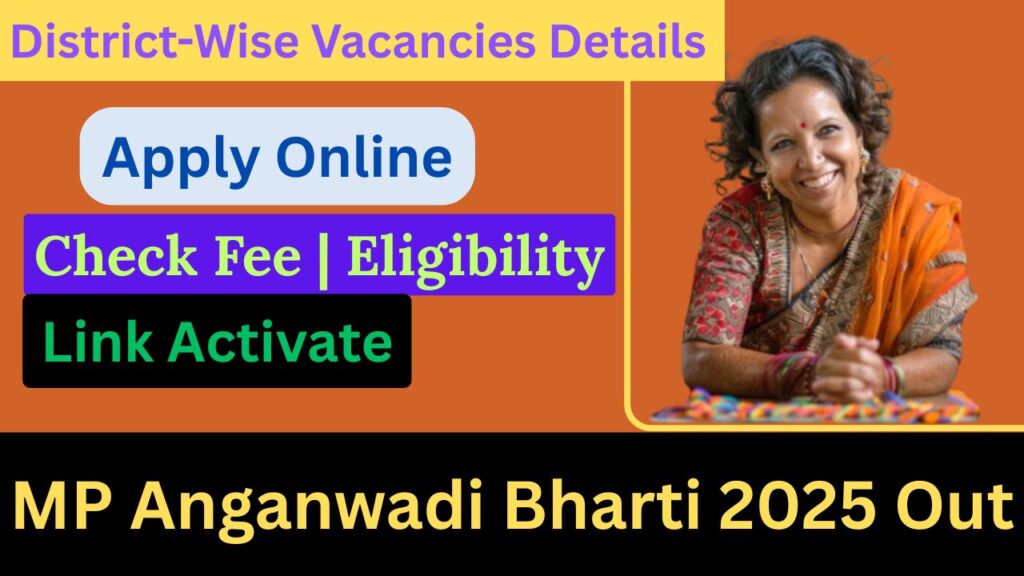
MP Anganwadi Bharti application link is open for 2027 posts for workers and 17477 posts for assistants. Candidates can apply online early to secure a job because the application portal opens for 10 days. Go through the link to check official notification on the official website.
By paying an online application fee of Rs.100 before closing the online portal, you can proceed with your application form. If you want to establish a career in Public service, you can fill the form for a total of 19504 vacancies. The recruitment started on an online portal on 20 June-2025 and closed on 4 JUly-2025.
MP Anganwadi Bharti 2025 District Wise Vacancy Detail
Division
District
Vacancies for Workers
Vacancies for Assistant
Bhopal
Bhopal
32
289
Bhopal
Raisen
27
450
Bhopal
Rajgadh
28
502
Bhopal
Sihor
27
270
Bhopal
Vidisha
57
528
Chambal
Bhind
31
469
Chambal
Muraina
47
633
Chambal
sheopur
56
375
Gwalior
Ashoknagar
51
260
Gwalior
Datiya
42
228
Gwalior
Guna
51
544
Gwalior
Gwalior
44
231
Gwalior
Shivpuri
95
611
Indore
Alirajpur
36
839
Indore
Badhwani
50
244
Indore
Burhanpur
18
94
Indore
Dhar
54
539
Indore
Indore
32
196
Indore
Jhabua
51
890
Indore
Khandwa
45
168
Indore
Khargone
55
356
Jabalpur
Balaghat
45
271
Jabalpur
Chhindwara
53
341
Jabalpur
Dindora
59
348
Jabalpur
Jabalpur
35
422
Jabalpur
Katni
28
252
Jabalpur
Mandala
58
524
Jabalpur
Narsinghpur
32
134
Jabalpur
Panna
12
45
Jabalpur
Sivni
43
310
Narmadapuram
Baitul
50
177
Narmadapuram
Harda
21
122
Narmadapuram
Narmadapuram
24
264
Rewa
Maihar
14
125
Rewa
Mauganj
6
281
Rewa
Rewa
32
390
Rewa
Satna
25
324
Rewa
Sidhi
30
121
Rewa
Singhrauli
18
200
Sagar
Chhatarpur
44
322
Sagar
Damoh
31
321
Sagar
Niwadi
13
71
Sagar
Panna
13
328
Sagar
Sagar
66
483
Sagar
Tikamgarh
21
223
Shahdol
Anuppur
30
150
Shahdol
Shahdol
53
276
Shahdol
Umriya
39
155
Ujjain
Agar Malwa
16
124
Ujjain
Devas
30
252
Ujjain
Mandsaur
23
297
Ujjain
Nimach
22
169
Ujjain
Ratlam
39
508
Ujjain
Shajapur
28
138
Ujjain
Ujjain
45
292
Total
2027
17477
Eligibility Criteria MP Anganwadi Bharti 2025
Applying for Aganwadi Assistant, Candidates must have passed 5th class from any recognized board in India. For MP Anganwadi Worker, Candidates must have passed 12th from any recognized board or have any equivalent qualification. Completed 10th class from a recognized board, these certificates are important for this Anganwadi Worker position. Candidate’s minimum age should be 18 years and maximum 35 years, age relaxation will be provided.
Staff Selection Commission is recruiting candidates for filling out the Delhi police vacancy 2025. This organization officially announced the recruitment process and the official notification is also released for the candidates to check every detail regarding the post or online application. There are a total of 7565 positions vacant for this post, candidates can apply for this till 21 October 2025. You can find the direct link for the application in the article.
Candidates who are applying for the Delhi police vacancy 2025 could meet the eligibility criteria for this position. Must apply for this position before the last day of registration or else he or she will not be able to apply anymore.
Follow these steps to apply online:
Visit Delhi police official website which is mentioned in the article.
After visiting the official page, search for the New Registration option to click.
Once you click that, the box will appear on your screen.
Fill them with your correct information and carefully check again.
After registration, you can login with your registration number and password, then you can fill out the application form for delhi police vacancy 2025
Preview the form before the final submit and download the copy for reference.
The scenario of higher education in India has been a significant transfigurement in last 10 years. It is no longer the case that the best private universities in India are the only standard setters for excellence. Private universities today are reinventing the world-class education allowing them to differentiate in quality academics, through leading-edge innovation and creating environments where students are not just learning but also creating, discovering and leading.
Well, if you are looking for higher education in India then it is important to know what the differences are in the top private universities. They are not simply teaching bodies but they are breeding grounds for tomorrow’s captains of industry, researchers and innovators who will chart courses through industries and address global challenges.
The Top Contenders
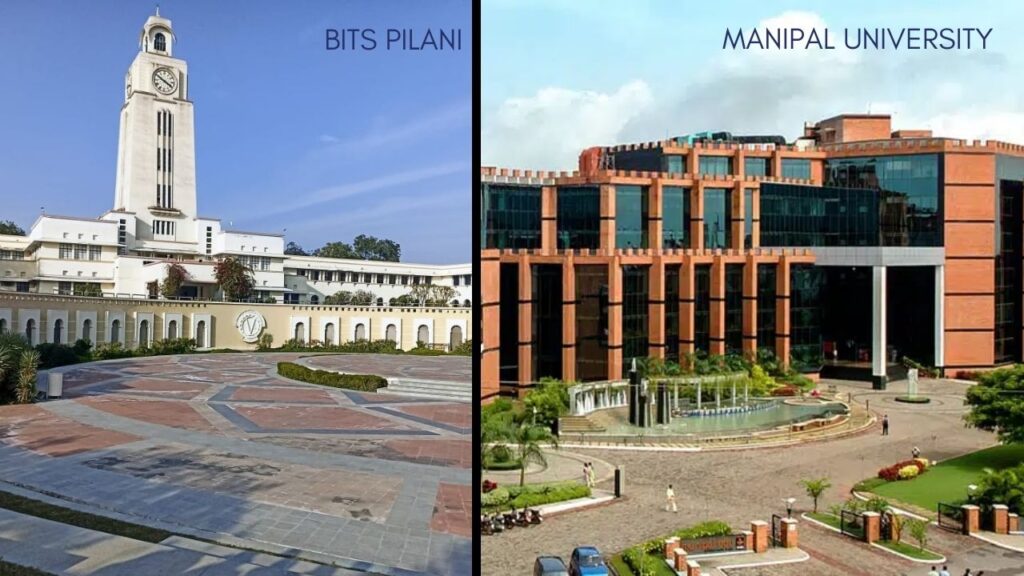
In the NIRF 2025 rankings, the private university sector is led by a few good institutions. The Manipal Academy of Higher Education (MAHE) emerges 3rd among universities across the country and stands as the best private university in the country. Closely following are BITS Pilani at rank 7, Amrita Vishwa Vidyapeetham at rank 8, VIT Vellore, LPU, Amity University and SRM Institution of Science and Technology at rank 11.
However, not only in rankings, Ashoka University is transforming Indian higher education. Ranked as the best new-age private university and awarded as the “University of the Year (Emerging)” in 2025 at the FICCI Higher Education Summit, Ashoka is the future of liberal arts and interdisciplinary education in India.
Manipal Academy of Higher Education (MAHE)
Amrita Vishwa Vidyapeetham
BITS Pilani
VIT Vellore
SRM Institution of Science and Technology
Amity University
Ashoka University
Lovely Professional University (LPU)
What Makes These Universities Stand Out?
Research and Innovation at the Core
Today’s private universities know that good teaching without innovation is half-truth. BITS Pilani has been especially creative in institutionalizing research amongst students. The institute, since 2023, has published more than 6,500 research papers in journals with average impact factor more than 4.1, filed 325+ patents, completed 13+ technology transfers, and incubated 138+ deep-tech startups with a combined valuation of over USD 300 million.These are not simply figures—they represent actual technology developed by students and professors that are reshaping markets and addressing real-world problems.
The Manipal Academy too has made huge investment in innovation infrastructure. Its Innovation Centre is a dynamic ecosystem that offers seed funding, incubation support, mentorship for patent filing and commercialization. The university has a state-of-the-art Central Analytical Instrumentation Facility (CAIF) with world class instruments such as SEM, NMR, XRD which enables interdisciplinary research in emerging areas like material science, biotech etc.
Ashoka University has now set up the Ashoka-Zeiss Core Imaging Facility, the first such facility in India, which caters to high end research in Cell Biology, Biophysics and Structural Biology. Inspiringly, in 2025, Ashoka was awarded the highest distinction for its research and innovation activities, demonstrating a strong commitment to advancing the frontiers of knowledge.
Faculty Excellence and Academic Rigor
The standard of faculty decides the standard of education. These elite private colleges have gone all out in trying to hire outstanding scholars, researchers, practitioners. Amity University has right faculty student ratio to provide quality education in meaningful mentorship and is supported by 2,100+ well experienced faculty members in helping 37,000 students in different campuses.
The curriculum at these schools is more than just textbooks. Many elite private universities weave in industry perspectives into their curriculum through guest lectures, internships and group work. That means students learn not only the theoretical underpinnings, but real-world applications and evolving industry issues.
Global Partnerships and International Exposure
It is always true that in a connected world, you need global exposure to get a good education. Ashoka University, one of India’s leading liberal arts universities, has partnered with 60+ prestigious institutions globally across 28 countries and five continents including Yale University, Sciences Po, University of Melbourne, EYH Paris. Partner organizations also provide opportunities for interaction with group and field trips during semester exchanges, summer programs, research collaborations and faculty exchange.
Similarly, Manipal University holds joint research programmes with top-notch institutions worldwide and is funded for research by various agencies such as DST, CSIR, AICTE. This global network ensures that students have access to an array of perspectives and world class academic resources.
Placement Excellence and Career Readiness
Quality education in the end translates into job opportunities. Manipal Academy secured more than 90% placement in 2025, with 8,000+ students placed across multiple programs. The highest package for engineering students went up to ₹69.25 LPA with average package of ₹12.31 LPA. Top recruiters: Microsoft, Amazon, Deloitte, IBM, Standard Chartered, and BookMyShow.
Inclusive Accessibility and Scholarships
Although being good quality generally carries a cost, many leading private universities understand that that should be manageable. These schools provide merit-based scholarships, aid packages and need-based grants so that gifted students aren’t turned away because of money.
The Innovation Ecosystem
What really sets the best private universities of today apart is their strategies for innovation across the board. BITS Pilani has created a number of innovation tracks to address a range of contexts – SPARKLE for transdisciplinary problem solving, SOLVE for applied innovation and PIEDS (Pilani Innovation & Entrepreneurship Development Society) along startup development.
Ashoka University launched the Young Scholars Programme: Innovators in Science & Tech (YSP IST). It’s for the high schoolers and it’s a 10 day live-in camp. It enables them to learn difficult subjects such as environmental chemistry, neuroscience, quantum computing and genetic engineering. These camps help create future inventors. They also ignite science curiosity at a young age.
Choosing a university is a very personal matter. If you are interested in a multidisciplinary education close to industry, Manipal Academy is excellent if you like comprehensive education with strong links to industry. If you want the best research and entrepreneurship route, BITS Pilani is unparalleled. Ashoka University, for those interested in liberal arts with a global outlook, provides a new frontier in Indian higher education.
What matters most is knowing what you want. Are you a basic researcher? Do you want to build startups? Are you looking for global exposure? The finest private Indian universities today cater to such journeys
The Future of Private Higher Education
The Indian private university sector is evolving fast. They are not simply copying public universities, they are innovating, conducting cutting edge research and drawing talent from around the world. This focus on quality, innovation, research and international collaboration is indicative of a vibrant, competitive ecosystem, and students stand to gain immensely from this.
Keep in mind as you start your higher education journey, Rankings are just one measure. What makes a school is its learning community, the quality of its faculty, the substance of its research, and its aspiration to produce not just accomplished professionals but responsible global citizens. India’s finest private universities are increasingly making the case that they can indeed deliver exactly that.
Conclusion
India’s leading private universities are transforming higher education with cutting-edge research, global outlook, industry-centred curriculum, and incubators of innovation. From BITS Pilani’s entrepreneurial culture to MAHE’s research excellence and Ashoka’s revolutionary liberal arts model, you will find a way to map out a future-ready career.
So when you’re picking your uni, focus on what suits your ambitions – be it research, startups, global learning or industry know-how.
Ultimately, these top private colleges in India are showing that they can shape not just degrees, but the leaders of tomorrow.
Candidates who want to apply for a Primary School Teacher job can now apply online through the official website. MPESB recruitment 2025 starts on 18 July 2025, and the portal will open until 01 August, 2025. There are several posts for Primary School Teachers, Apply now to secure the position. This post’s salary range is nearly Rs. 25,300 with additional benefits.
The minimum age limit is 21 years and the maximum is 40 years. Age relaxation of 5 years will be given to reserved categories. Read the official notification for full eligibility information.
MPESB Recruitment 2025 Highlights
Exam
Primary School Teacher Selection Test
Board
Madhya Pradesh Employees Selection Board
Purpose
MPESB is conducting an exam w is mandatory for Primary School Teachers. Recruitment will be based on merit list.
Vacancies
13089
Selection Process
Written Exam, Merit List, and Document Verification
Finding out the Difference Between CBSE and ICSE is important because it matters for the future of students. In India, ICSE (Indian Certificate of Secondary Education) affiliated schools are expensive but recognized internationally, and have become popular among students who want to achieve international opportunities.
And CBSE (Central Board of Secondary Education) has a wide range of affiliated schools which makes it cheaper but effective for national-level exams. Both have different teaching methods, syllabus structure, exam pattern & marks, and career opportunities.
This comparison is not for making it good or bad, showing their strengths and weaknesses will help students to decide better for their future.
Overview of CBSE and ICSE
CBSE – Central Board of Secondary Education
CBSE board is run under the Government of India.
A wider range of schools are affiliated to CBSE.
It is more on the side of theoretical education and focuses on subjects like Science & Maths.
Popular among aspirants of NEET, JEE, NDA, and UPSC as it covers all the exams syllabus concisely.
ICSE – Indian Certificate of Secondary Education
Council for the Indian School Certificate Examinations (CISCE) is a private education board which governs ICSE board.
As compared to CBSE, schools affiliated to ICSE in India and abroad are less in numbers.
It focuses on both theoretical and practical knowledge equally on all subjects including arts, science, and languages.
Its balanced education is valued internationally.
Curriculum and Teaching Style
CBSE curriculum is more structured and straightforward, it does not contain any extra details on any topic which makes it less but precise for exams. It prioritizes subjects like Science and Mathematics, designed with theoretical conceptual knowledge which makes it ideal for competitive exams. Other subjects like English and Hindi have fewer chapters and syllabi in comparison to ICSE. It is best for the engineering, medical, or government exams focused students.
ICSE curriculum is designed with lengthy explanations and balanced across subjects. It also focuses on other subjects like Literature, language and practical projects for balanced education. ICSE boards students have to study in-depth of each subject. That feels burdened sometimes but it improves analytical ability. It is best for overall knowledge, communication skills, and global recognition opportunities seeking students.
CBSE is easier in comparison to ICSE as it has a concise syllabus that covers easily within less time. It encourages more theoretical knowledge than projects. Students can easily clear exams with less academic pressure but it improves basic knowledge. ICSE is more detailed on every topic and stressing on projects, lab world, internal assessments making it heavier for children to cover. But it is best for building overall skills that improves analytical thinking.
Examination Pattern and Grading System
CBSE follows a continuous and comprehensive evaluation system to reduce exam stress and declaring results in CGPA Cumulative Grade Point Average system. Questions in the exam are based on the NCERT books.
ICSE follows marks-based evaluation and grades are assigned according to the percentage. Questions asked in exams need both depth of knowledge and analytical ability to represent the answer. In the final result, 20-30% makes are dependent on the internal assessments so projects are becoming necessary.
Recognition in India and Abroad
CBSE is recognized in major schools in India, making it best for students who plan to continue study in India. It is popular among the JEE, NEET, NDA and UPSC aspirants. ICSE is recognized globally by foreign universities. Developing language and communication skills with its english-oriented syllabus can help students to continue their studies in foreign universities.
Language and Communication Skills
If students want to continue their studies abroad, develop communication skills, and aim for jobs where language like English will be needed then ICSE is the best option because CBSE is more focused on Science and Maths. However, CBSE emphasizes English and Hindi but not on the higher level.
Which is More Expensive?
Many government schools are affiliated to CBSE board which make it affordable for the students. Private CBSE schools also have affordable fees in comparison to ICSE affiliated schools. More expensive due to their huge curriculum, projects, and emphasis on quality teaching.
Career and Competitive Exams
Competitive exams aspirants prefer to study in CBSE affiliated schools because it covers a more concise syllabus on important subjects like Economics, Maths and Science. However, ICSE boards schools produce creative minds. They emphasize on English Language & Literature, and analytical skills to help students secure their career in international companies.
Pros and Cons at a Glance
CBSE Pros
Cons
Easier syllabus
Lack of strong foundation in English and humanities
Affordable Fees
Limited application-based learning
20,000+ schools
Ideal for competitive exams
ICSE Pros
Cons
Tough syllabus
More-time consuming
International Recognition
Expensive schools
Strong English and analytical skills
Less useful for Indian competitive exams
Encourages overall development
Which Board Should You Choose?
It totally depends on your future goals, aiming to make your career in the medical field, engineering, or government sector then CBSE is a good option because it contains an overall concise syllabus that is needed to study in most of the Indian entrance exams. CBSE board students also can go abroad but they have to study hard even on their english and communication skills. Where ICSE is providing overall development, students can go abroad for higher studies with strong language skills and well-rounded knowledge.
Both boards have their strengths and weaknesses, for making the right decision, students should choose their board according to their interest, learning style, and career plan.
Students aiming for holistic or overseas education
Conclusion
Which board is best is a little bit complex, you must know the Difference Between CBSE and ICSE before you select your board. Students and parents both have to understand what are the career goals and which board is good for their children. Some students are not able to handle the tough syllabus of ICSE and some students want to go abroad, so it should be according to your plan not by other people’s recommendation.
The Common Admission Test can open the doors for India’s most prestigious colleges. Students get stressed with the syllabus most of the time and get confused, so it is important to know the CAT exam syllabus 2025 section-wise. This can help you understand the important topics that must be considered prior while preparing. The powerful strategy to prepare for any competitive exam is according to exam pattern. Read the full article to assess this knowledge which can help you beat the CAT exam.
It’s not about a lot of time and resources, just the right planning to assess important knowledge is required. Whether you are an average student or brighter one but CAT is not that simple as you think. Masters from top colleges matter in your placement. If you really want to take admission in an MBA or other postgraduate program, you need to clear the CAT exam.
Exam Pattern Overview
CAT is conducted online through a computer-based test format. The total 68 questions come in the examination which get distributed into three sections. This 120 minutes exam carries 204 marks to decide your future in your education journey. However 40 minutes is given for each section with +3 marks if the answer is correct but negative marking of -1 for each wrong answer. There’s no negative marking for TITA (Type In The Answer) questions.
Section-wise Distribution
Verbal Ability & RC carries 72 marks for 24 question Data Interpretation & Logical Reasoning carries 66 marks for 22 questions Quantitative Aptitude carries 66 marks for 22 questions
This section covers 36% of the paper. It focuses on RC more than grammar means 16 questions come from the Reading comprehension so it covers 66% of VARC section. While Verbal ability covers 33% of the section. The reading comprehensive features 4 passages with 4-5 questions per passage. The topic in these passages is almost relevant to niches like economics, psychology, literature, and current affairs.
Verbality Ability comprises 8 questions From:
Para summary question
Para jumbles
Odd sentence out
Sentence completion tasks
Section 2: Data Interpretation & Logical Reasoning (DILR)
This section 32% of the exam paper and considered most unpredictable questions come from the Data Interpretation & Logical Reasoning section. While the questions are in the sets of 3-4 questions, making it difficult to solve easily.
Topics of Data Interpretation & Logical Reasoning questions:
Data Interpretation
Logical Reasoning
Tables and charts analysis
Puzzles and arrangements
Bar graphs and pie charts
Seating arrangements
Line graphs and scatter plots
Blood relations and family trees
Caselets with numerical data
Coding-decoding problems
Syllogisms and Venn diagrams
Section 3: Quantitative Aptitude (QA)
Quantitative aptitude holds 32% weightage in the paper. It covers Arithmetic and Algebra topics, making it the hardest section.
Topics of Quantitative Aptitude Questions
Arithmetic (8-9 questions)
Algebra (5-7 questions)
Geometry (2-3 questions)
Modern Mathematics
Ratios and Proportions
Linear equations and inequalities
Coordinate geometry
Permutations and combinations
Percentages and their applications
Quadratic equations
Mensuration
Probability
Profit, Loss, and Simple/Compound Interest
Functions and graphs
Triangles and circles
Logarithms and surds
Time, Work, and Distance problems
Progressions and series
Mixtures and Allegations
Topic-wise Weightage Analysis
Highest Priority Topics:
Reading Comprehension
16 questions
Arithmetic
8 questions
Algebra
5-7 questions
Puzzles & Arrangements
8-10 questions
Medium Priority Topics:
Data Interpretation
8-9 questions
Geometry
3 questions
Verbal Ability
8 questions
Lower Priority Topics:
Modern Mathematics
2-3 questions
Number Systems
1-3 questions
Effective Preparation Strategy
Preparing for the CAT isn’t that easy but with right strategy planning you can clear out the exam. There is no need to rote memorization because these subjects require focus and proper time to understand every concept.
CAT needs comprehensive preparation with proper time duration like 6 to 9 months. Know your weaknesses, so you can distribute your time more on that topic. Divide all three sections with specific duration to complete your preparation properly.
Deep analysis and carefully 2-3 Reading comprehension daily is important
Solve 2-3 sets of Data Interpretation and logical reasoning to understand and filled in your brain
Daily solve at least 15-16 questions from the quantitative aptitude section. Try to solve easy problems first then go to the hard topics.
Mock Test Strategy
After preparing for 2 months, get ready to take mock tests section-wise and extend your mock test practice before the exam. Because analyzing every question helps you keep remembering the concepts and maintain your confidence.
Resource Selection
Choose online resources to prepare fast because the latest notes and mock tests can help you a lot during preparation for the CAT exam. Stick to single quality resources, don’t switch every time and focus on concept clarity rather than multiple resources and question papers.
Conclusion
Success in CAT requires strength, strategic preparation, and daily practice for clearing every doubt. Focus on high priority topics first then move on the medium priority to balance every section easily. Remember that quality study is more helpful to clear the exams rather than a lot of study material and wasting time on unnecessary topics. So, it is important to prepare according to the CAT exam syllabus 2025 section-wise for best outcome.